


Resources
From peer-reviewed research to accessible policy briefs, explore the scholarship that’s shaping debates and driving change.

506 Results


Economic research shows immigration is good for U.S. workers, the economy, and affordability (opens in a new tab)
Essays AUG 31, 2026
When President Donald Trump returned to the White House in 2025, mass deportations and immigration restrictions were renewed as one of the political priorities of his second administration. Since then,…
By: Christopher Bangert-Drowns (opens in a new tab)

Streamlining applications to social programs unlocks more support for the U.S. families who need it most (opens in a new tab)
Essays JUL 7, 2026
Millions of low-income families in the United States tap into multiple social programs to help them meet their needs. A single household, for example, might rely on the Supplemental Nutrition…
By: Neil Cholli (opens in a new tab), Derek Wu (opens in a new tab)

The One Big Beautiful Bill Act, one year later: Parsing the evidence on the law’s consequences so far (opens in a new tab)
Blog JUN 30, 2026
The One Big Beautiful Bill Act signed into law one year ago on July 4, 2025, shifted trillions of dollars in income from working-class families to corporations and very wealthy…
By: Lily Roberts (opens in a new tab)

Factsheet: What the research says about early care and education in the United States (opens in a new tab)
Factsheets APR 16, 2026
Research has long shown the importance and value of high-quality early childhood care and education. Child care offers working parents the ability to fully participate in the labor force and…
By: Equitable Growth (opens in a new tab)
How does early childhood care and education affect U.S. families and workers, and which policies support child participation and boost the quality of care? (opens in a new tab)
Reports APR 16, 2026
As states consider policy action in early childhood care and education, there is an existing—and growing—evidence base from which to draw lessons. This report summarizes the rigorous evidence on program…
By: Chloe Gibbs (opens in a new tab)

Federal policymakers can ensure Trump accounts do not exacerbate inequality in the United States (opens in a new tab)
Issue Briefs APR 14, 2026
In July 2025, Congress passed a federal budget bill (Public Law 119-21, also commonly known as the One Big Beautiful Bill Act) that, among other things, established a new type…
By: Megan Rivera (opens in a new tab)
A review of the state of child care in the United States (opens in a new tab)
Reports APR 9, 2026
Affordable, available, high-quality child care is essential for sustained, broadly shared economic growth and equitable access to workforce opportunities. In most of the United States, however, child care fails this…
By: Sam Abbott (opens in a new tab), Shira Markoff (opens in a new tab)

Factsheet: Using asset limits in public benefit programs (opens in a new tab)
Factsheets MAR 10, 2026
A household’s assets, or its overall wealth, are the resources required to ensure its family members can weather the financial disruption when unexpected expenses emerge. Yet many U.S. households do…
By: Megan Rivera (opens in a new tab)

Can remote work attenuate mothers’ mobility constraints in the U.S. labor force? (opens in a new tab)
Essays FEB 12, 2026
Women’s labor force participation increased dramatically over the course of the 20th century in the United States. Indeed, the labor force participation rate of women between the ages of 25…
By: Ilaria D’Angelis (opens in a new tab), Keren Horn (opens in a new tab)

Why federal food assistance became politically polarizing—and what to do about it (opens in a new tab)
Issue Briefs FEB 2, 2026
On January 31, 1964, President Lyndon B. Johnson requested that Congress pass federal legislation to make the Food Stamp Program permanent. Up to that point, the program had operated as…
By: Carlos Fernando Avenancio-Leon (opens in a new tab)
ASSA 2026 Round-up: Day 2 (opens in a new tab)
Blog JAN 5, 2026
Yesterday was the second day of the 2026 annual meeting of the Allied Social Science Associations, which is organized by the American Economic Association. The 3-day conference, held in Philadelphia…
By: Equitable Growth (opens in a new tab)
ASSA 2026 Round-up: Day 1 (opens in a new tab)
Blog JAN 4, 2026
Yesterday was the first day of the 2026 annual meeting of the Allied Social Science Associations, which is organized by the American Economic Association. The 3-day conference, held in Philadelphia…
By: Equitable Growth (opens in a new tab)

U.S. social insurance programs support workers and economic growth (opens in a new tab)
Essays DEC 2, 2025
Since coming to power in early 2025, Republican majorities in Congress have shifted resources away from the nation’s social insurance programs, most notably to offset the cost of H.R. 1,…
By: Megan Rivera (opens in a new tab)

Equitable Growth hosts Econ 101 virtual event on how U.S. social insurance programs boost economic mobility (opens in a new tab)
Essays DEC 1, 2025
Microsoft Copilot helped draft this event recap. The Washington Center for Equitable Growth recently hosted its latest Econ 101 briefing aimed at providing in-depth evidence for policymakers on how U.S.…
By: Equitable Growth (opens in a new tab)
Distributional weighting in benefit-cost analysis is practical and effective at assessing government rulemaking without bias against low-income individuals (opens in a new tab)
Reports NOV 13, 2025
Distributional weighting in benefit-cost analysis is a tool for overcoming bias against lower-income individuals in economists’ measurements of the net benefit of government policies that affect populations at different levels…
By: Daniel Acland (opens in a new tab)
Tariff costs impact industries with mostly White, male, and noncitizen workers (opens in a new tab)
Essays NOV 4, 2025
The U.S. economy is flying blind, with most economic-data publications paused indefinitely due to the shutdown of the federal government amid a general U.S. labor market slowdown and just as…
By: Christopher Bangert-Drowns (opens in a new tab)

In Conversation with Omari Swinton (opens in a new tab)
In Conversation SEP 24, 2025
Equitable Growth in Conversation is a recurring series where we talk with economists and other academics to help us better understand whether and how economic inequality affects economic growth and…
By: Sanjay Supan (opens in a new tab)

Even health care, the strongest sector of the U.S. jobs market, cannot deliver the wages its workers deserve without unionization (opens in a new tab)
Essays SEP 10, 2025
The growth of jobs in the U.S. health care industry is the linchpin to a strong U.S. labor market in 2025 and beyond. Health care is one of only a…
By: Adam Dean (opens in a new tab), Jamie McCallum (opens in a new tab)
States can support children and their economies using direct cash assistance from the Temporary Assistance for Needy Families block grant program (opens in a new tab)
Reports AUG 28, 2025
Efficient, effective, and responsive income support programs can reduce economic inequality and support economic mobility. If targeted effectively, these programs can help children, families, and workers meet their needs and…
By: Megan Rivera (opens in a new tab), Christopher Bangert-Drowns (opens in a new tab)

The 10 worst policies for equitable economic growth in the 2025 budget reconciliation law (opens in a new tab)
Essays JUL 14, 2025
The 2025 budget reconciliation law that was enacted earlier this month is a sprawling piece of legislation, touching almost every corner of the federal budget and the U.S. economy. It…
By: David S. Mitchell (opens in a new tab)

Republican reconciliation bill’s cuts to social programs will damage some congressional districts’ local economies (opens in a new tab)
Essays JUL 11, 2025
In a recent working paper, Equitable Growth grantee Robert Manduca of the University of Michigan, Ann Arbor demonstrates that government transfers make sizable contributions to local economies in much of…
By: Chiara Chanoi (opens in a new tab)

Americans informed about the distributional effects of Republicans’ tax and budget bill overwhelmingly oppose it (opens in a new tab)
Essays JUL 3, 2025
Republicans in the U.S. Senate recently passed a version of the One Big Beautiful Bill Act, championed by President Donald Trump. The House of Representatives passed an earlier version of…
By: Jacob Hacker (opens in a new tab), Patrick Sullivan (opens in a new tab)

Congressional Republicans’ budget bill is the most regressive in at least 40 years (opens in a new tab)
Essays JUN 25, 2025
The U.S. Congress is in the midst of debating a budget bill that would make massive changes to U.S. tax and spending policy over the course of the next decade…
By: Jacob Hacker (opens in a new tab), Patrick Sullivan (opens in a new tab)

Medicaid and SNAP cuts in congressional Republicans’ budget bill will negatively impact local economies (opens in a new tab)
Essays JUN 24, 2025
The budget reconciliation bill recently passed by the U.S. House of Representatives proposes to make large cuts to Medicaid, the Supplemental Nutrition Assistance Program, and other social programs to pay…
By: Robert Manduca (opens in a new tab)

The hidden trade-offs of nonwage job amenities for U.S. workers (opens in a new tab)
Essays JUN 10, 2025
When workers choose jobs with predictable schedules, safer conditions, or greater autonomy, they are often paying a price: lower wages. In some cases, these hidden trade-offs are considerable. Indeed, my…
By: Alex Bell (opens in a new tab)

The political implications of bad jobs and the decline of unions (opens in a new tab)
Blog MAY 13, 2025
Bad jobs have become a distinctive feature of the U.S. economy over the past few decades. Globally, a lack of adequate demand, or what economists call “secular stagnation,” has meant…
By: Adam Dean (opens in a new tab), Jamie McCallum (opens in a new tab)

More accurately measuring economic sentiment will help build a U.S. economy—and democracy—that works for all (opens in a new tab)
Blog MAY 13, 2025
When politicians and members of the media discuss the state of “the economy” in the United States, they often use a small handful of data points. Of all the indicators…
By: Jonathan Cohen (opens in a new tab), Katherine Cramer (opens in a new tab)

Housing insecurity and U.S. economic policies: Lessons from tenant organizing (opens in a new tab)
Blog MAY 13, 2025
The destructive force of authoritarian power has become a prominent feature of U.S. political life. In just the first few months of 2025, we’ve seen unprecedented moves to use the…
By: Jamila Michener (opens in a new tab)
Tariffs pose real risks to the U.S. labor market (opens in a new tab)
Blog MAY 12, 2025
Uncertainty around trade policy makes it difficult to discuss the current state of the U.S. labor market. Businesses, workers, and policymakers at all levels make decisions based on both what…
By: Kevin Rinz (opens in a new tab)

Factsheet: What we know about the federal employer-provided child care credit and how can it be better used by businesses (opens in a new tab)
Factsheets APR 22, 2025
The employer-provided child care credit, also referred to as Section 45F in the Internal Revenue Code, provides a limited subsidy to businesses in the United States that provide child care…
By: Megan Rivera (opens in a new tab)

Improving economic outcomes for single mothers and their children across the United States (opens in a new tab)
Blog APR 16, 2025
Single-mother households are becoming more and more common in the United States. Over the past 50 years, the number of children raised by single mothers has more than doubled. It…
By: Megan Rivera (opens in a new tab)

Do not abandon the care agenda (opens in a new tab)
Blog MAR 19, 2025
This column, co-authored by Equitable Growth President and CEO Shayna Strom and former Deputy Director of the White House Gender Policy Council Shilpa Phadke, first appeared in Democracy Journal in…
By: Equitable Growth (opens in a new tab)

The U.S. House of Representatives’ budget resolution threatens social infrastructure programs, putting families’ well-being at risk (opens in a new tab)
Blog MAR 10, 2025
In late February, the U.S. House of Representatives passed a budget resolution that calls for $4.5 trillion in tax cuts and $2 trillion in federal spending cuts. This resolution provides…
By: Priyanka Anand (opens in a new tab), Robert Moffitt (opens in a new tab)

Testimony by Michael Linden House Oversight Subcommittee on Healthcare and Financial Services (opens in a new tab)
Blog FEB 11, 2025
Chairman Grothman, Ranking Member Krishnamoorthi, and members of the Committee – thank you for the opportunity to be here. Today, I’d like to make three main points. First, federal investments…
By: Michael Linden (opens in a new tab)
ASSA 2025 Round-up: Day 3 (opens in a new tab)
Blog JAN 6, 2025
Yesterday was the third and final day of the 2025 annual meeting of the Allied Social Science Associations, which is organized by the American Economic Association. The 3-day conference, held…
By: Equitable Growth (opens in a new tab)
ASSA 2025 Round-up: Day 2 (opens in a new tab)
Blog JAN 5, 2025
Yesterday was the second day of the 2025 annual meeting of the Allied Social Science Associations, which is organized by the American Economic Association. The 3-day conference, held in San…
By: Equitable Growth (opens in a new tab)
ASSA 2025 Round-up: Day 1 (opens in a new tab)
Blog JAN 4, 2025
Yesterday was the first day of the 2025 annual meeting of the Allied Social Science Associations, which is organized by the American Economic Association. The 3-day conference, held in San…
By: Equitable Growth (opens in a new tab)

Recent research shows how paid leave impacts women’s employment and financial security in the United States (opens in a new tab)
Blog DEC 13, 2024
During the first several months of the COVID-19 pandemic, the federal government ensured that all U.S. workers had access to at least 2 weeks of paid sick leave and up…
By: Shira Markoff (opens in a new tab)

In Conversation with Fenaba Addo (opens in a new tab)
In Conversation DEC 12, 2024
Equitable Growth in Conversation is a recurring series where we talk with economists and other academics to help us better understand whether and how economic inequality affects economic growth and…
By: Shira Markoff (opens in a new tab)

New research highlights the impact of COVID-era unconditional cash benefits for U.S. workers and families (opens in a new tab)
Blog DEC 10, 2024
The breadth of the economic impact of the COVID-19 pandemic ushered in sweeping, albeit temporary, changes to income support programs and tax policies in the United States. These changes include…
By: Shira Markoff (opens in a new tab)

In Conversation with Mishaela Durán (opens in a new tab)
In Conversation SEP 12, 2024
Equitable Growth in Conversation is a recurring series where we talk with economists and other academics to help us better understand whether and how economic inequality affects economic growth and…
By: Shira Markoff (opens in a new tab)

New federal heat standard will protect U.S. workers from the ill effects of high temperatures amid intensifying climate change (opens in a new tab)
Blog AUG 1, 2024
U.S. workers are more vulnerable than ever to the ill effects of high and rising temperatures as the world continues to shatter heat records this year. Climate-related deaths and injuries…
By: Equitable Growth (opens in a new tab)

In Conversation with Natalie Foster (opens in a new tab)
In Conversation JUL 2, 2024
Equitable Growth in Conversation is a recurring series where we talk with economists and other academics to help us better understand whether and how economic inequality affects economic growth and…
By: Michael Linden (opens in a new tab)

Equitable Growth receives funding to advance women’s power, gender equality, and care economy (opens in a new tab)
Blog MAY 28, 2024
Melinda French Gates’ Pivotal funds organization as part of $1 billion global commitment The Washington Center for Equitable Growth announced today that it has received funding from Pivotal as part…
By: Equitable Growth (opens in a new tab)
Measuring psychological burdens in access to U.S. social programs (opens in a new tab)
Reports MAY 6, 2024
Lessons from new research on the Supplemental Nutrition Assistance Program Policymakers are increasingly paying attention to administrative burdens—those “frictions that people face in their encounters with public services.” In 2022,…
By: Alexander Hertel-Fernandez (opens in a new tab)
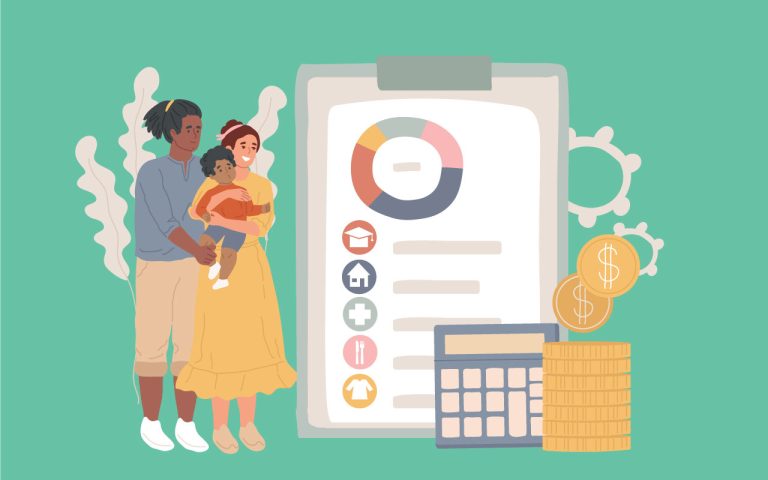
Enhanced Child Tax Credit helped U.S. families afford life-enhancing necessities and cope with inflation (opens in a new tab)
Blog APR 2, 2024
Amid ongoing congressional debate over expanding the Child Tax Credit for U.S. families, it’s important to understand why the fears about the expansion of that tax credit in 2021 were…
By: David S. Mitchell (opens in a new tab)

Equitable Growth hosts State of the Union press briefing with leading U.S. economists (opens in a new tab)
Blog MAR 7, 2024
The Washington Center for Equitable Growth last week hosted an online press briefing in prelude to tonight’s State of the Union address to the U.S. Congress by President Joe Biden.…
By: Equitable Growth (opens in a new tab)

The state of the U.S. labor market 4 years after the start of the COVID-19 recession (opens in a new tab)
Blog MAR 5, 2024
Over the past 4 years, the U.S. economy—in particular the U.S. labor market—weathered some incredible shocks and fluctuations. From the COVID-19 pandemic and supply chain breakdowns to global energy shocks…
By: Michael Linden (opens in a new tab)

Ahead of President Biden’s State of the Union address, the U.S. economy is strong (opens in a new tab)
Blog FEB 21, 2024
On March 7, President Joe Biden will deliver the 2024 State of the Union address to the U.S. Congress and the American public, in which he will tout his economic…
By: Austin Clemens (opens in a new tab)

Equitable Growth’s recent ‘Econ 101’ assessed the state of the U.S. economy and recovery for Capitol Hill staff (opens in a new tab)
Blog FEB 13, 2024
The Washington Center for Equitable Growth hosted a briefing last week—part of a series we call “Econ 101”—presenting insight on the state of the U.S. economy and how the current…
By: Equitable Growth (opens in a new tab)

Sameera Fazili and Mary Beth Maxwell join Equitable Growth’s Board of Directors (opens in a new tab)
Blog NOV 15, 2023
The Washington Center for Equitable Growth today announced the addition of two new members to its board of directors: Sameera Fazili, former deputy assistant to the president and deputy director…
By: Equitable Growth (opens in a new tab)
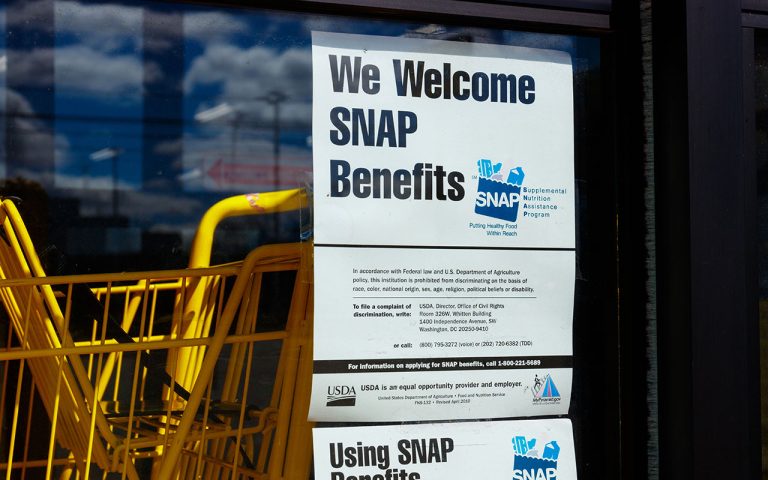
New evidence suggests that receiving benefits from the Supplemental Nutrition Assistance Program facilitates work in the long run (opens in a new tab)
Blog NOV 13, 2023
One of today’s most heated debates around U.S. income support programs is about work requirements. From the removal of work requirements through the 2021 enhancements to the Child Tax Credit…
By: Alix Gould-Werth (opens in a new tab)

What the minimum wage can tell us about the future of the U.S. child care system (opens in a new tab)
Blog NOV 1, 2023
The U.S. child care market is plagued by a math problem. Families in the United States are stretched thin, dedicating substantial portions of their household budgets to child care expenses.…
By: Sam Abbott (opens in a new tab)
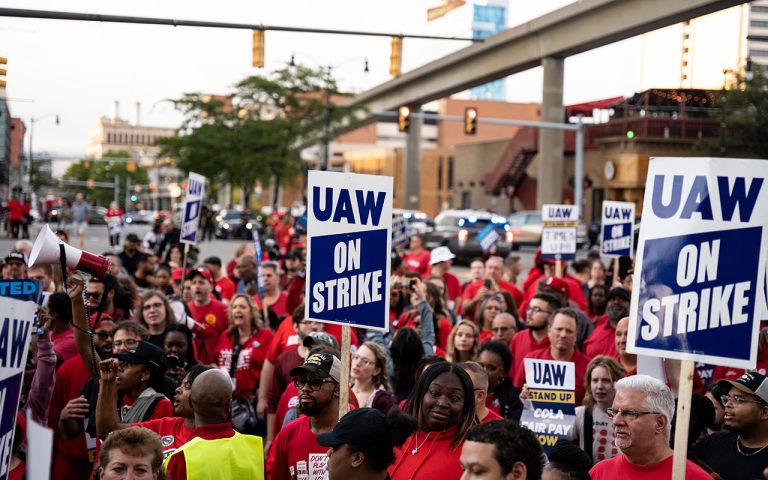
What recent research says about the benefits of labor strikes and growing worker power for broader U.S. economic growth (opens in a new tab)
Blog OCT 25, 2023
Labor organizing and strikes are experiencing a resurgence in the United States. Before this year’s bevy of labor actions—including Hollywood strikes, autoworker walk-outs, healthcare labor stoppages, and more—2022 and 2021…
By: Equitable Growth (opens in a new tab)
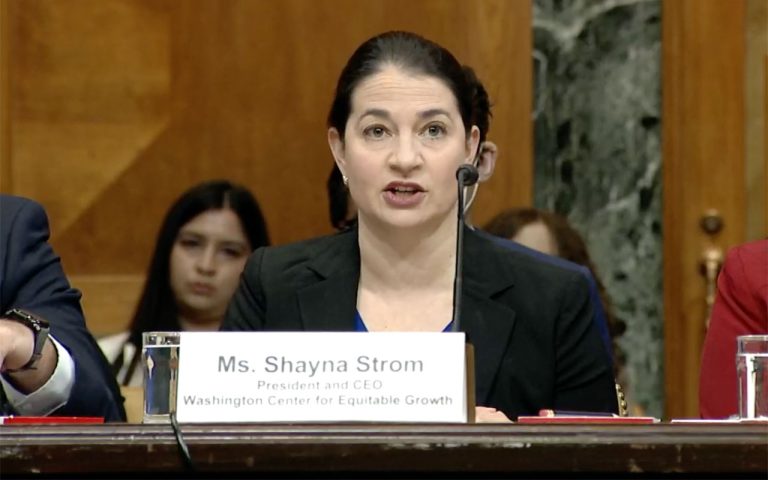
Testimony by Shayna Strom before the Senate Budget Committee (opens in a new tab)
Blog SEP 20, 2023
Chairman Whitehouse, Ranking Member Grassley, and members of the committee, thank you for the opportunity to testify today. I am the President and CEO of the Washington Center for Equitable…
By: Shayna Strom (opens in a new tab)

Latino homeownership: Confronting home appraisal bias to create a more equitable and more sustainable U.S. economic trajectory (opens in a new tab)
Blog AUG 10, 2023
Homeownership is part of the American Dream and a pathway to build wealth for many people in the United States. Homeownership allows families to plant roots, build equity, and secure…
By: Sam Kenney (opens in a new tab)
The effects of the expanded Child Tax Credit on low-income families in the United States (opens in a new tab)
Blog AUG 2, 2023
Childhood poverty is a stubborn problem in the United States. About 11 million U.S. children lived in poverty prior to the COVID-19 pandemic, accounting for nearly one-third of the impoverished…
By: Jesus Torres (opens in a new tab)

Short-term effects of the expanded Child Tax Credit on U.S. labor force participation amid the COVID-19 pandemic (opens in a new tab)
Blog JUL 26, 2023
There is a common politicized thread to arguments against expanding the federal antipoverty Child Tax Credit program permanently and to the justifications that a majority of the U.S. Supreme Court…
By: Sullivan Anderson (opens in a new tab)
New research shows that differences in state Unemployment Insurance rules cause inequity and inefficiency (opens in a new tab)
Blog JUL 19, 2023
The Unemployment Insurance system in the United States aims to provide temporary and partial wage replacement for workers who become unemployed through no fault of their own. In helping unemployed…
By: Daphné Skandalis (opens in a new tab), Ioana Marinescu (opens in a new tab), Maxim Massenkoff (opens in a new tab)

The economic costs of gun violence in the United States (opens in a new tab)
Issue Briefs JUL 18, 2023
When it comes to understanding the costs of gun violence in the United States, many people rightfully focus on the human cost. People who are slain or take their own…
By: Andre Gobbo (opens in a new tab)

Algorithmic wage discrimination requires policy solutions that enforce predictability and the U.S. spirit of equal pay for equal work (opens in a new tab)
Blog JUL 12, 2023
U.S. consumers generally believe that gig workers who labor for companies such as Uber Technologies Inc. and Lyft Inc. are free to set their own hours and thus able to…
By: Veena Dubal (opens in a new tab)
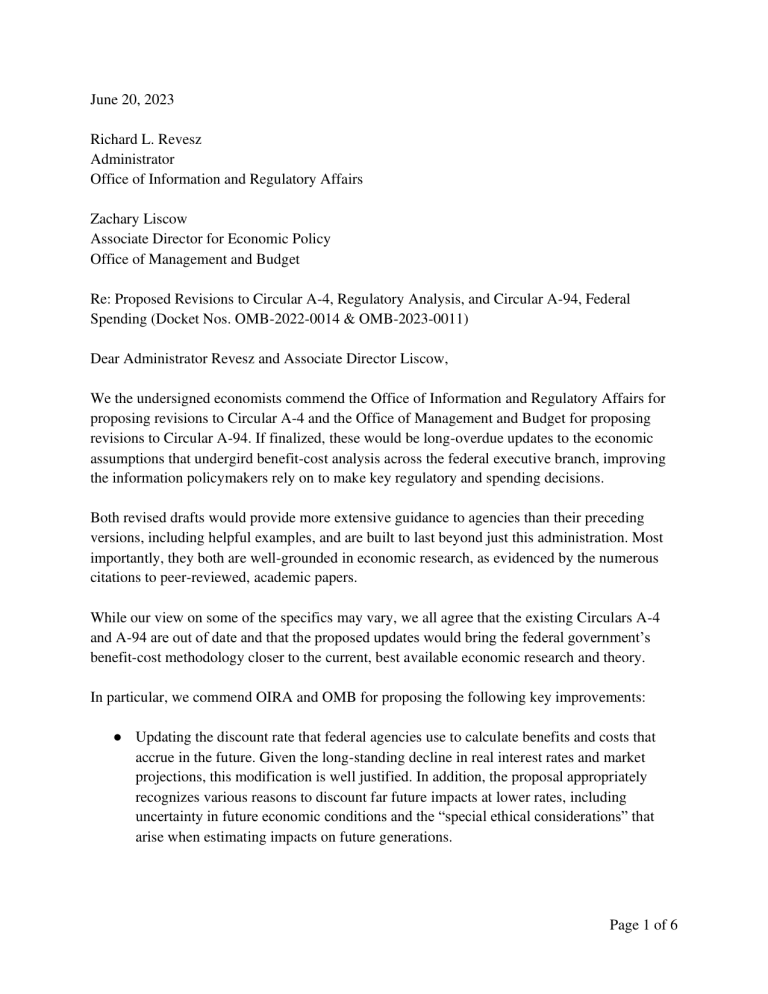
Equitable Growth delivers economist sign-on letter and comment letter to the White House Office of Information and Regulatory Affairs on its Proposed Revisions to Circular A-4, Regulatory Analysis (opens in a new tab)
Issue Briefs JUN 20, 2023
This post has been updated to reflect that Equitable Growth’s economist sign-on letter, not our comment letter, was submitted to regulations.gov due to an administrative submission error. The Washington Center…
By: Equitable Growth (opens in a new tab)

Paid sick leave means dads can spend more time caring for loved ones and less time worrying about missing work (opens in a new tab)
Blog JUN 15, 2023
The economic story of the United States in the post-WWII era is arguably the dramatic surge in women’s labor force participation. The increases in hours worked and income generated by…
By: Sam Abbott (opens in a new tab)

Wealth as a driver of income and consumption mobility in the United States (opens in a new tab)
Blog JUN 7, 2023
When most Americans think about how economic well-being transfers from parents to children, they will likely think about income, consumption, and wealth. After all, parents’ ability to provide for and…
By: Jonathan Fisher (opens in a new tab), David Johnson (opens in a new tab)
Food assistance can disrupt intergenerational poverty in the United States, promoting racial economic equity (opens in a new tab)
Blog MAY 30, 2023
The post-COVID-19 economy is a strange beast. Unemployment rates are at historic lows, but inflation—despite some cooling—remains high. Many parents continue to struggle with child care and their children’s schooling,…
By: Christopher Wimer (opens in a new tab), Zachary Parolin (opens in a new tab), Ronald Mincy (opens in a new tab), Benjamin Glasner (opens in a new tab)

Child care prices, inflation, and the end of federal pandemic-era aid in five charts (opens in a new tab)
Blog MAY 8, 2023
For much of the COVID-19 recession of 2020 and subsequent economic recovery, the child care sector was spared the accelerating inflation that impacted other areas of the U.S. economy. As…
By: Sam Abbott (opens in a new tab)

Police in public schools harm students, leading to far-reaching socioeconomic inequalities alongside less safe schools (opens in a new tab)
Blog APR 19, 2023
This column is the third in a series by guest authors examining systemic racial, ethnic, and gender inequities in the U.S. economy and in access to government social infrastructure and…
By: Tyler Whittenberg (opens in a new tab), Jessica Alcantara (opens in a new tab)

Employers can alleviate the U.S. child care crisis, but they cannot be the primary solution (opens in a new tab)
Blog APR 13, 2023
The U.S. Department of Commerce last month announced new requirements for semiconductor manufacturers seeking funding under the CHIPS and Science Act of 2022—a key component of the Biden Administration’s industrial…
By: Sam Abbott (opens in a new tab)

The importance of the American Rescue Plan for U.S. workers and families on the law’s second anniversary, in 8 charts (opens in a new tab)
Blog MAR 10, 2023
Tomorrow marks 2 years since the American Rescue Plan Act was signed into law. One year after the COVID-19 pandemic that began in early 2020 triggered enormous employment losses and…
By: Carmen Sanchez Cumming (opens in a new tab), Raksha Kopparam (opens in a new tab)

Executive actions to leverage federal agencies to improve child care in the United States (opens in a new tab)
Blog FEB 8, 2023
Relevant federal agencies: U.S. Census Bureau U.S. Department of Health and Human Services The White House White House Council of Economic Advisers Relevant federal laws: Child Care Development Block Grant…
By: Equitable Growth (opens in a new tab)

What is social infrastructure, and how does it support economic growth in the United States? (opens in a new tab)
Videos JAN 26, 2023
The word “infrastructure” brings to mind the big physical systems that underpin the U.S. economy, such as highways, bridges, tunnels, and water and sewage systems. Indeed, infrastructure is composed of…
By: Alix Gould-Werth (opens in a new tab), Sam Abbott (opens in a new tab), Emilie Openchowski (opens in a new tab)

Diversity in Economics video series uplifts diverse voices and research in economics and social sciences (opens in a new tab)
Videos JAN 5, 2023
A key priority of the Washington Center for Equitable Growth is supporting researchers from underrepresented backgrounds and at various points along their career ladders, contributing to the broader effort to…
By: Maria Monroe (opens in a new tab)

A missed opportunity to expand the Child Tax Credit will affect U.S. families and the broader economy now and for years to come (opens in a new tab)
Blog DEC 21, 2022
Earlier this week, the U.S. Congress released its proposed omnibus bill that funds the federal government through September 2023 and makes various other reforms to the nation’s retirement system, antitrust…
By: Equitable Growth (opens in a new tab)
Unions in the United States improve worker safety and lower health inequality (opens in a new tab)
Reports DEC 13, 2022
Ros Reggans was overjoyed when she learned that her employer, a Chicago-area nursing home chain, had received more than $12 million in COVID-19 relief funds through the 2020 Coronavirus Aid,…
By: Adam Dean (opens in a new tab), Jamie McCallum (opens in a new tab), Atheendar Venkataramani (opens in a new tab)
Early evidence on federal government income supports for U.S. individuals, workers, and families during the COVID-19 pandemic (opens in a new tab)
Reports DEC 13, 2022
This report focuses on preliminary research surrounding the three largest income support programs totaling $1.6 trillion that were paid directly to U.S. individuals, workers, and families amid the first two…
By: Alex Bell (opens in a new tab)

The economic impact of housing insecurity in the United States (opens in a new tab)
Videos DEC 8, 2022
This column is the first in a series by guest authors examining systemic racial, ethnic, and gender inequities in the U.S. economy and in access to government social infrastructure and…
By: Shailly Gupta Barnes (opens in a new tab)

Frequently asked questions about paid sick time for U.S. workers and their families and the broader U.S. economy (opens in a new tab)
Blog NOV 30, 2022
Sometimes people in the United States experience health conditions that affect their ability to work, whether it’s a cold, flu, or cancer. This may lead to questions about whether they…
By: Equitable Growth (opens in a new tab)

Railway negotiations highlight the importance of paid sick time for U.S. workers and the broader economy (opens in a new tab)
Blog NOV 30, 2022
The U.S. Congress this week is considering legislation imposing a new contract on U.S. railroad workers to avert a potential strike following a breakdown in negotiations between several of the…
By: Alix Gould-Werth (opens in a new tab), Sam Abbott (opens in a new tab)
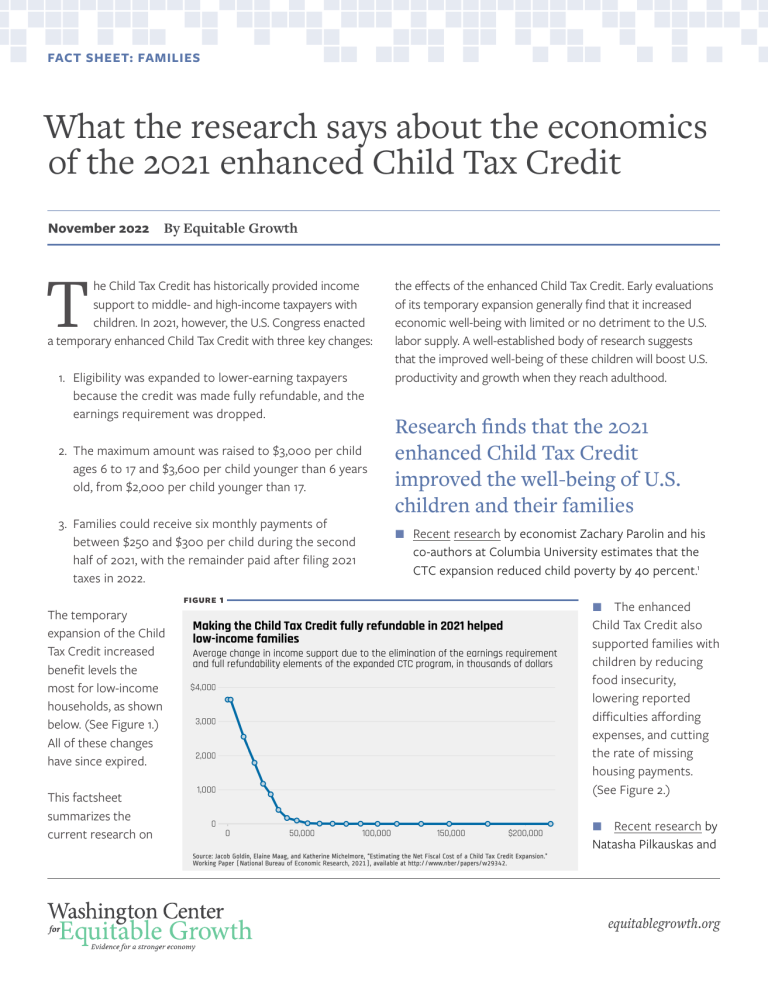
Factsheet: What the research says about the economics of the 2021 enhanced Child Tax Credit (opens in a new tab)
Factsheets NOV 29, 2022
The Child Tax Credit has historically provided income support to middle- and high-income taxpayers with children. In 2021, however, the U.S. Congress enacted a temporary enhanced Child Tax Credit with…
By: Equitable Growth (opens in a new tab)

Advancing research and evidence on child care and U.S. economic growth (opens in a new tab)
Blog NOV 10, 2022
Research shows that accessible and affordable child care is both a lifeline for working families and a driver of growth across the entire U.S. economy. A functioning child care market…
By: Equitable Growth (opens in a new tab)

Including immigrants in the U.S. tax system is fiscally responsible and can boost economic growth by lifting the well-being of their families (opens in a new tab)
Blog NOV 10, 2022
The recently enacted Inflation Reduction Act boasts the potential for more noncitizen immigrant workers and entrepreneurs to pay into the U.S. tax system, improving the federal government’s tax collection. What’s…
By: Shayak Sarkar (opens in a new tab)

What federal statistical agencies can do to improve survey response rates among Hispanic communities in the United States (opens in a new tab)
Blog OCT 14, 2022
Between 2010 and 2020, the Hispanic American population grew 23 percent, making it one of the fastest-growing communities in the United States. According to the 2020 decennial census, Hispanic Americans…
By: Raksha Kopparam (opens in a new tab)

Latino workers are often segregated into bad jobs, but a strong U.S. labor movement can boost job quality and U.S. economic growth (opens in a new tab)
Issue Briefs OCT 13, 2022
Latino workers represent a large and growing share of the U.S. workforce. But even with the highest employment rates in the United States, Latinos face a number of barriers to…
By: Carmen Sanchez Cumming (opens in a new tab)

Equitable Growth announces two Dissertation Scholars for 2022–23 academic year (opens in a new tab)
Blog OCT 6, 2022
The Washington Center for Equitable Growth each year offers funding and mentorship opportunities to two pre-doctoral students through our Dissertation Scholars program. This program, whose application coincides with Equitable Growth’s…
By: Equitable Growth (opens in a new tab)

Budget analyses of U.S. income support programs must incorporate long-term benefits for children (opens in a new tab)
Blog SEP 22, 2022
When any piece of legislation is considered by the U.S. Congress, it typically goes through a budget analysis to establish its impact on the federal government’s bottom line. These analyses,…
By: Anna Aizer (opens in a new tab), Hilary Hoynes (opens in a new tab), Adriana Lleras-Muney (opens in a new tab)

Policymakers can still use American Rescue Plan funds to bolster the U.S. child care system and ensure it has a strong future (opens in a new tab)
Blog SEP 20, 2022
In January, the 118th Congress will draw to a close following a productive session that saw legislative action on pandemic relief, infrastructure investments, manufacturing and research incentives, and critical investments…
By: Sam Abbott (opens in a new tab)

New research shows that 1 in 4 adults in the United States suffers from transportation insecurity (opens in a new tab)
Blog SEP 14, 2022
Access to transportation is crucial to ensuring that people can meet their basic needs and participate in society and the economy. It goes without saying that if people can’t get…
By: Alix Gould-Werth (opens in a new tab)

Consumers initially spend less than a third of their stimulus checks, on average, amid recessions (opens in a new tab)
Blog SEP 12, 2022
Economists and policymakers alike generally agree on the effectiveness of sending out direct stimulus checks to individuals to help reverse an economic downturn by encouraging more consumer spending. But they…
By: Equitable Growth (opens in a new tab)

Equitable Growth names Shayna Strom as interim president and CEO (opens in a new tab)
Blog SEP 8, 2022
The Washington Center for Equitable Growth today announced that Shayna Strom has been named its interim president and CEO. Strom comes to the organization with decades of experience bridging nonprofits,…
By: Equitable Growth (opens in a new tab)

Measuring spending inequality in the United States in real time (opens in a new tab)
Blog SEP 8, 2022
The onset of the COVID-19 pandemic and the resulting recession in 2020, followed by a swift U.S. economic recovery, offer lessons today about why real-time data are so crucial to…
By: Loujaina Abdelwahed (opens in a new tab), Jacob Robbins (opens in a new tab), Cole Campbell (opens in a new tab), Shogher Ohannessian (opens in a new tab), Todd Czurylo (opens in a new tab)

Why the Inflation Reduction Act is key to strong, broad-based U.S. economic growth (opens in a new tab)
Blog AUG 16, 2022
The Inflation Reduction Act spells good news for the U.S. economy. The newly signed legislation makes historic investments to combat climate change, lower healthcare costs, and crack down on tax…
By: David S. Mitchell (opens in a new tab)

How to stop a recession by strengthening income supports in the United States (opens in a new tab)
Blog AUG 15, 2022
Income support programs, such as Unemployment Insurance and the Supplemental Nutrition Assistance Program, are powerful tools to deploy when the threat of recession looms and unemployment climbs. By providing income…
By: Alix Gould-Werth (opens in a new tab)

American Sociological Association 2022 conference highlights inequities among vulnerable U.S. populations (opens in a new tab)
Blog AUG 12, 2022
The American Sociological Association held its 117th Annual Meeting from August 5–9, 2022 in Los Angeles, California. This event gathers sociologists and those involved in the scientific study of society…
By: Equitable Growth (opens in a new tab)

Policymakers tackling inflation can’t overlook the impact of higher interest rates on the U.S. child care market (opens in a new tab)
Blog AUG 11, 2022
As families in the United States grapple with rising prices and ongoing supply shortages, fiscal and monetary policymakers are shifting their focus from the COVID-19 recession and recovery to the…
By: Sam Abbott (opens in a new tab)

The economic evidence behind the Inflation Reduction Act and why it will boost strong, broad-based economic growth (opens in a new tab)
Blog AUG 5, 2022
The Inflation Reduction Act spells good news for the U.S. economy. The proposed legislation now before the U.S. Senate would make historic investments to combat climate change, lower healthcare costs,…
By: David S. Mitchell (opens in a new tab)
COVID-19 recession and ensuing economic recovery reveals why Unemployment Insurance fails to reach marginalized U.S. workers (opens in a new tab)
Blog JUL 13, 2022
Policymakers at the state and federal levels of government in the United States who are steeped in the nation’s Unemployment Insurance system are well aware that many unemployed workers fail…
By: Eliza Forsythe (opens in a new tab)
Reduced job turnover in small U.S. firms is an overlooked benefit of paid sick leave (opens in a new tab)
Blog JUL 5, 2022
For those U.S. workers fortunate enough to have access to it, paid sick leave is a vital tool for protecting both the public’s health and their own economic stability when…
By: Hilary Wething (opens in a new tab)
Factsheet: What the research says about the economic impacts of reproductive care (opens in a new tab)
Factsheets JUN 27, 2022
Before the U.S. Supreme Court ruling on June 24 in Dobbs v. Jackson Women’s Health Organization, more than five decades of liberating access to contraception and abortion care had demonstrable…
By: Kate Bahn (opens in a new tab), Emilie Openchowski (opens in a new tab)

May jobs report: Young workers are entering a uniquely evolving U.S. labor market (opens in a new tab)
Blog JUN 3, 2022
The recovery in the U.S. labor market continued in May, with 390,000 jobs added and the unemployment rate holding steady at nearly its pre-pandemic level at 3.6 percent, according to…
By: Kate Bahn (opens in a new tab), Kathryn Zickuhr (opens in a new tab)

Is there a skilled labor shortage? The economic evidence on skills gap and labor shortage concerns (opens in a new tab)
Blog MAY 31, 2022
Claims of a “skills gap” or “labor shortage” in the United States are often cited during times of high unemployment as the reason why workers are unable to find jobs…
By: Kathryn Zickuhr (opens in a new tab)

Developing a research agenda on racial and gender equity in the pandemic-era U.S. labor market (opens in a new tab)
Blog MAY 24, 2022
This summation of a joint roundtable discussion was written in partnership with The Century Foundation. Now, more than 2 years after the start of the COVID-19 pandemic in the United…
By: Sam Abbott (opens in a new tab), Kate Bahn (opens in a new tab), Julie Kashen (opens in a new tab)

Child care costs are going to rise, but policymakers can help U.S. families manage these increases (opens in a new tab)
Blog MAY 18, 2022
For decades, the U.S. child care market has been on the verge of a crisis. As any parent knows, child care in the United States has long been too expensive,…
By: Sam Abbott (opens in a new tab)

New research shows unstable schedules do not offer more flexibility for U.S. workers (opens in a new tab)
Blog MAY 18, 2022
A growing body of research documents the costs of schedule instability for workers in the United States. Inconsistent shifts make it harder for workers to maintain routines or plan their…
By: Peter J. Fugiel (opens in a new tab)
Making Short-Time Compensation work for the low-wage service sector (opens in a new tab)
Reports MAY 11, 2022
A first step to making Short-Time Compensation work for the broader U.S. economy Fast facts Short-Time Compensation—a social insurance program also known as worksharing that is part of the larger…
By: Carmen Sanchez Cumming (opens in a new tab), Alix Gould-Werth (opens in a new tab)
Factsheet: Six frequently asked questions about schedule quality and Fair Workweek laws across the United States (opens in a new tab)
Factsheets APR 15, 2022
Seven cities and one state have implemented Fair Workweek laws—legislation that aims to improve the quality of work schedules that employers offer to their workforce. If your jurisdiction is considering…
By: Equitable Growth (opens in a new tab)

Revisiting timely research that explores U.S. intersectional wage gaps amid Women’s History Month (opens in a new tab)
Issue Briefs MAR 8, 2022
The U.S. labor market faced one of the most severe challenges in recent history with the onset of the coronavirus pandemic in March 2020. In the 2 years since then,…
By: Equitable Growth (opens in a new tab)

February Jobs Day report: U.S. employment growth is still strong, but some care sector workers are being left behind (opens in a new tab)
Blog MAR 4, 2022
The U.S. economy continued its streak of strong month-to-month employment gains, adding 678,000 jobs between mid-January and mid-February. According to data released this morning by the U.S. Bureau of Labor…
By: Carmen Sanchez Cumming (opens in a new tab), Kathryn Zickuhr (opens in a new tab)

How Black activists spurred the U.S. government to expand school meal programs, addressing child hunger and boosting future productivity (opens in a new tab)
Blog FEB 22, 2022
Every school day, millions of students at public and private, nonprofit schools across the United States enjoy free or low-cost meals supported by the National School Lunch Program and School…
By: Shaun Harrison (opens in a new tab), Shanteal Lake (opens in a new tab), Sam Abbott (opens in a new tab)
Is moving to a new place key to upward mobility for U.S. workers and their families? (opens in a new tab)
Blog FEB 14, 2022
U.S. history is rife with examples of groups and individuals upending their lives and migrating in search of better economic opportunities for themselves, their families, and their descendants. This process…
By: Ellora Derenoncourt (opens in a new tab)

African American men and the U.S. labor market during recessions and economic recoveries (opens in a new tab)
Blog FEB 11, 2022
In my 2017 book, African American Men and the Labor Market During The Great Recession, I provided a multidimensional background on the disproportionate impact experienced by African American male workers…
By: Michelle Holder (opens in a new tab)
Getting cash transfer payments to recipients faster boosts household spending and stimulates the economy (opens in a new tab)
Issue Briefs FEB 9, 2022
Cash transfer programs are a widespread economic policy tool often used to stimulate spending or encourage savings among consumers. The United States most notably uses direct cash payments as part…
By: Neil Thakral (opens in a new tab), Linh Tô (opens in a new tab)

Consumption volatility across the U.S. income distribution is highest among low-income workers and their families (opens in a new tab)
Issue Briefs FEB 3, 2022
Rising income inequality and more unstable earnings in the United States today results in more precarious lives for low-income U.S. workers and their families. This earnings and income instability leads…
By: Jonathan Fisher (opens in a new tab), Bradley Hardy (opens in a new tab)
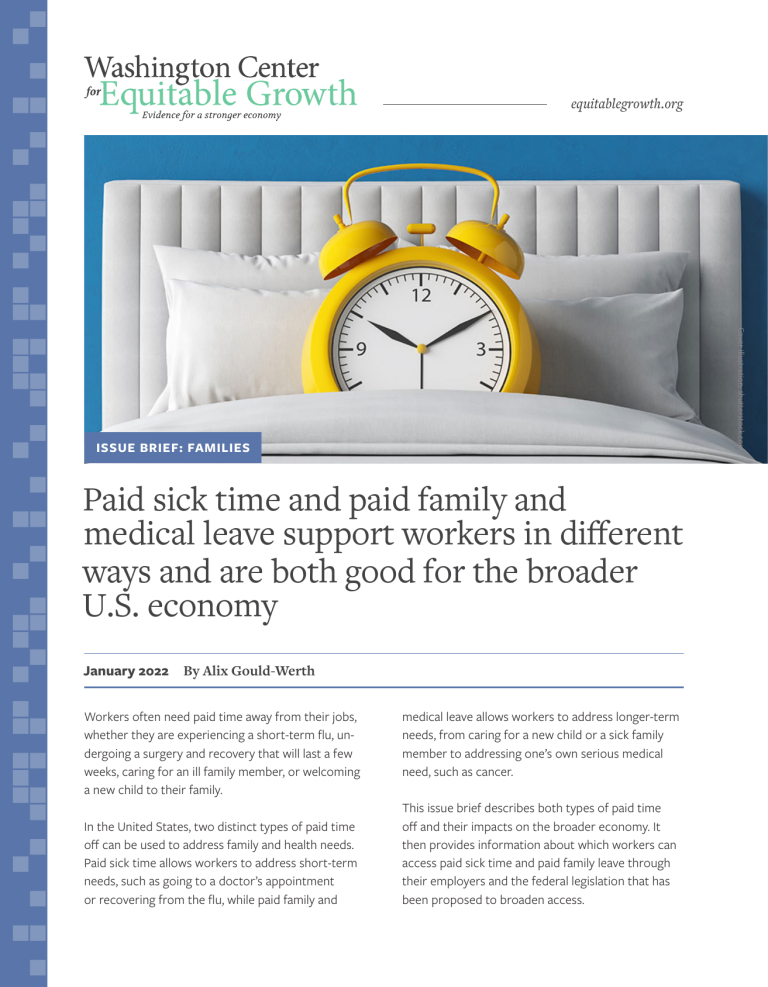
Paid sick time and paid family and medical leave support workers in different ways and are both good for the broader U.S. economy (opens in a new tab)
Issue Briefs JAN 25, 2022
Workers often need paid time away from their jobs, whether they are experiencing a short-term flu, undergoing a surgery and recovery that will last a few weeks, caring for an…
By: Alix Gould-Werth (opens in a new tab)
Fostering academic research on U.S. economic impact payments that goes beyond the marginal propensity to consume (opens in a new tab)
Blog JAN 18, 2022
Direct government payments to individuals are now a standard part of U.S. fiscal policymakers’ recession-fighting toolkit. Three rounds of so-called economic impact payments from the federal government have been paid…
By: Karen Dynan (opens in a new tab)

Paid sick leave improves public health outcomes and supports U.S. workers at a relatively low cost to employers (opens in a new tab)
Blog JAN 12, 2022
The United States is one of only three high-income countries in the world that does not have a universal paid sick leave program available to its workforce. Although an emergency…
By: Catherine Maclean (opens in a new tab), Stefan Pichler (opens in a new tab), Nicolas R. Ziebarth (opens in a new tab)

Recent Equitable Growth-funded research sheds light on the links between paid family and medical leave research and U.S. economic growth (opens in a new tab)
Blog DEC 23, 2021
The Washington Center for Equitable Growth has long prioritized the generation of new research on the economic effects of paid family and medical leave in the United States. This line…
By: Equitable Growth (opens in a new tab)
Implications of allowing U.S. employers to opt out of a payroll-tax-financed paid leave program (opens in a new tab)
Reports DEC 23, 2021
In recent years, policymakers have become increasingly focused on creating a national program of paid family and medical leave. The current patchwork arrangement of federal legislation, state initiatives, and employer-provided…
By: Laura D. Quinby (opens in a new tab), Robert L. Siliciano (opens in a new tab)

Exploring the impact of automation and new technologies on the future of U.S. workers and their families (opens in a new tab)
Issue Briefs DEC 17, 2021
As technological advances seemingly reshape every aspect of how U.S. workers and their families live and work, a persistent question in research and policy discussions is how these advances will…
By: Kathryn Zickuhr (opens in a new tab)
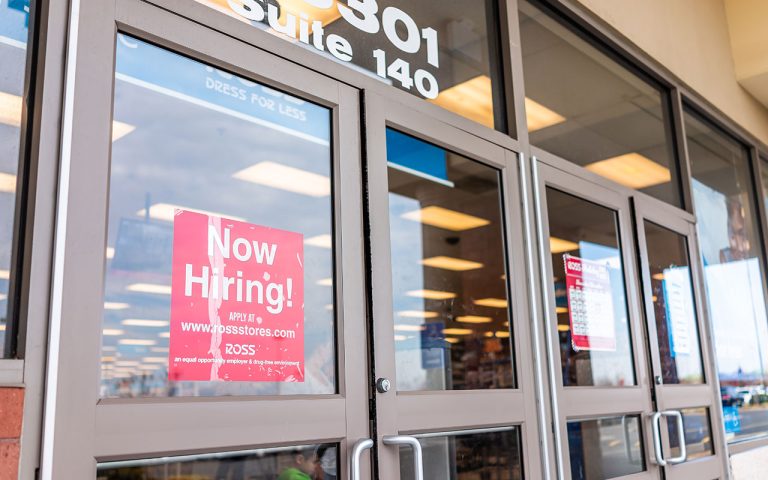
Worker power and pay quality for young workers without a college degree in the United States (opens in a new tab)
Blog DEC 9, 2021
New cross-country research by economist David Howell at The New School (also an Equitable Growth grantee and a member of Equitable Growth’s Research Advisory Board) provides strong evidence that the…
By: Kathryn Zickuhr (opens in a new tab)

Equitable Growth’s academic research and policy priorities shine through at Southern Economic Conference 2021 (opens in a new tab)
Blog DEC 9, 2021
The Southern Economic Association recently held its 91st Annual Meeting, gathering a diverse group of scholars from U.S. and international universities to discuss their research in theory and applied economics.…
By: Equitable Growth (opens in a new tab)

House Select Committee on Economic Disparity and Fairness in Growth (opens in a new tab)
Blog DEC 8, 2021
Hearing on “Growing our Economy by Investing in Families: How Supporting Family Caregiving Expands Economic Opportunity and Benefits All Americans” Testimony by Michelle Holder, President and CEO of the Washington…
By: Michelle Holder (opens in a new tab)
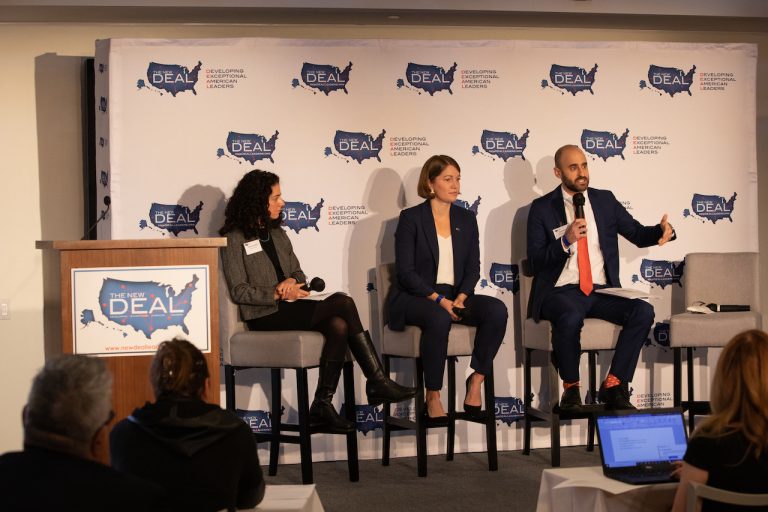
Equitable Growth joins NewDEAL Leaders to discuss child care in the post-pandemic U.S. economy (opens in a new tab)
Blog DEC 7, 2021
As the U.S. Congress finalizes its negotiations around the Build Back Better Act, policymakers at the federal, state, and local levels of government continue working to rebuild their respective economies…
By: Equitable Growth (opens in a new tab)

The impact of neighborhood disparities on intergenerational mobility and economic growth in the United States (opens in a new tab)
Blog DEC 1, 2021
The neighborhoods and communities in which we grow up and live affect our future life outcomes. Yet the push for policymakers to address neighborhood disparities in health and economic outcomes…
By: Patrick Edwards (opens in a new tab)
The economic evidence behind 10 policies in the Build Back Better Act (opens in a new tab)
Issue Briefs NOV 24, 2021
The U.S. House of Representatives late last week passed a key plank of President Joe Biden’s economic agenda, the Build Back Better Act. Coming on the heels of the president…
By: Maryam Janani-Flores (opens in a new tab), David S. Mitchell (opens in a new tab)

U.S. disability programs provide valuable benefits to low-income recipients across a range of health conditions (opens in a new tab)
Blog NOV 22, 2021
The three components of the U.S. social insurance system serve retirees and those recipients facing challenging health conditions. But all three programs have grown in recent decades, sparking various calls…
By: Manasi Deshpande (opens in a new tab)

The importance of neighborhoods and intergenerational economic inequality in the United States (opens in a new tab)
Blog NOV 19, 2021
Many neighborhoods and communities across the United States are shaped by pervasive economic inequality spanning multiple generations. This intergenerational economic inequality today limits the prosperity of many people who want…
By: Vincient Whatley (opens in a new tab)

New research shows the importance of worker power for addressing U.S. wage inequality (opens in a new tab)
Blog NOV 9, 2021
Workers in the United States over the past 40 years experienced stagnant real wages for those at the lower end of the income distribution, along with rising income inequality, even…
By: Equitable Growth (opens in a new tab)

Testimony by Michelle Holder before the Joint Economic Committee (opens in a new tab)
Blog OCT 28, 2021
Michelle Holder, the current president and CEO of the Washington Center for Equitable Growth, testified before the Joint Economic Committee of the U.S. Congress this past summer, when she was…
By: Michelle Holder (opens in a new tab)

Dispatch from EconCon 2021: Addressing racial and gender stratification in the U.S. economy is key to an equitable and sustainable recovery (opens in a new tab)
Blog OCT 21, 2021
The 2-day EconCon 2021 conference, held virtually from October 6–7, featured speakers, panelists, and moderators from across the progressive policy and academic landscape. They were tasked by the co-hosts of…
By: Equitable Growth (opens in a new tab)

Equitable Growth scholars highlight the need for broad investment in U.S. social infrastructure (opens in a new tab)
Blog OCT 20, 2021
Our nation’s social infrastructure is composed of the economic and social investments that are necessary for U.S. workers and families to be able to take care of their loved ones…
By: Alix Gould-Werth (opens in a new tab), Sam Abbott (opens in a new tab)

Evidence shows that now is the time to invest in U.S. workers and their families (opens in a new tab)
Blog OCT 20, 2021
In February 2020, we set out to examine the effects of a new predictable scheduling ordinance in eastern Pennsylvania on low-wage service-sector workers. We had no idea that the workers…
By: Elizabeth Oltmans Ananat (opens in a new tab), Anna Gassman-Pines (opens in a new tab)

New study in the Proceedings of the National Academy of Sciences shows schedule stability supports U.S. workers and the broader economy (opens in a new tab)
Blog OCT 12, 2021
As COVID-19 vaccination rates rise in the United States many businesses, especially in hard-hit industries such as retail and food service, are seeking to fill positions to keep pace with…
By: Alix Gould-Werth (opens in a new tab), Emilie Openchowski (opens in a new tab), Raksha Kopparam (opens in a new tab)

Equitable Growth welcomes two new Dissertation Scholars for 2021–22 academic year (opens in a new tab)
Blog SEP 22, 2021
The Washington Center for Equitable Growth through its Dissertation Scholars Program supports pre-doctoral students from the social sciences who are studying the links between inequality and growth. With a stipend…
By: Equitable Growth (opens in a new tab)
A cost-benefit analysis of The American Families Plan’s proposed investment in a nationwide public preschool program (opens in a new tab)
Issue Briefs SEP 22, 2021
President Joe Biden asked the U.S. Congress to consider investing $200 billion over 10 years in “a national partnership with states to offer free, high-quality, accessible, and inclusive preschool to…
By: Robert Lynch (opens in a new tab)

Congressional investments in social infrastructure would support immediate and long-term U.S. economic growth (opens in a new tab)
Blog SEP 16, 2021
The U.S. Congress this month began voting on a bevy of bills and amendments designed to shore up the nation’s social infrastructure as part of a legislative process known as…
By: Alix Gould-Werth (opens in a new tab), Sam Abbott (opens in a new tab)
Factsheet: What the research says about the economics of income support programs (opens in a new tab)
Issue Briefs SEP 16, 2021
Sufficient income is one of the most important components of a stable and healthy household budget. Income support programs help ensure that U.S. households have the income they need to…
By: Equitable Growth (opens in a new tab)

Factsheet: What the research says about the economics of early care and education (opens in a new tab)
Factsheets SEP 15, 2021
Despite the important role that child care plays in the lives of many U.S. families, the private child care market is not meeting their needs. This is not just an…
By: Equitable Growth (opens in a new tab)
The child care economy (opens in a new tab)
Reports SEP 15, 2021
Fact Sheet: What the research says about the economics of early care and educationDownload Report: The child care economyDownload U.S. workers and their families are largely on their own when…
By: Sam Abbott (opens in a new tab)

The coming public debt scare should not spook U.S. policymakers from investing in physical and social infrastructure (opens in a new tab)
Blog SEP 7, 2021
Public debt scaremongering is back in fashion on Capitol Hill. Republican legislators, from Senate Minority Leader Mitch McConnell (R-KY) on down, are invoking the high level of federal government debt—currently…
By: Barry Eichengreen (opens in a new tab)

Completing the unfinished New Deal to overcome 21st century U.S. economic inequality (opens in a new tab)
Blog AUG 31, 2021
President Joe Biden wants Congress to enact his two signature legislative packages—the $1 trillion bipartisan physical infrastructure plan passed by the U.S. Senate earlier in August and a $3.5 trillion…
By: David S. Mitchell (opens in a new tab)

Income support programs boost earnings for low-wage workers by reducing household poverty in the United States (opens in a new tab)
Blog AUG 26, 2021
The U.S. government expanded Unemployment Insurance and support for families with children amid the coronavirus pandemic to a degree unprecedented in recent history. Preliminary estimates of these expansions show their…
By: Michael A. Schultz (opens in a new tab)

Coronavirus disruptions in family caregiving highlight the importance of investments in U.S. care infrastructure and paid leave (opens in a new tab)
Blog AUG 24, 2021
Most workers in the United States at some point over the course of their lives will take on multiple unpaid caregiving responsibilities, be it caring for a child, an elderly…
By: Yulya Truskinovsky (opens in a new tab)

American Sociological Association 2021 conference centered on inequality and structural racism in the U.S. economy and society (opens in a new tab)
Blog AUG 19, 2021
The American Sociological Association last week held its annual meeting, virtually gathering scholars with the goal of making sociology “relevant to positive social transformation.” Over 5 days, attendees met and…
By: Aixa Alemán-Díaz (opens in a new tab)

Myths about competition in the global economy harm humanity and our planet (opens in a new tab)
Blog AUG 11, 2021
Competition around the globe is facing a crisis today. Mega corporations benefit from neoliberal ideologies and lax enforcement of the antitrust laws. Growing market power among fewer and fewer firms…
By: Raksha Kopparam (opens in a new tab)
Weak income support infrastructure harms U.S. workers and their families and constrains economic growth (opens in a new tab)
Issue Briefs AUG 5, 2021
The coronavirus public health emergency and resulting economic recession brought into stark relief the engrained problems with the system of income support for U.S. workers and their families. People in…
By: Liz Hipple (opens in a new tab), Alix Gould-Werth (opens in a new tab)

NBER Summer Institute 2021 Round-up: Week 3 (opens in a new tab)
Blog AUG 2, 2021
On July 12, the National Bureau of Economic Research kicked off its summer institute, an annual 3-week conference featuring discussions and paper presentations on specific subfields of economics, including measuring…
By: Equitable Growth (opens in a new tab)

Excessive heat harms U.S. workers unequally as the safety risks from climate change soar (opens in a new tab)
Blog JUL 19, 2021
This summer’s West Coast heat waves come as no surprise. But headlines about the various negative effects of excessive heat, including fatal wildfires, often overlook the plight of everyday workers.…
By: Michael Garvey (opens in a new tab)

Climate change among many issues discussed at annual Western Economic Association International conference (opens in a new tab)
Blog JUL 15, 2021
The Western Economic Association International at the end of June held its 96th annual conference, bringing audiences together for more than 280 concurrent sessions to collaborate, share, and learn from…
By: Equitable Growth (opens in a new tab)

Policymakers should ensure that the U.S. labor market recovery lasts by boosting workers’ bargaining power and strengthening social infrastructure (opens in a new tab)
Issue Briefs JUL 12, 2021
Many U.S. labor market indicators suggest that the United States is on its way toward a strong recovery. Over the past few months, hopeful signs are starting to emerge that…
By: Kate Bahn (opens in a new tab), Alix Gould-Werth (opens in a new tab), Carmen Sanchez Cumming (opens in a new tab)
The economic benefits of equal opportunity in the United States by ending racial, ethnic, and gender disparities (opens in a new tab)
Issue Briefs JUN 29, 2021
Racial, ethnic, and gender disparities across the U.S. economy are a personal tragedy for the millions of individuals who suffer from the emotional, psychological, and social consequences. These disparities also…
By: Robert Lynch (opens in a new tab)

A new report lays out the path forward for faltering U.S. Unemployment Insurance system (opens in a new tab)
Blog JUN 24, 2021
Today, experts from seven organizations released a fortuitously timed report charting a path forward for the U.S. Unemployment Insurance program. Unemployment Insurance is the main social insurance program designed to…
By: Alix Gould-Werth (opens in a new tab)

Father’s Day highlights why paid paternity leave should be part of all U.S. parental leave policies (opens in a new tab)
Blog JUN 17, 2021
This Sunday is Father’s Day, a holiday in which we celebrate and acknowledge our relationships with fathers, grandfathers, father figures, and others in our lives who helped raise us. For…
By: Equitable Growth (opens in a new tab)

The evidence behind Biden’s big plans for rebuilding infrastructure, reducing poverty, and combating inequality (opens in a new tab)
Blog APR 29, 2021
During his first 100 days in office, President Joe Biden turned core elements of his Build Back Better campaign plan into concrete policy proposals for congressional consideration. Dubbed the American…
By: David S. Mitchell (opens in a new tab)
Factsheet: What does the research say about the economics of paid leave? (opens in a new tab)
Factsheets APR 22, 2021
The United States is the only advanced economy in the Organisation for Economic Co-operation and Development that does not guarantee any paid family and medical leave to its entire workforce.…
By: Equitable Growth (opens in a new tab)
Factsheet: What does the research say about care infrastructure? (opens in a new tab)
Factsheets APR 15, 2021
The United States is emerging from the greatest health, economic, and caregiving crises in a century. Many policymakers are looking for ways to jumpstart the economy and, recognizing the tie…
By: Equitable Growth (opens in a new tab)

In Conversation with Mark Rank (opens in a new tab)
In Conversation APR 14, 2021
Equitable Growth in Conversation is a recurring series where we talk with economists and other academics to help us better understand whether and how economic inequality affects economic growth and…
By: Alix Gould-Werth (opens in a new tab)

Roads, bridges, bottles, and blocks: Rethinking infrastructure for the post-pandemic U.S. economy (opens in a new tab)
Blog APR 12, 2021
When the COVID-19 pandemic eventually wanes and economic conditions improve, many Americans will be able to safely resume familiar activities that have been curtailed amid the health and economic crises.…
By: Sam Abbott (opens in a new tab)

What the U.S. Census Household Pulse Survey reveals about the first year of the coronavirus recession, in six charts (opens in a new tab)
Blog APR 1, 2021
The U.S. Census Bureau’s new Household Pulse Survey is an invaluable and near real-time source of information for understanding how the coronavirus recession is affecting U.S. workers, families, and communities.…
By: Carmen Sanchez Cumming (opens in a new tab), Raksha Kopparam (opens in a new tab)

Equitable Growth network helps Biden-Harris administration implement evidence-backed economic policy (opens in a new tab)
Blog MAR 30, 2021
The Washington Center for Equitable Growth was founded in 2013 to promote the use of research in policy and decision-making. Our strategy—to ensure that lawmakers and advocates are armed with…
By: David S. Mitchell (opens in a new tab)

The child allowance will pay dividends for the entire U.S. economy far into the future (opens in a new tab)
Blog MAR 24, 2021
One feature of the newly enacted American Rescue Plan that got less attention in the lead up to its passage than the more headline-grabbing $1,400 economic impact payments are the…
By: Liz Hipple (opens in a new tab)

Moving with two careers is hard, but Unemployment Insurance for trailing spouses can help (opens in a new tab)
Blog MAR 16, 2021
Where one works is tied to where one lives, and for many job searchers, changing jobs also means having to move. These joint job-location decisions are one way that a…
By: Joanna Venator (opens in a new tab)

Women’s History Month: Systemic gender discrimination continues to harm working women amid the coronavirus recession (opens in a new tab)
Blog MAR 12, 2021
Women’s History Month is observed every March to celebrate the contributions of women politically, economically, and culturally throughout the history of the United States. It is an important month for…
By: Delaney Crampton (opens in a new tab)

Executive actions to coordinate federal countercyclical regulatory policy (opens in a new tab)
Blog FEB 17, 2021
This factsheet has been adapted from Yair Listokin’s Vision 2020 essay and his 2019 book, Law and Macroeconomics: Legal Remedies to Recessions. Overview Traditional macroeconomic tools—fiscal policy from the U.S.…
By: Equitable Growth (opens in a new tab)

New research shows that reductions in air pollution have intergenerational consequences (opens in a new tab)
Blog FEB 11, 2021
When the National Ambient Air Quality Standards were introduced in the United States 50 years ago as part of the 1970 Clean Air Act amendments, concerns about air pollution were…
By: Jonathan Colmer (opens in a new tab), John Voorheis (opens in a new tab)

The wage divide for Black and Latinx workers goes deeper than a ‘skills gap’ or requiring more credentials (opens in a new tab)
Blog FEB 4, 2021
The coronavirus recession continues to severely impact Black and Latinx workers, who are disproportionally suffering, compared to other workers in the United States. These more marginalized workers are registering higher…
By: Kate Bahn (opens in a new tab), Kathryn Zickuhr (opens in a new tab)
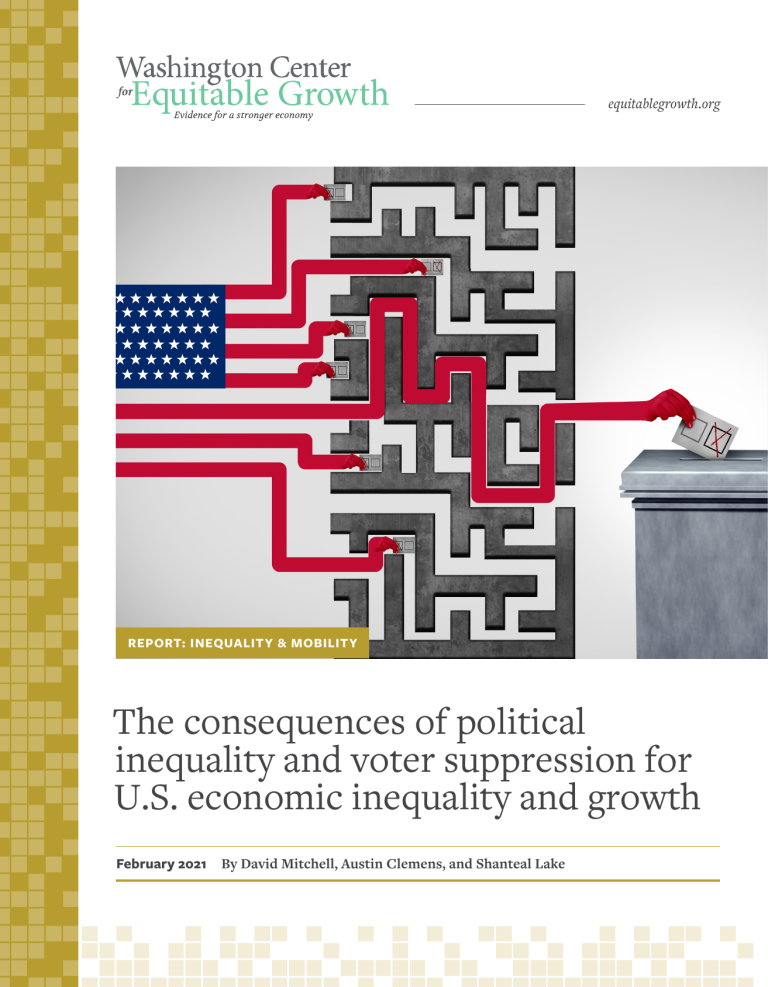
The consequences of political inequality and voter suppression for U.S. economic inequality and growth (opens in a new tab)
Reports FEB 3, 2021
Economic analysis that does not account for political power—who has it and how it is wielded—will inevitably fail to fully capture what keeps the United States from achieving equitable economic…
By: David S. Mitchell (opens in a new tab), Austin Clemens (opens in a new tab), Shanteal Lake (opens in a new tab)

New Equitable Growth book presents broad structural changes to boost U.S. wages for more equitable and sustainable economic growth (opens in a new tab)
Blog JAN 14, 2021
The Washington Center for Equitable Growth today publishes its latest book, Boosting Wages for U.S. Workers in the New Economy, in conjunction with a virtual launch event virtual today on…
By: Kate Bahn (opens in a new tab)

Foreword: Boosting Wages for U.S. Workers in the New Economy (opens in a new tab)
Blog JAN 14, 2021
The anemic wage growth that has characterized the U.S. economy for decades has deep structural causes that defy easy solutions. For decades, the benefits of economic growth have gravitated toward…
By: Jean Ross (opens in a new tab)

Broad structural change is needed to boost wages in a U.S. economy that is more equitable to produce strong, sustainable economic growth (opens in a new tab)
Blog JAN 14, 2021
The U.S. labor market is shackled by decades of wage stagnation for the majority of workers, persistent wage disparities by race, ethnicity, and gender, and sluggish economic growth. The steady…
By: Kate Bahn (opens in a new tab), Jesse Rothstein (opens in a new tab)

U.S. labor markets require a new approach to higher education (opens in a new tab)
Blog JAN 14, 2021
This essay is part of Boosting Wages for U.S. Workers in the New Economy, a compilation of 10 essays from leading economic thinkers who explore alternative policies for boosting wages…
By: Andria Smythe (opens in a new tab)

Public investments in social insurance, education, and child care can overcome market failures to promote family and economic well-being (opens in a new tab)
Blog JAN 14, 2021
This essay is part of Boosting Wages for U.S. Workers in the New Economy, a compilation of 10 essays from leading economic thinkers who explore alternative policies for boosting wages…
By: Sandra Black (opens in a new tab), Jesse Rothstein (opens in a new tab)

Studying the impact of the U.S. safety net is vital to boosting human capital and improving worker well-being (opens in a new tab)
Blog JAN 13, 2021
It’s no secret that the social safety net in the United States plays an important role in helping vulnerable American families through times of crisis. Recent studies only reinforce this…
By: Hilary Hoynes (opens in a new tab)

Equitable Growth invests in research grants to explore the role of paid sick leave and paid family and medical leave amid the coronavirus recession (opens in a new tab)
Blog JAN 4, 2021
The Washington Center for Equitable Growth is announcing a trio of research grants to scholars exploring the impact of paid family and medical leave and paid sick leave policies amid…
By: Sam Abbott (opens in a new tab), Alix Gould-Werth (opens in a new tab)

New research shows the impact of 2020 job and income losses on family dynamics and parents’ mental health in vulnerable households (opens in a new tab)
Blog DEC 14, 2020
As job losses in the United States persist amid the coronavirus recession, the economic and mental health fallout becomes ever clearer. Historically, research on the effects of job losses and…
By: Ariel Kalil (opens in a new tab)

In the United States, it’s not what you know but who your parents know (opens in a new tab)
Blog DEC 4, 2020
In the United States, an individual’s income tends to be closely related to their parents’ income. This fact—that children born into poverty in this country are likely to remain in…
By: Matthew Staiger (opens in a new tab)

Filling critical gaps in child care research to support effective and equitable reforms to help U.S. families and workers alike (opens in a new tab)
Blog DEC 2, 2020
The child care industry in the United States is facing a crisis on two fronts. In the short term, the coronavirus pandemic and the recession it caused leaves child care…
By: Sam Abbott (opens in a new tab)

How to bring down the price of drugs such as the novel coronavirus therapy remdesivir (opens in a new tab)
Issue Briefs NOV 20, 2020
The extraordinary ongoing effort to find treatments to cure, ameliorate symptoms of, and vaccinate against the novel coronavirus and COVID-19, the disease caused by the virus, is a reminder of…
By: Aaron S. Kesselheim (opens in a new tab)

Scholars and advocates say racial disparities and worker power are key to the coronavirus recession and to long-term U.S. economic recovery (opens in a new tab)
Essays OCT 30, 2020
The coronavirus recession took root in a U.S. economy already characterized by profound economic and racial inequality, deeply inadequate public investment, and significant holes in support systems for families. At…
By: Shanteal Lake (opens in a new tab)
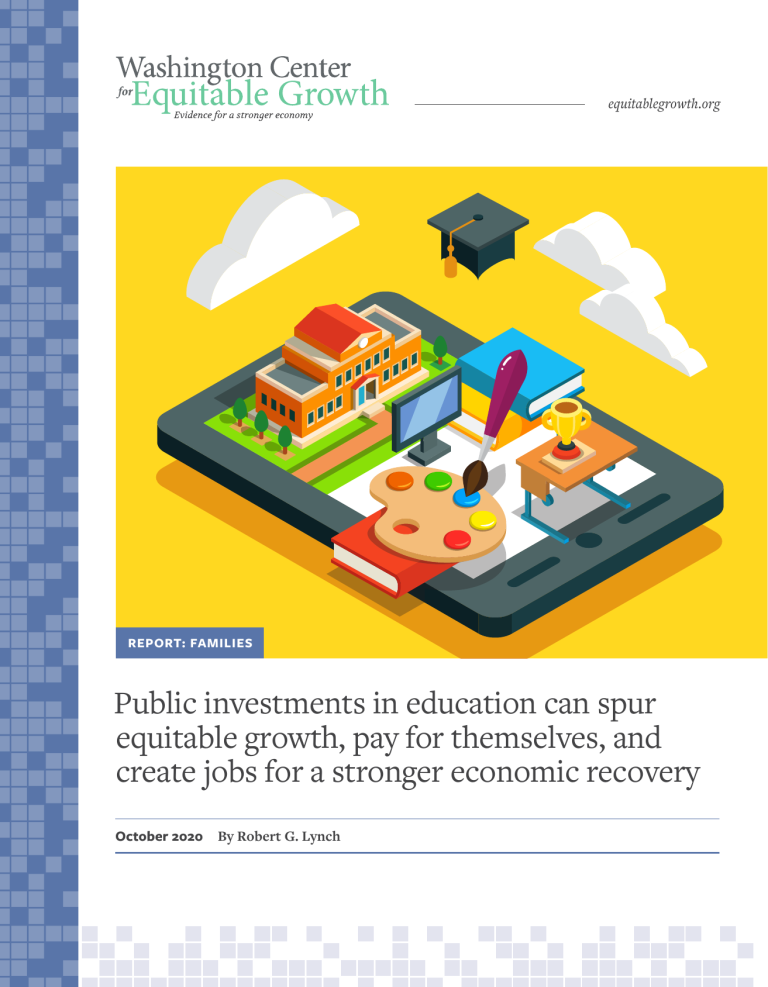
Public investments in education can spur equitable growth, pay for themselves, and create jobs for a stronger economic recovery (opens in a new tab)
Reports OCT 27, 2020
Public investments in education, in both physical structures and in services, are key to long-run economic growth and human well-being. Some of these investments are especially effective in promoting more…
By: Robert Lynch (opens in a new tab)
Factsheet: New study shows that emergency paid sick leave reduced COVID-19 infections in the United States (opens in a new tab)
Factsheets OCT 26, 2020
The United States is one of three high-income nations that does not guarantee paid sick leave for workers.338 As of March 2020, 25 percent of private-sector workers had no access…
By: Equitable Growth (opens in a new tab)
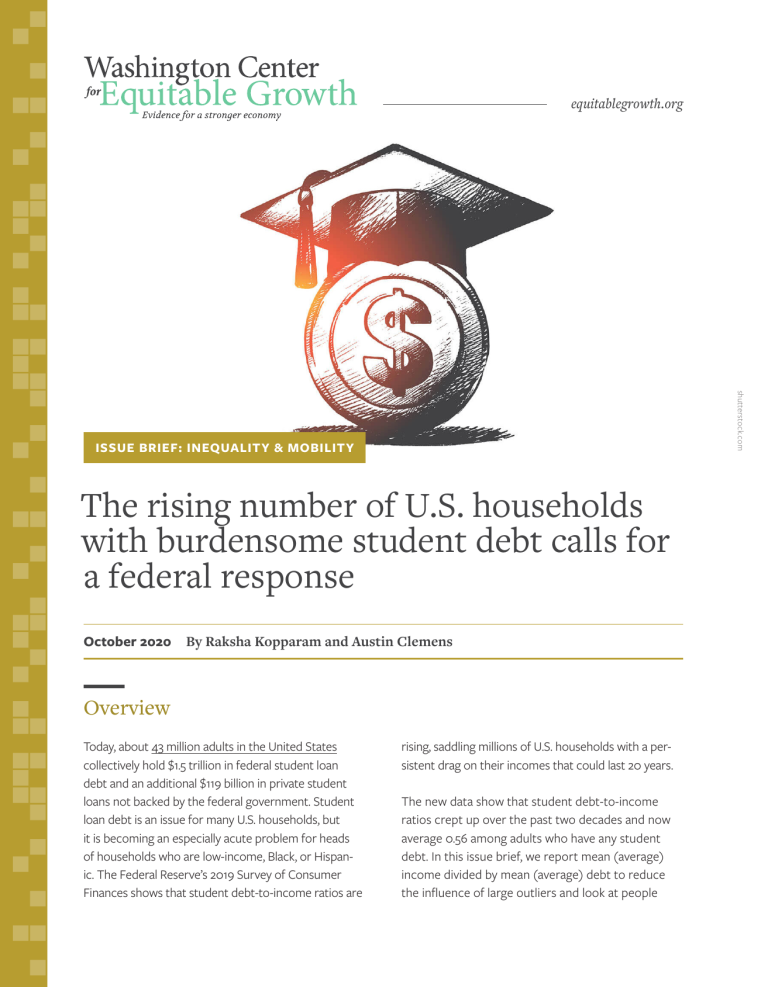
The rising number of U.S. households with burdensome student debt calls for a federal response (opens in a new tab)
Issue Briefs OCT 21, 2020
Today, about 43 million adults in the United States collectively hold $1.5 trillion in federal student loan debt and an additional $119 billion in private student loans not backed by…
By: Raksha Kopparam (opens in a new tab), Austin Clemens (opens in a new tab)
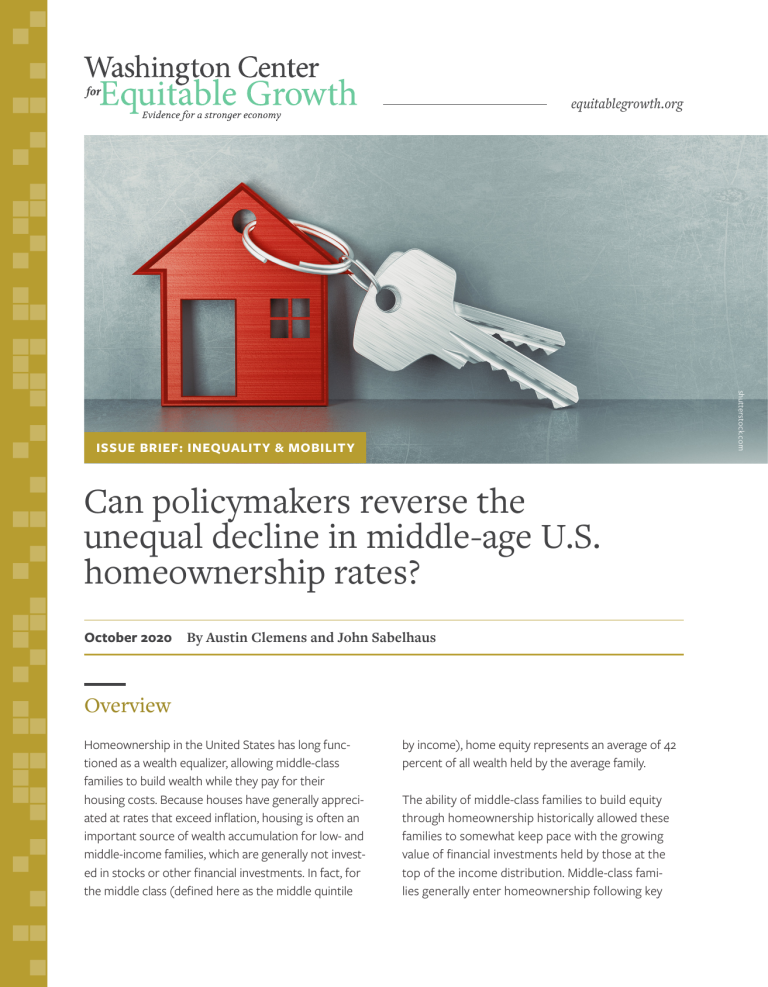
Can policymakers reverse the unequal decline in middle-age U.S. homeownership rates? (opens in a new tab)
Issue Briefs OCT 13, 2020
Homeownership in the United States has long functioned as a wealth equalizer, allowing middle-class families to build wealth while they pay for their housing costs. Because houses have generally appreciated…
By: Austin Clemens (opens in a new tab), John Sabelhaus (opens in a new tab)
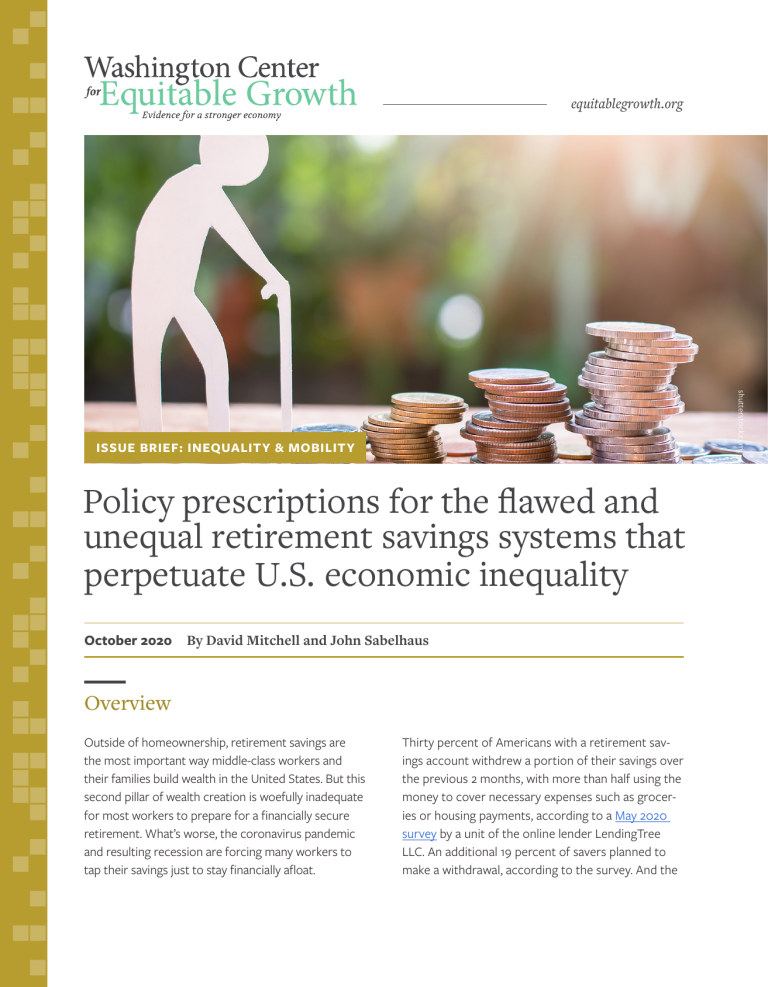
Policy prescriptions for the flawed and unequal retirement savings systems that perpetuate U.S. economic inequality (opens in a new tab)
Issue Briefs OCT 7, 2020
Outside of homeownership, retirement savings are the most important way middle-class workers and their families build wealth in the United States. But this second pillar of wealth creation is woefully…
By: David S. Mitchell (opens in a new tab), John Sabelhaus (opens in a new tab)

The hidden costs of stock-market-first U.S. economic policies (opens in a new tab)
Blog SEP 22, 2020
The idea that sound U.S. economic policy begins and ends with a strong stock market is becoming pervasive. Advocates of what I call the stock-market-first approach want you to focus…
By: John Sabelhaus (opens in a new tab)
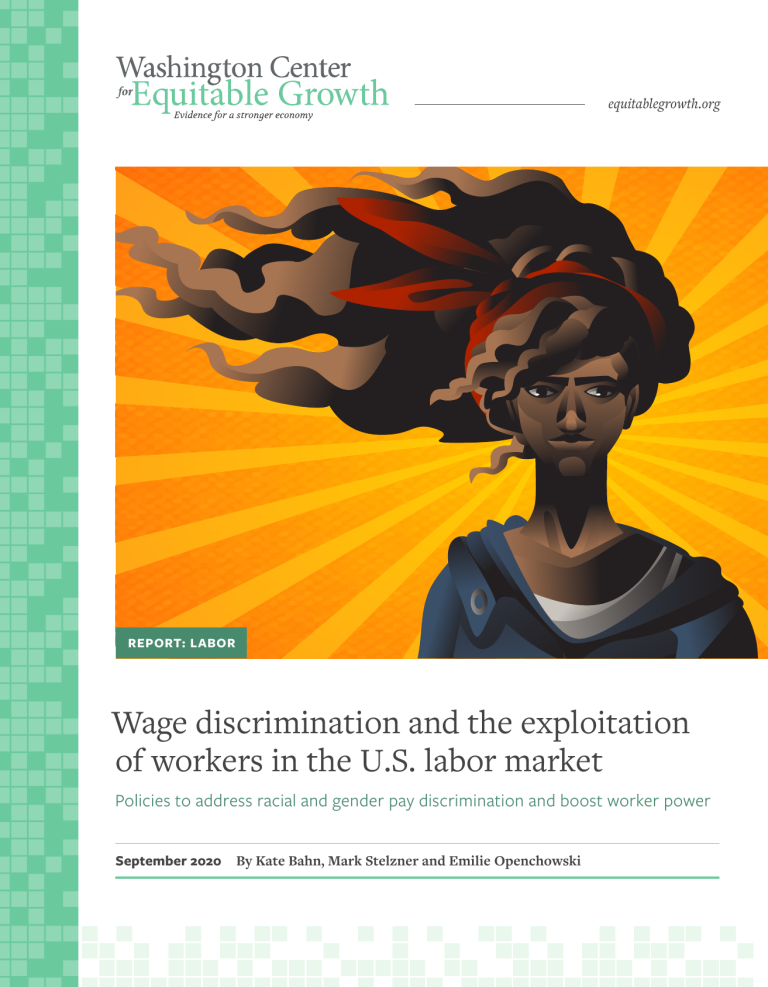
Wage discrimination and the exploitation of workers in the U.S. labor market (opens in a new tab)
Reports SEP 15, 2020
The U.S. labor market can be daunting to navigate, and especially so in recent months, as the coronavirus pandemic and recession have created a public health crisis and fueled business…
By: Kate Bahn (opens in a new tab), Mark Stelzner (opens in a new tab), Emilie Openchowski (opens in a new tab)

Equitable Growth announces record $1.07 million in research grants on inequality and broadly shared growth (opens in a new tab)
Blog AUG 31, 2020
The Washington Center for Equitable Growth today announced research grants totaling $1,074,060—our largest year to date—to seek evidence on important issues related to the intersections between economic inequality and growth.…
By: Korin Davis (opens in a new tab)

Achieving universal paid family and medical leave in the United States (opens in a new tab)
Blog AUG 24, 2020
The coronavirus pandemic and the recession it caused lay bare a familiar challenge for U.S. workers—balancing family and job responsibilities without access to paid family and medical leave. When a…
By: Equitable Growth (opens in a new tab)

Disaggregated data on Asian Americans, Native Hawaiians, and Pacific Islanders is crucial amid the coronavirus pandemic (opens in a new tab)
Issue Briefs AUG 20, 2020
The novel coronavirus pandemic and the recession it caused lay bare the clear links between racial and ethnic economic inequities, structural racism, and the outsized harm of these crises on…
By: Christian Edlagan (opens in a new tab), Raksha Kopparam (opens in a new tab)
Twenty-one policy resources to combat the coronavirus recession (opens in a new tab)
Blog AUG 5, 2020
Policymakers learned late last week that the U.S. economy registered a stunning 9.4 percent contraction in the second quarter of this year, a drop not experienced since the Great Depression…
By: David S. Mitchell (opens in a new tab)
Testimony by Heather Boushey before the Joint Economic Committee on the Coronavirus Recession (opens in a new tab)
Blog JUL 30, 2020
Thank you, Vice Chair Beyer and Chairman Lee, for inviting me to speak today. It’s an honor to be here. My name is Heather Boushey, and I am president and…
By: Heather Boushey (opens in a new tab)

Congress must act to help U.S. families facing an income crisis (opens in a new tab)
Blog JUL 29, 2020
We now have 4.3 million confirmed cases of the novel coronavirus in the United States. The virus moves fast, and policymakers in Washington move slow. Families across the country face…
By: Claudia Sahm (opens in a new tab)
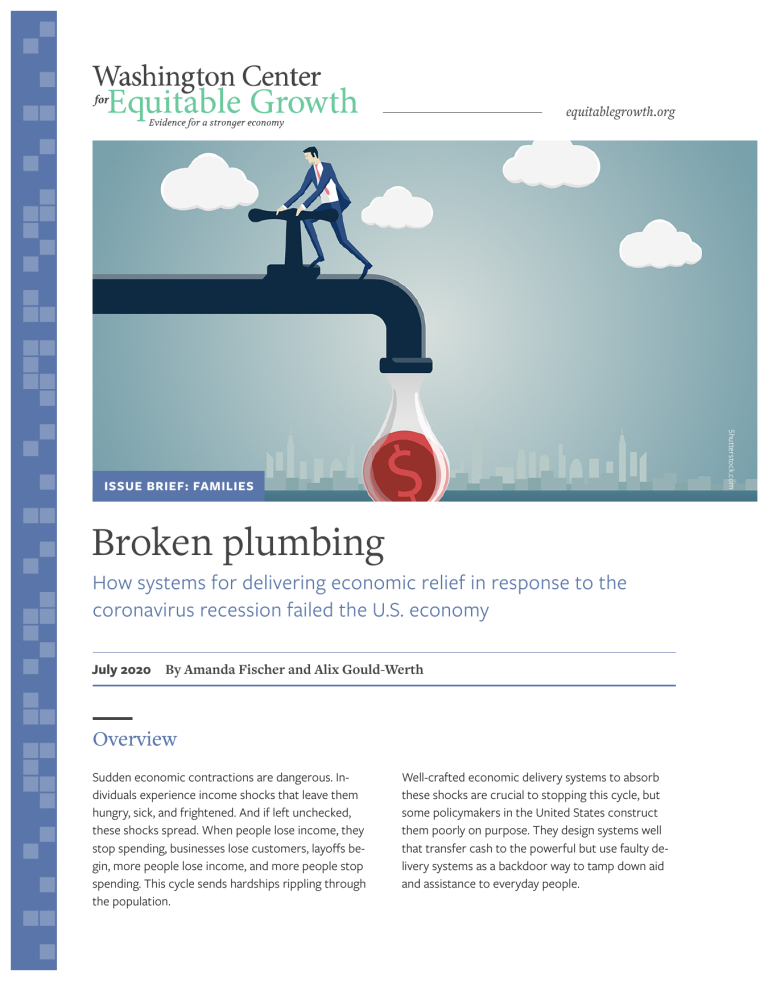
Broken plumbing: How systems for delivering economic relief in response to the coronavirus recession failed the U.S. economy (opens in a new tab)
Issue Briefs JUL 29, 2020
Sudden economic contractions are dangerous. Individuals experience income shocks that leave them hungry, sick, and frightened. And if left unchecked, these shocks spread. When people lose income, they stop spending,…
By: Amanda Fischer (opens in a new tab), Alix Gould-Werth (opens in a new tab)
A generational perspective on recent U.S. homeownership divergence by income and race (opens in a new tab)
Issue Briefs JUL 27, 2020
Between the end of 2012 and the end of 2019, the Federal Reserve Board estimates that the total value of U.S. owner-occupied housing increased nearly 60 percent, from $18.5 trillion…
By: John Sabelhaus (opens in a new tab), Austin Clemens (opens in a new tab)

Equitable Growth invests more than $250,000 to advance research on paid family and medical leave in the United States (opens in a new tab)
Blog JUL 22, 2020
The Washington Center for Equitable Growth today announced four research grants to scholars who are pushing the frontier of knowledge on paid family and medical leave in the United States.…
By: Alix Gould-Werth (opens in a new tab), Sam Abbott (opens in a new tab)

New research on the Great Recession shows extended unemployment benefits insignificantly affect U.S. unemployment rates (opens in a new tab)
Blog JUL 21, 2020
Unemployment rates in the United States are currently higher than they were at height of the Great Recession, standing at 11.1 percent in June after declining from a record high…
By: Kate Bahn (opens in a new tab)
A college degree is not the solution to U.S. wage inequality (opens in a new tab)
Issue Briefs JUL 20, 2020
Relatively stagnant or declining wages for the vast majority of U.S. workers became a feature of the U.S. economy after the 1970s, along with a shift to “lousy” and low-wage…
By: Kathryn Zickuhr (opens in a new tab)

Child care is essential for working parents, but is the industry ready and safe to reopen? (opens in a new tab)
Blog JUL 16, 2020
By now, it is no secret that parents across the United States are struggling. Adapting to life during the coronavirus pandemic has been difficult for nearly everyone, but parents—particularly those…
By: Sam Abbott (opens in a new tab)

New analysis shows state paid leave programs cushioned the blow of COVID-19, sparking important new questions (opens in a new tab)
Blog JUN 25, 2020
New analysis shows that while Congress was busy debating the parameters of federal paid leave to families dealing with the COVID-19 pandemic, state paid leave programs in Rhode Island and…
By: Sam Abbott (opens in a new tab)
Better workplace conditions for long-term eldercare staff are key to promoting resident safety amid the coronavirus pandemic (opens in a new tab)
Issue Briefs JUN 4, 2020
Residents and workers in long-term residential eldercare settings account for more than 40 percent of all the deaths in the United States due to COVID-19, the disease spread by the…
By: Krista Ruffini (opens in a new tab)
One year later: Recession Ready and the coronavirus recession (opens in a new tab)
Videos JUN 1, 2020
Proposals put forth can help support communities, stabilize the economy amid coronavirus recession One year ago, long before the risks of the new coronavirus and the ensuing recession enveloped our…
By: Equitable Growth (opens in a new tab)
Unboxing scheduling practices for U.S. warehouse workers (opens in a new tab)
Reports MAY 28, 2020
Workers in the United States struggle with low-quality work schedules. The Fair Labor Standards Act is the main piece of labor legislation regulating work hours. The law, passed in 1938,…
By: Sam Abbott (opens in a new tab), Alix Gould-Werth (opens in a new tab)
Green stimulus, not dirty bailouts, is the smart investment strategy during the coronavirus recession (opens in a new tab)
Issue Briefs MAY 18, 2020
In March, the federal government passed the Coronavirus Aid, Relief, and Economic Security bill, more commonly known as the CARES Act. The law aims to provide relief for businesses and…
By: Leah Stokes (opens in a new tab), Matto Mildenberger (opens in a new tab)

In Conversation with Trevon Logan (opens in a new tab)
In Conversation MAY 14, 2020
“Equitable Growth in Conversation” is a recurring series where we talk with economists and other academics to help us better understand whether and how economic inequality affects economic growth and…
By: Liz Hipple (opens in a new tab)

New working paper shows long-term U.S. economic and health benefits of the Supplemental Nutrition Assistance Program (opens in a new tab)
Blog MAY 11, 2020
As job losses in the United States grow by the millions each week, the dramatic economic fallout from the coronavirus recession comes more and more into focus. Expansions to the…
By: Martha Bailey (opens in a new tab), Hilary Hoynes (opens in a new tab), Maya Rossin-Slater (opens in a new tab)

Equitable Growth’s Jobs Day Graphs: April 2020 Report Edition (opens in a new tab)
Blog MAY 8, 2020
On May 8th, the U.S. Bureau of Labor Statistics released new data on the U.S. labor market during the month of April. Below are five graphs compiled by Equitable Growth…
By: Kate Bahn (opens in a new tab), Carmen Sanchez Cumming (opens in a new tab)

New congressional reports underscore structural inequalities driving U.S. racial disparities in coronavirus infections and COVID-19 deaths (opens in a new tab)
Blog MAY 4, 2020
Two recently released reports by the Joint Economic Committee and the Democratic Policy and Communications Committee echo the disturbing media reports that Americans of color, particularly African Americans, are disproportionately…
By: Liz Hipple (opens in a new tab)
Paid medical leave research (opens in a new tab)
Reports APR 30, 2020
Until recently, the policy debate over paid leave in the United States has most often focused on the need to expand access to paid parental and family caregiving benefits. Access…
By: Chantel Boyens (opens in a new tab)

Where should the marginal dollar go in U.S. fiscal policy—to testing or to the safety net—amid a pandemic-induced economic downturn? (opens in a new tab)
Blog APR 27, 2020
In our recent working paper, “An SEIR Infectious Disease Model with Testing and Conditional Quarantine,” the two of us and Simon Mongey, an assistant professor of economics at the University…
By: David Berger (opens in a new tab), Kyle Herkenhoff (opens in a new tab)

Dealing with the U.S. economic and public health effects of the coronavirus recession compassionately and with an eye on a strong recovery (opens in a new tab)
Blog APR 17, 2020
On March 24, I presented to a teleconference of about 100 economists and other experts gathered by my colleagues Emmanuel Saez and Gabriel Zucman of the University of California, Berkeley…
By: Jason Furman (opens in a new tab)

The coronavirus pandemic requires a wartime commitment for essential workers’ access to childcare (opens in a new tab)
Blog APR 16, 2020
The current public health and economic crisis caused by the coronavirus pandemic is reshaping society and the U.S. labor force in ways not experienced since World War II. Factories that…
By: Sam Abbott (opens in a new tab)

Two significant U.S. macroeconomic needs to consider amid the coronavirus pandemic (opens in a new tab)
Blog APR 15, 2020
Emmanuel Saez and Gabriel Zucman of the University of California, Berkeley organized a teleconference in late March of more than 100 economists and other experts at which I, along with…
By: N. Gregory Mankiw (opens in a new tab)
Rescuing small businesses to fight the coronavirus recession and prevent further economic inequality in the United States (opens in a new tab)
Issue Briefs APR 14, 2020
The U.S. Congress last month mobilized trillions of dollars in the Coronavirus Aid, Relief and Economic Security Act to help workers and businesses survive while mandatory COVID-19 public health measures…
By: Amanda Fischer (opens in a new tab)

The three ways fiscal policy can be used to fight COVID-19 and the coronavirus recession (opens in a new tab)
Blog APR 14, 2020
Late in March, before the U.S. Congress passed the $2.2 trillion Coronavirus Aid, Relief, and Economic Security Act and President Donald Trump signed it into law, economists Emmanuel Saez and…
By: Olivier Blanchard (opens in a new tab)

U.S. economic policy principles for confronting the coronavirus recession (opens in a new tab)
Blog APR 8, 2020
This post reflects our organization’s overall guiding policy principles for confronting the coronavirus recession as detailed on March 24. These principles still hold as there remains much to be done…
By: Heather Boushey (opens in a new tab), Somin Park (opens in a new tab)

How the coronavirus pandemic is harming family well-being for U.S. low-wage workers (opens in a new tab)
Blog APR 1, 2020
As the effects of the new coronavirus sweep through the U.S. economy, low-wage workers are hit first and hardest. Today, economist Liz Ananat at Barnard College and psychologist Anna Gassman-Pines…
By: Alix Gould-Werth (opens in a new tab), Raksha Kopparam (opens in a new tab)

Getting money urgently to low-wage U.S. workers (opens in a new tab)
Blog MAR 30, 2020
To cushion the blow of the COVID-19 pandemic, the U.S. Congress last week passed and President Donald Trump signed the $2.2 trillion emergency stimulus package, including provisions to send checks…
By: Lisa Cook (opens in a new tab)

Congress fights back, and it’s absolutely necessary (opens in a new tab)
Blog MAR 27, 2020
(This piece was updated on April 1, 2020 to reflect the IRS guidance on the economic impact payments related to the coronavirus recession.) The coronavirus is killing people at a…
By: Claudia Sahm (opens in a new tab)

Research shows paid leave is needed to protect families, workers, and businesses during the coronavirus recession and beyond (opens in a new tab)
Issue Briefs MAR 25, 2020
The challenge for U.S. workers of balancing family and job responsibilities amid the coronavirus recession without access to paid family and medical leave is, alas, a familiar story even before…
By: Sam Abbott (opens in a new tab)
Paid medical and caregiving leave during the coronavirus pandemic: What they are and why they matter (opens in a new tab)
Issue Briefs MAR 25, 2020
(This issue brief draws on a longer report by Jane Waldfogel and Emma Liebman, “Paid Family Care Leave: A missing piece in the U.S. social insurance system.”) Overview In response…
By: Chantel Boyens (opens in a new tab), Alix Gould-Werth (opens in a new tab)

Paid caregiving leave: A missing piece in the U.S. social insurance system (opens in a new tab)
Blog MAR 25, 2020
Amid the ongoing public health crisis from the COVID-19 pandemic, many individuals can expect to be called away from work to care for a sick loved one or a child…
By: Equitable Growth (opens in a new tab)

What does the research say about paid family and medical leave policy design options in the United States? (opens in a new tab)
Blog MAR 25, 2020
Policymakers have failed to provide Americans with guaranteed paid family and medical leave at the federal level. As a result, working families across the United States must strike a delicate…
By: Equitable Growth (opens in a new tab)

What is paid medical leave and how does it support U.S. workers’ health and the U.S. economy? (opens in a new tab)
Blog MAR 25, 2020
When U.S. workers fall ill, it can be challenging to balance medical needs and job responsibilities. For short sicknesses, such as a cold or the flu, several days of rest…
By: Equitable Growth (opens in a new tab)

The president must appoint a COVID-19 czar to ramp up production of medical supplies (opens in a new tab)
Blog MAR 24, 2020
COVID-19 presents the gravest threat in generations to the health and well-being of Americans. The largest of obstacle standing in the way of our defeating that threat is the capacity…
By: Susan Helper (opens in a new tab)

Economic experts propose policy responses to coronavirus recession (opens in a new tab)
Blog MAR 24, 2020
University of California, Berkeley economists Emmanuel Saez and Gabriel Zucman, in cooperation with Economics for Inclusive Prosperity, are hosting an invitation-only online conference today to discuss economic policy responses to…
By: Equitable Growth (opens in a new tab)

In joint letter, Equitable Growth asks Congress to ‘stanch economic bleeding’ in COVID-19 legislative package (opens in a new tab)
Blog MAR 19, 2020
Heather Boushey, the president and CEO of the Washington Center for Equitable Growth, along with the leaders of three other Washington-based economic think tanks—the Center for American Progress, the Economic…
By: Equitable Growth (opens in a new tab)

The only thing better than strengthening federal social supports now to prevent a coronavirus recession is strengthening them forever (opens in a new tab)
Blog MAR 17, 2020
(This piece has been updated to reflect the passage of revised legislation by the House of Representatives on March 14, 2020. The bill is now under consideration by the Senate.)…
By: Alix Gould-Werth (opens in a new tab)

New research shows paid leave increases mothers’ labor force participation following childbirth (opens in a new tab)
Blog MAR 12, 2020
Despite women’s rising U.S. labor force participation over the past seven decades, women remain more likely than men to take time off work and modify their work schedules following the…
By: Sam Abbott (opens in a new tab)

U.S. economic policymakers need to fight the coronavirus now (opens in a new tab)
Blog MAR 4, 2020
The human tragedy of the coronavirus is now here in the United States. Nine deaths from the coronavirus have been reported in Washington state so far. Each day, more and…
By: Claudia Sahm (opens in a new tab)

The never-ending cycle: Incarceration, credit scores, and wealth accumulation in the United States (opens in a new tab)
Blog MAR 4, 2020
There are many events in people’s lives that can suddenly change the course of their future. Being incarcerated, or having a history of incarceration, is one significant event that research…
By: William Darity Jr. (opens in a new tab), Sarah Elizabeth Gaither (opens in a new tab), Monica Garcia-Perez (opens in a new tab)

The economic imperative of enacting paid family leave across the United States (opens in a new tab)
Blog FEB 18, 2020
This essay is part of Vision 2020: Evidence for a stronger economy, a compilation of 21 essays presenting innovative, evidence-based, and concrete ideas to shape the 2020 policy debate. The…
By: Maya Rossin-Slater (opens in a new tab), Jenna Stearns (opens in a new tab)

Addressing the need for affordable, high-quality early childhood care and education for all in the United States (opens in a new tab)
Blog FEB 18, 2020
This essay is part of Vision 2020: Evidence for a stronger economy, a compilation of 21 essays presenting innovative, evidence-based, and concrete ideas to shape the 2020 policy debate. The…
By: Taryn Morrissey (opens in a new tab)

Fair work schedules for the U.S. economy and society: What’s reasonable, feasible, and effective (opens in a new tab)
Blog FEB 18, 2020
This essay is part of Vision 2020: Evidence for a stronger economy, a compilation of 21 essays presenting innovative, evidence-based, and concrete ideas to shape the 2020 policy debate. The…
By: Susan Lambert (opens in a new tab)

Earnings instability and mobility over our working lives: Improving short- and long-term economic well-being for U.S. workers (opens in a new tab)
Blog FEB 18, 2020
This essay is part of Vision 2020: Evidence for a stronger economy, a compilation of 21 essays presenting innovative, evidence-based, and concrete ideas to shape the 2020 policy debate. The…
By: Emily Wiemers (opens in a new tab), Michael Carr (opens in a new tab)

Policies to strengthen our nation’s Supplemental Nutrition Assistance Program (opens in a new tab)
Blog FEB 18, 2020
This essay is part of Vision 2020: Evidence for a stronger economy, a compilation of 21 essays presenting innovative, evidence-based, and concrete ideas to shape the 2020 policy debate. The…
By: Hilary Hoynes (opens in a new tab), Diane Schanzenbach (opens in a new tab)

Overcoming social exclusion: Addressing race and criminal justice policy in the United States (opens in a new tab)
Blog FEB 18, 2020
This essay is part of Vision 2020: Evidence for a stronger economy, a compilation of 21 essays presenting innovative, evidence-based, and concrete ideas to shape the 2020 policy debate. The…
By: Robynn Cox (opens in a new tab)

Prisoner re-entry in Native American communities offers lessons of resilience and nationwide policy solutions (opens in a new tab)
Blog FEB 18, 2020
This essay is part of Vision 2020: Evidence for a stronger economy, a compilation of 21 essays presenting innovative, evidence-based, and concrete ideas to shape the 2020 policy debate. The…
By: Blythe George (opens in a new tab)

The logistics of a reparations program in the United States (opens in a new tab)
Blog FEB 18, 2020
This essay is part of Vision 2020: Evidence for a stronger economy, a compilation of 21 essays presenting innovative, evidence-based, and concrete ideas to shape the 2020 policy debate. The…
By: Dania Francis (opens in a new tab)

Promote economic and racial justice: Eliminate student loan debt and establish a right to higher education across the United States (opens in a new tab)
Blog FEB 18, 2020
This essay is part of Vision 2020: Evidence for a stronger economy, a compilation of 21 essays presenting innovative, evidence-based, and concrete ideas to shape the 2020 policy debate. The…
By: Darrick Hamilton (opens in a new tab), Naomi Zewde (opens in a new tab)

“Women’s Work-Life Economics” (opens in a new tab)
Blog JAN 30, 2020
This article, “Women’s Work-Life Economics,” originally appeared in the 2019, Volume 23 of “LERA Perspectives on Work,” a magazine published by the Labor and Employment Relations Association, or LERA. More…
By: Heather Boushey (opens in a new tab), Kate Bahn (opens in a new tab)

What does the research say about the FAMILY Act? (opens in a new tab)
Blog JAN 27, 2020
In the most recent sign of growing interest in a federal paid leave policy, tomorrow at 10:00 a.m., the Committee on Ways and Means will hold a Hearing on Legislative…
By: Alix Gould-Werth (opens in a new tab)

What does the research say about the FAMILY Act provisions? (opens in a new tab)
Blog JAN 24, 2020
In February 2019, the Family and Medical Insurance Leave Act was reintroduced in the 116th Congress as H.R. 1185/S. 463. Five states have implemented paid leave programs: California (2004), New…
By: Equitable Growth (opens in a new tab)

ASSA Round-up: Day 3 (opens in a new tab)
Blog JAN 5, 2020
Today was the final day of the three-day annual meeting of the Allied Social Science Associations, which is organized by the American Economic Association. The conference, held in San Diego…
By: Equitable Growth (opens in a new tab)

ASSA Round-up: Day 2 (opens in a new tab)
Blog JAN 4, 2020
Today was the second day of the three-day annual meeting of the Allied Social Science Associations, which is organized by the American Economic Association. The conference, held in San Diego…
By: Equitable Growth (opens in a new tab)
ASSA Round-up: Day 1 (opens in a new tab)
Blog JAN 3, 2020
Today was the first day of the three-day annual meeting of the Allied Social Science Associations, which is organized by the American Economic Association. The conference, held in San Diego…
By: Equitable Growth (opens in a new tab)

New Equitable Growth Request for Proposals for scholars planning cutting-edge research on paid family and medical leave (opens in a new tab)
Blog DEC 11, 2019
How does the availability of paid personal medical leave affect employees’ economic security, health, and other outcomes? How does paid caregiving leave affect the physical and mental health of care…
By: Alix Gould-Werth (opens in a new tab)

Higher education is not the U.S. mobility engine it could be because admissions practices are rigging the system (opens in a new tab)
Blog NOV 7, 2019
Higher education in the United States has historically been a source of economic mobility—a ticket to the middle class and higher—for millions of Americans. But at a time of sustained…
By: David S. Mitchell (opens in a new tab)

New paid leave research demonstrates challenge of balancing work and caregiving (opens in a new tab)
Blog NOV 6, 2019
Paid leave supports people who hold dual roles as members of the workforce and members of families. Effort expended in worksites from office buildings to restaurant kitchens to factory floors…
By: Alix Gould-Werth (opens in a new tab)

How U.S. workers’ just-in-time schedules perpetuate racial and ethnic inequality (opens in a new tab)
Blog OCT 16, 2019
In an attempt to minimize labor costs, employers in today’s U.S. economy saddle workers with last-minute and low-quality schedules. These schedules, sometimes referred to as “just-in-time schedules,” are unpredictable, unstable,…
By: Cesar Perez (opens in a new tab), Alix Gould-Werth (opens in a new tab)

School segregation undermines U.S. economic mobility and dynamism (opens in a new tab)
Blog OCT 15, 2019
School segregation—far from being a topic relegated to debates about school busing in the past or something that is only relevant in the South—is an issue very much present and…
By: Liz Hipple (opens in a new tab)

U.S. school segregation in the 21st century (opens in a new tab)
Reports OCT 15, 2019
After several decades of neglect, school desegregation by race and income in primary and secondary schools is once again a topic of conversation among policymakers at the federal level and…
By: Will McGrew (opens in a new tab)

Public investment is crucial to strengthening U.S. economic growth and tackling inequality (opens in a new tab)
Blog SEP 23, 2019
Despite policymakers’ oft-repeated promises of more spending on infrastructure and other key investments, U.S. public investment has reached new lows. Public investment is a key driver of long-term productivity and…
By: Somin Park (opens in a new tab)

Testimony by Heather Boushey before the House Budget Committee (opens in a new tab)
Blog SEP 19, 2019
Thank you, Chairman Yarmuth and Ranking Member Womack, for inviting me to speak today. It’s an honor to be here. My name is Heather Boushey and I am President and…
By: Heather Boushey (opens in a new tab)

Newly released U.S. poverty statistics show that recent economic growth is not broadly shared (opens in a new tab)
Essays SEP 11, 2019
The U.S. Census Bureau yesterday released the 2018 poverty rate alongside information on the 2018 median household income in the United States. The takeaway? Things are not improving that much.…
By: Alix Gould-Werth (opens in a new tab)

Extensive nonstandard work hours among U.S. low-income mothers hinder their kids’ enrollment in center-based childcare (opens in a new tab)
Blog AUG 12, 2019
Significant income-based disparities in kids’ enrollment in center-based early childcare and education persist in the United States. Two well-documented reasons are the high costs of this kind of care and…
By: Cesar Perez (opens in a new tab)

In Conversation with Leemore Dafny (opens in a new tab)
In Conversation JUL 10, 2019
“Equitable Growth in Conversation” is a recurring series where we talk with economists and other academics to help us better understand whether and how economic inequality affects economic growth and…
By: Heather Boushey (opens in a new tab)

Research and resources on the 2020 presidential debate issues and themes (opens in a new tab)
Blog JUN 28, 2019
This week kicked off the first of 12 Democratic debates ahead of the 2020 election. Economic inequality took center stage, with candidates weighing in on issues including paid leave, competition,…
By: Delaney Crampton (opens in a new tab)

For Father’s Day: Evidence from three countries on the importance of paid parental leave for new dads (opens in a new tab)
Blog JUN 14, 2019
As we celebrate Father’s Day this weekend, in California, Rhode Island, and other states with operating paid leave policies, you may find fathers taking time away from the construction sites,…
By: Equitable Growth (opens in a new tab)

Paid family care leave is a missing piece in the U.S. social insurance system (opens in a new tab)
Blog JUN 10, 2019
The aging of the baby-boom generation means that millions of working families are part of a growing “sandwich generation,” juggling care for young children and aging parents. Many will need…
By: Elisabeth Jacobs (opens in a new tab)
Paid family care leave (opens in a new tab)
Reports JUN 10, 2019
Paid family and medical leave is receiving increased attention in the United States by policymakers, employers, media, and the public. Former President Barack Obama discussed the issue at his 2015…
By: Jane Waldfogel (opens in a new tab), Emma Liebman (opens in a new tab)

In Conversation with Janet Currie (opens in a new tab)
In Conversation MAY 21, 2019
“Equitable Growth in Conversation” is a recurring series where we talk with economists and other academics to help us better understand whether and how economic inequality affects economic growth and…
By: Heather Boushey (opens in a new tab)
Planning for the next recession by reforming U.S. automatic stabilizers (opens in a new tab)
Blog MAY 16, 2019
When the U.S. economy is cruising down the road in high gear, as it is these days, it can be hard to focus on the next engine failure. Having occurred…
By: Alyssa Fisher (opens in a new tab)

After Mother’s Day: Changes in mothers’ social programs over time (opens in a new tab)
Blog MAY 13, 2019
Yesterday was Mother’s Day. If you celebrated, maybe you enjoyed a homemade card, brunch on the town, a floral bouquet, or a mostly edible breakfast in bed. Today, I invite…
By: Alix Gould-Werth (opens in a new tab)

How corporate headquarters could support store managers in providing predictable work schedules (opens in a new tab)
Blog MAY 6, 2019
Over the past decade, a new body of research has emerged showing that when low-wage workers in the United States are confronted with unpredictable schedules, they suffer vis-a-vis their pocketbooks,…
By: Alix Gould-Werth (opens in a new tab)

What does the research tell us about how best to design paid leave policies? (opens in a new tab)
Blog MAY 2, 2019
This week, House Ways and Means Chairman Richard Neal (D-MA) announced the first-ever hearing in the House of Representatives to focus exclusively on the issue of paid family and medical…
By: Elisabeth Jacobs (opens in a new tab)

Economist Currie’s research on early childhood care and education highlights the need for a national childcare policy (opens in a new tab)
Blog APR 2, 2019
Recent months have seen the blossoming of more concrete ideas for addressing the pressing problem of a lack of access to high-quality, affordable childcare and education—an issue that has not…
By: Somin Park (opens in a new tab)

Linking racial stratification and poor health outcomes to economic inequality in the United States (opens in a new tab)
Blog MAR 28, 2019
The United States is marked by sharp racial divisions in who has access to the economic and social resources that enhance well-being and in who is exposed to conditions that…
By: Kyle Moore (opens in a new tab)

We can cut child poverty in the United States in half in 10 years (opens in a new tab)
Blog MAR 27, 2019
Over the past 50 years, the number of U.S. children living in poverty has been cut in half—a tremendous accomplishment. Yet nearly 10 million children, or 13 percent of children…
By: Janet Currie (opens in a new tab)

The effects of disability programs on financial outcomes in the United States (opens in a new tab)
Blog MAR 26, 2019
In his Pulitzer-Prize-winning book, Evicted: Poverty and Profit in the American City, Matthew Desmond documents the instability in the lives of low-income tenants in Milwaukee, who are frequently uprooted due…
By: Manasi Deshpande (opens in a new tab), Tal Gross (opens in a new tab)

Gender wage inequality in the United States: Causes and solutions to improve family well-being and economic growth (opens in a new tab)
Blog MAR 25, 2019
Disparities between men’s and women’s wages in the United States hinders economic growth by constraining family incomes and spending power. When comparing average full-time year-round incomes of men to those…
By: Equitable Growth (opens in a new tab)

Women’s History Month: U.S. women’s labor force participation (opens in a new tab)
Blog MAR 22, 2019
It’s Women’s History Month in the United States. What better time to discuss a key economic dynamic that both reflects and contributes to women’s changing role in American society than…
By: Elisabeth Jacobs (opens in a new tab), Kate Bahn (opens in a new tab)
Paid family and medical leave in the United States: A data agenda for practitioners (opens in a new tab)
Issue Briefs MAR 7, 2019
The United States is an outlier among developed nations for its lack of a national paid family and medical leave program. New parents across our nation struggle to balance the…
By: Equitable Growth (opens in a new tab)
Paid Family and Medical Leave in the United States: A Data Agenda (opens in a new tab)
Reports MAR 7, 2019
The United States continues to be an outlier among developed countries for its lack of a national paid leave program. New parents across our nation struggle to balance the demands…
By: Amy Batchelor (opens in a new tab)

Increasing evidence of the benefits of paid leave means Congress needs to consider a federal program like the FAMILY Act (opens in a new tab)
Blog FEB 12, 2019
Sen. Kirsten Gillibrand (D-NY) and Rep. Rosa DeLauro (D-CT) are expected to reintroduce today the FAMILY (Family Medical Insurance Leave) Act, a bill that would establish the first near-universal federal…
By: Heather Boushey (opens in a new tab)

Investments in early childhood education improve outcomes for program participants—and perhaps other children too (opens in a new tab)
Blog DEC 4, 2018
According to a growing body of empirical work, governments that spend money on early childhood education get a lot of bang for their buck—an estimated 7 percent to 10 percent…
By: Will McGrew (opens in a new tab)

Marriage is an unexpected fringe benefit of a quality job in the United States: Food for thought this holiday shopping season (opens in a new tab)
Blog NOV 27, 2018
The holiday shopping season is now upon us, and U.S. retail workers are in a crunch. They are working long, often unpredictable hours. The stresses of retail work are on…
By: Alix Gould-Werth (opens in a new tab)

In Conversation with Hilary Hoynes (opens in a new tab)
In Conversation NOV 14, 2018
Equitable Growth’s Executive Director and Chief Economist Heather Boushey talks with Hilary Hoynes, an economist and Haas Distinguished Chair in Economic Disparities at the Richard and Rhoda Goldman School of…
By: Heather Boushey (opens in a new tab)


Your Direct Line to Cutting Edge Research
Be the first to know about our latest events, research releases, and expert insights. Get exclusive updates delivered right to your inbox and never miss an opportunity to engage with our community.