


Resources
From peer-reviewed research to accessible policy briefs, explore the scholarship that’s shaping debates and driving change.

505 Results

The deeper argument at the heart of the federal budget debate (opens in a new tab)
Reports OCT 5, 2026
Interest rates on the national debt have recently crept up to levels that the U.S. government and the American people haven’t experienced in several decades. This is a potentially concerning…
By: Michael Linden (opens in a new tab)

Trump’s trade war with Canada grows increasingly costly as Section 338 tariffs harm both economies (opens in a new tab)
Essays SEP 22, 2026
President Donald Trump continues to escalate his administration’s perplexing trade spat with Canada through the expanded use of novel tariff powers in Section 338 of the Tariff Act of 1930.…
By: Christopher Bangert-Drowns (opens in a new tab)

What happens to U.S. workers without access to Unemployment Insurance amid economic downturns or disruptions related to AI? (opens in a new tab)
Essays SEP 2, 2026
The adoption of artificial intelligence in the workplace has led to predictions of U.S. labor market disruptions. In response, policymakers have increased attention on the fitness of the nation’s social…
By: Megan Rivera (opens in a new tab)
Defining extreme wealth is more complicated than it looks (opens in a new tab)
Videos AUG 13, 2026
Facing high levels of income and wealth inequality and shrinking tax revenues, U.S. policymakers are showing increased interest in proposals to tax the richest households. Yet determining which households fall into that category is complex and changes based…
By: Equitable Growth (opens in a new tab)

Estimating AI exposure is useful for research but cannot yet tell policymakers the whole story of AI’s impact on the labor market (opens in a new tab)
Essays AUG 7, 2026
Artificial intelligence has the potential to substantially change the nature and availability of work. To effectively manage the transitions this technology might bring to the U.S. economy, policymakers need information…
By: Chiara Chanoi (opens in a new tab)
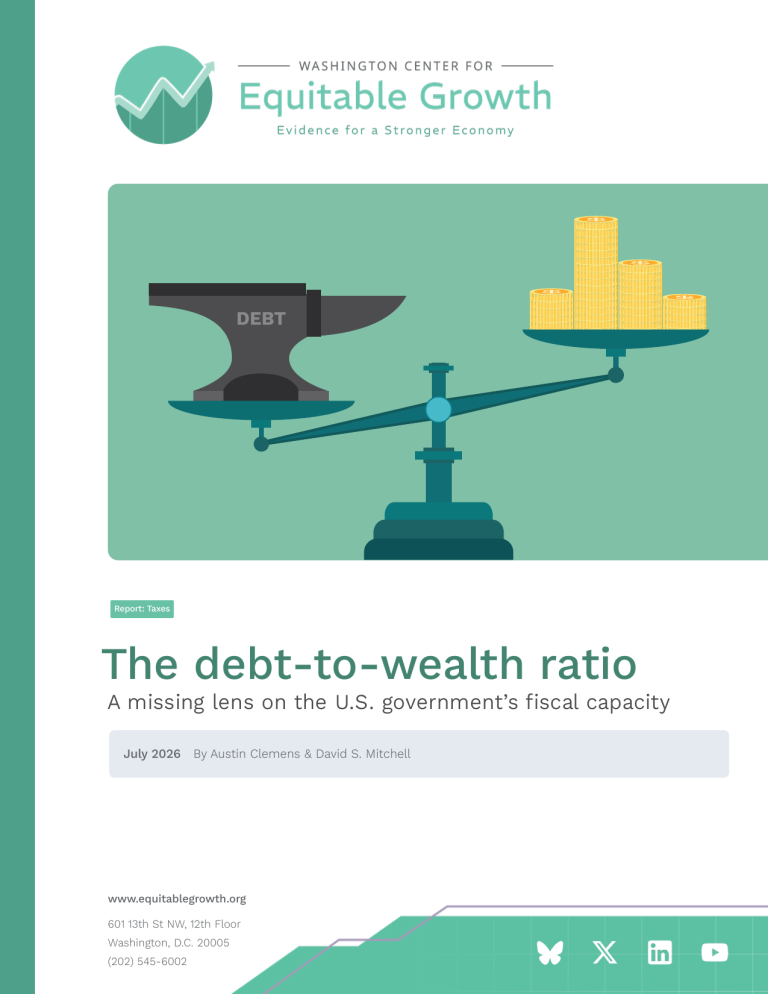
The debt-to-wealth ratio: A missing lens on the U.S. government’s fiscal capacity (opens in a new tab)
Reports JUL 30, 2026
Few statistics shape the fiscal debate in the United States as powerfully as the ratio of federal debt-to-Gross Domestic Product. Debt held by the public recently surpassed 100 percent of…
By: Austin Clemens (opens in a new tab), David S. Mitchell (opens in a new tab)

The costs of the Trump administration’s tariffs diverge for countries and industries so far in 2026 (opens in a new tab)
Essays JUL 14, 2026
The first 4 months of 2026 saw continued seismic changes in U.S. trade policy. In late February, the U.S. Supreme Court struck down the Trump administration’s use of the International…
By: Christopher Bangert-Drowns (opens in a new tab)

Personal Income in the United States nudges up in May but is down 0.76 percent in the past 6 months (opens in a new tab)
Essays JUN 25, 2026
According to today’s release of Personal Income estimates from the U.S. Bureau of Economic Analysis, U.S. household incomes have fallen 0.76 percent in the past 6 months, with month-to-month declines…
By: Austin Clemens (opens in a new tab)

U.S. income data for 2024 shows the top 10 percent accrued the highest share of income since 2000 (opens in a new tab)
Essays JUN 25, 2026
Today, Equitable Growth updated the U.S. Inequality Tracker through 2024 following the release of new data last week by the U.S. Bureau of Economic Analysis. The data show that the…
By: Austin Clemens (opens in a new tab)

Factsheet: Defining top U.S. income and wealth thresholds for tax policy (opens in a new tab)
Factsheets MAY 27, 2026
Federal and state policymakers in the United States, responding to high levels of income and wealth inequality and shrinking tax revenues, are increasingly interested in proposals to tax households with…
By: Austin Clemens (opens in a new tab)
Defining top wealth and income thresholds for U.S. tax policy design and analysis (opens in a new tab)
Reports MAY 27, 2026
Wealth and income inequality are an ongoing area of interest for policymakers. In particular, the rise of the richest of the rich—not just the top 1 percent, but also the…
By: Austin Clemens (opens in a new tab)
What is the relationship between inflation, interest rates, and economic growth, and what does it mean for the new Federal Reserve chair? (opens in a new tab)
Issue Briefs MAY 18, 2026
Since regaining the Oval Office in early 2025, President Donald Trump has repeatedly called for lower interest rates and severely criticized former Federal Reserve Board Chair Jerome Powell’s cautious approach…
By: Jacob Robbins (opens in a new tab)
Tariff policies in 2025 increased input costs for key U.S. industries, threatening growth and investment (opens in a new tab)
Essays MAR 24, 2026
All tariffs are not created equal. Throughout U.S. history, policymakers have imposed import taxes for a variety of economic and ideological reasons, with varying impacts. Targeted tariffs have been effective…
By: Christopher Bangert-Drowns (opens in a new tab)
New research examines the historical macroeconomic effects of tariffs and sheds light on current U.S. trade policies (opens in a new tab)
Essays MAR 4, 2026
U.S. policymakers have enacted tariffs for a variety of reasons over the course of the country’s history. Motivated by economic pressures to raise federal revenues or address balance-of-payment issues, or…
By: Christopher Bangert-Drowns (opens in a new tab)

The state of the U.S. economy one year into the second Trump administration (opens in a new tab)
Essays FEB 23, 2026
President Donald Trump will soon give his annual State of the Union speech before Congress, one year into his second term in the White House. Ahead of his remarks, now…
By: Michael Linden (opens in a new tab)

Analyzing recent U.S. economic policies using Equitable Growth’s Inequality Tracker (opens in a new tab)
Essays JAN 22, 2026
The Washington Center for Equitable Growth’s Inequality Tracker is a data visualization tool designed to help policymakers and economic analysts examine and analyze U.S. income and wealth inequality in the…
By: Austin Clemens (opens in a new tab)
ASSA 2026 Round-up: Day 3 (opens in a new tab)
Blog JAN 6, 2026
Yesterday was the third and final day of the 2026 annual meeting of the Allied Social Science Associations, which is organized by the American Economic Association. The 3-day conference, held…
By: Equitable Growth (opens in a new tab)
ASSA 2026 Round-up: Day 2 (opens in a new tab)
Blog JAN 5, 2026
Yesterday was the second day of the 2026 annual meeting of the Allied Social Science Associations, which is organized by the American Economic Association. The 3-day conference, held in Philadelphia…
By: Equitable Growth (opens in a new tab)

What impact is artificial intelligence having on the U.S. labor market and the nation’s economy? (opens in a new tab)
Essays NOV 14, 2025
As new and groundbreaking technologies emerge, they can function as a blank canvas onto which people project both aspirations and anxieties. Artificial intelligence—despite its quick uptake in broader society and…
By: Megan Rivera (opens in a new tab)
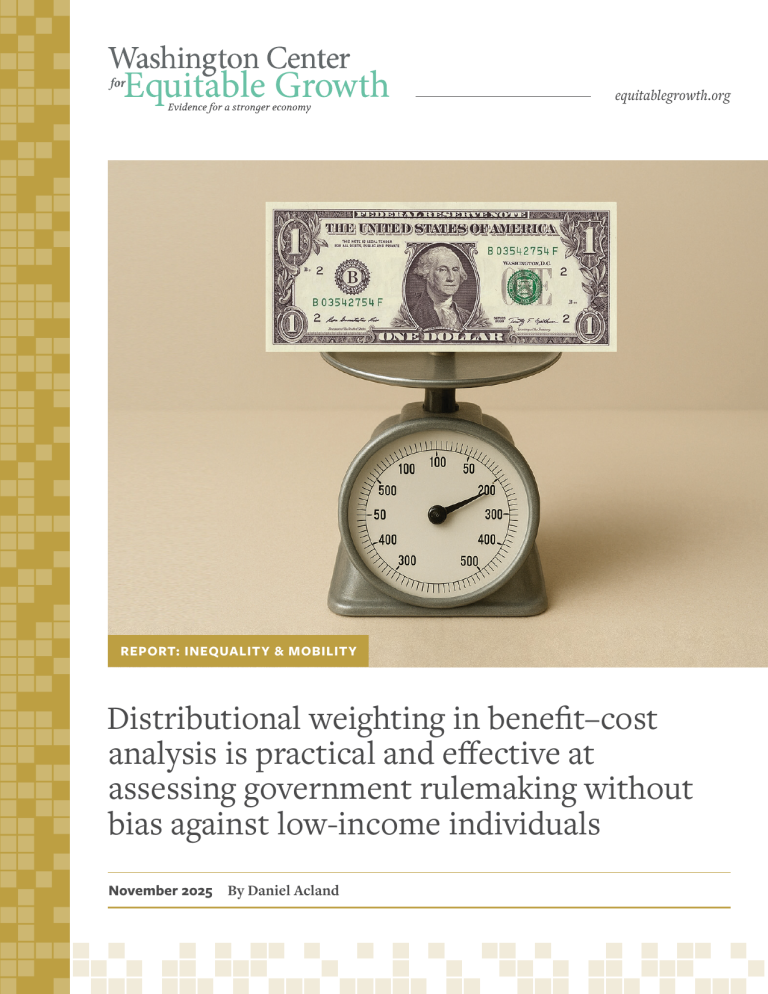
Distributional weighting in benefit-cost analysis is practical and effective at assessing government rulemaking without bias against low-income individuals (opens in a new tab)
Reports NOV 13, 2025
Distributional weighting in benefit-cost analysis is a tool for overcoming bias against lower-income individuals in economists’ measurements of the net benefit of government policies that affect populations at different levels…
By: Daniel Acland (opens in a new tab)

Risks escalate for U.S. retirement plans due to unregulated private credit funds and new rules opening them up to retirement savings accounts (opens in a new tab)
Essays OCT 29, 2025
When the privately owned auto parts manufacturer First Brands Group earlier this month began to be unable to service its $6.1 billion debt load, the financial press began to pick…
By: Lenore Palladino (opens in a new tab)
The Federal Reserve must maintain its independence for the U.S. economy to thrive (opens in a new tab)
Essays AUG 28, 2025
President Donald Trump is attempting to fire Federal Reserve Board Governor Lisa Cook, the first Black woman to serve in that role. He probably lacks the legal authority to do…
By: Alan Blinder (opens in a new tab)

What is austerity, and how does it affect the broader U.S. economy? (opens in a new tab)
Reports AUG 12, 2025
With the passage into law of the Republican budget reconciliation bill last month and the recent work of the Department of Government Efficiency under Elon Musk, austerity is once again…
By: Ernie Tedeschi (opens in a new tab), Kevin Rinz (opens in a new tab)

Tariffs impact U.S. industries differently, with manufacturing the most exposed (opens in a new tab)
Issue Briefs JUL 29, 2025
Estimates in this brief were generated July 21, before the announcement of trade deals with Japan and the European Union. All data and code used in the Equitable Growth tariff…
By: Christopher Bangert-Drowns (opens in a new tab)

Accounting for capital gains in income significantly increases U.S. inequality (opens in a new tab)
Blog JUL 15, 2025
The Washington Center for Equitable Growth’s recently launched U.S. Inequality Tracker uses data from the U.S. Bureau of Economic Analysis to show how income and wealth inequality have evolved in…
By: Austin Clemens (opens in a new tab)

Republican reconciliation bill’s cuts to social programs will damage some congressional districts’ local economies (opens in a new tab)
Essays JUL 11, 2025
In a recent working paper, Equitable Growth grantee Robert Manduca of the University of Michigan, Ann Arbor demonstrates that government transfers make sizable contributions to local economies in much of…
By: Chiara Chanoi (opens in a new tab)

Slow wage growth is the key to understanding U.S. inequality in the 21st century (opens in a new tab)
Issue Briefs JUL 8, 2025
The Washington Center for Equitable Growth today launched the U.S. Inequality Tracker, which tracks income and wealth inequality in the United States and highlights how particular components of income and…
By: Austin Clemens (opens in a new tab)
Equitable Growth responds to passage of the federal budget bill (opens in a new tab)
Blog JUL 7, 2025
On Friday, President Donald Trump signed the 2025 federal budget bill, cementing into law the most regressive piece of tax and budget legislation to be passed in the United States…
By: Equitable Growth (opens in a new tab)

Americans informed about the distributional effects of Republicans’ tax and budget bill overwhelmingly oppose it (opens in a new tab)
Essays JUL 3, 2025
Republicans in the U.S. Senate recently passed a version of the One Big Beautiful Bill Act, championed by President Donald Trump. The House of Representatives passed an earlier version of…
By: Jacob Hacker (opens in a new tab), Patrick Sullivan (opens in a new tab)
Congressional Republicans’ budget bill is the most regressive in at least 40 years (opens in a new tab)
Essays JUN 25, 2025
The U.S. Congress is in the midst of debating a budget bill that would make massive changes to U.S. tax and spending policy over the course of the next decade…
By: Jacob Hacker (opens in a new tab), Patrick Sullivan (opens in a new tab)

Medicaid and SNAP cuts in congressional Republicans’ budget bill will negatively impact local economies (opens in a new tab)
Essays JUN 24, 2025
The budget reconciliation bill recently passed by the U.S. House of Representatives proposes to make large cuts to Medicaid, the Supplemental Nutrition Assistance Program, and other social programs to pay…
By: Robert Manduca (opens in a new tab)

Testimony by Michael Linden on “The Big Beautiful Betrayal—Working Folks Pay While The Mega Rich Profit” (opens in a new tab)
Essays JUN 17, 2025
Senator Kaine, Senator Murphy, and members of the Forum, thank you for the opportunity to be here today. I’m going to make three key points. First, the Republican budget bill…
By: Michael Linden (opens in a new tab)

More accurately measuring economic sentiment will help build a U.S. economy—and democracy—that works for all (opens in a new tab)
Blog MAY 13, 2025
When politicians and members of the media discuss the state of “the economy” in the United States, they often use a small handful of data points. Of all the indicators…
By: Jonathan Cohen (opens in a new tab), Katherine Cramer (opens in a new tab)

Testimony by Michael Linden before the House Budget Committee (opens in a new tab)
Blog MAY 8, 2025
Chairman Arrington, Ranking Member Boyle, members of this committee, thank you for the opportunity to be here. Today, I’d like to make three main points. First, the main culprit responsible…
By: Michael Linden (opens in a new tab)
“Econ 101” briefing on taxing multinationals brings Hill staffers up to speed on U.S. role in coordinating global crack-down on tax avoidance (opens in a new tab)
Blog APR 3, 2025
The Washington Center for Equitable Growth last week hosted a briefing for Capitol Hill staffers on multinational corporate tax trends and policies—another in our “Econ 101” series for Hill staffers.…
By: Elena Patel (opens in a new tab)

Benchmarking the U.S. economy that President Donald Trump is set to inherit (opens in a new tab)
Issue Briefs JAN 16, 2025
When President Donald Trump takes the presidential oath of office again on January 20, he will be inheriting a very different economy, with a very different outlook, than the one…
By: Ernie Tedeschi (opens in a new tab)

ASSA 2025 Round-up: Day 2 (opens in a new tab)
Blog JAN 5, 2025
Yesterday was the second day of the 2025 annual meeting of the Allied Social Science Associations, which is organized by the American Economic Association. The 3-day conference, held in San…
By: Equitable Growth (opens in a new tab)

Addressing pervasive tax evasion by cryptocurrency users (opens in a new tab)
Blog NOV 21, 2024
The price of bitcoin and other cryptocurrencies reached record highs last week, buoyed by the U.S. election of Donald Trump, who is seen as friendly to this novel asset class,…
By: Magne Mogstad (opens in a new tab), Tom Meling (opens in a new tab), Arnstein Vestre (opens in a new tab)
The unequal impact of the Federal Reserve’s monetary tightening and easing on firms in the United States (opens in a new tab)
Blog SEP 16, 2024
The easing of inflation in the U.S. economy beginning in 2022 and recent signs of weakness in the U.S. labor market over the past several quarters have led households and…
By: Ezgi Kurt (opens in a new tab)

A researcher’s guide to identifying policy-relevant research questions for the federal government (opens in a new tab)
Essays MAY 30, 2024
Social science researchers play an important role in the policymaking process. Researchers help policymakers at all levels of government to understand key trends and issues in the U.S. economy and…
By: Alexander Hertel-Fernandez (opens in a new tab)
New recommendations for an integrated system of U.S. inequality statistics chart a bold path forward (opens in a new tab)
Blog APR 23, 2024
A new report from the National Academy of Science’s Committee on National Statistics is packed with recommendations for building an integrated system of national statistics that can provide accurate and…
By: Austin Clemens (opens in a new tab)

Testimony by Michael Linden before the Joint Economic Committee (opens in a new tab)
Blog MAR 12, 2024
Chair Heinrich, Vice Chair Schweikert, Members of the Committee, thank you so much for extending me the opportunity to testify before you today. My testimony will broadly cover three important…
By: Michael Linden (opens in a new tab)

Ahead of President Biden’s State of the Union address, the U.S. economy is strong (opens in a new tab)
Blog FEB 21, 2024
On March 7, President Joe Biden will deliver the 2024 State of the Union address to the U.S. Congress and the American public, in which he will tout his economic…
By: Austin Clemens (opens in a new tab)

Closing the billionaire borrowing loophole would strengthen the progressivity of the U.S. tax code (opens in a new tab)
Issue Briefs FEB 5, 2024
The vast majority of Americans are concerned that some wealthy people don’t pay their “fair share” of federal taxes. They’re right to be bothered: Loopholes in the U.S. tax code…
By: Edward Fox (opens in a new tab), Zachary Liscow (opens in a new tab)
New Circular A-4 offers opportunities for researchers interested in disaggregating the costs and benefits of U.S. regulations (opens in a new tab)
Blog FEB 1, 2024
This column is adapted from remarks I made at the Allied Social Sciences Associations 2024 annual meeting, held earlier this year in San Antonio, Texas, as part of a panel…
By: David S. Mitchell (opens in a new tab)
New research doesn’t overturn consensus on rising U.S. income inequality (opens in a new tab)
Issue Briefs JAN 10, 2024
New research from Gerald Auten at the U.S. Treasury Department and David Splinter at the U.S. Congress’ Joint Committee on Taxation makes the counter-to-conventional-wisdom claim that U.S. income inequality has…
By: Austin Clemens (opens in a new tab)
Doubling down on cuts to the IRS is bad for the federal budget and for tax fairness in the United States (opens in a new tab)
Blog JAN 9, 2024
The U.S. Congress recently announced a bipartisan budget deal for fiscal year 2024 appropriations for the U.S. federal government. The budget is largely consistent with the framework agreed to in…
By: David S. Mitchell (opens in a new tab)

New evidence shows that limiting a tax break for highly leveraged firms doesn’t hurt the U.S. economy (opens in a new tab)
Blog NOV 21, 2023
Does increasing taxes on businesses reduce private-sector investment? Most economists agree that investment in new projects and technologies is a key driver of economic growth. While the tax code plays…
By: David S. Mitchell (opens in a new tab)

Employment scarring research suggests benefits for aggressive U.S. fiscal policy in response to recessions (opens in a new tab)
Blog OCT 19, 2023
It can be difficult for the federal government to get its fiscal response to an economic downturn just right. Too much fiscal stimulus can create excess fiscal demand and inflation,…
By: Austin Clemens (opens in a new tab)
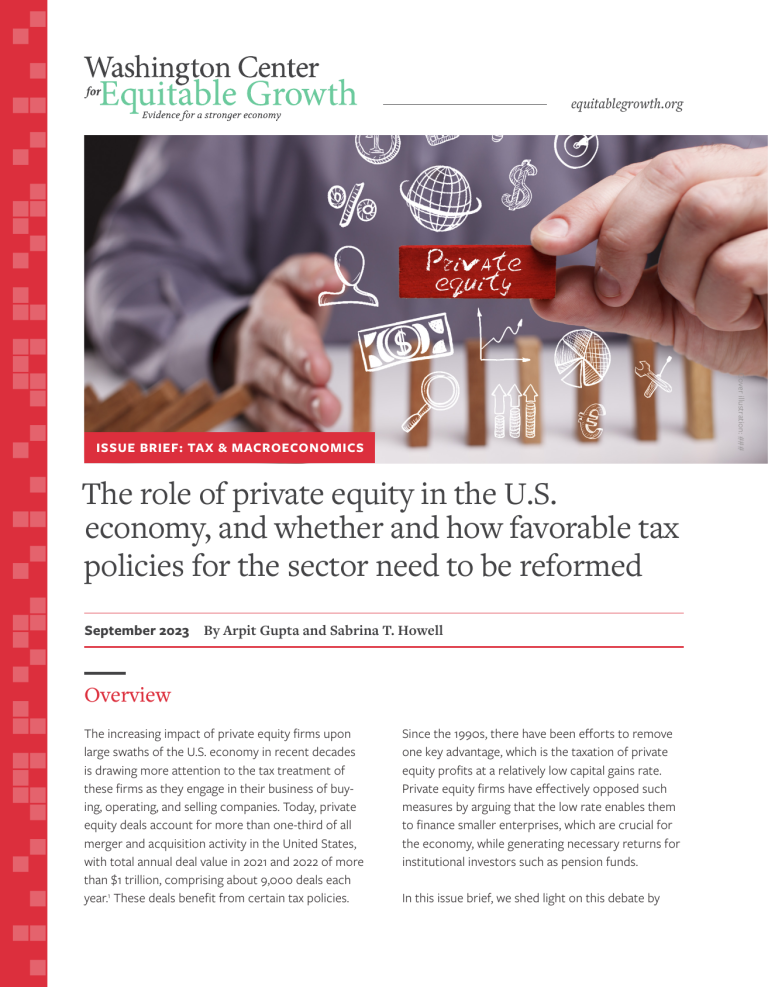
The role of private equity in the U.S. economy, and whether and how favorable tax policies for the sector need to be reformed (opens in a new tab)
Issue Briefs SEP 14, 2023
The increasing impact of private equity firms upon large swaths of the U.S. economy in recent decades is drawing more attention to the tax treatment of these firms as they…
By: Arpit Gupta (opens in a new tab), Sabrina Howell (opens in a new tab)

GDP 2.0: Measuring who prospers when the U.S. economy grows (opens in a new tab)
Blog JUL 11, 2023
This post was updated on July 11, 2023. Gross Domestic Product, or GDP, is the constant go-to economic indicator that news anchors and U.S. Members of Congress alike love to…
By: Austin Clemens (opens in a new tab)
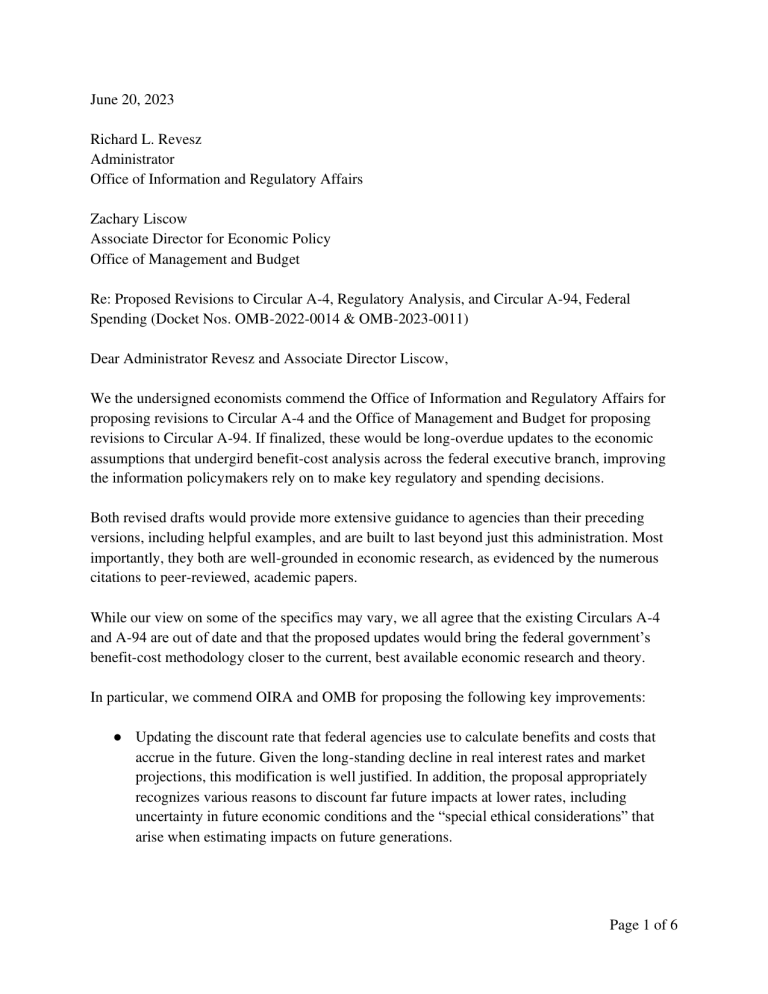
Equitable Growth delivers economist sign-on letter and comment letter to the White House Office of Information and Regulatory Affairs on its Proposed Revisions to Circular A-4, Regulatory Analysis (opens in a new tab)
Issue Briefs JUN 20, 2023
This post has been updated to reflect that Equitable Growth’s economist sign-on letter, not our comment letter, was submitted to regulations.gov due to an administrative submission error. The Washington Center…
By: Equitable Growth (opens in a new tab)
What monetary and fiscal policy can tell us about the U.S. recovery from the COVID-19 recession (opens in a new tab)
Blog JUN 14, 2023
The Federal Reserve is at the center of the main story in the U.S. economy, and not just because there’s actual ambiguity around this week’s Federal Open Market Committee meeting.…
By: Michael Madowitz (opens in a new tab)
Money for nothing: The Qualified Small Business Stock capital gains exclusion is a giveaway to wealthy investors, startup founders, and their employees (opens in a new tab)
Issue Briefs JUN 8, 2023
The Qualified Small Business Stock exclusion, enshrined in Section 1202 of the Internal Revenue Code, permits early-stage venture capital firms and angel investors in high-tech startups, those startups’ founders, and…
By: Manoj Viswanathan (opens in a new tab)
Proposed update to federal cost-benefit analysis guidelines correctly focuses on accounting for inequality in regulations (opens in a new tab)
Issue Briefs MAY 23, 2023
The White House last month unveiled a proposed update to an obscure but highly influential government document called the Circular A-4, which governs how the federal government conducts regulatory cost-benefit…
By: David S. Mitchell (opens in a new tab)

The rise of industrial policy means data synchronization is more critical than ever (opens in a new tab)
Blog MAY 12, 2023
Industrial policy is the hot new trend in D.C. policymaking circles, a Biden administration promise to radically transform the economy that is pouring federal dollars into green energy, infrastructure, and…
By: Austin Clemens (opens in a new tab)

Maybe some Earth Day soon, we’ll know what nature is worth (opens in a new tab)
Issue Briefs APR 24, 2023
This past January, the Biden administration unveiled its “National Strategy to Develop Statistics for Environmental-Economic Decisions,” an effort to bring the health and sustainability of natural resources in the United…
By: Austin Clemens (opens in a new tab)

Seven ways the inflation debate in the United States has changed since last year and how the Fed can now recalibrate its monetary policy (opens in a new tab)
Blog APR 12, 2023
Inflation in the United States today is considerably cooler than at its peak in the first half of 2022, but it will remain at the center of the economic policy…
By: Michael Madowitz (opens in a new tab)
Why measuring inflation is surprisingly challenging (opens in a new tab)
Blog APR 5, 2023
In spite of recent bank turmoil in the United States and abroad, reining in inflation remains very much at the top of the macroeconomic agenda for policymakers in advanced economies…
By: Michael Madowitz (opens in a new tab)
Summary of Equitable Growth’s March ‘Econ 101’ briefing on inflation for Capitol Hill staffers (opens in a new tab)
Blog MAR 23, 2023
The Washington Center for Equitable Growth hosted a briefing earlier this month—part of a series we call “Econ 101”—presenting the key points on inflation to congressional staffers in both the…
By: Equitable Growth (opens in a new tab)
Executive actions to modernize federal data collection and improve measurements of U.S. economic inequality (opens in a new tab)
Blog MAR 22, 2023
Relevant federal agencies U.S. Census Bureau U.S. Bureau of Economic Analysis, U.S. Department of Commerce U.S. Bureau of Labor Statistics, U.S. Department of Labor Relevant federal laws Internal Revenue Code…
By: Equitable Growth (opens in a new tab)
Inflation, Federal Reserve policymaking, and liquidity traps (opens in a new tab)
Blog MAR 14, 2023
The Federal Reserve is fighting inflation, but more importantly, the Fed wants everyone to know that it is fighting inflationary expectations. This means, in the short term, that with inflation…
By: Michael Madowitz (opens in a new tab)

The importance of the American Rescue Plan for U.S. workers and families on the law’s second anniversary, in 8 charts (opens in a new tab)
Blog MAR 10, 2023
Tomorrow marks 2 years since the American Rescue Plan Act was signed into law. One year after the COVID-19 pandemic that began in early 2020 triggered enormous employment losses and…
By: Carmen Sanchez Cumming (opens in a new tab), Raksha Kopparam (opens in a new tab)

Data infrastructure and tribal sovereignty can help break down barriers for Native Americans to build wealth (opens in a new tab)
Issue Briefs MAR 2, 2023
For centuries, Indigenous communities in the United States have faced devastating poverty. American Indians and Alaska Natives today experience the highest rate of poverty, at 25 percent, of any major…
By: Raksha Kopparam (opens in a new tab)
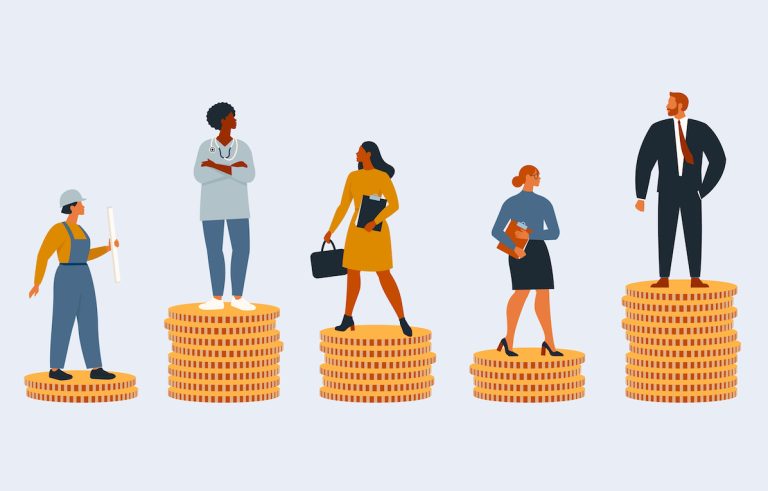
U.S. income and wealth inequality are no longer increasing, but a return to the equitable levels of the mid-20th century isn’t likely anytime soon (opens in a new tab)
Blog JAN 17, 2023
Five or 6 years ago, economists and pundits frequently debated whether the incomes of low- and middle-class households in the United States were stagnating. I wrote about it, and I…
By: Austin Clemens (opens in a new tab)

A missed opportunity to expand the Child Tax Credit will affect U.S. families and the broader economy now and for years to come (opens in a new tab)
Blog DEC 21, 2022
Earlier this week, the U.S. Congress released its proposed omnibus bill that funds the federal government through September 2023 and makes various other reforms to the nation’s retirement system, antitrust…
By: Equitable Growth (opens in a new tab)

New digital tools demonstrate the promise of measuring well-being in the United States (opens in a new tab)
Blog DEC 21, 2022
This summer, the Washington Center for Equitable Growth partnered with New America, the Justice, Health & Democracy Impact Initiative at Harvard University, and the U.S. Departments of Commerce and the…
By: Elizabeth Garlow (opens in a new tab), Austin Clemens (opens in a new tab), Anthony Guidotti (opens in a new tab)
U.S. inflationary trends amid the COVID-19 pandemic (opens in a new tab)
Reports DEC 13, 2022
Fast facts The chair of the Federal Reserve, Jerome Powell, and other members of the U.S. central bank’s Federal Open Market Committee, which sets monetary policies, are keenly aware of…
By: Michael Weber (opens in a new tab)
A review of federal lending to small business owners of color during the COVID-19 pandemic (opens in a new tab)
Reports DEC 13, 2022
The COVID-19 pandemic that began in early 2020 hammered small businesses across the globe. The number of active businesses declined precipitously, supply chain interruptions reduced business operations, and global trade…
By: Rachel Marie Brooks Atkins (opens in a new tab)
Early evidence on federal government income supports for U.S. individuals, workers, and families during the COVID-19 pandemic (opens in a new tab)
Reports DEC 13, 2022
This report focuses on preliminary research surrounding the three largest income support programs totaling $1.6 trillion that were paid directly to U.S. individuals, workers, and families amid the first two…
By: Alex Bell (opens in a new tab)
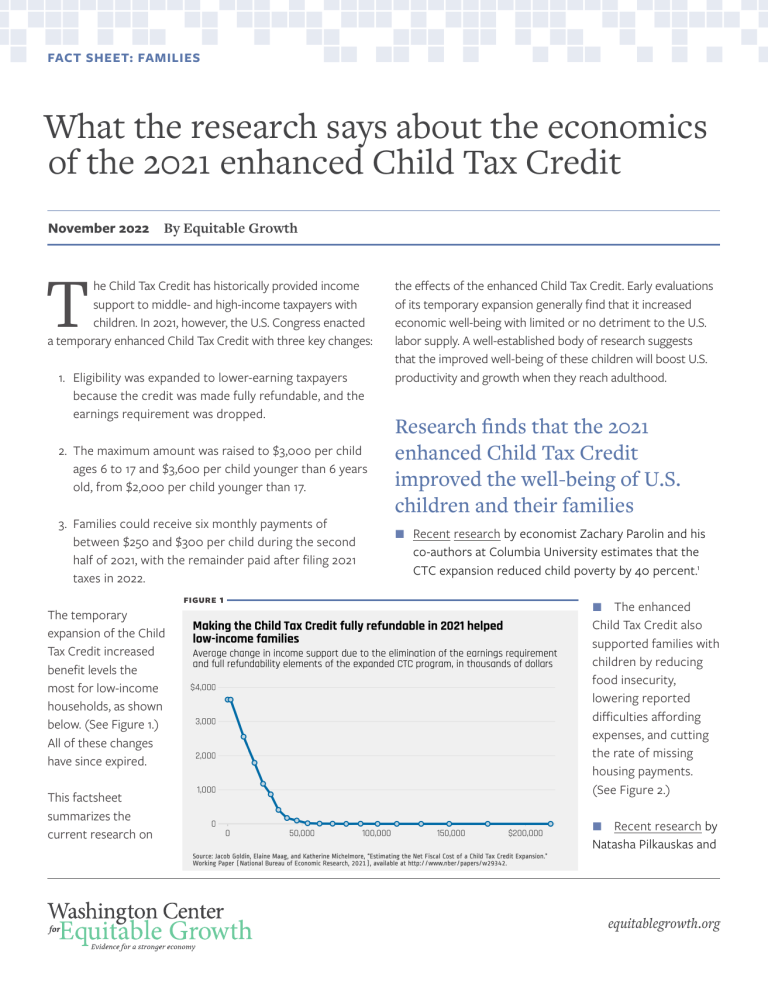
Factsheet: What the research says about the economics of the 2021 enhanced Child Tax Credit (opens in a new tab)
Factsheets NOV 29, 2022
The Child Tax Credit has historically provided income support to middle- and high-income taxpayers with children. In 2021, however, the U.S. Congress enacted a temporary enhanced Child Tax Credit with…
By: Equitable Growth (opens in a new tab)

How the Infrastructure Investment and Jobs Act of 2021 is promoting sustainable U.S. economic growth and mitigating climate change (opens in a new tab)
Issue Briefs NOV 18, 2022
In an issue brief earlier this year, Equitable Growth discussed how the Infrastructure Investment and Jobs Act of 2021 rests on sound economic principles and analyzed the ways that its…
By: Michael Madowitz (opens in a new tab), Shaun Harrison (opens in a new tab)

What are the distributional effects of monetary policy? (opens in a new tab)
Blog NOV 17, 2022
The Washington Center for Equitable Growth recently announced our 2023 Request for Proposals to support research investigating the various channels through which economic inequality, in all its forms, may or…
By: Shaun Harrison (opens in a new tab)

In Conversation with Lenore Palladino (opens in a new tab)
In Conversation NOV 16, 2022
Equitable Growth in Conversation is a recurring series where we talk with economists and other academics to help us better understand whether and how economic inequality affects economic growth and…
By: Kate Bahn (opens in a new tab)
The Fed is aggressively but perhaps deliberately playing catch-up on inflation (opens in a new tab)
Blog NOV 2, 2022
The members of the Federal Reserve Board’s interest-rate-setting committee are almost universally expected to raise interest rates by 0.75 percentage points this week, as they have at each of their…
By: Michael Madowitz (opens in a new tab)

What federal statistical agencies can do to improve survey response rates among Hispanic communities in the United States (opens in a new tab)
Blog OCT 14, 2022
Between 2010 and 2020, the Hispanic American population grew 23 percent, making it one of the fastest-growing communities in the United States. According to the 2020 decennial census, Hispanic Americans…
By: Raksha Kopparam (opens in a new tab)

Equitable Growth provides comments to the U.S. Bureau of Economic Analysis on its new distributing personal income report (opens in a new tab)
Blog OCT 5, 2022
In December 2021, the U.S. Bureau of Economic Analysis released a report that studied the feasibility of releasing its distributing personal income product on a quarterly basis. This feasibility study…
By: Equitable Growth (opens in a new tab)

Policymakers can still use American Rescue Plan funds to bolster the U.S. child care system and ensure it has a strong future (opens in a new tab)
Blog SEP 20, 2022
In January, the 118th Congress will draw to a close following a productive session that saw legislative action on pandemic relief, infrastructure investments, manufacturing and research incentives, and critical investments…
By: Sam Abbott (opens in a new tab)

Better data collection can help lift the LGBTQ+ community out of economic hardship in the United States (opens in a new tab)
Videos SEP 15, 2022
Over the past 2-plus years amid the COVID-19 pandemic, widespread evidence has underscored the reality that various communities and demographic groups in the United States experience socioeconomic hardships differently. Numerous…
By: Raksha Kopparam (opens in a new tab)

Measuring spending inequality in the United States in real time (opens in a new tab)
Blog SEP 8, 2022
The onset of the COVID-19 pandemic and the resulting recession in 2020, followed by a swift U.S. economic recovery, offer lessons today about why real-time data are so crucial to…
By: Loujaina Abdelwahed (opens in a new tab), Jacob Robbins (opens in a new tab), Cole Campbell (opens in a new tab), Shogher Ohannessian (opens in a new tab), Todd Czurylo (opens in a new tab)

Why the Inflation Reduction Act is key to strong, broad-based U.S. economic growth (opens in a new tab)
Blog AUG 16, 2022
The Inflation Reduction Act spells good news for the U.S. economy. The newly signed legislation makes historic investments to combat climate change, lower healthcare costs, and crack down on tax…
By: David S. Mitchell (opens in a new tab)

How to stop a recession by strengthening income supports in the United States (opens in a new tab)
Blog AUG 15, 2022
Income support programs, such as Unemployment Insurance and the Supplemental Nutrition Assistance Program, are powerful tools to deploy when the threat of recession looms and unemployment climbs. By providing income…
By: Alix Gould-Werth (opens in a new tab)

Policymakers tackling inflation can’t overlook the impact of higher interest rates on the U.S. child care market (opens in a new tab)
Blog AUG 11, 2022
As families in the United States grapple with rising prices and ongoing supply shortages, fiscal and monetary policymakers are shifting their focus from the COVID-19 recession and recovery to the…
By: Sam Abbott (opens in a new tab)
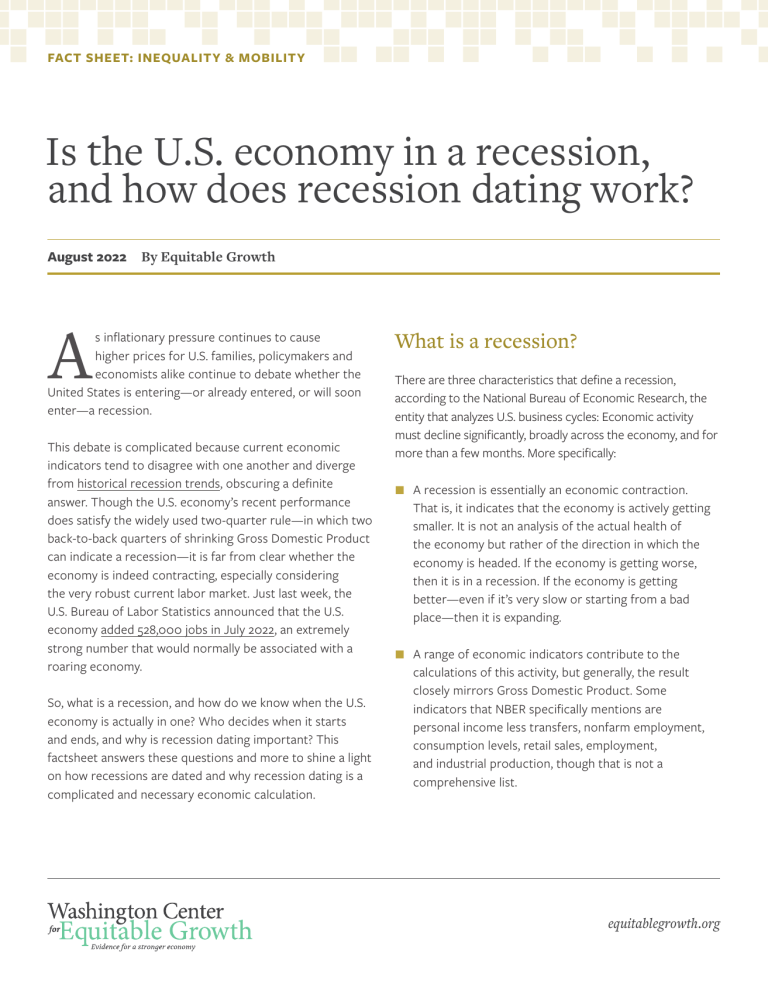
Factsheet: Is the U.S. economy in a recession, and how does recession dating work? (opens in a new tab)
Factsheets AUG 10, 2022
As inflationary pressure continues to cause higher prices for U.S. families, policymakers and economists alike continue to debate whether the United States is entering—or already entered, or will soon enter—a…
By: Equitable Growth (opens in a new tab)

The economic evidence behind the Inflation Reduction Act and why it will boost strong, broad-based economic growth (opens in a new tab)
Blog AUG 5, 2022
The Inflation Reduction Act spells good news for the U.S. economy. The proposed legislation now before the U.S. Senate would make historic investments to combat climate change, lower healthcare costs,…
By: David S. Mitchell (opens in a new tab)

NBER Summer Institute 2022 Round-up: Week 3 (opens in a new tab)
Blog AUG 1, 2022
On July 11, the National Bureau of Economic Research kicked off its summer institute, an annual 3-week conference featuring discussions and paper presentations on various topics in economics, including environmental…
By: Equitable Growth (opens in a new tab)
Taxing the rich: The effect of tax reform and the COVID-19 pandemic on tax flight among U.S. millionaires (opens in a new tab)
Blog JUL 28, 2022
Taxing the rich is one of the central policy debates in this time of rising inequality. Elite taxation can change the distribution of income in society, support equitable growth, and…
By: Cristobal Young (opens in a new tab), Ithai Lurie (opens in a new tab)

NBER Summer Institute 2022 Round-up: Week 2 (opens in a new tab)
Blog JUL 26, 2022
On July 11, the National Bureau of Economic Research kicked off its summer institute, an annual 3-week conference featuring discussions and paper presentations on various topics in economics, including disaggregating…
By: Equitable Growth (opens in a new tab)

Equitable Growth welcomes R. Jisung Park as a visiting scholar to examine economic impacts of climate change (opens in a new tab)
Videos JUL 25, 2022
Wildfires are blazing across Europe and temperatures are soaring around the world, exemplifying new extremes that are set to become normal as a result of climate change. But the effects…
By: Equitable Growth (opens in a new tab)

NBER Summer Institute 2022 Round-up: Week 1 (opens in a new tab)
Blog JUL 18, 2022
On July 11, the National Bureau of Economic Research kicked off its summer institute, an annual 3-week conference featuring discussions and paper presentations on various topics in economics, including monopsony…
By: Equitable Growth (opens in a new tab)

Canada is the first country to release subannual statistics on the distribution of income. Here’s how it was done. (opens in a new tab)
Blog JUL 7, 2022
Statistics Canada, the umbrella agency for national statistics in Canada, is the first statistical agency in the world to release subannual data on how economic growth is distributed among rich…
By: Austin Clemens (opens in a new tab)
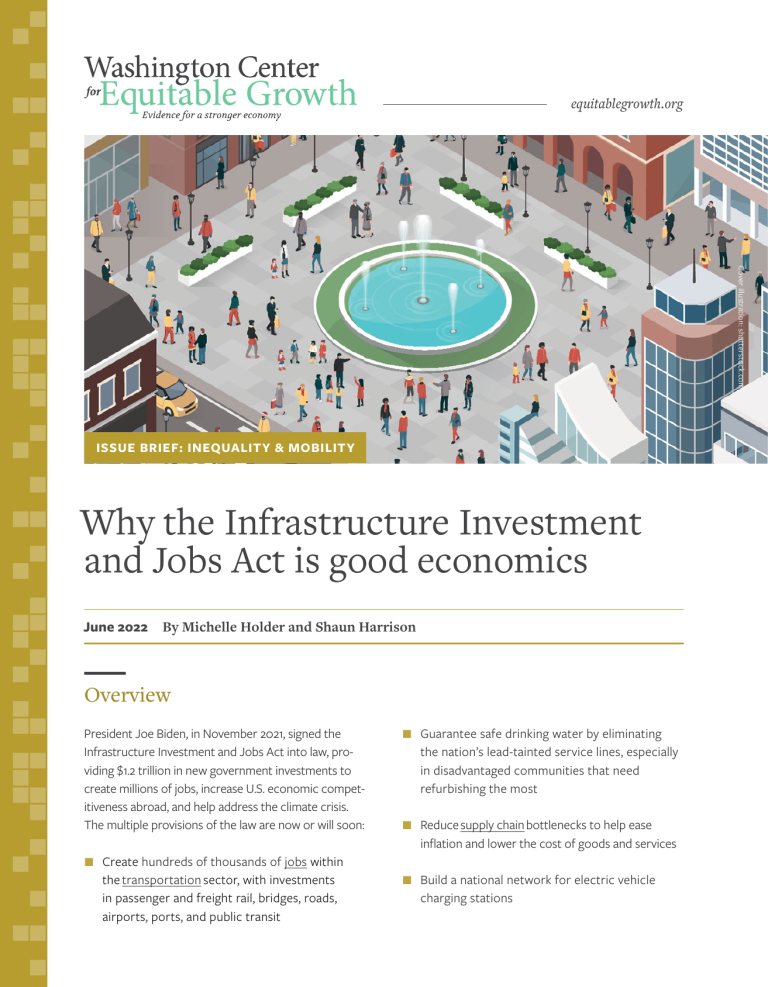
Why the Infrastructure Investment and Jobs Act is good economics (opens in a new tab)
Issue Briefs JUN 30, 2022
President Joe Biden, in November 2021, signed the Infrastructure Investment and Jobs Act into law, providing $1.2 trillion in new government investments to create millions of jobs, increase U.S. economic…
By: Michelle Holder (opens in a new tab), Shaun Harrison (opens in a new tab)

The impact of different inflationary pressures due to income inequality and racial disparities in the United States today (opens in a new tab)
Videos MAY 26, 2022
The Federal Reserve Bank of Minneapolis recently hosted a conference, “Unequal Inflation Impacts,” at which an illuminating set of presentations and additional research sources explored “the ways inflation puts different…
By: Jonathan Fisher (opens in a new tab)
Three observations from the kick-off of a new consensus study by the National Academy of Sciences on measuring U.S. economic inequality (opens in a new tab)
Blog MAY 19, 2022
A new National Academy of Sciences panel convened publicly for the first time this week to discuss how statistical agencies should unify and improve the measurement of inequality in income,…
By: Austin Clemens (opens in a new tab)

Child care costs are going to rise, but policymakers can help U.S. families manage these increases (opens in a new tab)
Blog MAY 18, 2022
For decades, the U.S. child care market has been on the verge of a crisis. As any parent knows, child care in the United States has long been too expensive,…
By: Sam Abbott (opens in a new tab)

Jobs report: Amid continued job gains, Asian American, Native Hawaiian, and Pacific Islander workers experience the U.S. labor market in different and often hidden ways (opens in a new tab)
Blog MAY 6, 2022
Between mid-March and mid-April, the U.S. economy added a strong 428,000 jobs, making it the 12th consecutive month in which employment growth surpasses 400,000 jobs. In addition, according to the…
By: Carmen Sanchez Cumming (opens in a new tab), Kathryn Zickuhr (opens in a new tab)
Testimony by Michelle Holder before the Joint Economic Committee on robust government investments (opens in a new tab)
Blog APR 27, 2022
Thank you, Chair Beyer, Ranking Member Lee, Vice Chair Heinrich, and members of the Joint Economic Committee, for inviting me to speak today. It’s an honor to be here virtually.…
By: Michelle Holder (opens in a new tab)

Modeling future economic damages from climate change is an important and underdeveloped area of research (opens in a new tab)
Blog APR 22, 2022
This year’s Earth Day celebrations come on the heels of yet another devastating UN report detailing the consequences of climate change—and the global lack of action to mitigate its effects—for…
By: Michael Garvey (opens in a new tab)

The American Rescue Plan helped U.S. families amid the coronavirus pandemic and provides a roadmap for policymakers today (opens in a new tab)
Blog MAR 11, 2022
When the coronavirus pandemic began to spread across the United States in March 2020 its impact was immediate and severe. The U.S. unemployment rate skyrocketed from a 50-year low of…
By: Michelle Holder (opens in a new tab)
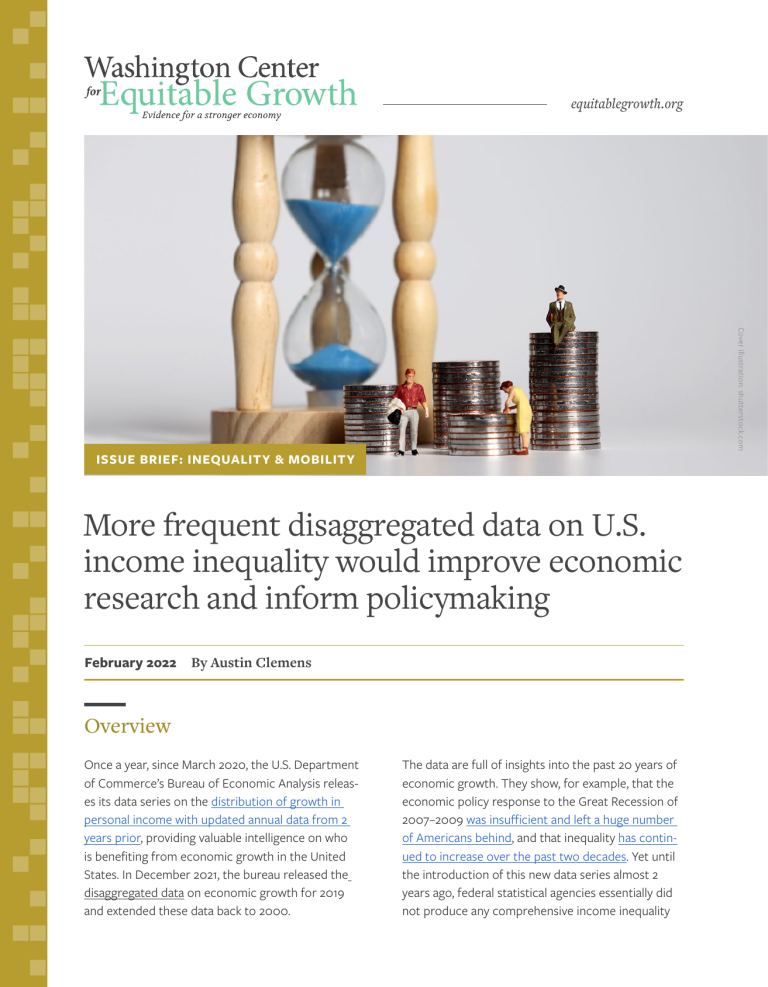
More frequent disaggregated data on U.S. income inequality would improve economic research and inform policymaking (opens in a new tab)
Issue Briefs FEB 24, 2022
Once a year, since March 2020, the U.S. Department of Commerce’s Bureau of Economic Analysis releases its data series on the distribution of growth in personal income with updated annual…
By: Austin Clemens (opens in a new tab)

Six charts that explain how inequality in the United States changed over the past 20 years (opens in a new tab)
Blog FEB 1, 2022
The U.S. Bureau of Economic Analysis, in late 2021, updated its data series on income inequality in the United States. This update adds data for 2019 and extends the data…
By: Austin Clemens (opens in a new tab)

The U.S. economy is in its fourth decade of rising inequality amid the need for more accurate data on its consequences (opens in a new tab)
Issue Briefs JAN 27, 2022
Economic inequality in the United States continued to rise over the first two decades of the 21st century, according to new data from the U.S. Bureau of Economic Analysis—a trend…
By: Austin Clemens (opens in a new tab)
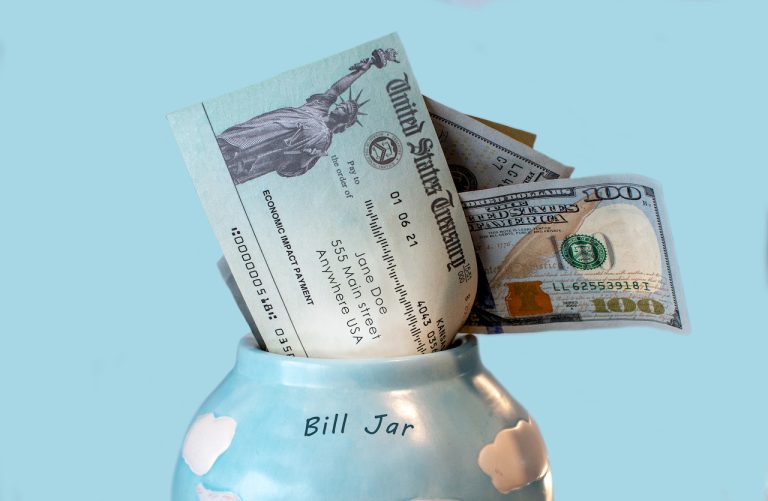
Fostering academic research on U.S. economic impact payments that goes beyond the marginal propensity to consume (opens in a new tab)
Blog JAN 18, 2022
Direct government payments to individuals are now a standard part of U.S. fiscal policymakers’ recession-fighting toolkit. Three rounds of so-called economic impact payments from the federal government have been paid…
By: Karen Dynan (opens in a new tab)

Austerity policies in the United States caused ‘stagflation’ in the 1970s and would do so again today (opens in a new tab)
Blog JAN 11, 2022
In the current debate among economists and policymakers in the United States about the causes of inflation, one of the most persistent and most deeply rooted questions is whether today’s…
By: Andrew Elrod (opens in a new tab)

In Conversation with Jonathan Fisher (opens in a new tab)
In Conversation DEC 16, 2021
Equitable Growth in Conversation is a recurring series where we talk with economists and other academics to help us better understand whether and how economic inequality affects economic growth and…
By: Kate Bahn (opens in a new tab), Jonathan Fisher (opens in a new tab)

Addressing the ‘double gap’ faced by Black women in the U.S. economy (opens in a new tab)
Blog NOV 30, 2021
In my testimony before the Joint Economic Committee of the U.S. Congress this past summer, I presented some of the findings from my 2020 report, “The “Double Gap” and the…
By: Michelle Holder (opens in a new tab)

U.S. disability programs provide valuable benefits to low-income recipients across a range of health conditions (opens in a new tab)
Blog NOV 22, 2021
The three components of the U.S. social insurance system serve retirees and those recipients facing challenging health conditions. But all three programs have grown in recent decades, sparking various calls…
By: Manasi Deshpande (opens in a new tab)

Testimony by Jonathan Fisher before the House Select Committee on Economic Disparity and Fairness in Growth (opens in a new tab)
Videos NOV 17, 2021
Statement for the Roundtable Meeting of the Committee on “Measuring Economic Disparity” House Select Committee on Economic Disparity and Fairness in Growth November 17, 2021 I am Jonathan Fisher, the…
By: Jonathan Fisher (opens in a new tab)

In Conversation with Erica Groshen (opens in a new tab)
In Conversation OCT 25, 2021
Equitable Growth in Conversation is a recurring series where we talk with economists and other academics to help us better understand whether and how economic inequality affects economic growth and…
By: Austin Clemens (opens in a new tab)

Dispatch from EconCon 2021: Addressing racial and gender stratification in the U.S. economy is key to an equitable and sustainable recovery (opens in a new tab)
Blog OCT 21, 2021
The 2-day EconCon 2021 conference, held virtually from October 6–7, featured speakers, panelists, and moderators from across the progressive policy and academic landscape. They were tasked by the co-hosts of…
By: Equitable Growth (opens in a new tab)

Supporting American Indian tribal sovereignty boosts economic outcomes for those on reservation lands (opens in a new tab)
Videos OCT 21, 2021
American Indian communities over the past 30 years experienced more economic growth and improved well-being than during any other point in the more than five centuries since European colonists and…
By: Equitable Growth (opens in a new tab)
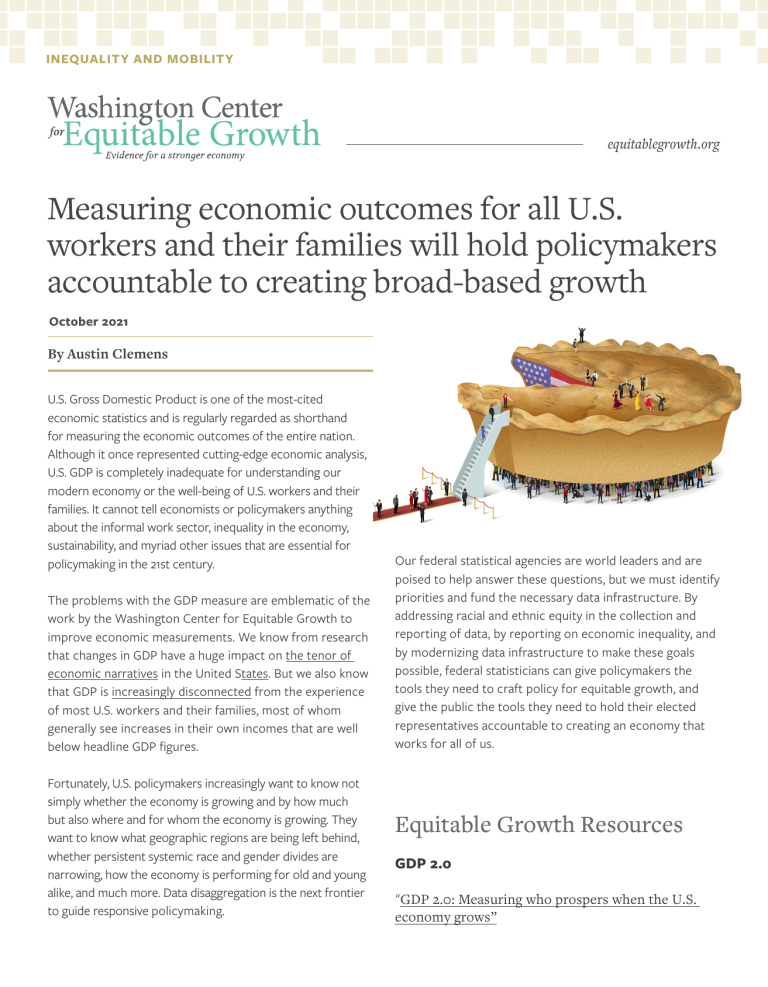
Measuring economic outcomes for all U.S. workers and their families will hold policymakers accountable to creating broad-based growth (opens in a new tab)
Issue Briefs OCT 7, 2021
U.S. Gross Domestic Product is one of the most-cited economic statistics and is regularly regarded as shorthand for measuring the economic outcomes of the entire nation. Although it once represented…
By: Austin Clemens (opens in a new tab)

Racial equity in U.S. data collection improves the accuracy of research, policy evaluation, and subsequent policymaking (opens in a new tab)
Videos SEP 28, 2021
The U.S. economy and society are rife with racial and ethnic inequalities, from wealth and income divides to disparities in health and well-being, education, and employment outcomes. These racial and…
By: Randall Akee (opens in a new tab)

Diversity in economics and data disaggregation can improve our understanding of the U.S. economy (opens in a new tab)
Videos SEP 27, 2021
Economics as a field is beleaguered by a diversity problem. This is not a new phenomenon, but diversity-related issues are now more widely discussed within many organizations and professional disciplines,…
By: Marie T. Mora (opens in a new tab)
A cost-benefit analysis of The American Families Plan’s proposed investment in a nationwide public preschool program (opens in a new tab)
Issue Briefs SEP 22, 2021
President Joe Biden asked the U.S. Congress to consider investing $200 billion over 10 years in “a national partnership with states to offer free, high-quality, accessible, and inclusive preschool to…
By: Robert Lynch (opens in a new tab)
The value of racial and gender diversity at the Federal Reserve (opens in a new tab)
Blog SEP 16, 2021
The Federal Reserve’s so-called dual mandate to maintain overall price stability and maximum sustainable growth in U.S. employment is always on the minds of the U.S. central bank’s Federal Open…
By: Equitable Growth (opens in a new tab)
The coming public debt scare should not spook U.S. policymakers from investing in physical and social infrastructure (opens in a new tab)
Blog SEP 7, 2021
Public debt scaremongering is back in fashion on Capitol Hill. Republican legislators, from Senate Minority Leader Mitch McConnell (R-KY) on down, are invoking the high level of federal government debt—currently…
By: Barry Eichengreen (opens in a new tab)
Completing the unfinished New Deal to overcome 21st century U.S. economic inequality (opens in a new tab)
Blog AUG 31, 2021
President Joe Biden wants Congress to enact his two signature legislative packages—the $1 trillion bipartisan physical infrastructure plan passed by the U.S. Senate earlier in August and a $3.5 trillion…
By: David S. Mitchell (opens in a new tab)

NBER Summer Institute 2021 Round-up: Week 2 (opens in a new tab)
Blog JUL 26, 2021
On July 12, the National Bureau of Economic Research kicked off its summer institute, an annual 3-week conference featuring discussions and paper presentations on specific subfields of economics, including wealth…
By: Equitable Growth (opens in a new tab)

NBER Summer Institute 2021 Round-up: Week 1 (opens in a new tab)
Blog JUL 19, 2021
On July 12, the National Bureau of Economic Research kicked off its summer institute, an annual 3-week conference featuring discussions and paper presentations on specific subfields of economics, including inequality…
By: Equitable Growth (opens in a new tab)

Fiscal austerity intensifies the increase in inequality after pandemics (opens in a new tab)
Blog JUL 13, 2021
(This column is reprinted with the permission of the authors. It was first published by voxeu.org on June 3, 2021) In the aftermath of past pandemics, fiscal policy played an…
By: Davide Furceri (opens in a new tab), Prakash Loungani (opens in a new tab), Jonathan Ostry (opens in a new tab), Pietro Pizzuto (opens in a new tab)

Average inflation targeting by the Federal Reserve and U.S. consumer expectations (opens in a new tab)
Blog JUL 13, 2021
In August 2020, the Federal Open Market Committee published an amended version of its “Statement on Longer-Run Goals and Monetary Policy Strategy.” In this revised statement, the FOMC reaffirmed its…
By: Carola Binder (opens in a new tab)

A temporary increase in inflation is not a long-run threat to U.S. economic growth and prosperity (opens in a new tab)
Blog JUL 9, 2021
After a decade of below-target rates of inflation and the widespread fear of a Japanese-style prolonged economic stagnation with low inflation and zero growth, the incipient economic recovery in the…
By: Francesco D’Acunto (opens in a new tab), Michael Weber (opens in a new tab)
The economic benefits of equal opportunity in the United States by ending racial, ethnic, and gender disparities (opens in a new tab)
Issue Briefs JUN 29, 2021
Racial, ethnic, and gender disparities across the U.S. economy are a personal tragedy for the millions of individuals who suffer from the emotional, psychological, and social consequences. These disparities also…
By: Robert Lynch (opens in a new tab)

A new report lays out the path forward for faltering U.S. Unemployment Insurance system (opens in a new tab)
Blog JUN 24, 2021
Today, experts from seven organizations released a fortuitously timed report charting a path forward for the U.S. Unemployment Insurance program. Unemployment Insurance is the main social insurance program designed to…
By: Alix Gould-Werth (opens in a new tab)

The imperative of focusing on racial equity in U.S. economic statistics (opens in a new tab)
Blog JUN 11, 2021
The coronavirus pandemic and resulting sharp recession put a glaring spotlight on the importance of data disaggregation. During the early stages of the pandemic, most states were not reporting coronavirus…
By: Shaun Harrison (opens in a new tab)
Sustained U.S. economic recovery depends on major equitable economic investments (opens in a new tab)
Blog JUN 11, 2021
When President Joe Biden made the case before a joint session of Congress in the spring for two new economic investment packages—a $2 trillion American Jobs Plan and a $1.8…
By: Michael Garvey (opens in a new tab)
The American anti-austerity tradition (opens in a new tab)
Blog MAY 20, 2021
The financialization of the U.S. economy has directed U.S. savings into more and more unproductive speculative investments. Consumption has become increasingly buoyed by unsustainable “indebted demand.” And the threat of…
By: Robert Manduca (opens in a new tab)

Overheating is not a concern for the U.S. economy (opens in a new tab)
Blog APR 26, 2021
Critics of President Joe Biden’s $1.9 trillion American Rescue Plan and further public investments financed through a combination of tax increases and deficit spending—such as his administration’s proposed American Jobs…
By: Equitable Growth (opens in a new tab)

Policy workshop addressed promises and challenges of using carbon pricing to combat climate change (opens in a new tab)
Blog APR 15, 2021
Climate change might be the world’s most complex public policy problem. It is more global, more long-term, more irreversible, and more uncertain than most other policy challenges and probably unique…
By: Gernot Wagner (opens in a new tab)

Investing in an equitable future (opens in a new tab)
Videos APR 14, 2021
The United States faces four converging and overlapping challenges—a public health crisis and resulting economic one, a reckoning over structural racism, and the worsening effects of climate change—all of which…
By: Equitable Growth (opens in a new tab)

Uncertainty about the size of annual tax refunds hinders the effectiveness of tax-based U.S. redistribution (opens in a new tab)
Blog APR 8, 2021
Each tax season, many families in the United States receive additional income through refundable tax credits, among them the Earned Income Tax Credit and Child Tax Credit. These two tax…
By: Sydnee Caldwell (opens in a new tab), Scott Nelson (opens in a new tab), Daniel Waldinger (opens in a new tab)
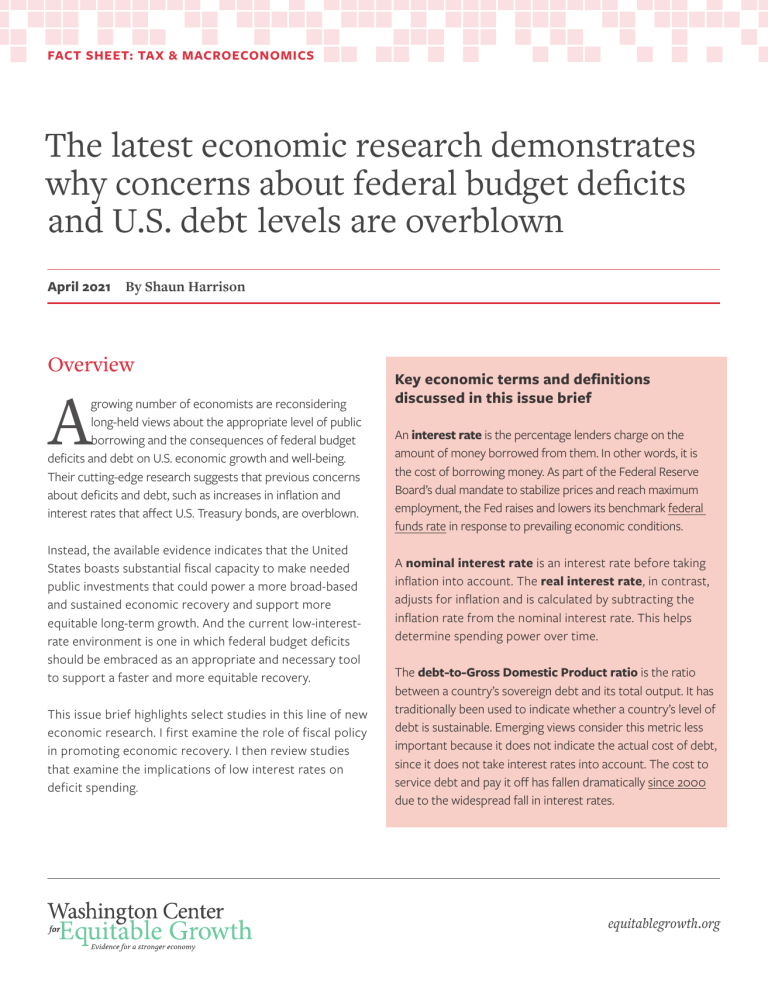
The latest economic research demonstrates why concerns about federal budget deficits and U.S. debt levels are overblown (opens in a new tab)
Issue Briefs APR 1, 2021
A growing number of economists are reconsidering long-held views about the appropriate level of public borrowing and the consequences of federal budget deficits and debt on U.S. economic growth and…
By: Shaun Harrison (opens in a new tab)

New Great Recession data suggest Congress should go big to spur a broad-based, sustained U.S. economic recovery (opens in a new tab)
Issue Briefs MAR 4, 2021
As federal policymakers debate President Joe Biden’s proposed $1.9 trillion American Rescue Plan, critics now argue that it will “overshoot,” meaning it would boost economic activity beyond the desired level.…
By: Austin Clemens (opens in a new tab)

Executive actions to improve U.S. economic measurements (opens in a new tab)
Blog MAR 3, 2021
Relevant federal offices and agencies White House Office of Management and Budget Interagency Working Group on Equitable Data Bureau of Economic Analysis, Department of Commerce Office of Tax Policy, Department…
By: Equitable Growth (opens in a new tab)

Executive actions to coordinate federal countercyclical regulatory policy (opens in a new tab)
Blog FEB 17, 2021
This factsheet has been adapted from Yair Listokin’s Vision 2020 essay and his 2019 book, Law and Macroeconomics: Legal Remedies to Recessions. Overview Traditional macroeconomic tools—fiscal policy from the U.S.…
By: Equitable Growth (opens in a new tab)
How to replace COVID relief deadlines with automatic ‘triggers’ that meet the needs of the U.S. economy (opens in a new tab)
Blog FEB 11, 2021
To strengthen the federal government’s response to the coronavirus pandemic and the resulting economic downturn, President Joe Biden seeks to enact his American Rescue Plan to stop the spread of…
By: David S. Mitchell (opens in a new tab), Corey Husak (opens in a new tab)

Sovereignty and improved economic outcomes for American Indians: Building on the gains made since 1990 (opens in a new tab)
Blog JAN 14, 2021
This essay is part of Boosting Wages for U.S. Workers in the New Economy, a compilation of 10 essays from leading economic thinkers who explore alternative policies for boosting wages…
By: Randall Akee (opens in a new tab)
Public investments in education can spur equitable growth, pay for themselves, and create jobs for a stronger economic recovery (opens in a new tab)
Reports OCT 27, 2020
Public investments in education, in both physical structures and in services, are key to long-run economic growth and human well-being. Some of these investments are especially effective in promoting more…
By: Robert Lynch (opens in a new tab)
The rising number of U.S. households with burdensome student debt calls for a federal response (opens in a new tab)
Issue Briefs OCT 21, 2020
Today, about 43 million adults in the United States collectively hold $1.5 trillion in federal student loan debt and an additional $119 billion in private student loans not backed by…
By: Raksha Kopparam (opens in a new tab), Austin Clemens (opens in a new tab)
Can policymakers reverse the unequal decline in middle-age U.S. homeownership rates? (opens in a new tab)
Issue Briefs OCT 13, 2020
Homeownership in the United States has long functioned as a wealth equalizer, allowing middle-class families to build wealth while they pay for their housing costs. Because houses have generally appreciated…
By: Austin Clemens (opens in a new tab), John Sabelhaus (opens in a new tab)
Policy prescriptions for the flawed and unequal retirement savings systems that perpetuate U.S. economic inequality (opens in a new tab)
Issue Briefs OCT 7, 2020
Outside of homeownership, retirement savings are the most important way middle-class workers and their families build wealth in the United States. But this second pillar of wealth creation is woefully…
By: David S. Mitchell (opens in a new tab), John Sabelhaus (opens in a new tab)
New wealth data show that the economic expansion after the Great Recession was a wealthless recovery for many U.S. households (opens in a new tab)
Issue Briefs OCT 5, 2020
The Federal Reserve’s 2019 Survey of Consumer Finances, or SCF, released last week, shows that the wealth of many U.S. households never recovered from the shock of the Great Recession…
By: Austin Clemens (opens in a new tab)
Structural racism and the coronavirus recession highlight why more and better U.S. data need to be widely disaggregated by race and ethnicity (opens in a new tab)
Issue Briefs SEP 24, 2020
The enduring legacy of structural racism in the United States is not news to the multihued communities of color across our nation. And in these Black, Latinx, Native American, Asian…
By: Austin Clemens (opens in a new tab), Michael Garvey (opens in a new tab)

The hidden costs of stock-market-first U.S. economic policies (opens in a new tab)
Blog SEP 22, 2020
The idea that sound U.S. economic policy begins and ends with a strong stock market is becoming pervasive. Advocates of what I call the stock-market-first approach want you to focus…
By: John Sabelhaus (opens in a new tab)
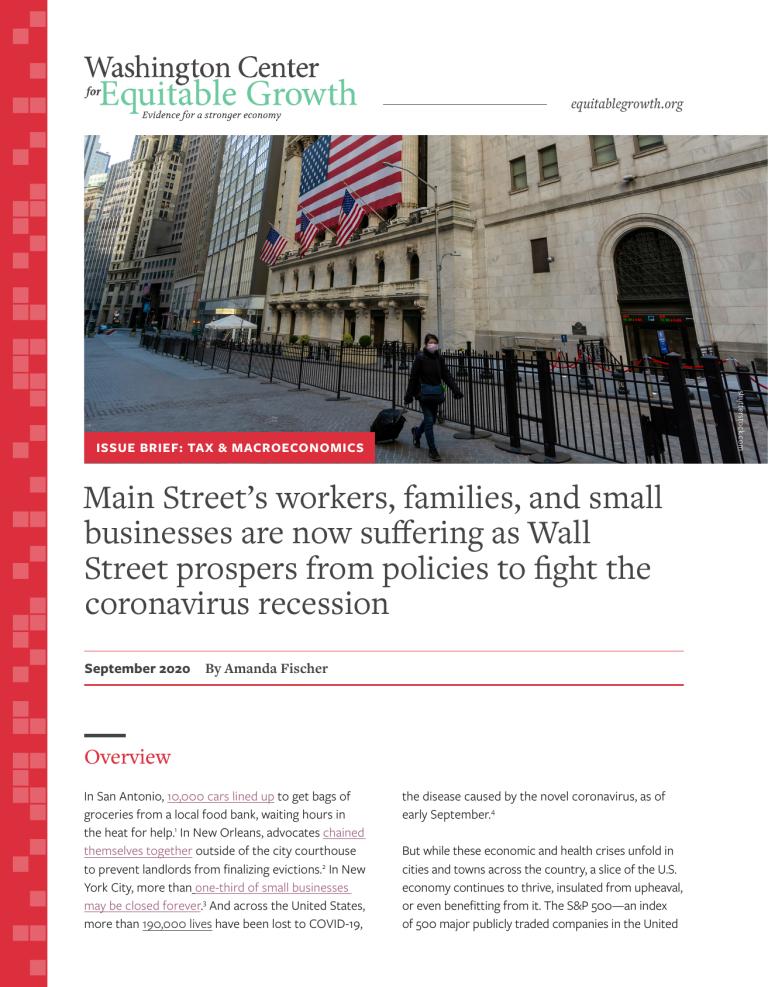
Main Street’s workers, families, and small businesses are now suffering as Wall Street prospers from policies to fight the coronavirus recession (opens in a new tab)
Issue Briefs SEP 17, 2020
In San Antonio, 10,000 cars lined up to get bags of groceries from a local food bank, waiting hours in the heat for help. In New Orleans, advocates chained themselves…
By: Amanda Fischer (opens in a new tab)
What is Gross Domestic Product, and what does it measure? (opens in a new tab)
Blog SEP 2, 2020
Gross Domestic Product growth may once have indicated good fortune for the vast majority of Americans, but over the past several decades, many Americans were left increasingly behind. This reality…
By: Austin Clemens (opens in a new tab)

Get more money immediately to U.S. families and help them out of the coronavirus recession (opens in a new tab)
Blog SEP 1, 2020
The costs of the deepening coronavirus recession and the benefits of the federal government providing another round of direct economic aid to families are clear. Let’s begin with the mounting…
By: Michael Garvey (opens in a new tab), Claudia Sahm (opens in a new tab)

Revamping U.S. small business rescue programs amid the coronavirus recession (opens in a new tab)
Blog AUG 27, 2020
The coronavirus economic rescue programs enacted by Congress this past spring failed to prevent layoffs and firm bankruptcies among the smallest employers in the United States. Existing resources, such as…
By: Equitable Growth (opens in a new tab)
Taxing wealth and investment income in the United States (opens in a new tab)
Issue Briefs AUG 25, 2020
The federal income tax does a poor job of taxing income derived from wealth. The root cause of this problem is that the tax code allows taxpayers to defer (without…
By: Equitable Growth (opens in a new tab)

Achieving universal paid family and medical leave in the United States (opens in a new tab)
Blog AUG 24, 2020
The coronavirus pandemic and the recession it caused lay bare a familiar challenge for U.S. workers—balancing family and job responsibilities without access to paid family and medical leave. When a…
By: Equitable Growth (opens in a new tab)

Disaggregated data on Asian Americans, Native Hawaiians, and Pacific Islanders is crucial amid the coronavirus pandemic (opens in a new tab)
Issue Briefs AUG 20, 2020
The novel coronavirus pandemic and the recession it caused lay bare the clear links between racial and ethnic economic inequities, structural racism, and the outsized harm of these crises on…
By: Christian Edlagan (opens in a new tab), Raksha Kopparam (opens in a new tab)
Building worker power in the United States (opens in a new tab)
Issue Briefs AUG 20, 2020
Wages have stagnated for most U.S. workers over the past 40 years while the labor market institutions that promote worker power have faltered in a pro-business and anti-worker policy environment.…
By: Equitable Growth (opens in a new tab)

Improving automatic stabilizers to combat U.S. economic recessions (opens in a new tab)
Issue Briefs AUG 19, 2020
The new coronavirus pandemic and the recession it caused show that the typical set of economic policies used to fight recessions in the United States should be designed to automatically…
By: Equitable Growth (opens in a new tab)

Reforming Unemployment Insurance across the United States (opens in a new tab)
Blog AUG 17, 2020
Longstanding problems with the Unemployment Insurance system in the United States are immediately evident amid the coronavirus recession and echo the problems experienced during the Great Recession more than a…
By: Equitable Growth (opens in a new tab)

Restoring the federal estate tax is a proven way to raise revenue and address wealth inequality (opens in a new tab)
Issue Briefs AUG 14, 2020
Wealth inequality in the United States is rising more steeply to the already very rich, even more than the well-known rise in income inequality. The wealthiest 1 percent of families…
By: John Sabelhaus (opens in a new tab)

Gaps in U.S. rural and urban economic growth widened in the post-Great Recession economy, with implications amid the coronavirus recession (opens in a new tab)
Blog AUG 6, 2020
Prior to the current coronavirus recession, most U.S. economic metrics pointed to a slow but steady nationwide recovery amid an 11-year post-Great Recession run of economic growth. But prosperity was…
By: Raksha Kopparam (opens in a new tab)
Testimony by Heather Boushey before the Joint Economic Committee on the Coronavirus Recession (opens in a new tab)
Blog JUL 30, 2020
Thank you, Vice Chair Beyer and Chairman Lee, for inviting me to speak today. It’s an honor to be here. My name is Heather Boushey, and I am president and…
By: Heather Boushey (opens in a new tab)

Congress must act to help U.S. families facing an income crisis (opens in a new tab)
Blog JUL 29, 2020
We now have 4.3 million confirmed cases of the novel coronavirus in the United States. The virus moves fast, and policymakers in Washington move slow. Families across the country face…
By: Claudia Sahm (opens in a new tab)
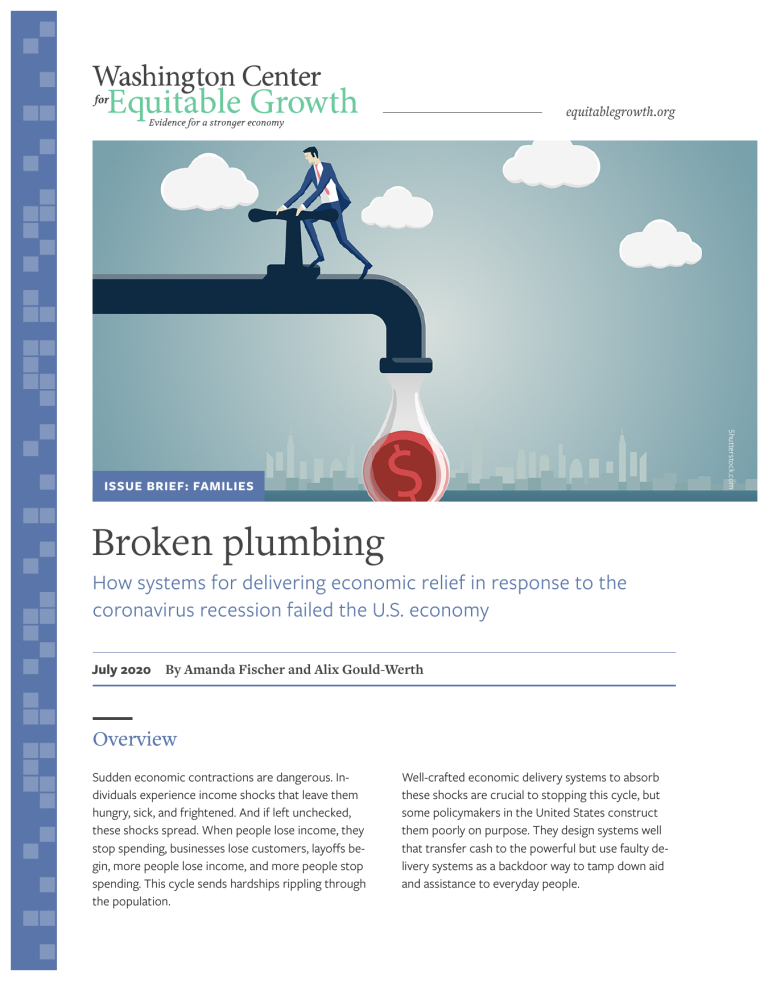
Broken plumbing: How systems for delivering economic relief in response to the coronavirus recession failed the U.S. economy (opens in a new tab)
Issue Briefs JUL 29, 2020
Sudden economic contractions are dangerous. Individuals experience income shocks that leave them hungry, sick, and frightened. And if left unchecked, these shocks spread. When people lose income, they stop spending,…
By: Amanda Fischer (opens in a new tab), Alix Gould-Werth (opens in a new tab)
A generational perspective on recent U.S. homeownership divergence by income and race (opens in a new tab)
Issue Briefs JUL 27, 2020
Between the end of 2012 and the end of 2019, the Federal Reserve Board estimates that the total value of U.S. owner-occupied housing increased nearly 60 percent, from $18.5 trillion…
By: John Sabelhaus (opens in a new tab), Austin Clemens (opens in a new tab)

Sleepwalking into depression: The economic response to COVID-19 in the United States (opens in a new tab)
Blog JUL 24, 2020
Almost five months into our country’s response to the coronavirus pandemic and ensuing recession, policymakers seem to have lost the urgency that characterized the initial days of dramatic, bipartisan action.…
By: Jacob Robbins (opens in a new tab)

New research on the Great Recession shows extended unemployment benefits insignificantly affect U.S. unemployment rates (opens in a new tab)
Blog JUL 21, 2020
Unemployment rates in the United States are currently higher than they were at height of the Great Recession, standing at 11.1 percent in June after declining from a record high…
By: Kate Bahn (opens in a new tab)
Did the Paycheck Protection Program work for small businesses across the United States? (opens in a new tab)
Issue Briefs JUL 15, 2020
Across the United States over the past few weeks, we’ve all seen advertisements, received emails, or heard from friends about small businesses trying to inch back to some semblance of…
By: Amanda Fischer (opens in a new tab)

Americans want green spending in federal coronavirus recession relief packages (opens in a new tab)
Blog JUL 7, 2020
Coronavirus recession relief packages now under discussion on Capitol Hill present an opportunity to power an economic rebound and address climate change at the same time. This approach would save…
By: Matto Mildenberger (opens in a new tab), Leah Stokes (opens in a new tab)
The coronavirus recession highlights the importance of automatic stabilizers (opens in a new tab)
Issue Briefs JUN 30, 2020
In February 2020, the U.S. unemployment rate was 3.5 percent. In May 2020, it stood at 13.3 percent. The unemployment rate for Black workers was a still-higher 16.8 percent. Unemployment…
By: Greg Leiserson (opens in a new tab)

The coronavirus recession is an opportunity to cancel all U.S. student loan debt (opens in a new tab)
Blog JUN 24, 2020
This past March, as a coronavirus relief measure, Congress suspended payments on a lion’s share of federally owned student loans for 6 months. When this temporary loan forbearance expires on…
By: Darrick Hamilton (opens in a new tab), Naomi Zewde (opens in a new tab)
Equitable Growth webinar will explore bold policies to ensure a broad-based economic recovery (opens in a new tab)
Blog JUN 23, 2020
The coronavirus pandemic and the ensuing economic recession have exposed and exacerbated many systemic inequalities in U.S. society, especially for Black and Latinx families. Even after a decade of growth…
By: David S. Mitchell (opens in a new tab)
Equitable Growth and The Hamilton Project bring together policymakers and academics to discuss how to fight the coronavirus recession (opens in a new tab)
Videos JUN 11, 2020
At a June 8 online event sponsored by the Washington Center for Equitable Growth and The Brookings Institution’s The Hamilton Project, key policymakers and academics discussed how the coronavirus recession…
By: David S. Mitchell (opens in a new tab)
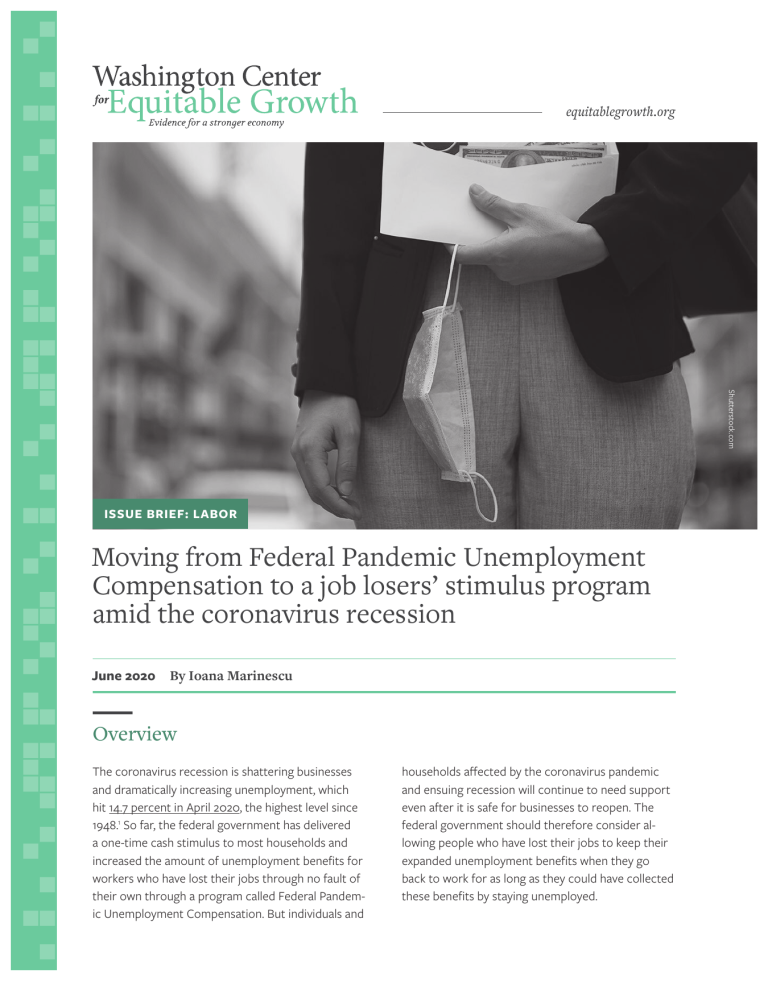
Moving from Federal Pandemic Unemployment Compensation to a job losers’ stimulus program amid the coronavirus recession (opens in a new tab)
Issue Briefs JUN 5, 2020
The coronavirus recession is shattering businesses and dramatically increasing unemployment, which hit 14.7 percent in April 2020, the highest level since 1948. So far, the federal government has delivered a…
By: Ioana Marinescu (opens in a new tab)
One year later: Recession Ready and the coronavirus recession (opens in a new tab)
Videos JUN 1, 2020
Proposals put forth can help support communities, stabilize the economy amid coronavirus recession One year ago, long before the risks of the new coronavirus and the ensuing recession enveloped our…
By: Equitable Growth (opens in a new tab)
Policy options for building resilient U.S. medical supply networks (opens in a new tab)
Issue Briefs MAY 29, 2020
U.S. policymakers in Congress across the political spectrum, from Sen. Marco Rubio (R-FL) to Rep. Elissa Slotkin (D-MI) to Sen. Bernie Sanders (I-VT), all agree that the United States is…
By: David Adler (opens in a new tab), Dan Breznitz (opens in a new tab), Susan Helper (opens in a new tab)
U.S. income inequality is worse and rising faster than policymakers probably realize (opens in a new tab)
Issue Briefs MAY 27, 2020
The use of U.S. administrative income tax data for research purposes over the past two decades has led to an ongoing debate about levels and trends in U.S. income inequality.…
By: John Sabelhaus (opens in a new tab), Somin Park (opens in a new tab)

Coronavirus recession: How to get the U.S. economy back on track (opens in a new tab)
Videos MAY 26, 2020
Amid our nation’s health and economic crises, government officials must do more. They must use research and evidence-based polices to support people today and strengthen our economic future. The Washington…
By: Equitable Growth (opens in a new tab)
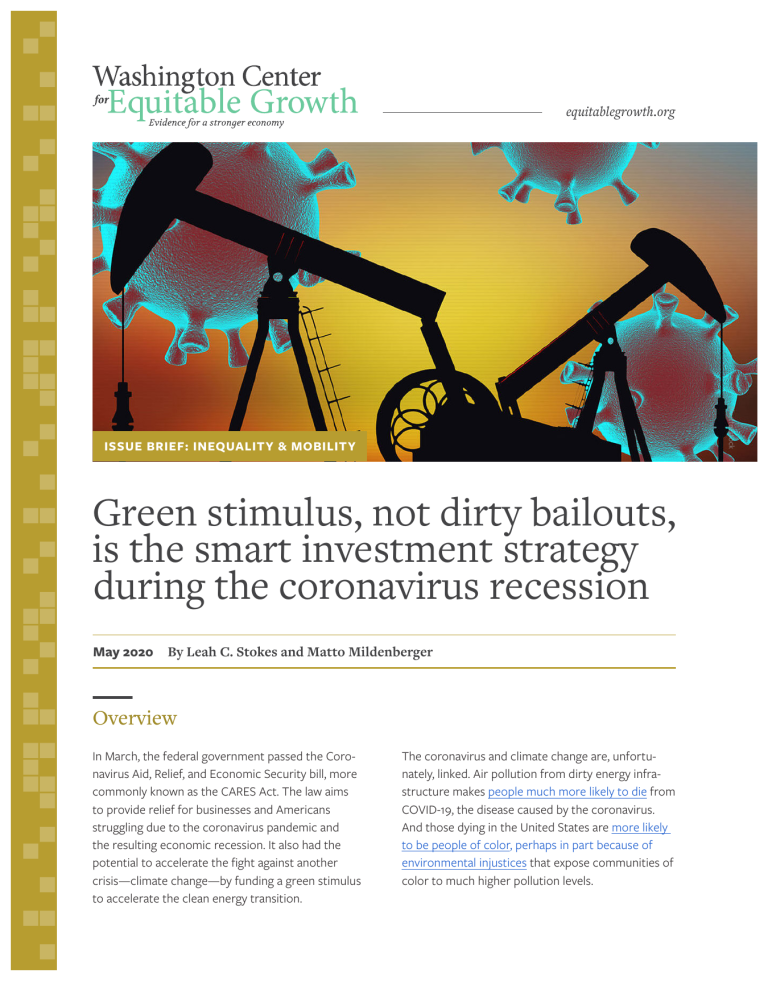
Green stimulus, not dirty bailouts, is the smart investment strategy during the coronavirus recession (opens in a new tab)
Issue Briefs MAY 18, 2020
In March, the federal government passed the Coronavirus Aid, Relief, and Economic Security bill, more commonly known as the CARES Act. The law aims to provide relief for businesses and…
By: Leah Stokes (opens in a new tab), Matto Mildenberger (opens in a new tab)

Data will provide accountability to ensure the U.S. economic recovery is shared broadly (opens in a new tab)
Blog MAY 15, 2020
The U.S. economy is a long way from experiencing a recovery from the coronavirus recession. But the actions Congress takes now will determine just how deep the recession gets and…
By: Austin Clemens (opens in a new tab)

For an equitable recovery, federal relief to deal with the coronavirus recession must be transparent to the U.S. public (opens in a new tab)
Blog MAY 13, 2020
U.S. policymakers’ decisions are only as good as the data they have to inform them, and the public’s trust in institutions is only as good as the information available to…
By: Amanda Fischer (opens in a new tab)

The coronavirus recession is severe, and the damage to the U.S. economy will last years (opens in a new tab)
Blog APR 29, 2020
I shared my views on the coronavirus recession on March 24, at a virtual conference that economists Emmanuel Saez and Gabriel Zucman at the University of California, Berkeley organized. My…
By: Claudia Sahm (opens in a new tab)

Good U.S. fiscal policy could have made us stronger before the coronavirus recession and can make us stronger afterward (opens in a new tab)
Blog APR 28, 2020
When U.S. policymakers seek to restore the U.S. economy in the wake of the coronavirus recession, what will constitute success? Returning the economy to its prepandemic state is not sufficient.…
By: John Sabelhaus (opens in a new tab)

Where should the marginal dollar go in U.S. fiscal policy—to testing or to the safety net—amid a pandemic-induced economic downturn? (opens in a new tab)
Blog APR 27, 2020
In our recent working paper, “An SEIR Infectious Disease Model with Testing and Conditional Quarantine,” the two of us and Simon Mongey, an assistant professor of economics at the University…
By: David Berger (opens in a new tab), Kyle Herkenhoff (opens in a new tab)


Your Direct Line to Cutting Edge Research
Be the first to know about our latest events, research releases, and expert insights. Get exclusive updates delivered right to your inbox and never miss an opportunity to engage with our community.