
Public investments in social insurance, education, and child care can overcome market failures to promote family and economic well-being
Blog JAN 14, 2021
By: Sandra Black, Jesse Rothstein
AUG 5, 2021
By: Liz Hipple and Alix Gould-Werth
The coronavirus public health emergency and resulting economic recession brought into stark relief the engrained problems with the system of income support for U.S. workers and their families. People in the United States access income support from a wide range of programs, including Social Security, Unemployment Insurance, the Earned Income Tax Credit, and the Temporary Assistance to Needy Families program, to name a few.
Despite the number of programs that make up our income support system, many people who need this support are blocked from accessing it. During the COVID-19 crisis, the existing income support infrastructure has been wholly insufficient for providing relief to those who needed it.130 And while the pandemic-specific income supports delivered through the Coronavirus Aid, Relief, and Economic Security, or CARES, Act and related programs successfully (opens in a new tab) blunted some of the worst pain of the pandemic, they also failed to deliver for all who needed (opens in a new tab) income support due to sustained underinvestment in these key income support programs over the past half-century.131
The coronavirus health and economic crisis is being felt widely by millions of U.S. workers and their families, yet people across the country face crises of their own every day no matter the broader economic or public health outlook. Whether it’s a personal or national crisis, the inability to access income support programs to weather unexpected storms has serious consequences, especially for many workers of color, women, and their families. Indeed, the coronavirus recession exposed already deep inequalities (opens in a new tab) in access to income supports along lines of race and gender.132
What is it, precisely, that stops people from accessing income supports? There are three main barriers:
No matter one’s place in the income distribution at any given time, these weaknesses in our nation’s income support system prevent the U.S. economy from reaching its full potential through lowered labor force participation, a weakened macroeconomy during economic recessions, and underinvestment in the human capital of the next generation of workers. What’s more, all of us are likely to face a personal need for income support at some point over the course of our lives.
So, let’s examine the challenges confronting the United States’ system of income supports. Then, we will turn to examining why these are problems both for our economy at large and ourselves as individuals.
We define income supports as those programs that transfer cash to households (including both social insurance programs that make transfers based on past earnings among other criteria, social welfare programs that make transfers based on current income and wealth levels among other criteria, as well as income transfers made through the tax system) and in-kind transfer programs that relieve pressure on household budgets and effectively provide income support (for example, when households receive food or housing support they no longer need to spend their limited income on food and housing and can instead use that cash to cover other needs). Together these distinct types of programs create our nation’s system of income supports. Let’s examine the challenges confronting our income support system across each of the three criteria mentioned before: eligibility, accessibility, and adequacy.
Despite fallacious stereotypes about profligacy in income support programs, it is actually intentionally (opens in a new tab) quite hard to access them in the first place.133 Eligibility criteria typically screen out many people based on their family status, asset levels, age, or ability status. Simply by getting married (opens in a new tab), maintaining (opens in a new tab) a modest “rainy day” fund, or keeping a reliable car (opens in a new tab), a person can lose eligibility for an income support program.134
Additionally, to access many income support programs, a person must be employed—despite the fact that lacking income may be the factor that is preventing (opens in a new tab) a person from maintaining employment.135 If a person cannot afford transportation or child care, for example, it can be difficult to stay employed.
Since the 1990s, changes to our income support system have only further tied eligibility to work (opens in a new tab) requirements, with the replacement of Aid to Families with Dependent Children with the Temporary Assistance for Needy Families (opens in a new tab) program and the creation of the Earned Income Tax Credit. Even the Supplemental Nutrition Assistance Program, or SNAP, colloquially known as food stamps, has work requirements (opens in a new tab).136
While many people with inadequate incomes are indeed active participants (opens in a new tab) in the labor force, others may have caretaking obligations, health challenges, or face discouragement in the search for employment situations that are safe.137 When workers hit a moment in their lives when they are unable to be in the labor force, this may actually be the time they need income support the most.
But even among people who meet all the eligibility requirements for income support, the rate at which they access those benefits remains low.
The low proportion (opens in a new tab) of eligible people accessing UI benefits provides a salient example of how systems and processes that are out of date or purposefully difficult to navigate keep people from accessing the income support they need and are eligible for.138 In the spring of 2020, an unprecedented number of workers were laid off as a result of the coronavirus recession and applied for Unemployment Insurance. More than 1 in 7 American workers (opens in a new tab) applied for income support through the UI program.139
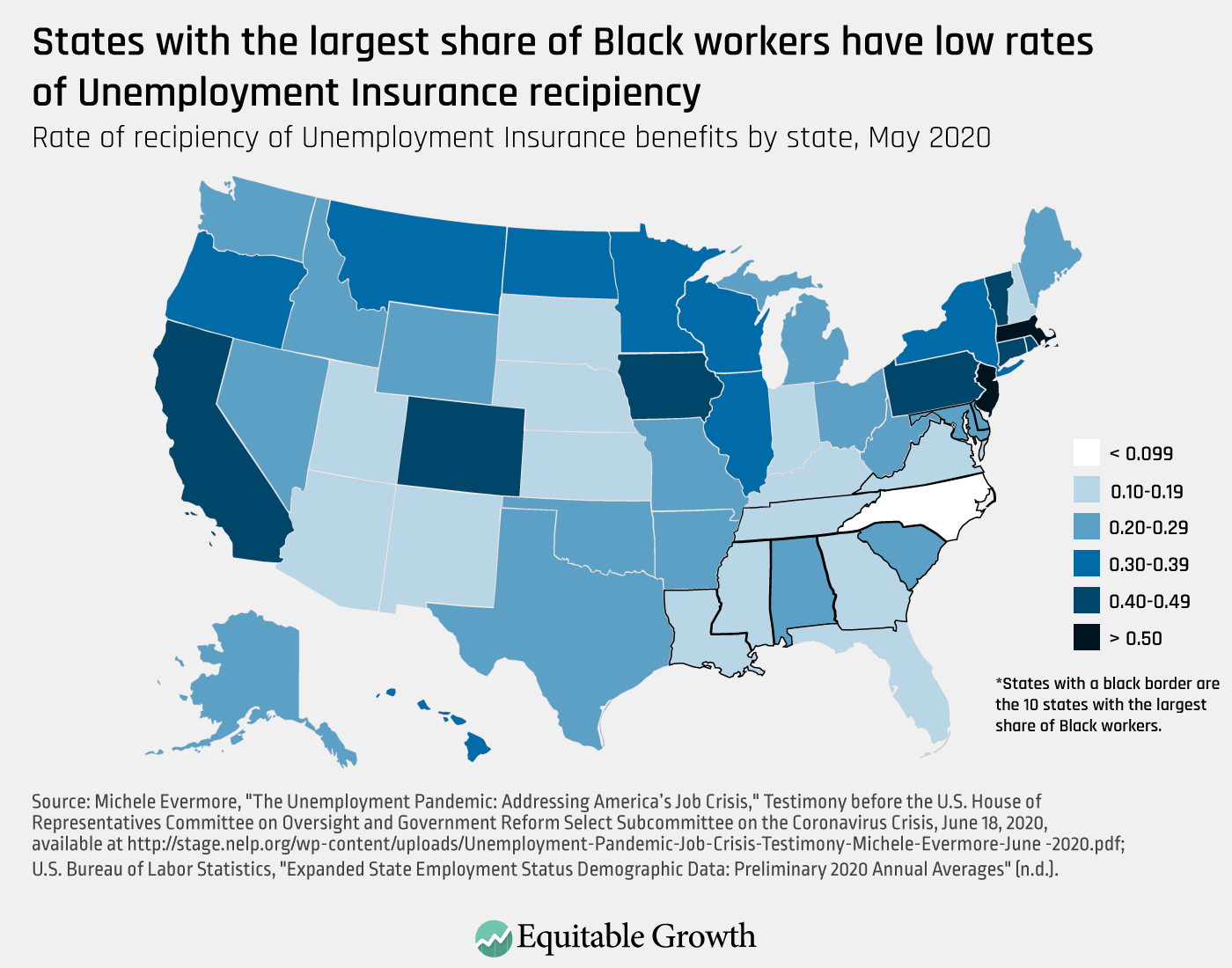
Yet poorly designed systems for applying for benefits, from understaffed phone lines to arcane websites, meant that millions of workers waited weeks to get the payments they were eligible for, if they got them at all (opens in a new tab). 140States make choices about whether to invest resources in improving system accessibility, and racism appears to shape these choices. Rates of UI access are low (opens in a new tab) in states with a greater share of Black workers.141 (See Figure 1.) (opens in a new tab)

Rate of recipiency of Unemployment Insurance benefits by state, May 2020
Many headlines highlighted the difficulty faced by workers who lost their jobs through no fault of their own in accessing Unemployment Insurance during the early days of the pandemic, but this is not the only example of the challenges of claiming income support for which one is eligible. In all public health and economic contexts, people struggle to travel to Social Security Administration field offices (opens in a new tab) to complete disability applications, complete the paperwork necessary to recertify (opens in a new tab) for the Supplemental Nutrition Assistance Program, and correctly document (opens in a new tab) their work participation to remain eligible for the Temporary Assistance for Needy Families program.142
The many difficulties people eligible for income support face is a policy choice (opens in a new tab), not an inevitability of bureaucratic programs.143 There are examples of income support programs with high take-up rates, such as the Earned Income Tax Credit and Social Security. The EITC has a nearly 80 percent take-up rate (opens in a new tab), and 97 percent (opens in a new tab) of elderly Americans receive Social Security benefits.144
A key reason for the high take-up rates for these two income support programs is the lack of red tape. Filing one’s taxes once a year and submitting an initial application are all that is required to receive these sources of income support. In stark contrast to programs with lower take-up rates, such as Unemployment Insurance and Temporary Assistance for Needy Families, there is no regular ongoing process that people have to go through to prove their eligibility. Indeed, the relative absence of bureaucratic hurdles associated with claiming tax credits is a factor that influenced Congress’ recent passage of legislation that provides (opens in a new tab) income support to children delivered through through periodic payments of a fully refundable Child Tax Credit during 2021.145
Even people who surmount the obstacles of meeting eligibility requirements and navigate the process required to gain access to income support find that the income is insufficient to help meet their basic needs. The maximum monthly amount that a family of four with no income receives from the Supplemental Nutrition Assistance Program is $680 (opens in a new tab), or $5.48 per person per day.146 Families with any income at all receive less than this.
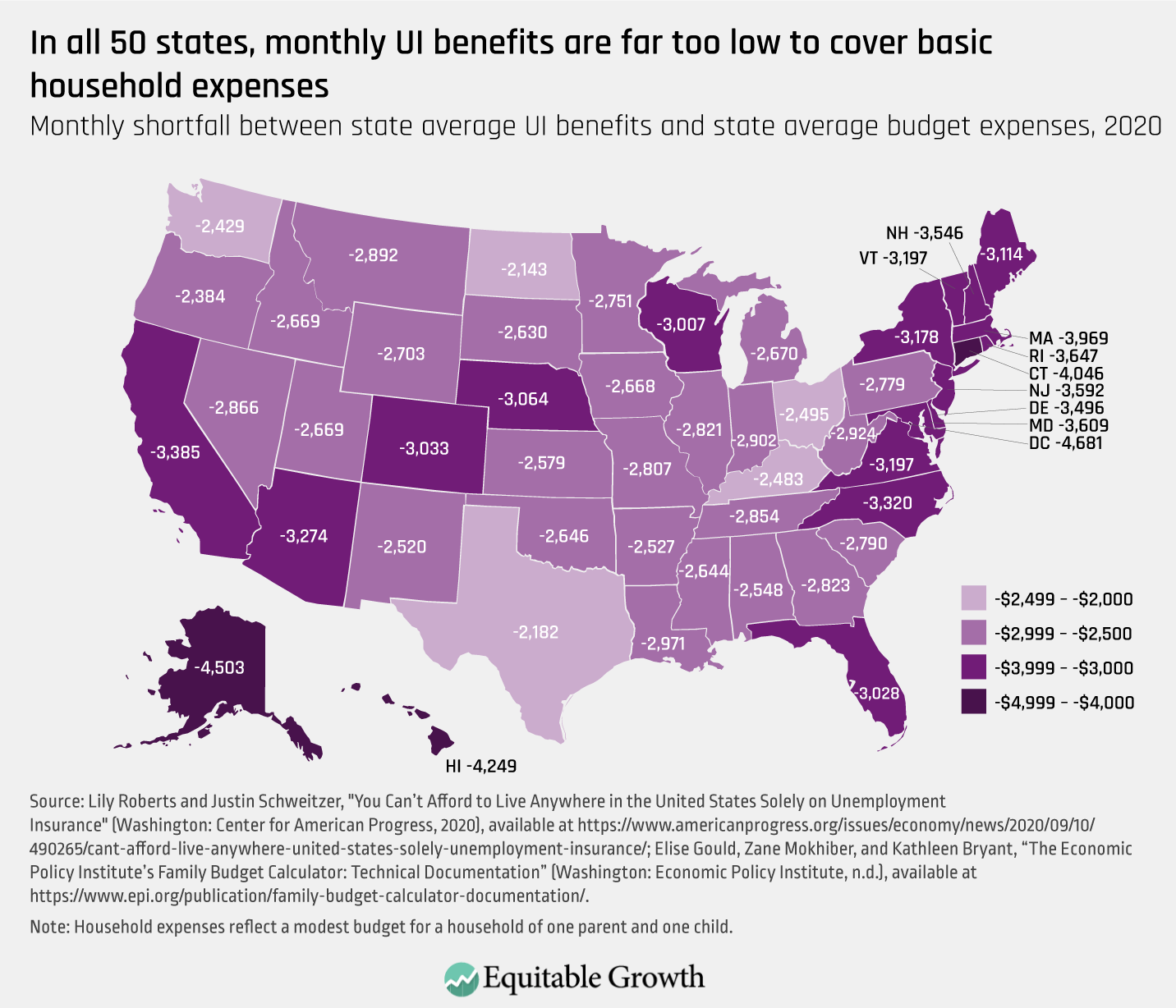
Despite being a social insurance program, Unemployment Insurance also doesn’t begin (opens in a new tab) to provide enough income to make up for the wages lost when a job is lost.147 Indeed, in no state (opens in a new tab) are regular UI benefits sufficient to cover a person’s basic needs of housing, food, child care, transportation, healthcare, taxes, and other necessities such as clothing and school supplies.148 (See Figure 2.)

Monthly shortfall between state average UI benefits and state average budget expenses, 2020
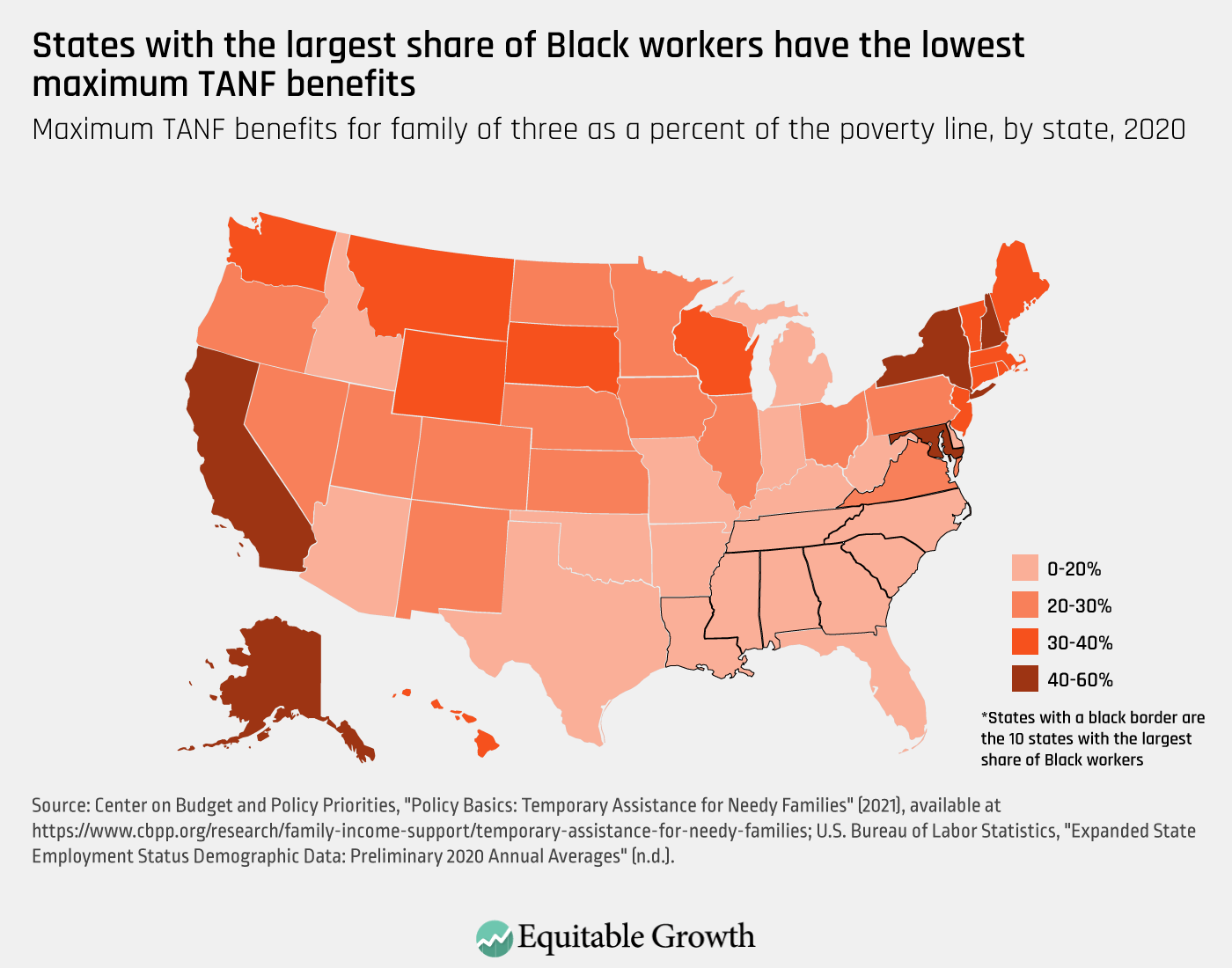
The income support provided by the Temporary Assistance to Needy Families program leaves a family of three (opens in a new tab) below half of the poverty line in almost every state and is time-limited, as its name suggests.149 Racism (opens in a new tab) also shapes the level of support this program provides: States with a greater share of Black residents provide lower levels of income support through the Temporary Assistance to Needy Families program than states with fewer Black residents.150

Maximum TANF benefits for family of three as a percent of the poverty line, by state, 2020
A weak system of income support harms individual workers and their families, who, at some point in their lives, experience the vicissitudes of life without adequate income. This weak system also harms the overall strength and growth potential of the U.S. economy.
During recessions, for example, income support acts as an “automatic stabilizer.”151 This means the use of income support programs, such as Unemployment Insurance and SNAP, increases during recessions as workers are laid off and apply for them to help replace their lost incomes.
This kind of income support not only helps those individual workers and their families in need, but also ensures people are still able to purchase goods and services during an economic downturn, which softens the aggregate impact (opens in a new tab) of recessions on the economy.152 Indeed, increased government spending on Unemployment Insurance during the Great Recession of 2007–2009 boosted overall Gross Domestic Product: For every $1 spent on extending UI benefits, we saw an additional $1.61 (opens in a new tab) in economic activity.153
Other income support programs, including the Temporary Assistance for Needy Families program, could also play this important countercyclical role, but policymakers have (opens in a new tab) so eroded (opens in a new tab) the program’s effectiveness that TANF income support does not respond swiftly when a recession hits.154 When any of these programs are difficult to access or have low benefit amounts, their efficacy as automatic stabilizers is blunted.
Another way a strong income support system strengthens the economy is via its positive impacts on U.S. labor market outcomes. Research shows that access to paid leave, child care support (opens in a new tab), and EITC (opens in a new tab) income support all increase women’s labor force participation rates.155
Another example comes from the UI system, which research shows improves workers’ “job matching.”156 This means that with more time, people are able to find jobs that are a better match for their skills. This doesn’t just benefit individual workers in terms of higher earnings. Better job matching also benefits the whole economy in the form of increased efficiency, productivity, and higher revenue on those higher earnings.
Weaknesses in our current system of income support also hurt the human capital development of workers (opens in a new tab), as well as the children of workers.157 This means the economic consequences of a weak system of income support aren’t just felt in the present but also extend into the future. An extensive body of research spanning decades shows the importance of childhood environments for human capital development.158
Human capital plays a crucial role in determining future education and earnings outcomes. Underinvesting in children’s human capital development today means less-educated and lower-earning workers in the future, which depresses the economy’s potential growth.
New research shows how widespread the economic benefits of just a single income support program—specifically, SNAP—can be.159 Hilary Hoynes, an economist at the University of California, Berkeley, and her co-authors find that children with early access to food assistance grew up to be better-educated and have healthier, longer, and more productive lives. This economically benefits all of us in the form of higher tax revenue, lower future expenditures on income support programs, and lower expenditure on the criminal justice system.
The issues discussed above with eligibility requirements, access difficulty, and income adequacy are all examples of how our current system of income support is failing to meet the needs of so many people in the United States. Such inadequacies are not abstract issues. While a common perception is that only a small proportion of U.S. residents have unmet need for income support, evidence (opens in a new tab) shows that the vast majority of people in the United States are at risk of a change in income that would lead them to experience poverty for 1 to 2 years.160
Nearly everyone at some point in their lives will experience an unmet need for income support. Contrary to racist portrayals (opens in a new tab) of who actually uses and benefits from income support programs, the experience of poverty is actually something that the majority of people in the United States will face in their lifetimes.161
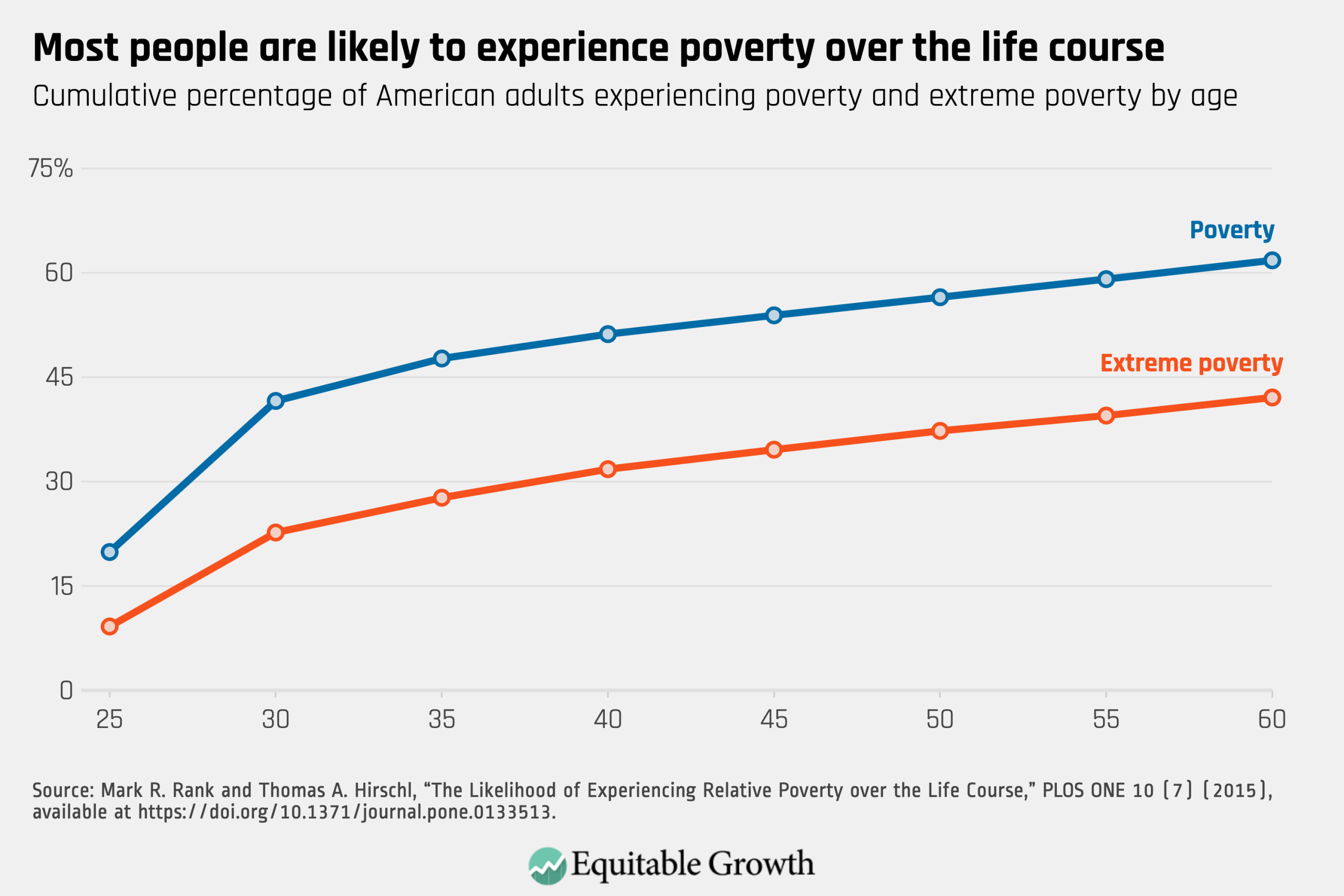
Research by Mark Rank at Washington University in St. Louis and Thomas Hirschl at Cornell University finds (opens in a new tab) that between the ages of 25 and 60, 54 percent of U.S. residents will experience poverty or near poverty at least once.162 Further, 61.8 percent of U.S. residents will spend a year below the 20th percentile of the income distribution, and 42.1 percent will spend a year below the 10th percentile. (See Figure 4.)

Cumulative percentage of American adults experience poverty and extreme poverty by age
Another way to think about this is through the construct of risk. Americans have a 54 percent chance of experiencing poverty at least once during adulthood. This is more than the chance of having appendicitis (opens in a new tab) or getting divorced (opens in a new tab) over the course of a lifetime.163
As economists Jesse Rothstein at UC Berkeley and Sandra Black at Columbia University argue, it is inefficient to have families self-insure against unpredictable risks they cannot reasonably calculate for themselves, such as the chances of losing a job or sufficiently saving for retirement.164 Either way, many (opens in a new tab) families are not in a position to set aside substantial savings in case they experience a dip in income that pushes them under the poverty line.165
Even if families were in such a position, Black and Rothstein explain, “The federal government can provide social insurance protections at a much lower overall cost, and by removing major risks from families’ own balance sheets, enable families to stretch their market earnings further.” This kind of social infrastructure also allows for increased consumption overall.
Because most people will need income support at some point in their lives, and despite all the barriers our current system of income support puts up to accessing support, nearly all people in the United States will access income support programs at some point over the course of their lives. Analysis (opens in a new tab) by the Urban Institute finds that in any given month, nearly 1 in 5 people benefit from SNAP, Supplemental Security Income, TANF, public or subsidized housing, the Women, Infants, and Children, or WIC, program, or the Child Care and Development Fund.166
In addition, analysis (opens in a new tab) by the White House Council of Economic Advisers found that over the 32-year period from 1978 to 2010, more than one-third of all people received support from one of just three of these income supports: the Supplemental Nutrition Assistance Program, the Temporary Assistance for Needy Families and its predecessor programs, or Supplemental Security Income.167 Taking into account additional income support and social infrastructure programs such as school lunches, WIC, or disability insurance, among others, the percentage rises to nearly half of all households. This doesn’t mean that support levels are adequate or that workers and their families will receive income support every time they need it. But it does illustrate the breadth of people that need income support at some point in their lives.
Indeed, the U.S. Treasury Department recently found that when you consider Medicare and Social Security, nearly every single U.S. household (opens in a new tab) receives some form of income support.168 This is an especially important example to keep in mind because, unlike most income support programs, Medicare and Social Security are the two components of our social infrastructure that are easiest to access when needed. Eligibility for Medicare is automatic at age 65 (opens in a new tab) and may not even require a separate enrollment process for people already receiving Social Security.169 Similarly, Social Security’s nearly universal design and eligibility requirements mean that almost every member (opens in a new tab) of the U.S. population will receive its benefits at some point. This makes Social Security the largest anti-poverty program (opens in a new tab) in the United States.170
As the Medicare and Social Security case studies show, it is possible to design an income support system that easily reaches broad swathes of the population. So why do some programs reach so few people? This is an intentional policy choice, informed by our (opens in a new tab) racist history (opens in a new tab) as well as our racist present (opens in a new tab).171 To prevent Black people in the United States, as well as other people of color, from accessing income support programs we restrict (opens in a new tab) their availability.172 Policymakers make this choice despite the overwhelming evidence that nearly every person in the United States will at some point in time need a strong income support system, regardless of the racial group to which they claim membership.
The U.S. system of income support is inadequate to support U.S. workers and their families. This is an issue because it constrains and limits the overall strength of the U.S. economy, unnecessarily deepening recessions, depressing labor force participation, and harming future growth potential by underinvesting in the human capital of the next generation of workers. The problem is also personal: At some point, everyone will need some form of income support, whether it is to weather a job loss or illness or to be assured of a secure retirement.
By broadening eligibility, increasing the level of income support, and removing barriers to access, policymakers can strengthen these systems of income support in ways that will both help everyone weather the inevitable vicissitudes of life with less undue suffering, as well as strengthen the overall U.S. economy in ways that will pay dividends for all of us.
Blog JAN 14, 2021
By: Sandra Black, Jesse Rothstein
Issue Briefs APR 30, 2020
By: Alix Gould-Werth
Blog MAY 16, 2019
By: Alyssa Fisher
Get updates on our latest research, event announcements, and policy insights delivered straight to your inbox. Stay connected with the leading voices on equitable growth.