


Policy
What Work Does Generative AI Do?
Essays SEP 8, 2026
By: Alexander Bick, Adam Blandin, David Deming, Tyler Schumacher
AI, Tech & Energy
Labor, Wages & Worker Power
 Browse All Resources
MAY 16, 2019
By: Alyssa Fisher
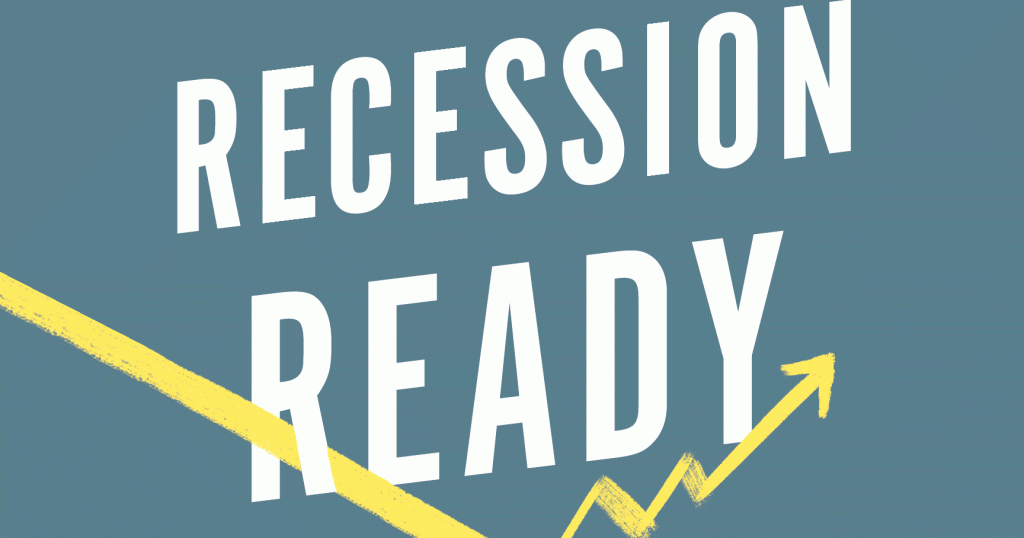
<img data-caption="In Recession Ready, experts from academia and the policy community propose six big ideas to be triggered when the economy shows clear, proven signs of heading into a recession.” alt=”In Recession Ready, experts from academia and the policy community propose six big ideas to be triggered when the economy shows clear, proven signs of heading into a recession.” class=”wp-photo size-full no-social-tools wp-image-51511″ src=”/wp-content/uploads/2019/05/rec-ready2-1.gif” width=”1728″ height=”908″ data-attachurl=”https://equitablegrowth.org/?attachment_id=51511″ data-attachid=”51511″ data-alignment=”alignnone” alt=”In <em>Recession Ready</em>, experts from academia and the policy community propose six big ideas to be triggered when the economy shows clear, proven signs of heading into a recession.”/>
When the U.S. economy is cruising down the road in high gear, as it is these days, it can be hard to focus on the next engine failure. Having occurred seven times in the past 50 years, recessions—like death and taxes—are inevitable. And they are painful, with harsh short-term effects on families and businesses and potentially deep long-term ill effects on the economy and society. But policymakers can ameliorate some of the next recession’s worst effects and minimize its long-term costs if they adopt smart policies now that will be triggered when the first warning signs of the downturn appear.
What are the best policies to put in place today? Policymakers need a guide, and Equitable Growth has joined forces with The Hamilton Project (opens in a new tab) to advance a set of specific, evidence-based policy ideas for shortening and easing the impacts of the next recession. In a new book, Recession Ready: Fiscal Policies to Stabilize the American Economy, experts from academia and the policy community propose six big ideas, including two entirely new initiatives and four significant improvements to existing programs, all to be triggered when the economy shows clear, proven signs of heading into a recession.
Recession Ready was edited by Equitable Growth Executive Director Heather Boushey, Ryan Nunn (opens in a new tab), a fellow in Economic Studies at the Brookings Institution and policy director for The Hamilton Project, and Jay Shambaugh (opens in a new tab), director of The Hamilton Project, senior fellow in Economic Studies at the Brookings Institution, and professor of economics and international affairs at the Elliott School of International Affairs at The George Washington University.
Automatic stabilizers for the economy are anything but a new concept. When a recession hits, the tax system and a number of key programs, from Unemployment Insurance to Medicaid, already cushion its effects by giving families suffering from unemployment or underemployment greater resources to cushion the blow or, in the case of the tax system, taking less (or nothing) in taxes. These results are important not only for families but also for the overall economy, which desperately needs the injection of greater resources. But as we have seen in most recessions, the existing automatic stabilizers are not nearly enough.
Recessions have victims. Millions of workers can lose their jobs. A generation of young people seeking to enter the workforce may find it daunting or even impossible. Families must contend with depleted savings and making painful choices among life’s necessities. And thriving businesses, especially small businesses, can be brought to their knees, hurting employers and employees. What’s worse, the most vulnerable are disproportionately affected. Numbers from the most recent downturn, while a severe example—it’s called the Great Recession for a reason—give an idea of the potential damage. The unemployment rate doubled to 10 percent and took 7 years to get back to its pre-recession level, 8.7 million jobs disappeared, and more than 5 million additional people were thrown into poverty—a number that would have been far greater (opens in a new tab) in the absence of the 2009 American Recovery and Reinvestment Act. There is evidence that these losses will have a long-term impact (opens in a new tab) on careers and earnings, especially for those who entered the job market during the recession.
The new Hamilton Project-Equitable Growth book provides background on past recessions, establishes the need for action ahead of the next recession, and contains a chapter on each of the six concrete ideas. The four proposals for strengthening existing programs are:
The two new automatic economic stabilizer programs in the Hamilton Project-Equitable Growth book are for infrastructure and direct payments to individuals:
For the most part, these initiatives are countercyclical. As pointed out by the editors and Jimmy O’Donnell (opens in a new tab) of The Hamilton Project in an early chapter, unemployment rates have reliably signaled the beginnings of recessions. These programs are to be triggered automatically by proven signs of a recession and expire when the economy is recovering. They inject funds into the economy to combat recession, and they withdraw those funds to avoid excessive stimulus during a recovery. Their activation would not prevent Congress and the administration from taking other measures to stabilize the economy during recessions and their aftermaths. But they would ensure significant, timely government action beyond the inadequate automatic spending that occurs under existing law. Because they affect different populations and have different implementation speeds, they are designed to be considered as a package in order to stimulate demand from individuals and families at all income levels and have a sustained impact. Congress should consider them now, because when the next recession appears on the horizon, it may be too late.
Essays SEP 8, 2026
By: Alexander Bick, Adam Blandin, David Deming, Tyler Schumacher
Working Papers SEP 8, 2026
By: Alexander Bick, Adam Blandin, David Deming, Tyler Schumacher
Essays SEP 2, 2026
By: Megan Rivera
Get updates on our latest research, event announcements, and policy insights delivered straight to your inbox. Stay connected with the leading voices on equitable growth.


