


Resources
From peer-reviewed research to accessible policy briefs, explore the scholarship that’s shaping debates and driving change.

3,838 Results

The deeper argument at the heart of the federal budget debate (opens in a new tab)
Reports OCT 5, 2026
Interest rates on the national debt have recently crept up to levels that the U.S. government and the American people haven’t experienced in several decades. This is a potentially concerning…
By: Michael Linden (opens in a new tab)

Trump’s trade war with Canada grows increasingly costly as Section 338 tariffs harm both economies (opens in a new tab)
Essays SEP 22, 2026
President Donald Trump continues to escalate his administration’s perplexing trade spat with Canada through the expanded use of novel tariff powers in Section 338 of the Tariff Act of 1930.…
By: Christopher Bangert-Drowns (opens in a new tab)

What Work Does Generative AI Do? (opens in a new tab)
Essays SEP 8, 2026
Since August 2024, our Real-Time Population Survey (RPS), a nationally representative survey of U.S. adults ages 18 to 64, has tracked how many Americans use generative artificial intelligence (AI). The adoption…
By: Alexander Bick (opens in a new tab), Adam Blandin (opens in a new tab), David Deming (opens in a new tab), Tyler Schumacher (opens in a new tab)
What Work Does Generative AI Do? (opens in a new tab)
Working Papers SEP 8, 2026
We measure how workers use genAI for their jobs in a nationally representative survey linking genAI adoption to detailed occupations and tasks. Our data provide the first task-level genAI adoption…
By: Alexander Bick (opens in a new tab), Adam Blandin (opens in a new tab), David Deming (opens in a new tab), Tyler Schumacher (opens in a new tab)

What happens to U.S. workers without access to Unemployment Insurance amid economic downturns or disruptions related to AI? (opens in a new tab)
Essays SEP 2, 2026
The adoption of artificial intelligence in the workplace has led to predictions of U.S. labor market disruptions. In response, policymakers have increased attention on the fitness of the nation’s social…
By: Megan Rivera (opens in a new tab)

Economic research shows immigration is good for U.S. workers, the economy, and affordability (opens in a new tab)
Essays AUG 31, 2026
When President Donald Trump returned to the White House in 2025, mass deportations and immigration restrictions were renewed as one of the political priorities of his second administration. Since then,…
By: Christopher Bangert-Drowns (opens in a new tab)
 View Chart
(opens in a new tab)
View Chart
(opens in a new tab)
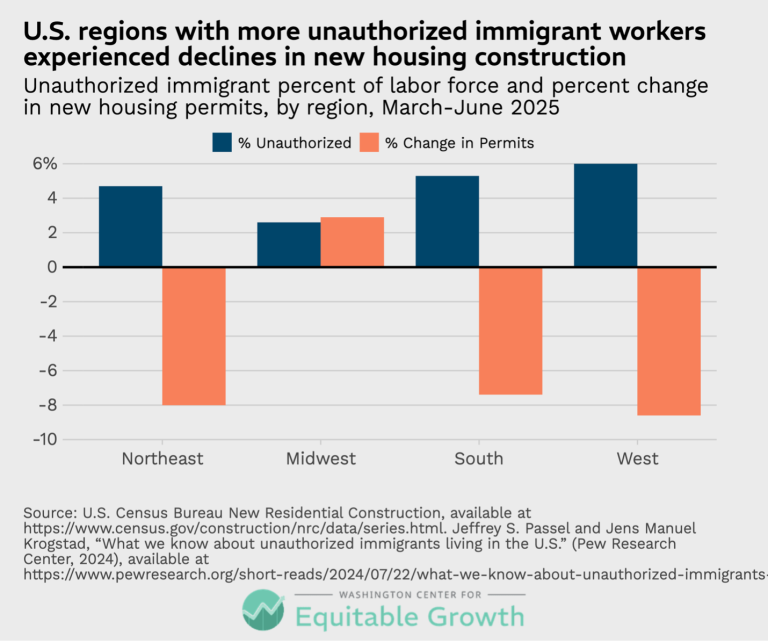
U.S. regions with more unauthorized immigrant workers experienced declines in new housing construction (opens in a new tab)
Visualizations AUG 31, 2026
 View Chart
(opens in a new tab)
View Chart
(opens in a new tab)
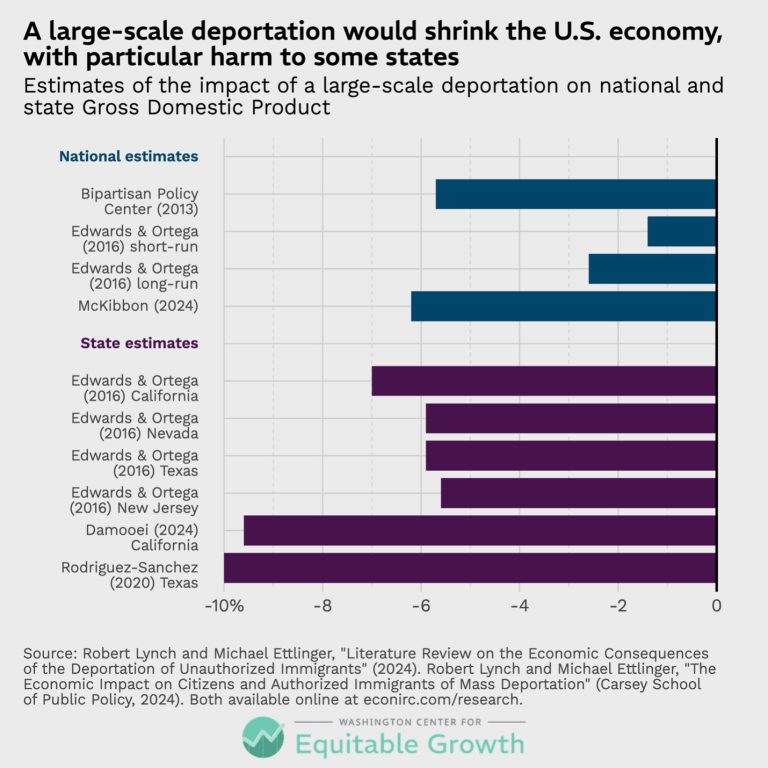
A large-scale deportation would shrink the U.S. economy, with particular harm to some states (opens in a new tab)
Visualizations AUG 31, 2026
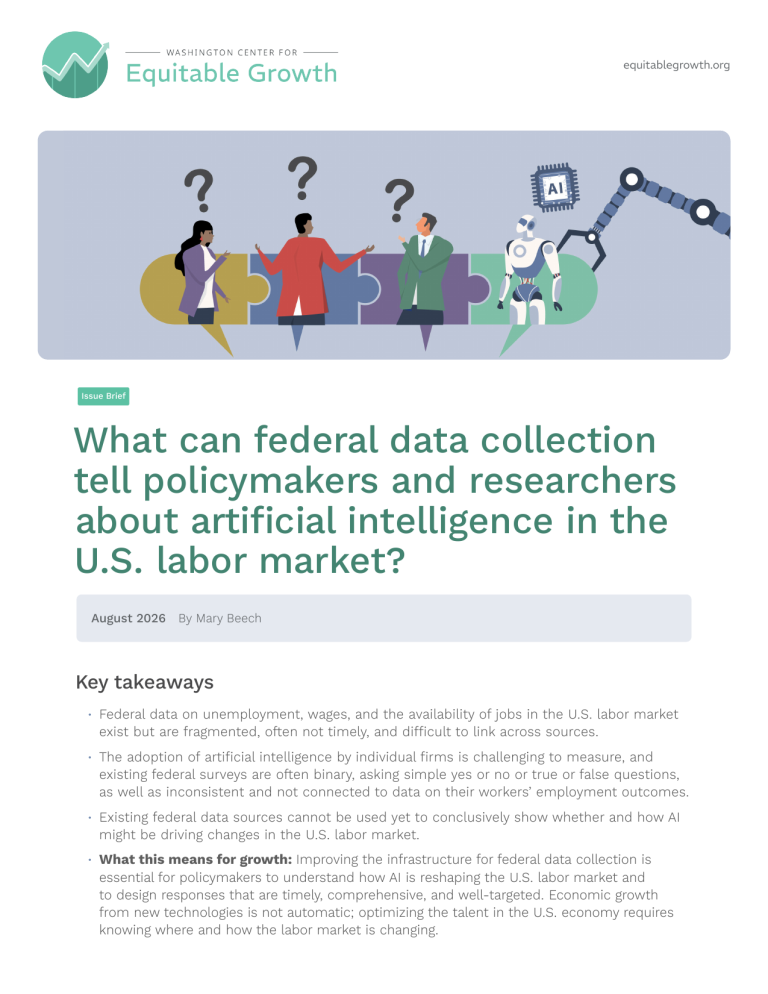
What can federal data collection tell policymakers and researchers about artificial intelligence in the U.S. labor market? (opens in a new tab)
Issue Briefs AUG 24, 2026
It is impossible to perfectly predict how artificial intelligence will affect the U.S. labor market. Policymakers and researchers are grappling with important questions around this topic, including what new opportunities…
By: Mary Beech (opens in a new tab)

Terms and conditions for generative AI users outline a new legal framework that puts U.S. consumers at risk (opens in a new tab)
Essays AUG 20, 2026
Generative AI, or genAI, is a form of artificial intelligence that produces content in response to prompts and includes large language model chatbots such as OpenAI’s ChatGPT or Anthropic’s Claude.…
By: Chiara Chanoi (opens in a new tab)
The Terms and Conditions of Generative AI (opens in a new tab)
Working Papers AUG 20, 2026
Generative AI raises pressing questions for myriad doctrinal areas. Policymakers and scholars have responded rapidly, devoting substantial attention to these difficult legal and policy questions. But, as a practical matter,…
By: John M. Newman, Andres Sawicki (opens in a new tab)

New research shows how U.S. homeownership and the accumulation of housing wealth are linked to political participation (opens in a new tab)
Essays AUG 14, 2026
Persistent affordability pressures have driven up housing costs for millions of U.S. families in recent years. Home prices remain near record highs relative to incomes, mortgage rates and associated costs…
By: Carlos Fernando Avenancio-Leon (opens in a new tab)
Housing Wealth Accumulation and Electoral Representation (opens in a new tab)
Working Papers AUG 14, 2026
We document that housing wealth accumulation systematically differs among homeowners by their political participation. Using a nationwide voter-property dataset, we find that realized housing appreciation increases monotonically the more a…
By: Carlos F. Avenancio-León, Yutao He (opens in a new tab), Michael Reher (opens in a new tab)
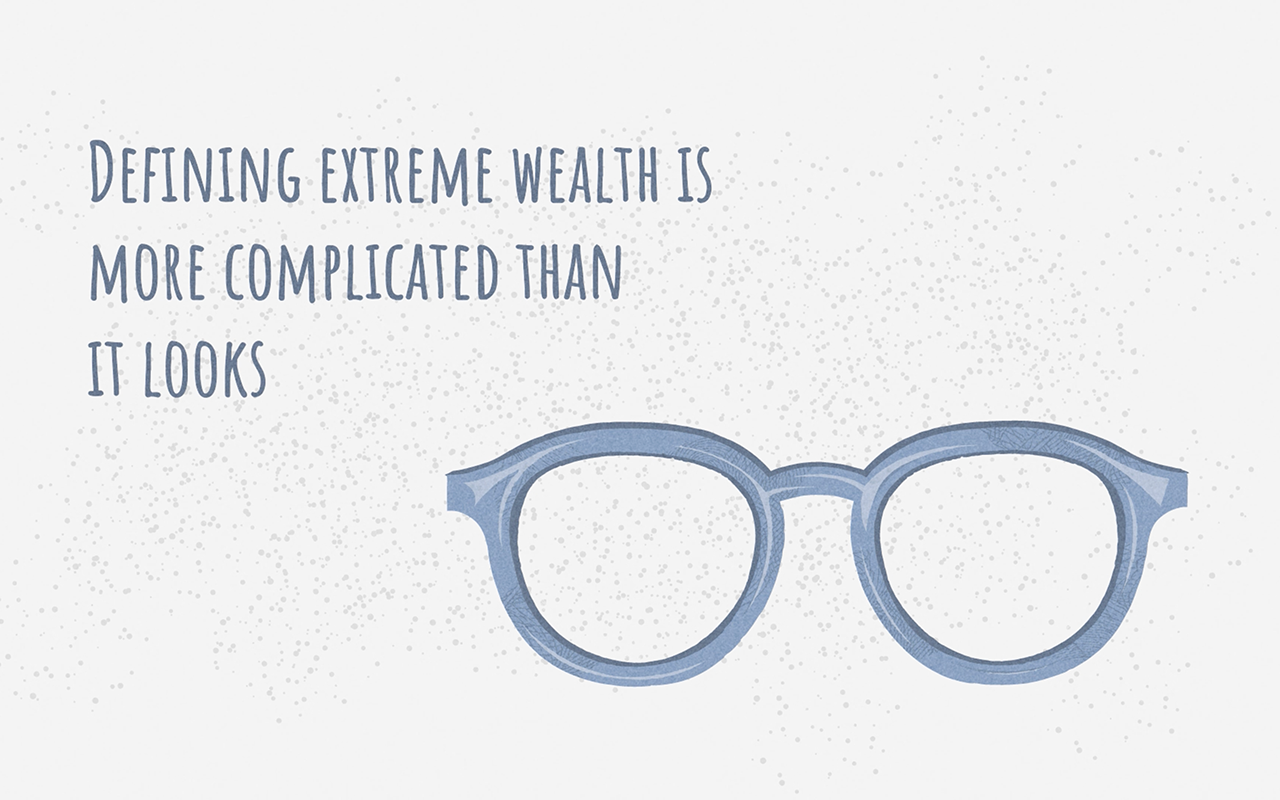
Defining extreme wealth is more complicated than it looks (opens in a new tab)
Videos AUG 13, 2026
Facing high levels of income and wealth inequality and shrinking tax revenues, U.S. policymakers are showing increased interest in proposals to tax the richest households. Yet determining which households fall into that category is complex and changes based…
By: Equitable Growth (opens in a new tab)

Estimating AI exposure is useful for research but cannot yet tell policymakers the whole story of AI’s impact on the labor market (opens in a new tab)
Essays AUG 7, 2026
Artificial intelligence has the potential to substantially change the nature and availability of work. To effectively manage the transitions this technology might bring to the U.S. economy, policymakers need information…
By: Chiara Chanoi (opens in a new tab)

Tracking new research on artificial intelligence and its impact on the U.S. labor market (opens in a new tab)
Essays AUG 5, 2026
Headlines often paint extreme and dissonant pictures of the future impact of AI on the U.S. economy and labor market, with workers themselves echoing the conflicting feelings of optimism and…
By: Equitable Growth (opens in a new tab)
The debt-to-wealth ratio: A missing lens on the U.S. government’s fiscal capacity (opens in a new tab)
Reports JUL 30, 2026
Few statistics shape the fiscal debate in the United States as powerfully as the ratio of federal debt-to-Gross Domestic Product. Debt held by the public recently surpassed 100 percent of…
By: Austin Clemens (opens in a new tab), David S. Mitchell (opens in a new tab)
 View Chart
(opens in a new tab)
View Chart
(opens in a new tab)
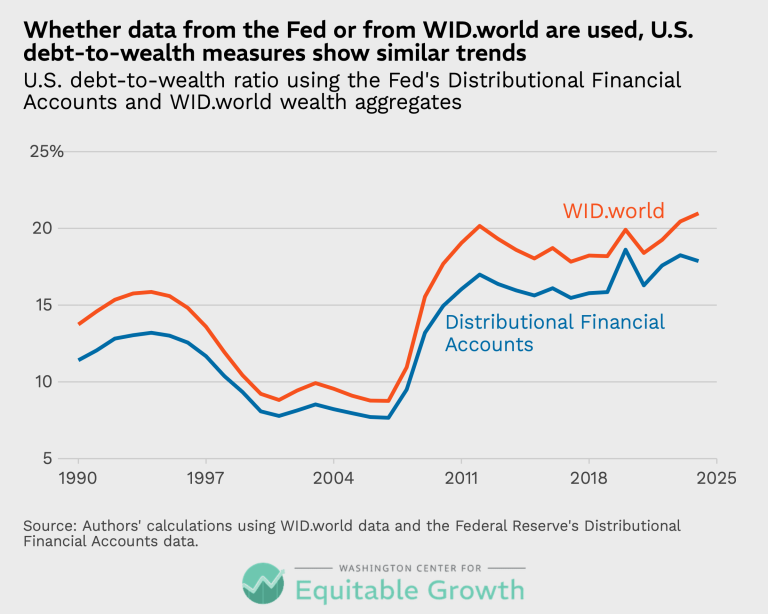
Whether data from the Fed or from WID.world are used, U.S. debt-to-wealth measures show similar trends (opens in a new tab)
Visualizations JUL 22, 2026
 View Chart
(opens in a new tab)
View Chart
(opens in a new tab)
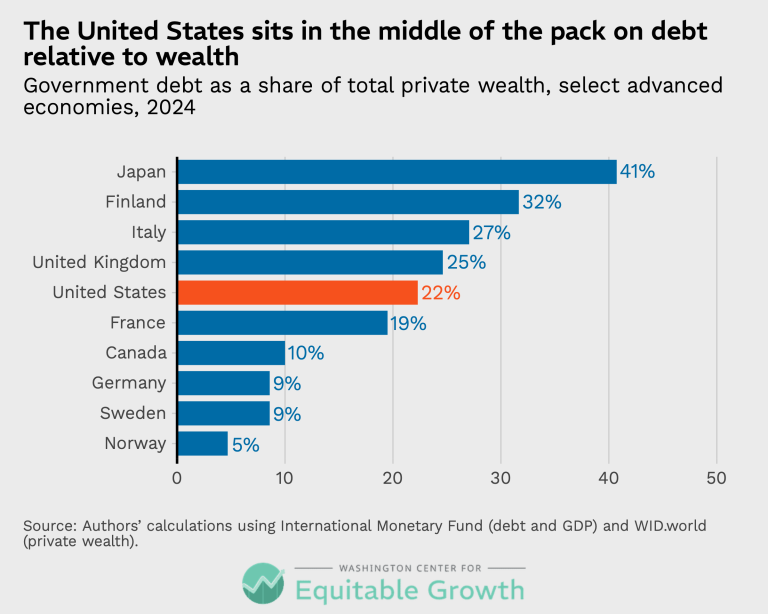
The United States sits in the middle of the pack on debt relative to wealth (opens in a new tab)
Visualizations JUL 22, 2026
 View Chart
(opens in a new tab)
View Chart
(opens in a new tab)
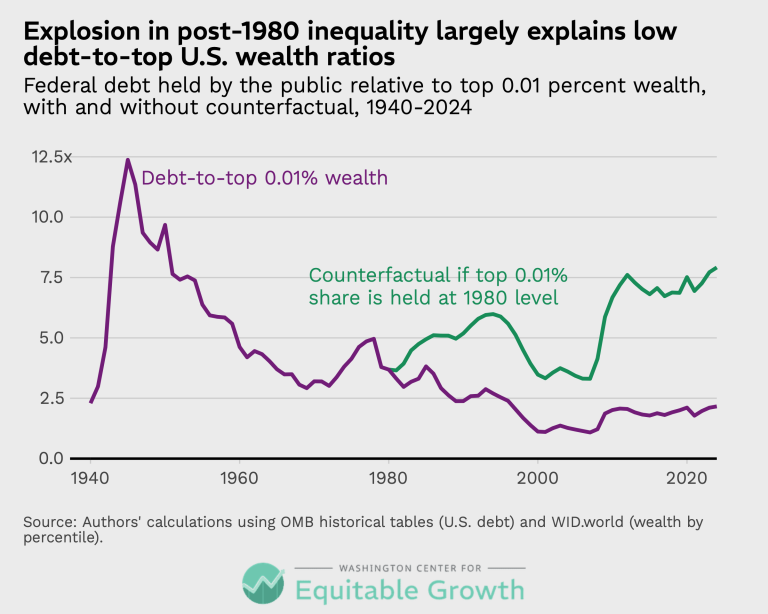
Explosion in post-1980 inequality largely explains low debt-to-top U.S. wealth ratios (opens in a new tab)
Visualizations JUL 22, 2026
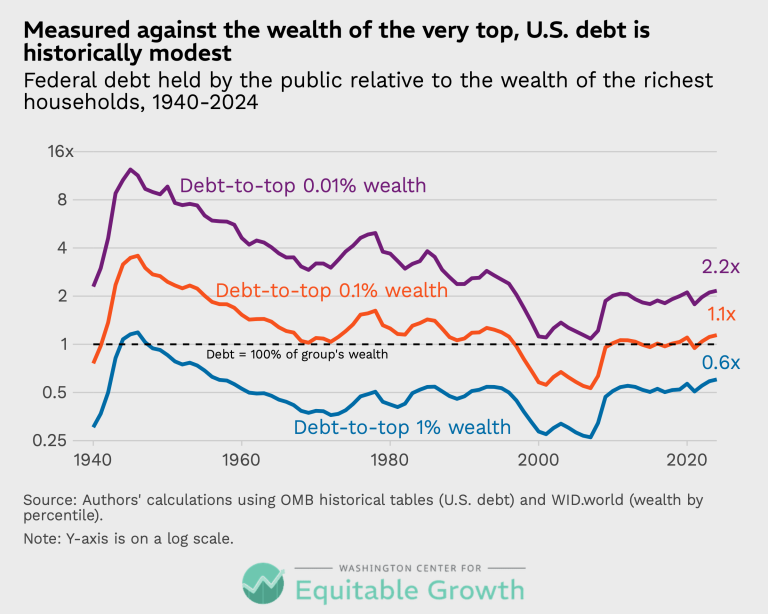 View Chart
(opens in a new tab)
View Chart
(opens in a new tab)
Measured against the wealth of the very top, U.S. debt is historically modest (opens in a new tab)
Visualizations JUL 22, 2026
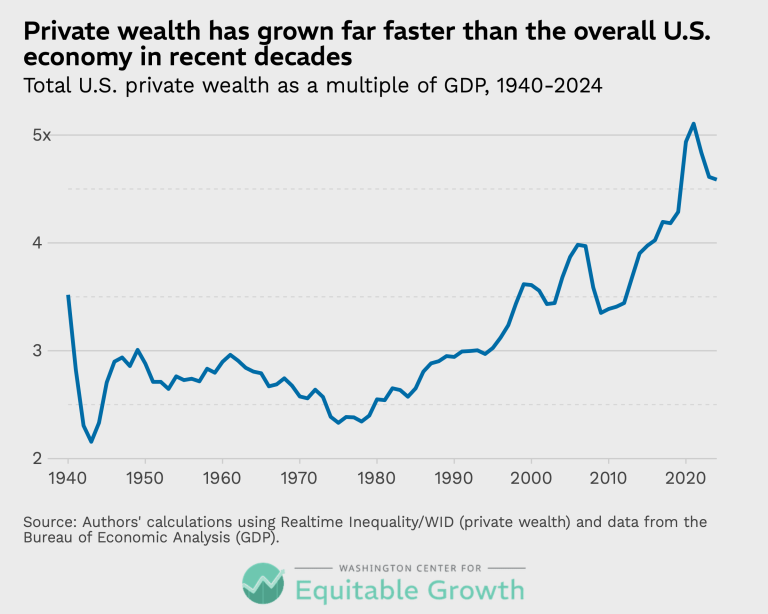 View Chart
(opens in a new tab)
View Chart
(opens in a new tab)
Private wealth has grown far faster than the overall U.S. economy in recent decades (opens in a new tab)
Visualizations JUL 22, 2026
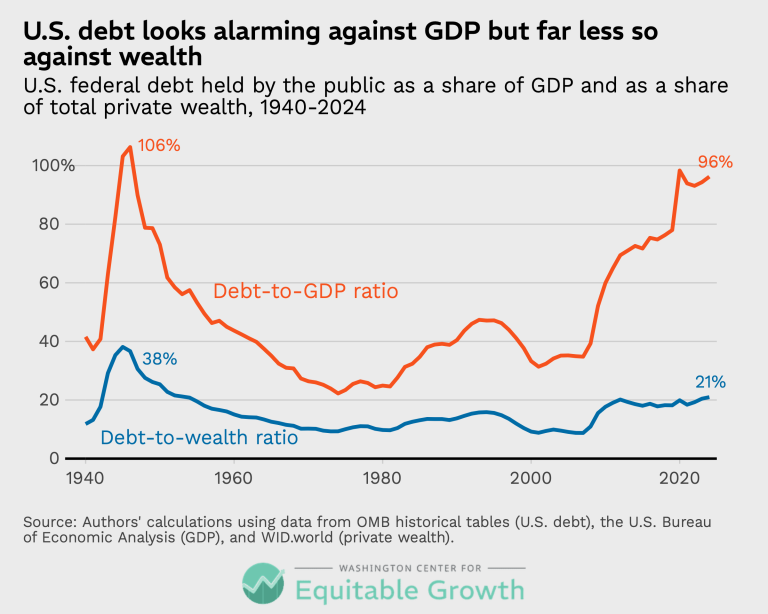 View Chart
(opens in a new tab)
View Chart
(opens in a new tab)
U.S. debt looks alarming against GDP but far less so against wealth (opens in a new tab)
Visualizations JUL 22, 2026

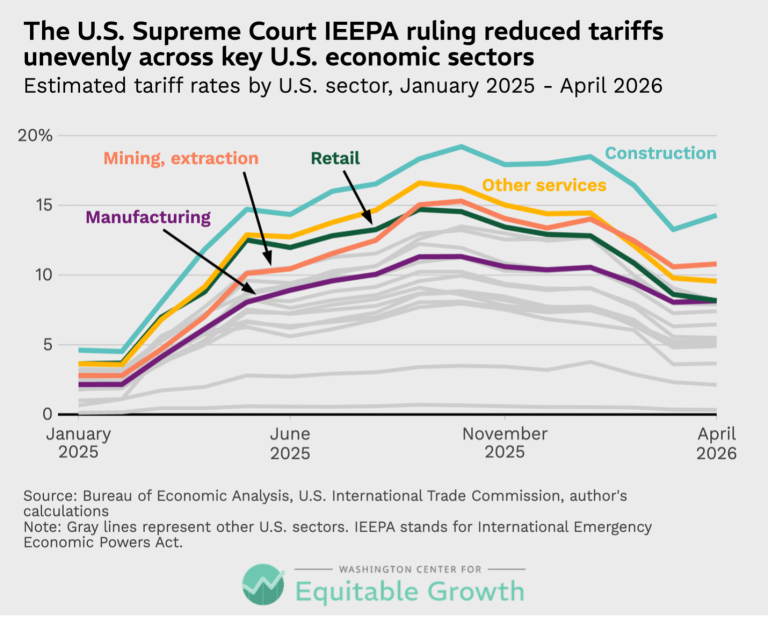
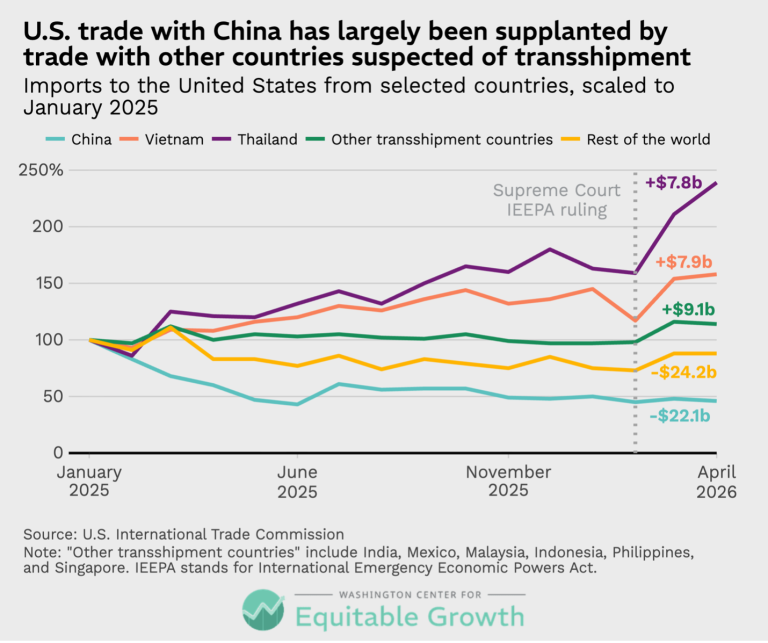
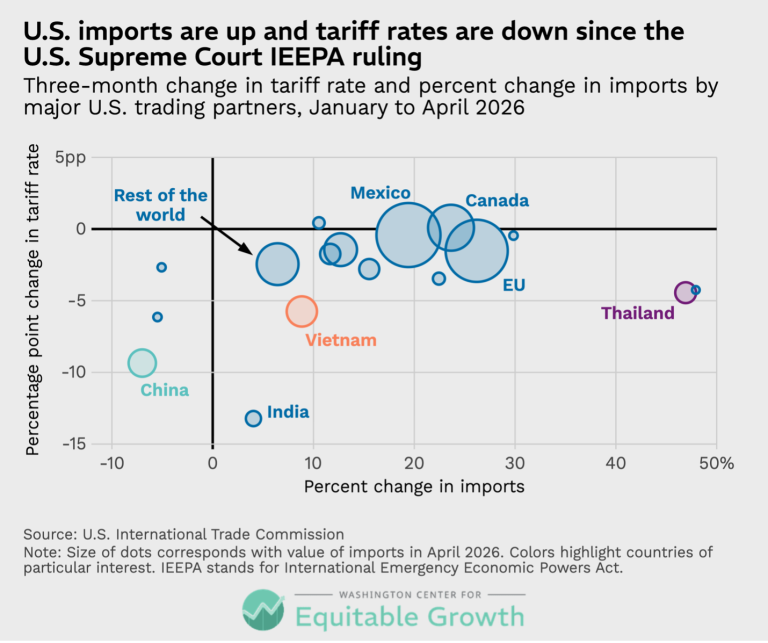
The costs of the Trump administration’s tariffs diverge for countries and industries so far in 2026 (opens in a new tab)
Essays JUL 14, 2026
The first 4 months of 2026 saw continued seismic changes in U.S. trade policy. In late February, the U.S. Supreme Court struck down the Trump administration’s use of the International…
By: Christopher Bangert-Drowns (opens in a new tab)
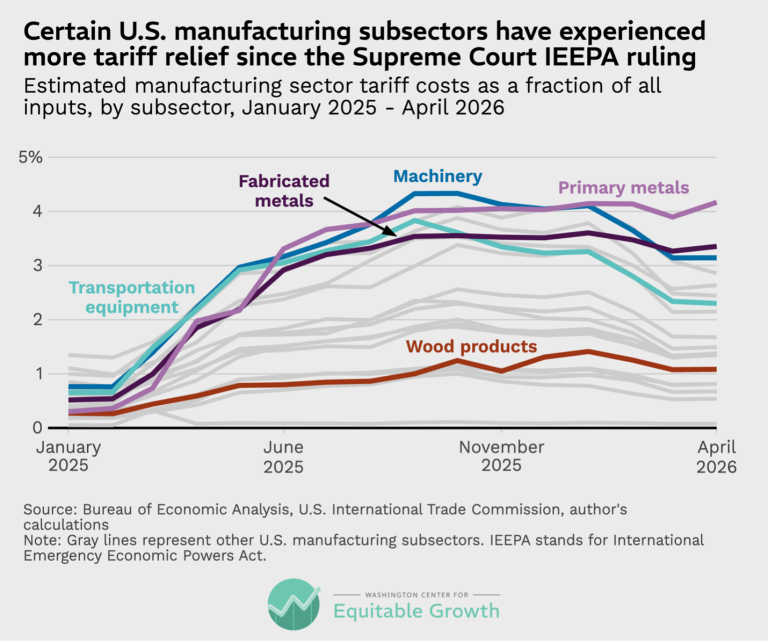 View Chart
(opens in a new tab)
View Chart
(opens in a new tab)
Certain U.S. manufacturing subsectors have experienced more tariff relief since the Supreme Court IEEPA ruling (opens in a new tab)
Visualizations JUL 13, 2026
 View Chart
(opens in a new tab)
View Chart
(opens in a new tab)
The U.S. Supreme Court IEEPA ruling reduced tariffs unevenly across key U.S. economic sectors (opens in a new tab)
Visualizations JUL 13, 2026
 View Chart
(opens in a new tab)
View Chart
(opens in a new tab)
U.S. trade with China has largely been supplanted by trade with other countries suspected of transshipment (opens in a new tab)
Visualizations JUL 13, 2026
 View Chart
(opens in a new tab)
View Chart
(opens in a new tab)
U.S. imports are up and tariff rates are down since the U.S. Supreme Court IEEPA ruling (opens in a new tab)
Visualizations JUL 13, 2026

Why Unemployment Insurance Alone Is Not Enough in the AI Era (opens in a new tab)
Essays JUL 8, 2026
Since the large language model ChatGPT was rolled out in November 2022, artificial intelligence has captured the public’s attention and generated myriad debates over the emerging technology’s potential impacts on…
By: Megan Rivera (opens in a new tab)

Streamlining applications to social programs unlocks more support for the U.S. families who need it most (opens in a new tab)
Essays JUL 7, 2026
Millions of low-income families in the United States tap into multiple social programs to help them meet their needs. A single household, for example, might rely on the Supplemental Nutrition…
By: Neil Cholli (opens in a new tab), Derek Wu (opens in a new tab)
Multiple Program Participation in the Safety Net: Incidence, Impediments, and Implications (opens in a new tab)
Working Papers JUL 7, 2026
Multiple program participation is a defining feature of the U.S. safety net, with half of recipients enrolling in two or more programs. Yet most research examines programs in isolation, missing…
By: Neil A. Cholli, Derek Wu (opens in a new tab)

The One Big Beautiful Bill Act, one year later: Parsing the evidence on the law’s consequences so far (opens in a new tab)
Blog JUN 30, 2026
The One Big Beautiful Bill Act signed into law one year ago on July 4, 2025, shifted trillions of dollars in income from working-class families to corporations and very wealthy…
By: Lily Roberts (opens in a new tab)

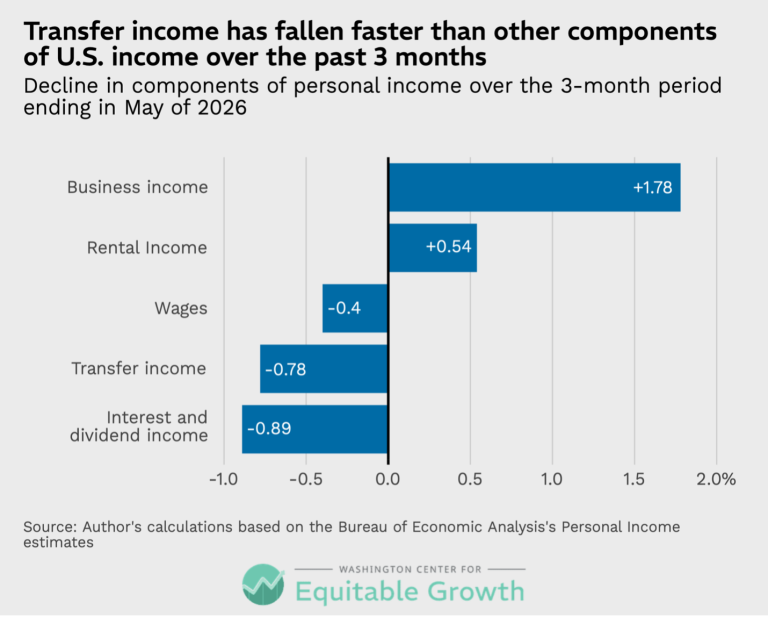
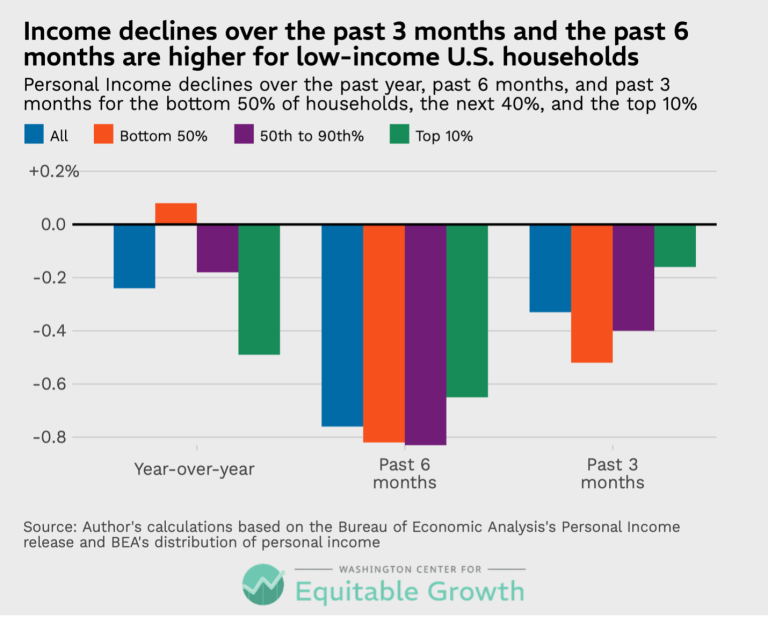
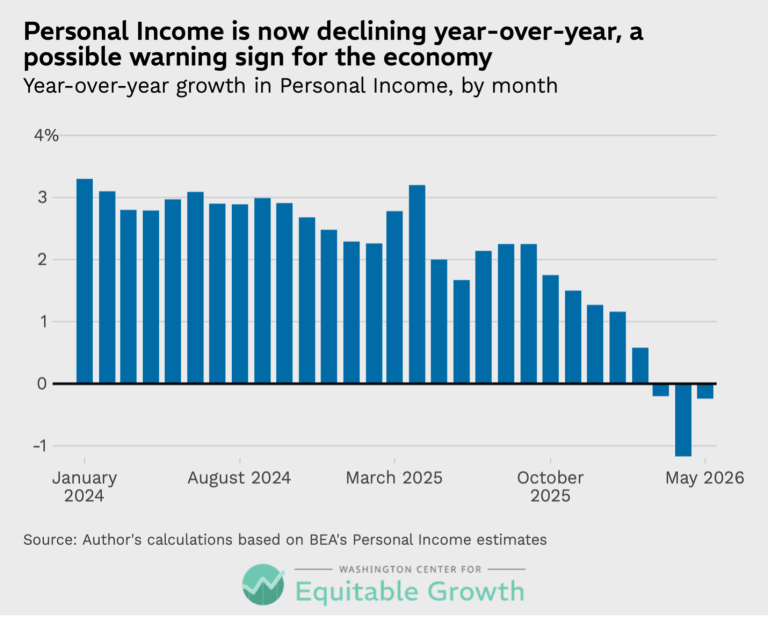
Personal Income in the United States nudges up in May but is down 0.76 percent in the past 6 months (opens in a new tab)
Essays JUN 25, 2026
According to today’s release of Personal Income estimates from the U.S. Bureau of Economic Analysis, U.S. household incomes have fallen 0.76 percent in the past 6 months, with month-to-month declines…
By: Austin Clemens (opens in a new tab)
 View Chart
(opens in a new tab)
View Chart
(opens in a new tab)
Transfer income has fallen faster than other components of U.S. income over the past 3 months (opens in a new tab)
Visualizations JUN 25, 2026
 View Chart
(opens in a new tab)
View Chart
(opens in a new tab)
Income declines over the past 3 months and the past 6 months are higher for low-income U.S. households (opens in a new tab)
Visualizations JUN 25, 2026
 View Chart
(opens in a new tab)
View Chart
(opens in a new tab)
Personal Income is now declining year-over-year, a possible warning sign for the economy (opens in a new tab)
Visualizations JUN 25, 2026

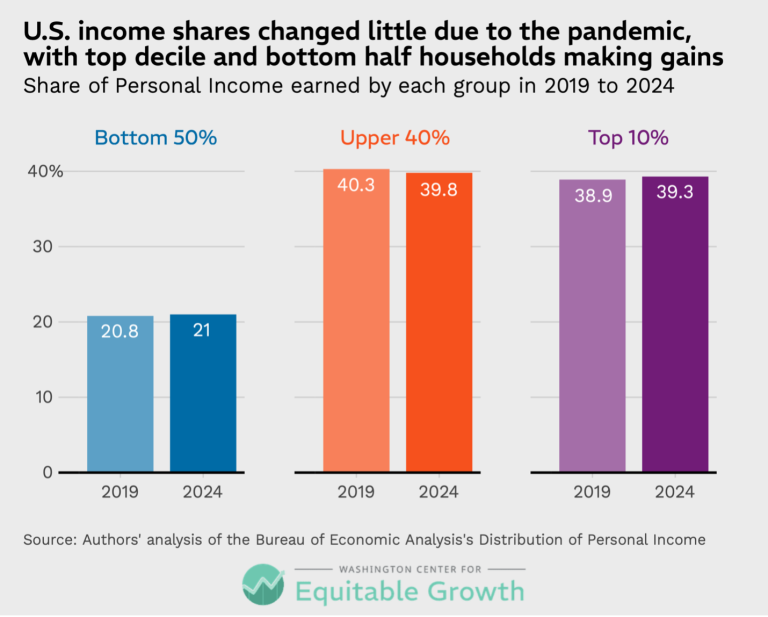
U.S. income data for 2024 shows the top 10 percent accrued the highest share of income since 2000 (opens in a new tab)
Essays JUN 25, 2026
Today, Equitable Growth updated the U.S. Inequality Tracker through 2024 following the release of new data last week by the U.S. Bureau of Economic Analysis. The data show that the…
By: Austin Clemens (opens in a new tab)
 View Chart
(opens in a new tab)
View Chart
(opens in a new tab)
U.S. income shares changed little due to the pandemic, with top decile and bottom half households making gains (opens in a new tab)
Visualizations JUN 24, 2026
 View Chart
(opens in a new tab)
View Chart
(opens in a new tab)
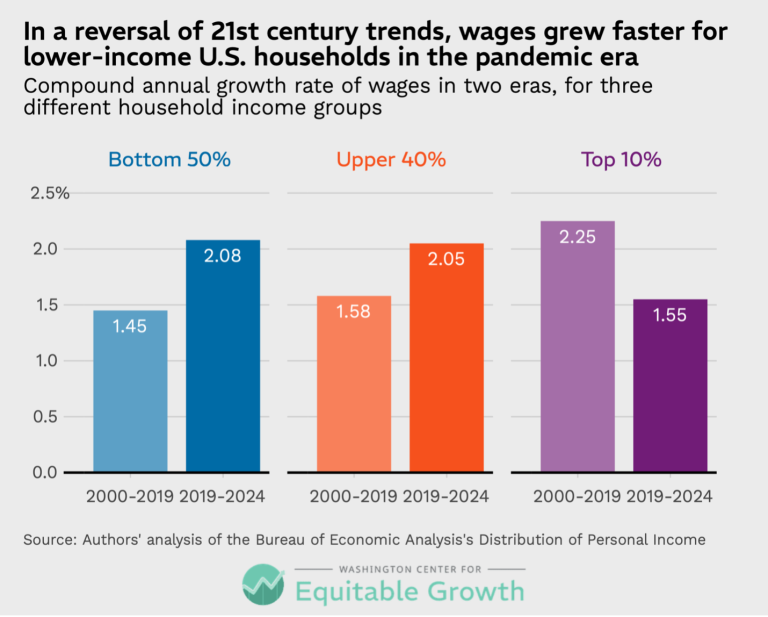
In a reversal of 21st century trends, wages grew faster for lower-income U.S. households in the pandemic era (opens in a new tab)
Visualizations JUN 24, 2026

U.S. workers will be hurt by immigration enforcement overreach (opens in a new tab)
Essays JUN 17, 2026
President Donald Trump last week signed the $70 billion Secure America Act, a budget reconciliation package that boosts funding for immigration and border enforcement agencies while imposing no limits on their authority.…
By: Christopher Bangert-Drowns (opens in a new tab)
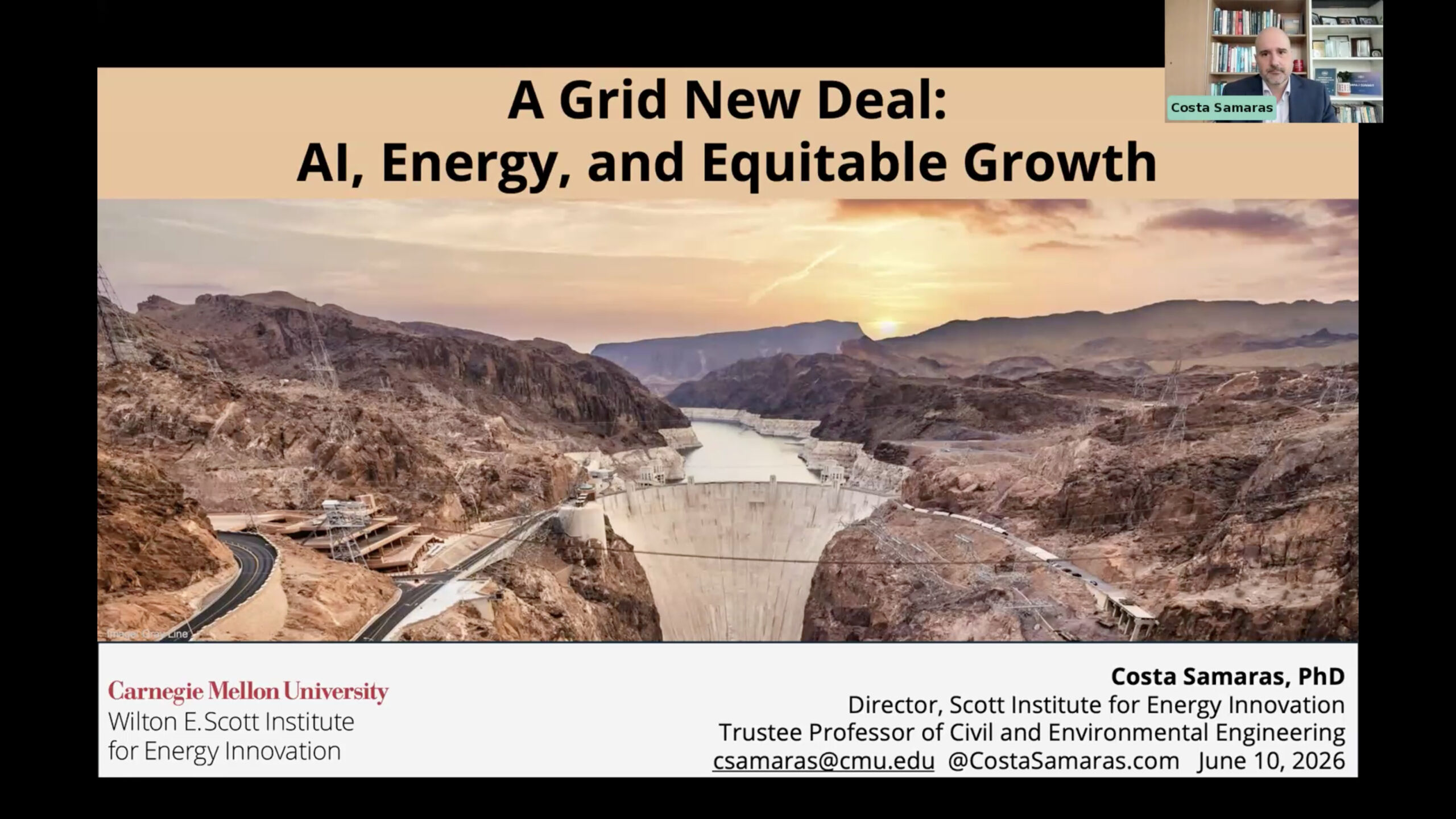
The United States can simultaneously foster an equitable AI boom and a clean energy economy (opens in a new tab)
Videos JUN 12, 2026
The Washington Center for Equitable Growth recently hosted a timely discussion exploring how the rapid expansion of artificial intelligence is colliding with—and reshaping—the clean energy transition. Bringing together researchers and…
By: Equitable Growth (opens in a new tab)

U.S. workers need sectoral bargaining now more than ever (opens in a new tab)
Essays JUN 4, 2026
U.S. union membership and coverage rates have declined for decades, fueled in part by legal barriers to new organizing, including the limiting of collective bargaining to specific workplaces or employers and misclassifying certain groups of workers so they…
By: Christopher Bangert-Drowns (opens in a new tab)
 View Chart
(opens in a new tab)
View Chart
(opens in a new tab)
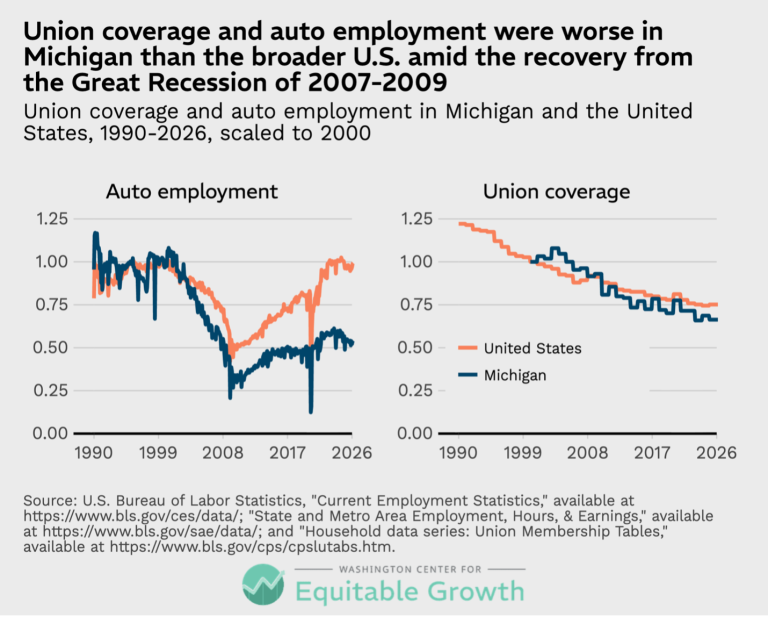
Union coverage and auto employment were worse in Michigan than the broader U.S. amid the recovery from the Great Recession of 2007-2009 (opens in a new tab)
Visualizations JUN 3, 2026
 View Chart
(opens in a new tab)
View Chart
(opens in a new tab)
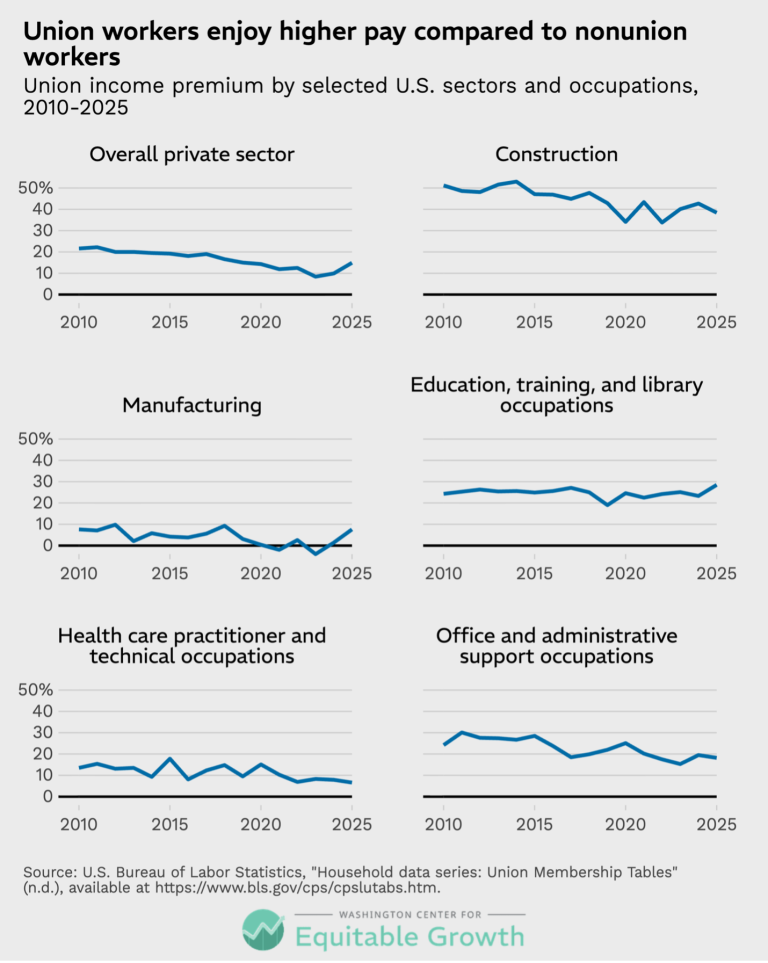
Union workers enjoy higher pay compared to nonunion workers (opens in a new tab)
Visualizations JUN 3, 2026
 View Chart
(opens in a new tab)
View Chart
(opens in a new tab)
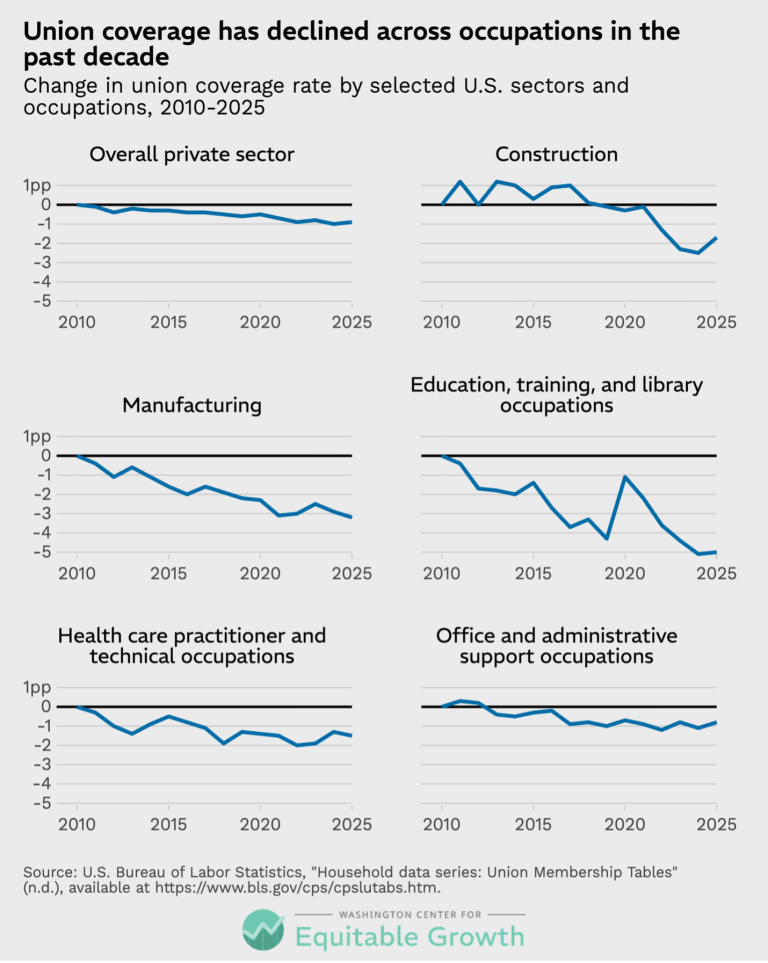
Union coverage has declined across occupations in the past decade (opens in a new tab)
Visualizations JUN 3, 2026

In Conversation with Costa Samaras (opens in a new tab)
In Conversation JUN 2, 2026
Equitable Growth in Conversation is a recurring series where we talk with economists and other academics to help us better understand whether and how economic inequality affects economic growth and…
By: Shayna Strom (opens in a new tab)

Factsheet: Defining top U.S. income and wealth thresholds for tax policy (opens in a new tab)
Factsheets MAY 27, 2026
Federal and state policymakers in the United States, responding to high levels of income and wealth inequality and shrinking tax revenues, are increasingly interested in proposals to tax households with…
By: Austin Clemens (opens in a new tab)
Defining top wealth and income thresholds for U.S. tax policy design and analysis (opens in a new tab)
Reports MAY 27, 2026
Wealth and income inequality are an ongoing area of interest for policymakers. In particular, the rise of the richest of the rich—not just the top 1 percent, but also the…
By: Austin Clemens (opens in a new tab)
 View Chart
(opens in a new tab)
View Chart
(opens in a new tab)
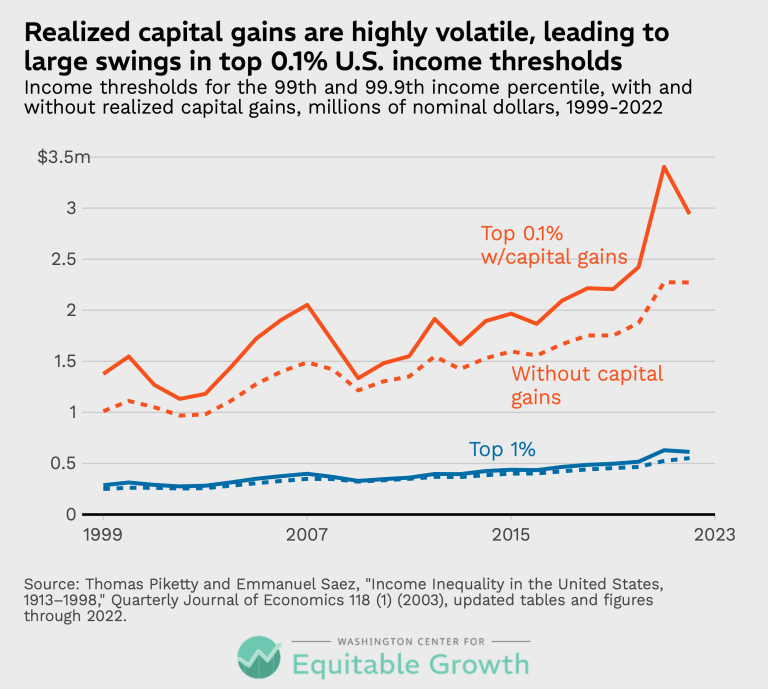
Realized capital gains are highly volatile, leading to large swings in the top 0.1% U.S. income thresholds (opens in a new tab)
Visualizations MAY 26, 2026
Navigating the research on the impacts of AI on work, workers, and the labor market (opens in a new tab)
Research Databases MAY 21, 2026
Artificial intelligence will have a largely unpredictable but potentially profound effect on the labor market. Individuals have speculated how AI will affect the workforce since its earliest developments. But public…
By: Chiara Chanoi (opens in a new tab)
 View Chart
(opens in a new tab)
View Chart
(opens in a new tab)
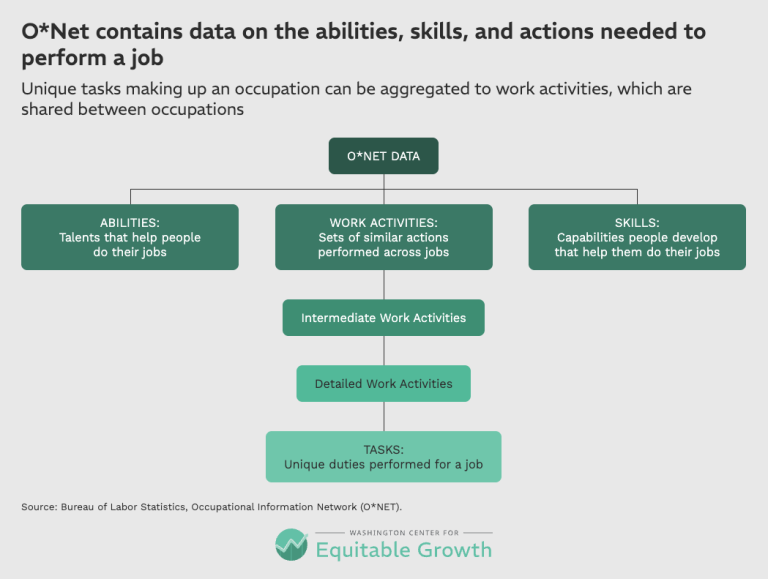
O*NET contains data on the abilities, skills, and actions needed to perform a job – revised (opens in a new tab)
Visualizations MAY 20, 2026
Barriers to Benefits: Unemployment Insurance Take-Up and Labor Market Effects (opens in a new tab)
Working Papers MAY 19, 2026
Unemployment insurance (UI) take-up is relatively low in the United States. We implement a large-scale field experiment among 50,000 likely unemployed individuals to study the causes and labor supply implications…
By: Casey McQuillan (opens in a new tab), Brendan Moore (opens in a new tab)

What is the relationship between inflation, interest rates, and economic growth, and what does it mean for the new Federal Reserve chair? (opens in a new tab)
Issue Briefs MAY 18, 2026
Since regaining the Oval Office in early 2025, President Donald Trump has repeatedly called for lower interest rates and severely criticized former Federal Reserve Board Chair Jerome Powell’s cautious approach…
By: Jacob Robbins (opens in a new tab)

The U.S. public is angry about economic conditions, and the middle class is losing ground. Are these trends connected? (opens in a new tab)
Essays MAY 14, 2026
A random sample of recent headlines likely would yield two fairly common stories about the U.S. economy. One is that the public is angry about the economy and the other…
By: Michael Linden (opens in a new tab)
 View Chart
(opens in a new tab)
View Chart
(opens in a new tab)
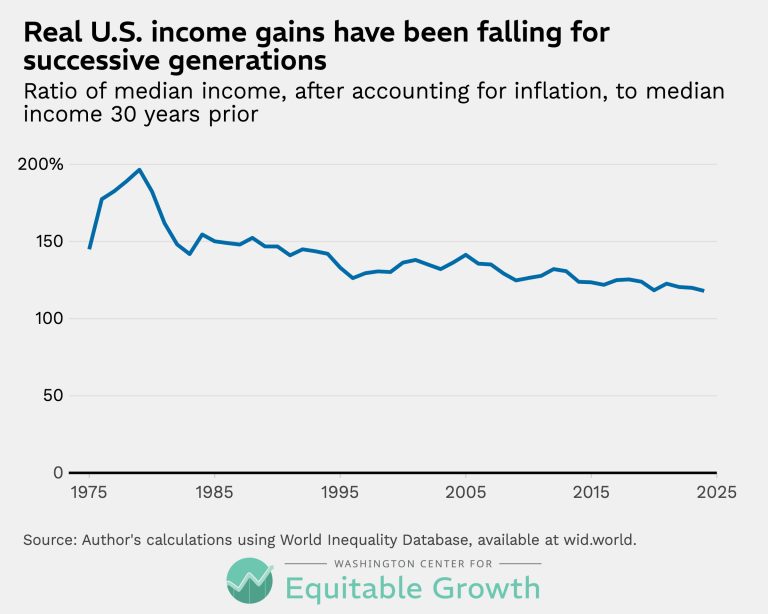
Real U.S. income gains have been falling for successive generations (opens in a new tab)
Visualizations MAY 13, 2026
 View Chart
(opens in a new tab)
View Chart
(opens in a new tab)
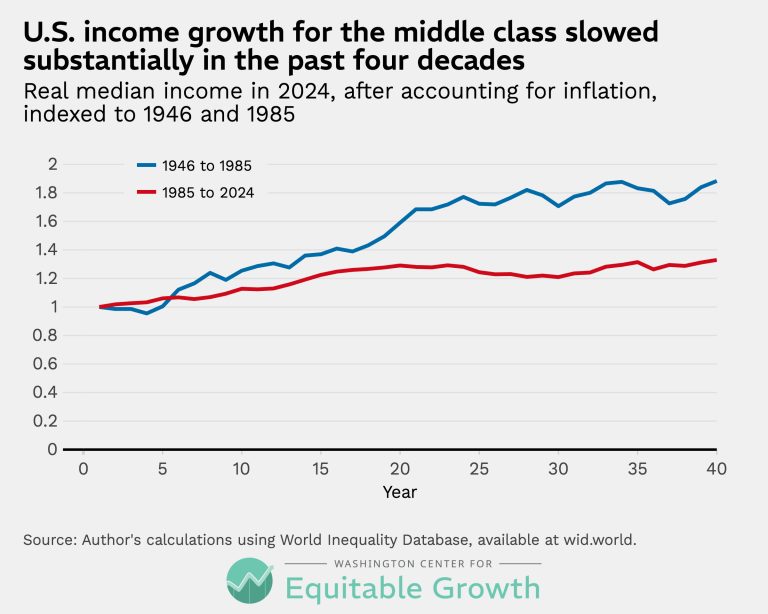
U.S. income growth for the middle class slowed substantially in the past four decades (opens in a new tab)
Visualizations MAY 13, 2026
 View Chart
(opens in a new tab)
View Chart
(opens in a new tab)
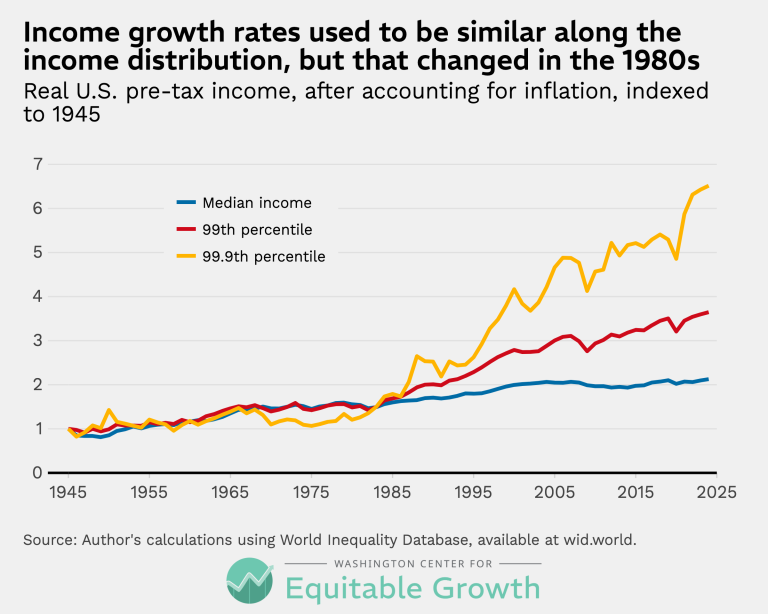
Income growth rates used to be similar along the income distribution, but that changed in the 1980s (opens in a new tab)
Visualizations MAY 13, 2026
 View Chart
(opens in a new tab)
View Chart
(opens in a new tab)
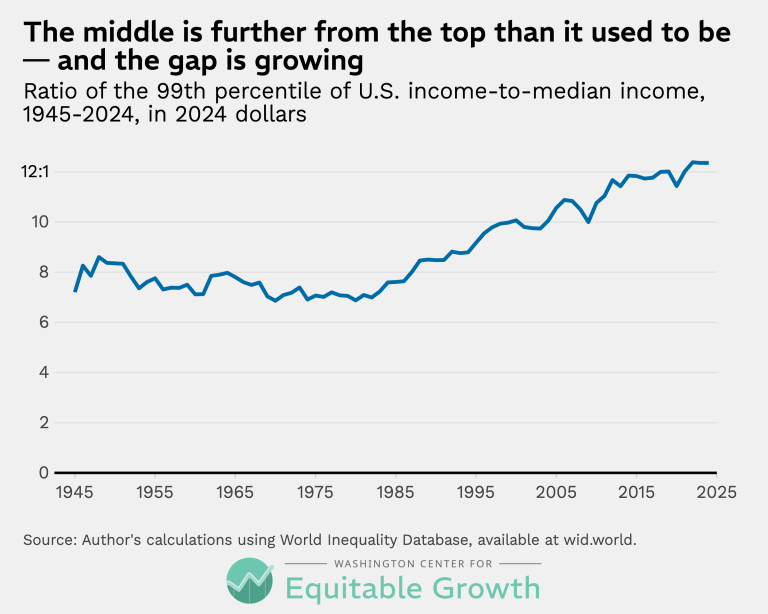
The middle is further from the top than it used to be—and the gap is growing (opens in a new tab)
Visualizations MAY 13, 2026
 View Chart
(opens in a new tab)
View Chart
(opens in a new tab)
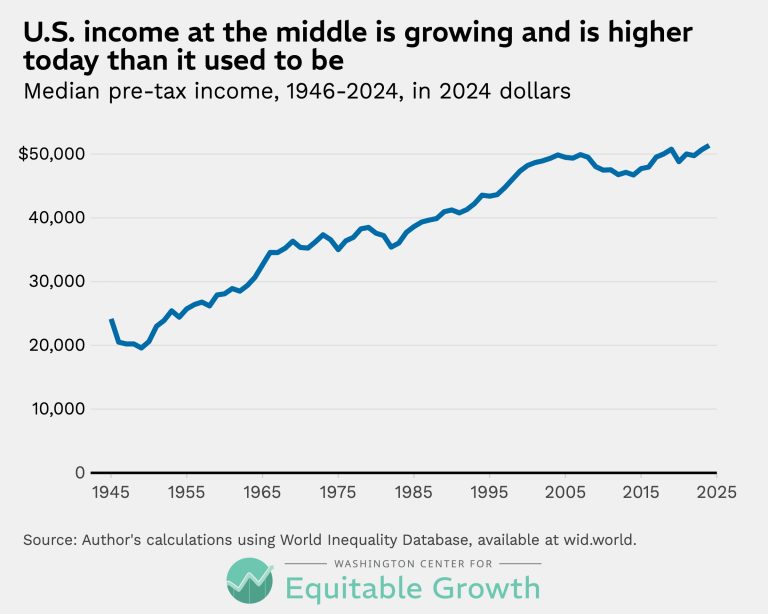
U.S. income at the middle is growing and is higher today than it used to be (opens in a new tab)
Visualizations MAY 13, 2026

Is Taxing Wealth Possible? Practical? Desirable? Yes, if we’re smart about it (opens in a new tab)
Essays MAY 7, 2026
While the American economy has outperformed much of the industrialized world in recent years, there are good reasons to be deeply concerned about its long-term prospects. It is dogged by…
By: David S. Mitchell (opens in a new tab)
 View Chart
(opens in a new tab)
View Chart
(opens in a new tab)
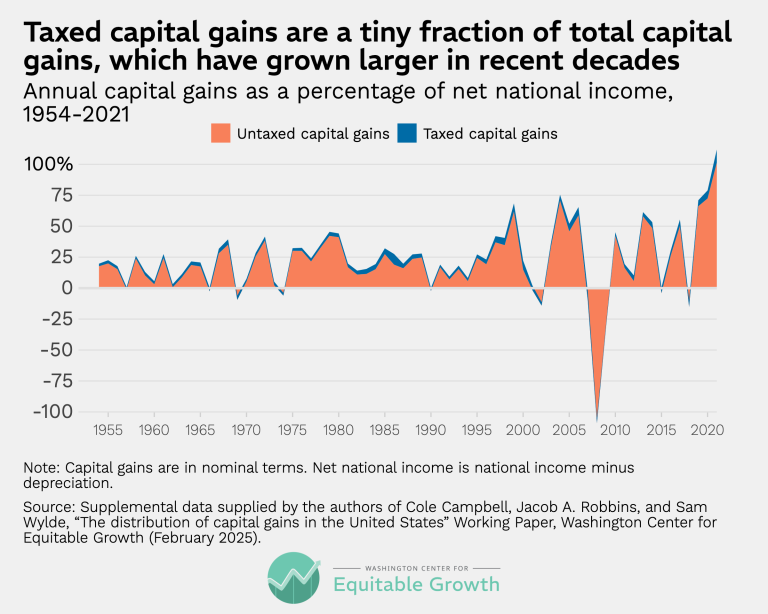
Taxed capital gains are a tiny fraction of total capital gains, which have grown larger in recent decades (opens in a new tab)
Visualizations MAY 6, 2026
 View Chart
(opens in a new tab)
View Chart
(opens in a new tab)
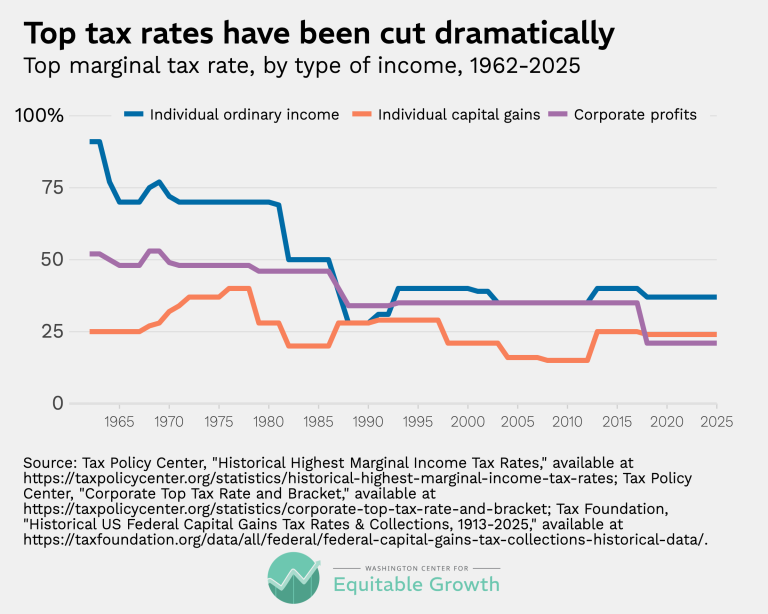
Top tax rates have been cut dramatically (opens in a new tab)
Visualizations MAY 6, 2026
 View Chart
(opens in a new tab)
View Chart
(opens in a new tab)
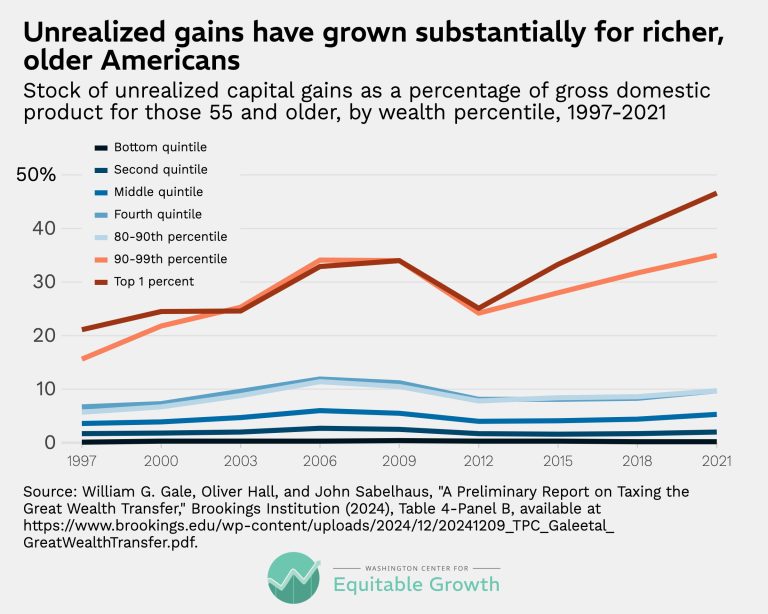
Unrealized gains have grown substantially for richer, older Americans (opens in a new tab)
Visualizations MAY 6, 2026
 View Chart
(opens in a new tab)
View Chart
(opens in a new tab)
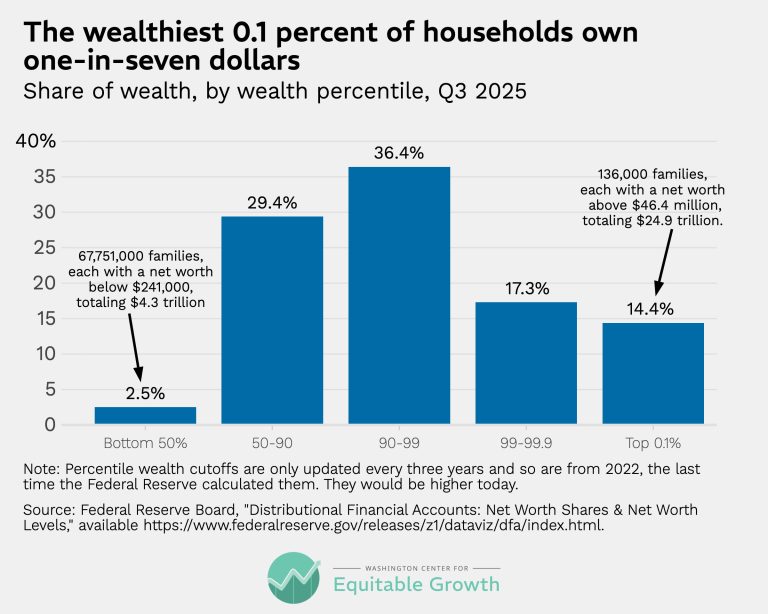
The wealthiest 0.1 percent of households own one-in-seven dollars (opens in a new tab)
Visualizations MAY 6, 2026
 View Chart
(opens in a new tab)
View Chart
(opens in a new tab)
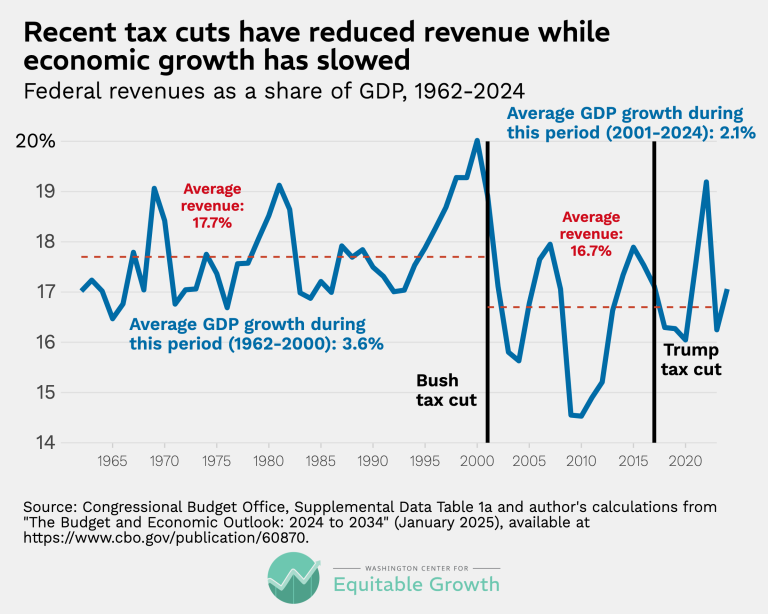
Recent tax cuts have reduced revenue while economic growth has slowed (opens in a new tab)
Visualizations MAY 6, 2026
 View Chart
(opens in a new tab)
View Chart
(opens in a new tab)
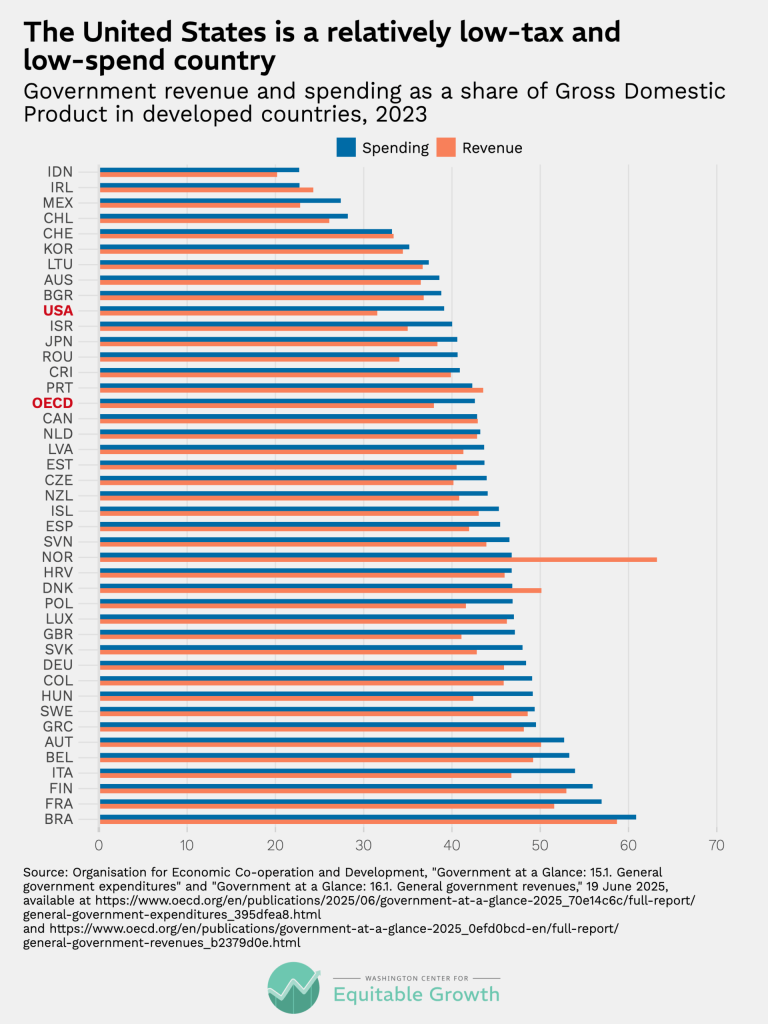
The United States is a relatively low-tax and low-spend country (opens in a new tab)
Visualizations MAY 6, 2026
 View Chart
(opens in a new tab)
View Chart
(opens in a new tab)
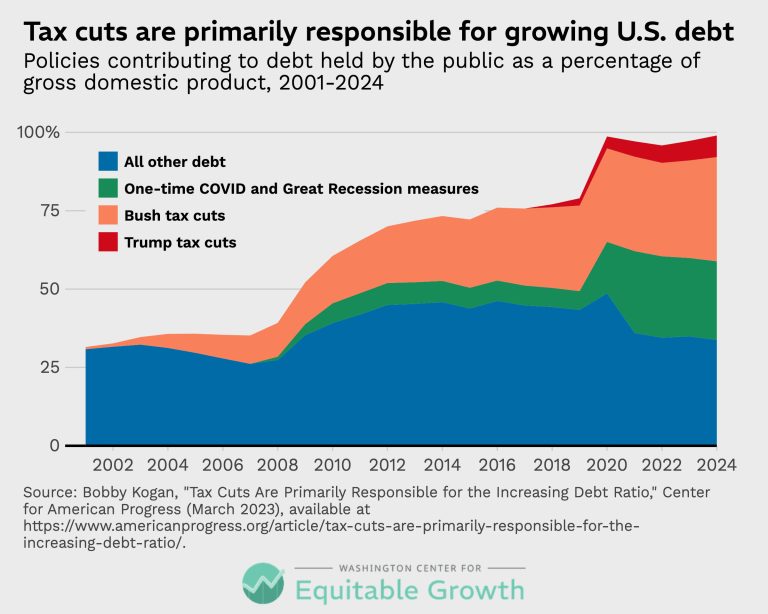
Tax cuts are primarily responsible for the growing U.S. debt (opens in a new tab)
Visualizations MAY 6, 2026
 View Chart
(opens in a new tab)
View Chart
(opens in a new tab)
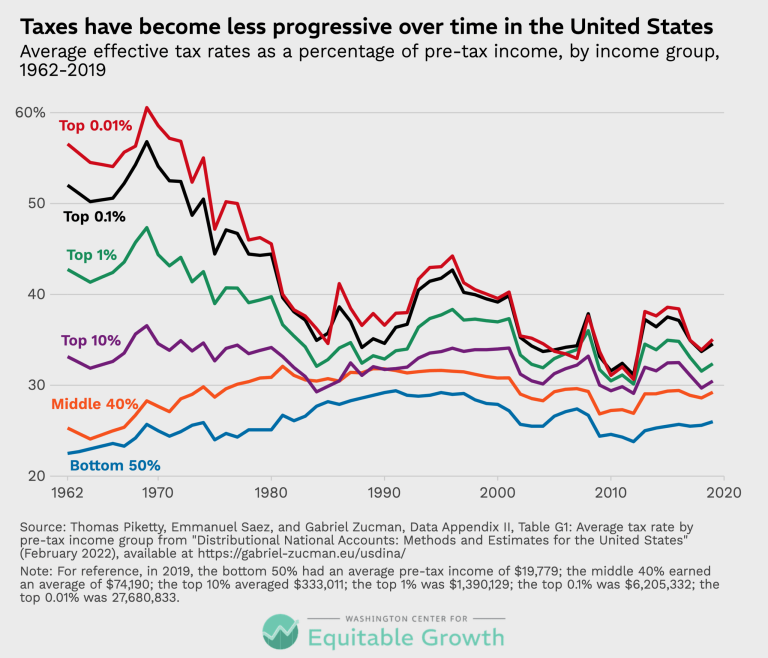
Taxes have become less progressive over time in the United States (opens in a new tab)
Visualizations MAY 6, 2026
 View Chart
(opens in a new tab)
View Chart
(opens in a new tab)
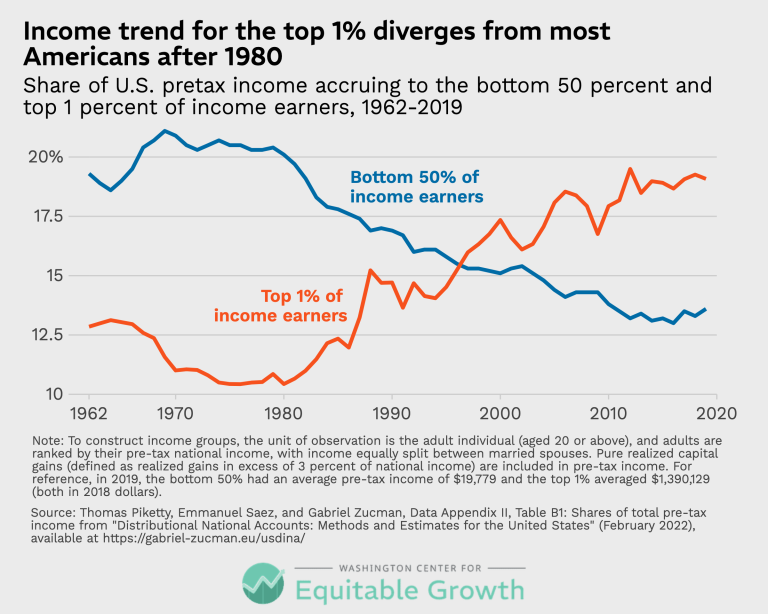
Income trend for the top 1% diverges from most Americans after 1980 (opens in a new tab)
Visualizations MAY 6, 2026

Research shows unions dampen support for right-wing populism and help workers navigate technological transitions (opens in a new tab)
Essays MAY 1, 2026
On May 1, much of the world—though not the United States—celebrates International Workers Day to honor the social and economic contributions of workers and labor unions. The May Day holiday began in large part to mark…
By: Christopher Bangert-Drowns (opens in a new tab)

Why the Iran war is bad for U.S. economic growth (opens in a new tab)
Essays APR 23, 2026
The growth trajectory of the U.S. economy is highly dependent on its connections to the outside world through trade and investments, as well as foreign policy and geopolitical developments. That…
By: Christopher Bangert-Drowns (opens in a new tab)

Research on climate change’s impact on U.S. workers underscores the benefits of workplace heat standards (opens in a new tab)
Essays APR 22, 2026
This year’s Earth Day follows a record-breaking heat wave across much of the East Coast, which followed a record-breaking heat wave that took hold in much of the West and…
By: Equitable Growth (opens in a new tab)

Factsheet: What the research says about early care and education in the United States (opens in a new tab)
Factsheets APR 16, 2026
Research has long shown the importance and value of high-quality early childhood care and education. Child care offers working parents the ability to fully participate in the labor force and…
By: Equitable Growth (opens in a new tab)

How does early childhood care and education affect U.S. families and workers, and which policies support child participation and boost the quality of care? (opens in a new tab)
Reports APR 16, 2026
As states consider policy action in early childhood care and education, there is an existing—and growing—evidence base from which to draw lessons. This report summarizes the rigorous evidence on program…
By: Chloe Gibbs (opens in a new tab)
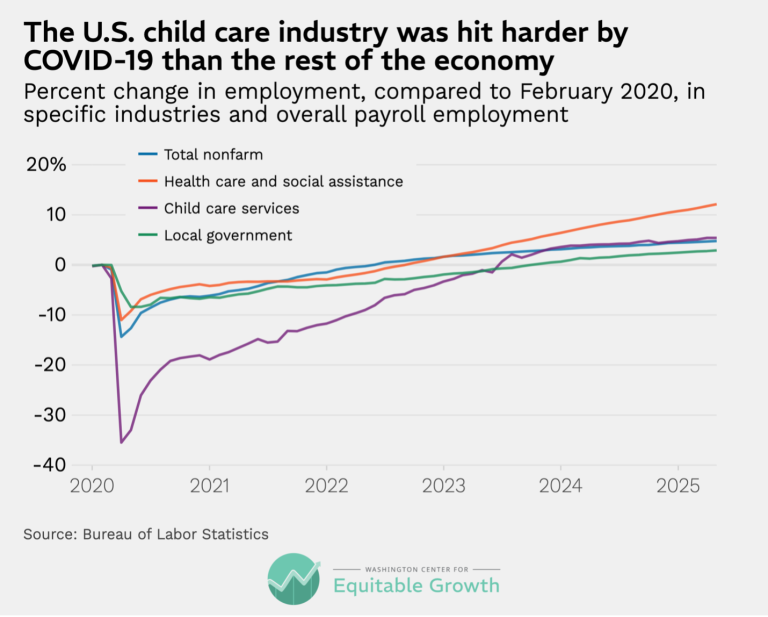 View Chart
(opens in a new tab)
View Chart
(opens in a new tab)
The U.S. child care industry was hit harder by COVID-19 than the rest of the economy (opens in a new tab)
Visualizations APR 15, 2026
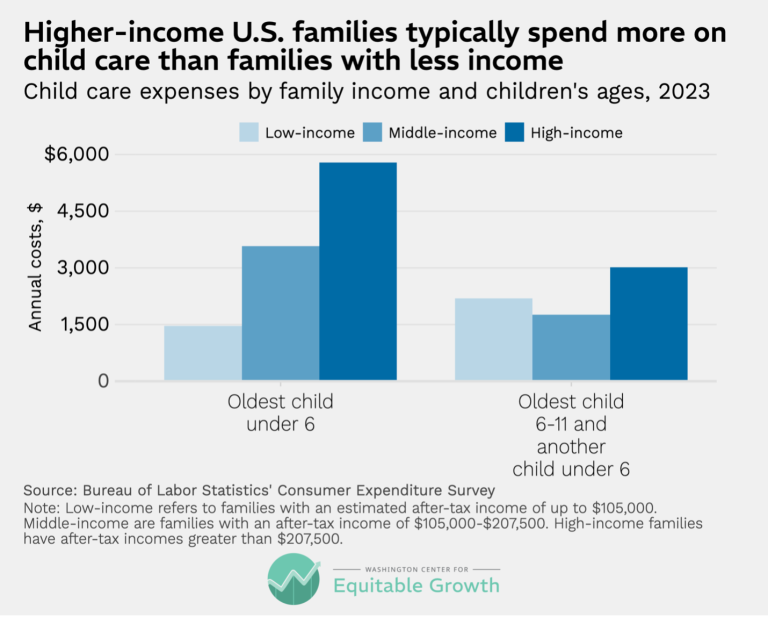 View Chart
(opens in a new tab)
View Chart
(opens in a new tab)
Higher-income U.S. families typically spend more on child care than families with less income (opens in a new tab)
Visualizations APR 15, 2026
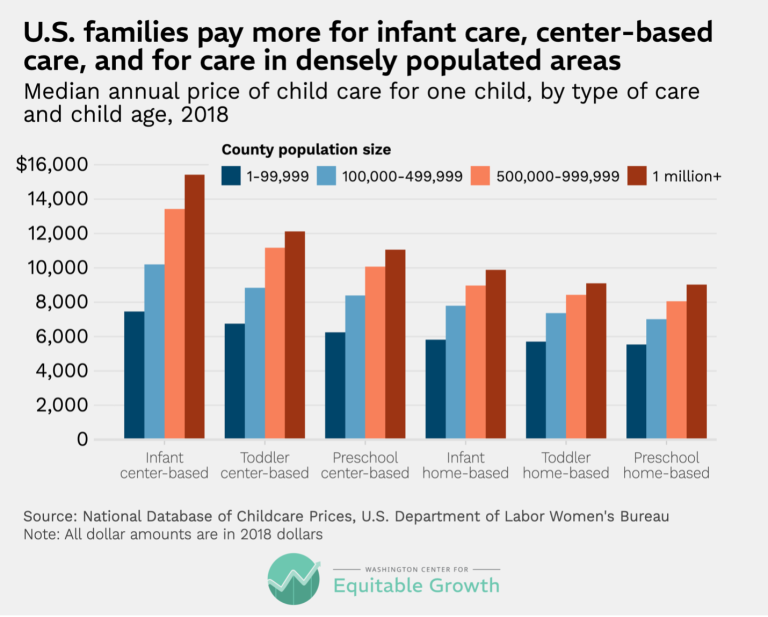 View Chart
(opens in a new tab)
View Chart
(opens in a new tab)
U.S. families pay more for infant care, center-based care, and for care in densely populated areas (opens in a new tab)
Visualizations APR 15, 2026
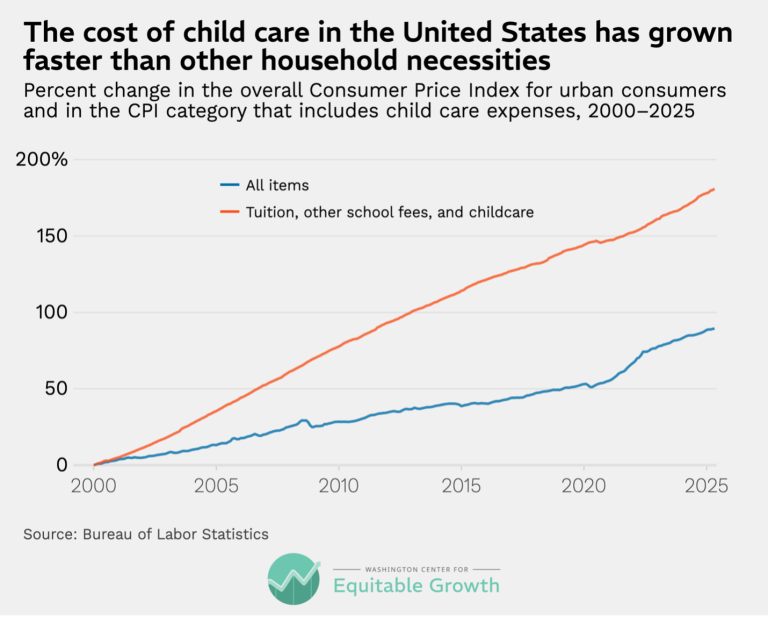 View Chart
(opens in a new tab)
View Chart
(opens in a new tab)
The cost of child care in the United States has grown faster than other household necessities (opens in a new tab)
Visualizations APR 15, 2026

The other two-tiered U.S. tax system: How pass-through businesses let the ultra-wealthy dodge federal taxes (opens in a new tab)
Essays APR 15, 2026
Many Americans likely remember when the legendary value investor Warren Buffett drew attention to a glaring unfairness in the tax code by pointing out that he paid a lower effective…
By: David S. Mitchell (opens in a new tab)
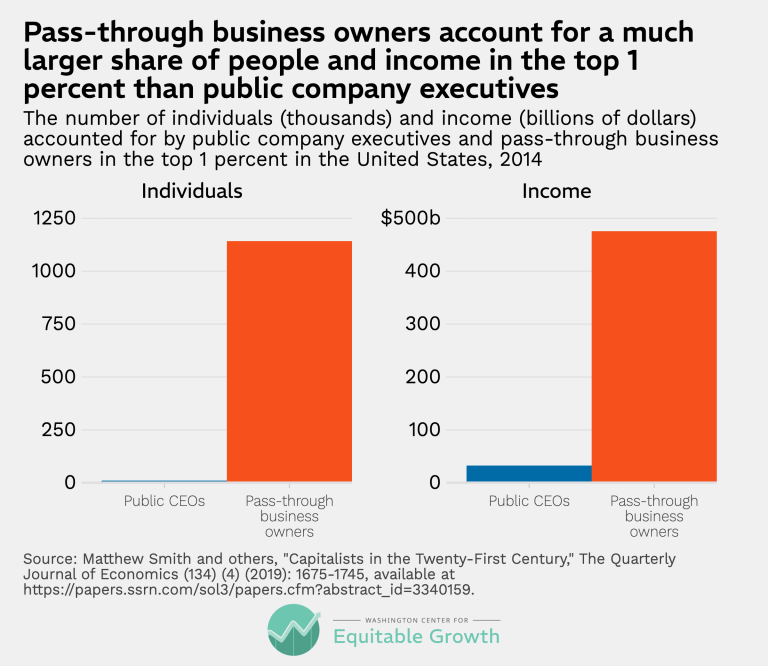 View Chart
(opens in a new tab)
View Chart
(opens in a new tab)
Pass-through business owners account for a much larger share of people and income in the top 1 percent than public company executives (opens in a new tab)
Visualizations APR 14, 2026
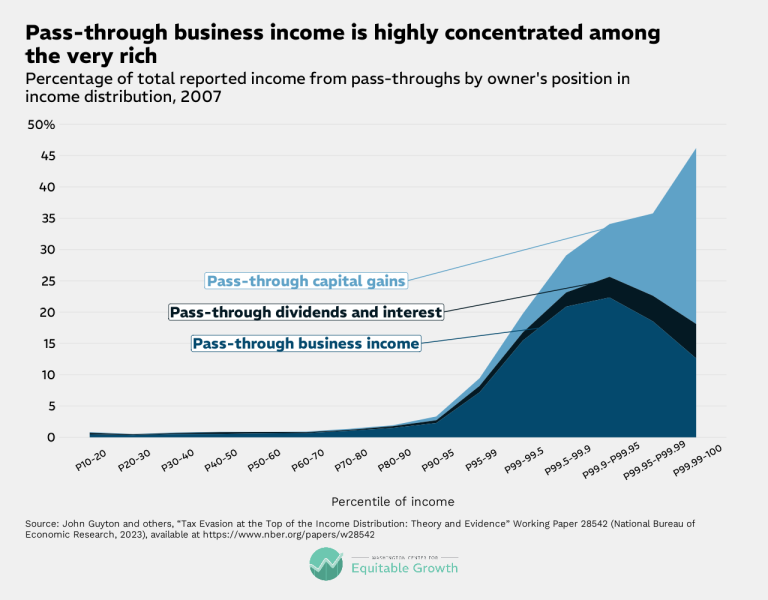 View Chart
(opens in a new tab)
View Chart
(opens in a new tab)
Pass-through business income is highly concentrated among the very rich (opens in a new tab)
Visualizations APR 14, 2026

Federal policymakers can ensure Trump accounts do not exacerbate inequality in the United States (opens in a new tab)
Issue Briefs APR 14, 2026
In July 2025, Congress passed a federal budget bill (Public Law 119-21, also commonly known as the One Big Beautiful Bill Act) that, among other things, established a new type…
By: Megan Rivera (opens in a new tab)
A review of the state of child care in the United States (opens in a new tab)
Reports APR 9, 2026
Affordable, available, high-quality child care is essential for sustained, broadly shared economic growth and equitable access to workforce opportunities. In most of the United States, however, child care fails this…
By: Sam Abbott (opens in a new tab), Shira Markoff (opens in a new tab)
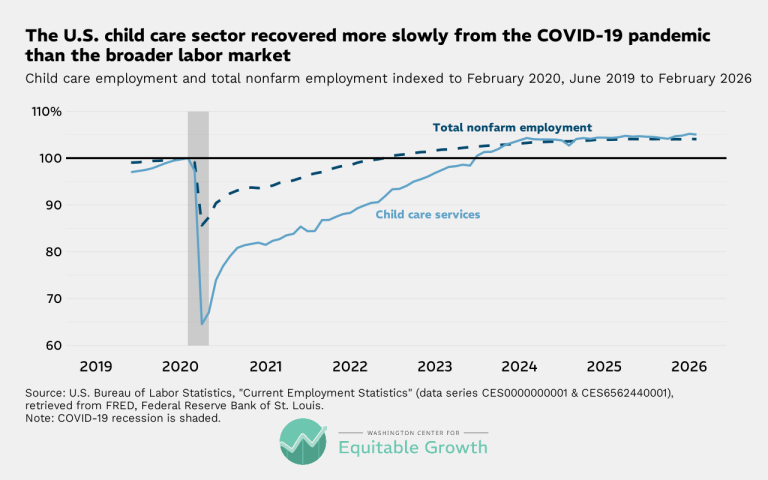 View Chart
(opens in a new tab)
View Chart
(opens in a new tab)
The U.S. child care sector recovered more slowly from the COVID-19 pandemic than the broader labor market (opens in a new tab)
Visualizations APR 8, 2026
 View Chart
(opens in a new tab)
View Chart
(opens in a new tab)
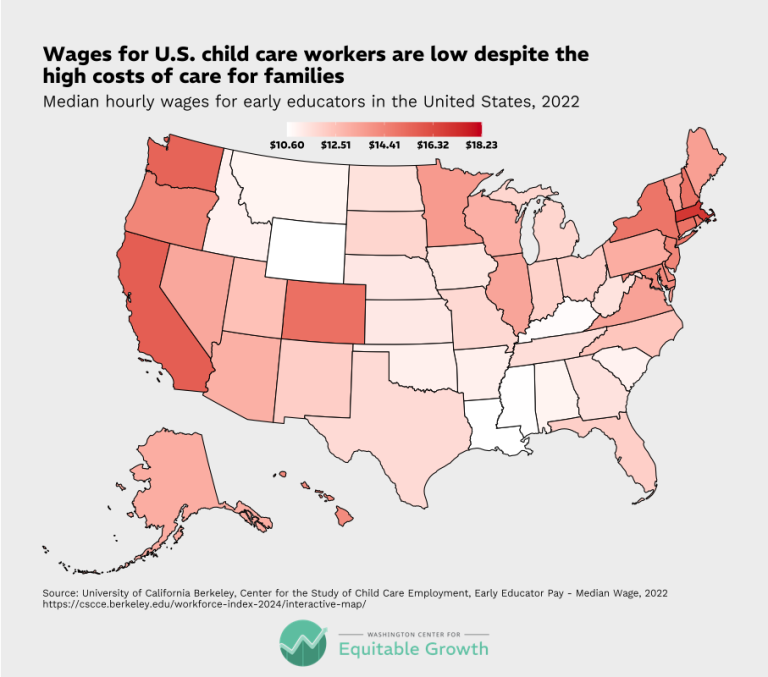
Wages for U.S. child care workers are low despite the high costs of care for families (opens in a new tab)
Visualizations APR 8, 2026
Equitable Growth event covers tariffs, tariff uncertainties, and the limits of U.S. trade policy (opens in a new tab)
Videos APR 1, 2026
The Washington Center for Equitable Growth recently hosted a webinar examining the economic, fiscal, and labor‑market effects of evolving U.S. tariff laws and regulations, particularly in the wake of the…
By: Christopher Bangert-Drowns (opens in a new tab)

Tariff policies in 2025 increased input costs for key U.S. industries, threatening growth and investment (opens in a new tab)
Essays MAR 24, 2026
All tariffs are not created equal. Throughout U.S. history, policymakers have imposed import taxes for a variety of economic and ideological reasons, with varying impacts. Targeted tariffs have been effective…
By: Christopher Bangert-Drowns (opens in a new tab)

Research-based perspectives on the connection between economic policy and rising support for authoritarian populism (opens in a new tab)
Essays MAR 19, 2026
In 2025, the Washington Center for Equitable Growth began to explore the evidence behind a link between the effects of economic policies and global support for authoritarian populist candidates for…
By: Melissa Grober-Morrow (opens in a new tab)
 View Chart
(opens in a new tab)
View Chart
(opens in a new tab)
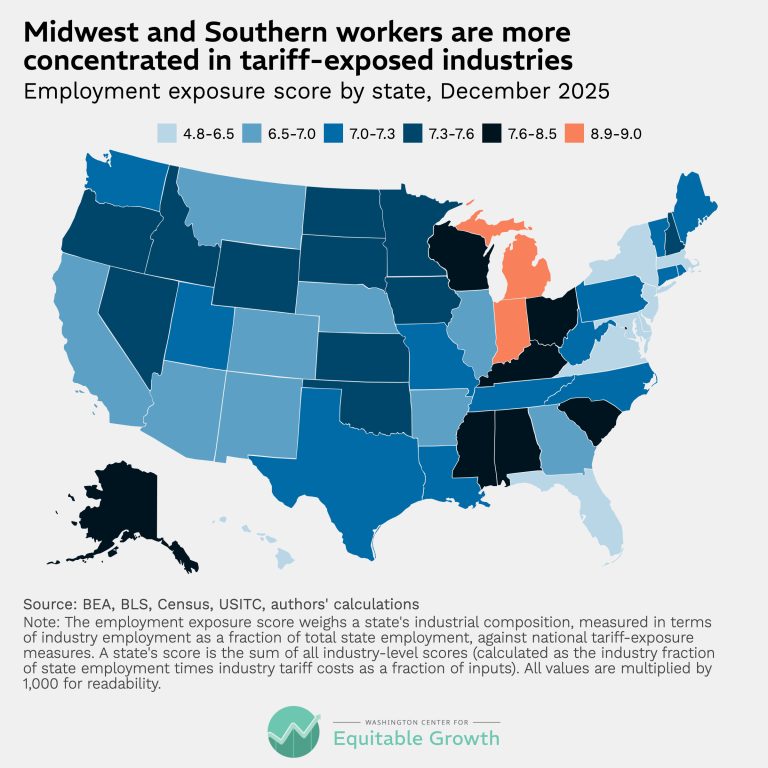
Midwest and Southern workers are more concentrated in tariff-exposed industries (opens in a new tab)
Visualizations MAR 17, 2026
 View Chart
(opens in a new tab)
View Chart
(opens in a new tab)
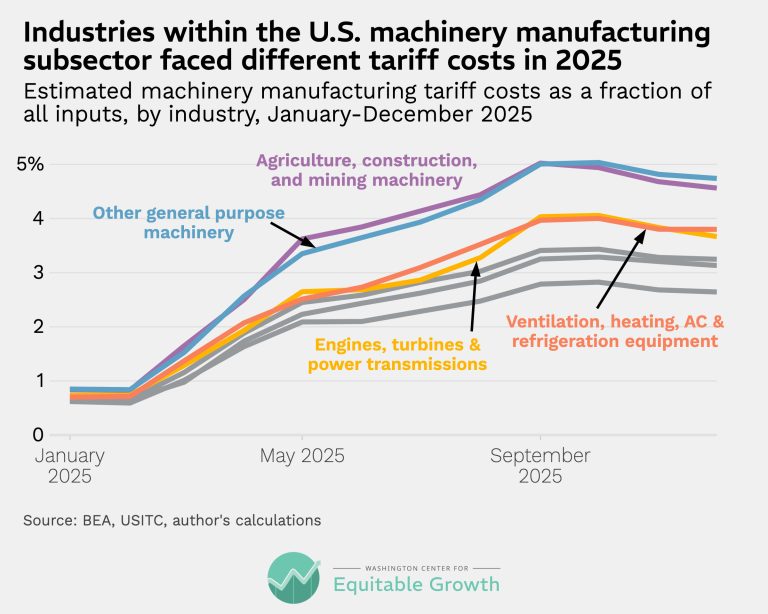
Industries within the U.S. machinery manufacturing subsector faced different tariff costs in 2025 (opens in a new tab)
Visualizations MAR 17, 2026
 View Chart
(opens in a new tab)
View Chart
(opens in a new tab)
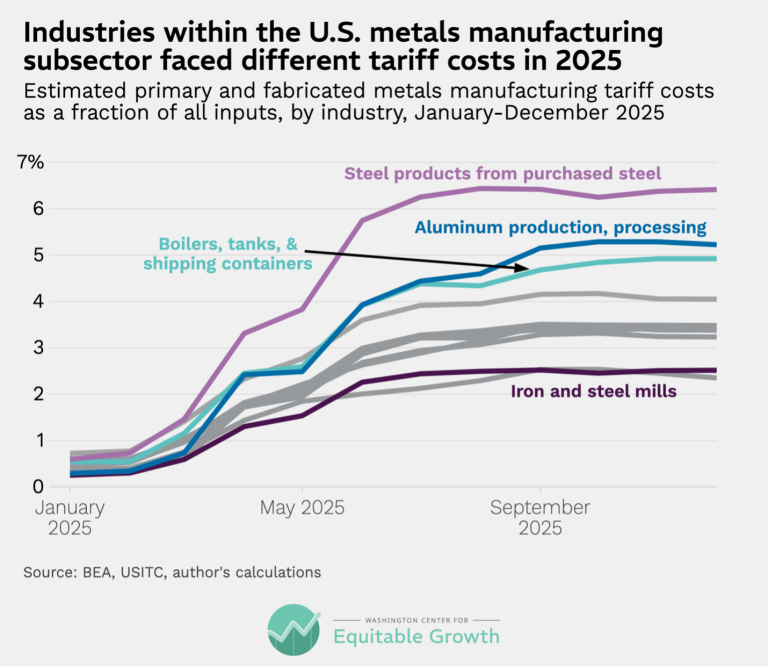
Industries within the U.S. metals manufacturing subsector faced different tariff costs in 2025 (opens in a new tab)
Visualizations MAR 17, 2026
 View Chart
(opens in a new tab)
View Chart
(opens in a new tab)
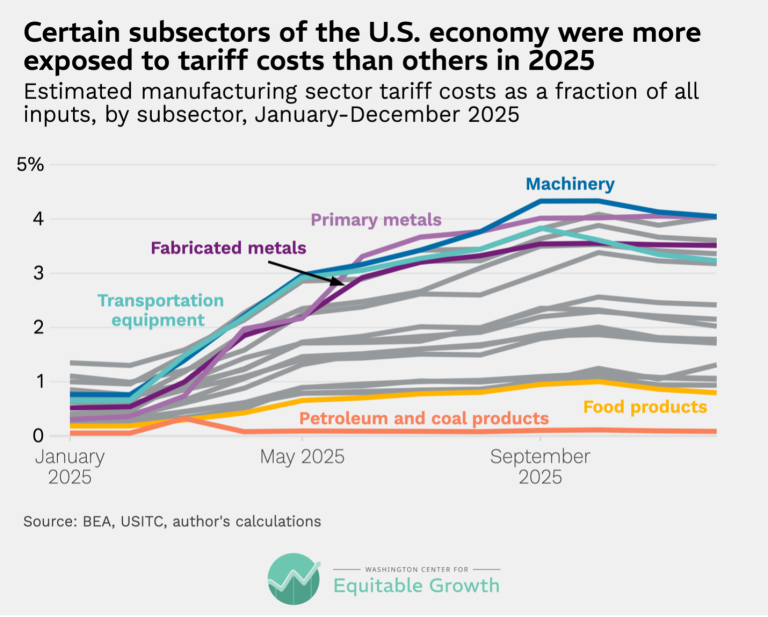
Certain subsectors of the U.S. economy were more exposed to tariff costs than others in 2025 (opens in a new tab)
Visualizations MAR 17, 2026
 View Chart
(opens in a new tab)
View Chart
(opens in a new tab)
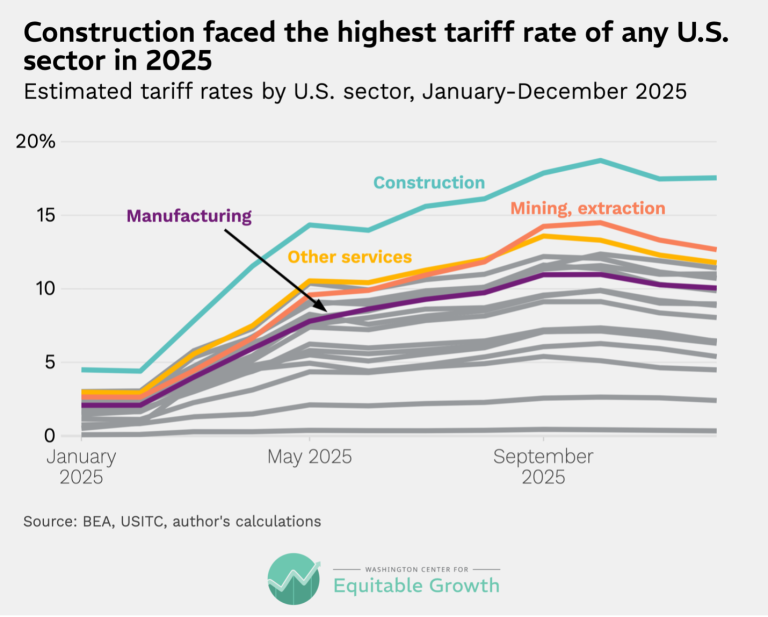
Construction faced the highest tariff rate of any U.S. sector in 2025 (opens in a new tab)
Visualizations MAR 17, 2026

The unintended macroeconomic effects of U.S. climate policy uncertainty (opens in a new tab)
Essays MAR 17, 2026
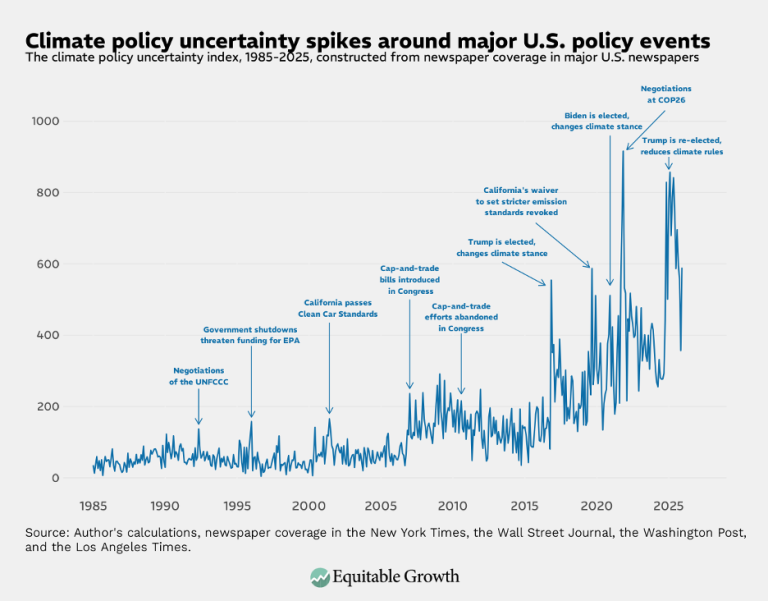
Recent policy developments in the United States highlight just how quickly climate policies can change. In January 2026, the U.S. Environmental Protection Agency announced that it would stop considering lives…
By: Diego Känzig (opens in a new tab)
The Macroeconomic Effects of Climate Policy Uncertainty (opens in a new tab)
Working Papers MAR 17, 2026
We develop a novel measure of climate policy uncertainty based on newspaper coverage. Our index spikes during key U.S. climate policy events—including presidential announcements on international agreements, congressional debates, and…
By: Konstantinos Gavriilidis (opens in a new tab), Diego R. Känzig, Ramya Raghavan (opens in a new tab), James H. Stock (opens in a new tab)
 View Chart
(opens in a new tab)
View Chart
(opens in a new tab)
Climate policy uncertainty spikes around major U.S. policy events (opens in a new tab)
Visualizations MAR 17, 2026
 View Chart
(opens in a new tab)
View Chart
(opens in a new tab)
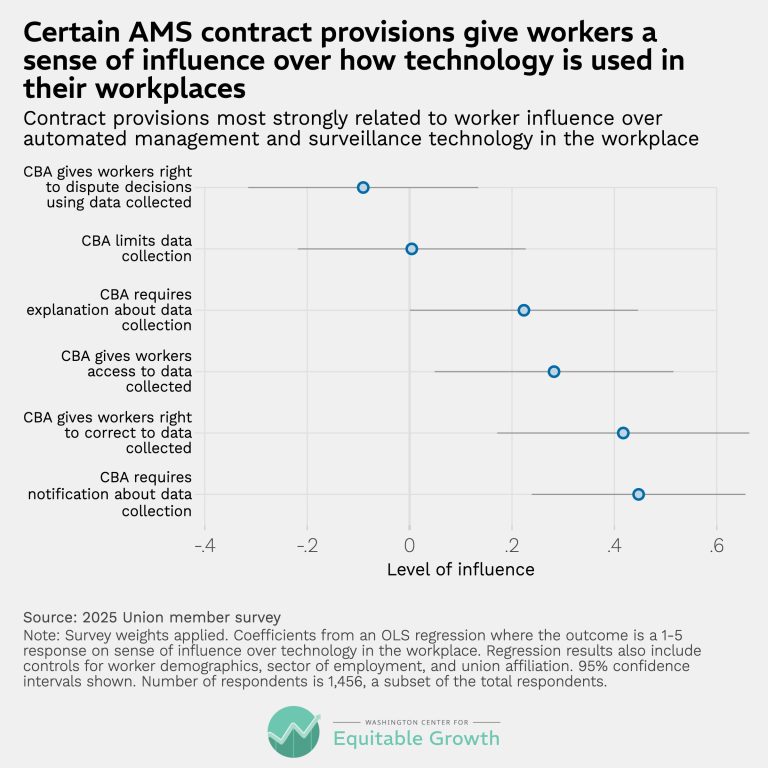
Certain AMS contract provisions give workers a sense of influence over how technology is used in their workplaces (opens in a new tab)
Visualizations MAR 12, 2026
How union contracts are protecting U.S. workers from automated management and surveillance in the workplace (opens in a new tab)
Reports MAR 12, 2026
Employers are increasingly using electronic and automated tools to collect data on their workers on and off the job and then using that data to inform decisions about workers’ pay,…
By: Alexander Hertel-Fernandez (opens in a new tab)
 View Chart
(opens in a new tab)
View Chart
(opens in a new tab)
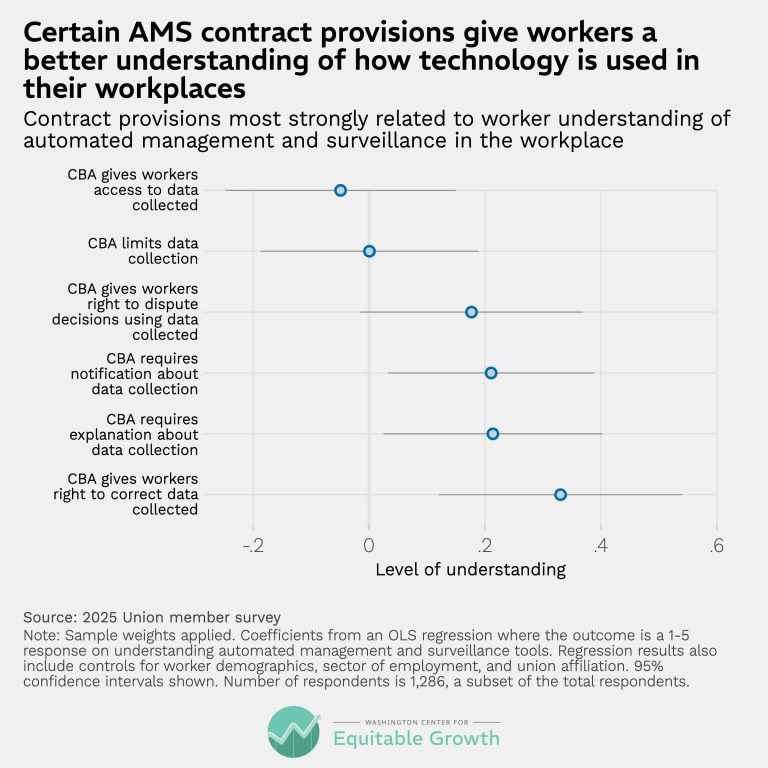
Certain AMS contract provisions give workers a better understanding of how technology is used in their workplaces (opens in a new tab)
Visualizations MAR 12, 2026
 View Chart
(opens in a new tab)
View Chart
(opens in a new tab)
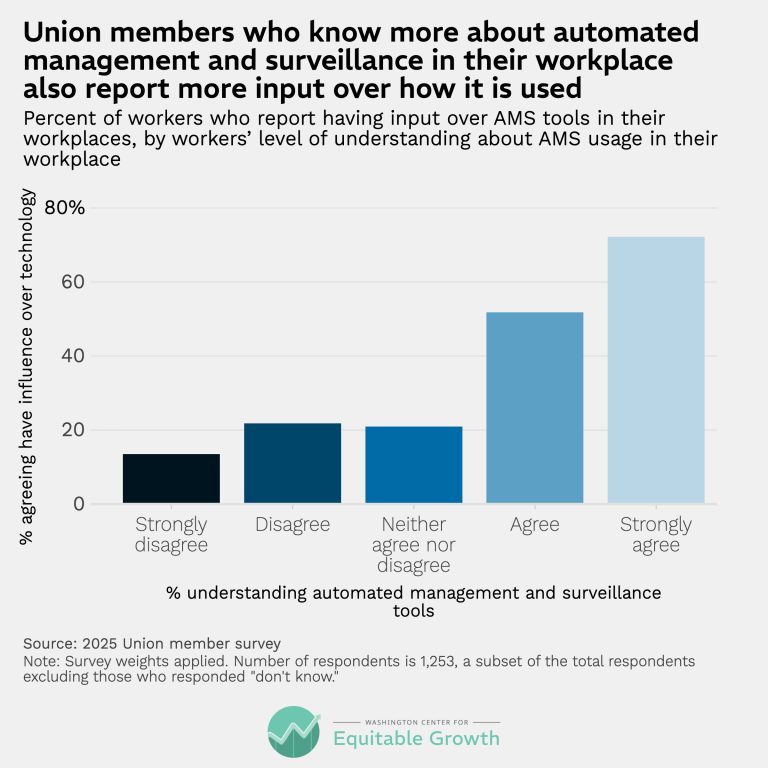
Union members who know more about automated management and surveillance in their workplace also report more input over how it is used (opens in a new tab)
Visualizations MAR 12, 2026
 View Chart
(opens in a new tab)
View Chart
(opens in a new tab)
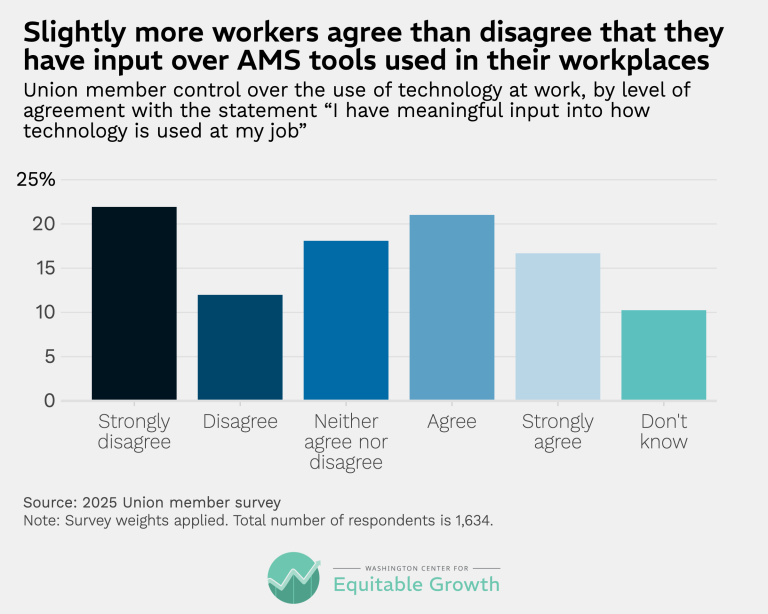
Slightly more workers agree than disagree that they have input over AMS tools used in their workplaces (opens in a new tab)
Visualizations MAR 12, 2026
 View Chart
(opens in a new tab)
View Chart
(opens in a new tab)
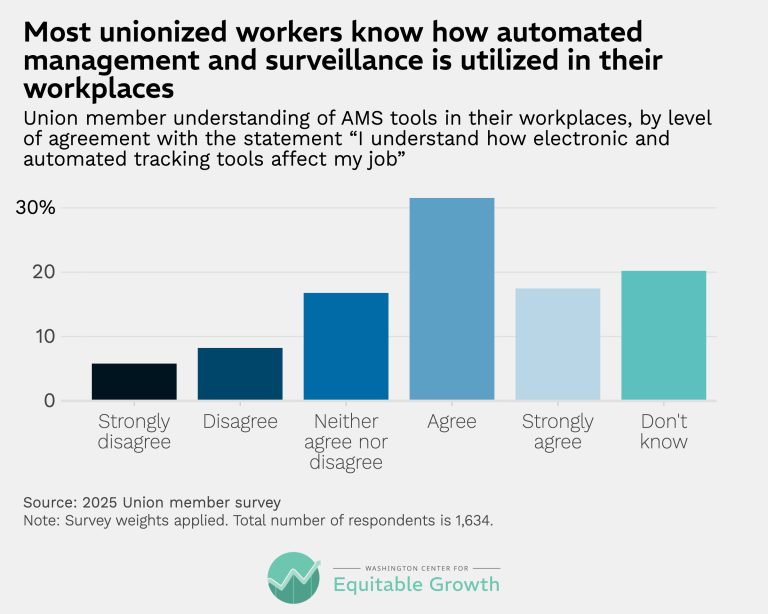
Most unionized workers know how automated management and surveillance are utilized in their workplaces (opens in a new tab)
Visualizations MAR 12, 2026
 View Chart
(opens in a new tab)
View Chart
(opens in a new tab)
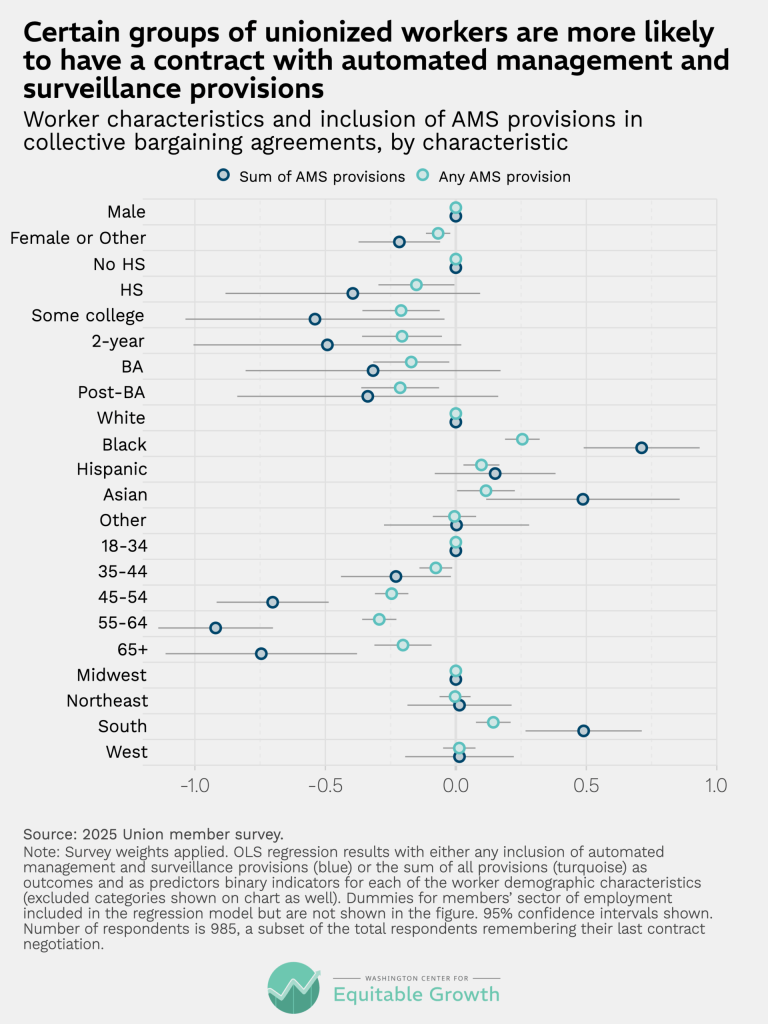
Certain groups of unionized workers are more likely to have a contract with automated management and surveillance provisions (opens in a new tab)
Visualizations MAR 12, 2026
 View Chart
(opens in a new tab)
View Chart
(opens in a new tab)
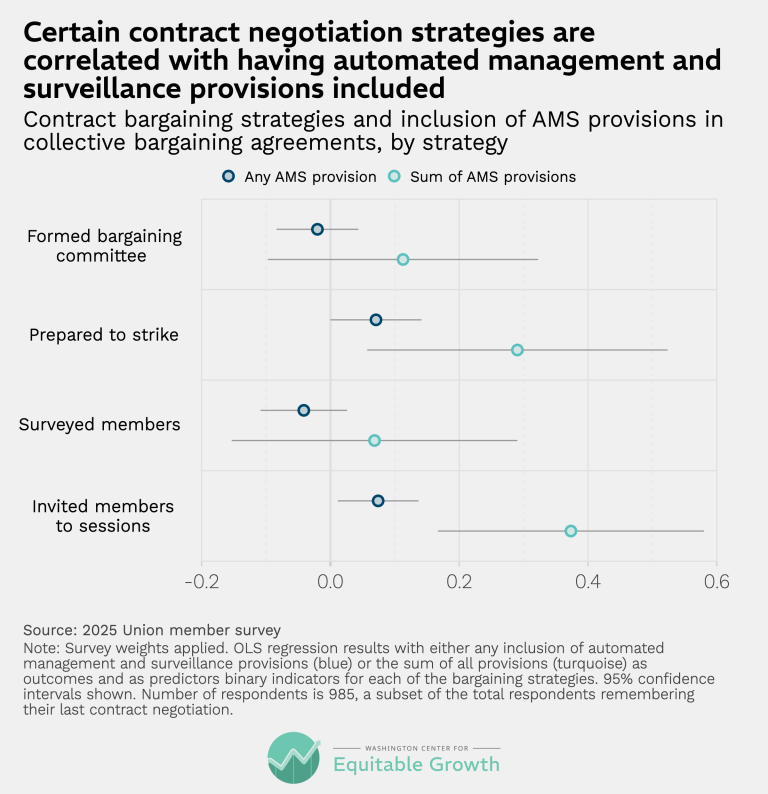
Certain contract negotiation strategies are correlated having automated management and surveillance provisions included (opens in a new tab)
Visualizations MAR 12, 2026
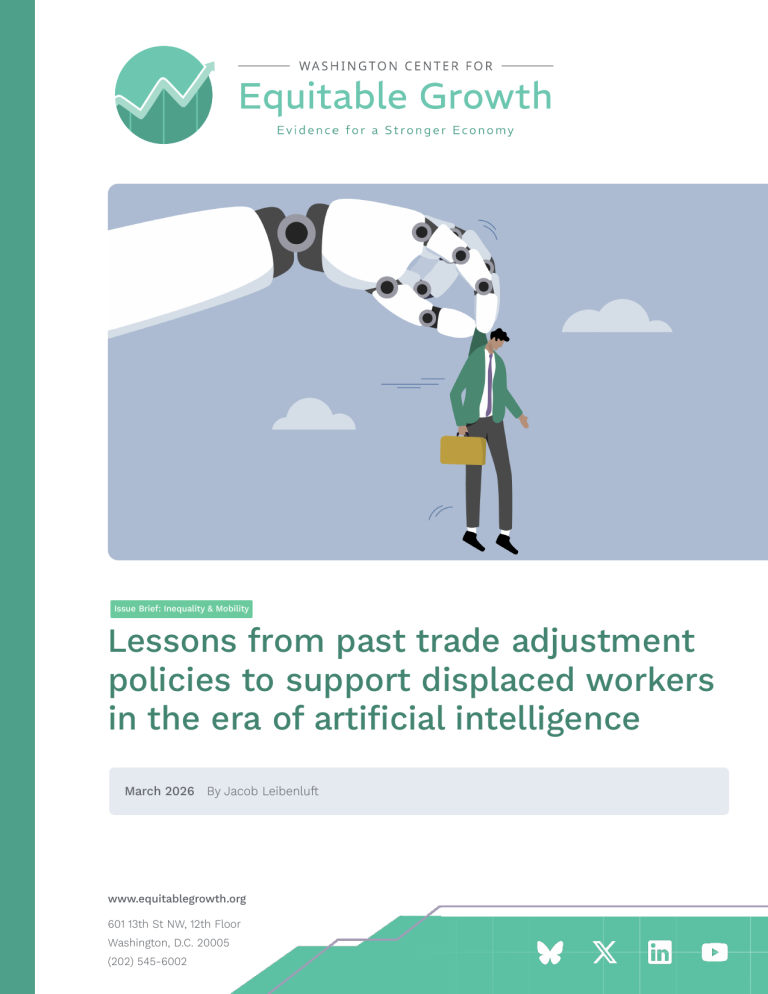
Lessons from past trade adjustment policies to support displaced workers in the era of artificial intelligence (opens in a new tab)
Reports MAR 11, 2026
More than 60 years ago, U.S. policymakers, economists, and labor leaders alike agreed that the potential for new economic forces to strengthen U.S. prosperity and security was just over the…
By: Jacob Leibenluft (opens in a new tab)

Factsheet: Using asset limits in public benefit programs (opens in a new tab)
Factsheets MAR 10, 2026
A household’s assets, or its overall wealth, are the resources required to ensure its family members can weather the financial disruption when unexpected expenses emerge. Yet many U.S. households do…
By: Megan Rivera (opens in a new tab)

New research examines the historical macroeconomic effects of tariffs and sheds light on current U.S. trade policies (opens in a new tab)
Essays MAR 4, 2026
U.S. policymakers have enacted tariffs for a variety of reasons over the course of the country’s history. Motivated by economic pressures to raise federal revenues or address balance-of-payment issues, or…
By: Christopher Bangert-Drowns (opens in a new tab)
The Macroeconomic Effects of Tariffs: Evidence From U.S. Historical Data (opens in a new tab)
Working Papers MAR 4, 2026
We study the macroeconomic effects of tariff policy using U.S. historical data from 1840–2024. We construct a narrative series of plausibly exogenous tariff changes–based on major legislative actions, multilateral negotiations,…
By: Tamar den Besten (opens in a new tab), Diego Känzig (opens in a new tab)

The state of the U.S. economy one year into the second Trump administration (opens in a new tab)
Essays FEB 23, 2026
President Donald Trump will soon give his annual State of the Union speech before Congress, one year into his second term in the White House. Ahead of his remarks, now…
By: Michael Linden (opens in a new tab)

Can remote work attenuate mothers’ mobility constraints in the U.S. labor force? (opens in a new tab)
Essays FEB 12, 2026
Women’s labor force participation increased dramatically over the course of the 20th century in the United States. Indeed, the labor force participation rate of women between the ages of 25…
By: Ilaria D’Angelis (opens in a new tab), Keren Horn (opens in a new tab)
Understanding the Congestion Child Penalty: Can Remote Work Attenuate It? (opens in a new tab)
Working Papers FEB 12, 2026
We study the impact of commuting time on the labor supply of women with children in the United States. We show that congestion and long commutes discourage the labor force…
By: Ilaria D’Angelis (opens in a new tab), Keren Horn (opens in a new tab)

Why federal food assistance became politically polarizing—and what to do about it (opens in a new tab)
Issue Briefs FEB 2, 2026
On January 31, 1964, President Lyndon B. Johnson requested that Congress pass federal legislation to make the Food Stamp Program permanent. Up to that point, the program had operated as…
By: Carlos Fernando Avenancio-Leon (opens in a new tab)
Dissecting Racial Politicization: Long-Run Evidence from the Food Stamp Program (opens in a new tab)
Working Papers FEB 2, 2026
We explore long-run racial polarization induced by the original Food Stamps Program: a major policy choice to expand the social safety net in the United States in the 1960s and…
By: Carlos F. Avenancio-León, Troup Howard (opens in a new tab), William Mullins (opens in a new tab)

Analyzing recent U.S. economic policies using Equitable Growth’s Inequality Tracker (opens in a new tab)
Essays JAN 22, 2026
The Washington Center for Equitable Growth’s Inequality Tracker is a data visualization tool designed to help policymakers and economic analysts examine and analyze U.S. income and wealth inequality in the…
By: Austin Clemens (opens in a new tab)

U.S. businesses report that tariff policies will likely lead to price increases and labor market impacts in 2026 (opens in a new tab)
Essays JAN 15, 2026
As 2026 begins, U.S. manufacturers are contending with a varied and uncertain economic environment. Many are weighing growth driven by domestic investments in data centers and artificial intelligence against the…
By: Christopher Bangert-Drowns (opens in a new tab)
ASSA 2026 Round-up: Day 3 (opens in a new tab)
Blog JAN 6, 2026
Yesterday was the third and final day of the 2026 annual meeting of the Allied Social Science Associations, which is organized by the American Economic Association. The 3-day conference, held…
By: Equitable Growth (opens in a new tab)
ASSA 2026 Round-up: Day 2 (opens in a new tab)
Blog JAN 5, 2026
Yesterday was the second day of the 2026 annual meeting of the Allied Social Science Associations, which is organized by the American Economic Association. The 3-day conference, held in Philadelphia…
By: Equitable Growth (opens in a new tab)
ASSA 2026 Round-up: Day 1 (opens in a new tab)
Blog JAN 4, 2026
Yesterday was the first day of the 2026 annual meeting of the Allied Social Science Associations, which is organized by the American Economic Association. The 3-day conference, held in Philadelphia…
By: Equitable Growth (opens in a new tab)

Equitable Growth event highlights the path forward to rebuild the U.S. administrative state (opens in a new tab)
Videos DEC 17, 2025
Microsoft Copilot helped draft this column. The Washington Center for Equitable Growth recently convened scholars, practitioners, and advocates for an Equitable Growth Presents event, titled “Reimagining the Federal Government: Building…
By: Equitable Growth (opens in a new tab)
Expanding eligibility for Unemployment Insurance helps low-income U.S. workers find better jobs (opens in a new tab)
Essays DEC 9, 2025
Unemployment Insurance serves as a critical income support program for U.S. workers who lose their jobs through no fault of their own. It is also a valuable tool to stabilize…
By: Casey McQuillan (opens in a new tab), Brendan Moore (opens in a new tab)

U.S. social insurance programs support workers and economic growth (opens in a new tab)
Essays DEC 2, 2025
Since coming to power in early 2025, Republican majorities in Congress have shifted resources away from the nation’s social insurance programs, most notably to offset the cost of H.R. 1,…
By: Megan Rivera (opens in a new tab)

Equitable Growth hosts Econ 101 virtual event on how U.S. social insurance programs boost economic mobility (opens in a new tab)
Essays DEC 1, 2025
Microsoft Copilot helped draft this event recap. The Washington Center for Equitable Growth recently hosted its latest Econ 101 briefing aimed at providing in-depth evidence for policymakers on how U.S.…
By: Equitable Growth (opens in a new tab)
Uncertainty created by ever-changing tariff policies harms U.S. economic growth (opens in a new tab)
Essays NOV 20, 2025
The approaches to international trade taken by the first and now second Trump administrations have been an endless jumble of tariff negotiations and ever-changing policies. Since 2018, duties have been…
By: Nirupama Rao (opens in a new tab)

In Conversation with Sabeel Rahman (opens in a new tab)
In Conversation NOV 18, 2025
Equitable Growth in Conversation is a recurring series where we talk with economists and other academics to help us better understand whether and how economic inequality affects economic growth and…
By: Shayna Strom (opens in a new tab)

What impact is artificial intelligence having on the U.S. labor market and the nation’s economy? (opens in a new tab)
Essays NOV 14, 2025
As new and groundbreaking technologies emerge, they can function as a blank canvas onto which people project both aspirations and anxieties. Artificial intelligence—despite its quick uptake in broader society and…
By: Megan Rivera (opens in a new tab)
Distributional weighting in benefit-cost analysis is practical and effective at assessing government rulemaking without bias against low-income individuals (opens in a new tab)
Reports NOV 13, 2025
Distributional weighting in benefit-cost analysis is a tool for overcoming bias against lower-income individuals in economists’ measurements of the net benefit of government policies that affect populations at different levels…
By: Daniel Acland (opens in a new tab)
 View Chart
(opens in a new tab)
View Chart
(opens in a new tab)
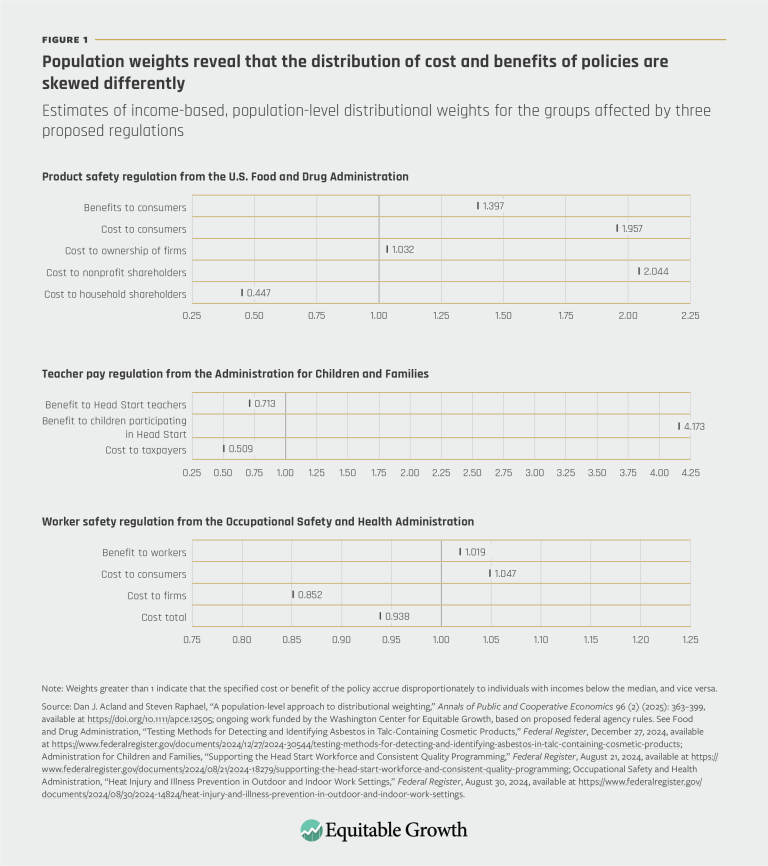
Population weights reveal that the distribution of cost and benefits of policies are skewed differently (opens in a new tab)
Visualizations NOV 13, 2025

Tariff costs impact industries with mostly White, male, and noncitizen workers (opens in a new tab)
Essays NOV 4, 2025
The U.S. economy is flying blind, with most economic-data publications paused indefinitely due to the shutdown of the federal government amid a general U.S. labor market slowdown and just as…
By: Christopher Bangert-Drowns (opens in a new tab)
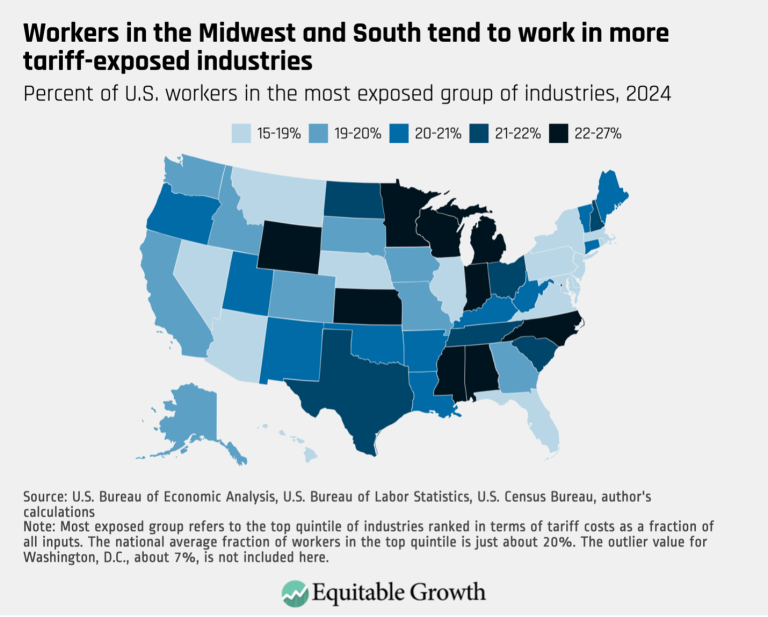 View Chart
(opens in a new tab)
View Chart
(opens in a new tab)
Workers in the Midwest and South tend to work in more tariff-exposed industries (opens in a new tab)
Visualizations NOV 3, 2025
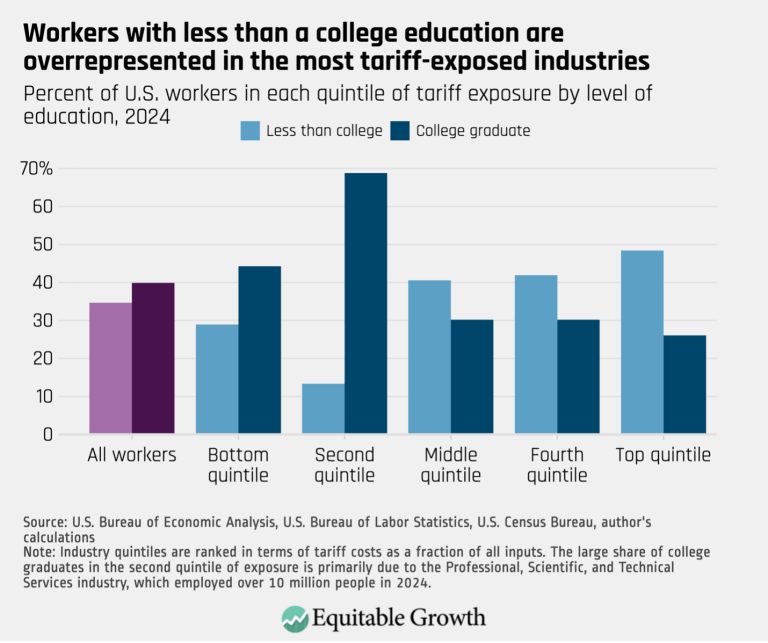 View Chart
(opens in a new tab)
View Chart
(opens in a new tab)
Workers with less than a college education are overrepresented in the most tariff-exposed industries (opens in a new tab)
Visualizations NOV 3, 2025
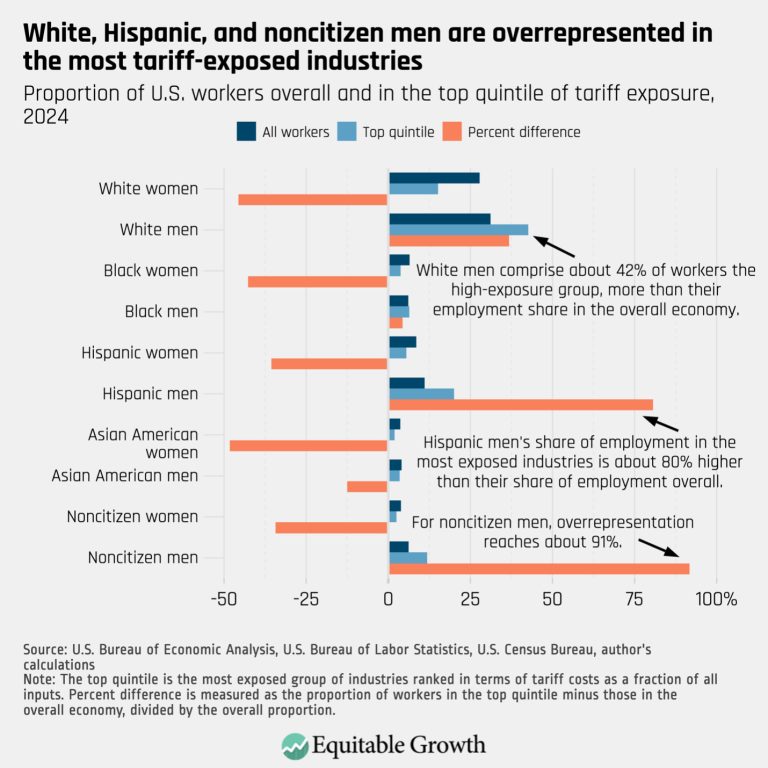 View Chart
(opens in a new tab)
View Chart
(opens in a new tab)
White, Hispanic, and noncitizen men are overrepresented in the most tariff-exposed industries (opens in a new tab)
Visualizations NOV 3, 2025
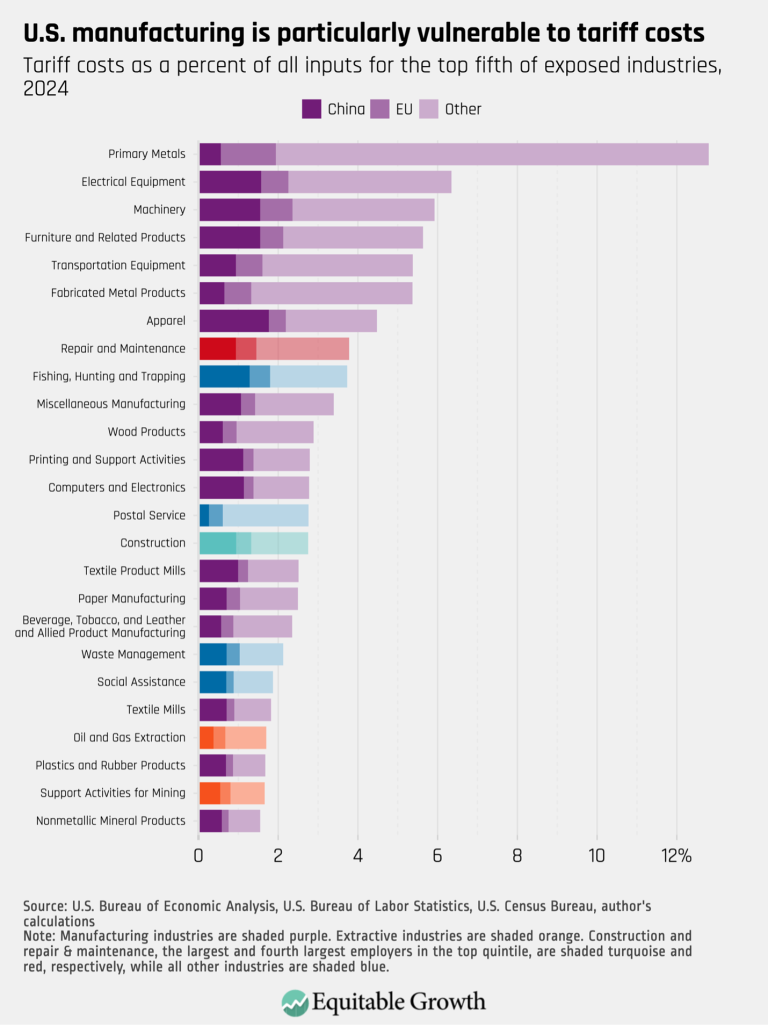 View Chart
(opens in a new tab)
View Chart
(opens in a new tab)
U.S. manufacturing is particularly vulnerable to tariff costs (opens in a new tab)
Visualizations NOV 3, 2025

Risks escalate for U.S. retirement plans due to unregulated private credit funds and new rules opening them up to retirement savings accounts (opens in a new tab)
Essays OCT 29, 2025
When the privately owned auto parts manufacturer First Brands Group earlier this month began to be unable to service its $6.1 billion debt load, the financial press began to pick…
By: Lenore Palladino (opens in a new tab)

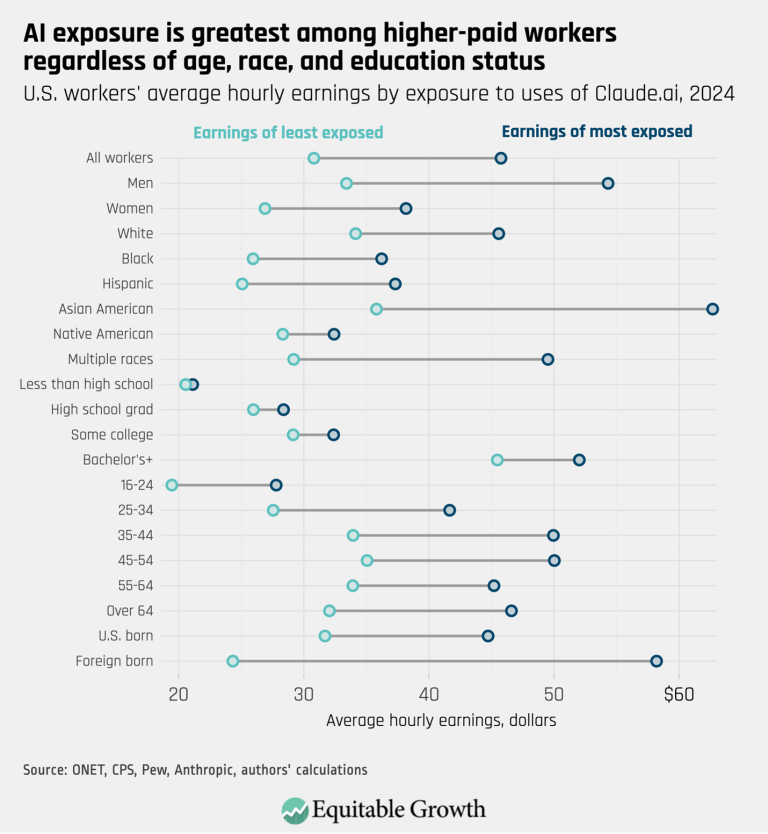
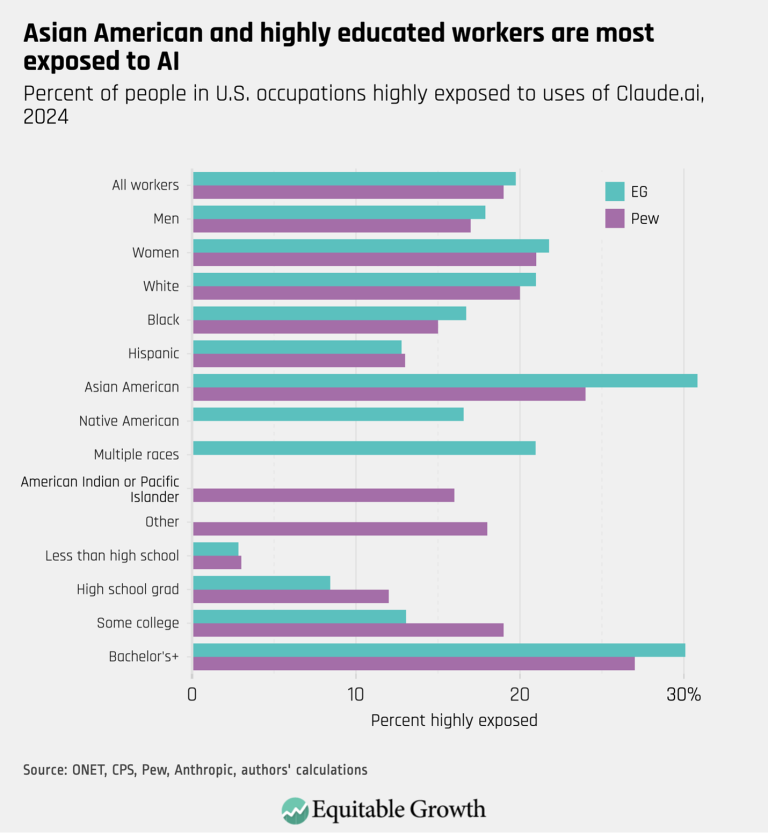
Workplace exposure to artificial intelligence is higher among U.S. workers with higher wages, depending on how AI is used (opens in a new tab)
Essays OCT 23, 2025
Recent advances using artificial intelligence in workplaces, particularly large language models such as Claude.ai and ChatGPT, are increasingly disrupting the U.S. labor market. The cognitive power of AI has the…
By: Chiara Chanoi (opens in a new tab), Christopher Bangert-Drowns (opens in a new tab)
AI exposure by U.S. occupations and work tasks and the effect on wages (opens in a new tab)
Working Papers OCT 23, 2025
This analysis of labor market AI exposure builds on previous work from the Pew Research Center and the AI firm Anthropic as well as Equitable Growth’s own job quality series,…
By: Chiara Chanoi (opens in a new tab), Chris Bangert-Drowns
 View Chart
(opens in a new tab)
View Chart
(opens in a new tab)
AI exposure is greatest among higher-paid workers regardless of age, race and education status (opens in a new tab)
Visualizations OCT 22, 2025
 View Chart
(opens in a new tab)
View Chart
(opens in a new tab)
Asian American and highly educated workers are most exposed to AI (opens in a new tab)
Visualizations OCT 22, 2025

Equitable Growth supports scholars studying the economics of the energy transition (opens in a new tab)
Essays OCT 22, 2025
The Washington Center for Equitable Growth today announced a new cohort of grantees. These nine scholars will study how the design and implementation of federal policy influences how businesses and…
By: Equitable Growth (opens in a new tab)
The Benefits of Unemployment Insurance For Marginally Attached Workers (opens in a new tab)
Working Papers OCT 21, 2025
Existing research consistently finds that UI benefits delay job finding with limited effects on job quality, but focuses on changes in unemployment insurance (UI) generosity while holding fixed access to…
By: Casey McQuillan (opens in a new tab), Brendan Moore (opens in a new tab)

Payment for schedule changes under Fair Workweek laws in three U.S. cities (opens in a new tab)
Essays OCT 16, 2025
Fair Workweek laws set new standards for scheduling U.S. workers in jobs and industries characterized by fluctuating and unpredictable work hours, such as jobs in retail and food service. A…
By: Susan Lambert (opens in a new tab), Julia Henly (opens in a new tab)

Rethinking U.S. economic mobility to study change within a generation (opens in a new tab)
Essays OCT 9, 2025
When most people think about intergenerational mobility, they often assume it unfolds gradually over long periods of time. Historical patterns have reinforced this perception, shaping a widespread belief that meaningful…
By: Raven Shaw (opens in a new tab)
Changing Opportunity: Sociological Mechanisms Underlying Growing Class Gaps and Shrinking Race Gaps in Economic Mobility (opens in a new tab)
Working Papers OCT 9, 2025
We show that intergenerational mobility changed rapidly by race and class in recent decades and use these trends to study the causal mechanisms underlying changes in economic mobility. For white…
By: Raj Chetty (opens in a new tab), Will Dobbie (opens in a new tab), Benjamin Goldman (opens in a new tab), Sonya R. Porter, Crystal S. Yang

The status of U.S. labor market data amid the government shutdown (opens in a new tab)
Essays OCT 3, 2025
The federal government ground to a halt earlier this week as Congress was unable to reach a bipartisan agreement on continuing funding after annual appropriations ran out at the end…
By: Christopher Bangert-Drowns (opens in a new tab), Michael Linden (opens in a new tab)

U.S. workers’ and managers’ experiences with Fair Workweek laws can inform enforcement and education (opens in a new tab)
Essays OCT 2, 2025
Fair Workweek laws are intended to set new standards for scheduling workers in jobs and industries characterized by fluctuating and unpredictable work hours, such as jobs in retail and food…
By: Susan Lambert (opens in a new tab), Julia Henly (opens in a new tab)

How Are Workers Experiencing Fair Workweek Laws? Evidence for policymakers and advocates (opens in a new tab)
Essays OCT 2, 2025
This factsheet, “How Are Workers Experiencing Fair Workweek Laws? Evidence for policymakers and advocates,” originally appeared on WorkRise at https://www.workrisenetwork.org/sites/default/files/2025-08/howareworkersexperiencingfairworkweeklaws.pdf. New laws that regulate employer scheduling practic…
By: Susan Lambert (opens in a new tab), Julia Henly (opens in a new tab)

Federal data is under attack, but data users can work together to preserve and democratize it (opens in a new tab)
Essays OCT 1, 2025
Staffing shortages, political interference, and a federal government shutdown are all disrupting the routine operations of the nonpartisan federal statistical agencies that reliably gather facts and publish data about the…
By: Peter Norlander (opens in a new tab)
Extracting O*NET Features from the NLx Corpus to Build Public Use Aggregate Labor Market Data (opens in a new tab)
Working Papers OCT 1, 2025
Data from online job postings are difficult to access and are not built in a standard or transparent manner. Data included in the standard taxonomy and occupational information database (O*NET)…
By: Stephen Meisenbacher (opens in a new tab), Svetlozar Nestorov (opens in a new tab), Peter Norlander (opens in a new tab)

In Conversation with Omari Swinton (opens in a new tab)
In Conversation SEP 24, 2025
Equitable Growth in Conversation is a recurring series where we talk with economists and other academics to help us better understand whether and how economic inequality affects economic growth and…
By: Sanjay Supan (opens in a new tab)
 View Chart
(opens in a new tab)
View Chart
(opens in a new tab)
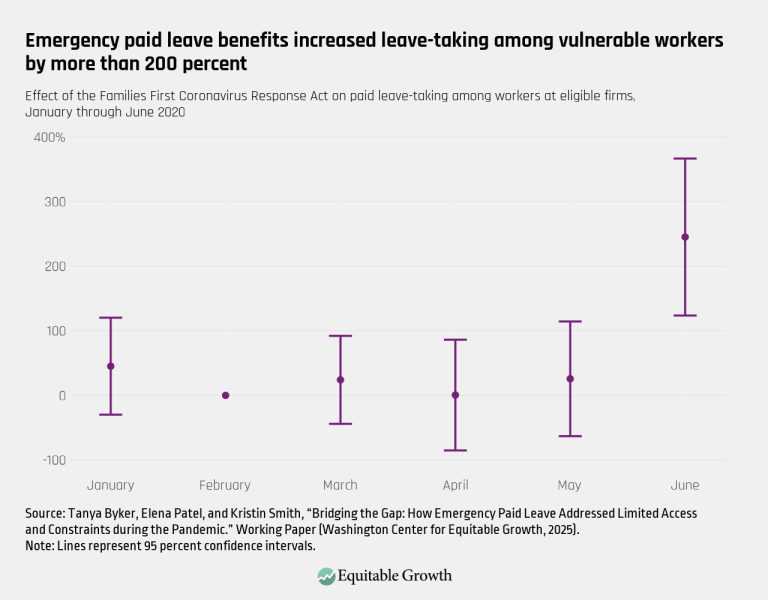
Emergency paid leave benefits increased leave-taking among vulnerable workers by more than 200 percent – Final (opens in a new tab)
Visualizations SEP 23, 2025
 View Chart
(opens in a new tab)
View Chart
(opens in a new tab)
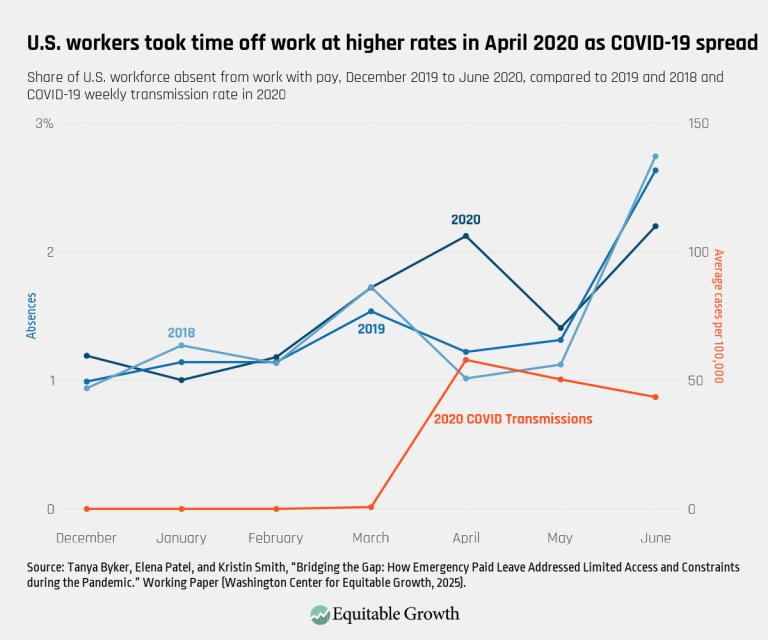
U.S. workers took time off work at higher rates in April 2020 as COVID-19 spread (opens in a new tab)
Visualizations SEP 23, 2025

Emergency paid leave during the COVID-19 pandemic offered essential protections for U.S. workers (opens in a new tab)
Essays SEP 23, 2025
When the COVID-19 pandemic swept across the United States in early 2020, it didn’t just bring about a public health emergency. It also exposed a longstanding weakness in the U.S.…
By: Tanya Byker (opens in a new tab), Elena Patel (opens in a new tab), Kristin Smith (opens in a new tab)
Fitting the Bill? The First Federal Paid Leave Mandate (opens in a new tab)
Working Papers SEP 23, 2025
We find that the first federal paid leave mandate in the US, enacted under the Families First Coronavirus Response Act, increased paid leave taking by nearly 200% for eligible workers,…
By: Tanya Byker (opens in a new tab), Elena Patel (opens in a new tab), Kristin Smith (opens in a new tab)

Equitable Growth announces funding for research on the impact of AI on U.S. workers and competition (opens in a new tab)
Essays SEP 18, 2025
The Washington Center for Equitable Growth today announced a new cohort of grantees studying how artificial intelligence and new technology can support workers and promote competition across the U.S. economy.…
By: Equitable Growth (opens in a new tab)

Populist voters feel a sense of loss that is reshaping democracies around the world (opens in a new tab)
Essays SEP 11, 2025
Across Europe, populist parties—once relegated to the political fringe—are now mainstays of national politics. Some are even winning power in the Netherlands, Sweden, Italy, Austria, and beyond. Whether left-wing or…
By: Justin Gest (opens in a new tab)

Threats to social status and support for far-right political parties (opens in a new tab)
Essays SEP 11, 2025
Once on the political fringes, far-right parties have become established actors in many democracies. The European Parliament election in 2024, for example, resulted in far-right parties receiving more than 20…
By: Tarik Abou-Chadi (opens in a new tab)

A place-based economic development strategy to foster rural U.S. prosperity (opens in a new tab)
Essays SEP 11, 2025
Whether one lives in a city of 2 million people or a town of 2,000, we all want to live in healthy and thriving communities, to have the chance to…
By: Gbenga Ajilore (opens in a new tab)

How U.S. tax policies have fueled right-wing populism (opens in a new tab)
Essays SEP 11, 2025
Among the many factors fueling support for right-wing populism in the United States is federal tax policies. The nation’s tax system confuses, frustrates, and angers many citizens in ways that…
By: Andrea Louise Campbell (opens in a new tab)
To restore democracy, end shareholder primacy at U.S. corporations and on Wall Street (opens in a new tab)
Essays SEP 11, 2025
Workers in the United States have no say over business decisions made in their workplaces by corporate America. Unions, of course, are important for workers’ ability to exercise power over…
By: Lenore Palladino (opens in a new tab)
 View Chart
(opens in a new tab)
View Chart
(opens in a new tab)
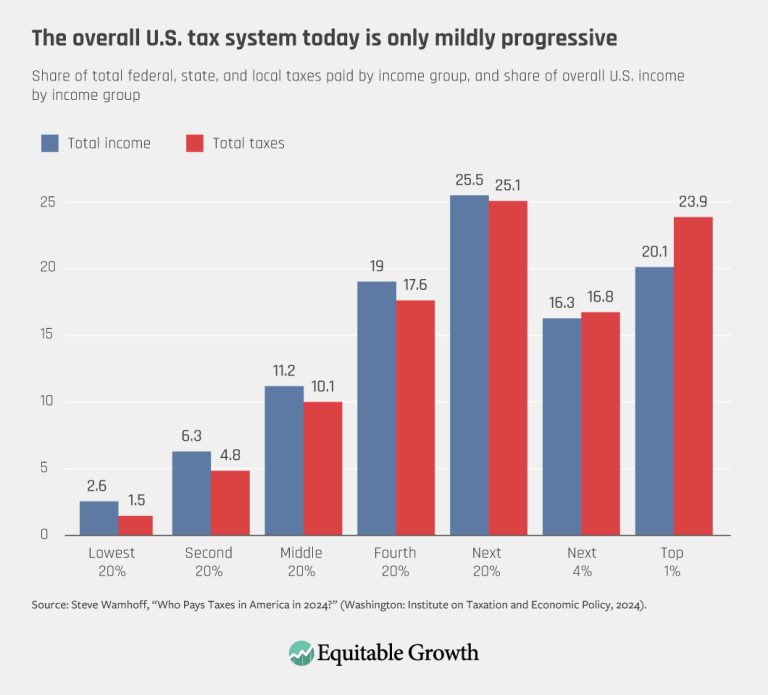
The overall U.S. tax system today is only mildly progressive (opens in a new tab)
Visualizations SEP 10, 2025

Even health care, the strongest sector of the U.S. jobs market, cannot deliver the wages its workers deserve without unionization (opens in a new tab)
Essays SEP 10, 2025
The growth of jobs in the U.S. health care industry is the linchpin to a strong U.S. labor market in 2025 and beyond. Health care is one of only a…
By: Adam Dean (opens in a new tab), Jamie McCallum (opens in a new tab)
 View Chart
(opens in a new tab)
View Chart
(opens in a new tab)
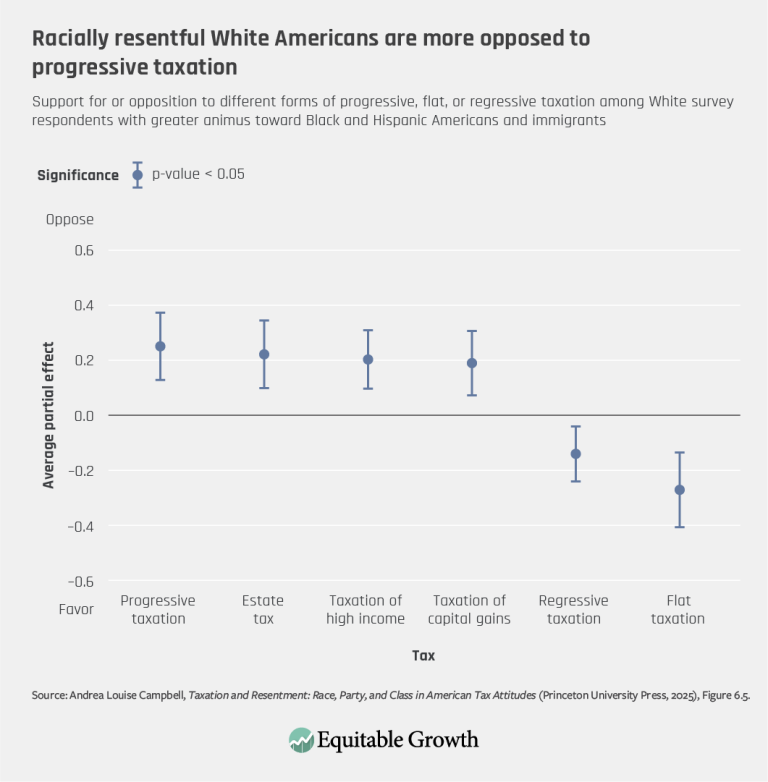
Racially resentful White Americans are more opposed to progressive taxation (opens in a new tab)
Visualizations SEP 9, 2025
 View Chart
(opens in a new tab)
View Chart
(opens in a new tab)
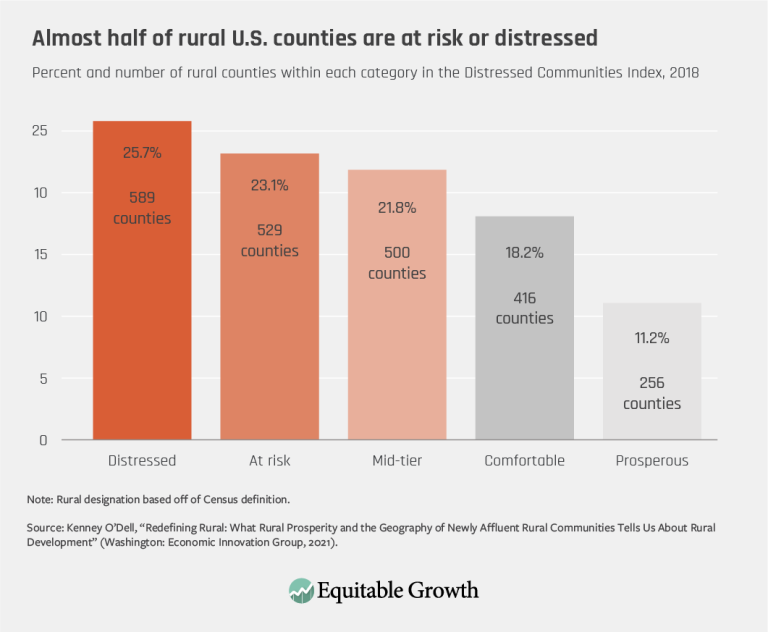
Almost half of rural U.S. counties are at risk or distressed (opens in a new tab)
Visualizations SEP 8, 2025
 View Chart
(opens in a new tab)
View Chart
(opens in a new tab)
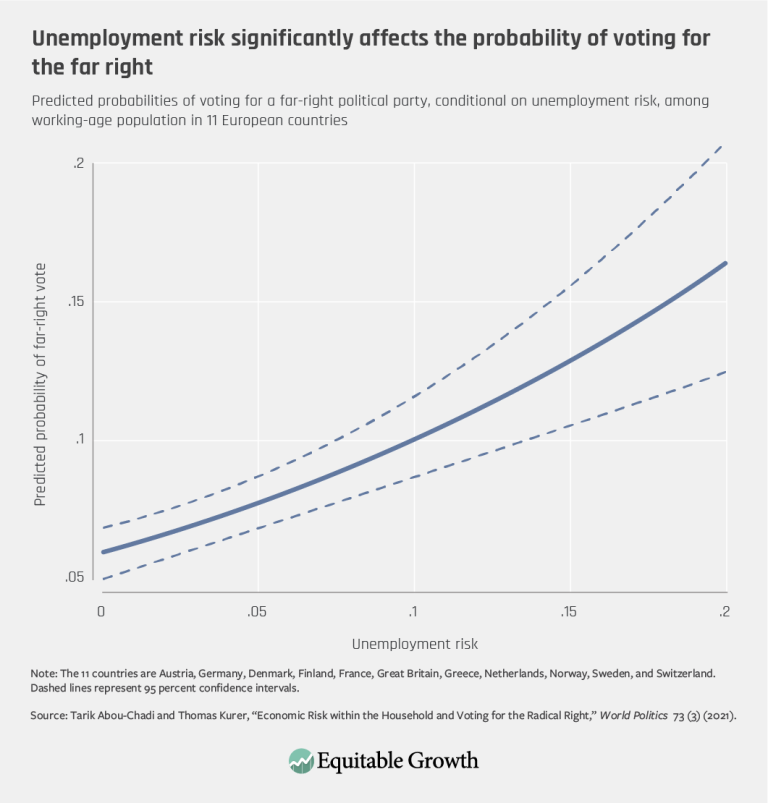
Unemployment risk significantly affects the probability of voting for the far right (opens in a new tab)
Visualizations SEP 5, 2025
 View Chart
(opens in a new tab)
View Chart
(opens in a new tab)
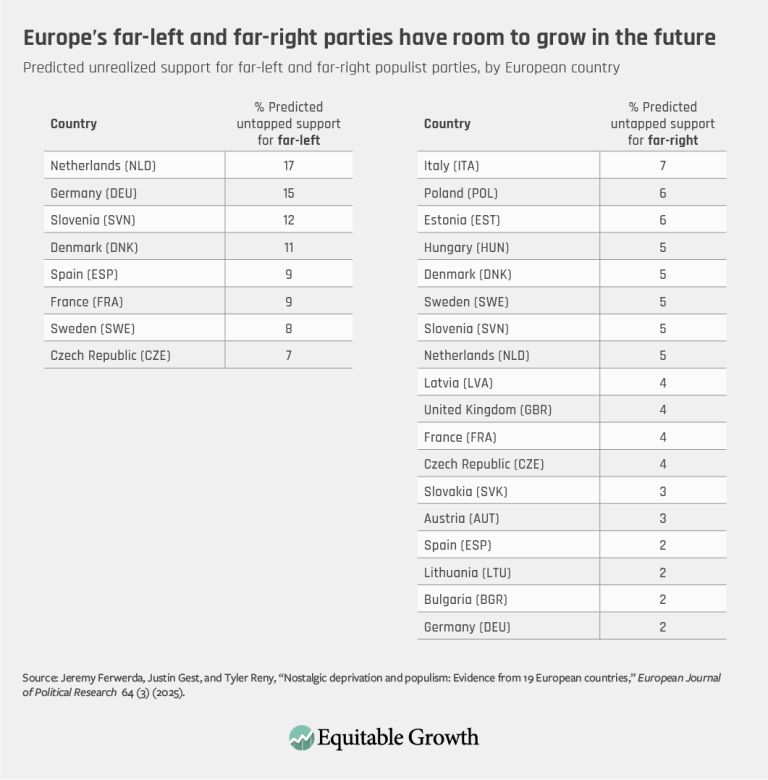
Europe’s far-left and far-right parties have room to grow in the future (opens in a new tab)
Visualizations SEP 4, 2025
 View Chart
(opens in a new tab)
View Chart
(opens in a new tab)
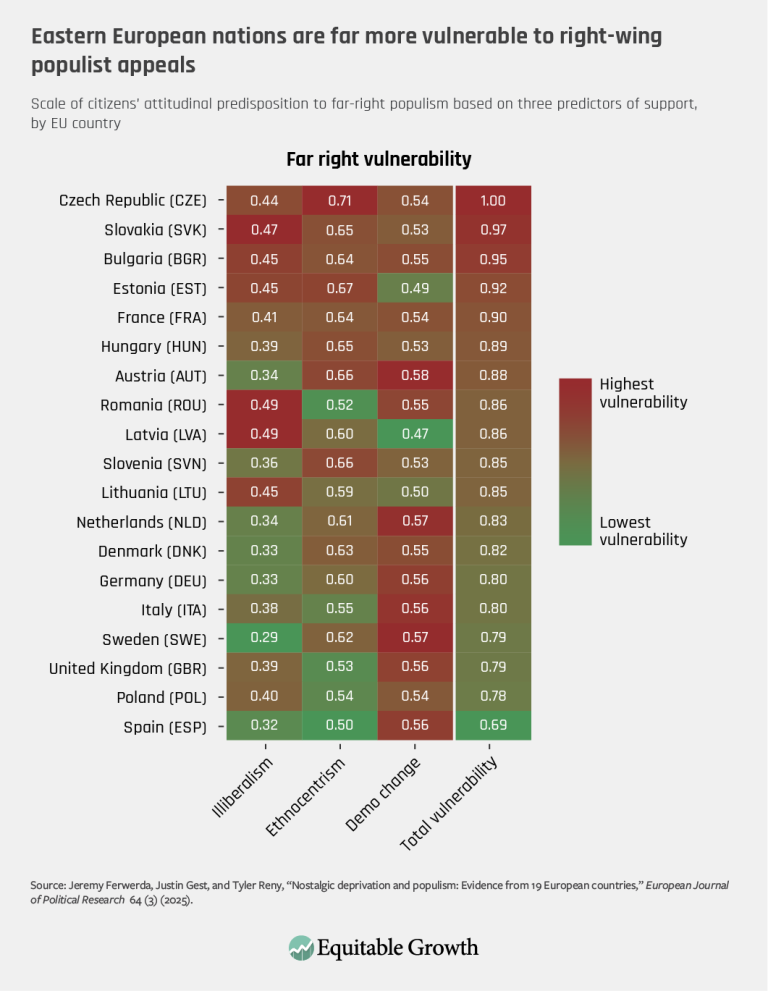
Eastern European nations are far more vulnerable to right-wing populist appeals (opens in a new tab)
Visualizations SEP 4, 2025
 View Chart
(opens in a new tab)
View Chart
(opens in a new tab)
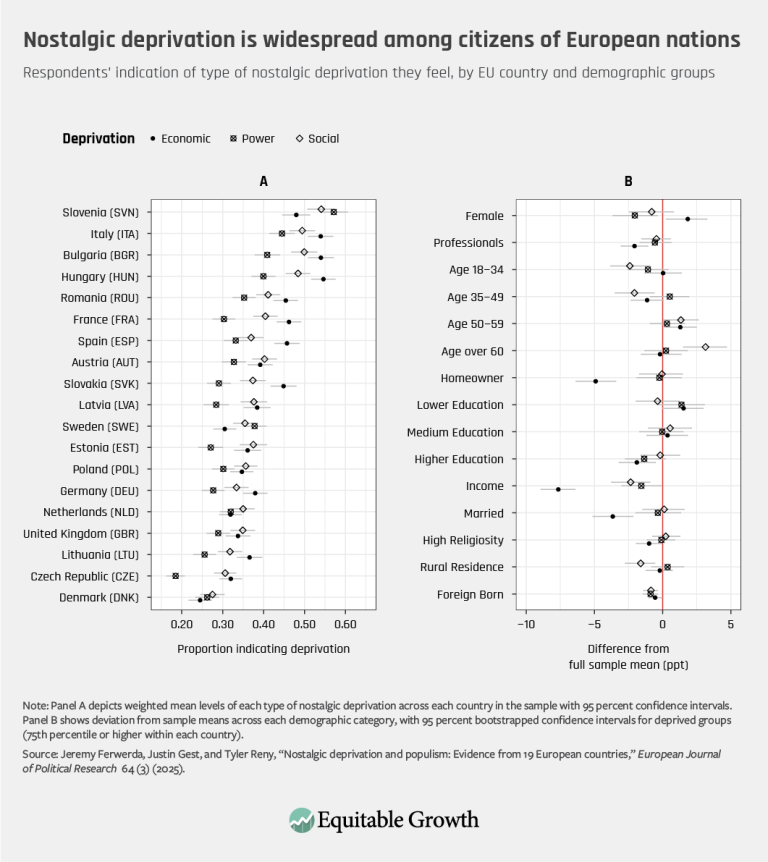
Nostalgic deprivation is widespread among citizens of European nations (opens in a new tab)
Visualizations SEP 4, 2025
In Her Hands: A Guaranteed Income Initiative (opens in a new tab)
Working Papers SEP 4, 2025
In Her Hands (IHH) is a guaranteed income (GI) initiative aimed at addressing persistent economic insecurity among women in neighborhoods with some of Georgia’s highest poverty rates. Co-designed with local…
By: Laura Brugger (opens in a new tab), Shadonna Davis (opens in a new tab), Desha Elliott (opens in a new tab), Leah Hamilton (opens in a new tab), Stephen Roll (opens in a new tab), Latrice Rollins (opens in a new tab), Simone Smith (opens in a new tab), Aaron Quick (opens in a new tab), Naomi Zewde (opens in a new tab)

The Federal Reserve must maintain its independence for the U.S. economy to thrive (opens in a new tab)
Essays AUG 28, 2025
President Donald Trump is attempting to fire Federal Reserve Board Governor Lisa Cook, the first Black woman to serve in that role. He probably lacks the legal authority to do…
By: Alan Blinder (opens in a new tab)
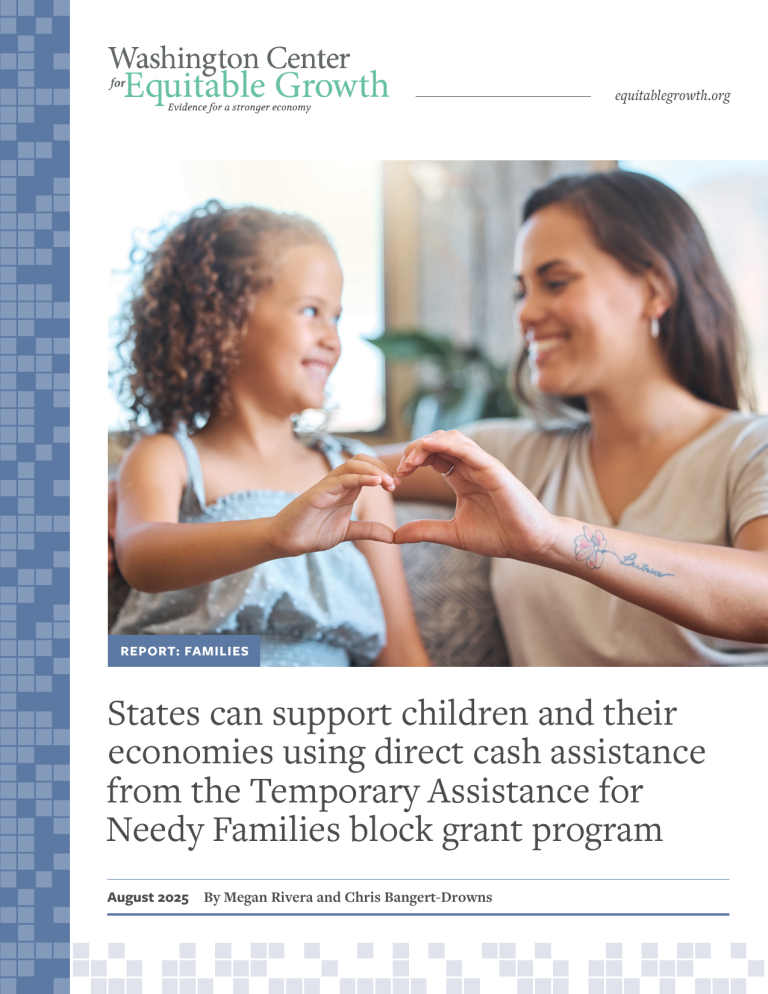
States can support children and their economies using direct cash assistance from the Temporary Assistance for Needy Families block grant program (opens in a new tab)
Reports AUG 28, 2025
Efficient, effective, and responsive income support programs can reduce economic inequality and support economic mobility. If targeted effectively, these programs can help children, families, and workers meet their needs and…
By: Megan Rivera (opens in a new tab), Christopher Bangert-Drowns (opens in a new tab)
 View Chart
(opens in a new tab)
View Chart
(opens in a new tab)
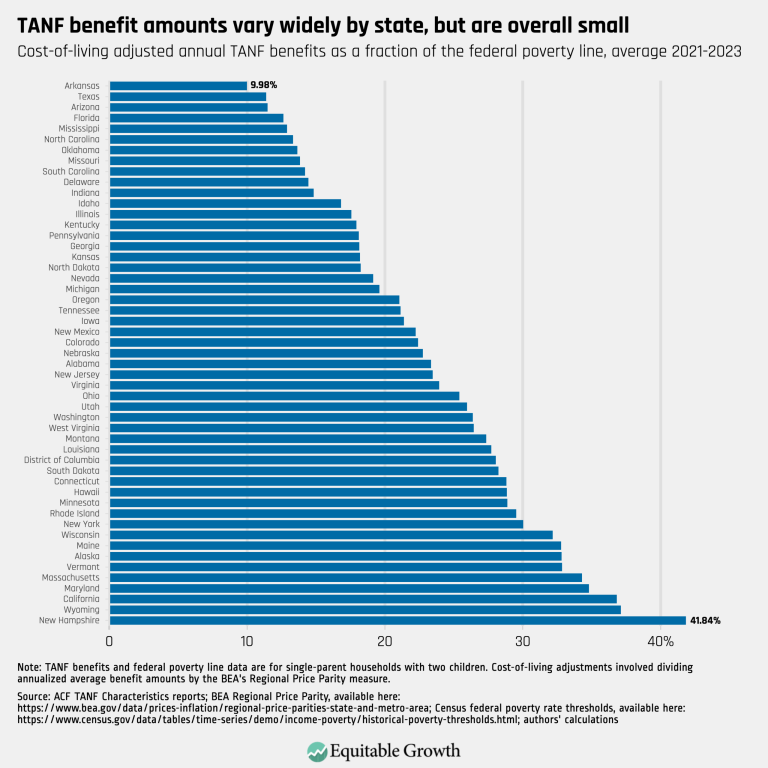
TANF benefit amounts vary widely by state, but are overall small – updated (opens in a new tab)
Visualizations AUG 26, 2025
 View Chart
(opens in a new tab)
View Chart
(opens in a new tab)
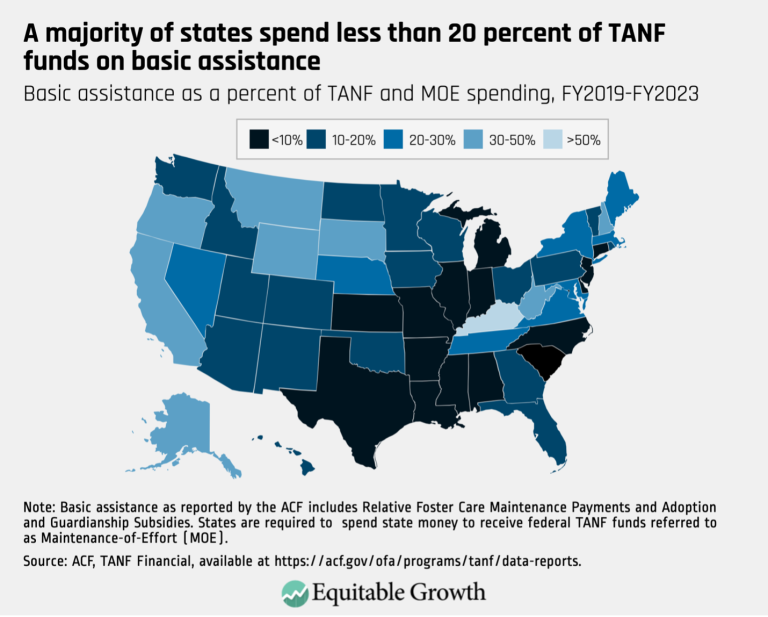
A majority of states spend less than 20 percent of TANF funds on basic assistance (opens in a new tab)
Visualizations AUG 26, 2025
 View Chart
(opens in a new tab)
View Chart
(opens in a new tab)
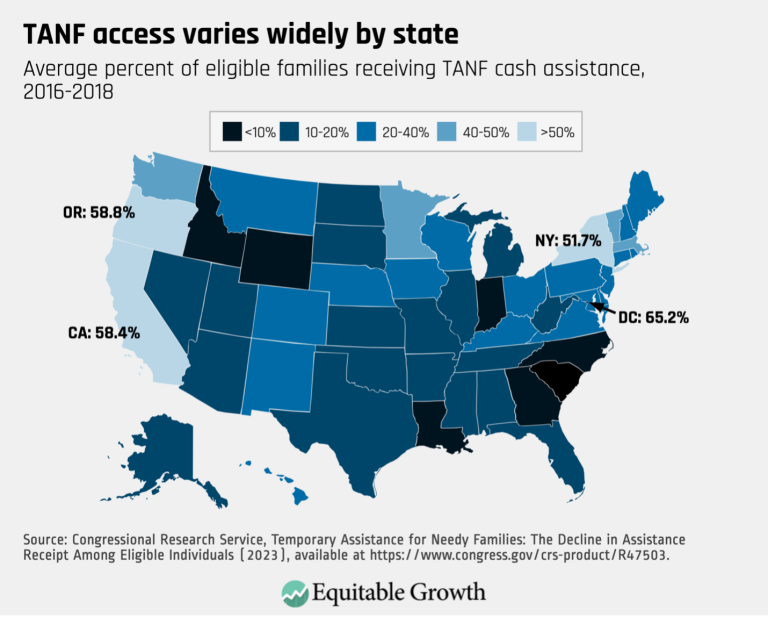
TANF access varies widely by state (opens in a new tab)
Visualizations AUG 26, 2025
 View Chart
(opens in a new tab)
View Chart
(opens in a new tab)
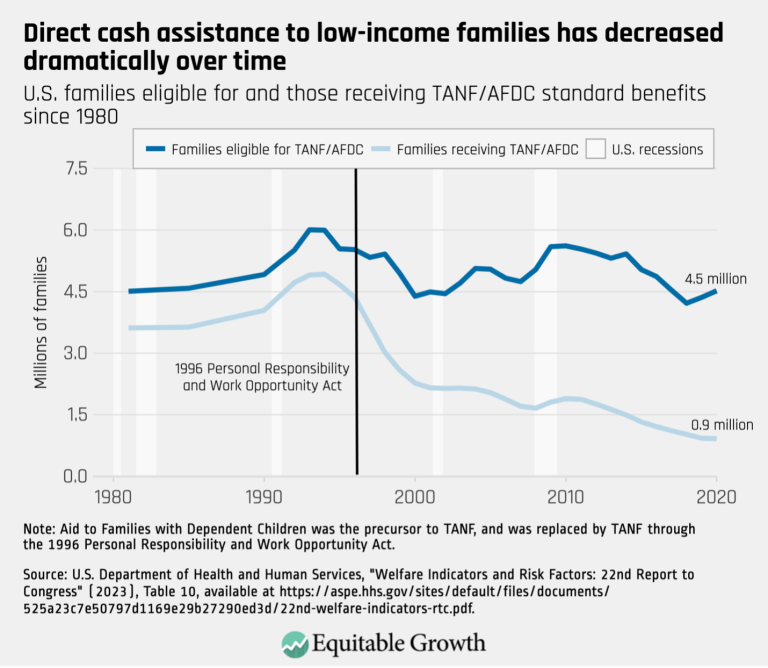
Direct cash assistance to low-income families has decreased dramatically over time (opens in a new tab)
Visualizations AUG 26, 2025

How artificial intelligence uncouples hard work from fair wages through ‘surveillance pay’ practices—and how to fix it (opens in a new tab)
Issue Briefs AUG 21, 2025
Correction: Freddie Mac and Udemy contacted the Washington Center for Equitable Growth on March 18, 2026 and April 2, 2026, respectively, to say they no longer had business relationships with…
By: Veena Dubal (opens in a new tab), Wilneida Negrón (opens in a new tab)

Equitable Growth awards funding to early career scholars studying the effects of economic inequality (opens in a new tab)
Essays AUG 20, 2025
The Washington Center for Equitable Growth announced today that it has awarded funding to seven scholars seeking to better understand the effects of economic inequality in the United States and…
By: Equitable Growth (opens in a new tab)

What is austerity, and how does it affect the broader U.S. economy? (opens in a new tab)
Reports AUG 12, 2025
With the passage into law of the Republican budget reconciliation bill last month and the recent work of the Department of Government Efficiency under Elon Musk, austerity is once again…
By: Ernie Tedeschi (opens in a new tab), Kevin Rinz (opens in a new tab)
 View Chart
(opens in a new tab)
View Chart
(opens in a new tab)
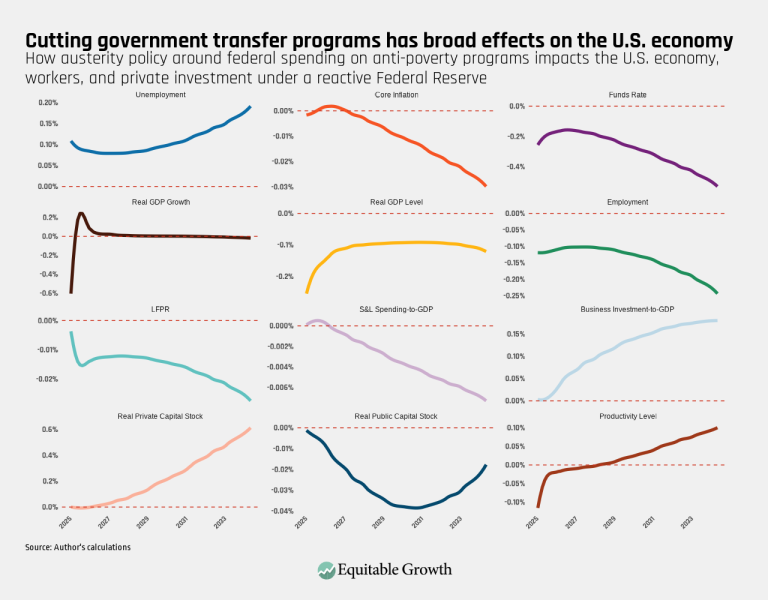
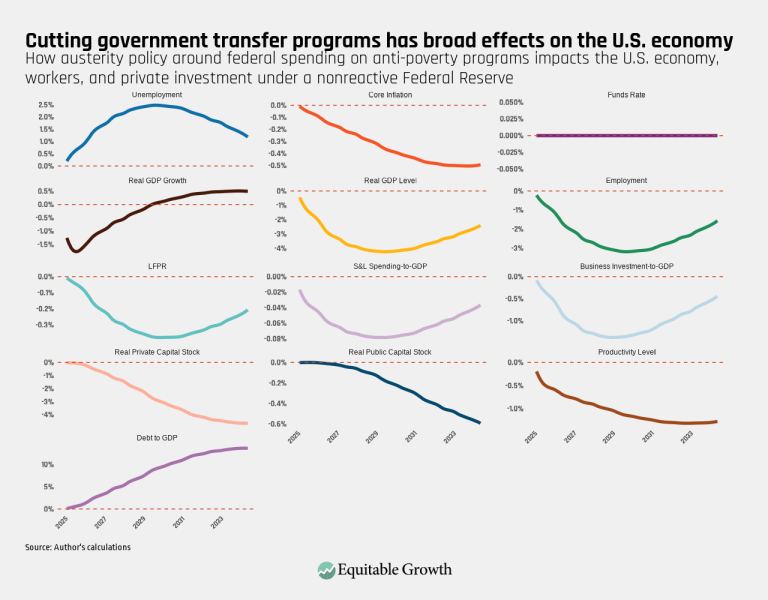
Cutting government transfer programs has broad effects on the U.S. economy (opens in a new tab)
Visualizations AUG 12, 2025
 View Chart
(opens in a new tab)
View Chart
(opens in a new tab)
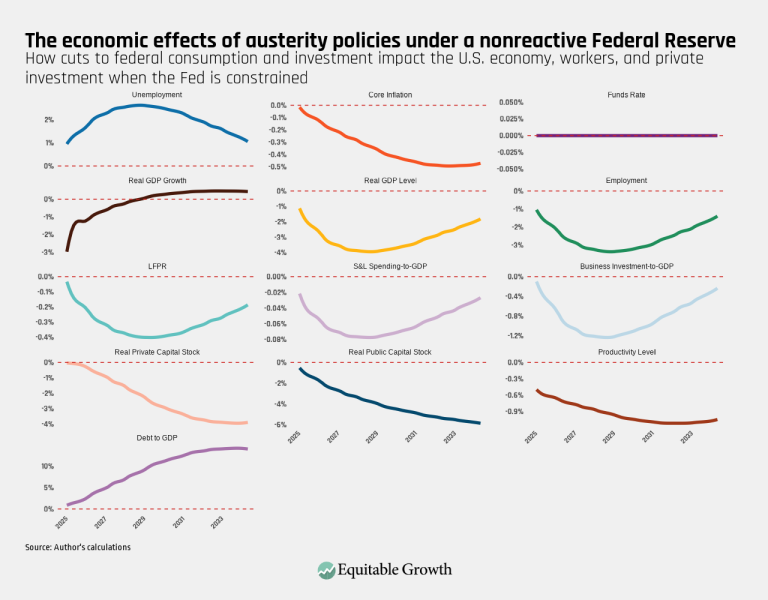
Cutting government transfer programs has broad effects on the U.S. economy (opens in a new tab)
Visualizations AUG 12, 2025
 View Chart
(opens in a new tab)
View Chart
(opens in a new tab)
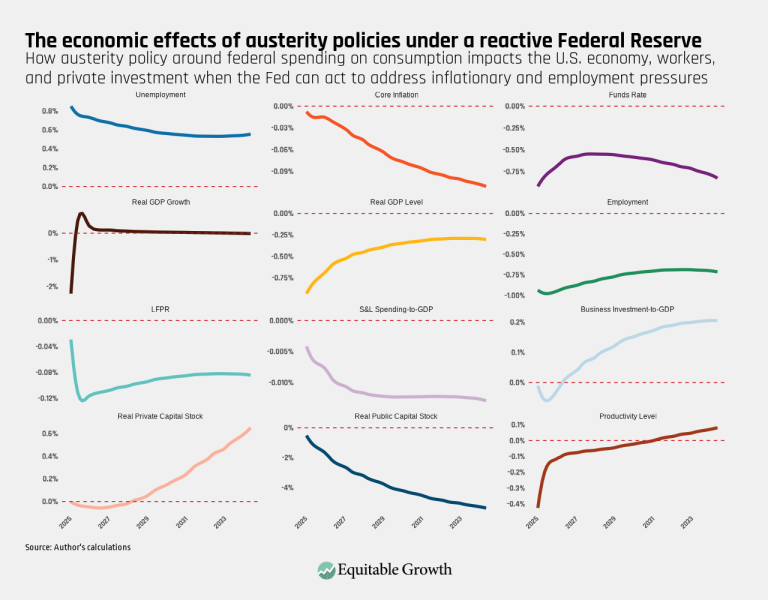
The economic effects of austerity policies under a nonreactive Federal Reserve – Final (opens in a new tab)
Visualizations AUG 12, 2025
 View Chart
(opens in a new tab)
View Chart
(opens in a new tab)
The economic effects of austerity policies under a reactive Federal Reserve (opens in a new tab)
Visualizations AUG 12, 2025
 View Chart
(opens in a new tab)
View Chart
(opens in a new tab)
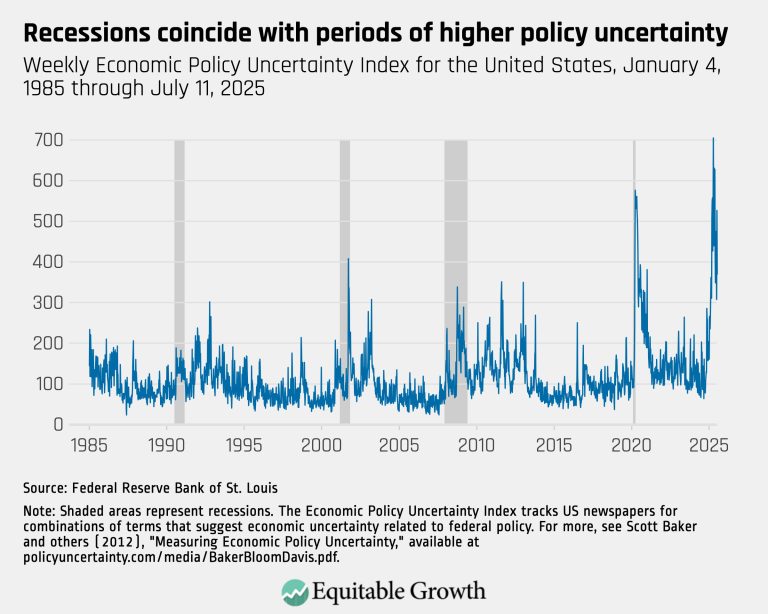
Recessions coincide with periods of higher policy uncertainty – updated (opens in a new tab)
Visualizations AUG 7, 2025
 View Chart
(opens in a new tab)
View Chart
(opens in a new tab)
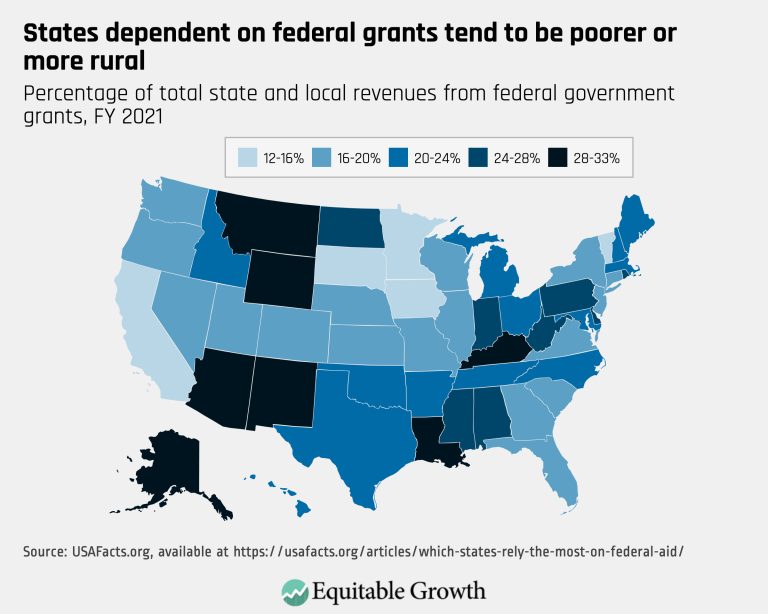
States dependent on federal grants tend to be poorer or more rural (opens in a new tab)
Visualizations AUG 7, 2025
Why Financial Crises Recur (opens in a new tab)
Working Papers AUG 5, 2025
Financial crises have occurred around the world for over two centuries. These crises have been so costly and frequent that one wonders why governments cannot prevent them from recurring despite…
By: Gary B. Gorton (opens in a new tab), Jeffery Y. Zhang (opens in a new tab)

Tariffs impact U.S. industries differently, with manufacturing the most exposed (opens in a new tab)
Issue Briefs JUL 29, 2025
Estimates in this brief were generated July 21, before the announcement of trade deals with Japan and the European Union. All data and code used in the Equitable Growth tariff…
By: Christopher Bangert-Drowns (opens in a new tab)
 View Chart
(opens in a new tab)
View Chart
(opens in a new tab)
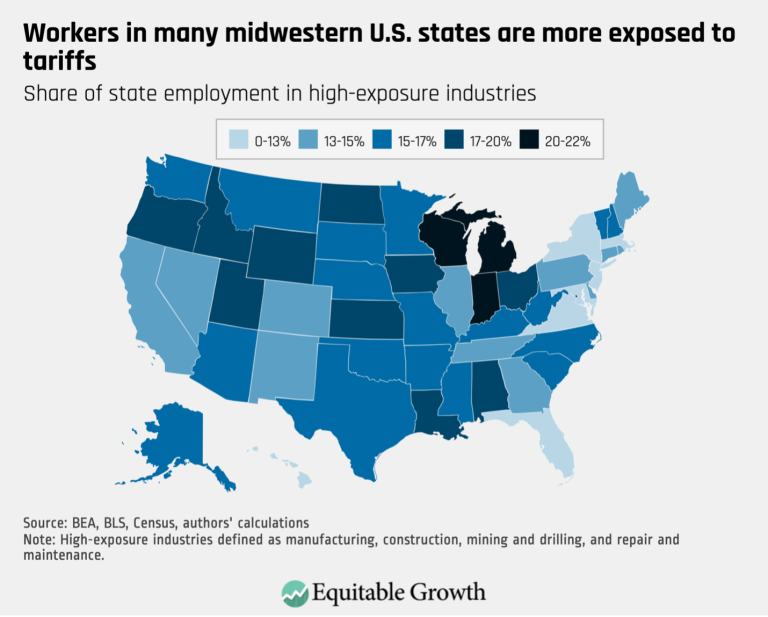
Workers in many midwestern U.S. states are more exposed to tariffs (opens in a new tab)
Visualizations JUL 28, 2025
 View Chart
(opens in a new tab)
View Chart
(opens in a new tab)
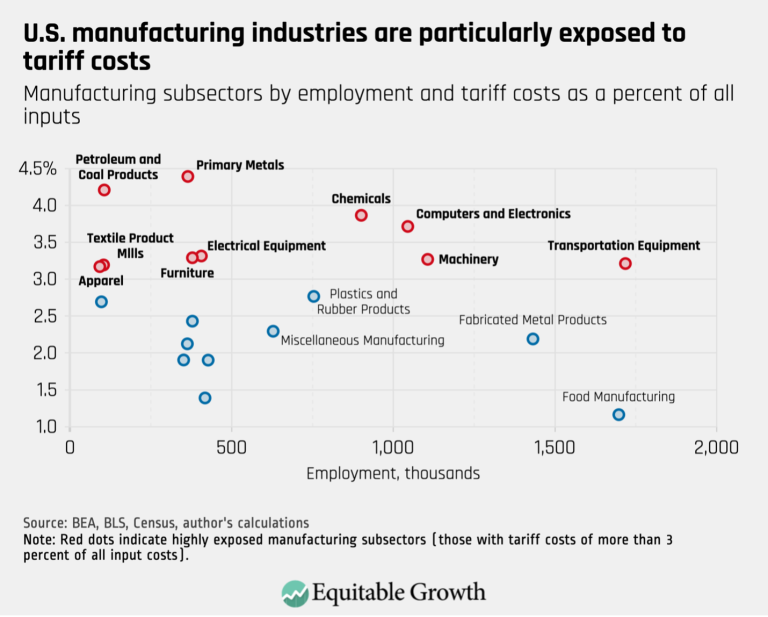
U.S. manufacturing industries are particularly exposed to tariff costs (opens in a new tab)
Visualizations JUL 28, 2025
 View Chart
(opens in a new tab)
View Chart
(opens in a new tab)
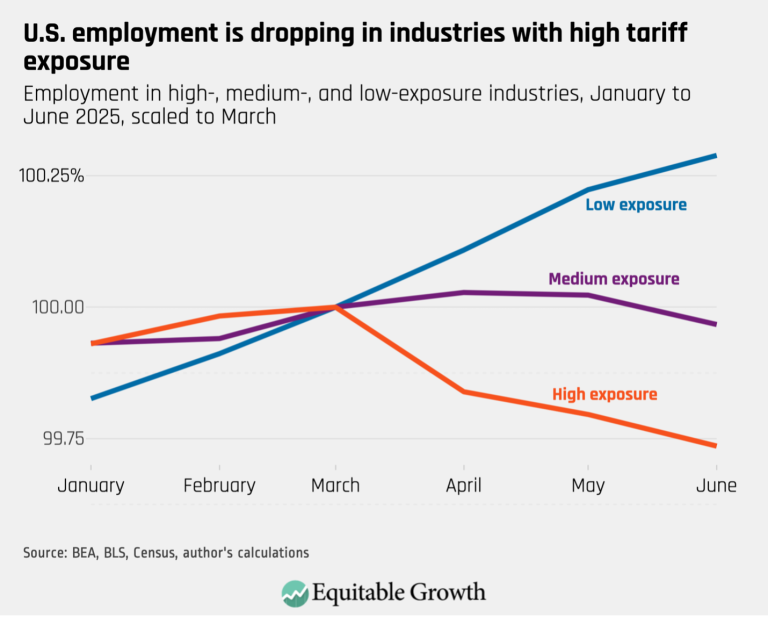
U.S. employment is dropping in industries with high tariff exposure (opens in a new tab)
Visualizations JUL 28, 2025
 View Chart
(opens in a new tab)
View Chart
(opens in a new tab)
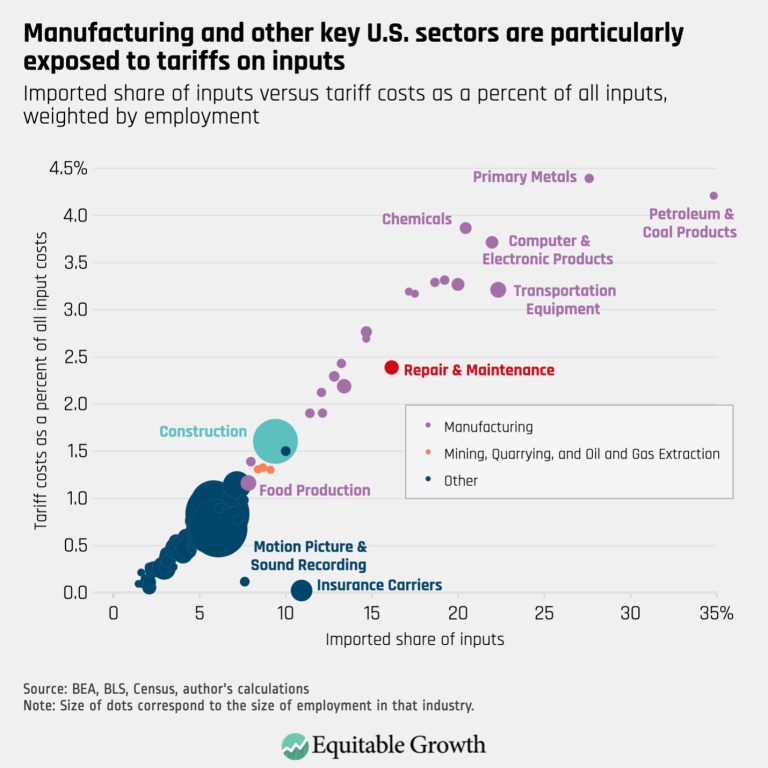
Manufacturing and other key U.S. sectors are particularly exposed to tariffs on inputs (opens in a new tab)
Visualizations JUL 28, 2025
 View Chart
(opens in a new tab)
View Chart
(opens in a new tab)
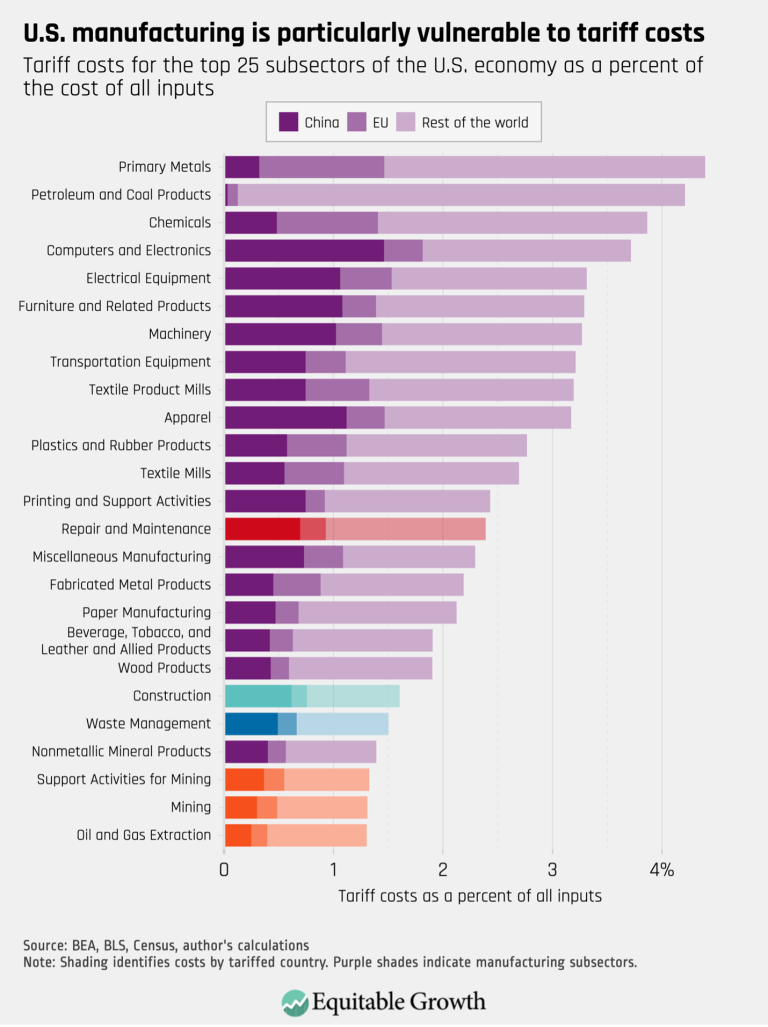
U.S. manufacturing is particularly vulnerable to tariff costs (opens in a new tab)
Visualizations JUL 28, 2025
How are Municipal-Level Fair Workweek Laws Playing Out on the Ground? Experiences of Food Service and Retail Workers in Three Cities (opens in a new tab)
Working Papers JUL 24, 2025
An updated version of this paper was posted on December 09, 2025. The first municipal-level law regulating employers’ scheduling practices was enacted in SanFrancisco in 2015. A decade later, ten…
By: Susan J. Lambert, Julia R. Henly, Hyojin Cho (opens in a new tab), Resha Swanson-Varner (opens in a new tab), Yuxi He (opens in a new tab)
Equity Prices, Market Power, and Optimal Corporate Tax Policy (opens in a new tab)
Working Papers JUL 22, 2025
We study the optimal design of corporate tax policy in a textbook life-cycle model featuring two key deviations: (i) firms are imperfectly competitive and (ii) households save by purchasing equity…
By: Ignacio González (opens in a new tab), Juan A. Montecino (opens in a new tab), Joseph E. Stiglitz

Accounting for capital gains in income significantly increases U.S. inequality (opens in a new tab)
Blog JUL 15, 2025
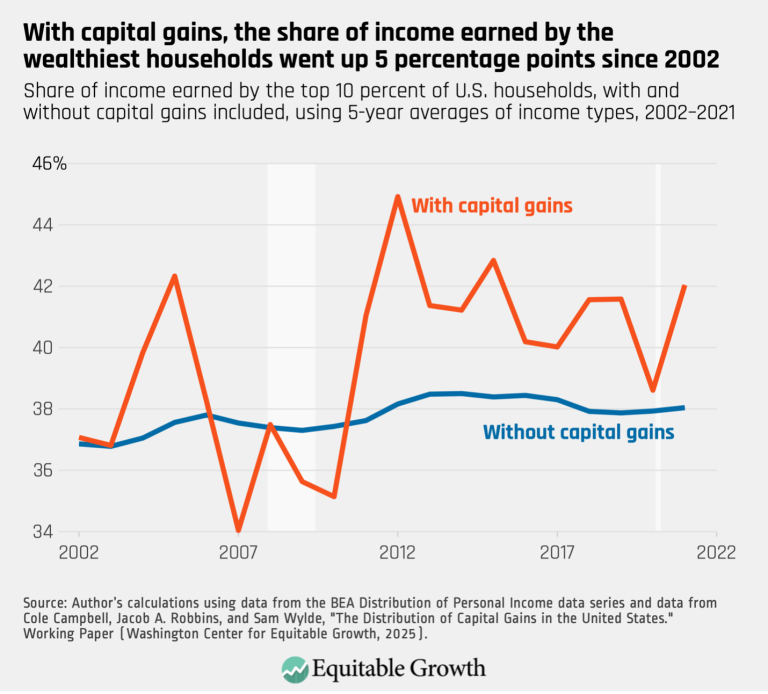
The Washington Center for Equitable Growth’s recently launched U.S. Inequality Tracker uses data from the U.S. Bureau of Economic Analysis to show how income and wealth inequality have evolved in…
By: Austin Clemens (opens in a new tab)
 View Chart
(opens in a new tab)
View Chart
(opens in a new tab)
With capital gains, the share of income earned by the wealthiest households went up 5 percentage points since 2002 (opens in a new tab)
Visualizations JUL 14, 2025
 View Chart
(opens in a new tab)
View Chart
(opens in a new tab)
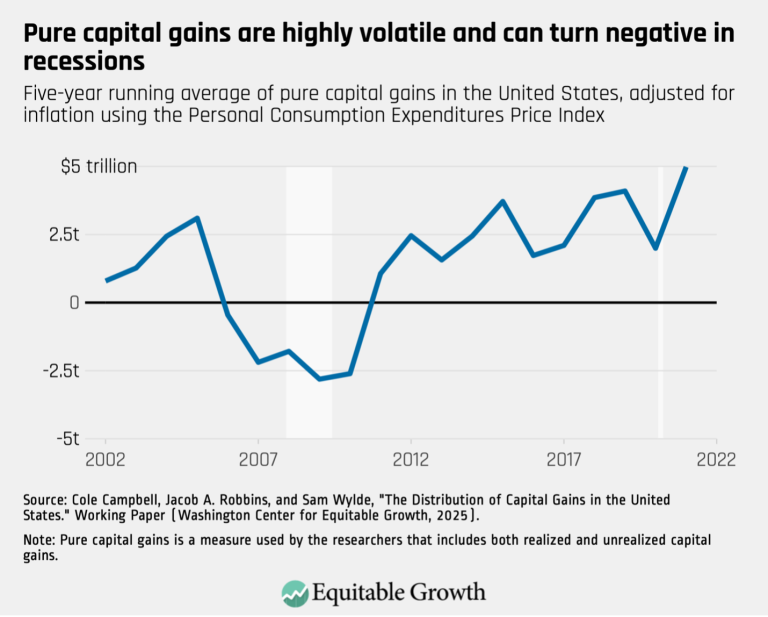
Pure capital gains are highly volatile and can turn negative in recessions (opens in a new tab)
Visualizations JUL 14, 2025

The 10 worst policies for equitable economic growth in the 2025 budget reconciliation law (opens in a new tab)
Essays JUL 14, 2025
The 2025 budget reconciliation law that was enacted earlier this month is a sprawling piece of legislation, touching almost every corner of the federal budget and the U.S. economy. It…
By: David S. Mitchell (opens in a new tab)

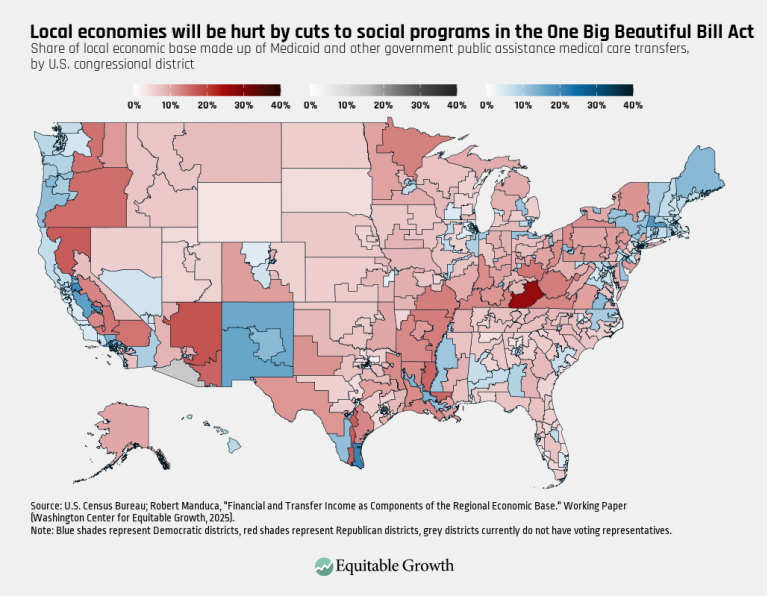
Republican reconciliation bill’s cuts to social programs will damage some congressional districts’ local economies (opens in a new tab)
Essays JUL 11, 2025
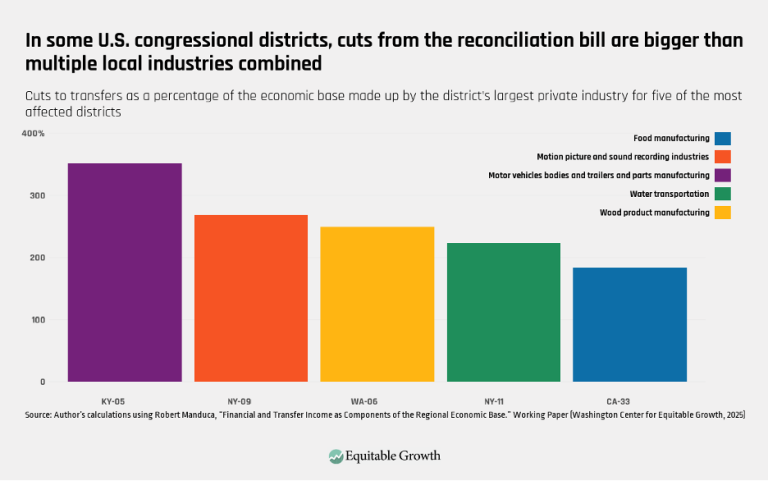
In a recent working paper, Equitable Growth grantee Robert Manduca of the University of Michigan, Ann Arbor demonstrates that government transfers make sizable contributions to local economies in much of…
By: Chiara Chanoi (opens in a new tab)
 View Chart
(opens in a new tab)
View Chart
(opens in a new tab)
In some U.S. congressional districts, cuts from the reconciliation bill are bigger than multiple local industries combined (opens in a new tab)
Visualizations JUL 10, 2025

Adoption of generative AI will have different effects across jobs in the U.S. logistics workforce (opens in a new tab)
Essays JUL 10, 2025
Generative artificial intelligence promises to profoundly reshape labor markets, much like previous automation waves did, but with clear differences. Unlike earlier technologies, such as computerization, which primarily automated routine administrative…
By: Christophe Combemale (opens in a new tab), Dustin Ferrone (opens in a new tab), Andrew Barber (opens in a new tab), Laurence Ales (opens in a new tab)
 View Chart
(opens in a new tab)
View Chart
(opens in a new tab)
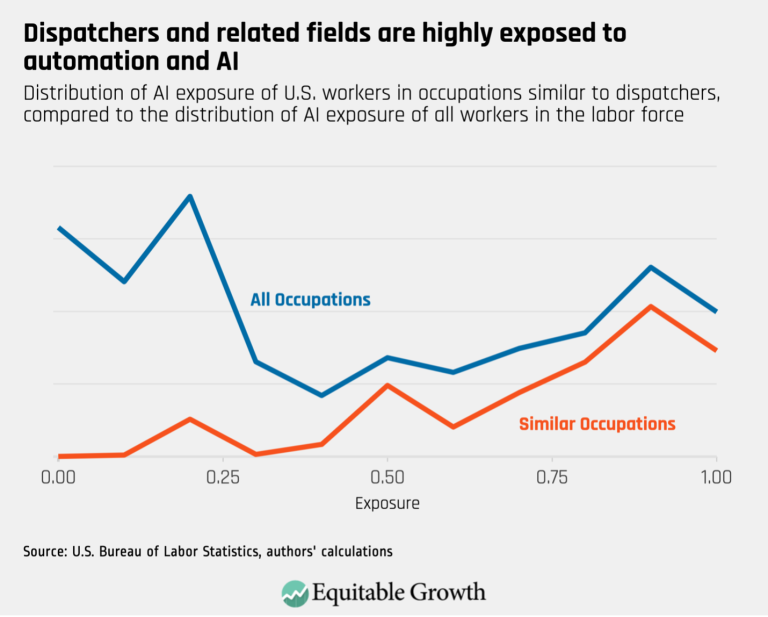
Dispatchers and related fields are highly exposed to automation and AI (opens in a new tab)
Visualizations JUL 10, 2025
 View Chart
(opens in a new tab)
View Chart
(opens in a new tab)
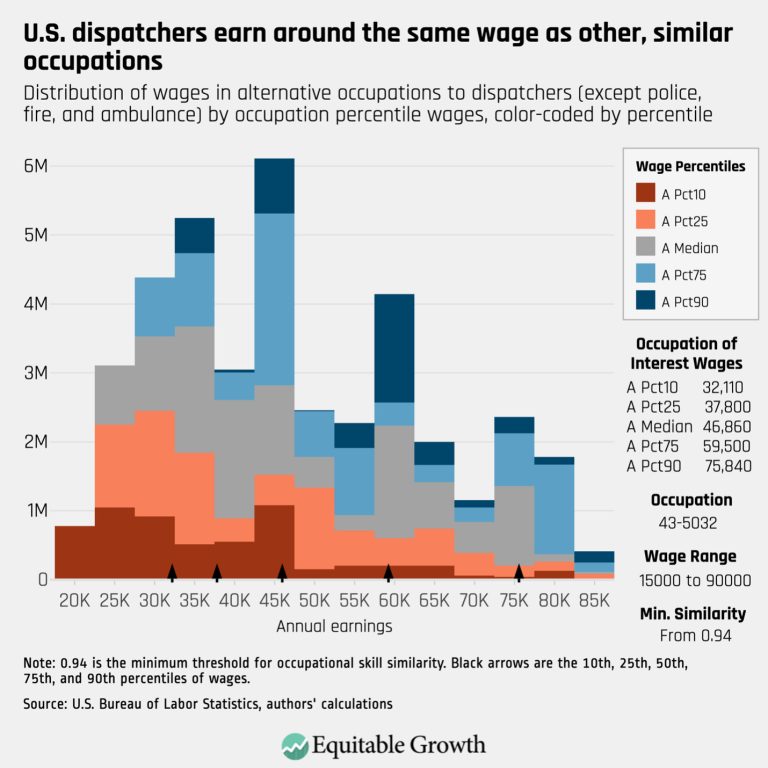
U.S. dispatchers earn around the same wage as other, similar occupations (opens in a new tab)
Visualizations JUL 10, 2025
 View Chart
(opens in a new tab)
View Chart
(opens in a new tab)
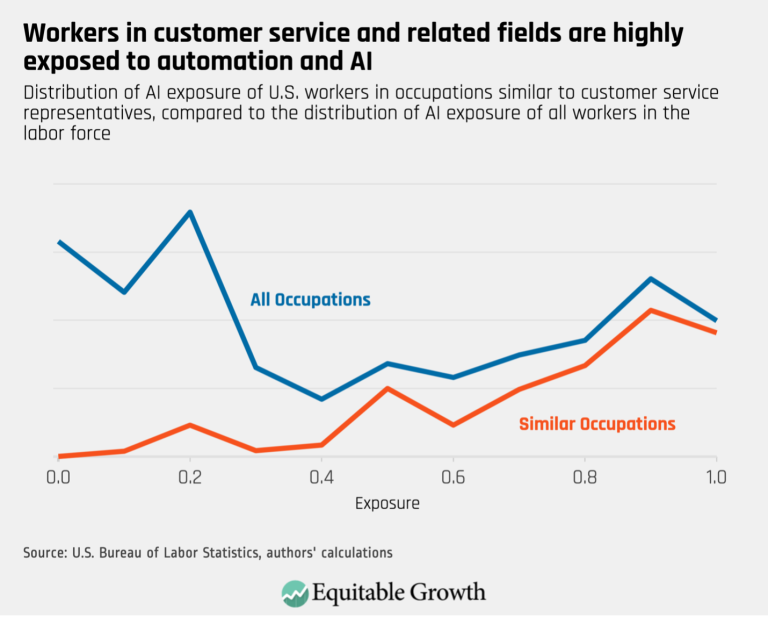
Workers in customer service and related fields are highly exposed to automation and AI (opens in a new tab)
Visualizations JUL 10, 2025
 View Chart
(opens in a new tab)
View Chart
(opens in a new tab)
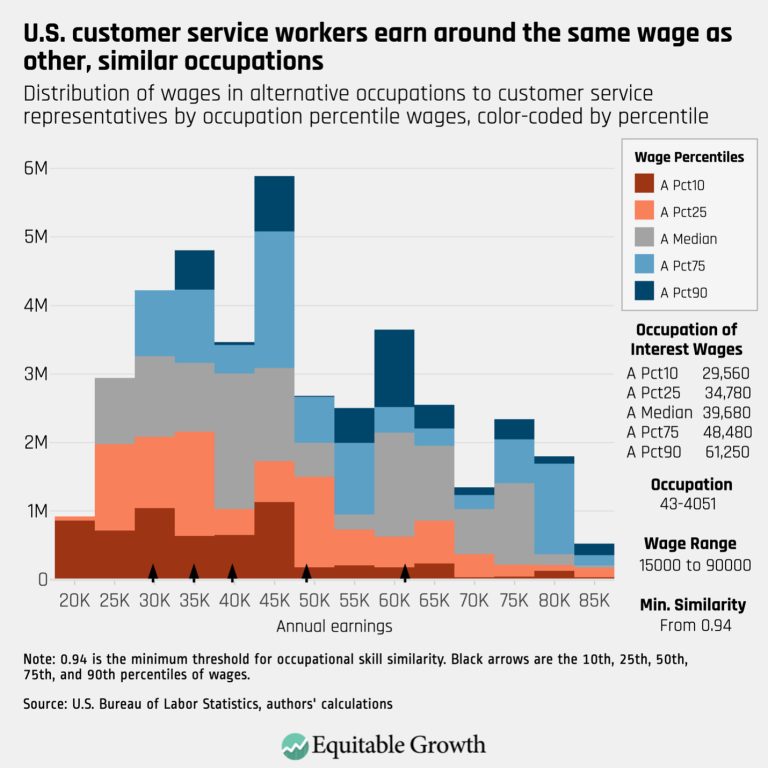
U.S. customer service workers earn around the same wage as other, similar occupations (opens in a new tab)
Visualizations JUL 10, 2025
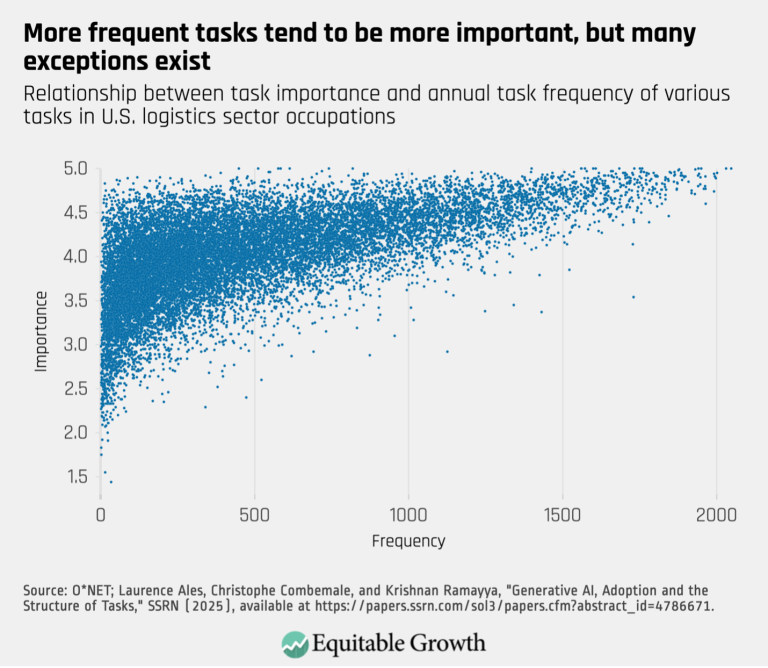 View Chart
(opens in a new tab)
View Chart
(opens in a new tab)
More frequent tasks tend to be more important, but many exceptions exist (opens in a new tab)
Visualizations JUL 9, 2025

Slow wage growth is the key to understanding U.S. inequality in the 21st century (opens in a new tab)
Issue Briefs JUL 8, 2025
The Washington Center for Equitable Growth today launched the U.S. Inequality Tracker, which tracks income and wealth inequality in the United States and highlights how particular components of income and…
By: Austin Clemens (opens in a new tab)

Equitable Growth responds to passage of the federal budget bill (opens in a new tab)
Blog JUL 7, 2025
On Friday, President Donald Trump signed the 2025 federal budget bill, cementing into law the most regressive piece of tax and budget legislation to be passed in the United States…
By: Equitable Growth (opens in a new tab)

Americans informed about the distributional effects of Republicans’ tax and budget bill overwhelmingly oppose it (opens in a new tab)
Essays JUL 3, 2025
Republicans in the U.S. Senate recently passed a version of the One Big Beautiful Bill Act, championed by President Donald Trump. The House of Representatives passed an earlier version of…
By: Jacob Hacker (opens in a new tab), Patrick Sullivan (opens in a new tab)
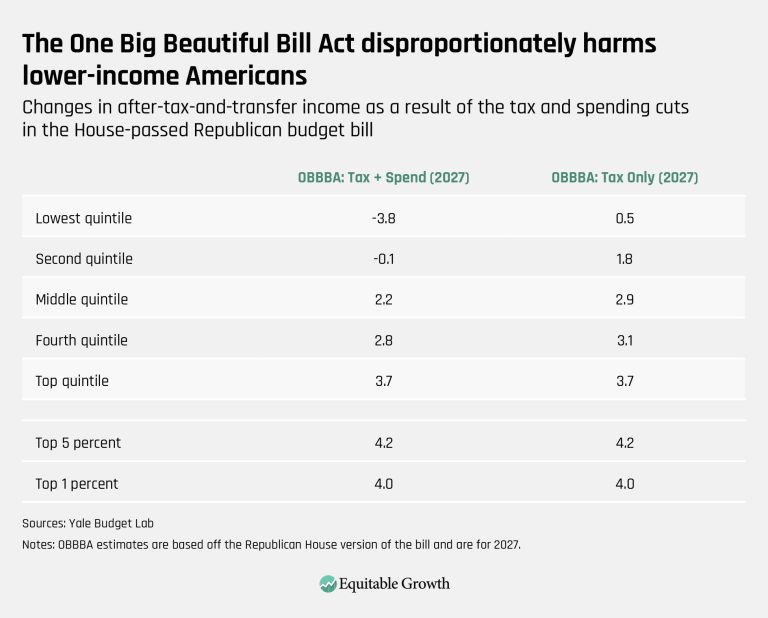 View Chart
(opens in a new tab)
View Chart
(opens in a new tab)
The One Big Beautiful Bill Act disproportionately harms lower-income Americans (opens in a new tab)
Visualizations JUL 3, 2025
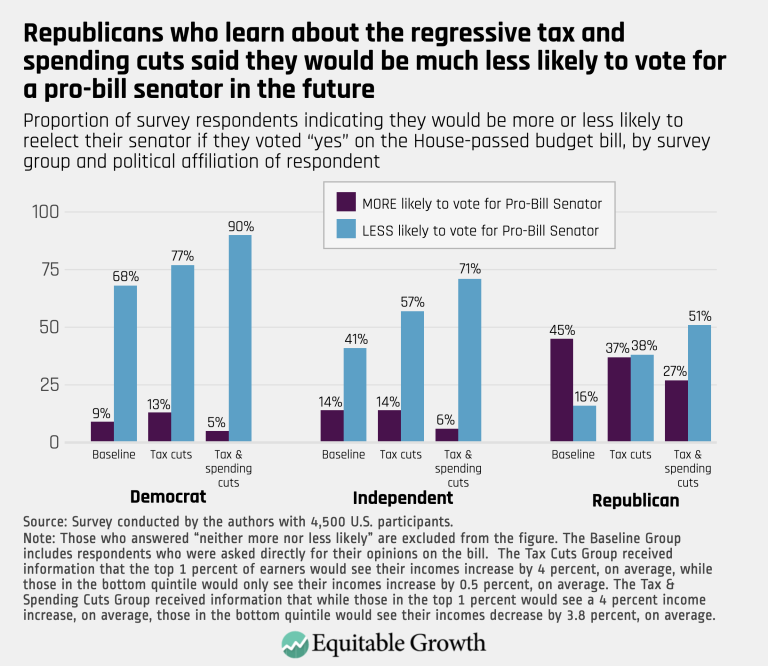
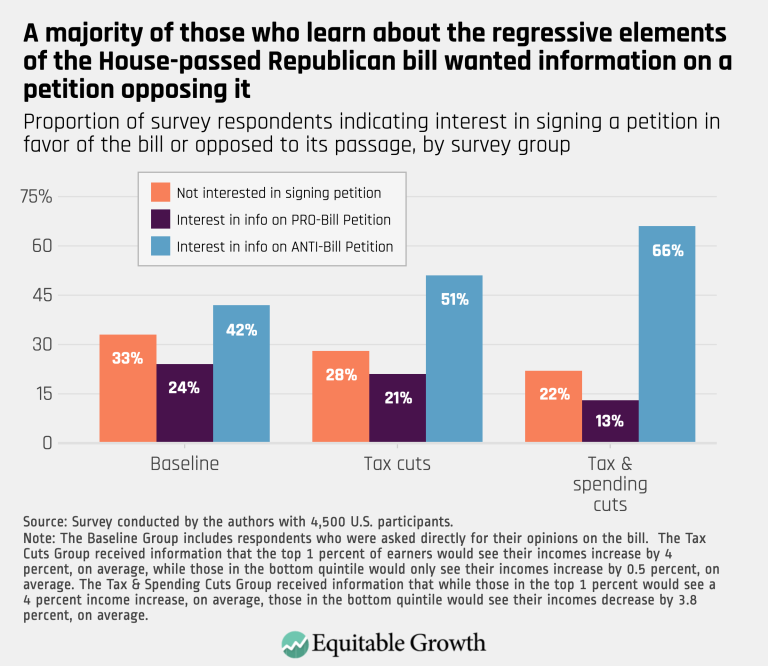
 View Chart
(opens in a new tab)
View Chart
(opens in a new tab)
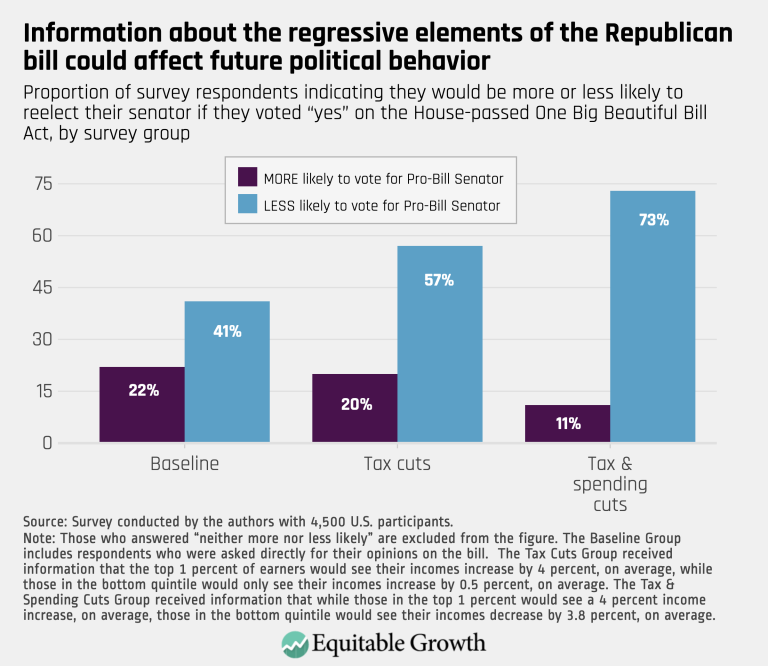
Information about the regressive elements of the Republican bill could affect future political behavior (opens in a new tab)
Visualizations JUL 2, 2025
 View Chart
(opens in a new tab)
View Chart
(opens in a new tab)
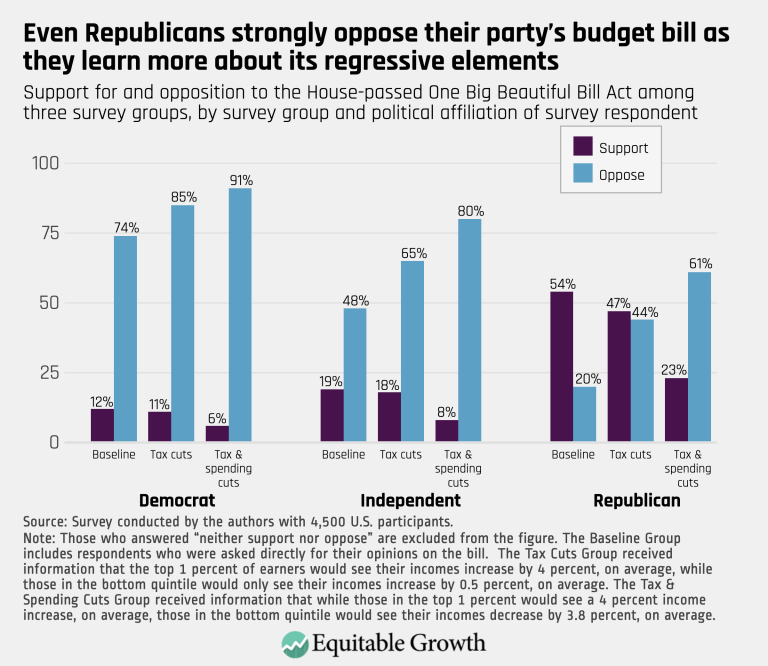
Even Republicans strongly oppose their party’s budget bill as they learn more about its regressive elements (opens in a new tab)
Visualizations JUL 2, 2025
 View Chart
(opens in a new tab)
View Chart
(opens in a new tab)
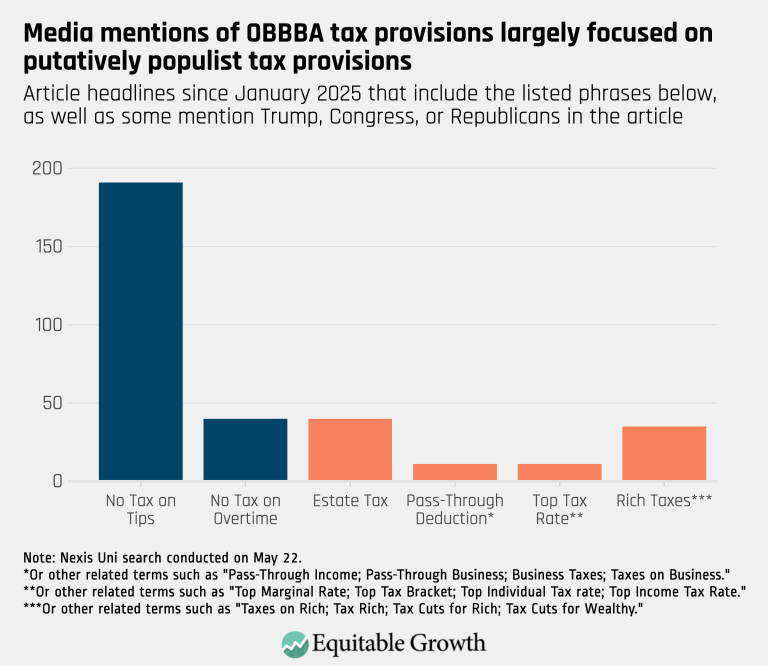
Media mentions of OBBBA tax provisions largely focused on putatively populist tax provisions (opens in a new tab)
Visualizations JUL 2, 2025
 View Chart
(opens in a new tab)
View Chart
(opens in a new tab)
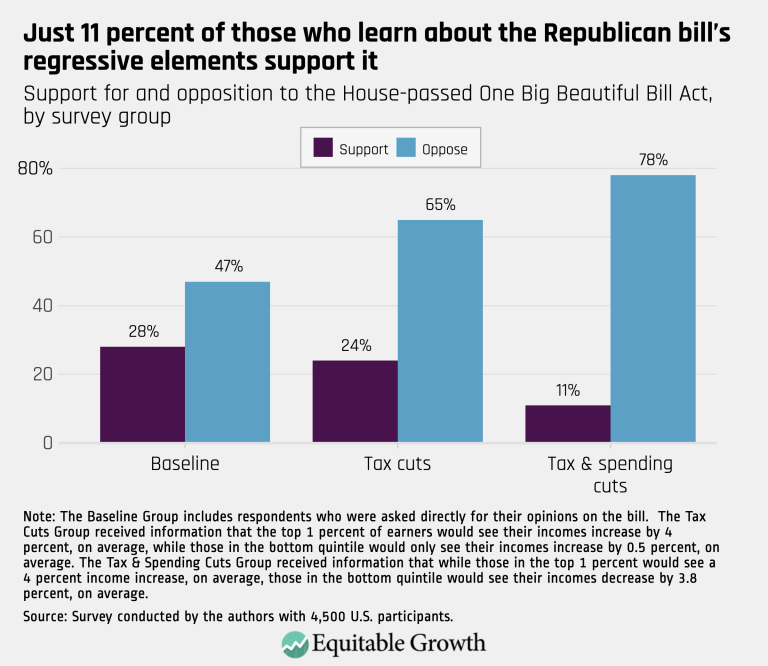
Just 11 percent of those who learn about the Republican bill’s regressive elements support it (opens in a new tab)
Visualizations JUL 2, 2025
Optimal Monetary Policy Under Menu Costs (opens in a new tab)
Working Papers JUL 1, 2025
We analytically characterize optimal monetary policy in a multisector economy with menu costs and contrast it with the textbook New Keynesian model based on Calvo pricing. Following a sectoral productivity…
By: Daniele Caratelli (opens in a new tab), Basil Halperin (opens in a new tab)
 View Chart
(opens in a new tab)
View Chart
(opens in a new tab)
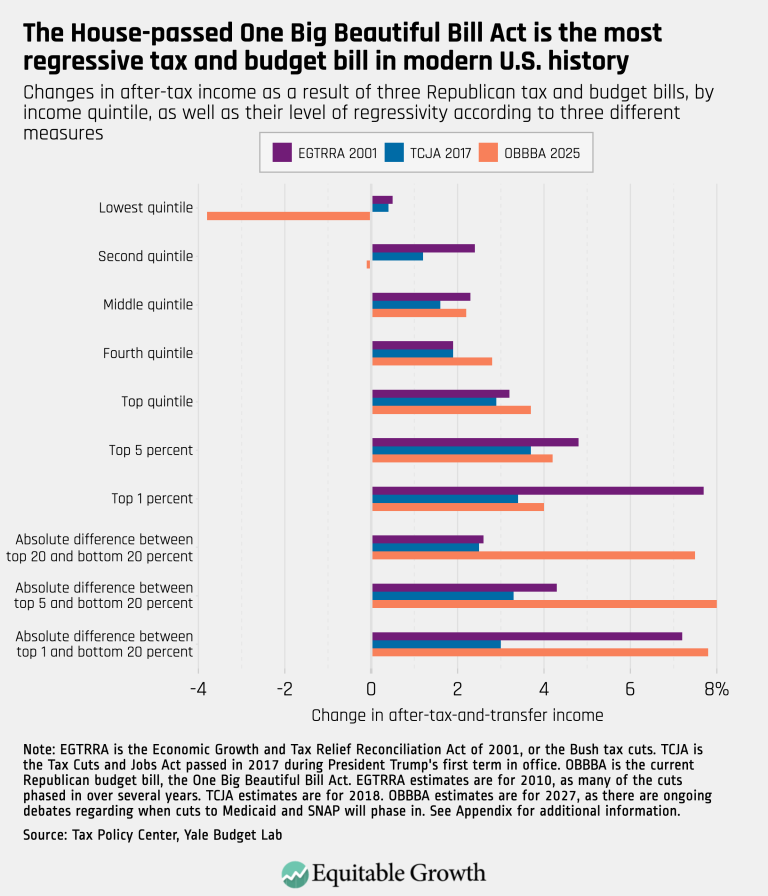
The House-passed One Big Beautiful Bill Act is the most regressive tax and budget bill in modern U.S. history (opens in a new tab)
Visualizations JUN 27, 2025
 View Chart
(opens in a new tab)
View Chart
(opens in a new tab)
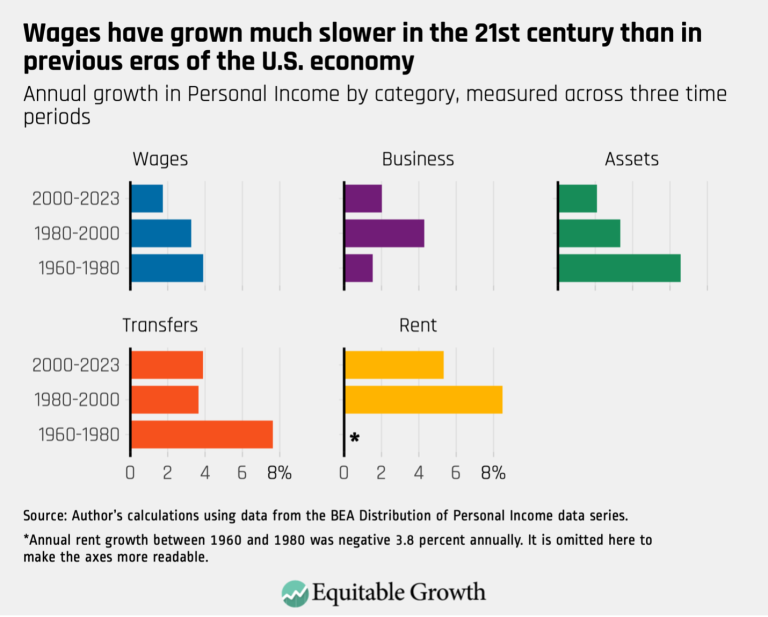
Wages have grown much slower in the 21st century than in previous eras of the U.S. economy (opens in a new tab)
Visualizations JUN 25, 2025
 View Chart
(opens in a new tab)
View Chart
(opens in a new tab)
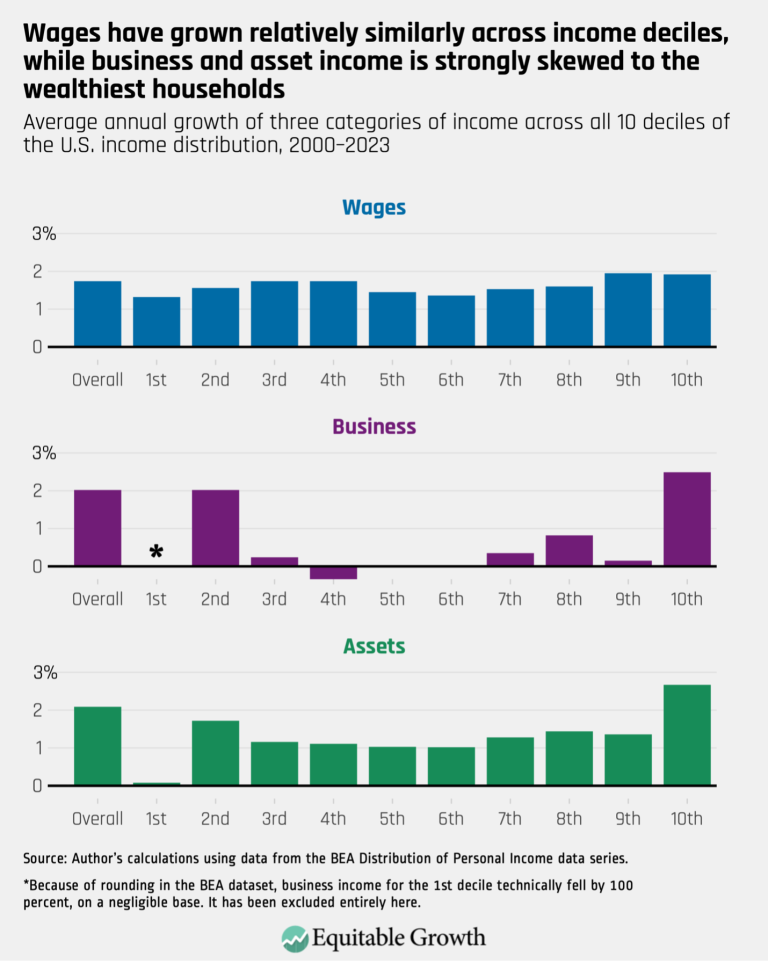
Wages have grown relatively similarly across income deciles, while business and asset income is strongly skewed to the wealthiest households (opens in a new tab)
Visualizations JUN 25, 2025
 View Chart
(opens in a new tab)
View Chart
(opens in a new tab)
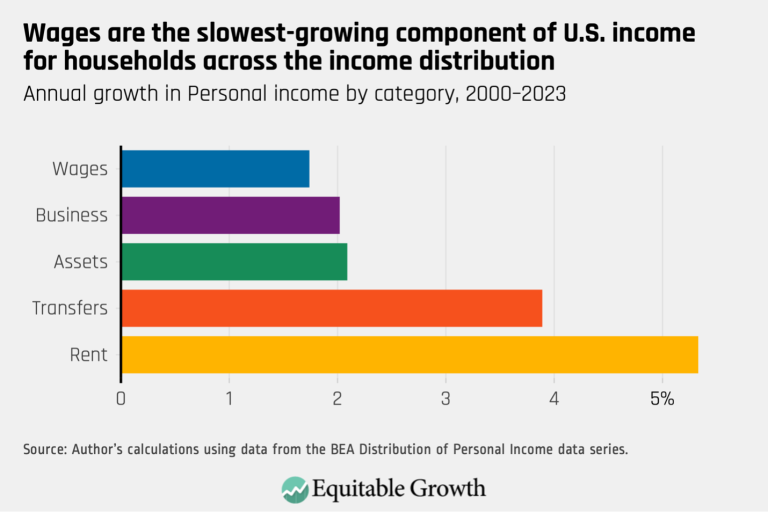
Wages are the slowest-growing component of U.S. income for households across the income distribution (opens in a new tab)
Visualizations JUN 25, 2025
 View Chart
(opens in a new tab)
View Chart
(opens in a new tab)
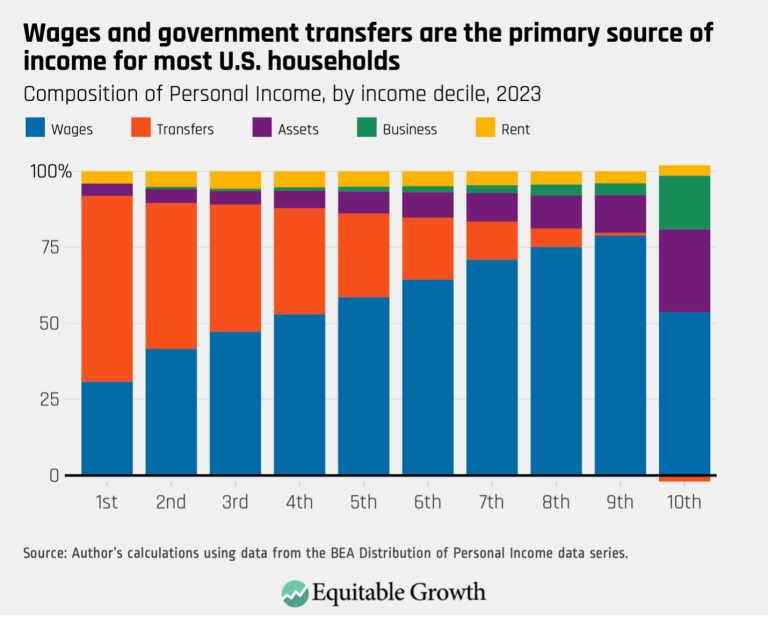
Wages and government transfers are the primary source of income for most U.S. households (opens in a new tab)
Visualizations JUN 25, 2025
 View Chart
(opens in a new tab)
View Chart
(opens in a new tab)
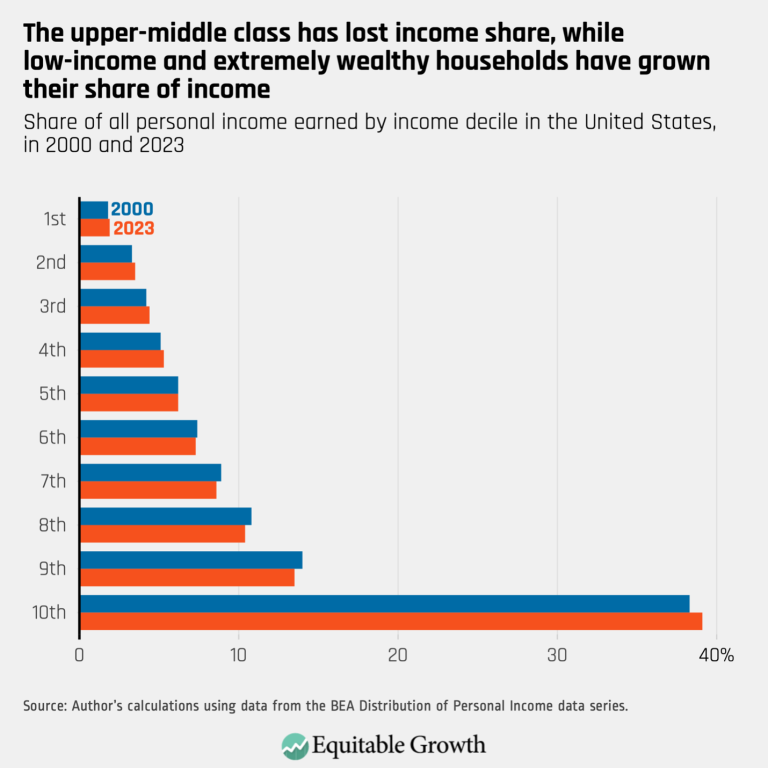
The upper-middle class has lost income share, while low-income and extremely wealthy households have grown their share of income (opens in a new tab)
Visualizations JUN 25, 2025
 View Chart
(opens in a new tab)
View Chart
(opens in a new tab)
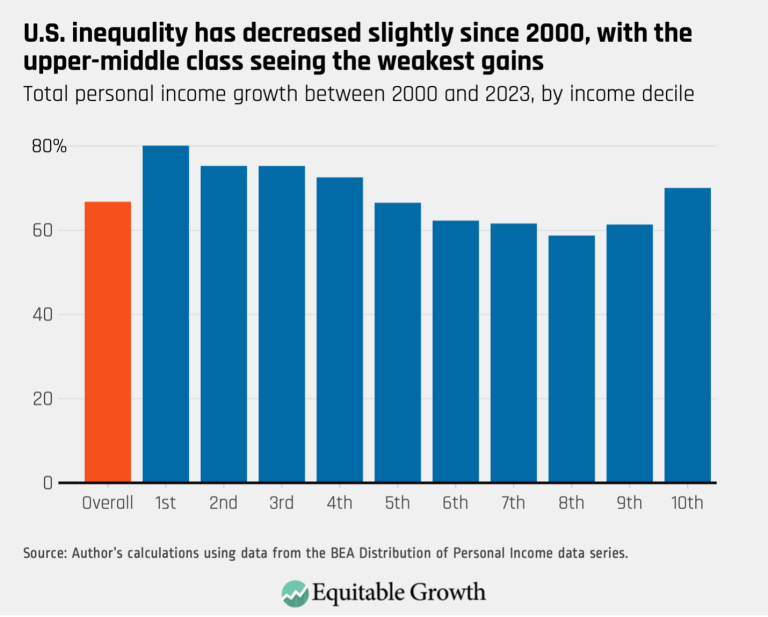
U.S. inequality has decreased slightly since 2000, with the upper-middle class seeing the weakest gains (opens in a new tab)
Visualizations JUN 25, 2025
 View Chart
(opens in a new tab)
View Chart
(opens in a new tab)
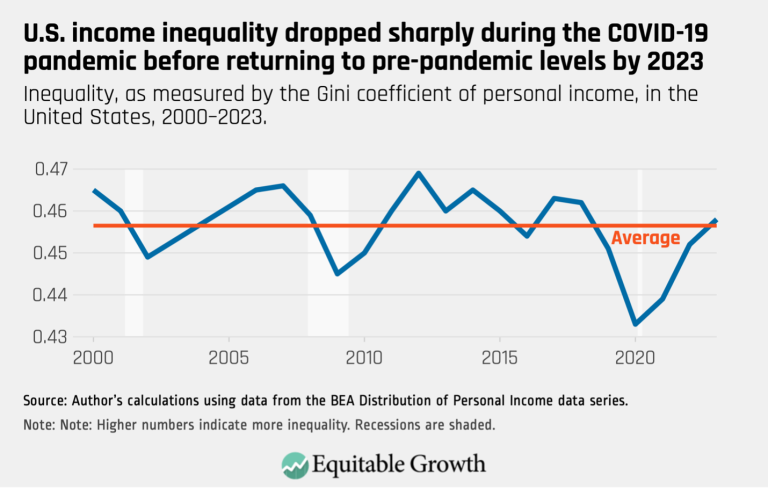
U.S. income inequality dropped sharply during the COVID-19 pandemic before returning to pre-pandemic levels by 2023 (opens in a new tab)
Visualizations JUN 25, 2025

Americans Informed About the Distributional Effects of Republicans’ Budget Bill Overwhelmingly Oppose It (opens in a new tab)
Working Papers JUN 25, 2025
Republicans in the Senate are currently considering the One Big Beautiful Bill Act, which, if enacted, would be the most regressive U.S. tax and budget law in at least the…
By: Jacob S. Hacker, Patrick Sullivan (opens in a new tab)

Congressional Republicans’ budget bill is the most regressive in at least 40 years (opens in a new tab)
Essays JUN 25, 2025
The U.S. Congress is in the midst of debating a budget bill that would make massive changes to U.S. tax and spending policy over the course of the next decade…
By: Jacob Hacker (opens in a new tab), Patrick Sullivan (opens in a new tab)
 View Chart
(opens in a new tab)
View Chart
(opens in a new tab)
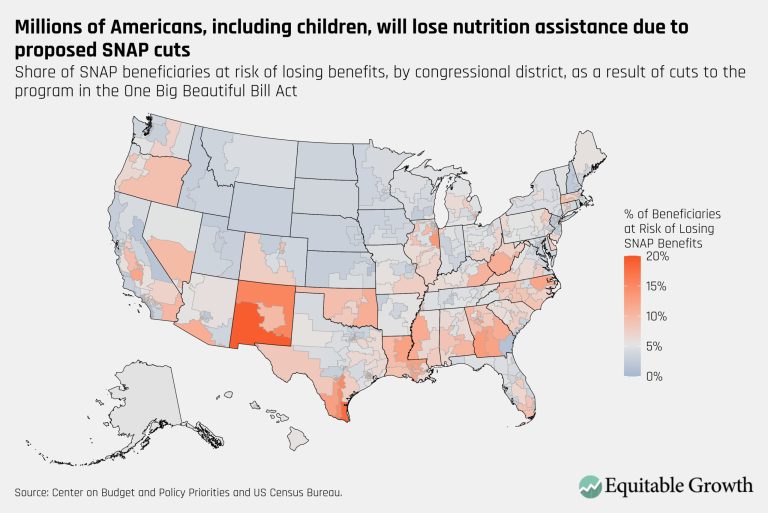
Millions of Americans, including children, will lose nutrition assistance due to proposed SNAP cuts – updated (opens in a new tab)
Visualizations JUN 24, 2025

Medicaid and SNAP cuts in congressional Republicans’ budget bill will negatively impact local economies (opens in a new tab)
Essays JUN 24, 2025
The budget reconciliation bill recently passed by the U.S. House of Representatives proposes to make large cuts to Medicaid, the Supplemental Nutrition Assistance Program, and other social programs to pay…
By: Robert Manduca (opens in a new tab)
Financial and Transfer Income as Components of the Regional Economic Base (opens in a new tab)
Working Papers JUN 24, 2025
Economists and geographers have long divided industries into “basic” and “nonbasic” sectors depending on whether they bring money into a region from outside or serve local demand. Traditionally, the regional…
By: Robert Manduca (opens in a new tab)
 View Chart
(opens in a new tab)
View Chart
(opens in a new tab)
Local economies will be hurt by cuts to social programs in the One Big Beautiful Bill Act (opens in a new tab)
Visualizations JUN 24, 2025
 View Chart
(opens in a new tab)
View Chart
(opens in a new tab)
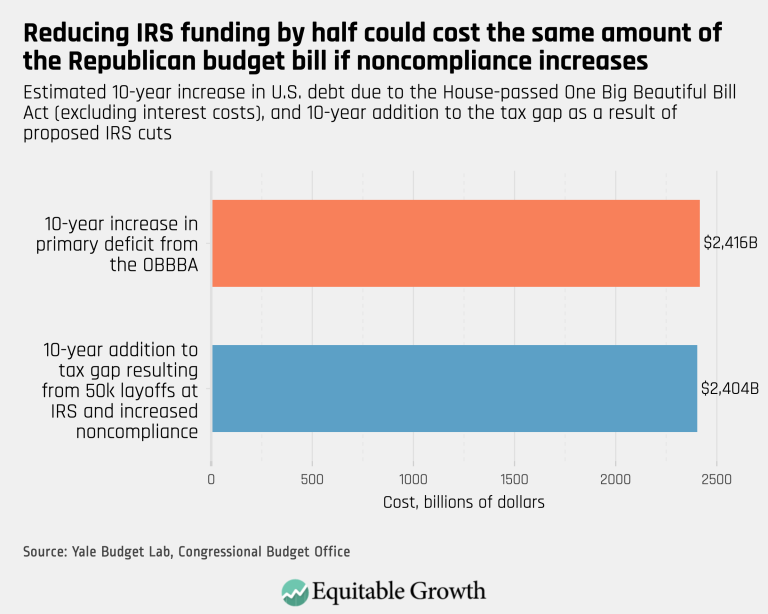
Reducing IRS funding by half could cost the same amount of the Republican budget bill in noncompliance increases (opens in a new tab)
Visualizations JUN 23, 2025
 View Chart
(opens in a new tab)
View Chart
(opens in a new tab)
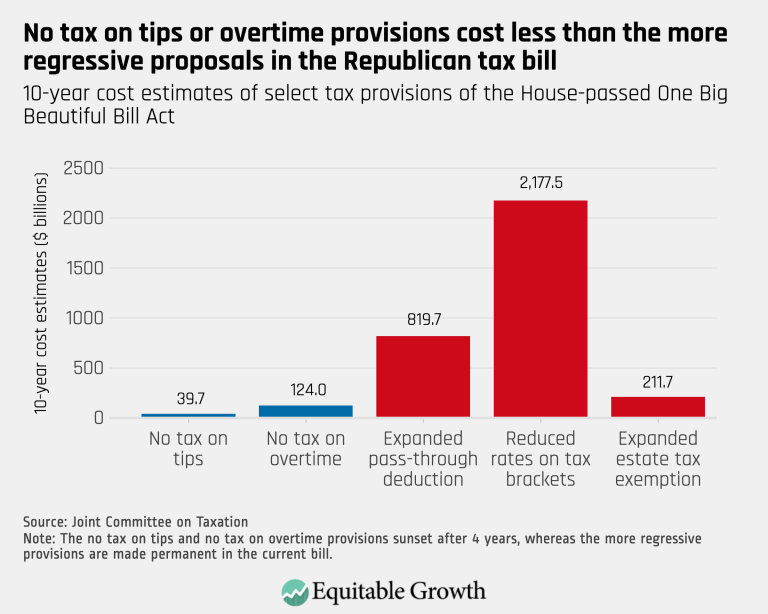
No tax on tips or overtime provisions cost less than the more regressive proposals in the Republican tax bill (opens in a new tab)
Visualizations JUN 23, 2025
 View Chart
(opens in a new tab)
View Chart
(opens in a new tab)
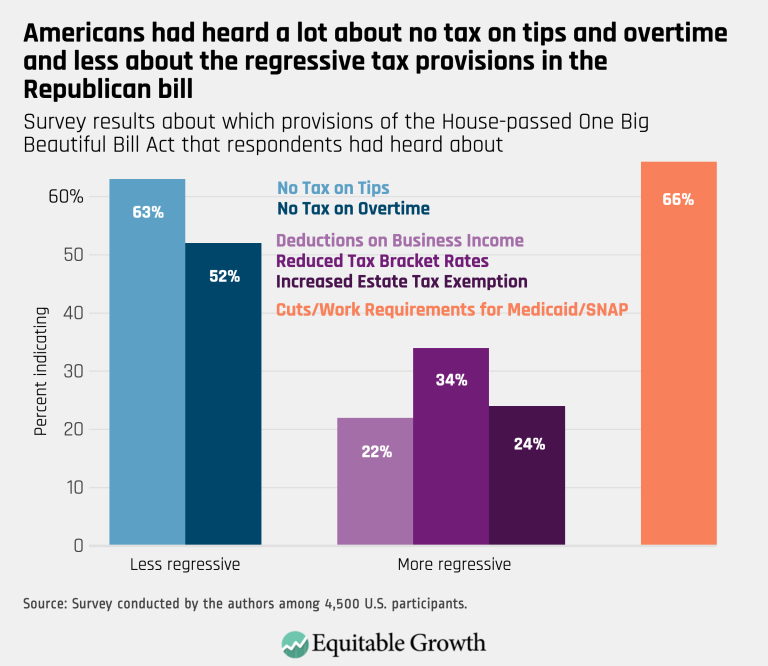
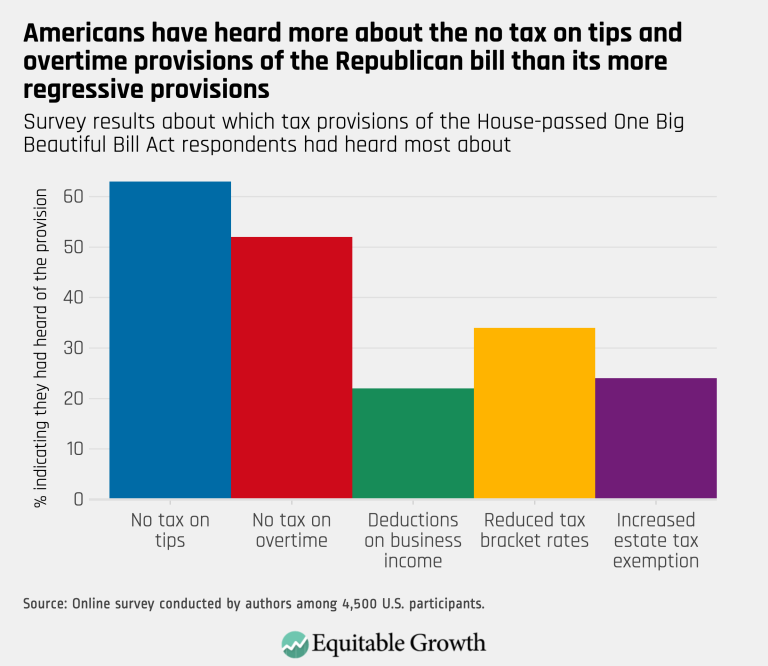
Americans have heard more about the no tax on tips and overtime provisions of the Republican bill than its more regressive provisions (opens in a new tab)
Visualizations JUN 23, 2025
 View Chart
(opens in a new tab)
View Chart
(opens in a new tab)
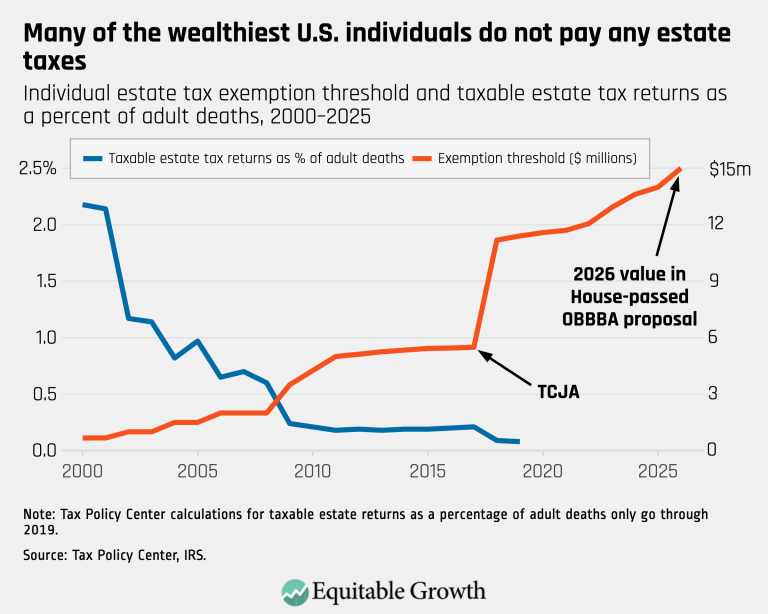
Many of the wealthiest U.S. individuals do not pay any estate taxes (opens in a new tab)
Visualizations JUN 23, 2025
 View Chart
(opens in a new tab)
View Chart
(opens in a new tab)
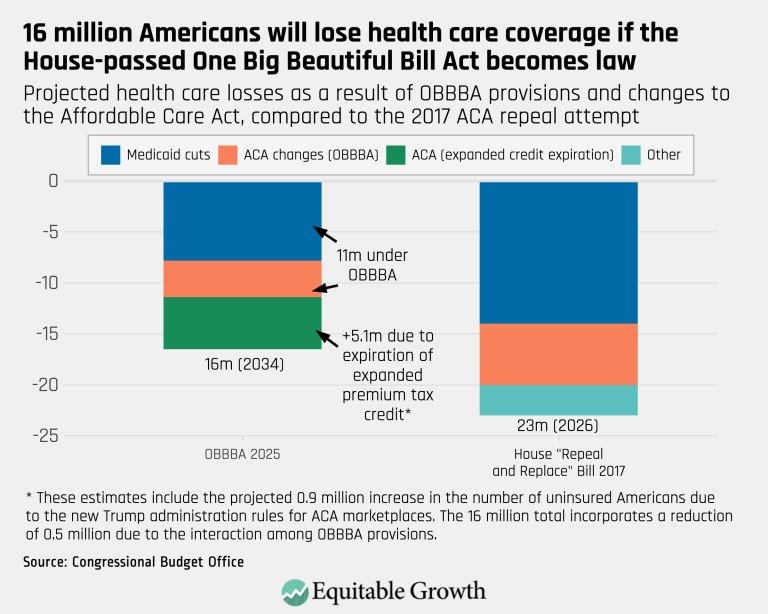
16 million Americans will lose health care coverage if the House-passed One Big Beautiful Bill Act becomes law (opens in a new tab)
Visualizations JUN 23, 2025
 View Chart
(opens in a new tab)
View Chart
(opens in a new tab)
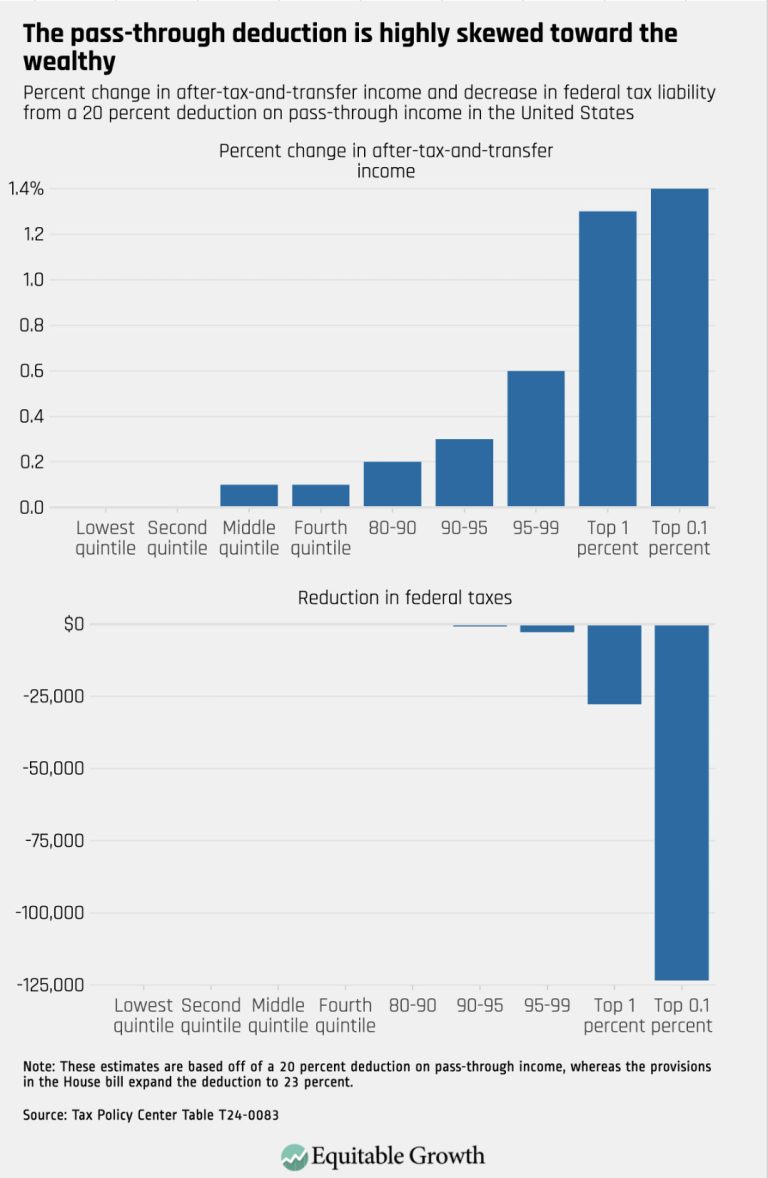
The pass-through deduction is highly skewed toward the wealthy (opens in a new tab)
Visualizations JUN 20, 2025

Testimony by Michael Linden on “The Big Beautiful Betrayal—Working Folks Pay While The Mega Rich Profit” (opens in a new tab)
Essays JUN 17, 2025
Senator Kaine, Senator Murphy, and members of the Forum, thank you for the opportunity to be here today. I’m going to make three key points. First, the Republican budget bill…
By: Michael Linden (opens in a new tab)

Factsheet: U.S. economic mobility and policies to increase upward mobility (opens in a new tab)
Factsheets JUN 17, 2025
The United States often has been touted as a land of opportunity, where hard work leads to success and children do better than their parents. But increasingly, these notions of…
By: Shira Markoff (opens in a new tab), Melissa Grober-Morrow (opens in a new tab)

The ‘funny math’ of top U.S. tax rates (opens in a new tab)
Essays JUN 11, 2025
The current reconciliation bill now before Congress won’t correct for the low tax rates paid by the richest Americans Overview Calculating the effective tax rate of the richest Americans can…
By: Patrick Driessen (opens in a new tab), David S. Mitchell (opens in a new tab)
 View Chart
(opens in a new tab)
View Chart
(opens in a new tab)
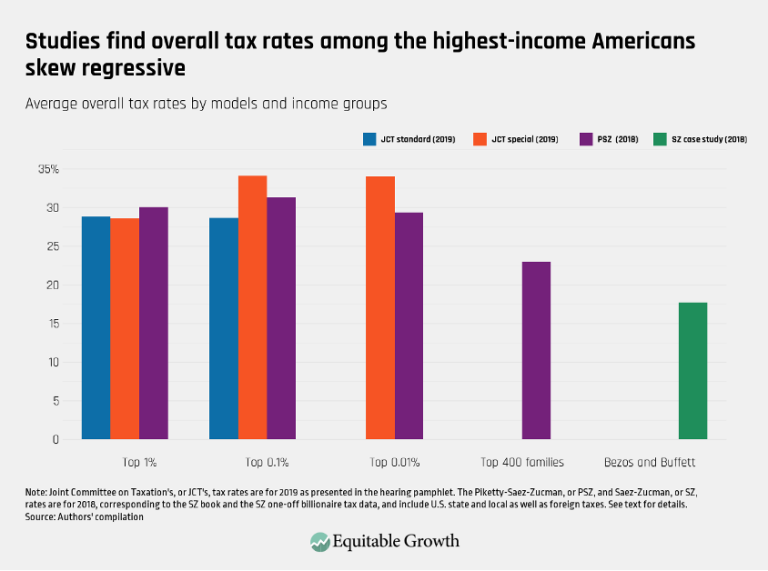
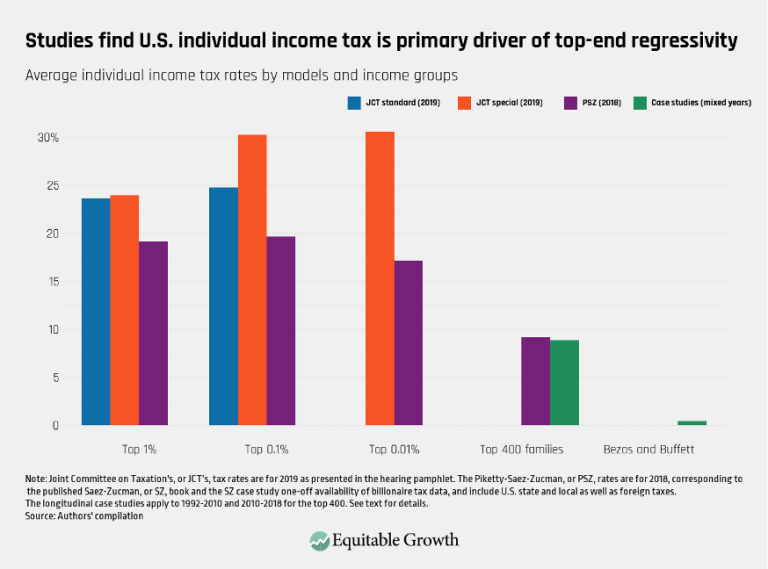
Studies find overall tax rates among the highest-income Americans skew regressive (opens in a new tab)
Visualizations JUN 10, 2025
 View Chart
(opens in a new tab)
View Chart
(opens in a new tab)
Studies find U.S. individual income tax is primary driver of top-end regressivity (opens in a new tab)
Visualizations JUN 10, 2025

The hidden trade-offs of nonwage job amenities for U.S. workers (opens in a new tab)
Essays JUN 10, 2025
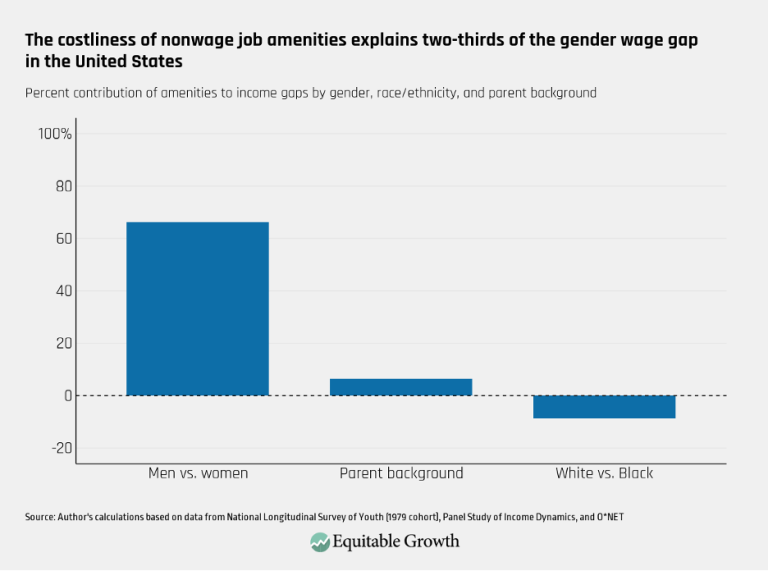
When workers choose jobs with predictable schedules, safer conditions, or greater autonomy, they are often paying a price: lower wages. In some cases, these hidden trade-offs are considerable. Indeed, my…
By: Alex Bell (opens in a new tab)
 View Chart
(opens in a new tab)
View Chart
(opens in a new tab)
The costliness of nonwage job amenities explains two-thirds of the gender wage gap in the United States (opens in a new tab)
Visualizations JUN 10, 2025
 View Chart
(opens in a new tab)
View Chart
(opens in a new tab)
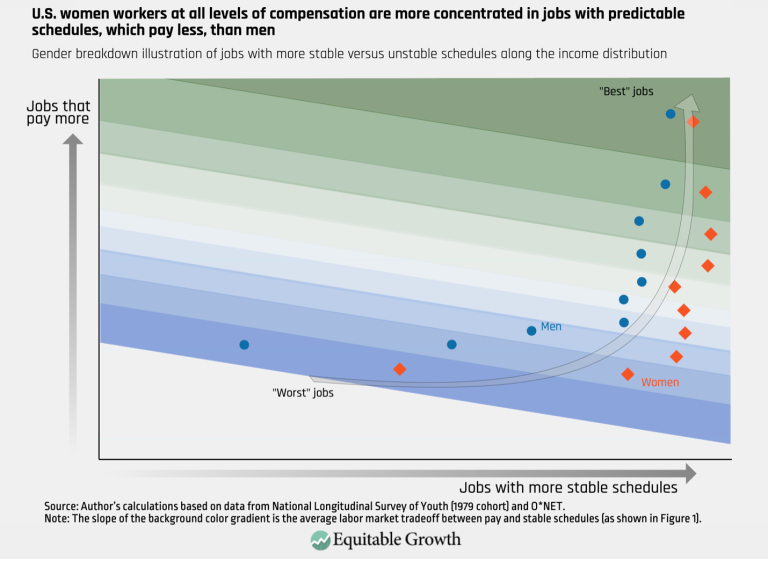
U.S. women workers at all levels of compensation are more concentrated in jobs with predictable schedules, which pay less, than men (opens in a new tab)
Visualizations JUN 10, 2025
 View Chart
(opens in a new tab)
View Chart
(opens in a new tab)
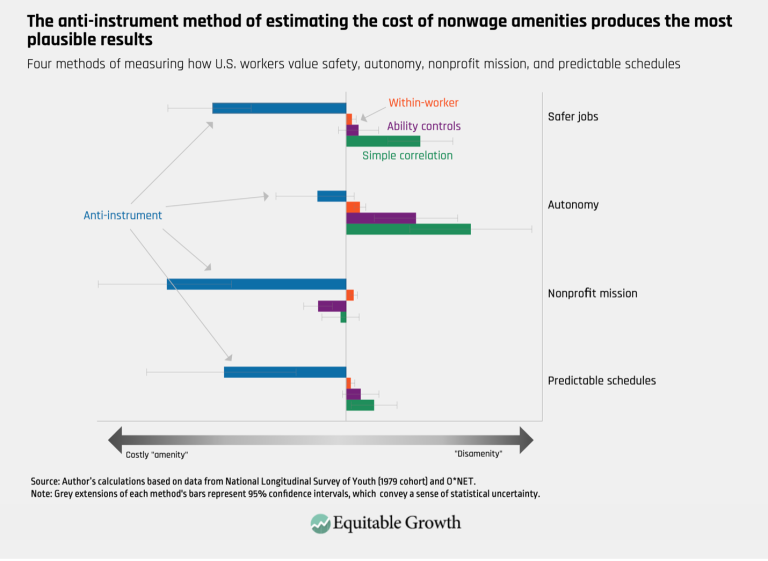
The anti-instrument method of estimating the cost of nonwage amenities produces the most plausible results (opens in a new tab)
Visualizations JUN 10, 2025
 View Chart
(opens in a new tab)
View Chart
(opens in a new tab)
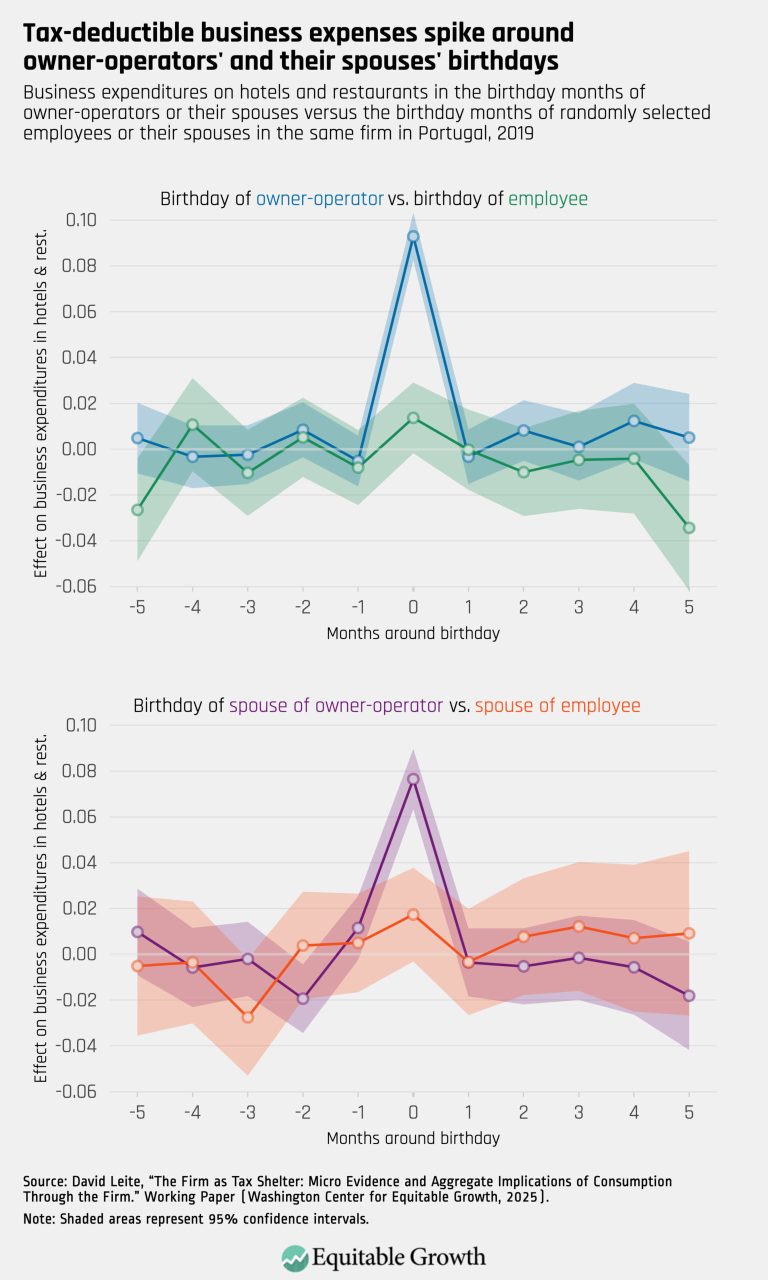
Tax-deductible business expenses spike around owner-operators’ and their spouses’ birthdays – updated (opens in a new tab)
Visualizations JUN 5, 2025

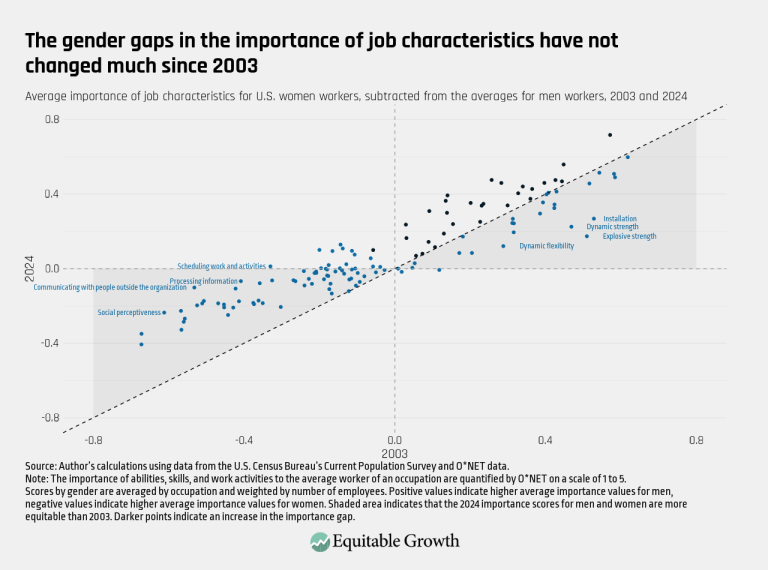
U.S. labor market data reveal that different job characteristics contribute to the gender wage gap (opens in a new tab)
Essays JUN 5, 2025
In 2003, women in the United States earned on average approximately 80 percent as much as U.S. men did per hour. By 2024, the gender pay gap had grown to…
By: Chiara Chanoi (opens in a new tab)
 View Chart
(opens in a new tab)
View Chart
(opens in a new tab)
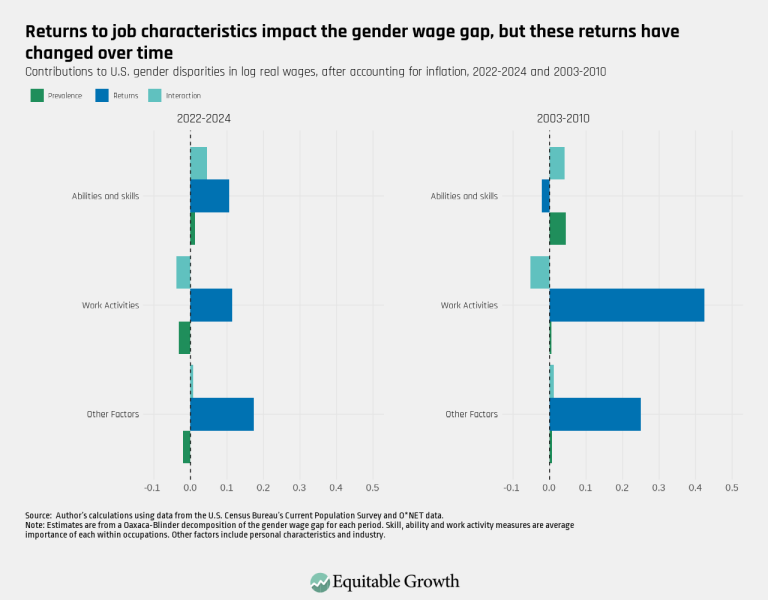
Returns to job characteristics impact the gender wage gap, but these returns have changed over time (opens in a new tab)
Visualizations JUN 4, 2025
 View Chart
(opens in a new tab)
View Chart
(opens in a new tab)
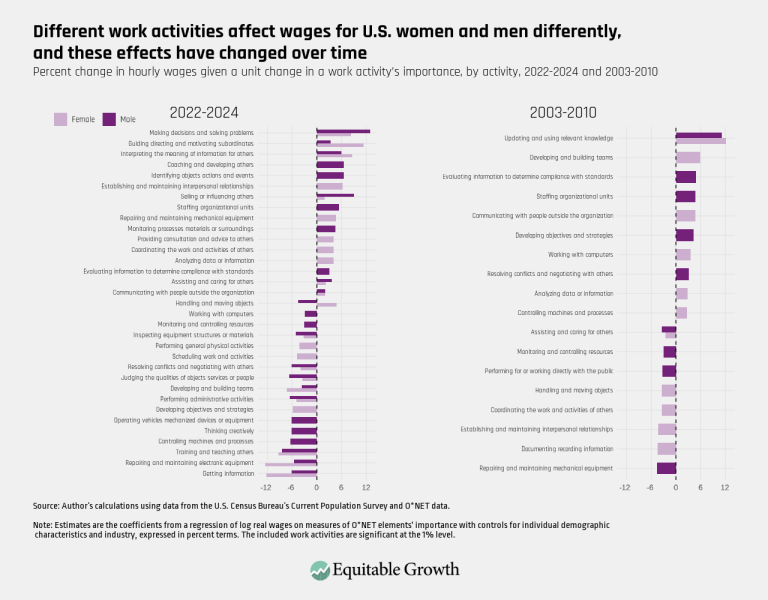
Different work activities affect wages for U.S. women and men differently, and these effects have changed over time (opens in a new tab)
Visualizations JUN 4, 2025
 View Chart
(opens in a new tab)
View Chart
(opens in a new tab)
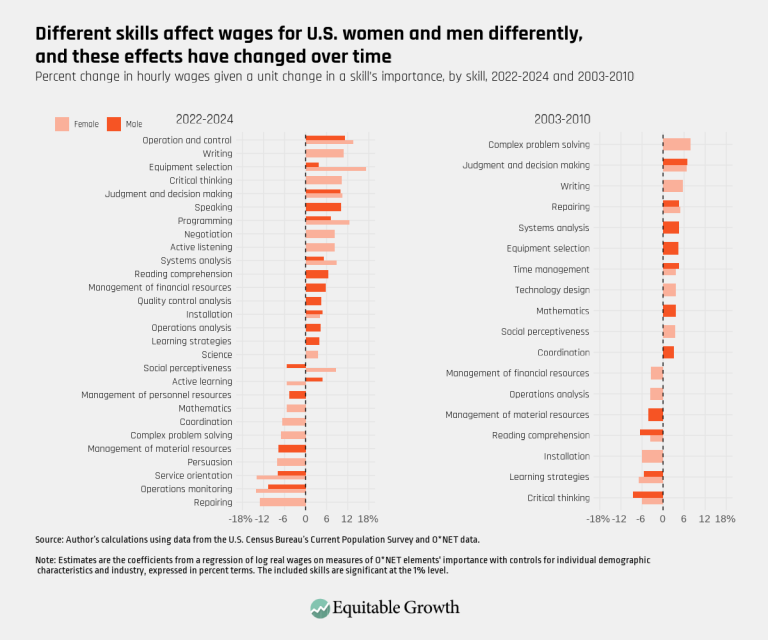
Different skills affect wages for U.S. women and men differently, and these effects have changed over time (opens in a new tab)
Visualizations JUN 4, 2025
 View Chart
(opens in a new tab)
View Chart
(opens in a new tab)
The gender gaps in the importance of job characteristics have not changed much since 2003 (opens in a new tab)
Visualizations JUN 4, 2025
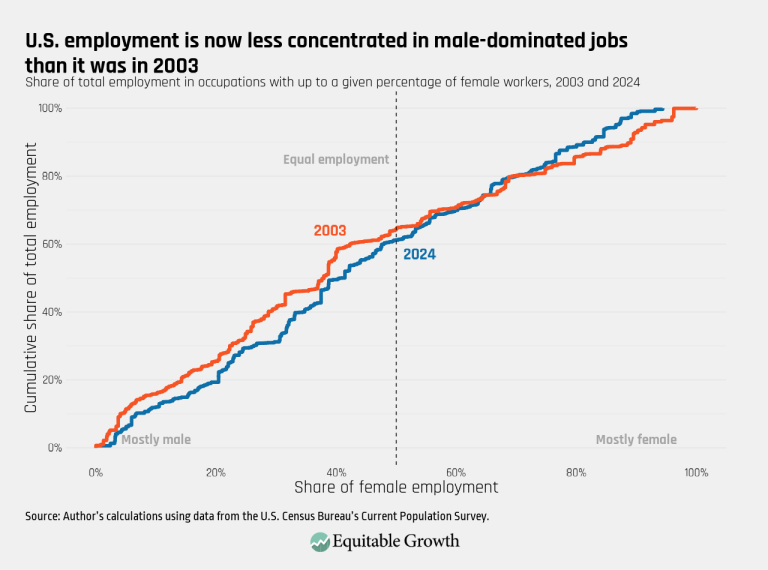 View Chart
(opens in a new tab)
View Chart
(opens in a new tab)
U.S. employment is now less concentrated in male-dominated jobs than it was in 2003 (opens in a new tab)
Visualizations JUN 4, 2025
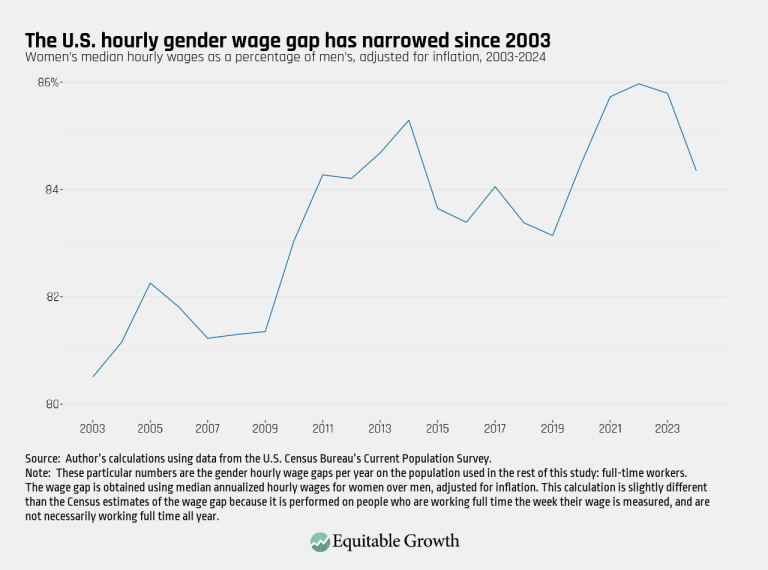 View Chart
(opens in a new tab)
View Chart
(opens in a new tab)
The U.S. hourly gender wage gap has narrowed since 2003 – updated (opens in a new tab)
Visualizations JUN 4, 2025
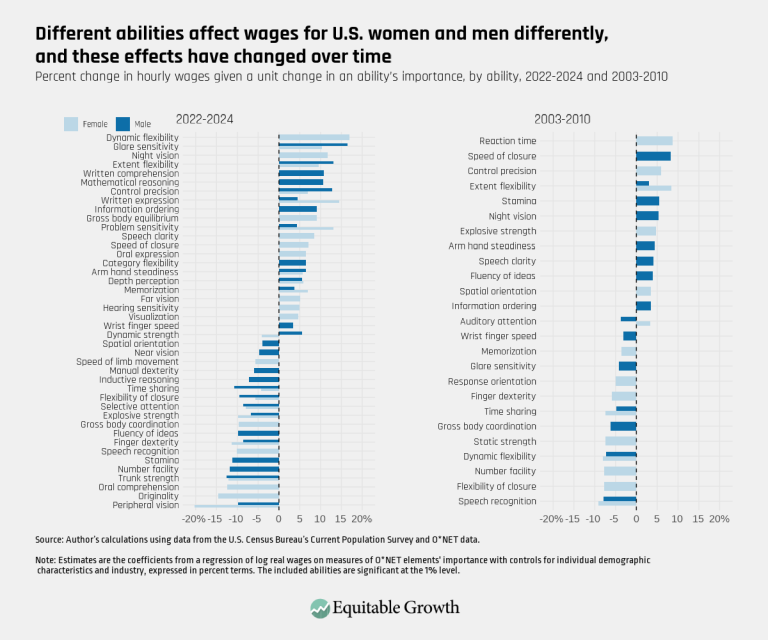 View Chart
(opens in a new tab)
View Chart
(opens in a new tab)
Different abilities affect wages for U.S. women and men differently, and these effects have changed over time – updated (opens in a new tab)
Visualizations JUN 4, 2025

Equitable Growth event brings together scholars and the policy community to discuss the rise of right-wing populism and the future of economic policy (opens in a new tab)
Videos MAY 29, 2025
This article was drafted with assistance from Perplexity AI. The Washington Center for Equitable Growth in mid-May hosted an event on “The rise of populism and the future of economic…
By: Equitable Growth (opens in a new tab)

Business owners often use their firms as tax shelters, reducing government revenue and reported income inequality (opens in a new tab)
Blog MAY 22, 2025
Picture this scene: After sharing a meal with friends, someone in the group grabs the check and says, “I’ll take this so I can expense it through my company.” It…
By: David Leite (opens in a new tab)
The Firm as Tax Shelter (opens in a new tab)
Working Papers MAY 22, 2025
I present evidence that firms serve as tax-free consumption vehicles. Drawing on a unique combination of data from an electronic invoicing program in Portugal (e-Fatura), I show that individuals who…
By: David Leite (opens in a new tab)
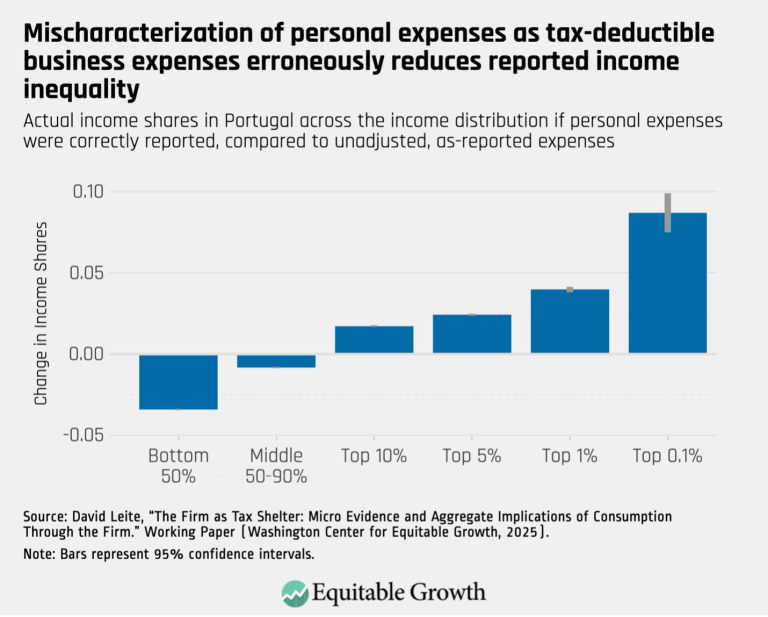 View Chart
(opens in a new tab)
View Chart
(opens in a new tab)
Mischaracterization of personal expenses as tax-deductible business expenses erroneously reduces reported income inequality (opens in a new tab)
Visualizations MAY 22, 2025
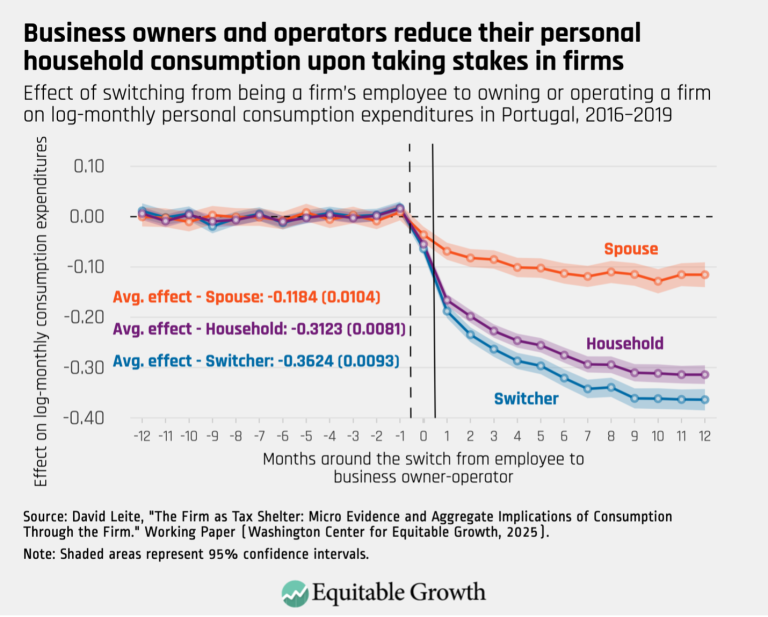 View Chart
(opens in a new tab)
View Chart
(opens in a new tab)
Business owners and operators reduce their personal household consumption upon taking stakes in firms (opens in a new tab)
Visualizations MAY 21, 2025
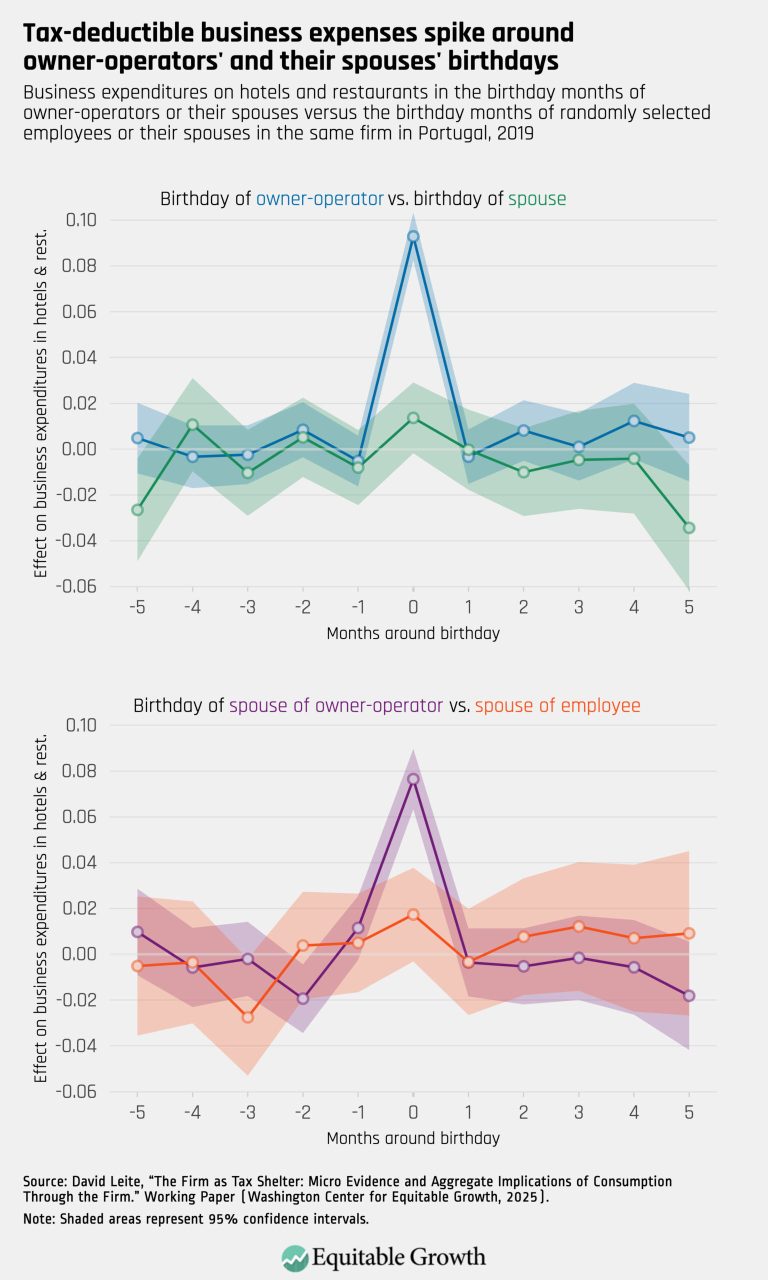 View Chart
(opens in a new tab)
View Chart
(opens in a new tab)
Tax-deductible business expenses spike around owner-operators’ and their spouses’ birthdays (opens in a new tab)
Visualizations MAY 21, 2025

The political implications of bad jobs and the decline of unions (opens in a new tab)
Blog MAY 13, 2025
Bad jobs have become a distinctive feature of the U.S. economy over the past few decades. Globally, a lack of adequate demand, or what economists call “secular stagnation,” has meant…
By: Adam Dean (opens in a new tab), Jamie McCallum (opens in a new tab)

Federal and state governments can help solve the employment problems of people in distressed places to spur equitable growth (opens in a new tab)
Blog MAY 13, 2025
Places in the United States differ greatly in their residents’ access to jobs, including access to good jobs. In economically distressed places, these job problems can be addressed by creating…
By: Timothy Bartik (opens in a new tab)

More accurately measuring economic sentiment will help build a U.S. economy—and democracy—that works for all (opens in a new tab)
Blog MAY 13, 2025
When politicians and members of the media discuss the state of “the economy” in the United States, they often use a small handful of data points. Of all the indicators…
By: Jonathan Cohen (opens in a new tab), Katherine Cramer (opens in a new tab)

Understanding the role of immigration and economic factors in boosting support for far-right political parties (opens in a new tab)
Blog MAY 13, 2025
Far-right and right-wing populist political parties differ in many respects, but nearly all share one common thread: strong opposition to immigration. These parties often push for stricter border controls and,…
By: Sirus H. Dehdari (opens in a new tab)

America’s job-quality crisis and how to revive workers’ pay, dignity, job advancement, and economic well-being (opens in a new tab)
Blog MAY 13, 2025
The poor quality of jobs in the United States is a slow-burning crisis that has been underway for many decades and has eroded many workers’ quality of life. Too many…
By: Erin Kelly (opens in a new tab)

How the China trade shock impacted U.S. manufacturing workers and labor markets, and the consequences for U.S. politics (opens in a new tab)
Blog MAY 13, 2025
In the early 2000s, manufacturing-intensive communities in the United States entered a period of economic upheaval that would reshape their labor markets over the next two decades. China’s dramatic rise…
By: David Autor (opens in a new tab), David Dorn (opens in a new tab), Gordon Hanson (opens in a new tab)

Housing insecurity and U.S. economic policies: Lessons from tenant organizing (opens in a new tab)
Blog MAY 13, 2025
The destructive force of authoritarian power has become a prominent feature of U.S. political life. In just the first few months of 2025, we’ve seen unprecedented moves to use the…
By: Jamila Michener (opens in a new tab)

Countering right-wing populism: Identifying its cultural roots and charting a path forward (opens in a new tab)
Blog MAY 13, 2025
Donald Trump’s victory in the 2024 U.S. presidential election set off an animated debate among Democrats over what went wrong with their policymaking, messaging, and campaigning. Specifically, Democrats puzzled over…
By: Yotam Margalit (opens in a new tab)

How the economic and political geography of the United States fuels right-wing populism—and what the Democratic Party can do about it (opens in a new tab)
Blog MAY 13, 2025
In wealthy nations around the world, the rise of the knowledge economy has increased political and economic divides that fuel right-wing populism. These divides generally have a strong geographic dimension,…
By: Jacob Hacker (opens in a new tab), Paul Pierson (opens in a new tab)

Tariffs pose real risks to the U.S. labor market (opens in a new tab)
Blog MAY 12, 2025
Uncertainty around trade policy makes it difficult to discuss the current state of the U.S. labor market. Businesses, workers, and policymakers at all levels make decisions based on both what…
By: Kevin Rinz (opens in a new tab)
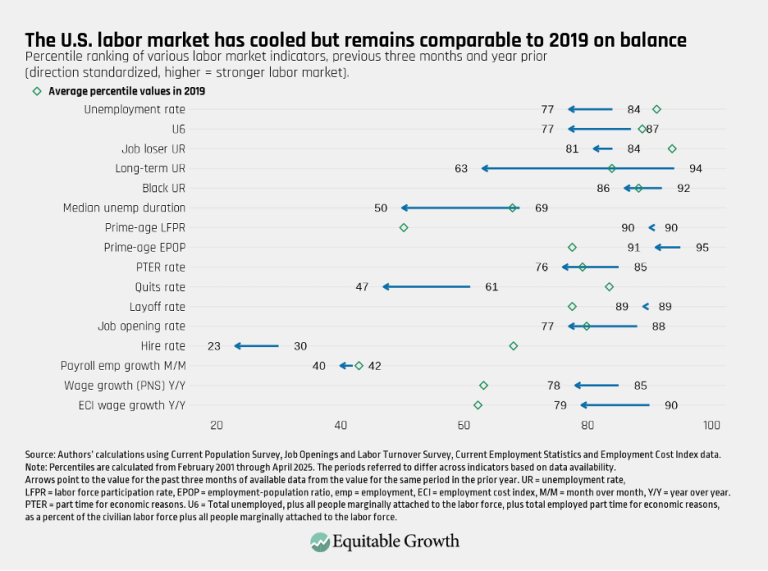 View Chart
(opens in a new tab)
View Chart
(opens in a new tab)
rinz fig 1 (opens in a new tab)
Visualizations MAY 9, 2025
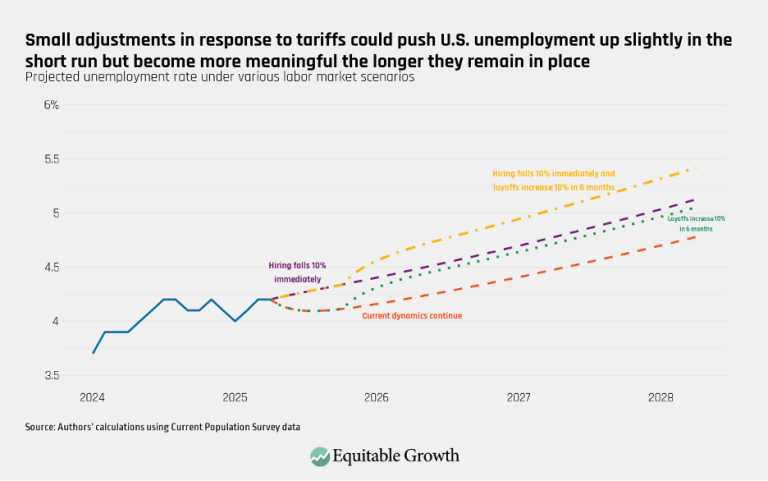 View Chart
(opens in a new tab)
View Chart
(opens in a new tab)
Small adjustments in response to tariffs could push U.S. unemployment up slightly in the short run but become more meaningful the longer they remain in place (opens in a new tab)
Visualizations MAY 9, 2025
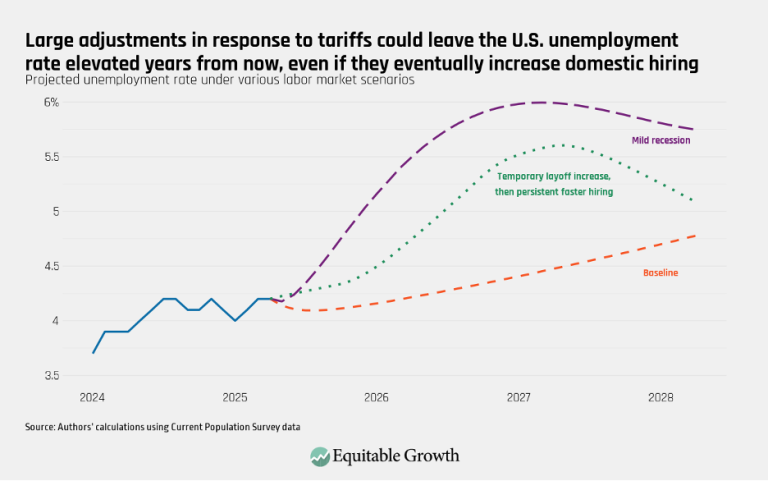 View Chart
(opens in a new tab)
View Chart
(opens in a new tab)
rinz fig 3 (opens in a new tab)
Visualizations MAY 9, 2025
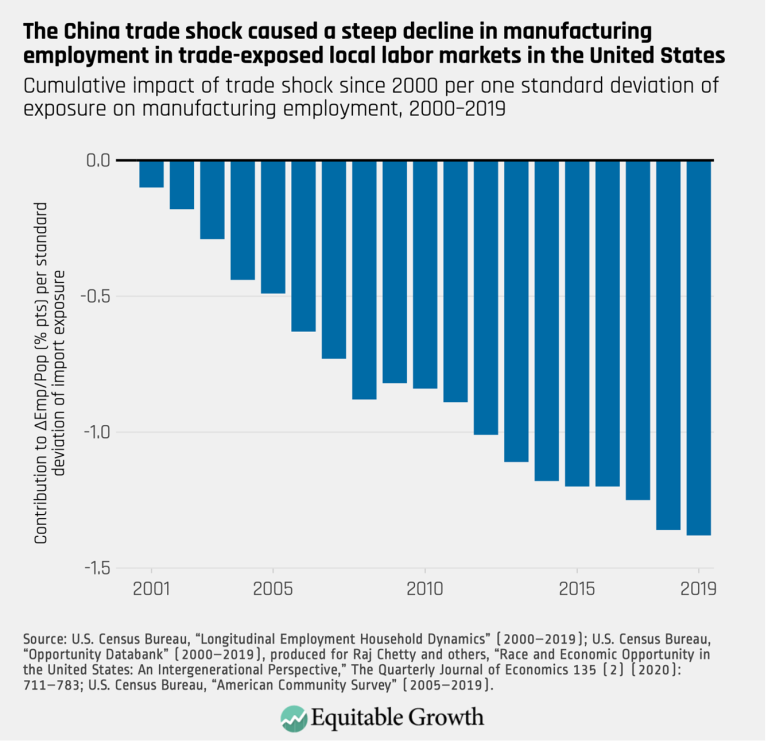 View Chart
(opens in a new tab)
View Chart
(opens in a new tab)
The China trade shock caused a steep decline in manufacturing employment in trade-exposed local labor markets in the United States (opens in a new tab)
Visualizations MAY 8, 2025
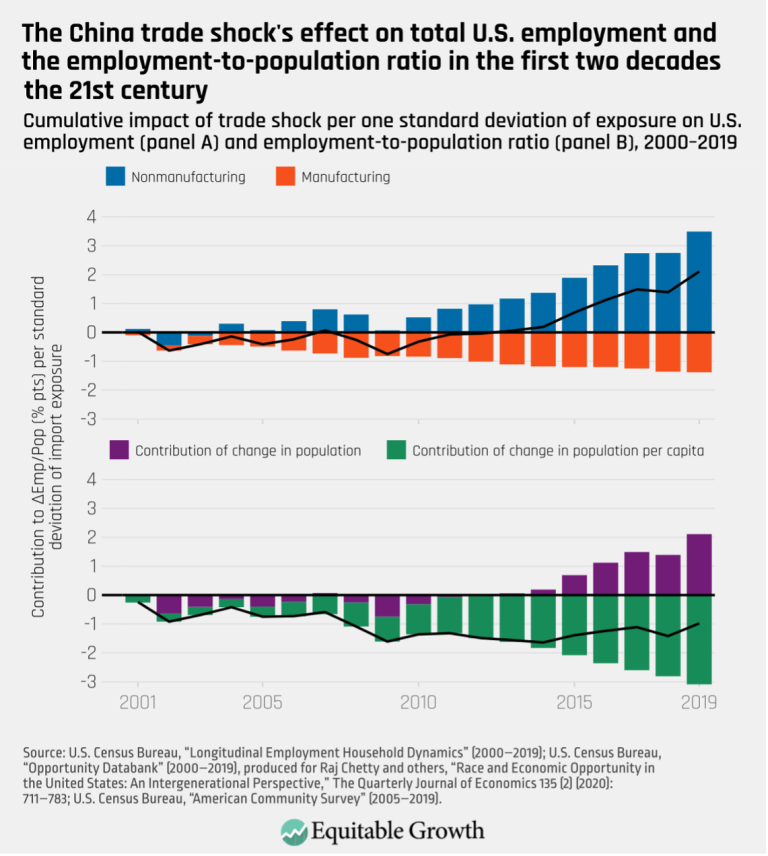 View Chart
(opens in a new tab)
View Chart
(opens in a new tab)
The China trade shock’s effect on total U.S. employment and the employment-to-population ratio in the first two decades the 21st century (opens in a new tab)
Visualizations MAY 8, 2025
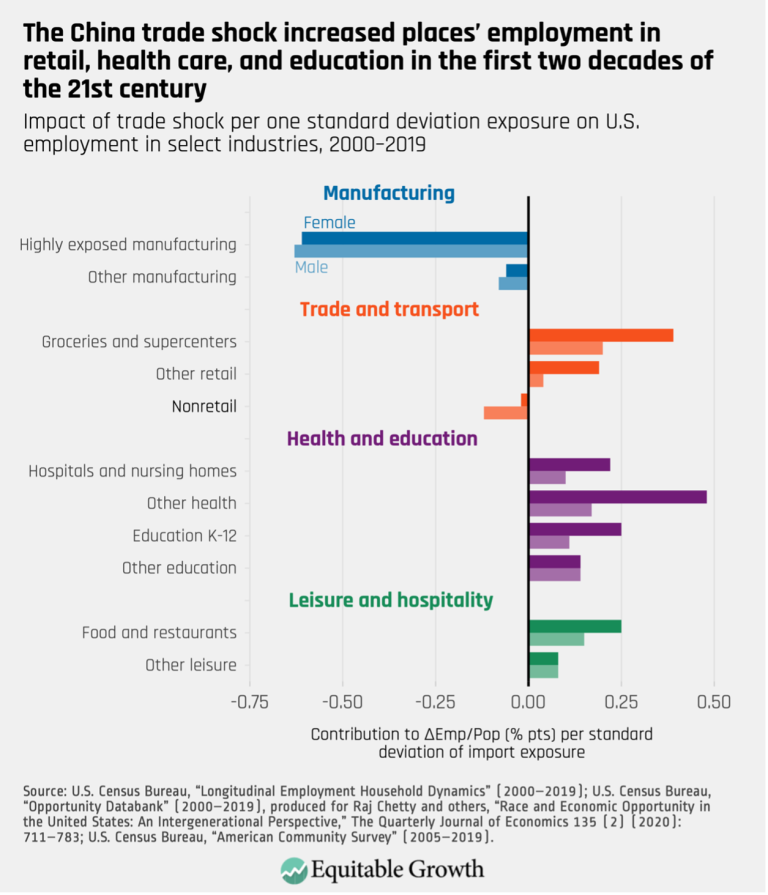 View Chart
(opens in a new tab)
View Chart
(opens in a new tab)
The China trade shock increased places’ employment in retail, health care, and education in the first two decades of the 21st century (opens in a new tab)
Visualizations MAY 8, 2025
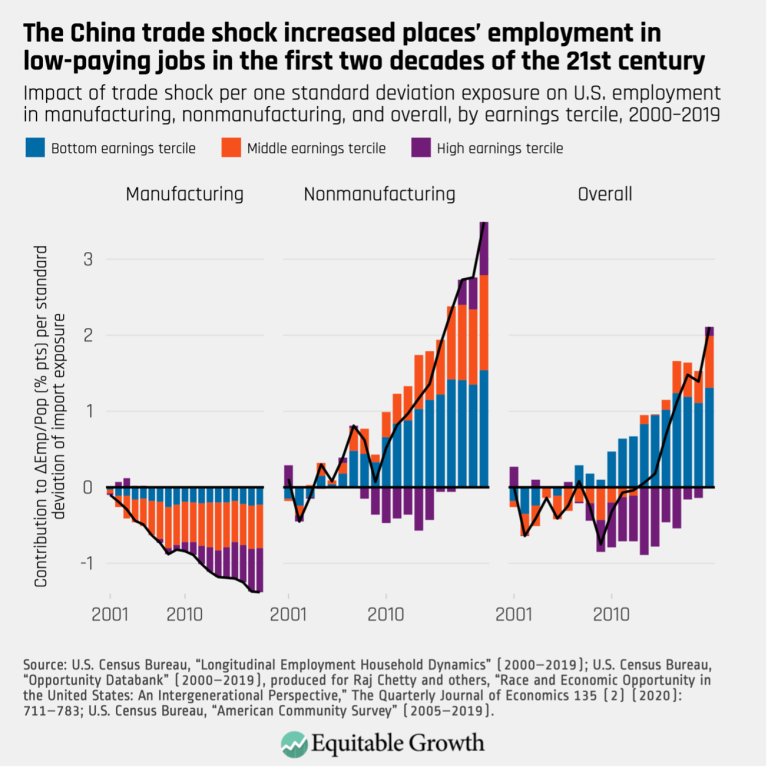 View Chart
(opens in a new tab)
View Chart
(opens in a new tab)
The China trade shock increased places’ employment in low-paying jobs in the first two decades of the 21st century (opens in a new tab)
Visualizations MAY 8, 2025
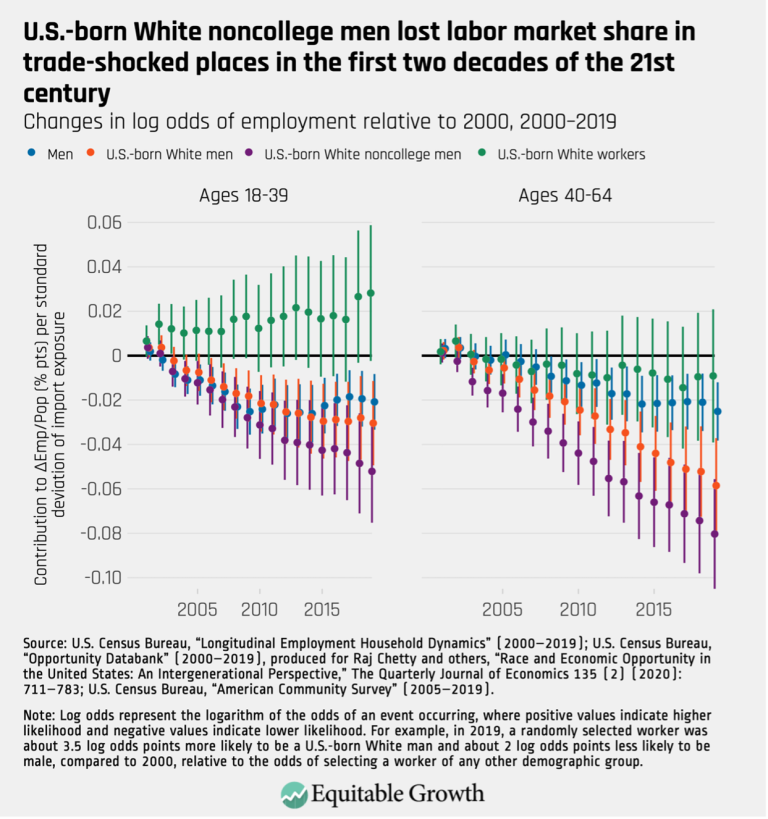 View Chart
(opens in a new tab)
View Chart
(opens in a new tab)
U.S.-born White noncollege men lost labor market share in trade-shocked places in the first two decades of the 21st century (opens in a new tab)
Visualizations MAY 8, 2025

Testimony by Michael Linden before the House Budget Committee (opens in a new tab)
Blog MAY 8, 2025
Chairman Arrington, Ranking Member Boyle, members of this committee, thank you for the opportunity to be here. Today, I’d like to make three main points. First, the main culprit responsible…
By: Michael Linden (opens in a new tab)

Why do some jobs pay better than others? Think about what workers do. (opens in a new tab)
Issue Briefs MAY 6, 2025
Most U.S. labor market data characterize jobs by describing the categories of industry and occupation to which the jobs belong. But to understand why some types of jobs tend to…
By: Kevin Rinz (opens in a new tab), Chiara Chanoi (opens in a new tab), Christopher Bangert-Drowns (opens in a new tab)
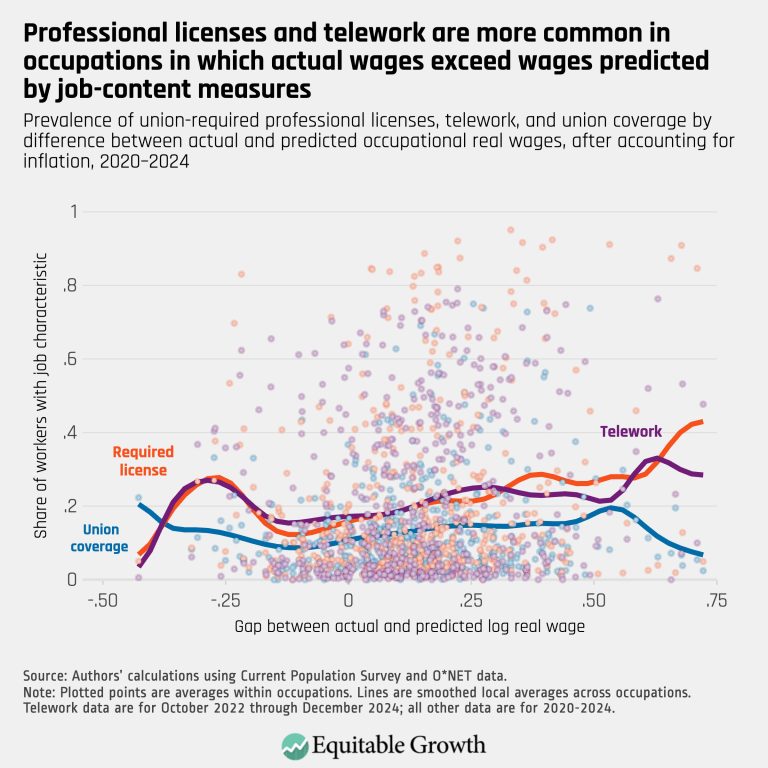 View Chart
(opens in a new tab)
View Chart
(opens in a new tab)
Professional licenses and telework are more common in occupations in which actual wages exceed wages predicted by job-content measures (opens in a new tab)
Visualizations MAY 6, 2025
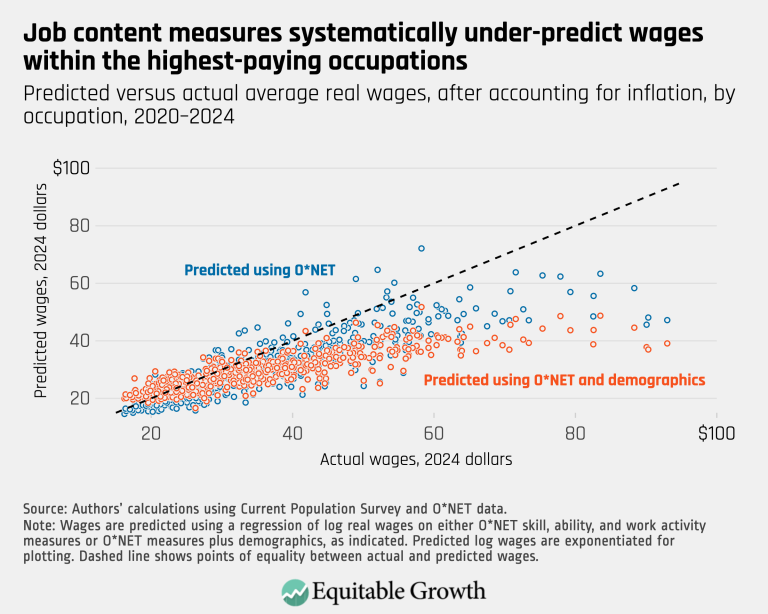 View Chart
(opens in a new tab)
View Chart
(opens in a new tab)
playfair (2) (opens in a new tab)
Visualizations MAY 6, 2025
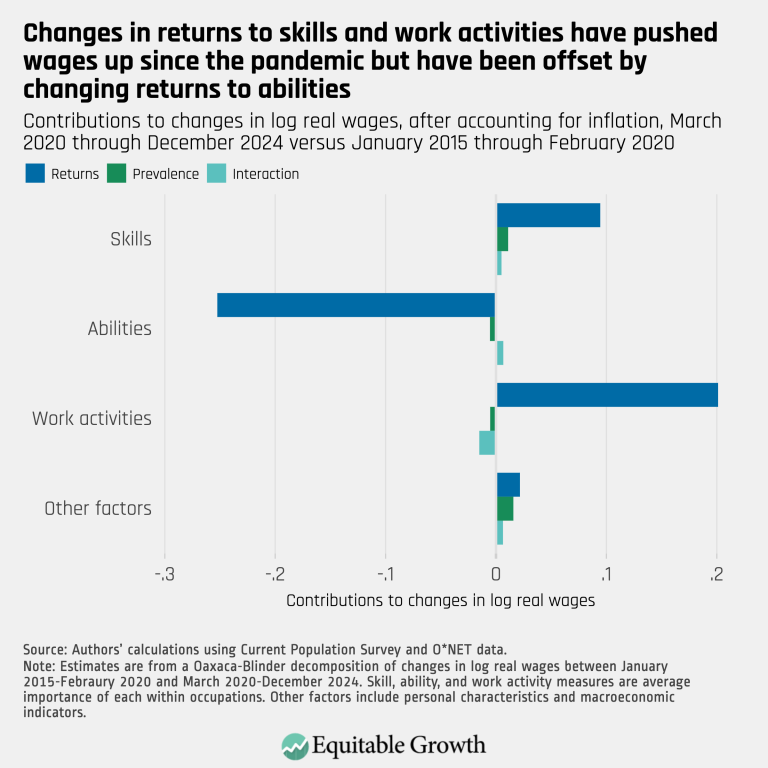 View Chart
(opens in a new tab)
View Chart
(opens in a new tab)
playfair (opens in a new tab)
Visualizations MAY 6, 2025

Advancing economic research on the Inflation Reduction Act: Q&A with Susan Helper (opens in a new tab)
Blog MAY 1, 2025
The Inflation Reduction Act of 2022 is the most significant economic and clean energy jobs program the United States has ever initiated. To improve overall understanding of whether the new…
By: Susan Helper (opens in a new tab)

Designing economic policy that strengthens U.S. democracy and incorporates people’s lived experiences (opens in a new tab)
Videos APR 30, 2025
Around the globe, people are increasingly dissatisfied with the state of democratic capitalism. In the United States and other rich democracies, economic policy has too often in recent decades produced…
By: Alexander Hertel-Fernandez (opens in a new tab), Shayna Strom (opens in a new tab)
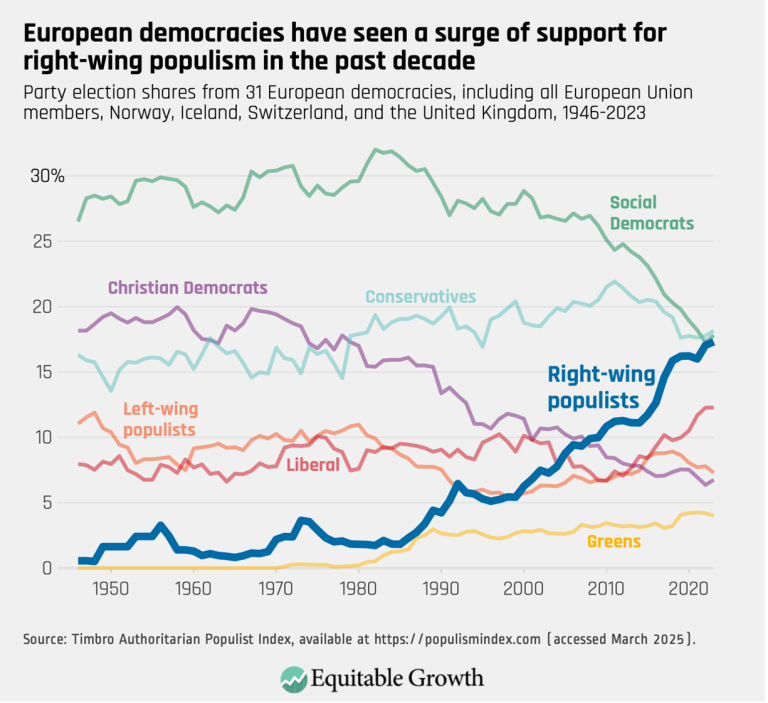 View Chart
(opens in a new tab)
View Chart
(opens in a new tab)
European democracies have seen a surge of support for right-wing populism in the past decade (opens in a new tab)
Visualizations APR 29, 2025

Advancing economic research on the Inflation Reduction Act: Q&A with Heather Boushey (opens in a new tab)
Issue Briefs APR 23, 2025
The Inflation Reduction Act of 2022 is the most significant economic and clean energy jobs program the United States has ever initiated. To improve overall understanding of whether the new…
By: Equitable Growth (opens in a new tab)

Factsheet: What we know about the federal employer-provided child care credit and how can it be better used by businesses (opens in a new tab)
Factsheets APR 22, 2025
The employer-provided child care credit, also referred to as Section 45F in the Internal Revenue Code, provides a limited subsidy to businesses in the United States that provide child care…
By: Megan Rivera (opens in a new tab)

Evaluating the Inflation Reduction Act: Job quality, spillovers, and place-based policymaking (opens in a new tab)
Blog APR 16, 2025
The Inflation Reduction Act of 2022 is the most significant economic and clean energy jobs program the United States has ever initiated. To improve overall understanding of whether the new…
By: Equitable Growth (opens in a new tab)

Improving economic outcomes for single mothers and their children across the United States (opens in a new tab)
Blog APR 16, 2025
Single-mother households are becoming more and more common in the United States. Over the past 50 years, the number of children raised by single mothers has more than doubled. It…
By: Megan Rivera (opens in a new tab)
“Econ 101” briefing on taxing multinationals brings Hill staffers up to speed on U.S. role in coordinating global crack-down on tax avoidance (opens in a new tab)
Blog APR 3, 2025
The Washington Center for Equitable Growth last week hosted a briefing for Capitol Hill staffers on multinational corporate tax trends and policies—another in our “Econ 101” series for Hill staffers.…
By: Elena Patel (opens in a new tab)
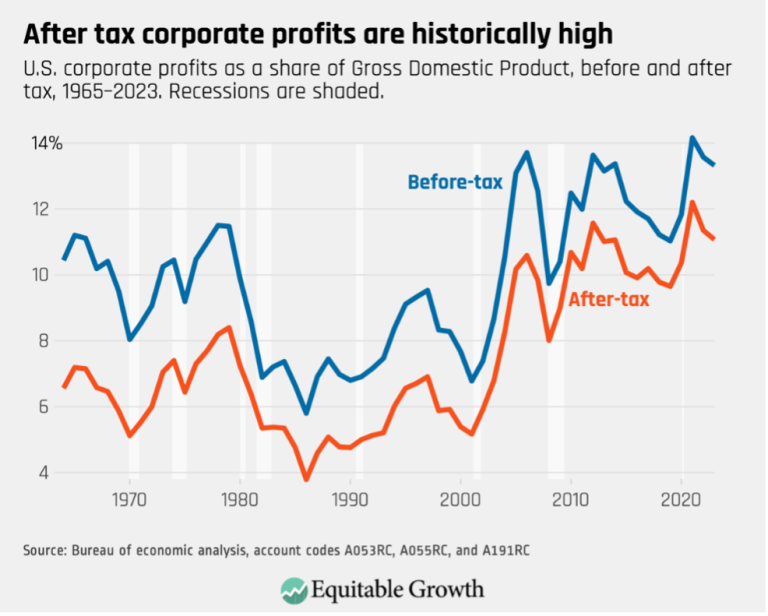 View Chart
(opens in a new tab)
View Chart
(opens in a new tab)
After tax corporate profits are historically high (opens in a new tab)
Visualizations APR 3, 2025
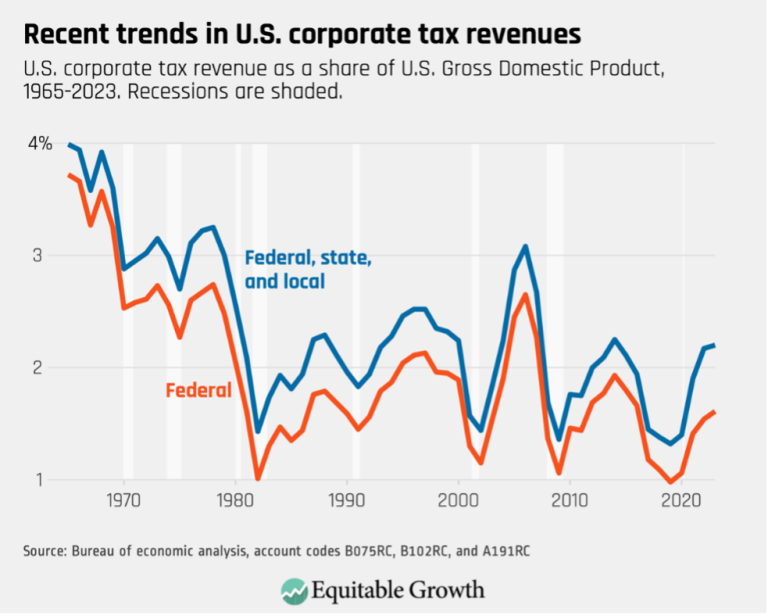

Request for Proposals: The economic effects of the Inflation Reduction Act (opens in a new tab)
RFPs APR 2, 2025
By: Equitable Growth (opens in a new tab)
The qualified small business stock exclusion overwhelmingly benefits the wealthy and should be reformed in 2025 (opens in a new tab)
Issue Briefs APR 1, 2025
This year’s debate over the expiring personal income and estate tax provisions of the 2017 Tax Cuts and Jobs Act provides an opportunity for reforming the qualified small business stock…
By: Jean Ross (opens in a new tab)

Analogies for AI policymaking (opens in a new tab)
Blog MAR 27, 2025
As a suite of technologies under the label of artificial intelligence increasingly take center stage, policymakers recognize the need to develop deep technical expertise about the deployment of evolving technologies…
By: Sorelle Friedler (opens in a new tab), Marc Aidinoff (opens in a new tab)

What makes a job ‘good’? How U.S. labor market data can provide insight to improve workers’ economic conditions (opens in a new tab)
Blog MAR 26, 2025
Since the Great Recession of 2007–2009, a great deal of U.S. economic policymaking has been dedicated to creating jobs. The tools used to do so vary widely, from awarding grants…
By: Kevin Rinz (opens in a new tab), Chiara Chanoi (opens in a new tab)

Do not abandon the care agenda (opens in a new tab)
Blog MAR 19, 2025
This column, co-authored by Equitable Growth President and CEO Shayna Strom and former Deputy Director of the White House Gender Policy Council Shilpa Phadke, first appeared in Democracy Journal in…
By: Equitable Growth (opens in a new tab)

Equitable Growth hosts Hill briefing on proliferation and taxation of U.S. pass-through businesses (opens in a new tab)
Blog MAR 13, 2025
On March 7, the Washington Center for Equitable Growth hosted a briefing—part of a series we call “Econ 101”—for Hill staffers curious about the proliferation of pass-through businesses and how…
By: Equitable Growth (opens in a new tab)

The U.S. House of Representatives’ budget resolution threatens social infrastructure programs, putting families’ well-being at risk (opens in a new tab)
Blog MAR 10, 2025
In late February, the U.S. House of Representatives passed a budget resolution that calls for $4.5 trillion in tax cuts and $2 trillion in federal spending cuts. This resolution provides…
By: Priyanka Anand (opens in a new tab), Robert Moffitt (opens in a new tab)

Tackling AI, taxation, and the fair distribution of AI’s benefits (opens in a new tab)
Blog MAR 5, 2025
Artificial intelligence poses significant challenges to income growth, inequality, and meaningful work. At the same time, AI has geopolitical significance, with many national and supranational governments shying away from intervening…
By: Mona Sloane (opens in a new tab), Ekkehard Ernst (opens in a new tab)

New research finds capital gains are highly concentrated and hardly taxed, underscoring widespread U.S. inequality (opens in a new tab)
Blog FEB 26, 2025
For two decades, booming stock, housing, and private business markets have driven large capital gains in the United States. Real capital gains, which are the inflation-adjusted appreciation of a financial…
By: Jacob Robbins (opens in a new tab), Cole Campbell (opens in a new tab), Sam Wylde (opens in a new tab)
The distribution of capital gains in the United States (opens in a new tab)
Working Papers FEB 26, 2025
Booming stock, housing, and private business markets have driven large capital gains in the United States, averaging 20% of national income over the past two decades. Using internal IRS tax…
By: Cole Campbell (opens in a new tab), Jacob A. Robbins, Sam Wylde (opens in a new tab)
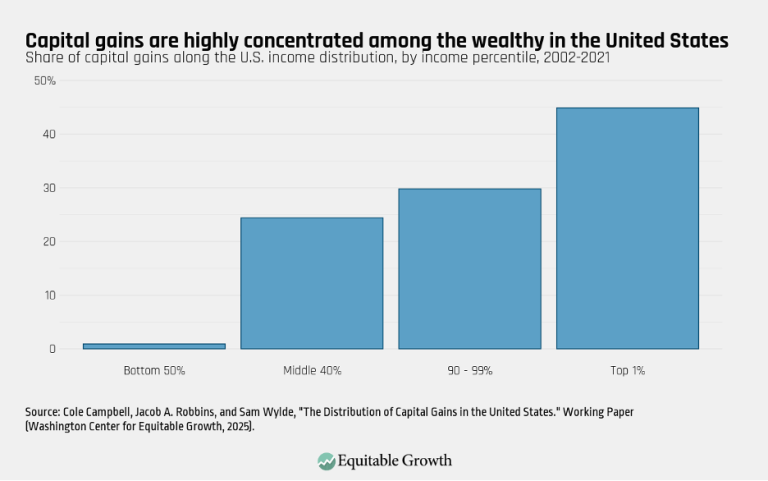 View Chart
(opens in a new tab)
View Chart
(opens in a new tab)
Capital gains are highly concentrated among the wealthy in the United States (opens in a new tab)
Visualizations FEB 26, 2025

Boosting U.S. worker power and voice in the AI-enabled workplace (opens in a new tab)
Blog FEB 19, 2025
The deployment of Artificial Intelligence in the workplace has grown rapidly in the United States. Labor unions have been at the forefront of efforts to encourage more productive and sustainable…
By: Virginia Doellgast (opens in a new tab), Nell Geiser (opens in a new tab)
As the U.S. labor market stabilizes, is nominal wage growth now too hot? (opens in a new tab)
Blog FEB 13, 2025
After the tumultuous swings of the early COVID-19 pandemic period and years of normalization since then, economic data from the past several months suggest that the U.S. labor market may…
By: Kevin Rinz (opens in a new tab)
Tax avoidance among large, complex partnerships in the United States (opens in a new tab)
Reports FEB 12, 2025
Decades-old conventional wisdom held that businesses organized as partnerships in the United States were mostly small enterprises with a handful of active individuals sharing personal liability for the businesses they…
By: David S. Mitchell (opens in a new tab)
The Spiderweb of Partnership Tax Structures (opens in a new tab)
Working Papers FEB 12, 2025
U.S. partnerships control more than $40 trillion in assets, vastly outnumber U.S. public firms, and contribute significantly to the U.S. tax non-compliance of pass-through entities, which is larger than the…
By: Ryan Hess (opens in a new tab), Emily Black (opens in a new tab), Zaynah Javed (opens in a new tab), Jonathan Hennessy (opens in a new tab), Rebecca Lester (opens in a new tab), Jacob Goldin (opens in a new tab), Daniel E. Ho, Annette Portz (opens in a new tab)

Testimony by Michael Linden House Oversight Subcommittee on Healthcare and Financial Services (opens in a new tab)
Blog FEB 11, 2025
Chairman Grothman, Ranking Member Krishnamoorthi, and members of the Committee – thank you for the opportunity to be here. Today, I’d like to make three main points. First, federal investments…
By: Michael Linden (opens in a new tab)
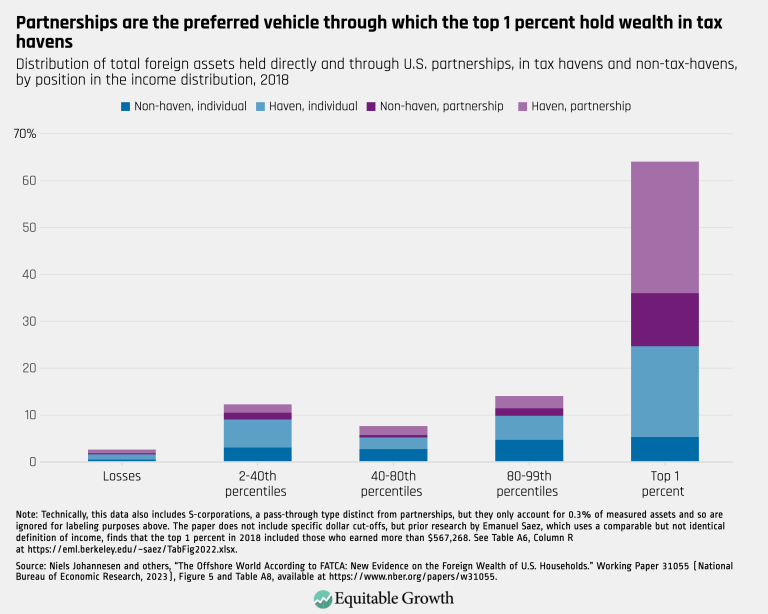 View Chart
(opens in a new tab)
View Chart
(opens in a new tab)
Partnerships are the preferred vehicle through which the top 1 percent hold wealth in tax havens (opens in a new tab)
Visualizations FEB 11, 2025
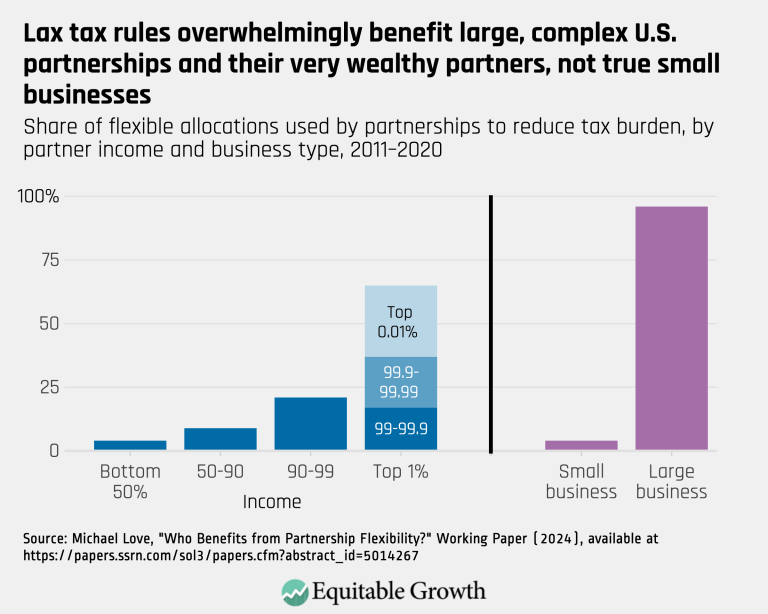
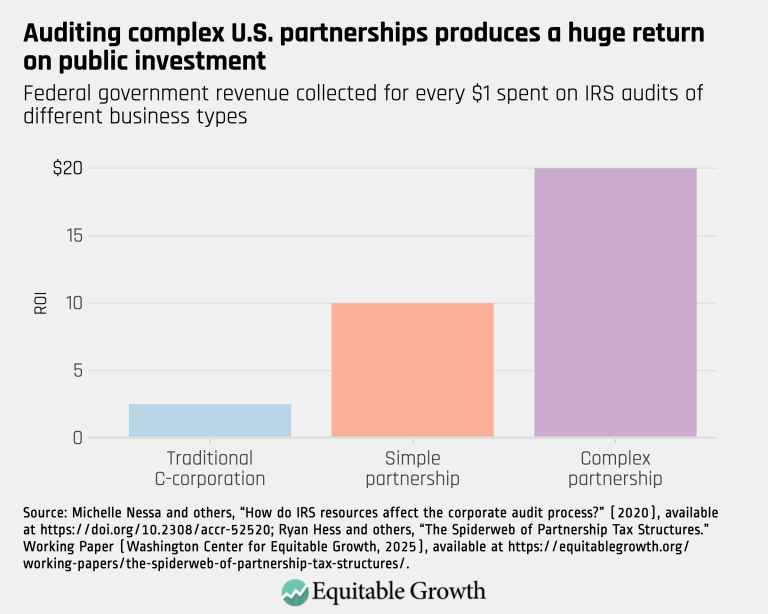 View Chart
(opens in a new tab)
View Chart
(opens in a new tab)
Auditing complex U.S. partnerships produces a huge return on public investment (opens in a new tab)
Visualizations FEB 11, 2025
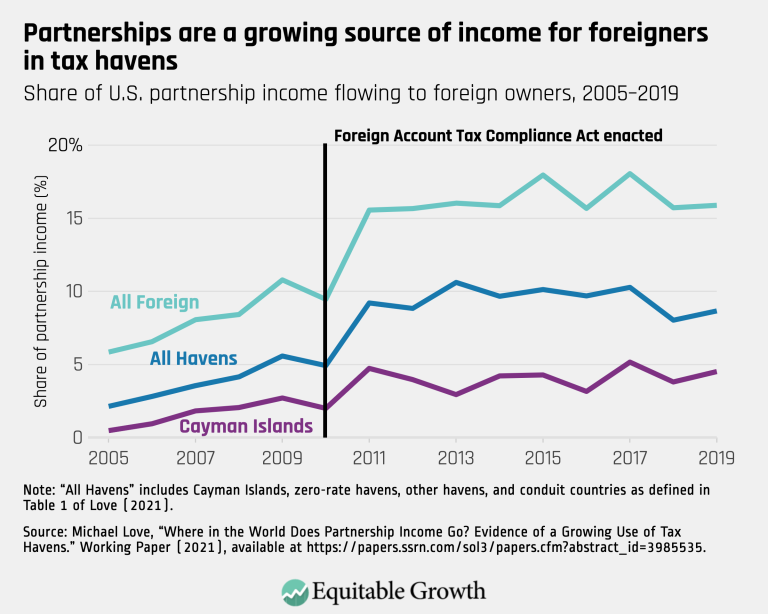 View Chart
(opens in a new tab)
View Chart
(opens in a new tab)
Partnerships are a growing source of income for foreigners in tax havens (opens in a new tab)
Visualizations FEB 11, 2025


Your Direct Line to Cutting Edge Research
Be the first to know about our latest events, research releases, and expert insights. Get exclusive updates delivered right to your inbox and never miss an opportunity to engage with our community.