
Economic research shows immigration is good for U.S. workers, the economy, and affordability
Essays AUG 31, 2026
By: Christopher Bangert-Drowns
APR 9, 2026
By: Sam Abbott and Shira Markoff
Affordable, available, high-quality child care is essential for sustained, broadly shared economic growth and equitable access to workforce opportunities.1 In most of the United States, however, child care fails this three-pronged standard. The child care market has been plagued by a troublesome math problem for decades: Care is too expensive for most parents, yet the industry is not profitable enough to deliver an adequate supply of care or competitive wages for child care workers.
Many economists (opens in a new tab) have called for robust public investment to correct failures in the U.S. child care market.2 In 2021 and 2022, federal policymakers got closer to delivering such investments when considering the Child Care for Working Families Act (opens in a new tab) within the Build Back Better framework proposed during the Biden administration.3 At the time, economists estimated (opens in a new tab) this policy would have increased maternal employment by up to 10 percentage points and improved the quality of care, all while lowering out-of-pocket costs for most families.4 But no such investment materialized after the legislation failed to advance in the U.S. Congress.
Today, momentum for federal investments in child care is largely stalled while failures in the child care market remain, leaving states struggling to fill policy gaps. State-level child care policymaking is inherently heterogeneous, with variations in funding reliability, local care infrastructure, and workforce requirements. Relying on states to solve this care crisis alone creates geographic policy variations that are likely to deepen national inequality in access to quality child care. Still, state actions can serve as important test runs for future public investment at a national scale, allowing states to pilot new ideas and develop critical care infrastructure.5
This report explores major trends and opportunities in states’ child care policies. It begins with the key challenges around child care at a national level and background on federal child care policies and their state-level counterparts. Next, it discusses legislative trends at the state level, including updates in child care policies from recent legislative sessions. Finally, it offers a research agenda in support of child care policymaking at the state level and in the service of future national action.
In 2021, U.S. Department of the Treasury recognized child care as a failed market (opens in a new tab),6 and there is little evidence that anything has improved since then. Within the existing system, families are constantly stretched thin, devoting substantial portions of household budgets to the costs of care. Meanwhile, profit margins in the child care industry are a scant 1 percent, and child care workers are some of the lowest paid in the overall U.S. labor force.
How can all this be true? The answer lies in a dual-sided liquidity—or cash flow—problem. Unlike Kindergarten-through-12th grade education, which is publicly funded, or higher education, which families have more time to save for and various financing options to choose from, the cost of child care falls mostly on young families with breadwinners early in their careers. Families typically incur these costs when their living expenses are high relative to their mostly low-to-moderate incomes and with little or no savings, meaning they can only afford so much for child care before substituting for other options, such as turning to family members for care or reducing their work hours. Providers are therefore discouraged from raising prices and wages too quickly.
At the same time, providers’ costs are relatively fixed, with labor accounting for 60 percent to 80 percent (opens in a new tab) of a provider’s operating expenses.7 To keep prices as low as possible, providers often squeeze labor costs. As quality and safety standards require providers to maintain minimum staffing levels, wages are the primary mechanism for keeping costs low.
This dual-sided liquidity constraint has yielded an untenable situation for everyone involved, but particularly for families and care workers. Child care is unaffordable for many families, and costs vary significantly based on location, type of care (home-based or center-based), and the child’s age. Recent analysis using the National Database of Childcare Prices finds that child care costs families between 8.9 percent to 16 percent (opens in a new tab) of their median income for full-day care for one child.8 The typical standard of affordable child care is 7 percent of household income; some scholars estimate (opens in a new tab) that child care costs exceed this threshold for most parents—68 percent—across the country.9
Availability is also a challenge. More than half of children in the United States live in areas that the Center for American Progress calls “child care deserts (opens in a new tab),” meaning that the number of slots in licensed child care facilities is lower than the number of children who need them.10 Child care deserts particularly affect children in low- and moderate-income households, Latinos, and families in rural areas.
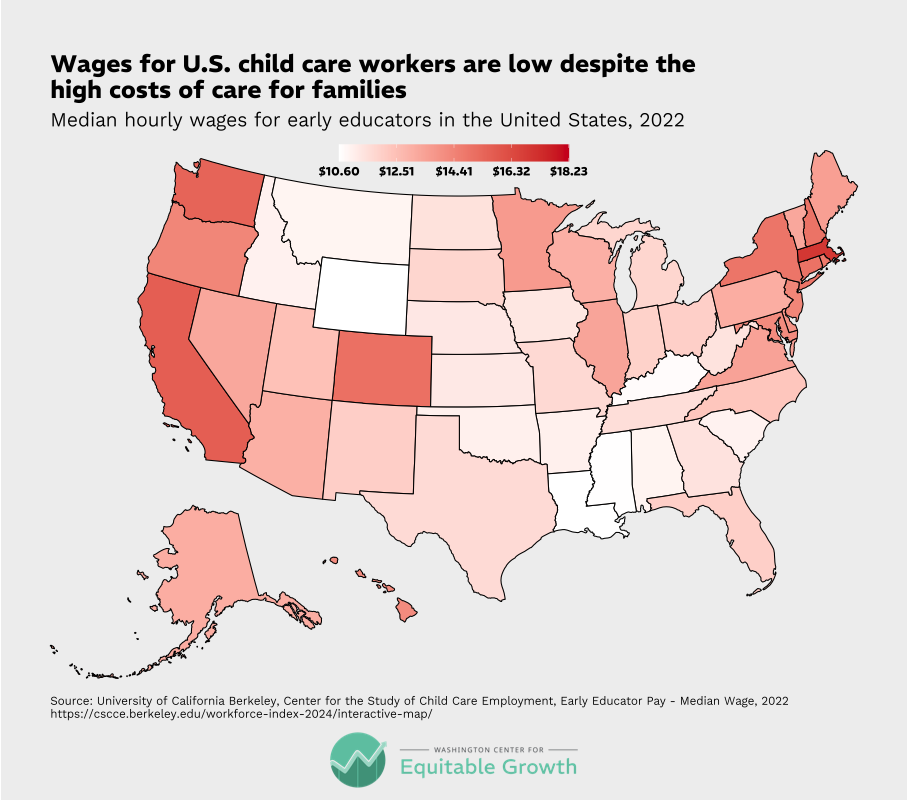
As expensive as child care is, families are still receiving an effective discount at the expense of underpaid child care workers, who are 95 percent women and are more likely to be Black or Latino (opens in a new tab) compared to the overall workforce.11 The median hourly wage for child care workers as of 2023 was $14.60, which falls in the bottom 5 percent of all occupational wages in the United States. Not surprisingly, then, the turnover rate in the child care sector is higher than for workers in the economy as a whole. Of the 12 percent of workers who left the child care sector each month from 2019 to 2023, 6.5 percent left the workforce entirely and 4.7 percent moved mainly to other low-wage jobs, (opens in a new tab) such as home care aides, cashiers, and housekeepers.12 (See Figure 1.)

Median hourly wages for early educators in the United States, 2022
The needs of care workers and families are obviously in tension. Indeed, when child care wages do rise—as they do after increases in state and local minimum wages13—researchers find that the supply of child care tends to shrink while prices rise. Robust public investment could help relieve this pressure.
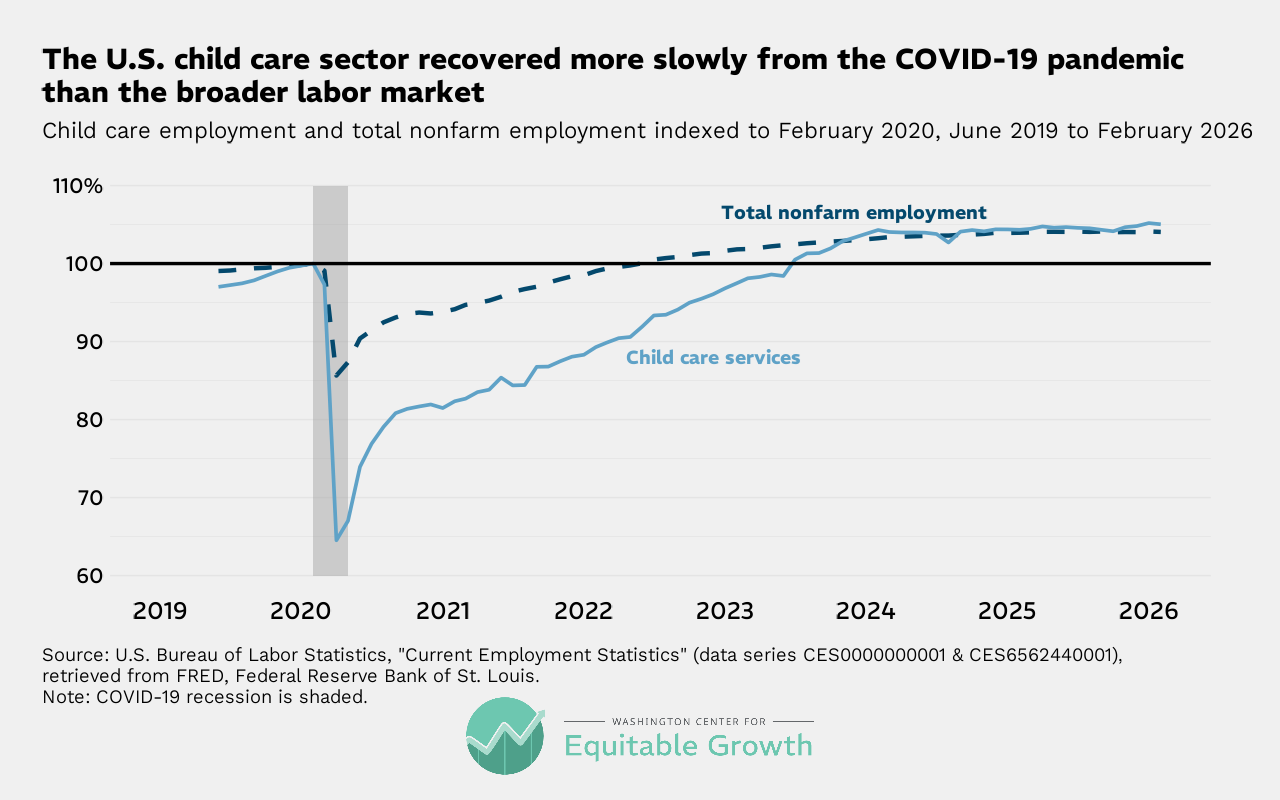
The COVID-19 pandemic exacerbated many of the longstanding issues in the child care sector. Child care was one of the hardest-hit industries during the pandemic. Employment for child care workers decreased 33.9 percent from April 2019 to April 2020, (opens in a new tab)14 compared with a 15.7 percent reduction in employment nationally.
Even as demand for child care services increased as the pandemic waned, the industry had a shortage of workers. While wages for most low-wage jobs rose in 2022 amid a then-tight labor market, wages for child care workers increased less than others (opens in a new tab), making those jobs less attractive.15 The child care sector did not fully recover from COVID-19-related job loses until the summer of 2023, a full year after the broader labor market had recovered. (See Figure 2.)

Child care employment and total nonfarm employment indexed to February 2020, June 2019 to February 2026
In response to the COVID-19 pandemic, the U.S. Congress appropriated more than $40 billion to stabilize the industry, with states granted wide flexibility for the use of these funds.16 States also could also apply part of the $350 billion they received under the State and Local Fiscal Recovery Funds (opens in a new tab) of the American Rescue Plan Act of 2021 for child care or early childhood programs.17 Many state policymakers chose to subsidize the demand for child care by capping families’ copays or increasing the amount of care subsidies families could receive. Others piloted supply-side interventions to induce new providers into the market.
These policy improvements proved to be ephemeral. Rather than acting as a down-payment in preparation for long-term public investment, the last of the COVID-19 relief funds expired in December 2024, after which states have made disparate decisions (opens in a new tab) about whether and how to sustain the programs they funded as they finish their required spend-downs of pandemic funds through December 2026.18
Child care policies at the federal level in the United States typically serve two primary functions: to ease the supply- and demand-side liquidity constraints described above and to ensure minimum health, safety, and quality for child care services. This section describes the main federal policy levers that impact the affordability, accessibility, and quality of child care and their state-level counterparts.
The federal government provides funding and support for child care and early childhood education primarily through two programs: Head Start (opens in a new tab) and the Child Care Development Fund (opens in a new tab), both of which are administered by the U.S. Department of Health and Human Services’ Administration for Children and Families.19 For Head Start, the U.S. Department of Health and Human Services directly funds school districts, nonprofit organizations, faith-based institutions, and other organizations to operate Head Start programs for 3- to 5-year-olds and Early Head Start programs for birth through 3 years of age.
In the context of state child care policies, the Child Care Development Fund is more relevant than Head Start. Under this program—which is composed of the Child Care Development Block Grant and the Child Care Entitlement to States programs—the federal government provides funds to states to administer child care assistance programs. In general, assistance takes the form of block grant voucher subsidies to low-income families to offset the cost of care or direct contracts with providers. States have wide latitude for how they use their block grant funds so long as they remain in compliance with minimum federal standards.
The federal government’s eligibility requirements for child care subsidies are that:
Depending on state policy, families participating in block grant programs usually have to contribute some of their own money toward their children’s care on a sliding scale based on income.
As part of the Child Care Development Fund, funding for the Child Care and Development Block Grant is discretionary, meaning the U.S. Congress must authorize spending for it each budget cycle. It is combined with mandatory funding from the Child Care Entitlement to States program, which is authorized under the Social Security Act. These funds are also meant to cover a wide range of needs, including the Temporary Assistance to Needy Families program.
Federal funding levels for these block grants to the states—and public spending on U.S. children in general—are below existing needs and have not kept pace with inflation. Among the 38 member nations of the Organisation for Economic Co-operation and Development, the United States ranks in the bottom three in terms of early care and education spending as a percent of Gross Domestic Product, spending 0.3 percent, below the average of 0.7 percent.
What’s more, due to the discretionary nature of the funds and the diversity in state priorities, the amount spent directly on care varies by state, and eligible families are not guaranteed participation. While almost 6.5 million children under the age of 5 qualify (opens in a new tab) for subsidy funds across the United States, only about 921,000 receive them.20
The Child Care and Development Block Grant was reauthorized in 2014 to include updated health and safety standards that child care providers must meet in order to qualify for subsidies. Primarily, the 2014 reauthorization required providers to undergo annual monitoring, relicensing inspections, health and safety trainings, and background checks. Relatedly, states were also required to provide accessible health, safety, and quality information to families.
The reauthorization included no guaranteed funding increases, contributing to state block grant programs becoming further underresourced (opens in a new tab).21 These resource constraints contributed to delays and challenges (opens in a new tab) in states’ compliance with the 2014 law.22 Beyond these minimum health and safety requirements, additional standards are set at the state level.
The federal tax code contains two provisions intended to offset the cost of child care or encourage the provision of child care services: the Child and Dependent Care Tax Credit and the Employer-Provided Child-Care Credit.
The Child and Dependent Care Tax Credit allows families to claim a percentage of their work-related child and dependent care expenses as a tax credit. The maximum credit value is $3,000 for one child and $6,000 for two or more children. Beginning in 2026, Public Law 119-21 (also known as H.R. 1 or the One Big Beautiful Bill Act of 2025) increased the tax credit calculation from 35 percent to 50 percent of qualifying care expenses, though the maximum credit values remain unchanged. Importantly, the Child and Dependent Care Tax Credit is nonrefundable, meaning low-income families who have a smaller tax bill often receive less than the full credit amount for which they may otherwise qualify.
The Employer-Provided Child-Care Credit, sometimes referred to as Section 45F, allows businesses to claim a percentage of qualified child care expenses related to providing or locating child care for their employees.23 Recently, H.R. 1 significantly increased the size of this credit, allowing businesses to claim up to 50 percent—up from 25 percent—of qualifying expenses for a maximum credit of $600,000, up from $150,000, for small businesses.
States and the District of Columbia leverage their use of federal funds for child care in different ways on both the demand and the supply side of the child care market. Some states also supplement federal funds and offer child care tax credits. This section of the report highlights these differences and how states are adapting to the end of the federal COVID-19 child care funding.
States are responsible for administering child care assistance using funds from the Child Care and Development Block Grant program. So long as they comply with the federal eligibility and quality rules, states have discretion in how they run their programs. States, for example, can set a lower income requirement than 85 percent of the state median income. They also can choose whether to give parents child care vouchers to defray costs or pay providers directly to provide slots for eligible children.
Many states have local child care programs and provide additional resources that go beyond the federal block grants. The District of Columbia, for example, has the Early Childhood Educator Pay Equity Fund (opens in a new tab) that uses city revenue to provide awards to child care providers to increase the wages of their workers.24 Many states also used some of their COVID-19 pandemic relief funds to shore up and enhance child care assistance in their states.
Now that states are no longer receiving pandemic relief funds and their budgets are tighter, there is a looming question as to whether pandemic-era state enhancements to child care can be retained. Those decisions will come quickly this year. The District of Columbia’s wage subsidy program, for example, was amended to reduce required pay rates (opens in a new tab) for care workers in January 2026, and the program is not funded past fiscal year 2027 (opens in a new tab) due to budget shortfalls.25
Child care regulations (opens in a new tab) are primarily established at the state level, with substantial variation across states and care settings (center-based care or in-home care).26 Regulations typically pertain to health and safety standards, including immunization and food safety requirements, class size and child-to-staff ratios, and staffing qualifications, including educational requirements. Research suggests (opens in a new tab) that state regulations are fairly static with infrequent policy changes, with the exception being the emergency phase of the COVID-19 pandemic (opens in a new tab).27
Evidence generally shows that more stringent regulations reduce the number of child care establishments (opens in a new tab), child care slots (opens in a new tab), job postings (opens in a new tab), and the size of the child care workforce (opens in a new tab).28 Evidence is mixed (opens in a new tab) on whether regulations impact child care use (opens in a new tab) and household expenses (opens in a new tab).29 Because such standards are some of the only tools that states have to ensure acceptable safety and quality levels, robust public investment and resources are needed to help providers meet these standards while minimizing unintended consequences on care workers and families.
Twenty-nine states and the District of Columbia (opens in a new tab)have state-level Child Care and Dependent Tax Credits that build upon the federal tax credit.30 Maximum credits range from $345 (Virginia) to $18,000 (Oregon). In 16 states and District of Columbia, this credit is refundable.
As of tax year 2025, Colorado, Louisiana, and Nebraska also provide child care and early education workforce credits to help offset the low wages prevalent throughout the early care and education sector. The remainder of U.S. states offer no child tax credits.
Both New Mexico and Vermont have identified dedicated funding sources to make comprehensive investments in their child care systems, which we detail below. For states that lack these funding models—for economic or political reasons—a patchwork approach to child care’s many unique challenges is more common. Recently enacted and pending state legislation on child care (opens in a new tab) runs the gamut, showing how states are trying a patchwork of solutions to shore up their child care sectors, stabilize their child care workforces, and address affordability for families in their states.31 The sampled policies outlined below are categorized into demand-side policies that support families and supply-side policies that impact the structure of the child care market.
Underpinning these diverse efforts are the political and economic viability of their funding models. While some states have been successful in finding dedicated funding or new tax revenue, others have relied on expected federal payments or macroeconomic trends that have not proved to be very stable.
New Mexico has made both substantial policy changes and a massive investment in child care and early childhood education beginning with the onset of the COVID-19 pandemic. In 2020, the state launched the Early Childhood (opens in a new tab) Education and Care Department (opens in a new tab), creating the Early Childhood Education and Care Fund with $320 million in general appropriations, which is supplemented annually with oil and gas revenue.32 As of 2025, the fund has $10 billion.
In 2022, voters also passed a constitutional amendment (opens in a new tab) that permanently directs funds from the state’s Land Grant Permanent Fund—a sovereign wealth fund that is constitutionally mandated to provide funding for education and other specific beneficiaries—to early childhood care and education.33 Child care assistance in the state is now heavily state funded and not as reliant on federal funding as other states.
Also in 2022, New Mexico expanded subsidy eligibility to families at or below 400 percent of the federal poverty level, and, in 2025, policymakers created the first universal child care program (opens in a new tab) in the United States, expanding eligibility to all families with no copays or income limits.34 Through this phased-in expansion, the number of eligible children has risen by 98 percent, from 98,000 to 194,0000. Roughly 20 percent of eligible children are served through the program.
Importantly, New Mexico’s universal child care program includes supply-side interventions (opens in a new tab) to accommodate the anticipated demand for slots.35 The state has increased reimbursement rates, established a low-interest loan fund to support physical care infrastructure needs, and has engaged in several recruitment and licensing efforts. Since 2019, licensed child care slots in New Mexico have risen 22 percent, from 58,523 to 71,509.
While the funding structure underpinning New Mexico’s universal child care program is unique, it serves as an important programmatic test case for other states. Already, the composition of children served in New Mexico’s system has shifted younger, with infants and toddlers rising from 29 percent of the child care caseload to 38 percent. Younger children require more labor-intensive care and are therefore costlier for providers. Fees for preschool and school-age children—which cost providers much less to care for—are often used to subsidize the care of younger enrollees (opens in a new tab).36 If and how the state absorbs these shifting costs will be instructive to policymakers in other states and at the federal level.
Vermont also has made significant public investments in child care to cover most families within the state. In 2021, the legislature passed Act 45 (opens in a new tab).37 On the demand side, the new law (opens in a new tab) increased subsidy eligibility for families earning up to 350 percent of the federal poverty line and waived copayments for families below 150 percent of the poverty line.38 On the supply side, the law established scholarships and student loan assistance for new early child care and education providers.
In 2023, Vermont also passed Act 76 (opens in a new tab), which implemented a new payroll tax to help fund child care expansions.39 The act increased the income eligibility for child care and early childhood tuition assistance up to 575 percent of the federal poverty line and waived copays for families at 175 percent of the federal poverty line or lower. To support child care providers, the law increased reimbursement rates and introduced financial bonuses for providers that increase or renew their state quality ratings, among other provisions.
Researchers are still examining the effects of Vermont’s public investment in child care, but early evidence finds promising increases both in families served and active providers. Since implementation of Act 76, the number of families receiving child care subsidies (opens in a new tab) has increased 48 percent, rising from approximately 5,400 families to 8,000 families.40 On the supply side, yearslong declines in available providers have begun to reverse (opens in a new tab).41 Between January 2020 and July 2023, the number of child care providers declined nearly 9 percent across all program types, but the provider market has since stabilized, increasing 2.4 percent since the law’s implementation.
Many state and federal child care policies are centered on reducing the cost burden for families through vouchers and subsidies. The Child Care and Development Block Grant program provides states with wide flexibility on the structure of these subsidies, and states can pursue additional funding to expand the scope or amount of these subsidies.
State-level policies aimed at supporting families focus on expanding child care assistance and providing tax credits for child care, including:
There is robust research evidence that demand-side interventions increase child care participation for eligible families and support parental labor force participation. Most state-level demand-side interventions, however, are too small in scale to meet the needs of all eligible families or induce a supply-side response necessary to improve affordability and accessibility more broadly.
Demand-side subsidies absent sufficient supply-side supports can, at least in the short term, contribute to a shortage of care slots or higher prices for unsubsidized families (opens in a new tab), as was observed in the rollout of Minnesota’s Child Care Assistance Program.48
States rely on a patchwork of supply-side interventions to stabilize or grow their local child care markets and invest in their child care workforces. Other policies under states’ purview, including quality regulations, have potential supply-side implications as well. Policymakers may pursue these policies at any time to address weaknesses or quality concerns within their child care markets, or they may be paired with increasing demand-side investments to account for the growing needs of families in their states.
A growing body of research demonstrates that supply-side supports can lead to better-quality child care and increased maternal employment, but most supply-side policies to date are, once again, too narrowly targeted to be transformative. Below are several examples of encouraging supply-side supports at the state level.
Several states have used the federal Child Care and Development Block Grant program and supplemental state funds to increase subsidy payments rates, provide low-interest development loans, and organizational support to providers entering the child care market. Such provider-oriented interventions include:
During the COVID-19 pandemic, many states looked for ways to stabilize their child care workforces, and some states have continued to enact or consider policies designed to support the recruitment and retention of child care workers. These policies include:
Overall, these state investments in the child care workforce are associated with better-quality service, reduced staff turnover, and higher compensation (opens in a new tab), though families’ costs also are expected to rise absent complementary demand-side investments.59
State policymakers establish health, safety, and quality standards that providers must meet to obtain licensing and qualify for subsidies. As stated above, researchers (opens in a new tab) generally find that without additional resources, such regulations can have a negative effect on the number of child care establishments, slots, and job postings (opens in a new tab), putting upward pressure on prices for families.60
Policymakers must therefore balance the importance of guaranteeing safe, high-quality care with the potential unintended consequences of imposing new standards. By providing technical and material support to providers in meeting regulatory requirements, state policymakers can ensure safety and quality standards while minimizing potential negative ramifications for families and care workers alike. Some approaches include:
States also have enacted or proposed policies to incentivize employers to support child care affordability and access for their employees. Motivated by the tremendous economic benefits that businesses receive from the U.S. child care industry—including a larger and more diverse labor force—many policymakers believe firms must have financial stakes (opens in a new tab) in providing child care.64 These policies, which can have supply- and demand-side implications, include:
Employer-sponsored child care can address tricky coverage gaps for workers with the greatest needs (opens in a new tab), including those who live in low-coverage areas or work nonstandard hours.67 There is evidence however, that employer-provided benefits for child care can stifle employees’ mobility in the U.S. labor market (opens in a new tab), as they fear losing critical benefits.68 Some child care advocates have also raised concerns about employer-first policy solutions leading the child care market further down the path of privatization and away from robust public investments.69
State child care policymaking (opens in a new tab) faces significant headwinds over the next few years.70 First, many states are experiencing tighter budgets with the expiration of pandemic relief funds. A number of states made significant tax cuts in the past few years (opens in a new tab) using budget surpluses as justification—even though those surpluses were often the result of temporary infusions of federal pandemic relief.71 These states are more likely to be facing potential cuts to child care funding than making new investments.
Second, states are facing significant uncertainty around federal funding for critical programs and services, including child care. Legislatively, the One Big Beautiful Bill Act significantly shifts health care (opens in a new tab) and social service costs to states.72 While the U.S. Congress has not cut Child Care and Development Block Grant funds, slashing federal funds for other programs puts a tremendous strain on state budgets and could cause states to cut state funding for child care assistance.
The Trump administration has also taken an unpredictable—and at times punitive (opens in a new tab)73—approach to federal funding cuts, cancelling (opens in a new tab) previously awarded grants (opens in a new tab) that policymakers had already incorporated into their state and local budgets.74 In early 2026, the administration announced a freeze (opens in a new tab) on funding for the Child Care Development Fund, Temporary Assistance for Needy Families program, and the Social Services Block Grant in five blue states, citing broad and often-unsubstantiated claims of fraud.75 A federal judge has temporally blocked this freeze pending litigation, (opens in a new tab) allowing child care payments to continue.76
In this uncertain funding environment, states that made substantial investments in child care in the past few years are likely to be focused on retaining those expansions, rather than passing new policies requiring additional funding.
The COVID-19 era fostered significant investments and innovations in state child care policies, but it is unclear what will happen next. Although child care affordability and availability was an issue prior to the COVID-19 pandemic, the pandemic forced the crisis to the fore. It showed in stark relief just how critical child care is to the ability of parents, especially mothers, to work and for the functioning of the U.S. economy. Many states responded to the crisis, supported by the influx of federal pandemic relief funds, with bolder action and bigger investments in child care. Now that states have run out of these funds, it is uncertain whether they can or will use state funds to maintain these expansions.
The unpredictability of the federal government is an impediment for advancing child care policies. Several states have political conditions that could have been favorable to making significant advances in child care policies this year and next year. Yet the threats to federal funding for state-administered programs, including child care assistance (opens in a new tab),77 means that state officials are facing uncertain legal and budgetary landscapes. Given such uncertainties, as well as strained coffers (opens in a new tab),78 it is difficult to imagine many states making child care policy changes that would require significant new investments or that could expose them to costly legal challenges. It is more likely that they will focus on preserving existing child care programs rather than starting new programs.
Research and evaluation are needed on newer policies. Many of the trending child care policy ideas, such as tri-share and pay supplements for child care workers, are too new to have been the subject of extensive research and evaluation. Still, states continue to propose and enact these policies in search of solutions to their child care crises. Research on the effectiveness of these policies would help policymakers determine which of these ideas should be replicated or scaled up.
Comparing the potential impact of different policy approaches could be helpful for policymakers. Current policies tackle child care issues from the standpoint of providers, families, workers, and employers, but little is known about the comparative impact of these different approaches or how they interact with one another. Is subsidizing child care providers more effective at lowering costs than providing vouchers to parents, or are both approaches needed, and at what levels? To the extent that it is possible to compare the potential impacts of different policy approaches, such research would help state policymakers understand which types of policy interventions would be best for addressing specific challenges faced in their state.
State-by-state approaches to child care interventions reveal a patchwork of strategies that are generally too small to be transformative and can have unintended consequences. In the absence of federal public investments, states have done what they can, pursuing a variety of policy approaches to ease the cost burden on families, boost worker pay, and induce new providers into the child care market. Yet these policies are often limited in scale, failing to make transformative change across their child care markets outside the limits of their specific scope. Further, without a holistic approach, policy options that address a problem on the demand side may worsen a problem on the supply side—and vice versa.
State policymakers can fill critical gaps, but robust federal investments remain a necessary condition for an accessible, affordable, and high-quality child care system with the potential to grow a more equitable economy.
Evaluation needs:
Research needs:
Research questions:
1.
Sam Abbott, “The child care economy” (Washington: Washington Center for Equitable Growth, 2021), available at https://equitablegrowth.org/research-paper/the-child-care-economy/.
2.
“An Open Letter from Economists in Support of Child Care Relief,” available at https://www.americanprogress.org/wp-content/uploads/sites/2/2020/06/Economists-letter.pdf (opens in a new tab) (last accessed March 2026); Sandra Black and Jesse Rothstein, “Public investments in social insurance, education, and child care can overcome market failures to promote family and economic well-being” (Washington: Washington Center for Equitable Growth, 2021), available at https://equitablegrowth.org/public-investments-in-social-insurance-education-and-child-care-can-overcome-market-failures-to-promote-family-and-economic-well-being/.
3.
Early Childhood Policy Team, “Fact Sheet: What To Know About the Child Care for Working Families Act” (Washington: Center for American Progress, 2025), available at https://www.americanprogress.org/article/fact-sheet-what-to-know-about-the-child-care-for-working-families-act/ (opens in a new tab).
4.
Jonathan Borowsky and others, “An Equilibrium Model of the Impact of Increased Public Investment in Early Childhood Education.” Working Paper 30140 (National Bureau of Economic Research, 2022), available at https://www.nber.org/papers/w30140 (opens in a new tab).
5.
Sam Abbott, “Policymakers can still use American Rescue Plan funds to bolster the U.S. child care system and ensure it has a strong future” (Washington: Washington Center for Equitable Growth, 2022), available at https://equitablegrowth.org/policymakers-can-still-use-american-rescue-plan-funds-to-bolster-the-u-s-child-care-system-and-ensure-it-has-a-strong-future/.
6.
U.S. Department of the Treasury, “Treasury Releases Report Showing U.S. Childcare System Overburdens Families and Causes Shortages Due to Inadequate Supply,” Press release, September 15, 2021, available at https://home.treasury.gov/news/press-releases/jy0354 (opens in a new tab).
7.
U.S. Department of Labor, Women’s Bureau, “Fact Sheet: Childcare Prices in Local Areas: Initial Findings from the National Database of Childcare Prices” (2023), available at https://www.dol.gov/sites/dolgov/files/WB/NDCP/Fact-sheet-English-508-compliant.pdf (opens in a new tab).
8.
Georgia Poyatzis and Gretchen Livingston, “New Data: Childcare costs remain an almost prohibitive expense,” U.S. Department of Labor Blog, November 19, 2024, available at https://blog.dol.gov/2024/11/19/new-data-childcare-costs-remain-an-almost-prohibitive-expense (opens in a new tab).
9.
Abigail N. Walters, Pamela Joshi, and Leah Shafer, “Who Can Afford Child Care? A National and State Analysis of Affordability for Working Parents” (Boston: Boston University School of Social Work, 2026), available at https://www.diversitydatakids.org/sites/default/files/file/DDK_Who_Can_Afford_Child_Care_A_National_and_State_Analysis_of_Affordability_Feb162026_Final.pdf (opens in a new tab).
10.
Center for American Progress, “Child Care Deserts” (n.d.), available at https://www.americanprogress.org/series/child-care-deserts/ (opens in a new tab).
11.
Kristin Butcher and others, “The Labor Market for Childcare Workers” (Chicago: Federal Reserve Bank of Chicago, 2024), available at https://www.chicagofed.org/publications/chicago-fed-insights/2024/childcare-labor-market (opens in a new tab).
12.
Ibid.
13.
Sam Abbott, “What the minimum wage can tell us about the future of the U.S. child care system” (Washington: Washington Center for Equitable Growth, 2023), available at https://equitablegrowth.org/what-the-minimum-wage-can-tell-us-about-the-future-of-the-u-s-child-care-system/.
14.
U.S. Bureau of Labor Statistics, “Childcare employment—before, during, and after the COVID-19 pandemic” (2024), available at https://www.bls.gov/opub/mlr/2024/article/childcare-employment-before-during-and-after-the-covid-19-pandemic.htm (opens in a new tab).
15.
Rose Khattar and Maureen Coffey, “The Child Care Sector Is Still Struggling to Hire Workers” (Washington: Center for American Progress, 2023), available at https://www.americanprogress.org/article/the-child-care-sector-is-still-struggling-to-hire-workers/ (opens in a new tab).
16.
Abbott, “Policymakers can still use American Rescue Plan funds to bolster the U.S. child care system and ensure it has a strong future.”
17.
U.S. Department of the Treasury, “State and Local Fiscal Recovery Funds” (n.d.), available at https://home.treasury.gov/policy-issues/coronavirus/assistance-for-state-local-and-tribal-governments/state-and-local-fiscal-recovery-funds (opens in a new tab).
18.
Julie Kashen and Laura Valle Gutierrez, “With Arrival of Child Care Cliff, Some States Have Stepped in to Save the Sector” (New York: The Century Foundation, 2024), available at https://tcf.org/content/report/with-arrival-of-child-care-cliff-some-states-have-stepped-in-to-save-the-sector/ (opens in a new tab).
19.
“Head Start,” available at https://headstart.gov/ (opens in a new tab) (last accessed March 2026); Rebecca Daugherty, “Child Care and Development Fund” CCDBG and CCES, Explained” (Washington: Bipartisan Policy Center, 2025), available at https://bipartisanpolicy.org/explainer/child-care-and-development-fund-ccdbg-cces/ (opens in a new tab).
20.
First Five Years Fund, “2025 Child Care and Early Learning State Fact Sheets” (n.d.), available at https://www.ffyf.org/2025-state-fact-sheets/ (opens in a new tab).
21.
Gina Adams and Julia R. Henly, “Child Care Subsidies: Supporting Work And Child Development For Healthy Families,” Health Affairs, April 12, 2020, available at https://www.healthaffairs.org/content/briefs/child-care-subsidies-supporting-work-and-child-development-healthy-1773889724671 (opens in a new tab).
22.
Christine Johnson-Staub and Shiva Sethi, “From Opportunity to Change: State Experiences Implementing CCDBG” (Washington: CLASP, 2019), available at https://www.clasp.org/sites/default/files/publications/2019/03/Opportunity%20to%20Change%20Main%20Body.pdf (opens in a new tab).
23.
Megan Rivera, “Factsheet: What we know about the federal employer-provided child care credit and how can it be better used by businesses” (Washington: Washington Center for Equitable Growth, 2025), available at https://equitablegrowth.org/factsheet-what-we-know-about-the-federal-employer-provided-child-care-credit-and-how-can-it-be-better-used-by-businesses/.
24.
Office of the State Superintendent of Education, “Early Childhood Educator Pay Equity Fund: Information for Facility Leaders and Staff” (n.d.), available at https://osse.dc.gov/pef (opens in a new tab).
25.
Early Childhood Educator Pay Scales Amendment Act of 2025, L26-0100, March 18, 2026, available at https://lims.dccouncil.gov/Legislation/B26-0176 (opens in a new tab); Alex Koma, “D.C. is cutting pay raises for childcare workers to meet budget pressures. No one seems happy about it.” WAMU 88.5, October 22, 2025, available at https://wamu.org/story/25/10/22/d-c-is-cutting-pay-raises-for-childcare-workers-to-meet-budget-pressures-no-one-seems-happy-about-it/?ref=51st.news (opens in a new tab).
26.
Chris M. Herbst, “Child Care in the United States: Markets, Policy, and Evidence.” Working Paper 15547 (Institute of Labor Economics, 2022), available at https://www.econstor.eu/bitstream/10419/265768/1/dp15547.pdf (opens in a new tab).
27.
David M. Blau, “Do child care regulations affect the child care and labor markets?” Journal of Policy Analysis and Management 22 (3) (2003): 443–465, available at https://onlinelibrary.wiley.com/doi/abs/10.1002/pam.10140 (opens in a new tab); Umair Ali, Chris M. Herbst, and Christos A. Makridis, “Minimum quality regulations and the demand for childcare labor,” Journal of Policy Analysis and Management 43 (3) (2024): 660–695, available at https://onlinelibrary.wiley.com/doi/abs/10.1002/pam.22568 (opens in a new tab).
28.
V. Joseph Hotz and Mo Xiao, “The Impact of Regulations on the Supply and Quality of Care in Child Care Markets,” American Economic Review 101 (5) (2011): 1775–1805, available at https://www.aeaweb.org/articles?id=10.1257/aer.101.5.1775 (opens in a new tab); William T. Gormley Jr., “State regulations and the availability of child-care services,” Journal of Policy Analysis and Management 10 (1) (1991): 78–95, available at https://onlinelibrary.wiley.com/doi/abs/10.2307/3325514 (opens in a new tab); Ali, Herbst, and Makridis, “Minimum quality regulations and the demand for childcare labor”; Blau, “Do child care regulations affect the child care and labor markets?”
29.
Sandra L. Hofferth and Duncan D. Chaplin, “State regulations and child care choice” Population Research and Policy Review 17 (1998): 111–140, available at https://www.jstor.org/stable/40230180 (opens in a new tab); Blau, “Do child care regulations affect the child care and labor markets?”; Tasneem Chipty, “Economic Effects of Quality Regulations in the Day-Care Industry,” American Economic Review 85 (2) (1995): 419–424, available at https://www.jstor.org/stable/2117959 (opens in a new tab).
30.
National Women’s Law Center, “States Can Make Care Less Taxing: Tax Credits Related to Child Care, Tax Year 2025” (2026), available at https://nwlc.org/resource/states-can-make-care-less-taxing-tax-credits-related-to-child-care-tax-year-2025/ (opens in a new tab).
31.
Kyra Weber, Hannah Gabelnick, and Karen Schulman, “Progress and Setbacks: State Child Care and Early Education Updates 2025” (Washington: National Women’s Law Center, 2026), available at https://nwlc.org/resource/progress-and-setbacks-state-child-care-and-early-education-updates-2025/ (opens in a new tab).
32.
“About ECECD,” available at https://www.nmececd.org/about-ececd/ (opens in a new tab) (last accessed March 2026).
33.
Jacob Vigil, “Early Childhood Care and Education in New Mexico: Using New Tools and Rising to the Challenge” (Albuquerque, NM: New Mexico Voices for Children, 2023), available at https://www.nmvoices.org/archives/17588 (opens in a new tab).
34.
New Mexico Early Childhood Education and Care Department, “Universal Child Care Brief” (2025), available at https://www.nmececd.org/wp-content/uploads/2025/12/Universal-Child-Care-Brief-12-11-25_FINAL_REV2.pdf (opens in a new tab).
35.
Office of the Governor Michelle Lujan Grisham, “New Mexico is first state in nation to offer universal child care,” Press release, September 8, 2025, available at https://www.governor.state.nm.us/2025/09/08/new-mexico-is-first-state-in-nation-to-offer-universal-child-care/ (opens in a new tab).
36.
Policy Equity Group, “Universal Pre-K only works if states also stabilize infant and toddler care; otherwise, it can be detrimental.” (2023), available at https://policyequity.com/universal-pre-k-only-works-if-states-also-stabilize-infant-and-toddler-care-otherwise-it-can-be-detrimental/#:~:text=As%20governors%20on%20both%20sides,workforce%20are%20depending%20on%20it (opens in a new tab).
37.
An act relating to the governance and financing of Vermont’s child care system, Act 45 (H.171), June 1, 2021, available at https://legislature.vermont.gov/bill/status/2022/H.171 (opens in a new tab).
38.
Child Trends, “Understanding Changes to Child Care Policies in Vermont: Access to Child Care and Early Education” (n.d.), available at https://www.childtrends.org/project/understanding-changes-to-child-care-policies-in-vermont (opens in a new tab).
39.
An act relating to child care, early education, workers’ compensation, and unemployment insurance, Act 76, 2023, available at https://legislature.vermont.gov/Documents/2024/Docs/ACTS/ACT076/ACT076%20As%20Enacted.pdf (opens in a new tab).
40.
Child Trends, “Vermont’s Child Care Subsidy Expansion Means More Families Have Affordable Child Care” (2025), available at https://www.childtrends.org/publications/vermonts-child-care-subsidy-expansion-affordable (opens in a new tab).
41.
Katie Richards and others, “Vermont Policy Changes Associated with Increase in Supply of Child Care” (Rockville, MD: Child Trends, 2025), available at https://cms.childtrends.org/wp-content/uploads/2025/08/VermontPolicyChanges_ChildTrends_August2025.pdf (opens in a new tab).
42.
Prenatal-to-3 Policy Impact Center, “Child Care Subsidies” (n.d.), available at https://pn3policy.org/pn-3-state-policy-roadmap-2024/us/child-care-subsidies/ (opens in a new tab).
43.
Alaska Senate Majority, “Legislature Passes Bill Expanding Access to Affordable Child Care,” Press release, May 17, 2025, available at https://alaskasenate.org/press/051725_press_release.htm (opens in a new tab).
44.
Connecticut Senate Democrats, “Senate Bill 1: Landmark Child Care Expansion Clears Senate,” May 30, 2025, available at https://www.senatedems.ct.gov/senate-bill-1-landmark-child-care-expansion-clears-senate (opens in a new tab).
45.
Child Care and Development Fund, Public Law 57 (House Bill 1248), April 10, 2025, available at https://iga.in.gov/legislative/2025/bills/house/1248/details (opens in a new tab); An act to direct the Mississippi Department of Human Services to Submit an Amendment to the Mississippi Child Care Development Fund (CCDF) Plan to the Federal Government to Provide that Certain Parents or Primary Caregivers of Children will be Eligible for Child Care Services under the Mississippi Child Care Payment Program…, House Bill 85, 2025, available at https://billstatus.ls.state.ms.us/documents/2025/pdf/HB/0001-0099/HB0085IN.pdf (opens in a new tab); Expands eligibility requirements of State’s child care assistance program to include full-time graduate and post-graduate students, Bill S3429 Sca (1R), June 10, 2024, available at https://www.njleg.state.nj.us/bill-search/2024/S3429 (opens in a new tab).
46.
A Bill to be Entitled, House Hill 136, July 1, 2025, available at https://legiscan.com/GA/text/HB136/id/3204611 (opens in a new tab).
47.
National Women’s Law Center, “States Can Make Care Less Taxing: Tax Credits Related to Child Care, Tax Year 2025.”
48.
Matt Bruenig, “Visualizing the Child Care Subsidy Cliffs in the Dem Proposal” (Washington: People’s Policy Project, 2021), available at https://www.peoplespolicyproject.org/2021/11/29/visualizing-the-child-care-subsidy-cliffs-in-the-dem-proposal/ (opens in a new tab).
49.
An act increasing the reimbursement rates child care providers receive through the state child care assistance program, HF 2035, January 14, 2026, available at https://custom.statenet.com/public/resources.cgi?id=ID:bill:IA2025000H2035&ciq=ncsl&client_md=76c04c06a9d79a327de0126fff7b0b3a&mode=current_text (opens in a new tab); Budget Act of 2025, SB-102, June 24, 2025, available at https://leginfo.legislature.ca.gov/faces/billNavClient.xhtml?bill_id=202520260SB102 (opens in a new tab).
50.
An act to repeal section 208.053, RSMo, and to enact in lieu thereof two new sections relating to child care reimbursement, House Bill 2778, January 7, 2026, available at https://custom.statenet.com/public/resources.cgi?id=ID:bill:MO2026000H2778&ciq=ncsl&client_md=bce57c4f6f5688f06fa7420670b1bd63&mode=current_text (opens in a new tab).
51.
“Commonwealth Cares for Children (C3) Grants,” available at https://www.mass.gov/info-details/commonwealth-cares-for-children-c3-grants (opens in a new tab) (last accessed March 2026).
52.
An act relative to municipal zoning requirements for child day care providers, HB 1195, March 12, 2026, available at https://custom.statenet.com/public/resources.cgi?id=ID:bill:NH2025000H1195&ciq=ncsl&client_md=49f7c374611077caeef871e78acf5e35&mode=current_text (opens in a new tab).
53.
Aaron Loewenberg, “In Effort to Entice Child Care Staff, More States Follow Kentucky’s Lead” (Washington: Alliance for Early Success, 2024), available at https://earlysuccess.org/automatic-subsidies-for-child-care-workforce-2024/ (opens in a new tab).
54.
Office of the State Superintendent of Education, “Early Childhood Educator Pay Equity Fund: Information for Facility Leaders and Staff.”
55.
Izzi Greenberg, “Connecticut’s Landmark 2025 Child-Care Bills: What Passed, Why It Matters, and How We Stack Up Nationally” (Child Care for CT, 2025), available at https://www.childcareforct.org/post/connecticut-s-landmark-2025-child-care-bills-what-passed-why-it-matters-and-how-we-stack-up-natio (opens in a new tab).
56.
To amend the state teacher education program; and to amend the eligibility requirements for loan forgiveness and the loan repayment amounts under the state teacher education program, HB 1023, November 20, 2024, available at https://arkleg.state.ar.us/Bills/Detail?id=HB1023&ddBienniumSession=2025%2F2025R (opens in a new tab).
57.
Relating to the Early Childhood Education Workforce Development Fund; declaring an emergency, HB 3011 A, 2025, available at https://olis.oregonlegislature.gov/liz/2025R1/Measures/Overview/HB3011 (opens in a new tab).
58.
National Women’s Law Center, “States Can Make Care Less Taxing: Tax Credits Related to Child Care, Tax Year 2025.”
59.
Jessica H. Brown and Chris M. Herbst, “Minimum wage, worker quality, and consumer well-being: Evidence from the Child Care Market.” Discussion Paper 16257 (Institute for Labor Economics, 2023), available at https://papers.ssrn.com/sol3/papers.cfm?abstract_id=4490167 (opens in a new tab).
60.
Chris M. Herbst, “Child Care in the United States” Markets, Policy, and Evidence,” Journal of Policy Analysis and Management 42 (1) (2023): 255–304, available at https://onlinelibrary.wiley.com/doi/abs/10.1002/pam.22436 (opens in a new tab); Ali, Herbst, and Makridis, “Minimum quality regulations and the demand for childcare labor.”
61.
An act amending Title 41, Chapter 14, Article 1, Arizona Revised Statutes, by adding Section 41-1971; Relating to the Department of Economic Security, House Bill 2239, March 5, 2026, available at https://custom.statenet.com/public/resources.cgi?id=ID:bill:AZ2026000H2239&ciq=ncsl&client_md=0c9f8eab48823638015147492fe959e5&mode=current_text (opens in a new tab).
62.
AN act relating to providing prelicensing supports to individuals interested in becoming a licensed child care provider; amending RCW 43.216.265; adding a new section to chapter 43.216 RCW; and adding a new section to chapter 19.27 RCW, SB 6078, January 12, 2026, available at https://custom.statenet.com/public/resources.cgi?id=ID:bill:WA2025000S6078&ciq=ncsl&client_md=d9d479fbed14902eaebd6ceb62b797d8&mode=current_text (opens in a new tab).
63.
An act to make child care regulatory reforms; and to make building code revisions, H 412, March 17, 2025, available at https://lrs.sog.unc.edu/billsum/H-412-2025-2026 (opens in a new tab).
64.
Elliot Haspel, “With U.S. child care in crisis, businesses must step up,” Bloomberg CityLab, January 14, 2022, available at https://www.bloomberg.com/news/articles/2022-01-14/the-business-tax-that-could-save-u-s-child-care (opens in a new tab).
65.
Elijah Rassoul, Alyssa Fortner, and Shira Small, “Cost-Sharing for Child Care: Looking at the Tri-Share Model” (Washington: CLASP, 2024), available at https://www.clasp.org/blog/cost-sharing-for-child-care-looking-at-the-tri-share-model/ (opens in a new tab).
66.
A bill to amend and reenact Sec. 11-21-97 and 11-24-44 of the Code of West Virginia, as amended, relating to maximizing utility and accessibility of West Virginia’s child care tax credit for employers by extending this credit to employer-sponsored daycare facilities accessible to the work site in addition to on-site, fully employer-provided day cares, HB 4517, February 17, 2026, available at https://bills.wvlegislature.gov/bill/history/2026/RS/HB4517/ (opens in a new tab).
67.
Lena Hipp, Taryn W. Morrissey, and Mildred E. Warner, “Who participates and who benefits from employer-provided child-care assistance?” Journal of Marriage and Family 79 (3) (2017): 614–635, available at https://onlinelibrary.wiley.com/doi/abs/10.1111/jomf.12359 (opens in a new tab); Cesar Perez, “Extensive nonstandard work hours among U.S. low-income mothers hinder their kids’ enrollment in center-based childcare” (Washington: Washington Center for Equitable Growth, 2019), available at https://equitablegrowth.org/extensive-nonstandard-work-hours-among-u-s-low-income-mothers-hinder-their-kids-enrollment-in-center-based-childcare/.
68.
Brigitte C. Madrian, “Employment-based health insurance and job mobility: Is there evidence of Job-Lock?” Working Paper 4476 (National Bureau of Economic Research, 1993), available at https://www.nber.org/system/files/working_papers/w4476/w4476.pdf (opens in a new tab).
69.
Sam Abbott, “Employers can alleviate the U.S. child care crisis, but they cannot be the primary solution” (Washington: Washington Center for Equitable Growth, 2023), available at https://equitablegrowth.org/employers-can-alleviate-the-u-s-child-care-crisis-but-they-cannot-be-the-primary-solution/.
70.
Weber, Gabelnick, and Schulman, “Progress and Setbacks: State Child Care and Early Education Updates 2025.”
71.
Wesley Tharpe, “States’ Recent Tax-Cut Spree Creates Big Risks for Families and Communities” (Washington: Center on Budget and Policy Priorities, 2023), available at https://www.cbpp.org/research/state-budget-and-tax/states-recent-tax-cut-spree-creates-big-risks-for-families-and (opens in a new tab)
72.
Preethi Rao and others, “State-Level Impacts of Key Medicaid Provisions in the One Big Beautiful Bill Act” (Santa Monica, CA: RAND, 2026), available at https://www.rand.org/pubs/research_reports/RRA4098-1.html (opens in a new tab); Robert Manduca, “Medicaid and SNAP cuts in congressional Republicans’ budget bill will negatively impact local economies” (Washington: Washington Center for Equitable Growth, 2025), available at https://equitablegrowth.org/medicaid-and-snap-cuts-in-congressional-republicans-budget-bill-will-negatively-impact-local-economies/.
73.
Sam Berger and Devin O’Connor, “The Trump Administration Is Engaging in Increasingly Blatant Efforts to Misuse Federal Funds to Coerce and Punish” Off the Charts blog, January 27, 2026, available at https://www.cbpp.org/blog/the-trump-administration-is-engaging-in-increasingly-blatant-efforts-to-misuse-federal-funds (opens in a new tab).
74.
Gréta Bedekovics and Will Ragland, “Mapping Federal Funding Cuts to U.S. Colleges and Universities” (Washington: Center for American Progress, 2025), available at https://www.americanprogress.org/article/mapping-federal-funding-cuts-to-us-colleges-and-universities/ (opens in a new tab); Michael Phillis and Matthew Daly, “White House cancels nearly $8B in clean energy projects in blue states,” PBS News, October 2, 2025, available at https://www.pbs.org/newshour/politics/white-house-cancels-nearly-8b-in-clean-energy-projects-in-blue-states (opens in a new tab).
75.
U.S. Department of Health and Human Services, “HHS Freezes Child Care and Family Assistance Grants in Five States for Fraud Concerns,” Press release, January 6, 2026, available at https://www.hhs.gov/press-room/hhs-freezes-child-care-family-assistance-grants-five-states-fraud-concerns.html (opens in a new tab).
76.
Geoff Mulvihill, “Feds can’t withhold social service funds from 5 Democratic states amid fraud claims, judge rules,” AP News, February 6, 2026, available at https://apnews.com/article/social-service-funds-trump-democratic-states-536a40afc6abca52bd9a660196394333 (opens in a new tab).
77.
Nick Gwyn, “Trump Administration’s Five-State Funding Freeze Is Unlawful, Harmful, and a Major Threat to People in Every State” (Washington: Center on Budget and Policy Priorities, 2026), available at https://www.cbpp.org/research/federal-budget/trump-administrations-five-state-funding-freeze-is-unlawful-harmful-and-a (opens in a new tab).
78.
Josh Goodman, “Mounting Pressures Usher in a New Budget Era” (Washington: Pew, 2026), available at https://www.pew.org/en/research-and-analysis/articles/2026/01/12/mounting-pressures-usher-in-a-new-budget-era (opens in a new tab).
Essays AUG 31, 2026
By: Christopher Bangert-Drowns
Essays JUL 7, 2026
By: Neil Cholli, Derek Wu
Working Papers JUL 7, 2026
By: Neil A. Cholli, Derek Wu
Get updates on our latest research, event announcements, and policy insights delivered straight to your inbox. Stay connected with the leading voices on equitable growth.