


Resources
From peer-reviewed research to accessible policy briefs, explore the scholarship that’s shaping debates and driving change.

1,765 Results


What Work Does Generative AI Do? (opens in a new tab)
Essays SEP 8, 2026
Since August 2024, our Real-Time Population Survey (RPS), a nationally representative survey of U.S. adults ages 18 to 64, has tracked how many Americans use generative artificial intelligence (AI). The adoption…
By: Alexander Bick (opens in a new tab), Adam Blandin (opens in a new tab), David Deming (opens in a new tab), Tyler Schumacher (opens in a new tab)

What happens to U.S. workers without access to Unemployment Insurance amid economic downturns or disruptions related to AI? (opens in a new tab)
Essays SEP 2, 2026
The adoption of artificial intelligence in the workplace has led to predictions of U.S. labor market disruptions. In response, policymakers have increased attention on the fitness of the nation’s social…
By: Megan Rivera (opens in a new tab)

Economic research shows immigration is good for U.S. workers, the economy, and affordability (opens in a new tab)
Essays AUG 31, 2026
When President Donald Trump returned to the White House in 2025, mass deportations and immigration restrictions were renewed as one of the political priorities of his second administration. Since then,…
By: Christopher Bangert-Drowns (opens in a new tab)
 View Chart
(opens in a new tab)
View Chart
(opens in a new tab)
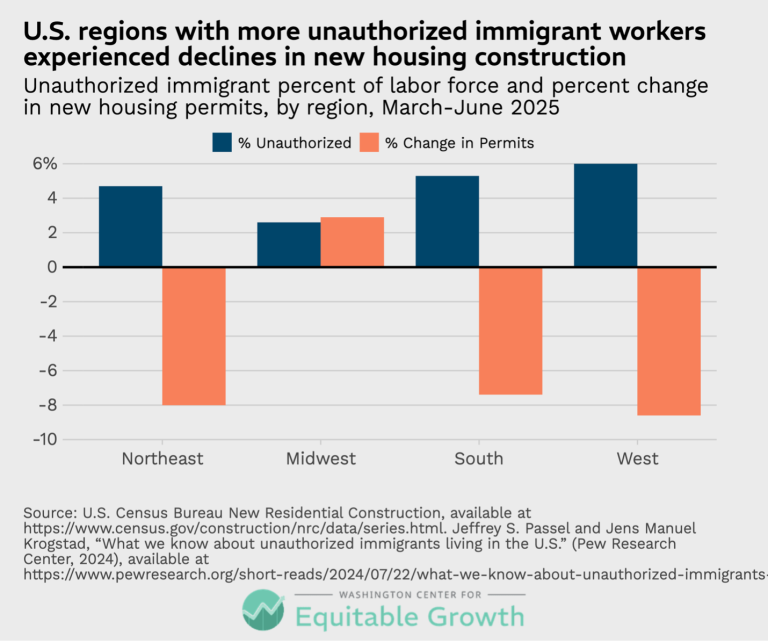
U.S. regions with more unauthorized immigrant workers experienced declines in new housing construction (opens in a new tab)
Visualizations AUG 31, 2026
 View Chart
(opens in a new tab)
View Chart
(opens in a new tab)
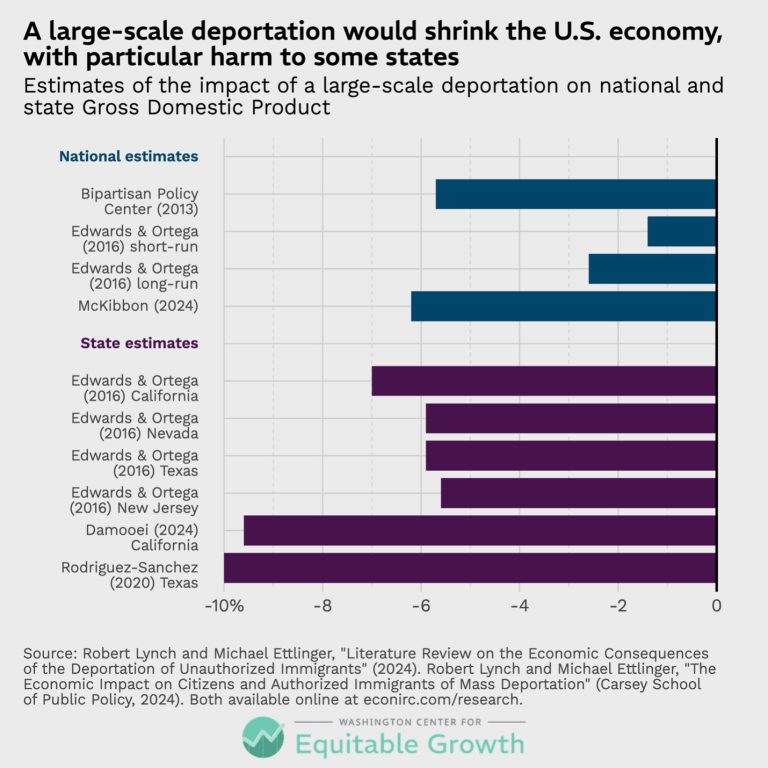
A large-scale deportation would shrink the U.S. economy, with particular harm to some states (opens in a new tab)
Visualizations AUG 31, 2026
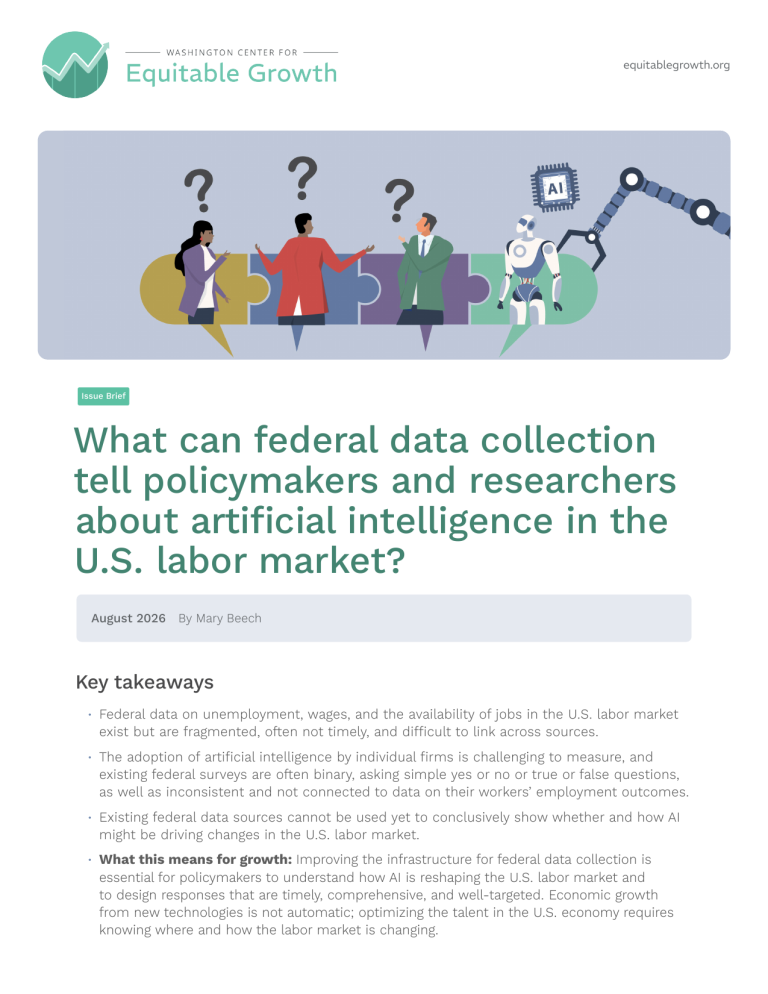
What can federal data collection tell policymakers and researchers about artificial intelligence in the U.S. labor market? (opens in a new tab)
Issue Briefs AUG 24, 2026
It is impossible to perfectly predict how artificial intelligence will affect the U.S. labor market. Policymakers and researchers are grappling with important questions around this topic, including what new opportunities…
By: Mary Beech (opens in a new tab)

Terms and conditions for generative AI users outline a new legal framework that puts U.S. consumers at risk (opens in a new tab)
Essays AUG 20, 2026
Generative AI, or genAI, is a form of artificial intelligence that produces content in response to prompts and includes large language model chatbots such as OpenAI’s ChatGPT or Anthropic’s Claude.…
By: Chiara Chanoi (opens in a new tab)

Estimating AI exposure is useful for research but cannot yet tell policymakers the whole story of AI’s impact on the labor market (opens in a new tab)
Essays AUG 7, 2026
Artificial intelligence has the potential to substantially change the nature and availability of work. To effectively manage the transitions this technology might bring to the U.S. economy, policymakers need information…
By: Chiara Chanoi (opens in a new tab)

Tracking new research on artificial intelligence and its impact on the U.S. labor market (opens in a new tab)
Essays AUG 5, 2026
Headlines often paint extreme and dissonant pictures of the future impact of AI on the U.S. economy and labor market, with workers themselves echoing the conflicting feelings of optimism and…
By: Equitable Growth (opens in a new tab)

Why Unemployment Insurance Alone Is Not Enough in the AI Era (opens in a new tab)
Essays JUL 8, 2026
Since the large language model ChatGPT was rolled out in November 2022, artificial intelligence has captured the public’s attention and generated myriad debates over the emerging technology’s potential impacts on…
By: Megan Rivera (opens in a new tab)

Personal Income in the United States nudges up in May but is down 0.76 percent in the past 6 months (opens in a new tab)
Essays JUN 25, 2026
According to today’s release of Personal Income estimates from the U.S. Bureau of Economic Analysis, U.S. household incomes have fallen 0.76 percent in the past 6 months, with month-to-month declines…
By: Austin Clemens (opens in a new tab)
 View Chart
(opens in a new tab)
View Chart
(opens in a new tab)
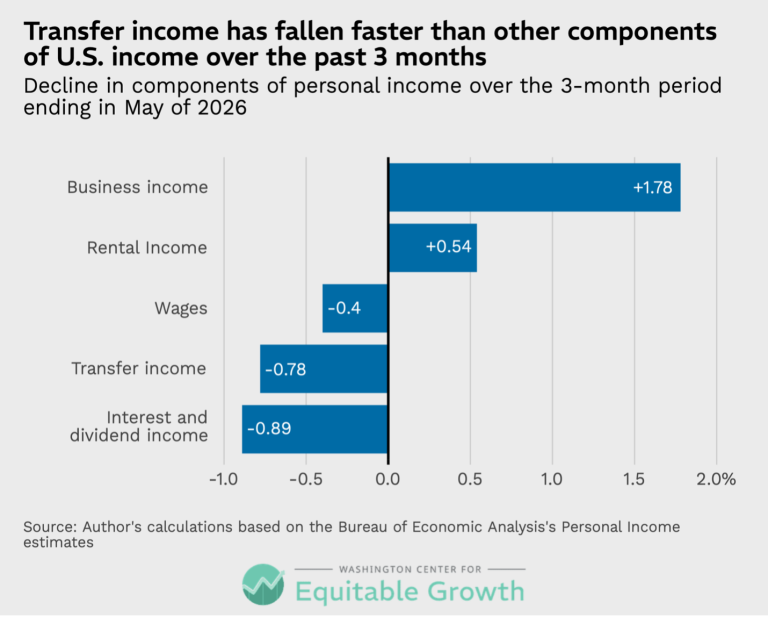
Transfer income has fallen faster than other components of U.S. income over the past 3 months (opens in a new tab)
Visualizations JUN 25, 2026
 View Chart
(opens in a new tab)
View Chart
(opens in a new tab)
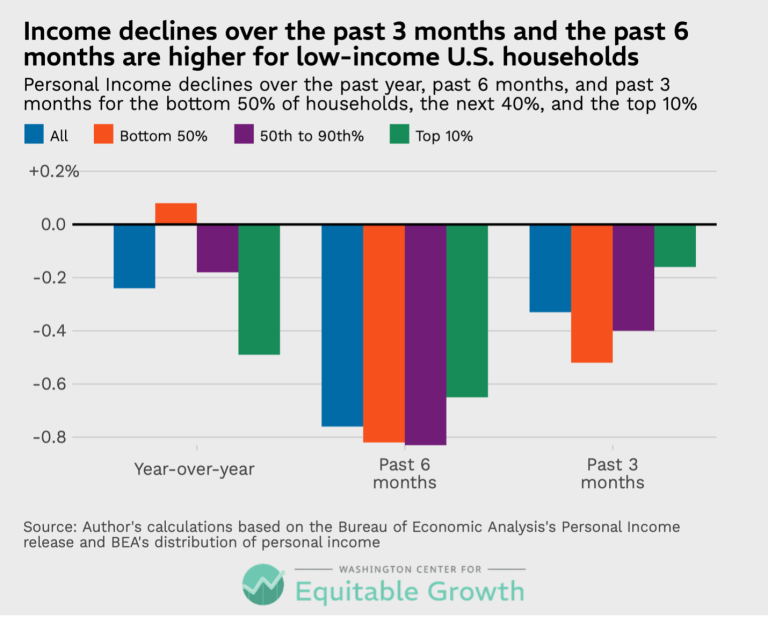
Income declines over the past 3 months and the past 6 months are higher for low-income U.S. households (opens in a new tab)
Visualizations JUN 25, 2026
 View Chart
(opens in a new tab)
View Chart
(opens in a new tab)
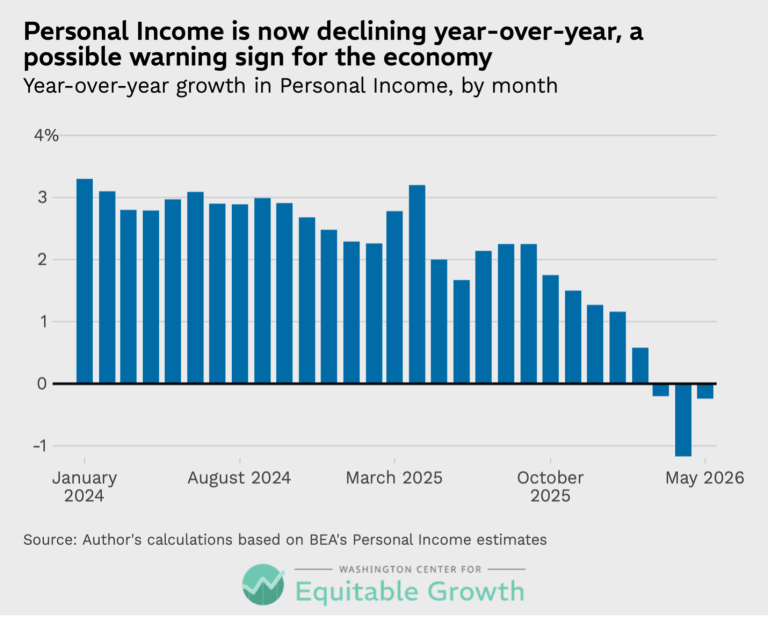
Personal Income is now declining year-over-year, a possible warning sign for the economy (opens in a new tab)
Visualizations JUN 25, 2026
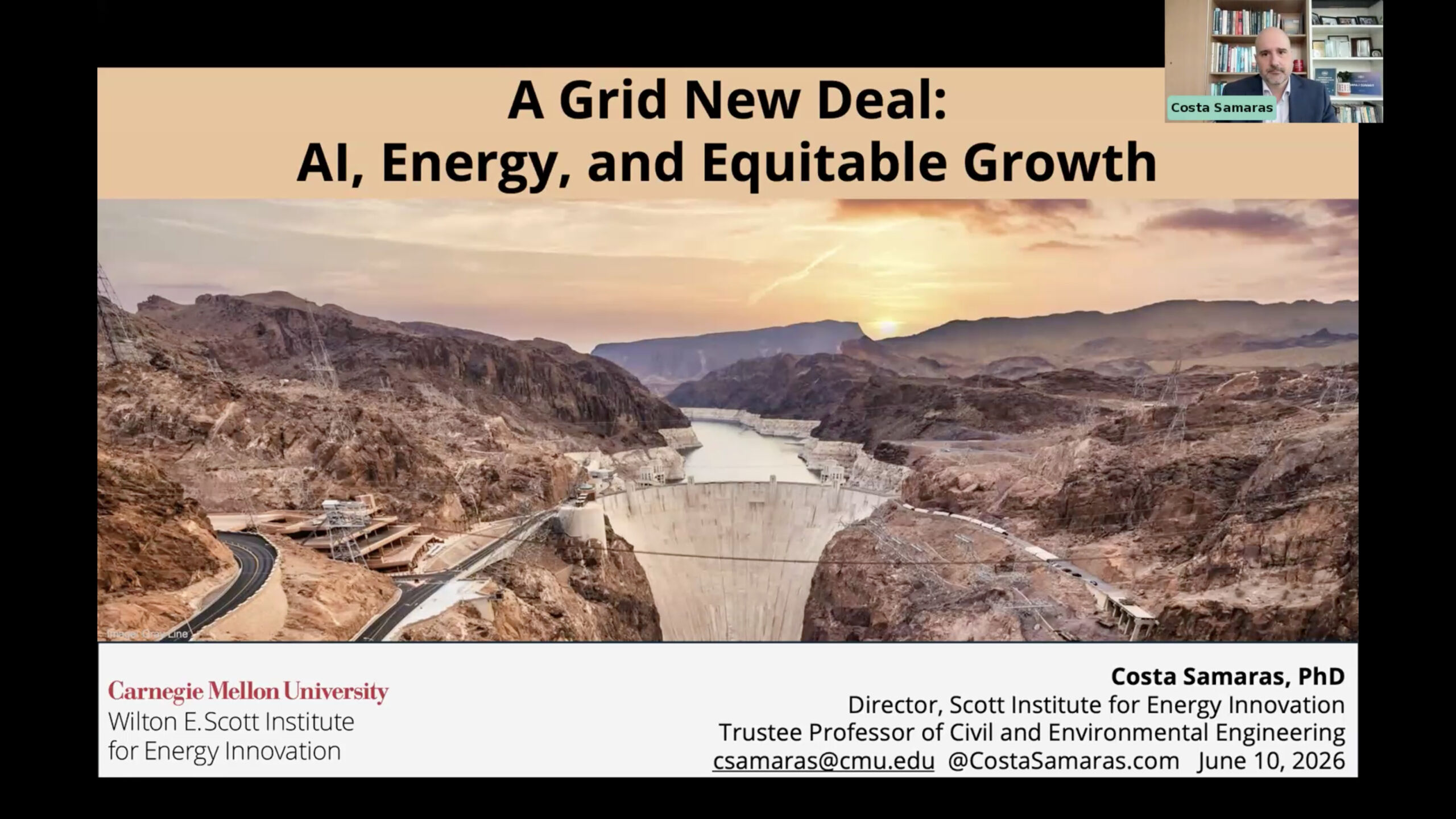
The United States can simultaneously foster an equitable AI boom and a clean energy economy (opens in a new tab)
Videos JUN 12, 2026
The Washington Center for Equitable Growth recently hosted a timely discussion exploring how the rapid expansion of artificial intelligence is colliding with—and reshaping—the clean energy transition. Bringing together researchers and…
By: Equitable Growth (opens in a new tab)

U.S. workers need sectoral bargaining now more than ever (opens in a new tab)
Essays JUN 4, 2026
U.S. union membership and coverage rates have declined for decades, fueled in part by legal barriers to new organizing, including the limiting of collective bargaining to specific workplaces or employers and misclassifying certain groups of workers so they…
By: Christopher Bangert-Drowns (opens in a new tab)
 View Chart
(opens in a new tab)
View Chart
(opens in a new tab)
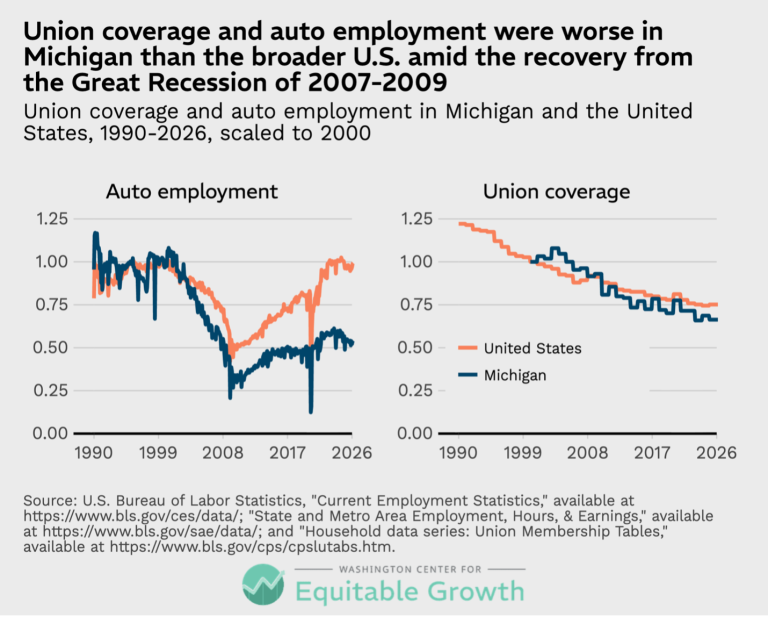
Union coverage and auto employment were worse in Michigan than the broader U.S. amid the recovery from the Great Recession of 2007-2009 (opens in a new tab)
Visualizations JUN 3, 2026
 View Chart
(opens in a new tab)
View Chart
(opens in a new tab)
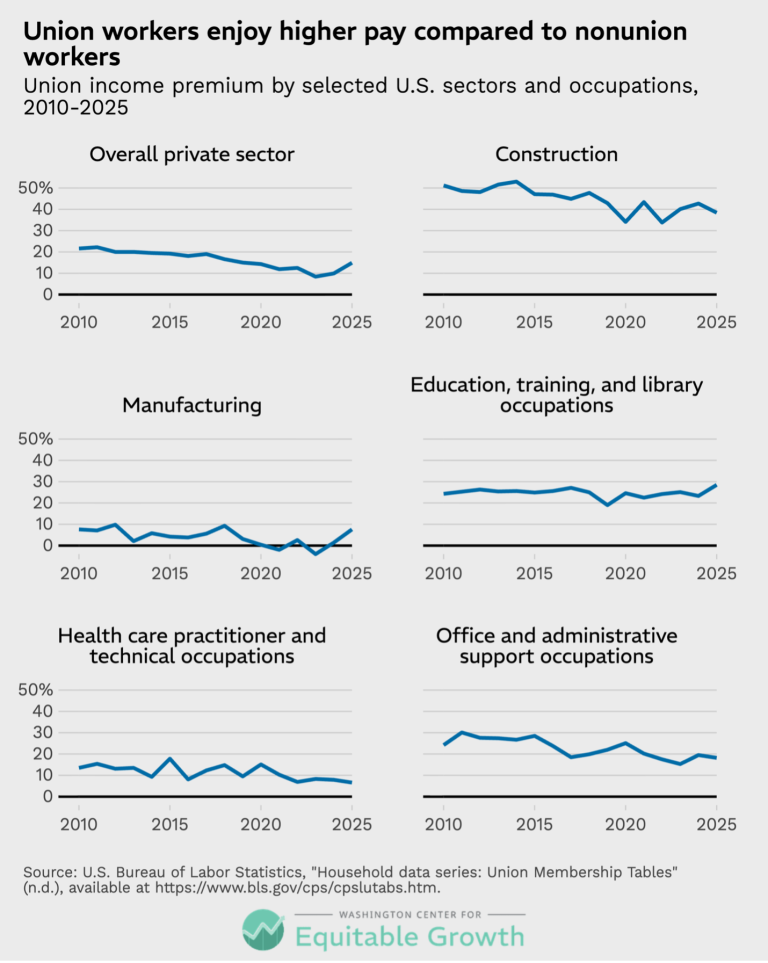
Union workers enjoy higher pay compared to nonunion workers (opens in a new tab)
Visualizations JUN 3, 2026
 View Chart
(opens in a new tab)
View Chart
(opens in a new tab)
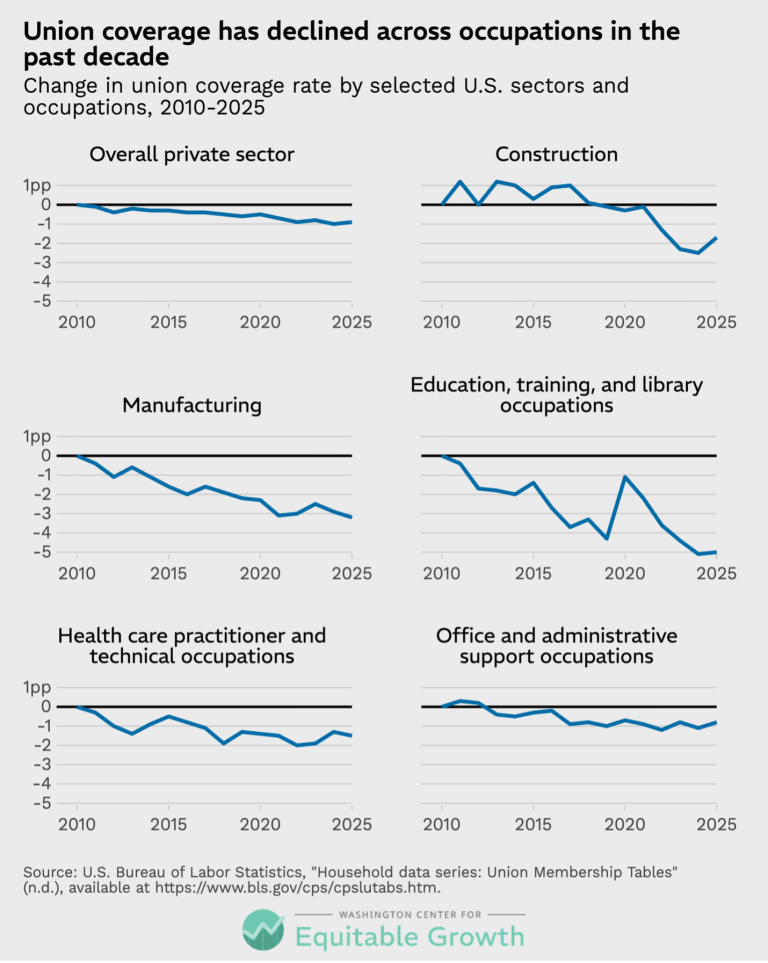
Union coverage has declined across occupations in the past decade (opens in a new tab)
Visualizations JUN 3, 2026

In Conversation with Costa Samaras (opens in a new tab)
In Conversation JUN 2, 2026
Equitable Growth in Conversation is a recurring series where we talk with economists and other academics to help us better understand whether and how economic inequality affects economic growth and…
By: Shayna Strom (opens in a new tab)
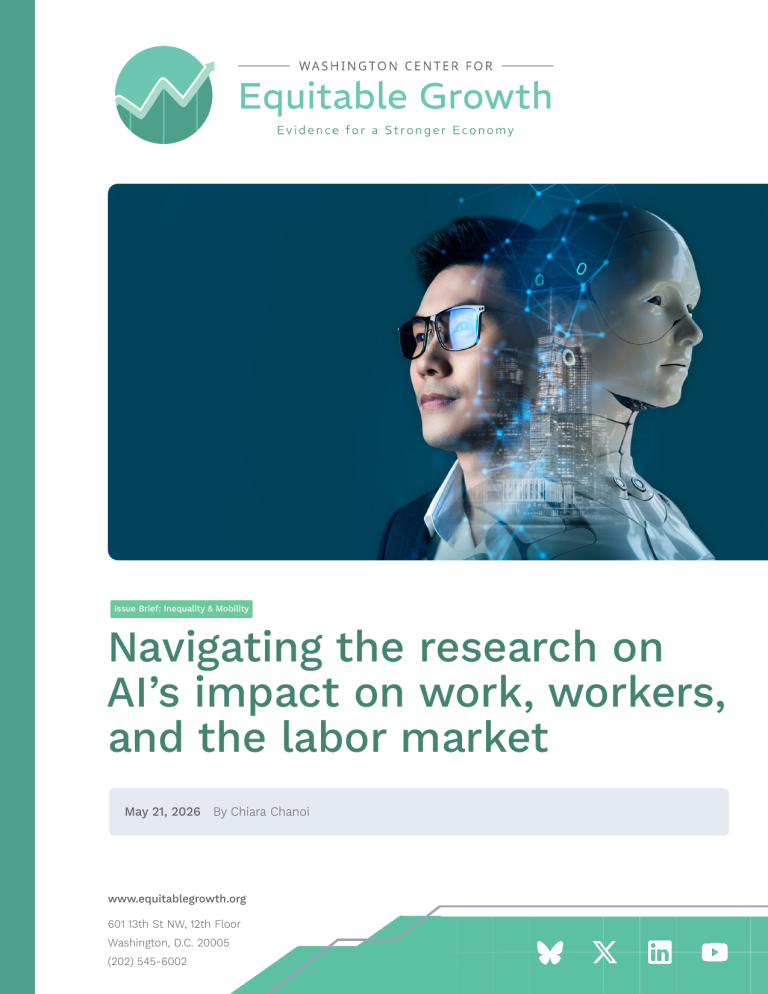
Navigating the research on the impacts of AI on work, workers, and the labor market (opens in a new tab)
Research Databases MAY 21, 2026
Artificial intelligence will have a largely unpredictable but potentially profound effect on the labor market. Individuals have speculated how AI will affect the workforce since its earliest developments. But public…
By: Chiara Chanoi (opens in a new tab)

What is the relationship between inflation, interest rates, and economic growth, and what does it mean for the new Federal Reserve chair? (opens in a new tab)
Issue Briefs MAY 18, 2026
Since regaining the Oval Office in early 2025, President Donald Trump has repeatedly called for lower interest rates and severely criticized former Federal Reserve Board Chair Jerome Powell’s cautious approach…
By: Jacob Robbins (opens in a new tab)

Research shows unions dampen support for right-wing populism and help workers navigate technological transitions (opens in a new tab)
Essays MAY 1, 2026
On May 1, much of the world—though not the United States—celebrates International Workers Day to honor the social and economic contributions of workers and labor unions. The May Day holiday began in large part to mark…
By: Christopher Bangert-Drowns (opens in a new tab)
 View Chart
(opens in a new tab)
View Chart
(opens in a new tab)
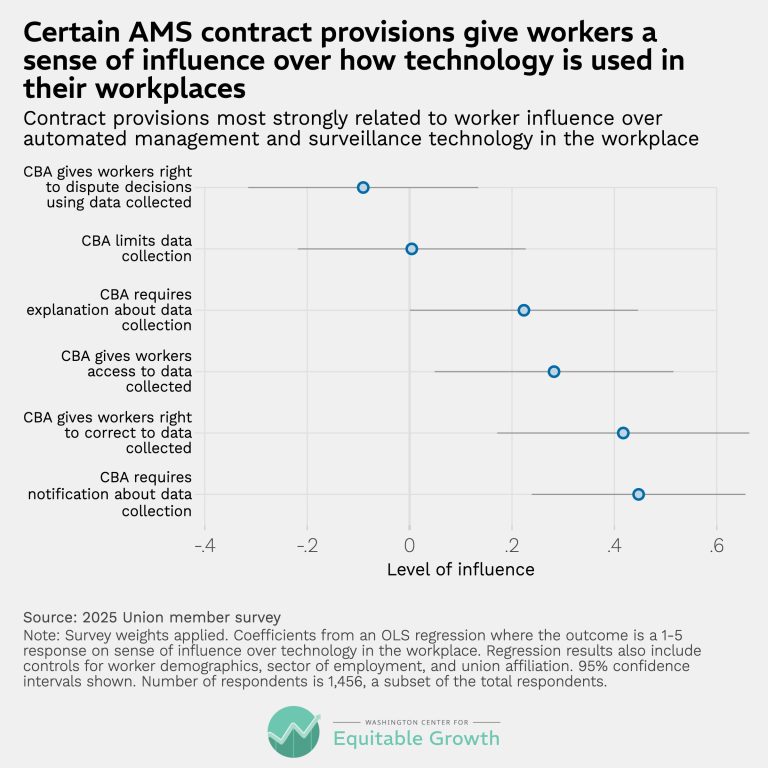
Certain AMS contract provisions give workers a sense of influence over how technology is used in their workplaces (opens in a new tab)
Visualizations MAR 12, 2026
How union contracts are protecting U.S. workers from automated management and surveillance in the workplace (opens in a new tab)
Reports MAR 12, 2026
Employers are increasingly using electronic and automated tools to collect data on their workers on and off the job and then using that data to inform decisions about workers’ pay,…
By: Alexander Hertel-Fernandez (opens in a new tab)
 View Chart
(opens in a new tab)
View Chart
(opens in a new tab)
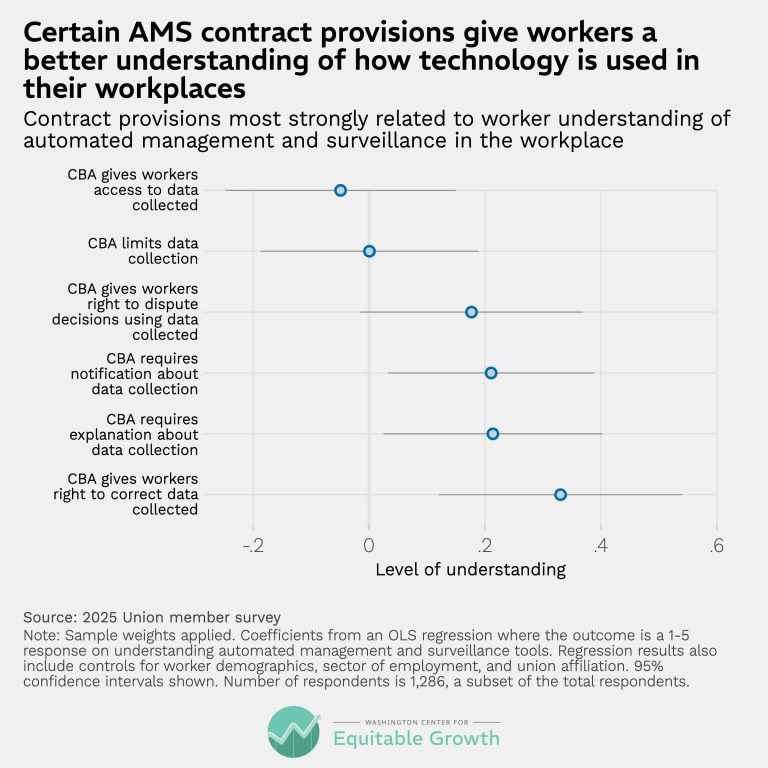
Certain AMS contract provisions give workers a better understanding of how technology is used in their workplaces (opens in a new tab)
Visualizations MAR 12, 2026
 View Chart
(opens in a new tab)
View Chart
(opens in a new tab)
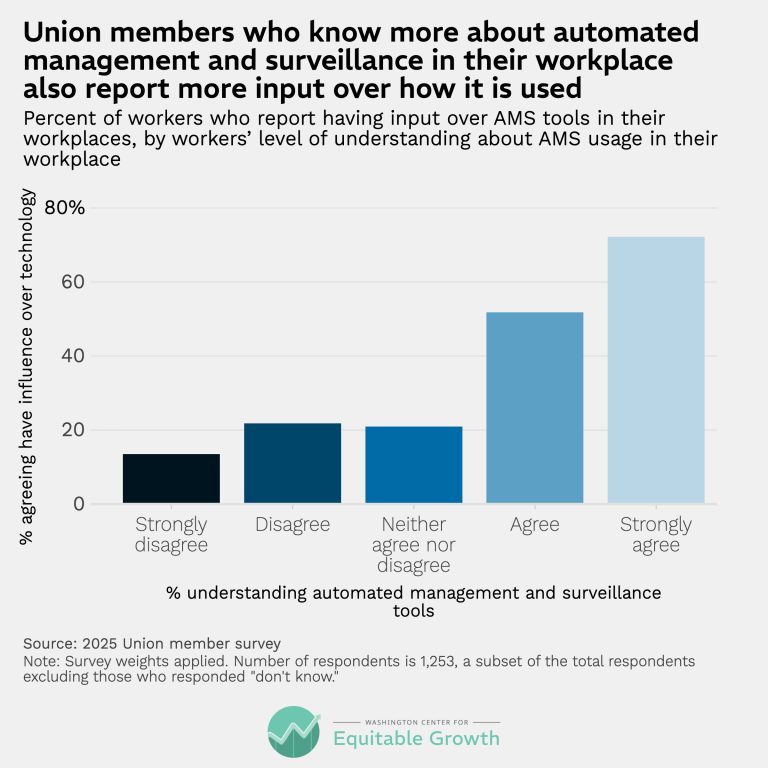
Union members who know more about automated management and surveillance in their workplace also report more input over how it is used (opens in a new tab)
Visualizations MAR 12, 2026
 View Chart
(opens in a new tab)
View Chart
(opens in a new tab)
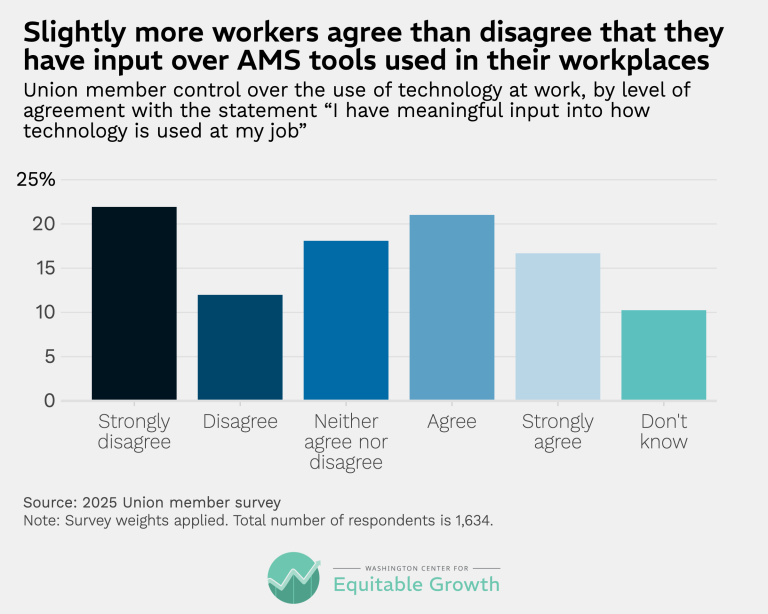
Slightly more workers agree than disagree that they have input over AMS tools used in their workplaces (opens in a new tab)
Visualizations MAR 12, 2026
 View Chart
(opens in a new tab)
View Chart
(opens in a new tab)
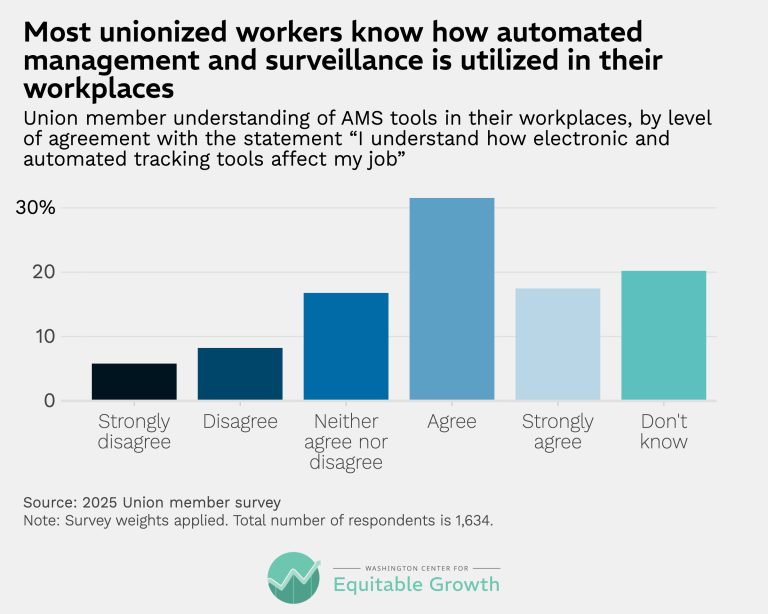
Most unionized workers know how automated management and surveillance are utilized in their workplaces (opens in a new tab)
Visualizations MAR 12, 2026
 View Chart
(opens in a new tab)
View Chart
(opens in a new tab)
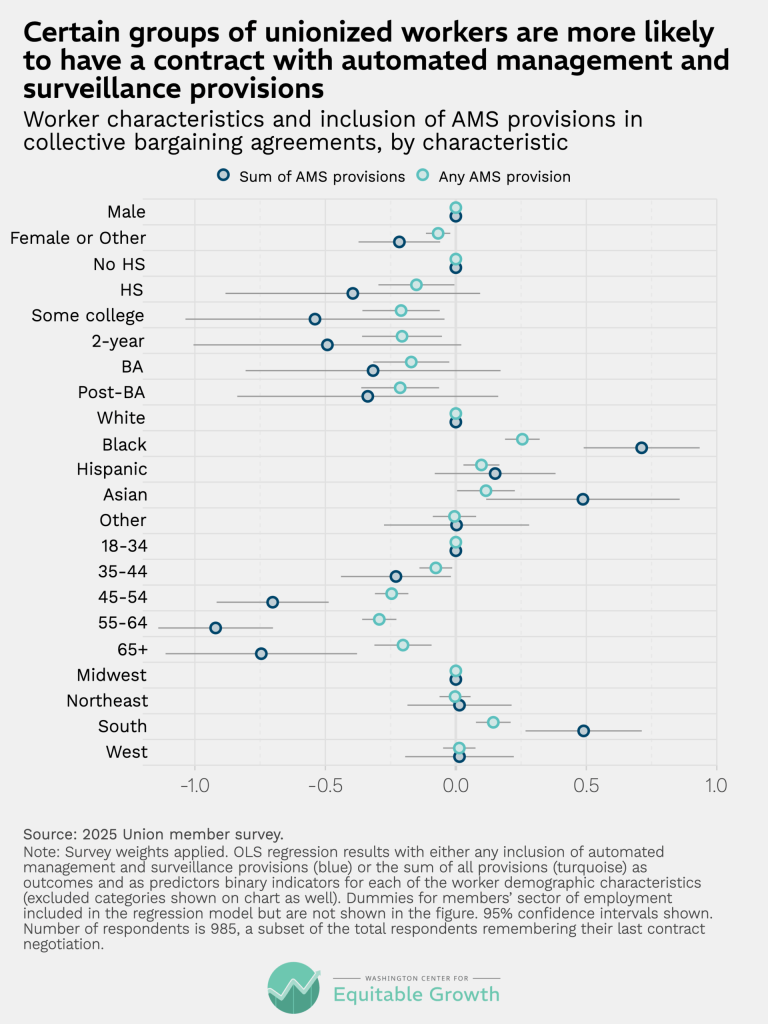
Certain groups of unionized workers are more likely to have a contract with automated management and surveillance provisions (opens in a new tab)
Visualizations MAR 12, 2026
 View Chart
(opens in a new tab)
View Chart
(opens in a new tab)
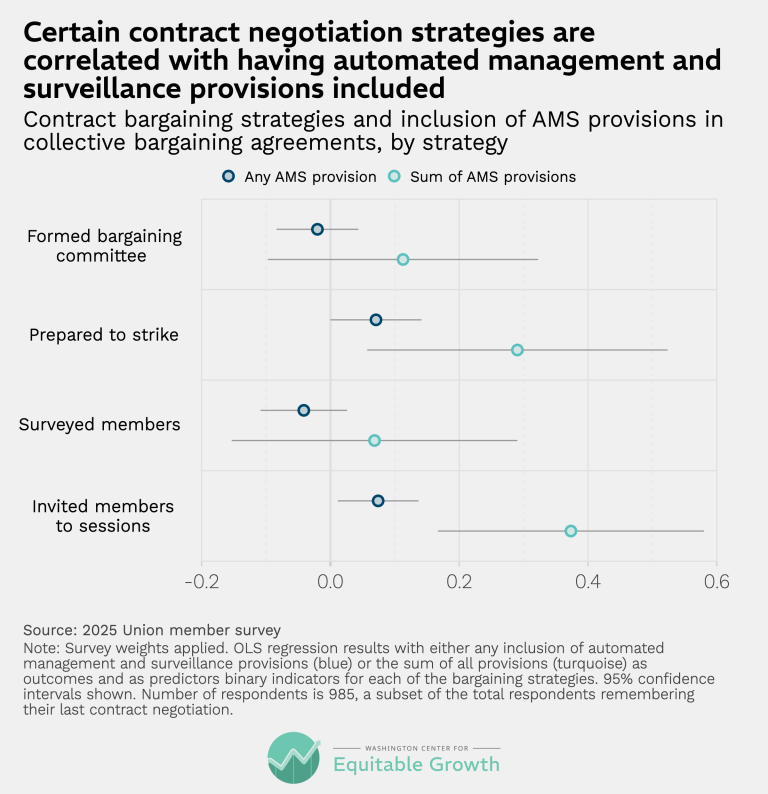
Certain contract negotiation strategies are correlated having automated management and surveillance provisions included (opens in a new tab)
Visualizations MAR 12, 2026
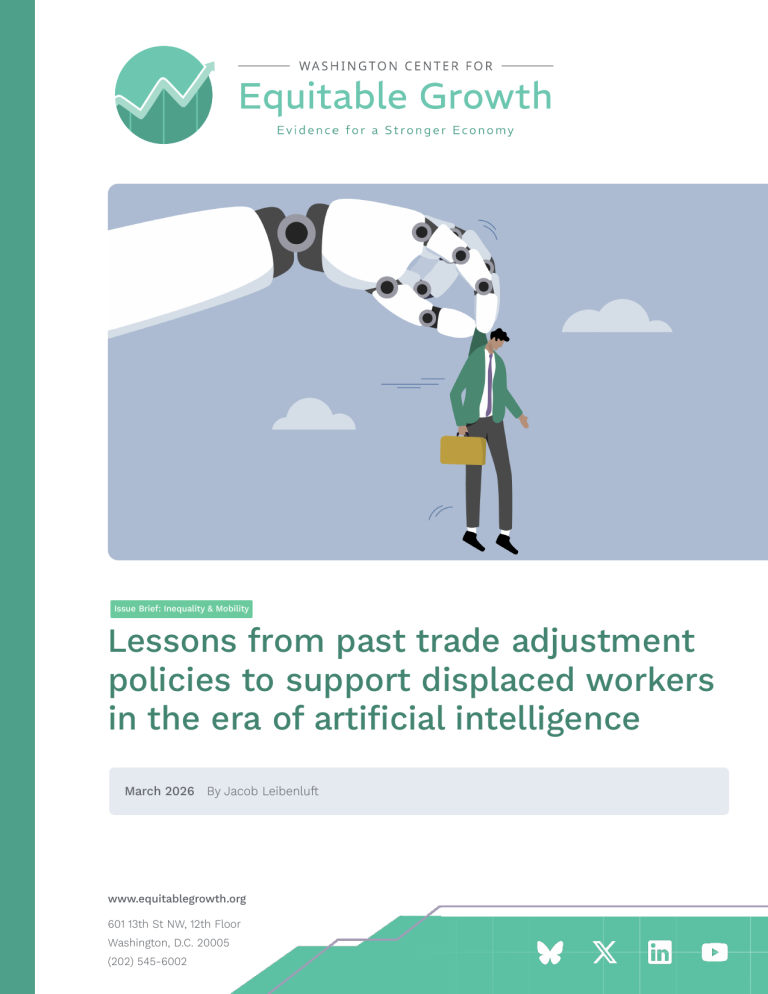
Lessons from past trade adjustment policies to support displaced workers in the era of artificial intelligence (opens in a new tab)
Reports MAR 11, 2026
More than 60 years ago, U.S. policymakers, economists, and labor leaders alike agreed that the potential for new economic forces to strengthen U.S. prosperity and security was just over the…
By: Jacob Leibenluft (opens in a new tab)

Factsheet: Using asset limits in public benefit programs (opens in a new tab)
Factsheets MAR 10, 2026
A household’s assets, or its overall wealth, are the resources required to ensure its family members can weather the financial disruption when unexpected expenses emerge. Yet many U.S. households do…
By: Megan Rivera (opens in a new tab)
ASSA 2026 Round-up: Day 3 (opens in a new tab)
Blog JAN 6, 2026
Yesterday was the third and final day of the 2026 annual meeting of the Allied Social Science Associations, which is organized by the American Economic Association. The 3-day conference, held…
By: Equitable Growth (opens in a new tab)
ASSA 2026 Round-up: Day 2 (opens in a new tab)
Blog JAN 5, 2026
Yesterday was the second day of the 2026 annual meeting of the Allied Social Science Associations, which is organized by the American Economic Association. The 3-day conference, held in Philadelphia…
By: Equitable Growth (opens in a new tab)
ASSA 2026 Round-up: Day 1 (opens in a new tab)
Blog JAN 4, 2026
Yesterday was the first day of the 2026 annual meeting of the Allied Social Science Associations, which is organized by the American Economic Association. The 3-day conference, held in Philadelphia…
By: Equitable Growth (opens in a new tab)
Expanding eligibility for Unemployment Insurance helps low-income U.S. workers find better jobs (opens in a new tab)
Essays DEC 9, 2025
Unemployment Insurance serves as a critical income support program for U.S. workers who lose their jobs through no fault of their own. It is also a valuable tool to stabilize…
By: Casey McQuillan (opens in a new tab), Brendan Moore (opens in a new tab)

U.S. social insurance programs support workers and economic growth (opens in a new tab)
Essays DEC 2, 2025
Since coming to power in early 2025, Republican majorities in Congress have shifted resources away from the nation’s social insurance programs, most notably to offset the cost of H.R. 1,…
By: Megan Rivera (opens in a new tab)

Equitable Growth hosts Econ 101 virtual event on how U.S. social insurance programs boost economic mobility (opens in a new tab)
Essays DEC 1, 2025
Microsoft Copilot helped draft this event recap. The Washington Center for Equitable Growth recently hosted its latest Econ 101 briefing aimed at providing in-depth evidence for policymakers on how U.S.…
By: Equitable Growth (opens in a new tab)

What impact is artificial intelligence having on the U.S. labor market and the nation’s economy? (opens in a new tab)
Essays NOV 14, 2025
As new and groundbreaking technologies emerge, they can function as a blank canvas onto which people project both aspirations and anxieties. Artificial intelligence—despite its quick uptake in broader society and…
By: Megan Rivera (opens in a new tab)

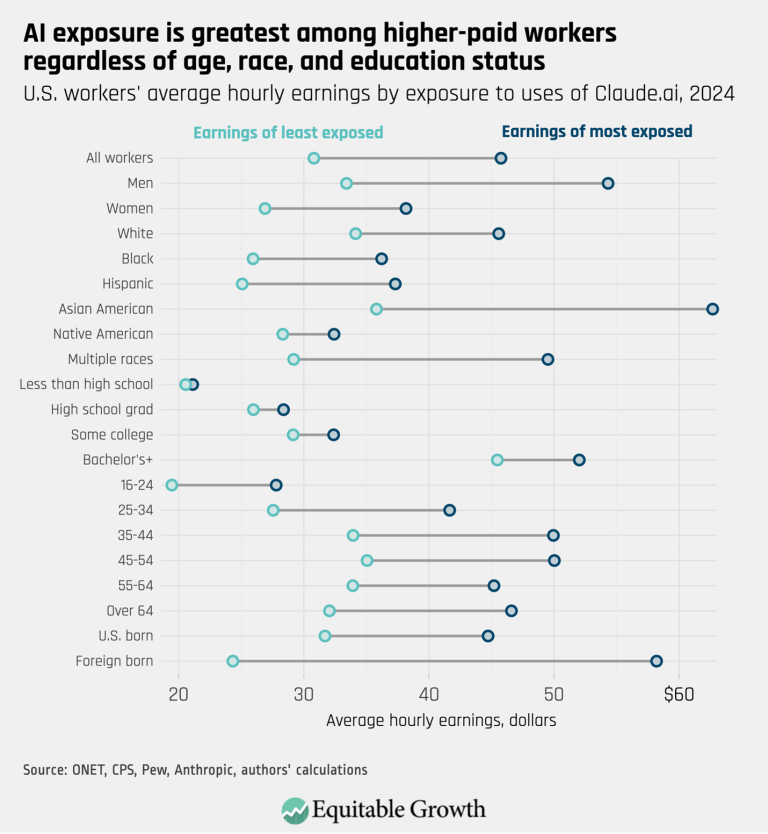
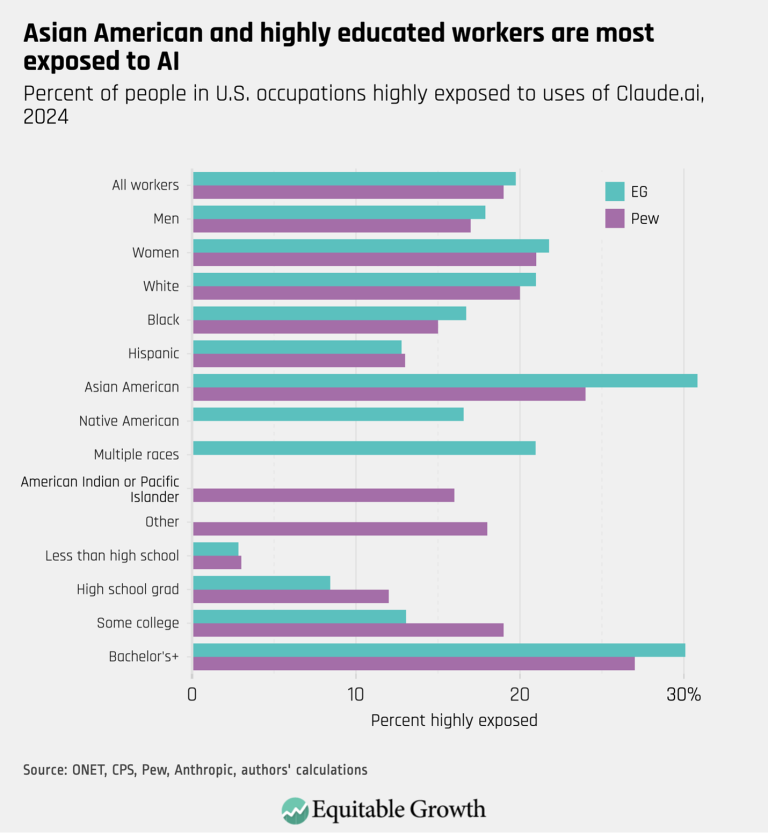
Workplace exposure to artificial intelligence is higher among U.S. workers with higher wages, depending on how AI is used (opens in a new tab)
Essays OCT 23, 2025
Recent advances using artificial intelligence in workplaces, particularly large language models such as Claude.ai and ChatGPT, are increasingly disrupting the U.S. labor market. The cognitive power of AI has the…
By: Chiara Chanoi (opens in a new tab), Christopher Bangert-Drowns (opens in a new tab)
 View Chart
(opens in a new tab)
View Chart
(opens in a new tab)
AI exposure is greatest among higher-paid workers regardless of age, race and education status (opens in a new tab)
Visualizations OCT 22, 2025
 View Chart
(opens in a new tab)
View Chart
(opens in a new tab)
Asian American and highly educated workers are most exposed to AI (opens in a new tab)
Visualizations OCT 22, 2025

Equitable Growth supports scholars studying the economics of the energy transition (opens in a new tab)
Essays OCT 22, 2025
The Washington Center for Equitable Growth today announced a new cohort of grantees. These nine scholars will study how the design and implementation of federal policy influences how businesses and…
By: Equitable Growth (opens in a new tab)

Payment for schedule changes under Fair Workweek laws in three U.S. cities (opens in a new tab)
Essays OCT 16, 2025
Fair Workweek laws set new standards for scheduling U.S. workers in jobs and industries characterized by fluctuating and unpredictable work hours, such as jobs in retail and food service. A…
By: Susan Lambert (opens in a new tab), Julia Henly (opens in a new tab)

U.S. workers’ and managers’ experiences with Fair Workweek laws can inform enforcement and education (opens in a new tab)
Essays OCT 2, 2025
Fair Workweek laws are intended to set new standards for scheduling workers in jobs and industries characterized by fluctuating and unpredictable work hours, such as jobs in retail and food…
By: Susan Lambert (opens in a new tab), Julia Henly (opens in a new tab)

How Are Workers Experiencing Fair Workweek Laws? Evidence for policymakers and advocates (opens in a new tab)
Essays OCT 2, 2025
This factsheet, “How Are Workers Experiencing Fair Workweek Laws? Evidence for policymakers and advocates,” originally appeared on WorkRise at https://www.workrisenetwork.org/sites/default/files/2025-08/howareworkersexperiencingfairworkweeklaws.pdf. New laws that regulate employer scheduling practic…
By: Susan Lambert (opens in a new tab), Julia Henly (opens in a new tab)
Federal data is under attack, but data users can work together to preserve and democratize it (opens in a new tab)
Essays OCT 1, 2025
Staffing shortages, political interference, and a federal government shutdown are all disrupting the routine operations of the nonpartisan federal statistical agencies that reliably gather facts and publish data about the…
By: Peter Norlander (opens in a new tab)
 View Chart
(opens in a new tab)
View Chart
(opens in a new tab)
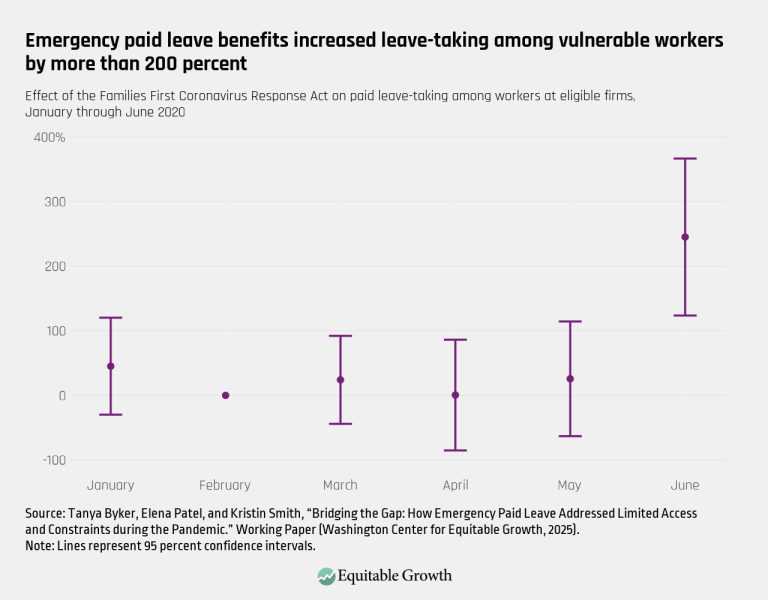
Emergency paid leave benefits increased leave-taking among vulnerable workers by more than 200 percent – Final (opens in a new tab)
Visualizations SEP 23, 2025
 View Chart
(opens in a new tab)
View Chart
(opens in a new tab)
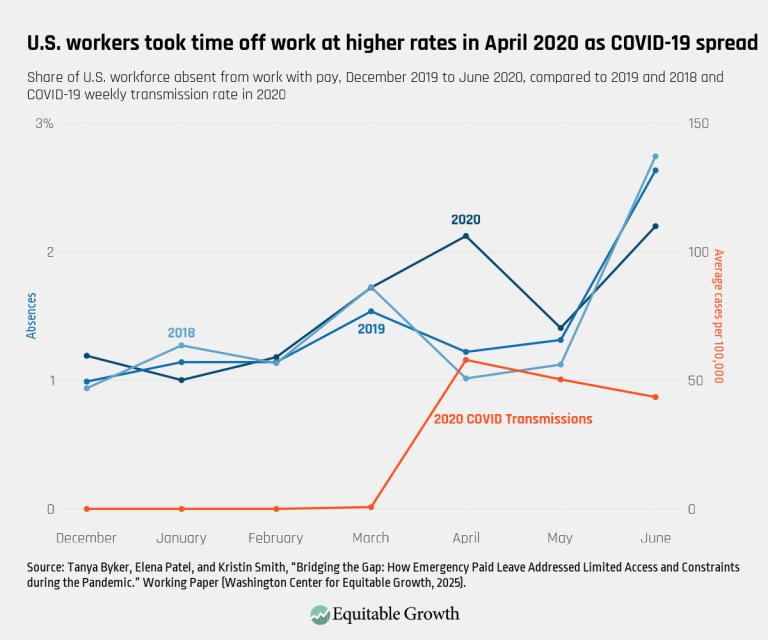
U.S. workers took time off work at higher rates in April 2020 as COVID-19 spread (opens in a new tab)
Visualizations SEP 23, 2025

Emergency paid leave during the COVID-19 pandemic offered essential protections for U.S. workers (opens in a new tab)
Essays SEP 23, 2025
When the COVID-19 pandemic swept across the United States in early 2020, it didn’t just bring about a public health emergency. It also exposed a longstanding weakness in the U.S.…
By: Tanya Byker (opens in a new tab), Elena Patel (opens in a new tab), Kristin Smith (opens in a new tab)

Equitable Growth announces funding for research on the impact of AI on U.S. workers and competition (opens in a new tab)
Essays SEP 18, 2025
The Washington Center for Equitable Growth today announced a new cohort of grantees studying how artificial intelligence and new technology can support workers and promote competition across the U.S. economy.…
By: Equitable Growth (opens in a new tab)

Even health care, the strongest sector of the U.S. jobs market, cannot deliver the wages its workers deserve without unionization (opens in a new tab)
Essays SEP 10, 2025
The growth of jobs in the U.S. health care industry is the linchpin to a strong U.S. labor market in 2025 and beyond. Health care is one of only a…
By: Adam Dean (opens in a new tab), Jamie McCallum (opens in a new tab)

How artificial intelligence uncouples hard work from fair wages through ‘surveillance pay’ practices—and how to fix it (opens in a new tab)
Issue Briefs AUG 21, 2025
Correction: Freddie Mac and Udemy contacted the Washington Center for Equitable Growth on March 18, 2026 and April 2, 2026, respectively, to say they no longer had business relationships with…
By: Veena Dubal (opens in a new tab), Wilneida Negrón (opens in a new tab)

Adoption of generative AI will have different effects across jobs in the U.S. logistics workforce (opens in a new tab)
Essays JUL 10, 2025
Generative artificial intelligence promises to profoundly reshape labor markets, much like previous automation waves did, but with clear differences. Unlike earlier technologies, such as computerization, which primarily automated routine administrative…
By: Christophe Combemale (opens in a new tab), Dustin Ferrone (opens in a new tab), Andrew Barber (opens in a new tab), Laurence Ales (opens in a new tab)
 View Chart
(opens in a new tab)
View Chart
(opens in a new tab)
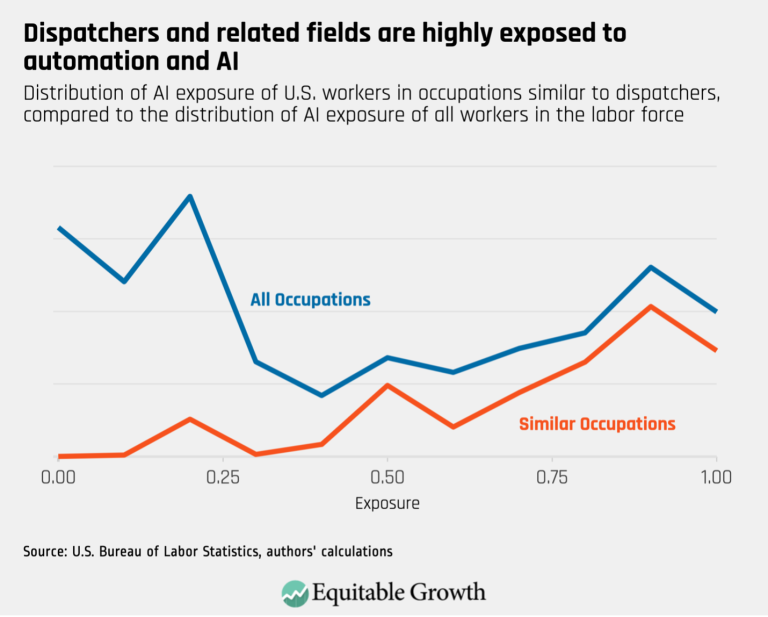
Dispatchers and related fields are highly exposed to automation and AI (opens in a new tab)
Visualizations JUL 10, 2025
 View Chart
(opens in a new tab)
View Chart
(opens in a new tab)
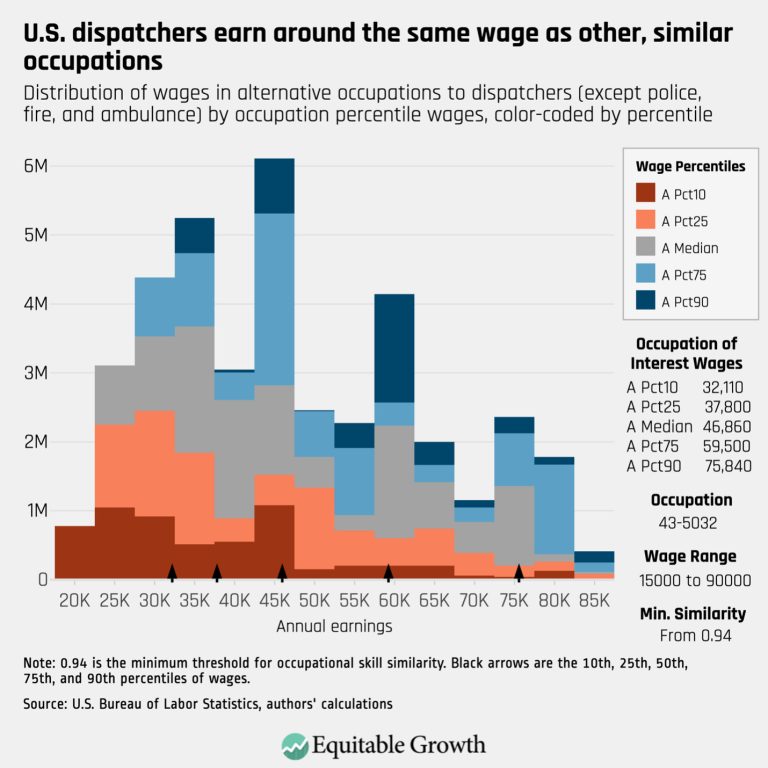
U.S. dispatchers earn around the same wage as other, similar occupations (opens in a new tab)
Visualizations JUL 10, 2025
 View Chart
(opens in a new tab)
View Chart
(opens in a new tab)
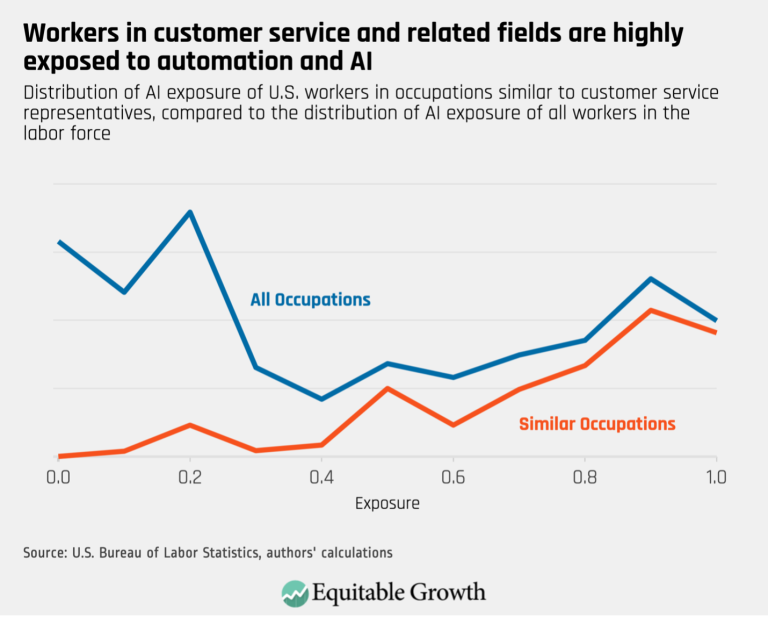
Workers in customer service and related fields are highly exposed to automation and AI (opens in a new tab)
Visualizations JUL 10, 2025
 View Chart
(opens in a new tab)
View Chart
(opens in a new tab)
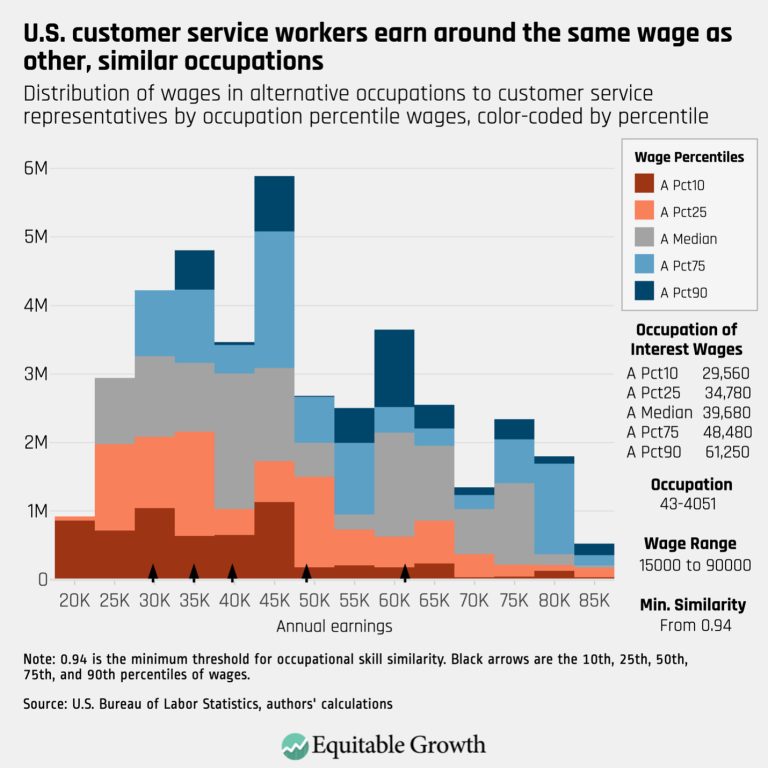
U.S. customer service workers earn around the same wage as other, similar occupations (opens in a new tab)
Visualizations JUL 10, 2025
 View Chart
(opens in a new tab)
View Chart
(opens in a new tab)
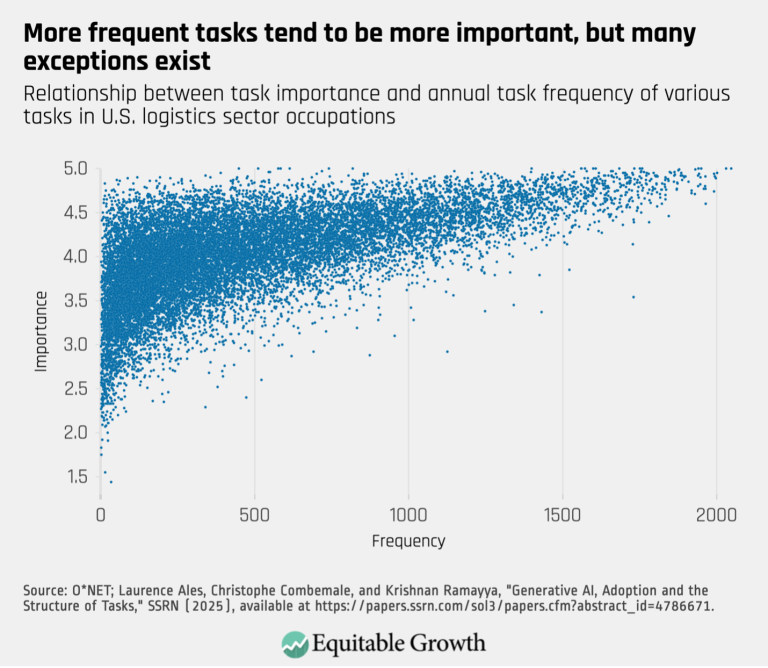
More frequent tasks tend to be more important, but many exceptions exist (opens in a new tab)
Visualizations JUL 9, 2025

Slow wage growth is the key to understanding U.S. inequality in the 21st century (opens in a new tab)
Issue Briefs JUL 8, 2025
The Washington Center for Equitable Growth today launched the U.S. Inequality Tracker, which tracks income and wealth inequality in the United States and highlights how particular components of income and…
By: Austin Clemens (opens in a new tab)
 View Chart
(opens in a new tab)
View Chart
(opens in a new tab)
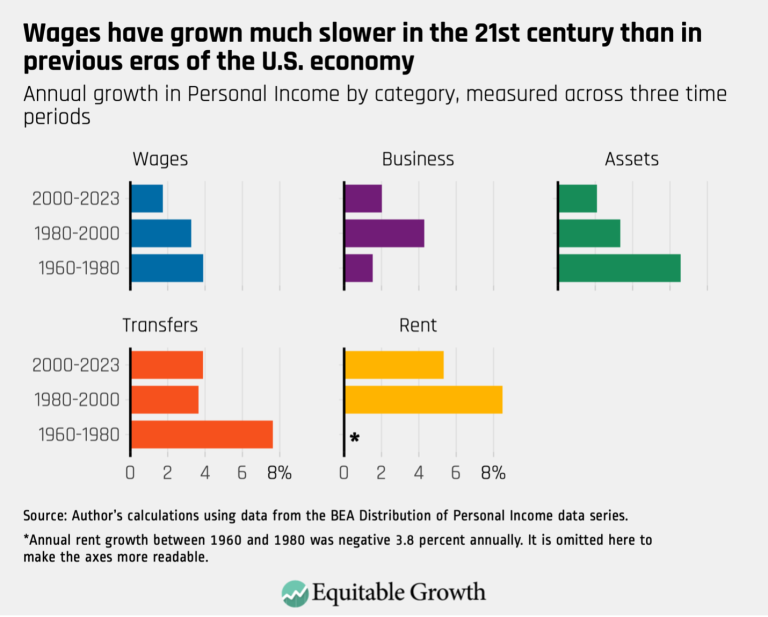
Wages have grown much slower in the 21st century than in previous eras of the U.S. economy (opens in a new tab)
Visualizations JUN 25, 2025
 View Chart
(opens in a new tab)
View Chart
(opens in a new tab)
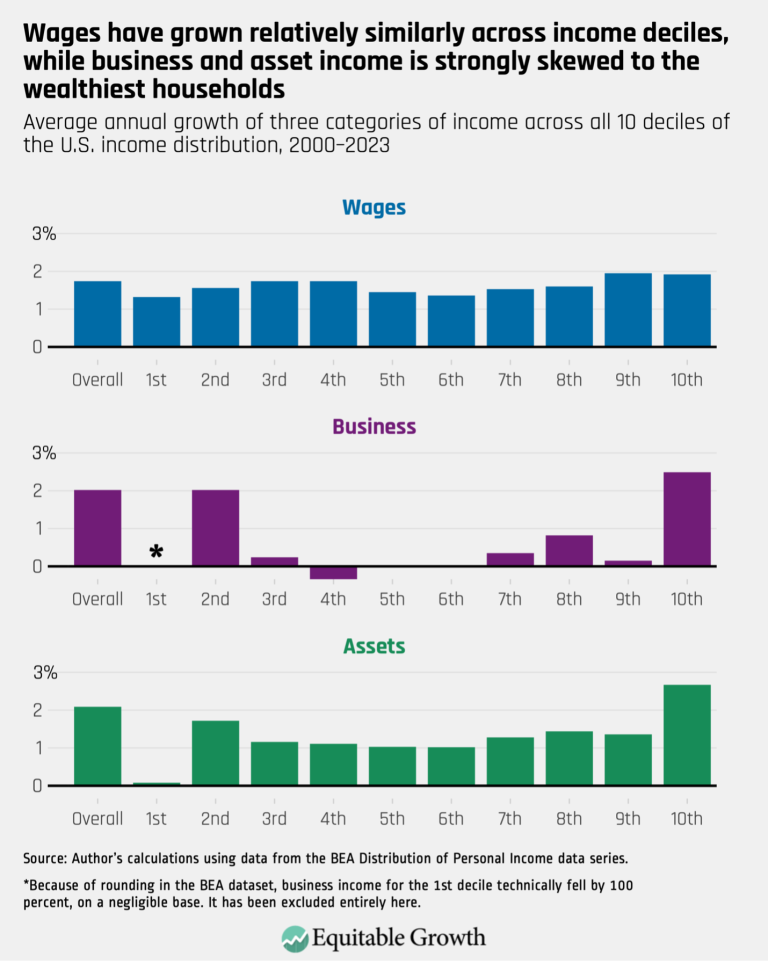
Wages have grown relatively similarly across income deciles, while business and asset income is strongly skewed to the wealthiest households (opens in a new tab)
Visualizations JUN 25, 2025
 View Chart
(opens in a new tab)
View Chart
(opens in a new tab)
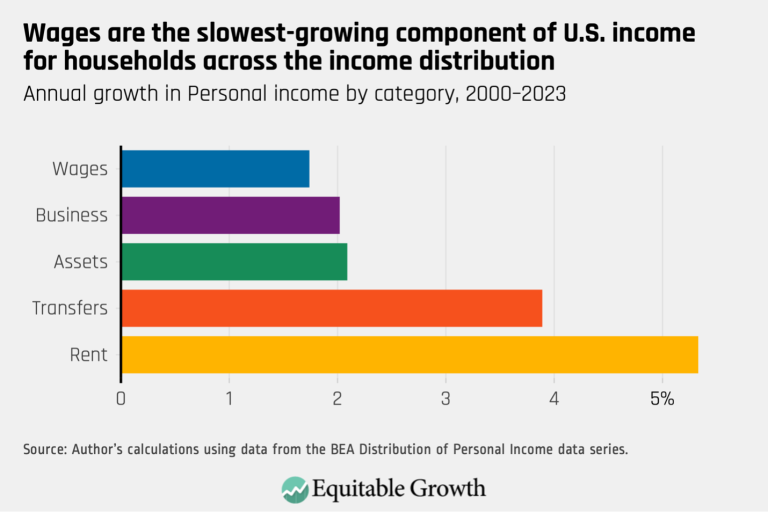
Wages are the slowest-growing component of U.S. income for households across the income distribution (opens in a new tab)
Visualizations JUN 25, 2025
 View Chart
(opens in a new tab)
View Chart
(opens in a new tab)
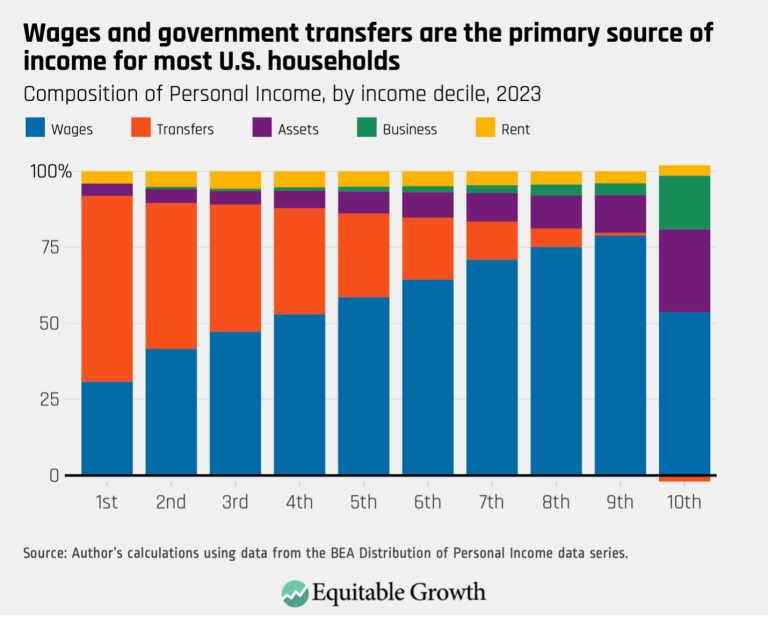
Wages and government transfers are the primary source of income for most U.S. households (opens in a new tab)
Visualizations JUN 25, 2025
 View Chart
(opens in a new tab)
View Chart
(opens in a new tab)
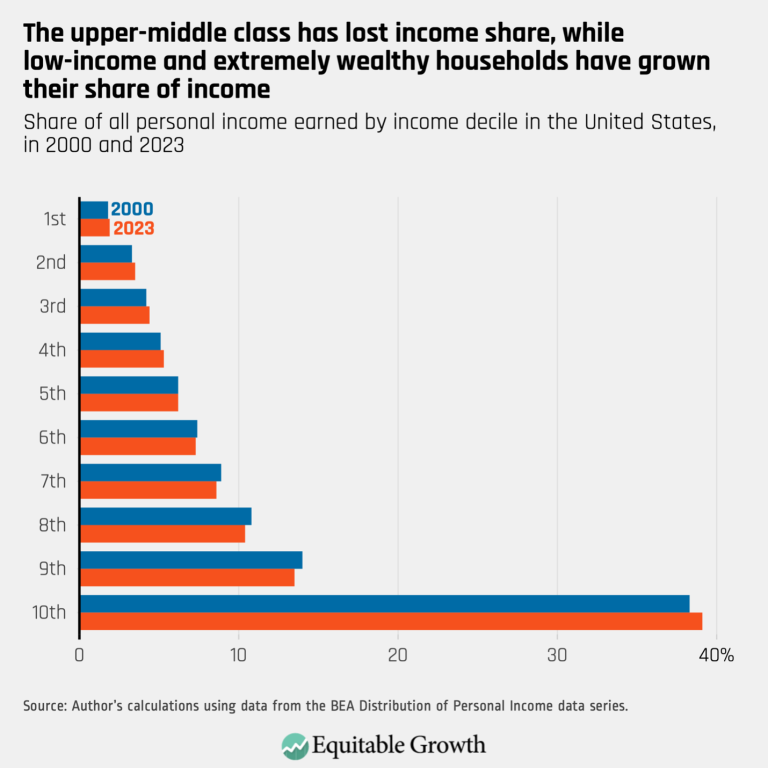
The upper-middle class has lost income share, while low-income and extremely wealthy households have grown their share of income (opens in a new tab)
Visualizations JUN 25, 2025
 View Chart
(opens in a new tab)
View Chart
(opens in a new tab)
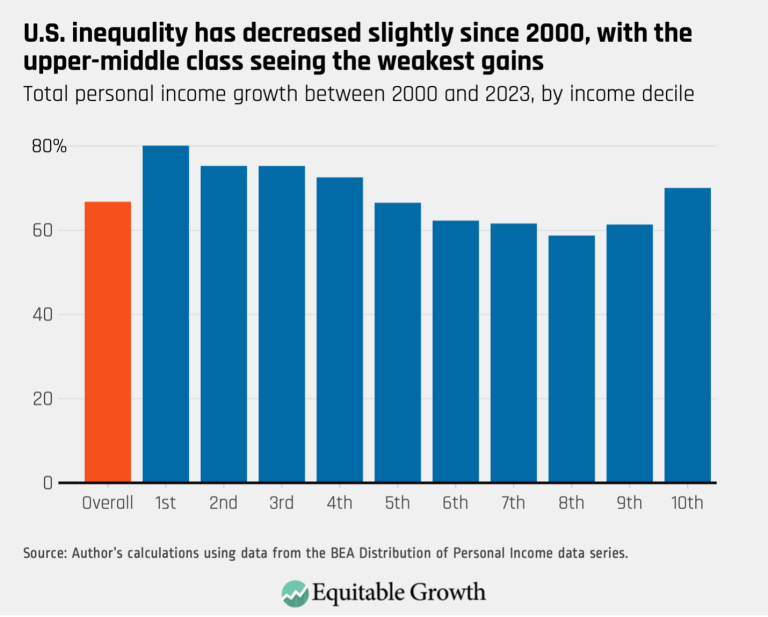
U.S. inequality has decreased slightly since 2000, with the upper-middle class seeing the weakest gains (opens in a new tab)
Visualizations JUN 25, 2025
 View Chart
(opens in a new tab)
View Chart
(opens in a new tab)
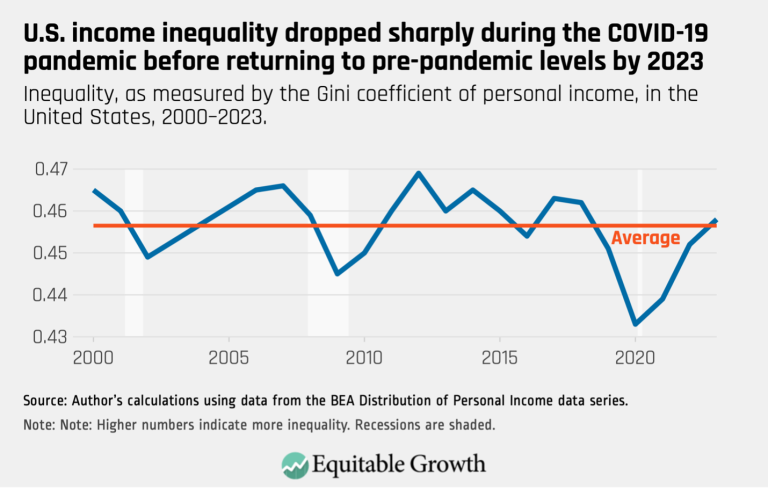
U.S. income inequality dropped sharply during the COVID-19 pandemic before returning to pre-pandemic levels by 2023 (opens in a new tab)
Visualizations JUN 25, 2025

The hidden trade-offs of nonwage job amenities for U.S. workers (opens in a new tab)
Essays JUN 10, 2025
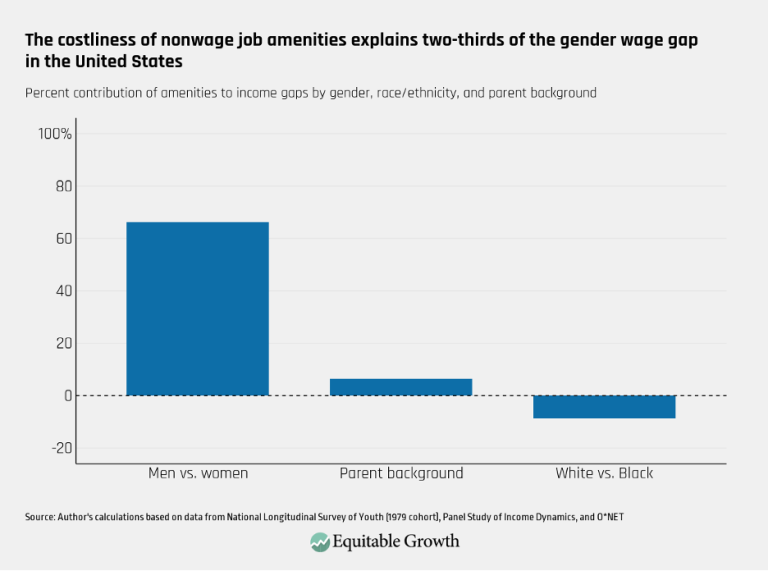
When workers choose jobs with predictable schedules, safer conditions, or greater autonomy, they are often paying a price: lower wages. In some cases, these hidden trade-offs are considerable. Indeed, my…
By: Alex Bell (opens in a new tab)
 View Chart
(opens in a new tab)
View Chart
(opens in a new tab)
The costliness of nonwage job amenities explains two-thirds of the gender wage gap in the United States (opens in a new tab)
Visualizations JUN 10, 2025
 View Chart
(opens in a new tab)
View Chart
(opens in a new tab)
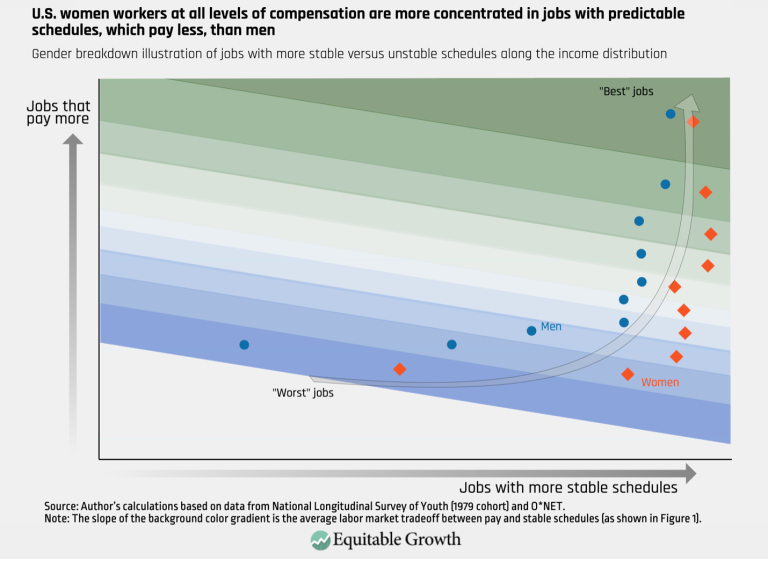
U.S. women workers at all levels of compensation are more concentrated in jobs with predictable schedules, which pay less, than men (opens in a new tab)
Visualizations JUN 10, 2025
 View Chart
(opens in a new tab)
View Chart
(opens in a new tab)
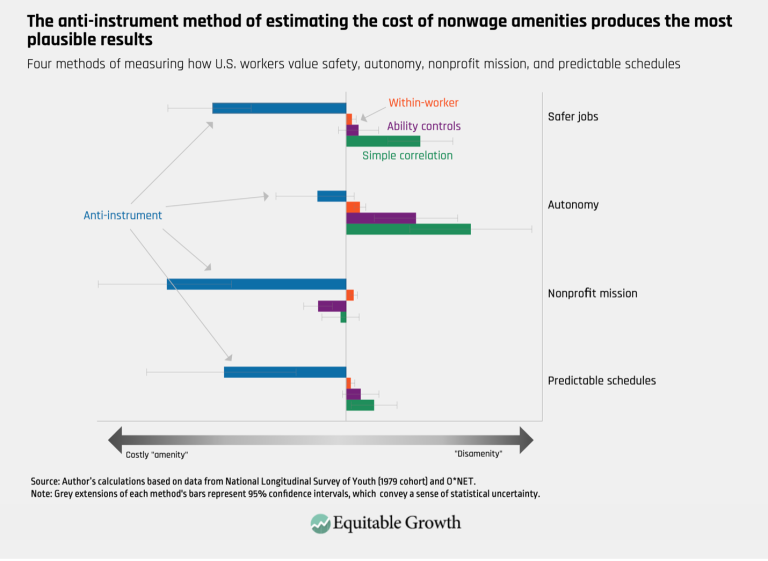
The anti-instrument method of estimating the cost of nonwage amenities produces the most plausible results (opens in a new tab)
Visualizations JUN 10, 2025

The political implications of bad jobs and the decline of unions (opens in a new tab)
Blog MAY 13, 2025
Bad jobs have become a distinctive feature of the U.S. economy over the past few decades. Globally, a lack of adequate demand, or what economists call “secular stagnation,” has meant…
By: Adam Dean (opens in a new tab), Jamie McCallum (opens in a new tab)

Tariffs pose real risks to the U.S. labor market (opens in a new tab)
Blog MAY 12, 2025
Uncertainty around trade policy makes it difficult to discuss the current state of the U.S. labor market. Businesses, workers, and policymakers at all levels make decisions based on both what…
By: Kevin Rinz (opens in a new tab)
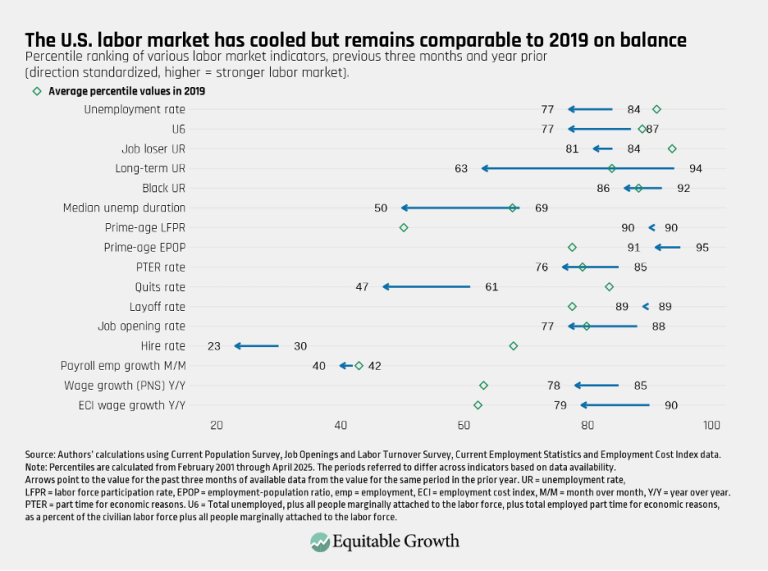 View Chart
(opens in a new tab)
View Chart
(opens in a new tab)
rinz fig 1 (opens in a new tab)
Visualizations MAY 9, 2025
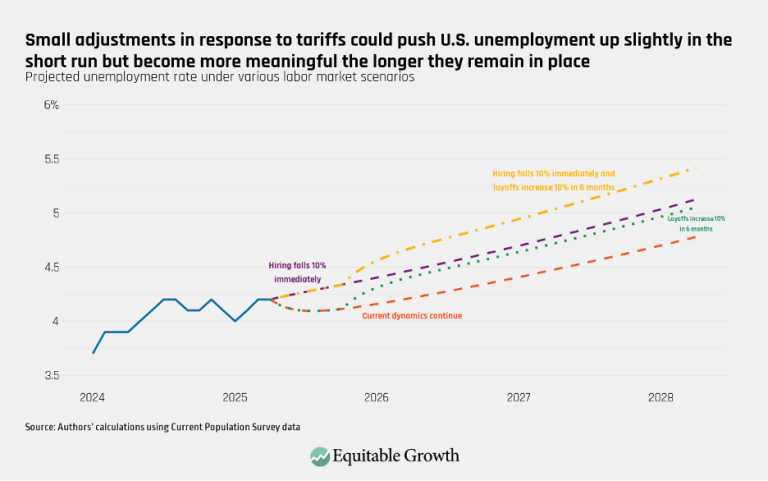 View Chart
(opens in a new tab)
View Chart
(opens in a new tab)
Small adjustments in response to tariffs could push U.S. unemployment up slightly in the short run but become more meaningful the longer they remain in place (opens in a new tab)
Visualizations MAY 9, 2025
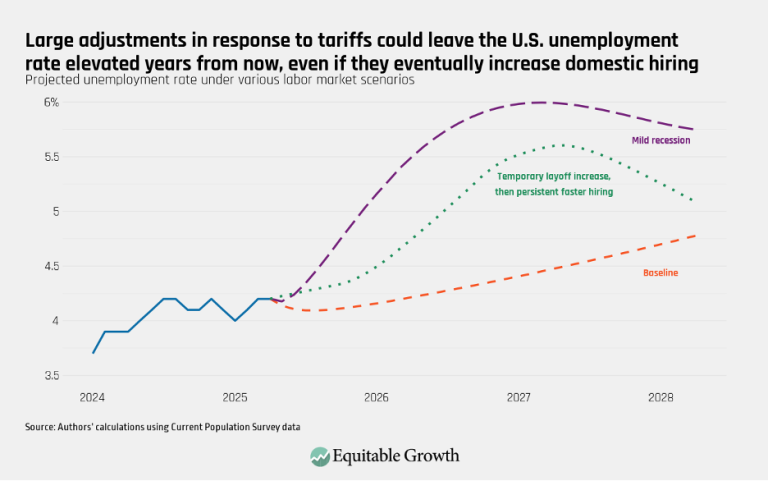 View Chart
(opens in a new tab)
View Chart
(opens in a new tab)
rinz fig 3 (opens in a new tab)
Visualizations MAY 9, 2025

Why do some jobs pay better than others? Think about what workers do. (opens in a new tab)
Issue Briefs MAY 6, 2025
Most U.S. labor market data characterize jobs by describing the categories of industry and occupation to which the jobs belong. But to understand why some types of jobs tend to…
By: Kevin Rinz (opens in a new tab), Chiara Chanoi (opens in a new tab), Christopher Bangert-Drowns (opens in a new tab)
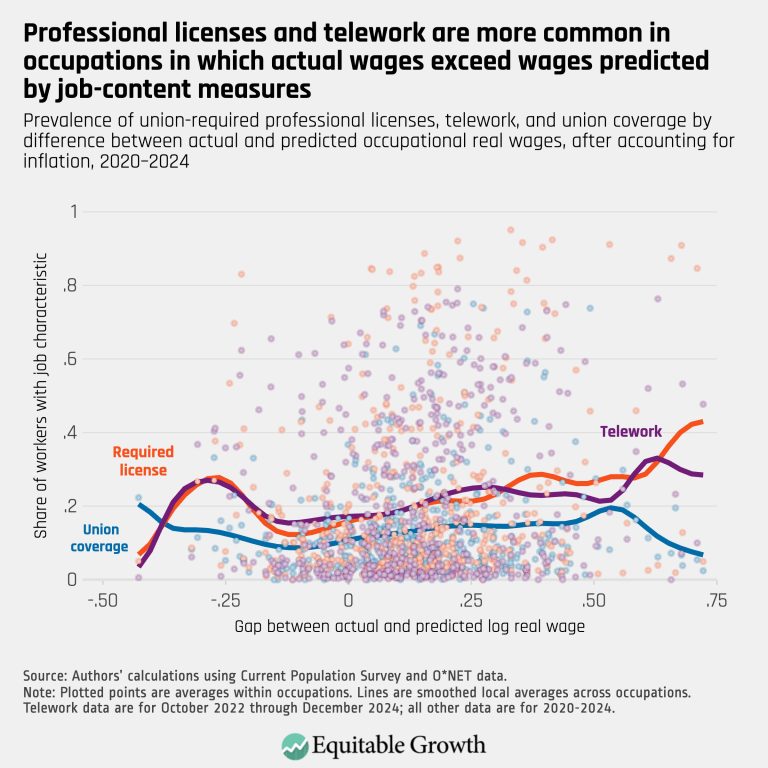 View Chart
(opens in a new tab)
View Chart
(opens in a new tab)
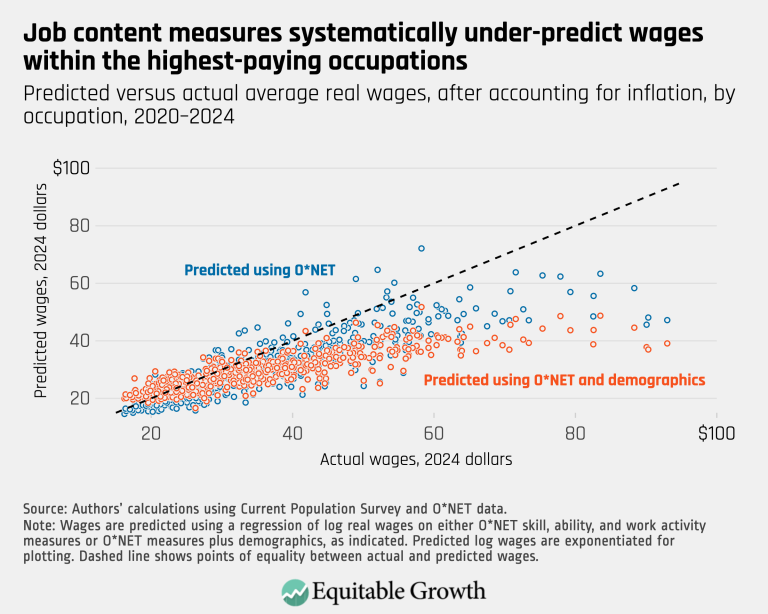
Professional licenses and telework are more common in occupations in which actual wages exceed wages predicted by job-content measures (opens in a new tab)
Visualizations MAY 6, 2025
 View Chart
(opens in a new tab)
View Chart
(opens in a new tab)
playfair (2) (opens in a new tab)
Visualizations MAY 6, 2025
 View Chart
(opens in a new tab)
View Chart
(opens in a new tab)
playfair (opens in a new tab)
Visualizations MAY 6, 2025

Analogies for AI policymaking (opens in a new tab)
Blog MAR 27, 2025
As a suite of technologies under the label of artificial intelligence increasingly take center stage, policymakers recognize the need to develop deep technical expertise about the deployment of evolving technologies…
By: Sorelle Friedler (opens in a new tab), Marc Aidinoff (opens in a new tab)

What makes a job ‘good’? How U.S. labor market data can provide insight to improve workers’ economic conditions (opens in a new tab)
Blog MAR 26, 2025
Since the Great Recession of 2007–2009, a great deal of U.S. economic policymaking has been dedicated to creating jobs. The tools used to do so vary widely, from awarding grants…
By: Kevin Rinz (opens in a new tab), Chiara Chanoi (opens in a new tab)

Do not abandon the care agenda (opens in a new tab)
Blog MAR 19, 2025
This column, co-authored by Equitable Growth President and CEO Shayna Strom and former Deputy Director of the White House Gender Policy Council Shilpa Phadke, first appeared in Democracy Journal in…
By: Equitable Growth (opens in a new tab)

Tackling AI, taxation, and the fair distribution of AI’s benefits (opens in a new tab)
Blog MAR 5, 2025
Artificial intelligence poses significant challenges to income growth, inequality, and meaningful work. At the same time, AI has geopolitical significance, with many national and supranational governments shying away from intervening…
By: Mona Sloane (opens in a new tab), Ekkehard Ernst (opens in a new tab)

Boosting U.S. worker power and voice in the AI-enabled workplace (opens in a new tab)
Blog FEB 19, 2025
The deployment of Artificial Intelligence in the workplace has grown rapidly in the United States. Labor unions have been at the forefront of efforts to encourage more productive and sustainable…
By: Virginia Doellgast (opens in a new tab), Nell Geiser (opens in a new tab)
As the U.S. labor market stabilizes, is nominal wage growth now too hot? (opens in a new tab)
Blog FEB 13, 2025
After the tumultuous swings of the early COVID-19 pandemic period and years of normalization since then, economic data from the past several months suggest that the U.S. labor market may…
By: Kevin Rinz (opens in a new tab)

Understanding market concentration in the AI supply chain (opens in a new tab)
Blog JAN 28, 2025
Artificial intelligence is more than just the applications we use, such as chatbots and predictive algorithms. Beneath the surface of AI lies a technology stack that is increasingly concentrated at…
By: Tejas Narechania (opens in a new tab)
ASSA 2025 Round-up: Day 3 (opens in a new tab)
Blog JAN 6, 2025
Yesterday was the third and final day of the 2025 annual meeting of the Allied Social Science Associations, which is organized by the American Economic Association. The 3-day conference, held…
By: Equitable Growth (opens in a new tab)
ASSA 2025 Round-up: Day 1 (opens in a new tab)
Blog JAN 4, 2025
Yesterday was the first day of the 2025 annual meeting of the Allied Social Science Associations, which is organized by the American Economic Association. The 3-day conference, held in San…
By: Equitable Growth (opens in a new tab)

Accelerating research can help fill the AI knowledge gaps for U.S. policymakers (opens in a new tab)
Issue Briefs DEC 17, 2024
It is hard for policymakers to ignore today’s “AI arms race” and the public debate on the economic and social significance of generative artificial intelligence. The discourse is fueled in…
By: Rohini Kosoglu (opens in a new tab), Christian Edlagan (opens in a new tab)

Recent research shows how paid leave impacts women’s employment and financial security in the United States (opens in a new tab)
Blog DEC 13, 2024
During the first several months of the COVID-19 pandemic, the federal government ensured that all U.S. workers had access to at least 2 weeks of paid sick leave and up…
By: Shira Markoff (opens in a new tab)

New research highlights the impact of COVID-era unconditional cash benefits for U.S. workers and families (opens in a new tab)
Blog DEC 10, 2024
The breadth of the economic impact of the COVID-19 pandemic ushered in sweeping, albeit temporary, changes to income support programs and tax policies in the United States. These changes include…
By: Shira Markoff (opens in a new tab)

The U.S. labor market keeps beating projections (opens in a new tab)
Blog NOV 5, 2024
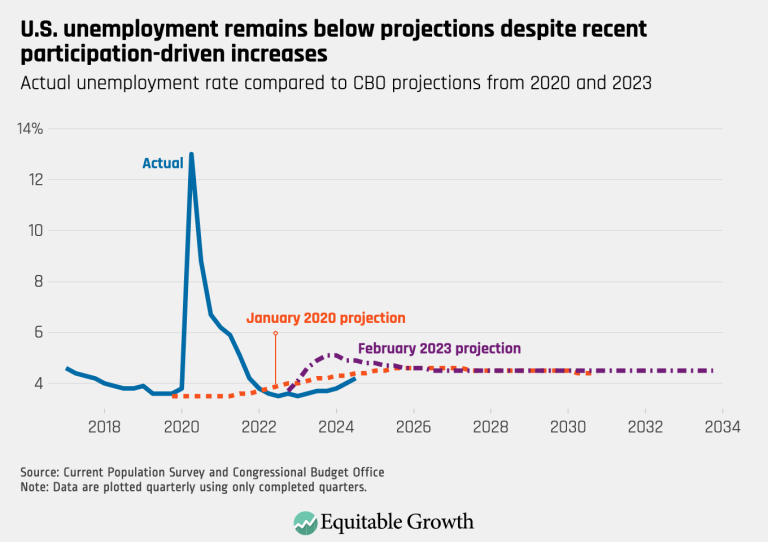
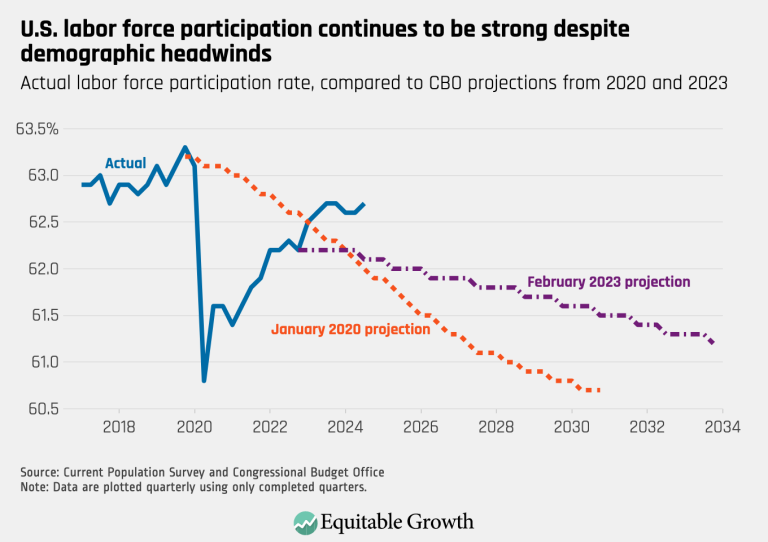
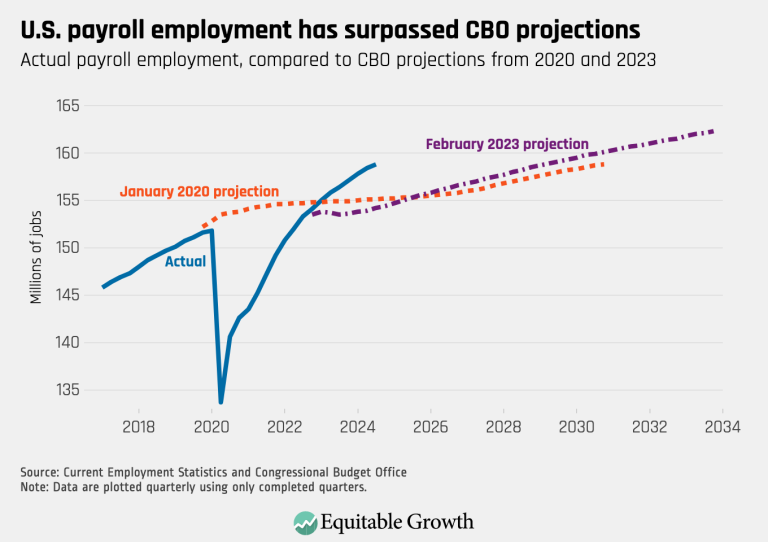
No single economic indicator fully describes the state of the U.S. labor market. Yet a range of commonly used measures, from the unemployment rate and the prime-age employment-population ratio to…
By: Kevin Rinz (opens in a new tab)
 View Chart
(opens in a new tab)
View Chart
(opens in a new tab)
U.S. unemployment remains below projections despite recent participation-driven increases (opens in a new tab)
Visualizations NOV 5, 2024
 View Chart
(opens in a new tab)
View Chart
(opens in a new tab)
U.S. labor force participation continues to be strong despite demographic headwinds (opens in a new tab)
Visualizations NOV 5, 2024
 View Chart
(opens in a new tab)
View Chart
(opens in a new tab)
U.S. payroll employment has surpassed CBO projections (opens in a new tab)
Visualizations NOV 5, 2024
 View Chart
(opens in a new tab)
View Chart
(opens in a new tab)
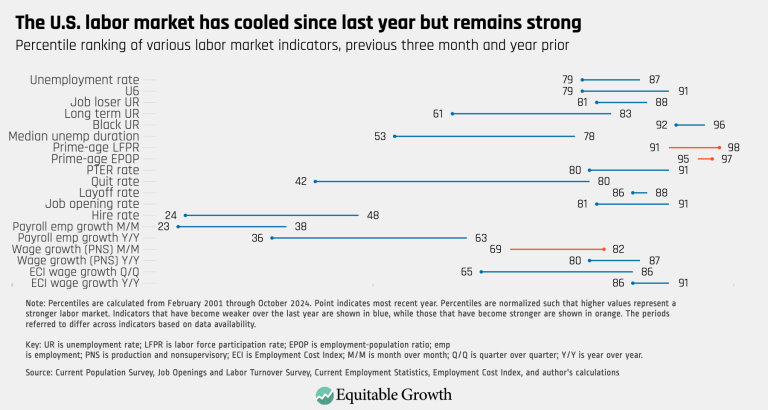
The U.S. labor market has cooled since last year but remains strong (opens in a new tab)
Visualizations NOV 4, 2024

Changing earnings requirements for Unemployment Insurance could improve access and better support U.S. workers (opens in a new tab)
Blog OCT 24, 2024
Temporary changes to the Unemployment Insurance program played an enormous role in the U.S. policy response to the COVID-19 pandemic and resulting sharp-but-short recession in 2020. Typically, Unemployment Insurance replaces…
By: Kevin Rinz (opens in a new tab)
 View Chart
(opens in a new tab)
View Chart
(opens in a new tab)
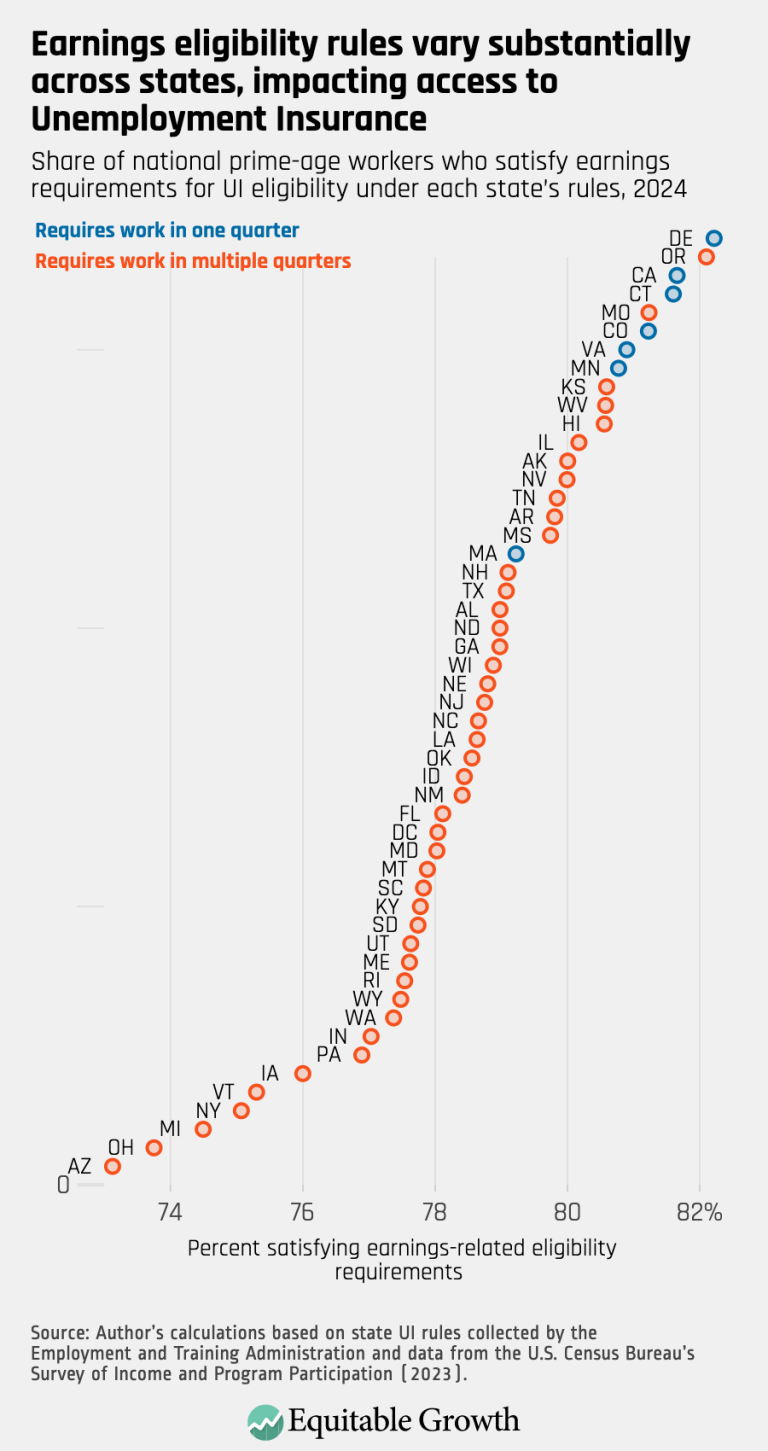
Earnings eligibility rules vary substantially across states, impacting access to Unemployment Insurance (opens in a new tab)
Visualizations OCT 24, 2024
 View Chart
(opens in a new tab)
View Chart
(opens in a new tab)
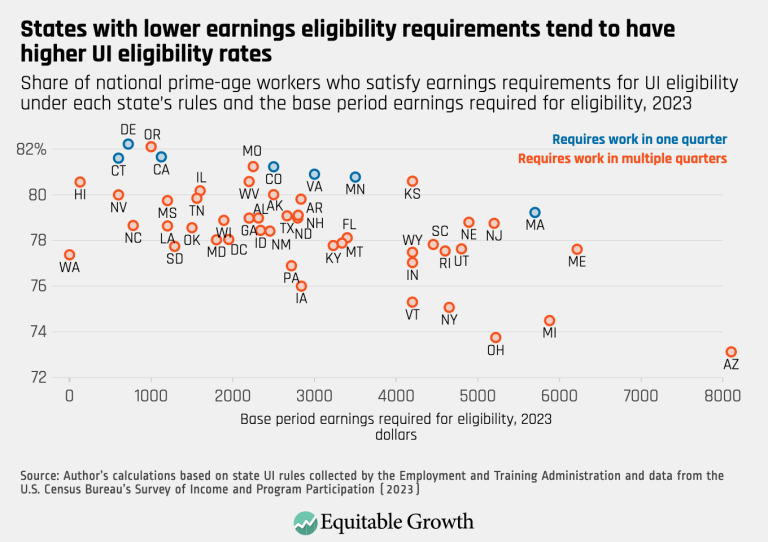
States with lower earnings eligibility requirements tend to have higher UI eligibility rates (opens in a new tab)
Visualizations OCT 24, 2024
 View Chart
(opens in a new tab)
View Chart
(opens in a new tab)
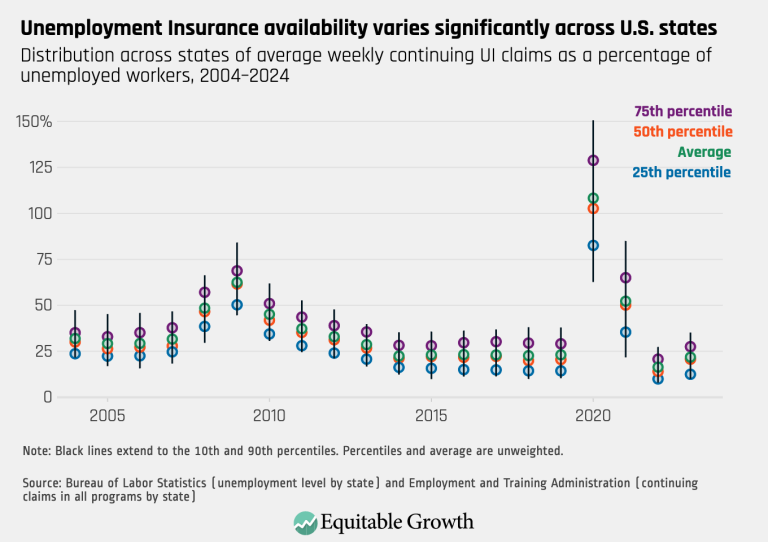
Unemployment Insurance availability varies significantly across U.S. states (opens in a new tab)
Visualizations OCT 24, 2024
 View Chart
(opens in a new tab)
View Chart
(opens in a new tab)
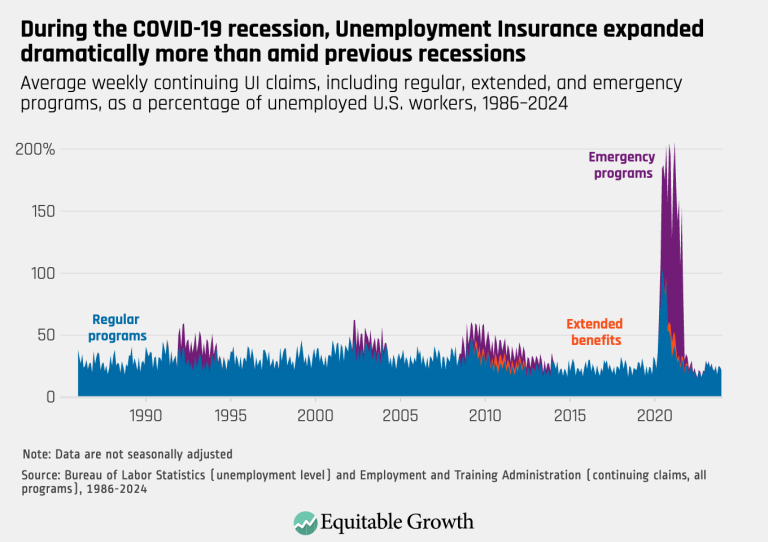
During the COVID-19 recession, Unemployment Insurance expanded dramatically more than amid previous recessions (opens in a new tab)
Visualizations OCT 24, 2024

Equitable Growth renews collective bargaining agreement with Nonprofit Professional Employees Union (opens in a new tab)
Blog OCT 7, 2024
The Washington Center for Equitable Growth has renewed its 3-year collective bargaining agreement with the Nonprofit Professional Employees Union IFPTE Local 70. The agreement, which was signed on August 23,…
By: Equitable Growth (opens in a new tab)
Estimating the prevalence of automated management and surveillance technologies at work and their impact on workers’ well-being (opens in a new tab)
Reports OCT 1, 2024
Evidence from a new national survey and implications for U.S. federal policy U.S. employers are deploying artificial-intelligence-powered and automated tools to monitor and manage workers, including tracking workers’ locations, activities,…
By: Alexander Hertel-Fernandez (opens in a new tab)
 View Chart
(opens in a new tab)
View Chart
(opens in a new tab)
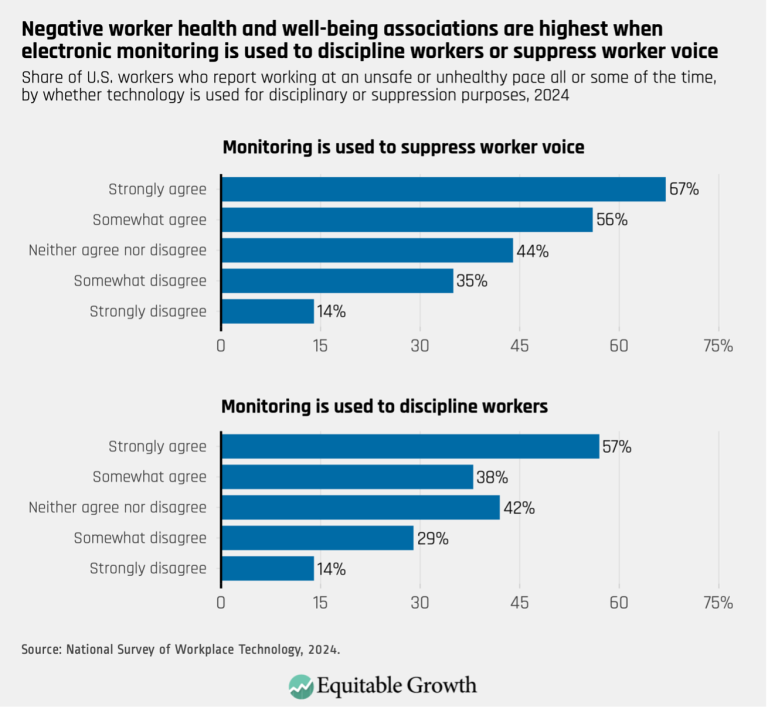
Negative worker health and well-being associations are highest when electronic monitoring is used to discipline workers or suppress worker voice (opens in a new tab)
Visualizations SEP 12, 2024
 View Chart
(opens in a new tab)
View Chart
(opens in a new tab)
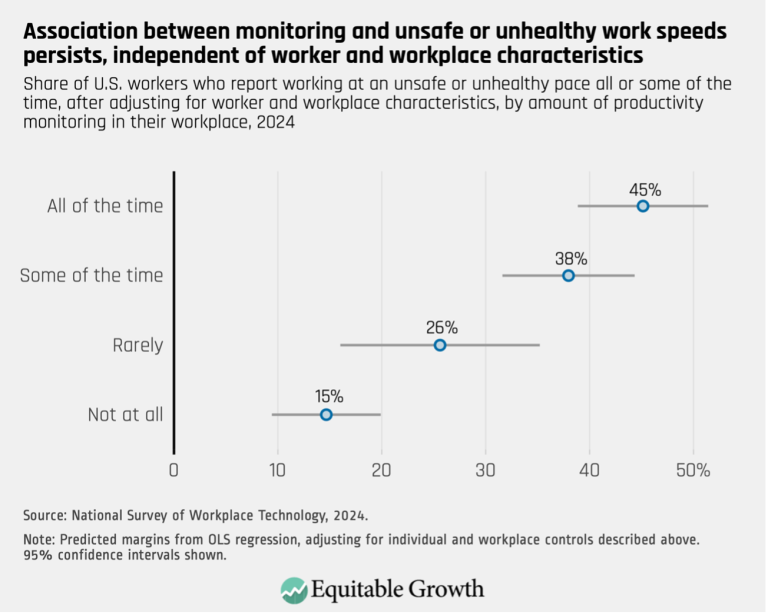
Association between monitoring and unsafe or unhealthy work speeds persists, independent of worker and workplace characteristics (opens in a new tab)
Visualizations SEP 12, 2024
 View Chart
(opens in a new tab)
View Chart
(opens in a new tab)
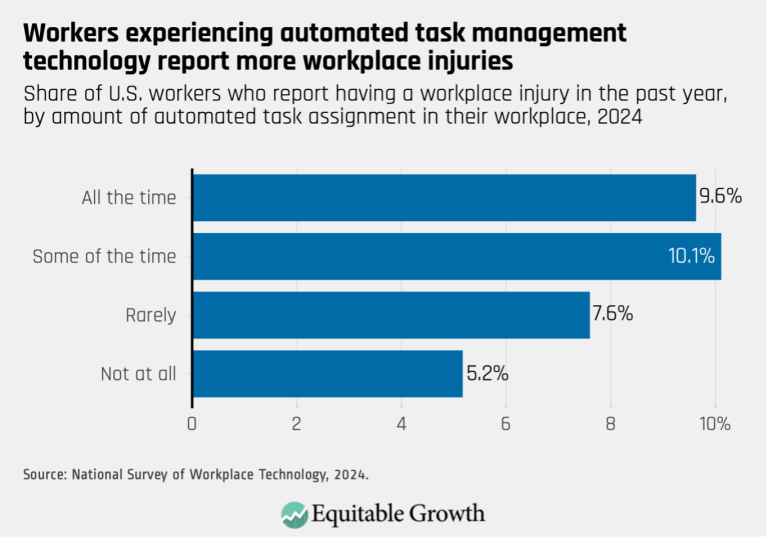
Workers experiencing automated task management technology report more workplace injuries (opens in a new tab)
Visualizations SEP 12, 2024
 View Chart
(opens in a new tab)
View Chart
(opens in a new tab)
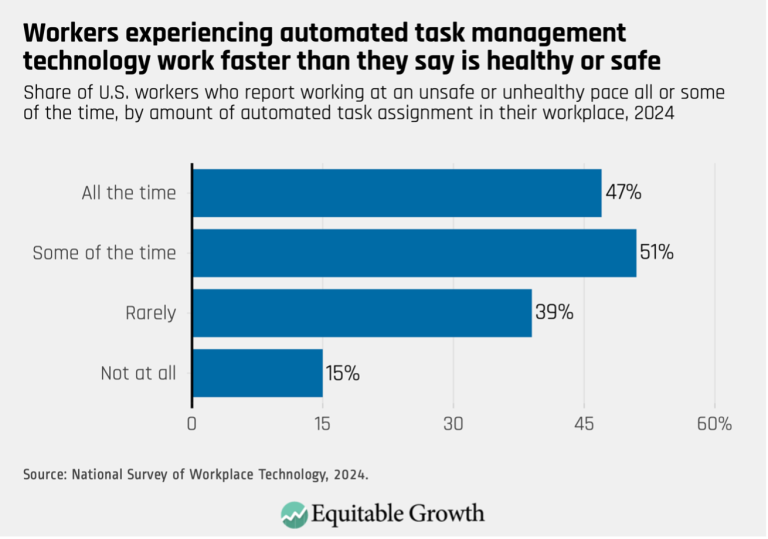
Workers experiencing automated task management technology work faster than they say is healthy or safe (opens in a new tab)
Visualizations SEP 12, 2024
 View Chart
(opens in a new tab)
View Chart
(opens in a new tab)
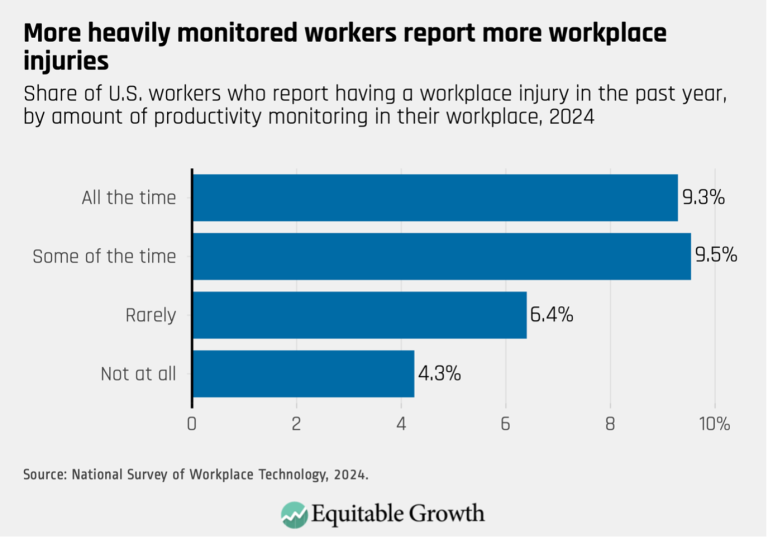
More heavily monitored workers report more workplace injuries (opens in a new tab)
Visualizations SEP 12, 2024
 View Chart
(opens in a new tab)
View Chart
(opens in a new tab)
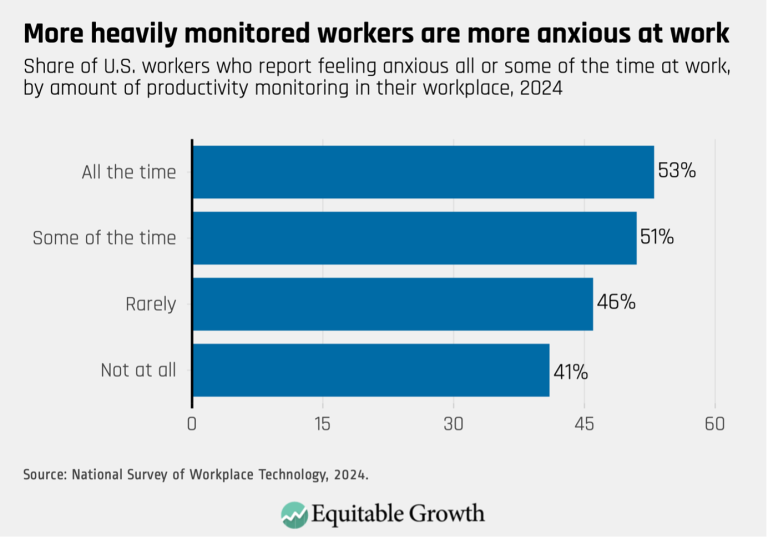
More heavily monitored workers are more anxious at work (opens in a new tab)
Visualizations SEP 12, 2024
 View Chart
(opens in a new tab)
View Chart
(opens in a new tab)
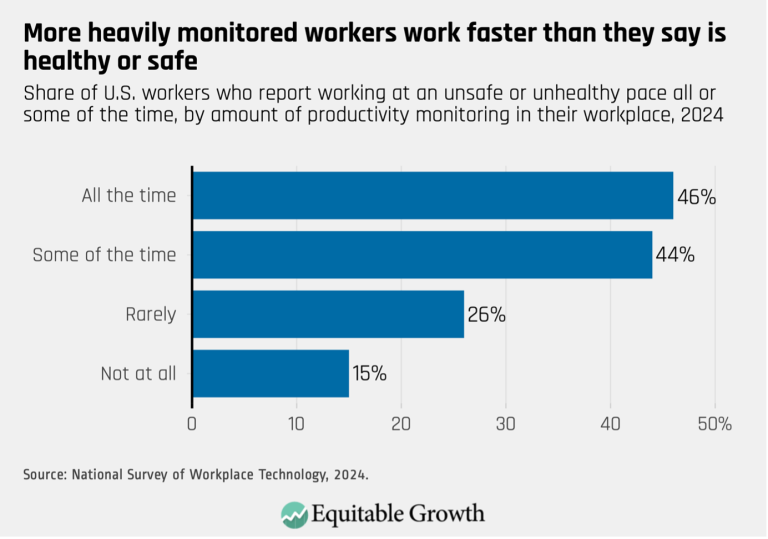
More heavily monitored workers works faster than they say is healthy or safe (opens in a new tab)
Visualizations SEP 12, 2024
 View Chart
(opens in a new tab)
View Chart
(opens in a new tab)
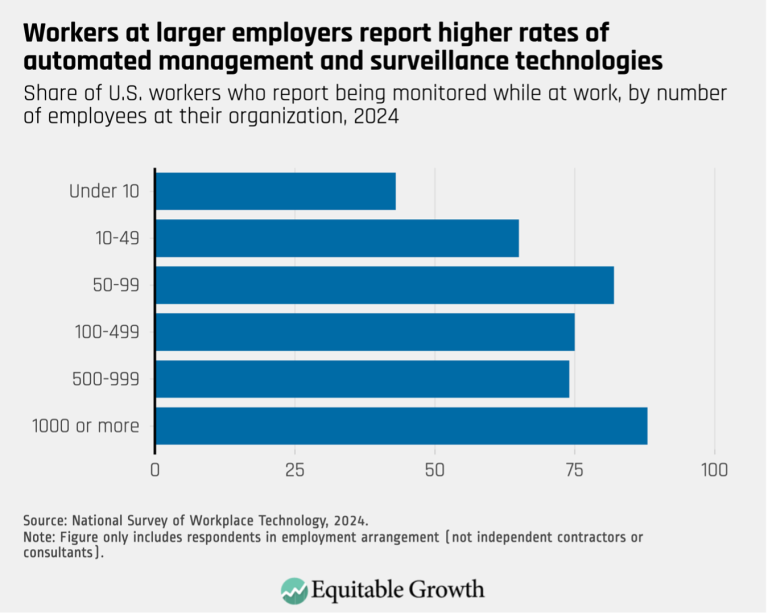
Workers at larger employers report higher rates of automated management and surveillance technologies (opens in a new tab)
Visualizations SEP 12, 2024
 View Chart
(opens in a new tab)
View Chart
(opens in a new tab)
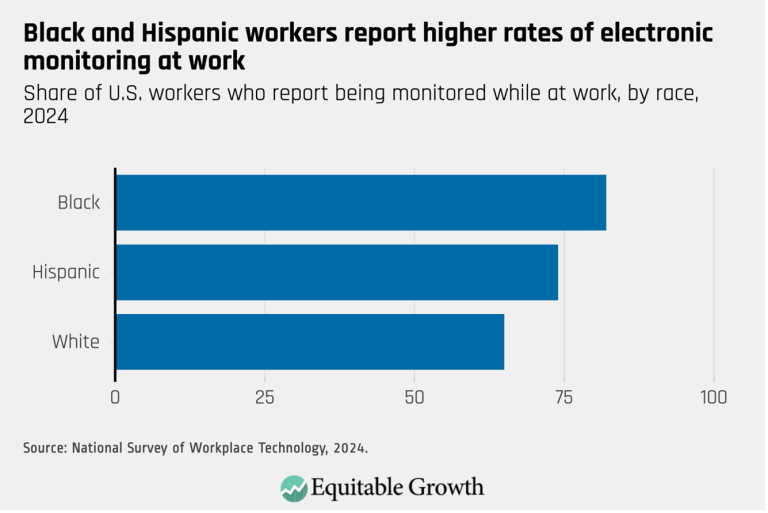
Black and Hispanic workers report higher rates of electronic monitoring at work (opens in a new tab)
Visualizations SEP 12, 2024
 View Chart
(opens in a new tab)
View Chart
(opens in a new tab)
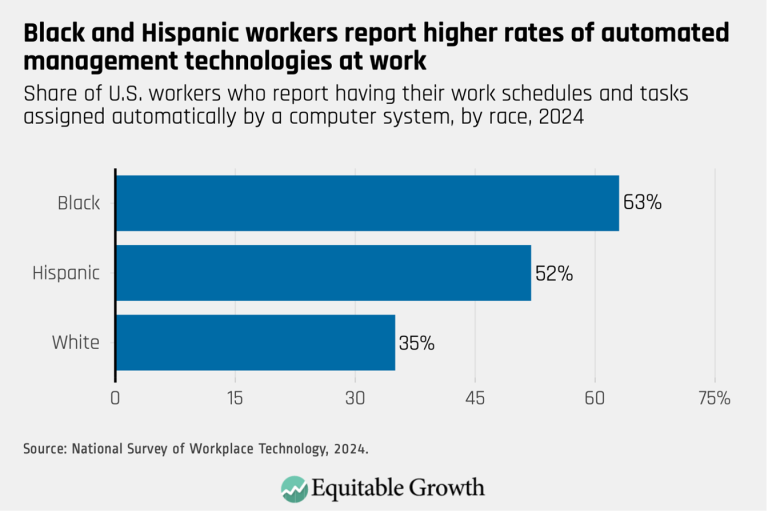
Black and Hispanic workers report higher rates of automated management technologies at work (opens in a new tab)
Visualizations SEP 12, 2024
 View Chart
(opens in a new tab)
View Chart
(opens in a new tab)
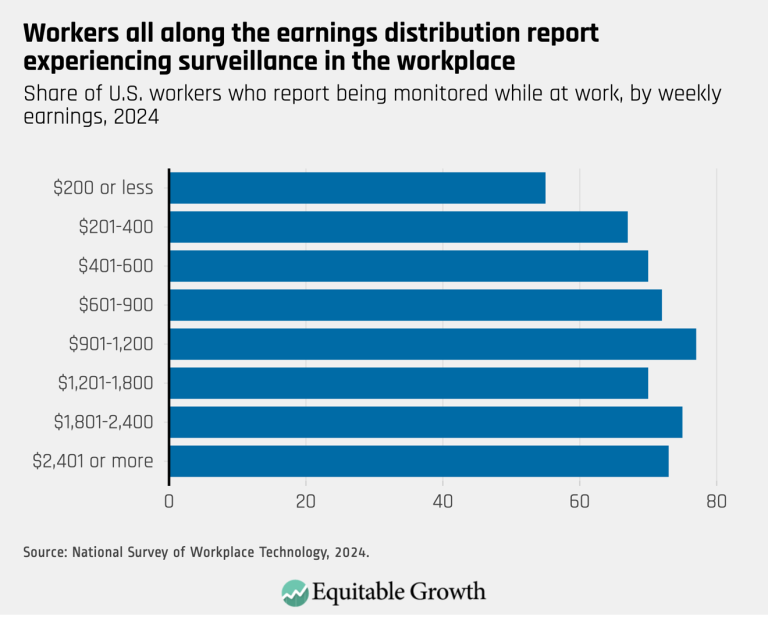
Workers all along the earnings distribution report experiencing surveillance in the workplace (opens in a new tab)
Visualizations SEP 12, 2024
 View Chart
(opens in a new tab)
View Chart
(opens in a new tab)
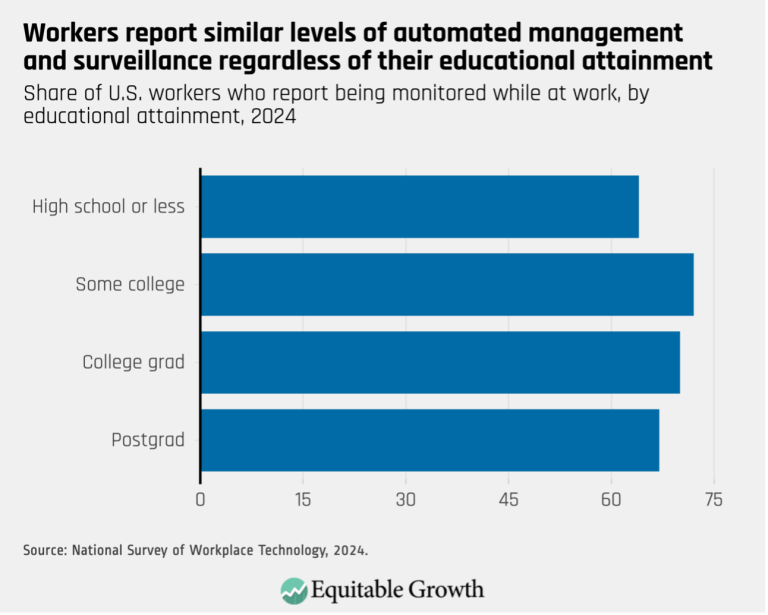
Workers report similar levels of automated management and surveillance regardless of their educational attainment (opens in a new tab)
Visualizations SEP 12, 2024
The upcoming U.S. election’s most important policy effects are under the radar (opens in a new tab)
Blog SEP 3, 2024
Although the old maxim that Labor Day marks the true beginning of U.S. presidential campaigns may no longer hold, the end of summer and beginning of fall remain a period…
By: Kevin Rinz (opens in a new tab)
 View Chart
(opens in a new tab)
View Chart
(opens in a new tab)
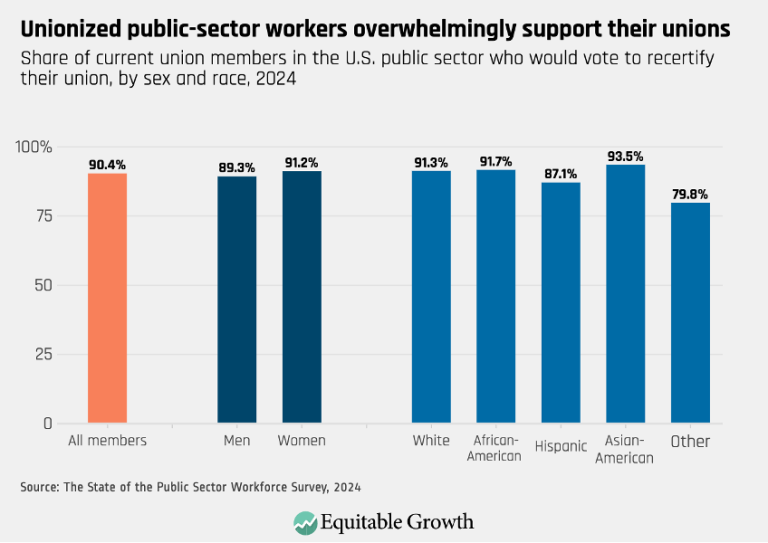
Unionized public-sector workers overwhelmingly support their unions (opens in a new tab)
Visualizations AUG 29, 2024
 View Chart
(opens in a new tab)
View Chart
(opens in a new tab)
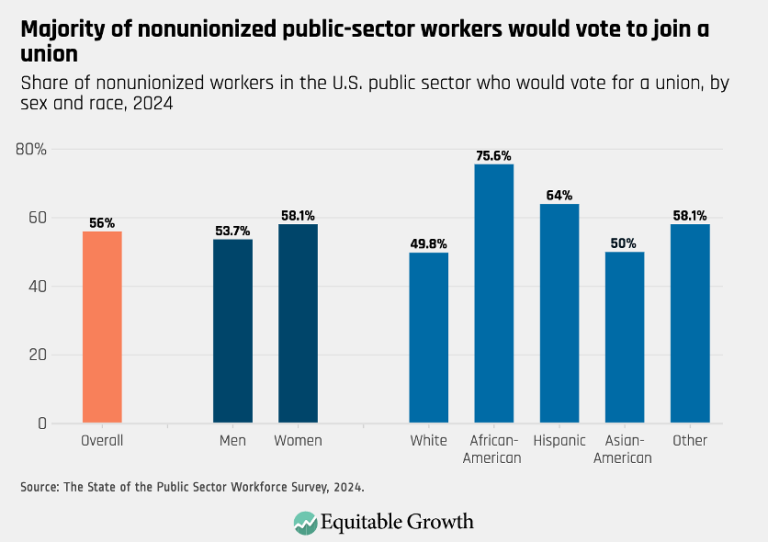
Majority of nonunionized public-sector workers would vote to join a union (opens in a new tab)
Visualizations AUG 29, 2024

Will labor’s surging popularity result in new union members in the United States? (opens in a new tab)
Blog AUG 29, 2024
Mass strikes across U.S. industries, successful organizing drives in multiple sectors of the economy, and a U.S. president who declares himself proud to be labeled “the most pro-union president in…
By: Jake Rosenfeld (opens in a new tab)

New labor market data suggest that U.S. wage growth may be cooling too much (opens in a new tab)
Blog AUG 6, 2024
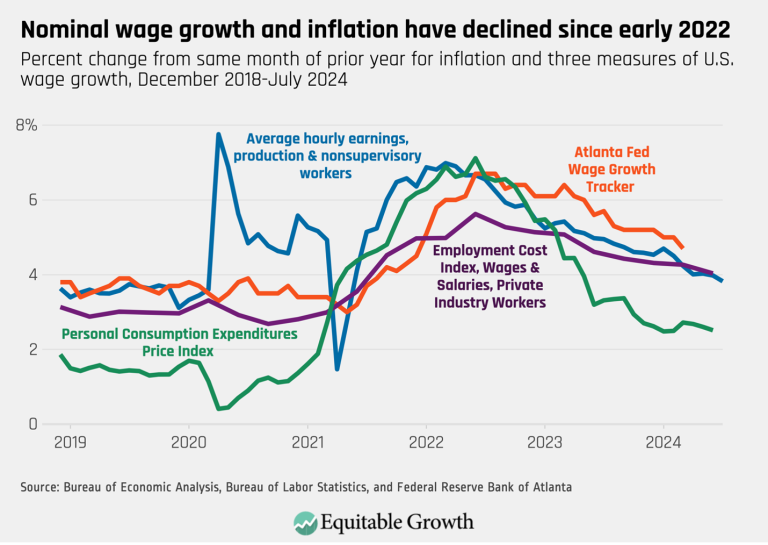
After increasing rapidly over the course of 2021, nominal wage growth (before accounting for inflation) in the United States has been trending down consistently across measures since early- to mid-2022.…
By: Kevin Rinz (opens in a new tab)
 View Chart
(opens in a new tab)
View Chart
(opens in a new tab)
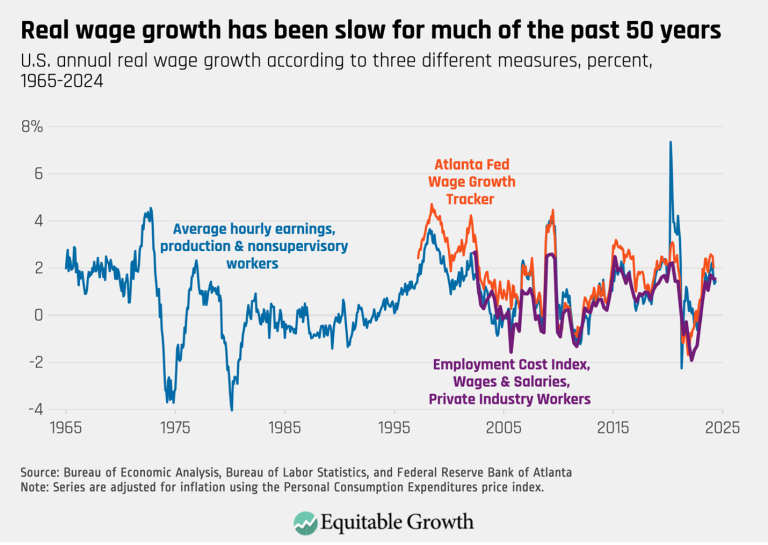
Real wage growth has been slow for much of the past 50 years (opens in a new tab)
Visualizations AUG 6, 2024
 View Chart
(opens in a new tab)
View Chart
(opens in a new tab)
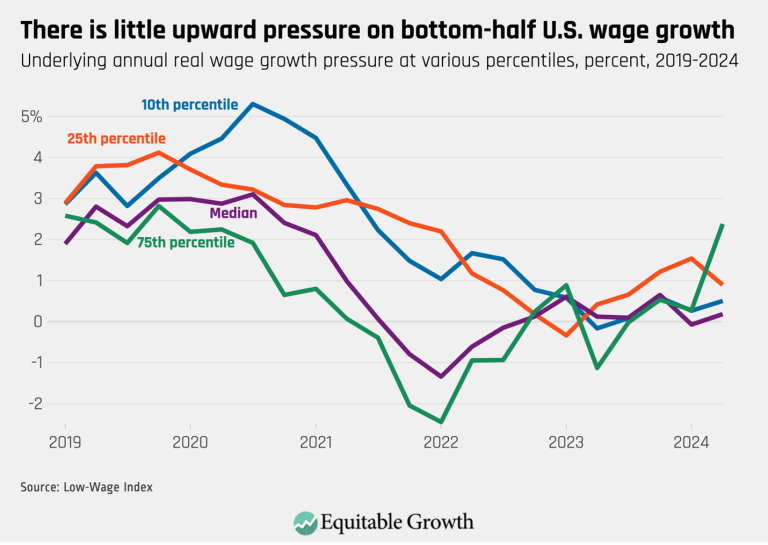
There is little upward pressure on bottom half of U.S. wage growth (opens in a new tab)
Visualizations AUG 6, 2024
 View Chart
(opens in a new tab)
View Chart
(opens in a new tab)
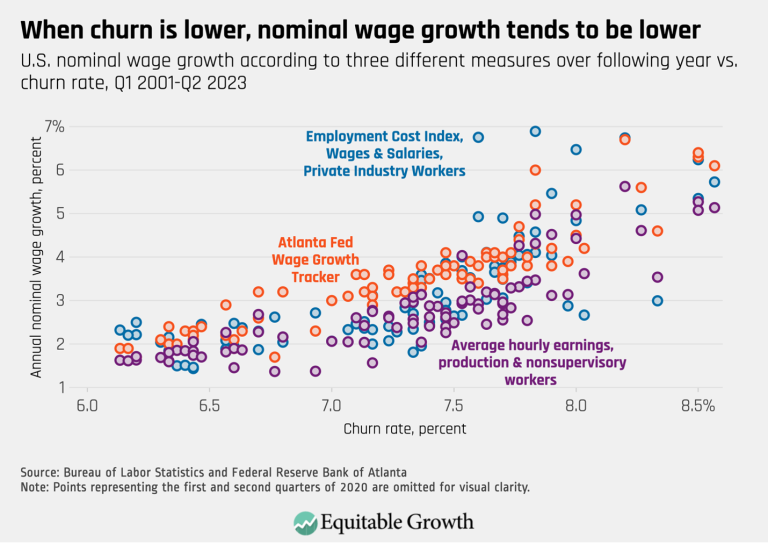
When churn is lower, nominal wage growth tends to be lower (opens in a new tab)
Visualizations AUG 6, 2024
 View Chart
(opens in a new tab)
View Chart
(opens in a new tab)
Nominal wage growth and inflation have declined since 2022 (opens in a new tab)
Visualizations AUG 6, 2024

New federal heat standard will protect U.S. workers from the ill effects of high temperatures amid intensifying climate change (opens in a new tab)
Blog AUG 1, 2024
U.S. workers are more vulnerable than ever to the ill effects of high and rising temperatures as the world continues to shatter heat records this year. Climate-related deaths and injuries…
By: Equitable Growth (opens in a new tab)

New federal heat standard offers novel distributional analysis to determine which workers benefit and how (opens in a new tab)
Blog JUL 16, 2024
The U.S. Department of Labor recently released a much-anticipated proposed rule that promises to protect workers from on-the-job injuries and deaths that result from toiling in the heat. The timing…
By: David S. Mitchell (opens in a new tab)

The new Labor Department overtime rule is a win for workers—and good policy, too (opens in a new tab)
Blog JUL 8, 2024
On July 1, the first step of the U.S. Department of Labor’s new overtime rule went into effect, meaning about 1 million salaried, white-collar workers currently exempt from overtime began…
By: Janelle Jones (opens in a new tab), Rajesh Nayak (opens in a new tab)

A researcher’s guide to identifying policy-relevant research questions for the federal government (opens in a new tab)
Essays MAY 30, 2024
Social science researchers play an important role in the policymaking process. Researchers help policymakers at all levels of government to understand key trends and issues in the U.S. economy and…
By: Alexander Hertel-Fernandez (opens in a new tab)

What is going on with wage growth in the United States? (opens in a new tab)
Blog MAY 16, 2024
Fast wage growth is a key feature of a strong labor market. U.S. workers, and low-wage workers in particular, experienced exceptional wage growth over the past couple of years, which…
By: Kevin Rinz (opens in a new tab)
 View Chart
(opens in a new tab)
View Chart
(opens in a new tab)
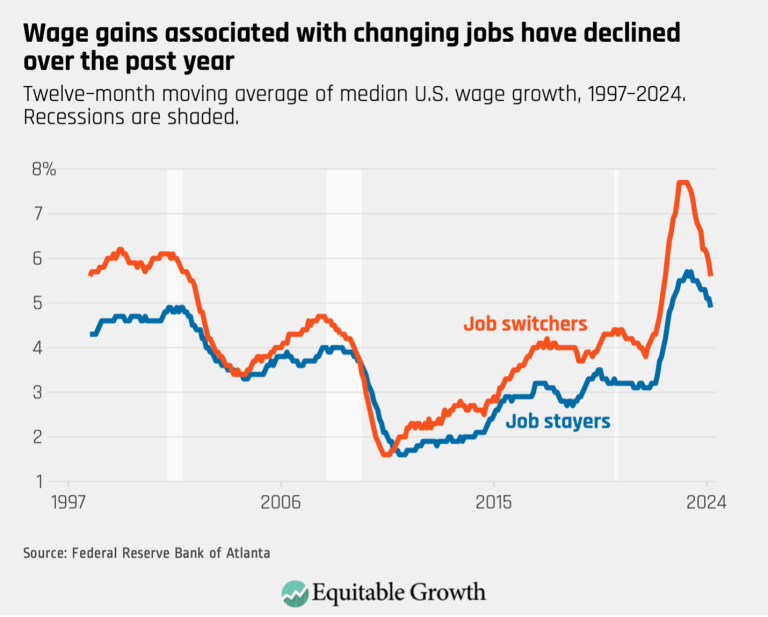
Wage gains associated with changing jobs have declined over the past year (opens in a new tab)
Visualizations MAY 16, 2024
 View Chart
(opens in a new tab)
View Chart
(opens in a new tab)
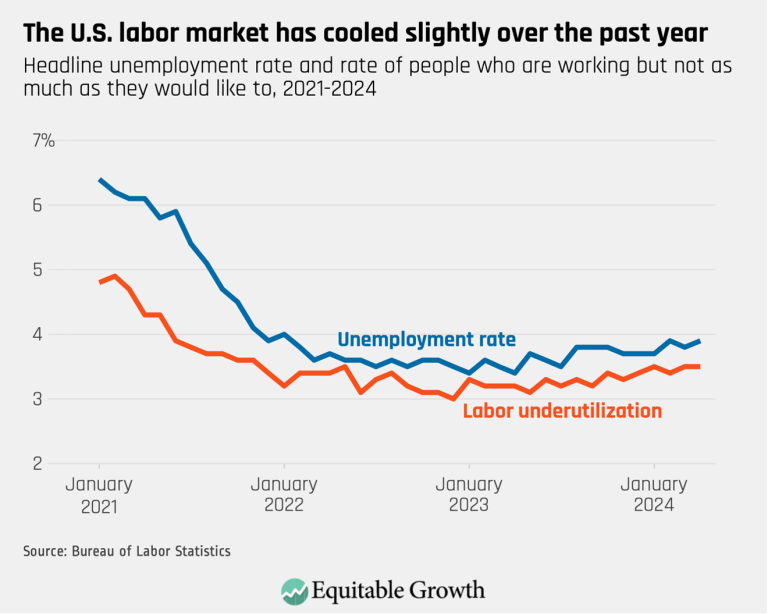
The U.S. labor market has cooled slightly over the past year (opens in a new tab)
Visualizations MAY 16, 2024
 View Chart
(opens in a new tab)
View Chart
(opens in a new tab)
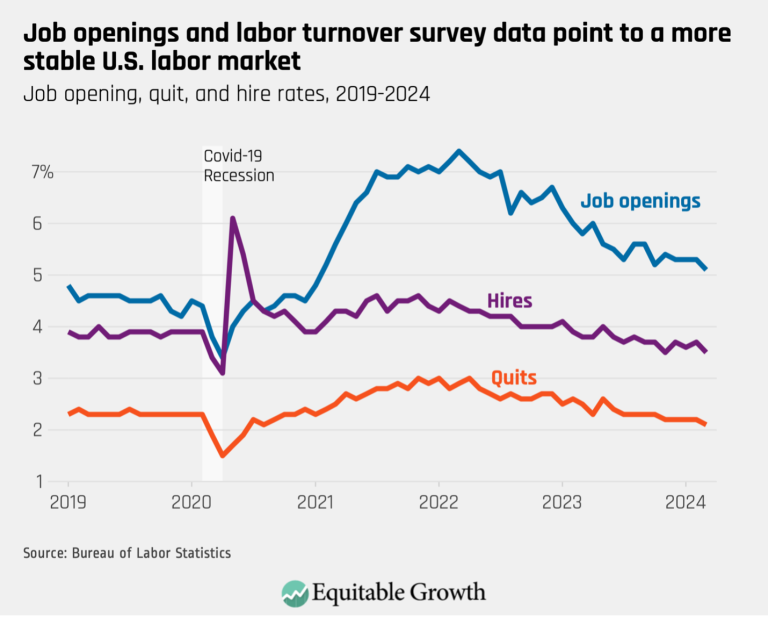
Job openings and labor turnover survey data point to a more stable U.S. labor market (opens in a new tab)
Visualizations MAY 16, 2024
 View Chart
(opens in a new tab)
View Chart
(opens in a new tab)
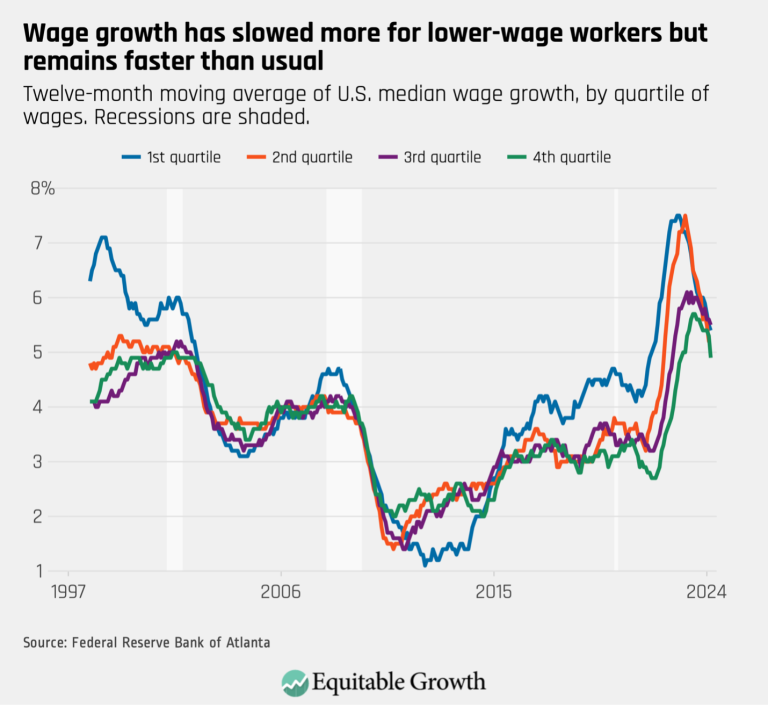
Wage growth has slowed more for lower-range workers but remains faster than usual (opens in a new tab)
Visualizations MAY 16, 2024
 View Chart
(opens in a new tab)
View Chart
(opens in a new tab)
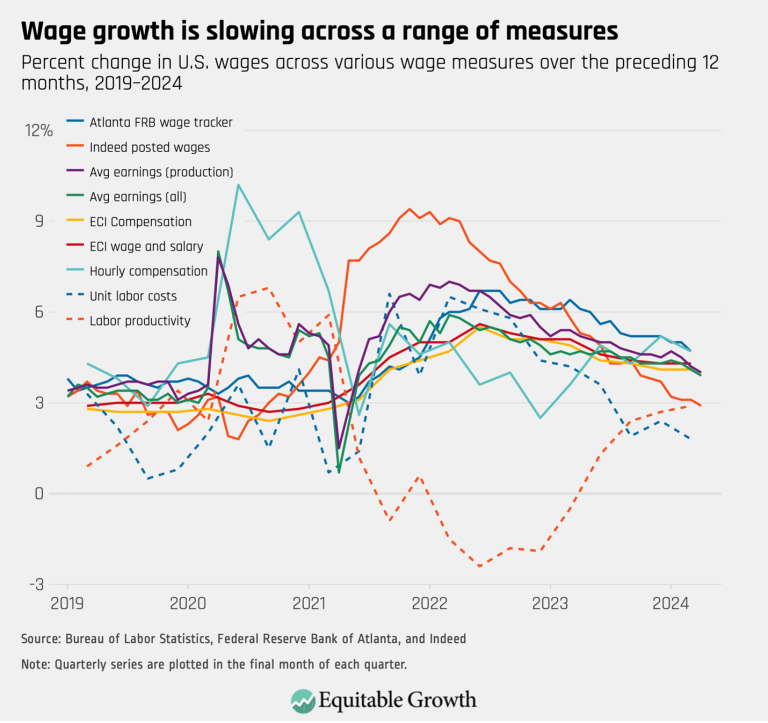
Wage growth is slowing across a range of measures (opens in a new tab)
Visualizations MAY 16, 2024

U.S. workers, generative AI, and the future of work (opens in a new tab)
Blog MAY 9, 2024
The launch of ChatGPT in November 2022 captured the world’s attention and illustrated the potential of generative Artificial Intelligence to instantly perform tasks long considered quintessentially “human.” Already, the technology…
By: Molly Kinder (opens in a new tab)

New workplace surveillance bill would protect U.S. workers and address new technological risks (opens in a new tab)
Blog MAY 2, 2024
Across the U.S. economy, the risks posed by unchecked automated surveillance and management technologies are widespread—and growing. These technologies can sometimes be beneficial for workers, customers, and businesses alike. For…
By: Alexander Hertel-Fernandez (opens in a new tab)

An Unemployment Insurance modernization bill now before the U.S. Senate is a much-needed step in the right direction (opens in a new tab)
Blog APR 9, 2024
The nearly 90-year-old federal-state Unemployment Insurance program provides much-needed relief to unemployed workers who lose their jobs through no fault of their own and helps to stabilize the U.S. economy…
By: Alexander Hertel-Fernandez (opens in a new tab)
 View Chart
(opens in a new tab)
View Chart
(opens in a new tab)
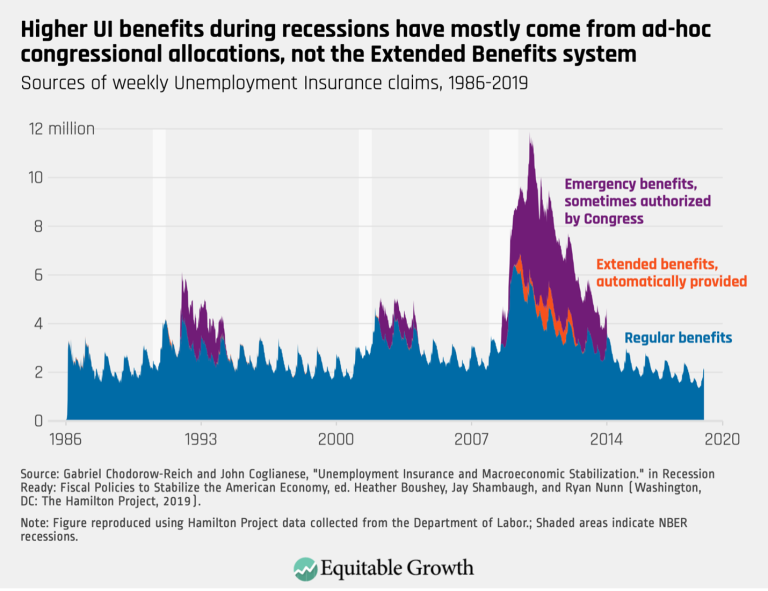
Higher UI benefits during recessions have mostly come from ad-hoc congressional allocations, not the Extended Benefits system (opens in a new tab)
Visualizations APR 5, 2024
 View Chart
(opens in a new tab)
View Chart
(opens in a new tab)
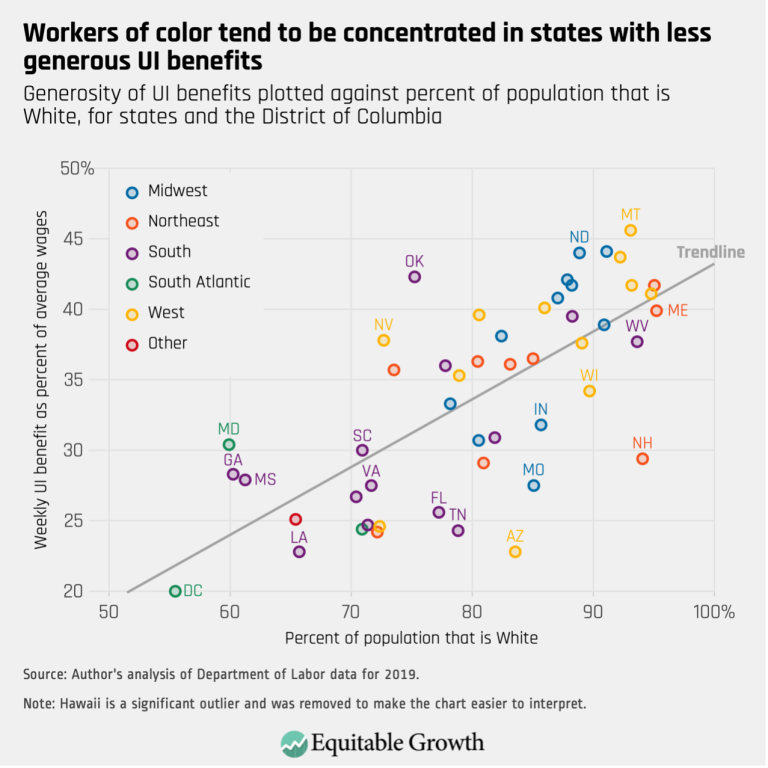
Workers of color tend to be concentrated in states with less generous UI benefits (opens in a new tab)
Visualizations APR 5, 2024
 View Chart
(opens in a new tab)
View Chart
(opens in a new tab)
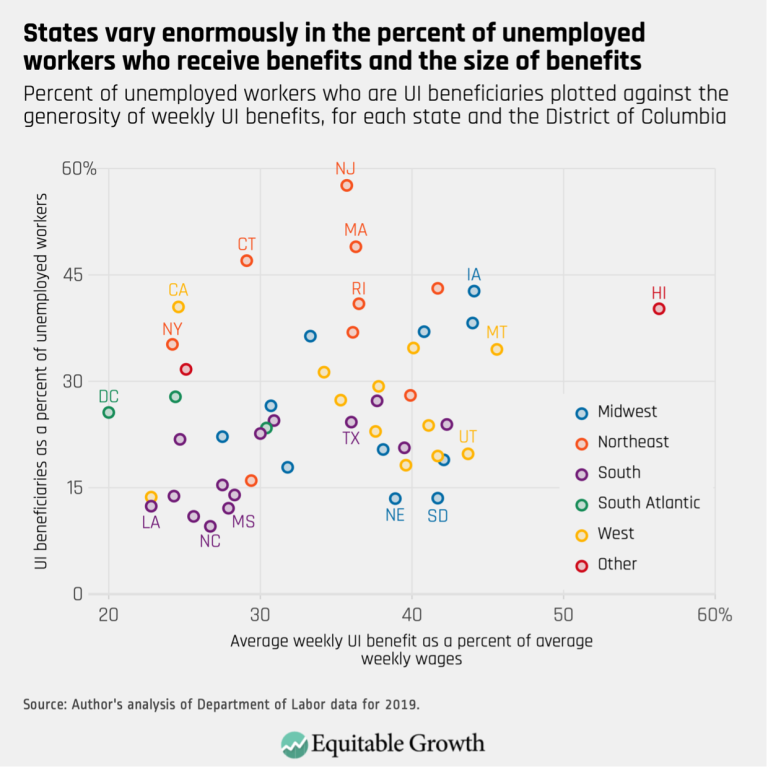
States vary enormously in the percent of unemployed workers who receive benefits and the size of benefits (opens in a new tab)
Visualizations APR 5, 2024

Equitable Growth hosts State of the Union press briefing with leading U.S. economists (opens in a new tab)
Blog MAR 7, 2024
The Washington Center for Equitable Growth last week hosted an online press briefing in prelude to tonight’s State of the Union address to the U.S. Congress by President Joe Biden.…
By: Equitable Growth (opens in a new tab)

The state of the U.S. labor market 4 years after the start of the COVID-19 recession (opens in a new tab)
Blog MAR 5, 2024
Over the past 4 years, the U.S. economy—in particular the U.S. labor market—weathered some incredible shocks and fluctuations. From the COVID-19 pandemic and supply chain breakdowns to global energy shocks…
By: Michael Linden (opens in a new tab)
 View Chart
(opens in a new tab)
View Chart
(opens in a new tab)
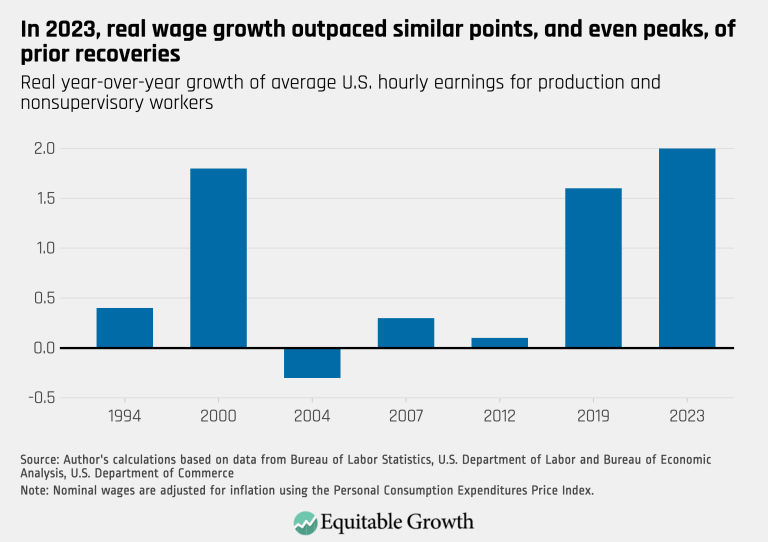
In 2023, real wage growth outpaces similar points, and even peaks, of prior recoveries (opens in a new tab)
Visualizations MAR 4, 2024
 View Chart
(opens in a new tab)
View Chart
(opens in a new tab)
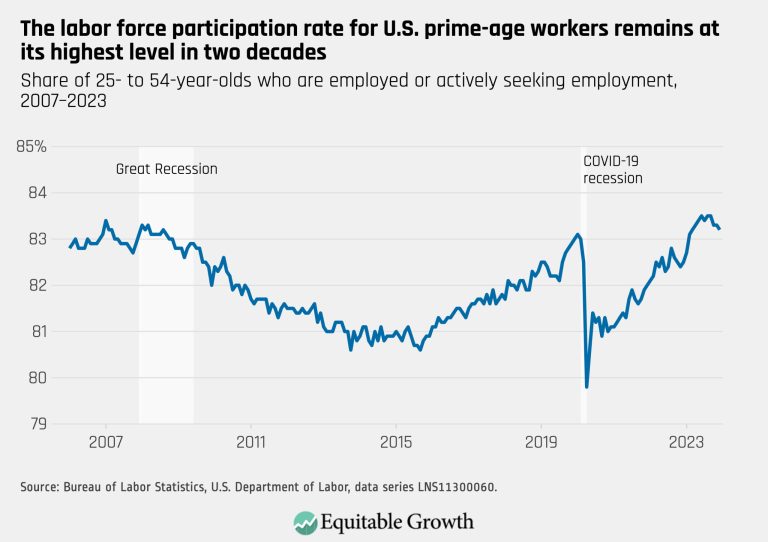
The labor force participation rate for U.S. prime-age workers remains at its highest level in two decades (opens in a new tab)
Visualizations MAR 4, 2024

Equitable Growth’s recent ‘Econ 101’ assessed the state of the U.S. economy and recovery for Capitol Hill staff (opens in a new tab)
Blog FEB 13, 2024
The Washington Center for Equitable Growth hosted a briefing last week—part of a series we call “Econ 101”—presenting insight on the state of the U.S. economy and how the current…
By: Equitable Growth (opens in a new tab)

Sameera Fazili and Mary Beth Maxwell join Equitable Growth’s Board of Directors (opens in a new tab)
Blog NOV 15, 2023
The Washington Center for Equitable Growth today announced the addition of two new members to its board of directors: Sameera Fazili, former deputy assistant to the president and deputy director…
By: Equitable Growth (opens in a new tab)
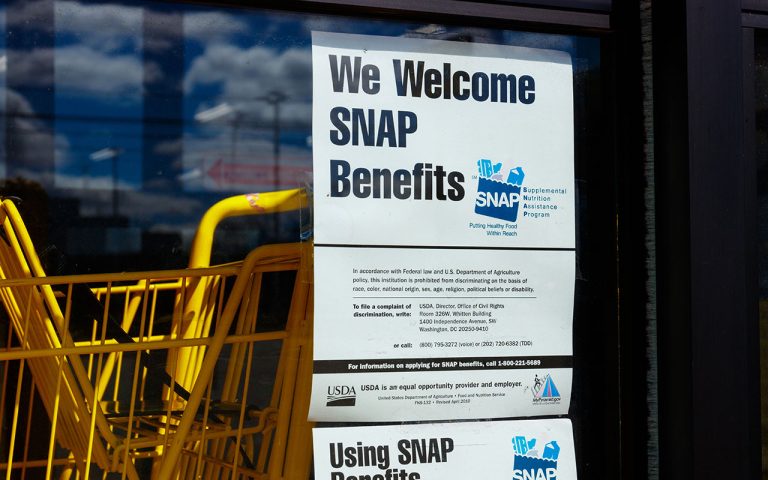
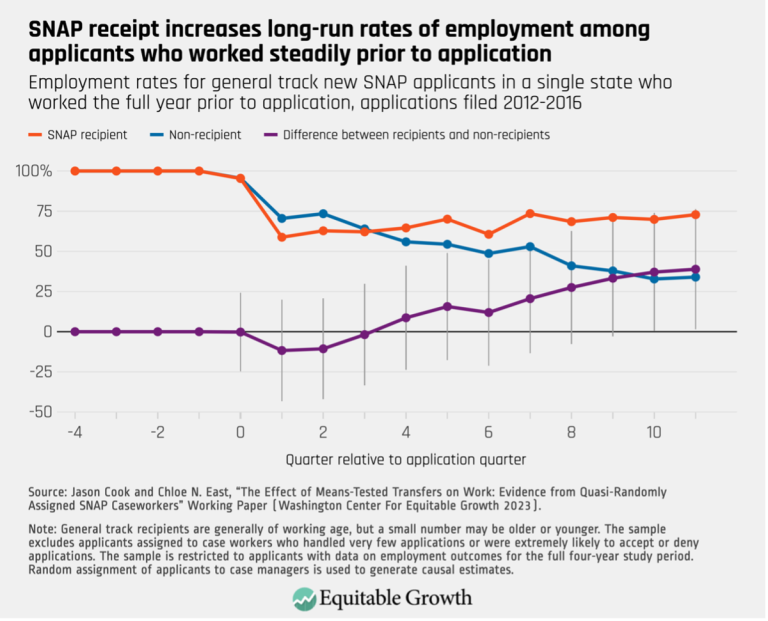
New evidence suggests that receiving benefits from the Supplemental Nutrition Assistance Program facilitates work in the long run (opens in a new tab)
Blog NOV 13, 2023
One of today’s most heated debates around U.S. income support programs is about work requirements. From the removal of work requirements through the 2021 enhancements to the Child Tax Credit…
By: Alix Gould-Werth (opens in a new tab)
 View Chart
(opens in a new tab)
View Chart
(opens in a new tab)
SNAP receipt increases long-run rates of employment among applicants who worked steadily prior to application (opens in a new tab)
Visualizations NOV 8, 2023
 View Chart
(opens in a new tab)
View Chart
(opens in a new tab)
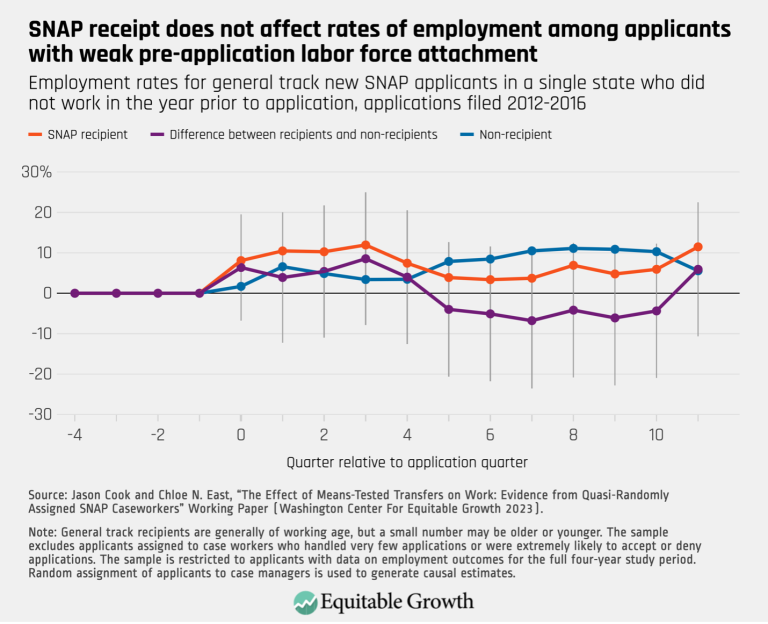
SNAP receipt does not affect rates of employment among applicants with weak pre-application labor force attachment (opens in a new tab)
Visualizations NOV 8, 2023
 View Chart
(opens in a new tab)
View Chart
(opens in a new tab)
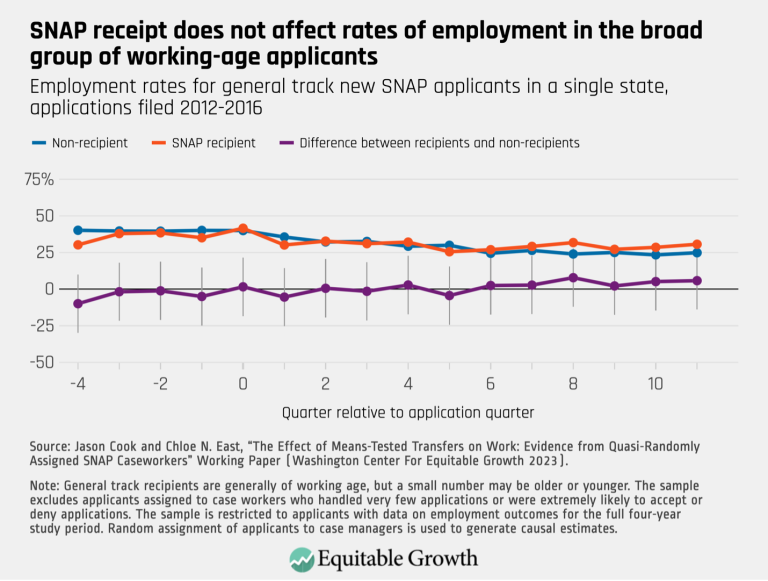
SNAP receipt does not affect rates of employment in the broad group of working-age applicant (opens in a new tab)
Visualizations NOV 8, 2023

What the minimum wage can tell us about the future of the U.S. child care system (opens in a new tab)
Blog NOV 1, 2023
The U.S. child care market is plagued by a math problem. Families in the United States are stretched thin, dedicating substantial portions of their household budgets to child care expenses.…
By: Sam Abbott (opens in a new tab)
 View Chart
(opens in a new tab)
View Chart
(opens in a new tab)
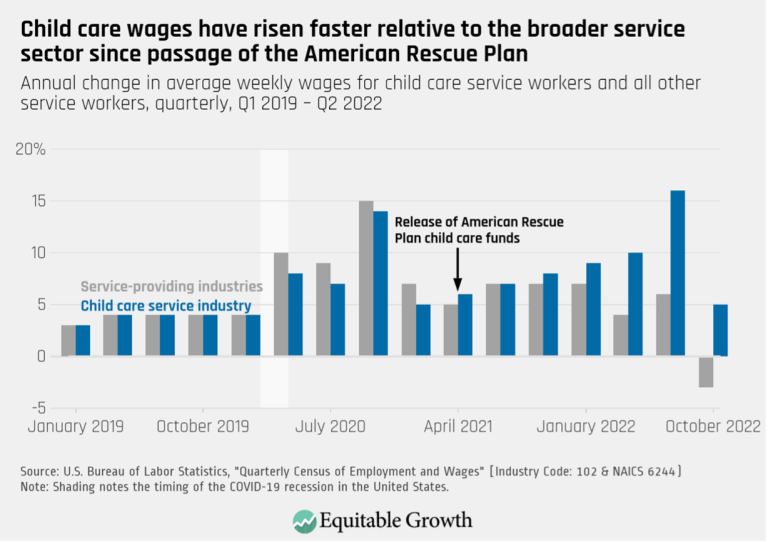
Child care wages have risen faster relative to the broader service sector since passage of the American Rescue Plan (opens in a new tab)
Visualizations OCT 31, 2023
 View Chart
(opens in a new tab)
View Chart
(opens in a new tab)
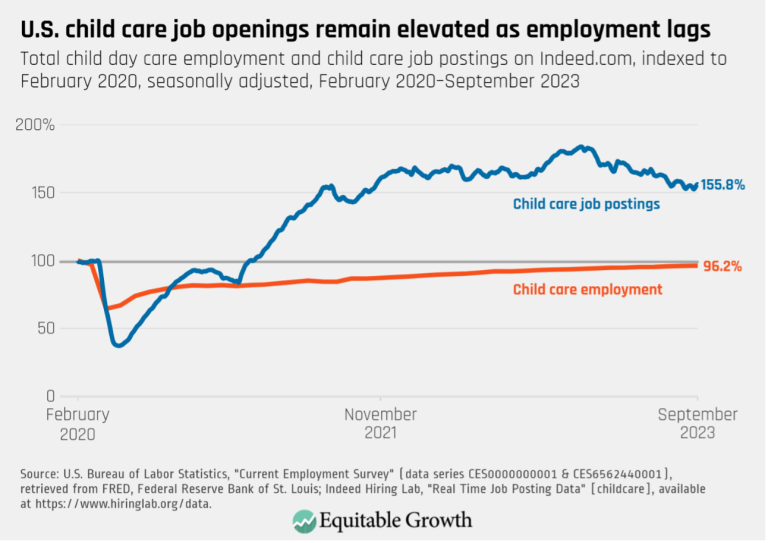
U.S. child care job openings remain elevated as employment lags (opens in a new tab)
Visualizations OCT 31, 2023
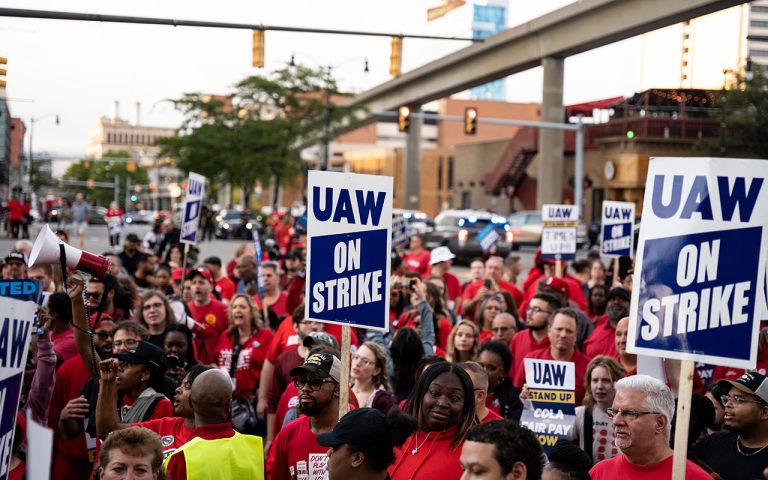
What recent research says about the benefits of labor strikes and growing worker power for broader U.S. economic growth (opens in a new tab)
Blog OCT 25, 2023
Labor organizing and strikes are experiencing a resurgence in the United States. Before this year’s bevy of labor actions—including Hollywood strikes, autoworker walk-outs, healthcare labor stoppages, and more—2022 and 2021…
By: Equitable Growth (opens in a new tab)
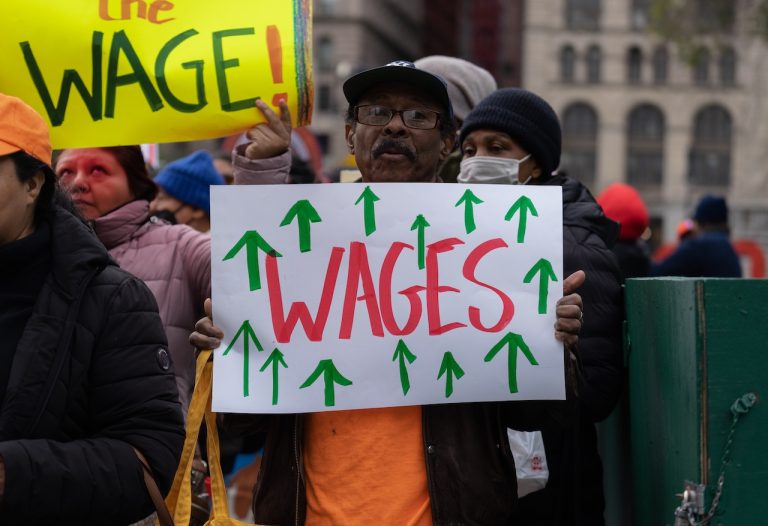
New research finds $15 minimum wages raise pay and increase employment for low-wage workers (opens in a new tab)
Blog OCT 16, 2023
Increasing the minimum wage has repeatedly been shown to raise the pay of low-wage workers and improve the overall economy. While the federal minimum wage remains at its 2009 level…
By: Michael Reich (opens in a new tab), Justin Wiltshire (opens in a new tab), Carl McPherson (opens in a new tab)
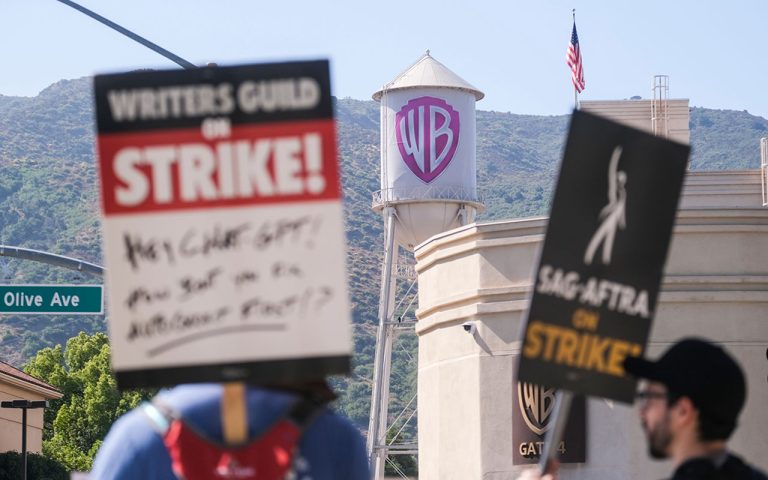
Strong unions push firms to reduce riskier debt, lowering risks of unemployment for U.S. workers (opens in a new tab)
Blog SEP 27, 2023
Unionization efforts and labor organizing are increasingly ubiquitous in the United States. Indeed, July 2023 was one of the busiest months for strikes in 30 years, following two years of…
By: Carlos Fernando Avenancio-Leon (opens in a new tab), Alessio Piccolo (opens in a new tab), Roberto Pinto (opens in a new tab)
New research shows that differences in state Unemployment Insurance rules cause inequity and inefficiency (opens in a new tab)
Blog JUL 19, 2023
The Unemployment Insurance system in the United States aims to provide temporary and partial wage replacement for workers who become unemployed through no fault of their own. In helping unemployed…
By: Daphné Skandalis (opens in a new tab), Ioana Marinescu (opens in a new tab), Maxim Massenkoff (opens in a new tab)
 View Chart
(opens in a new tab)
View Chart
(opens in a new tab)
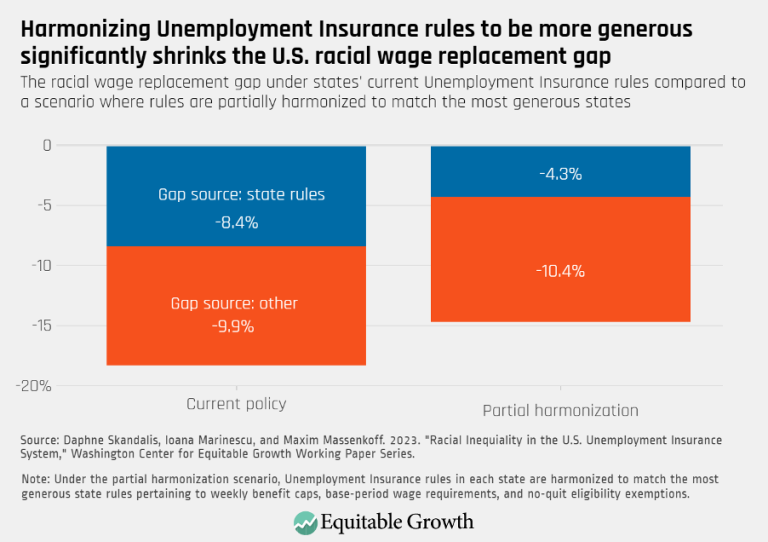
Harmonizing Unemployment Insurance rules to be more generous significantly shrinks the U.S. racial wage replacement gap (opens in a new tab)
Visualizations JUL 19, 2023

Algorithmic wage discrimination requires policy solutions that enforce predictability and the U.S. spirit of equal pay for equal work (opens in a new tab)
Blog JUL 12, 2023
U.S. consumers generally believe that gig workers who labor for companies such as Uber Technologies Inc. and Lyft Inc. are free to set their own hours and thus able to…
By: Veena Dubal (opens in a new tab)

Equitable Growth’s Jobs Day Graphs: June 2023 Report Edition (opens in a new tab)
Blog JUL 7, 2023
On July 7th, the U.S. Bureau of Labor Statistics released new data on the U.S. labor market during the month of June. Below are five graphs compiled by Equitable Growth…
By: Austin Clemens (opens in a new tab), Carmen Sanchez Cumming (opens in a new tab)
 View Chart
(opens in a new tab)
View Chart
(opens in a new tab)
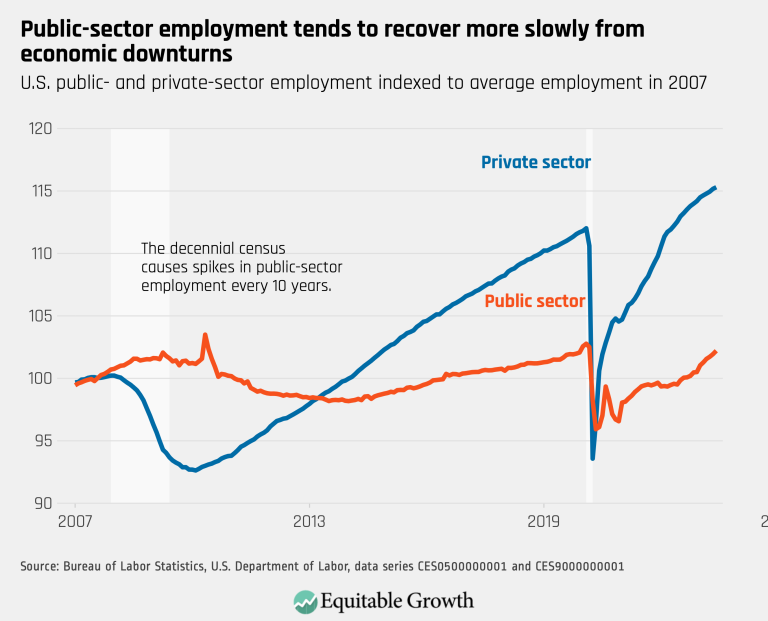
Public-sector employment tends to recover more slowly from economic downturns (opens in a new tab)
Visualizations JUL 7, 2023
 View Chart
(opens in a new tab)
View Chart
(opens in a new tab)
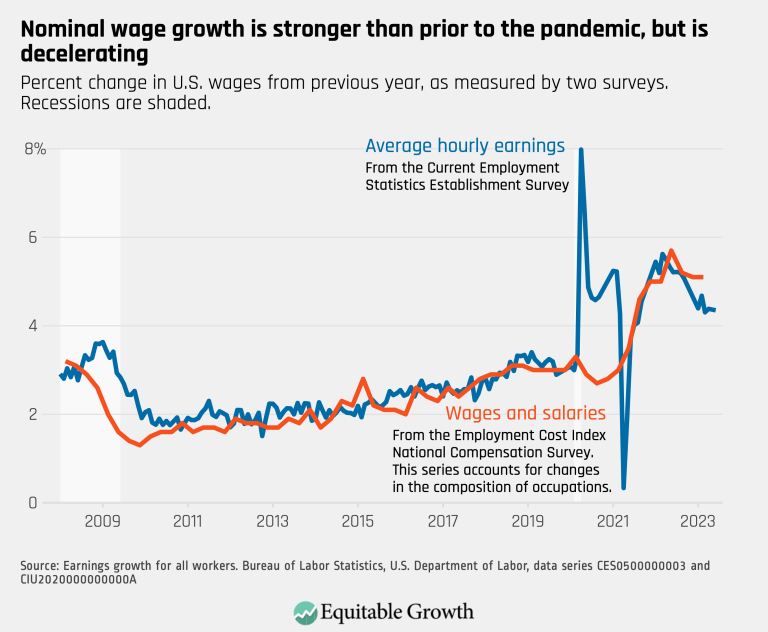
Nominal wage growth is stronger than prior to the pandemic, but is decelerating (opens in a new tab)
Visualizations JUL 7, 2023
 View Chart
(opens in a new tab)
View Chart
(opens in a new tab)
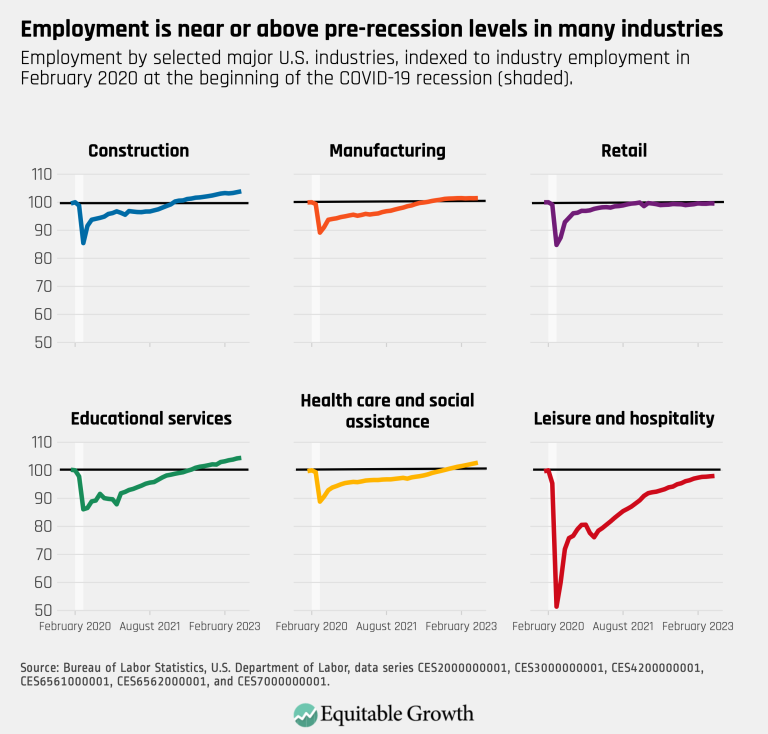
Employment is near or above pre-recession levels in many industries (opens in a new tab)
Visualizations JUL 7, 2023
 View Chart
(opens in a new tab)
View Chart
(opens in a new tab)
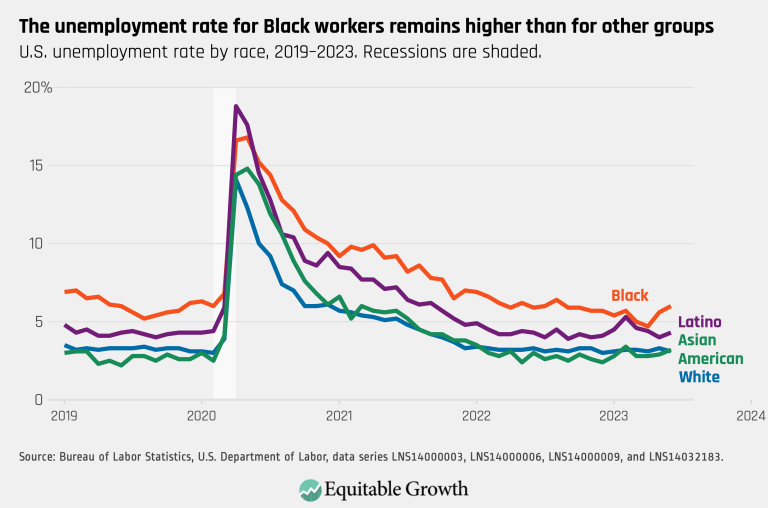
The unemployment rate for Black workers remains higher than for other groups (opens in a new tab)
Visualizations JUL 7, 2023
 View Chart
(opens in a new tab)
View Chart
(opens in a new tab)
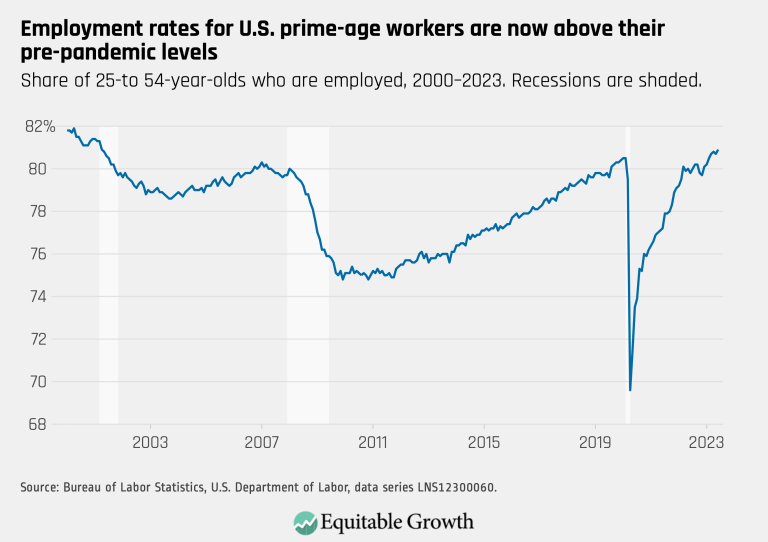
Employment rates for U.S. prime-age workers are now above their pre-pandemic levels (opens in a new tab)
Visualizations JUL 7, 2023
 View Chart
(opens in a new tab)
View Chart
(opens in a new tab)
playfair-8 (opens in a new tab)
Visualizations JUL 6, 2023
 View Chart
(opens in a new tab)
View Chart
(opens in a new tab)
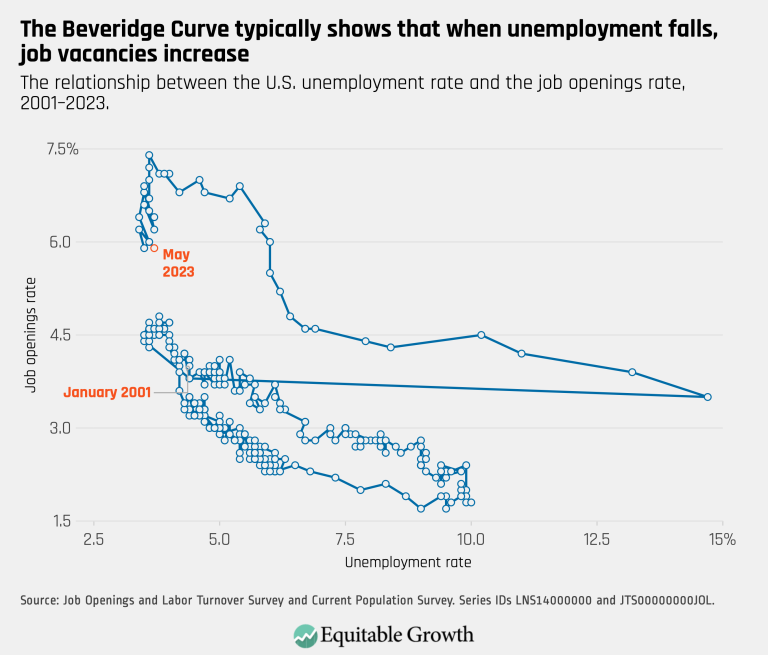
The Beveridge Curve typically shows that when unemployment falls, job vacancies increase (opens in a new tab)
Visualizations JUL 6, 2023
 View Chart
(opens in a new tab)
View Chart
(opens in a new tab)
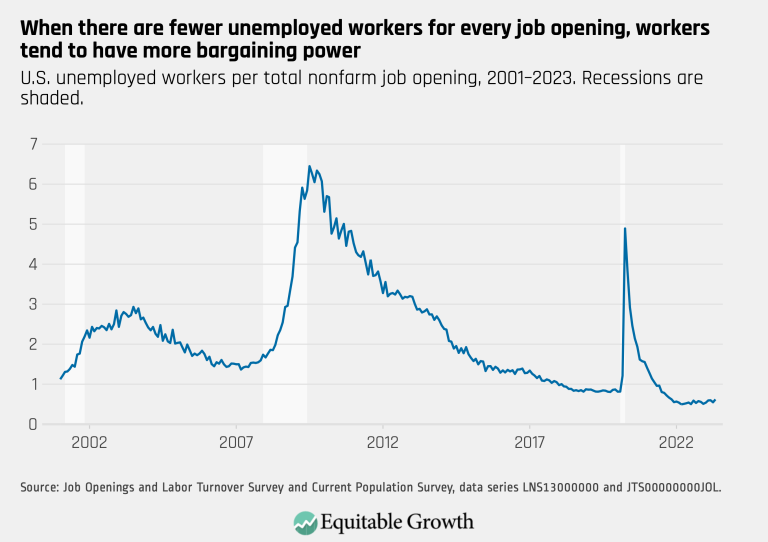
When there are fewer unemployed workers for every job opening, workers tend to have more bargaining power (opens in a new tab)
Visualizations JUL 6, 2023
 View Chart
(opens in a new tab)
View Chart
(opens in a new tab)
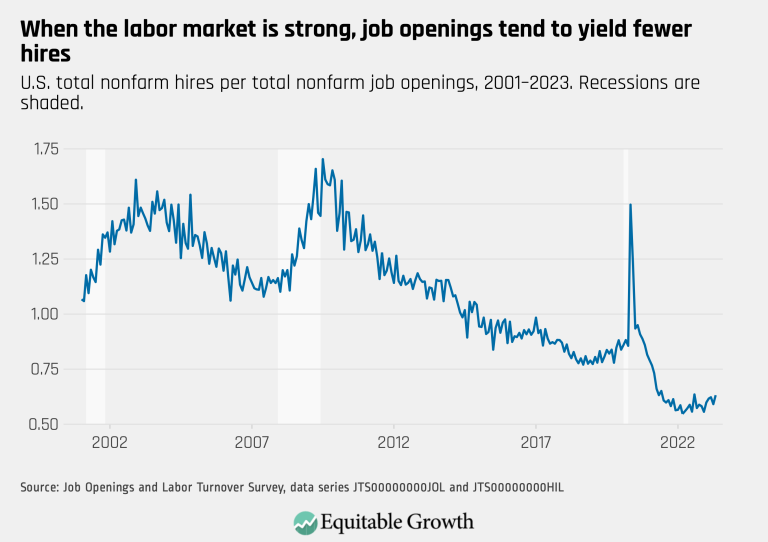
When the labor market is strong, job openings tend to yield fewer hires (opens in a new tab)
Visualizations JUL 6, 2023
 View Chart
(opens in a new tab)
View Chart
(opens in a new tab)
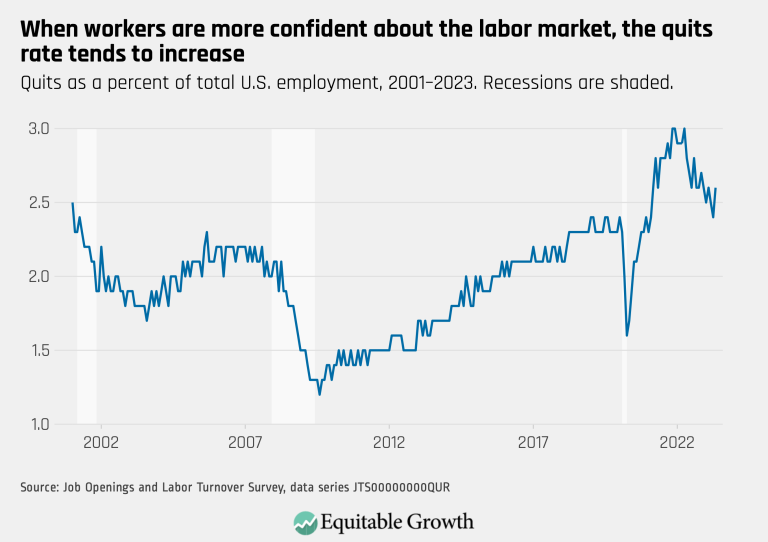
When workers are more confident about the labor market, the equity rate tends to increase (opens in a new tab)
Visualizations JUL 6, 2023

JOLTS Day Graphs: May 2023 Edition (opens in a new tab)
Blog JUL 6, 2023
Every month the U.S. Bureau of Labor Statistics releases data on hiring, firing, and other labor market flows from the Job Openings and Labor Turnover Survey, better known as JOLTS.…
By: Carmen Sanchez Cumming (opens in a new tab), Austin Clemens (opens in a new tab)

Ahead of the June Jobs Day report, here is what the past three months of employment data say about the health of the U.S. labor market (opens in a new tab)
Blog JUL 6, 2023
The U.S. economy is now flush with many more jobs than prior to the onset of the COVID-19 recession in early 2020, and employment growth in the country continues to…
By: Carmen Sanchez Cumming (opens in a new tab)
 View Chart
(opens in a new tab)
View Chart
(opens in a new tab)
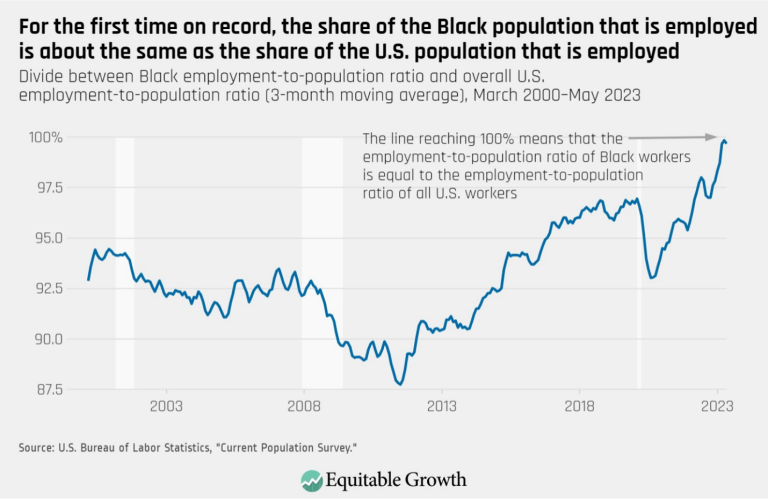
For the first time on record, the share of the Black population that is employed is about the same as the share of the U.S. population that is employed (opens in a new tab)
Visualizations JUL 6, 2023
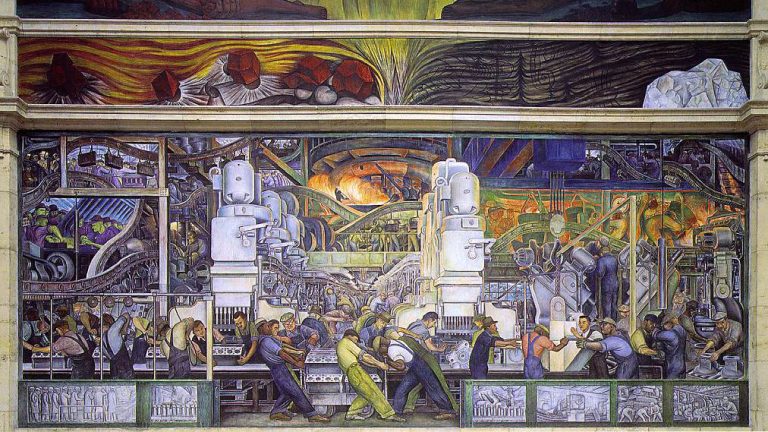
Industrial policies will be more effective at supporting good jobs and a stronger U.S. economy where there is institutional support for worker power (opens in a new tab)
Reports JUL 6, 2023
Fast facts Interest in industrial policies as tools to address the climate crisis, reach national security goals, and boost domestic economic growth and innovation is surging, with more and more…
By: Carmen Sanchez Cumming (opens in a new tab)
 View Chart
(opens in a new tab)
View Chart
(opens in a new tab)
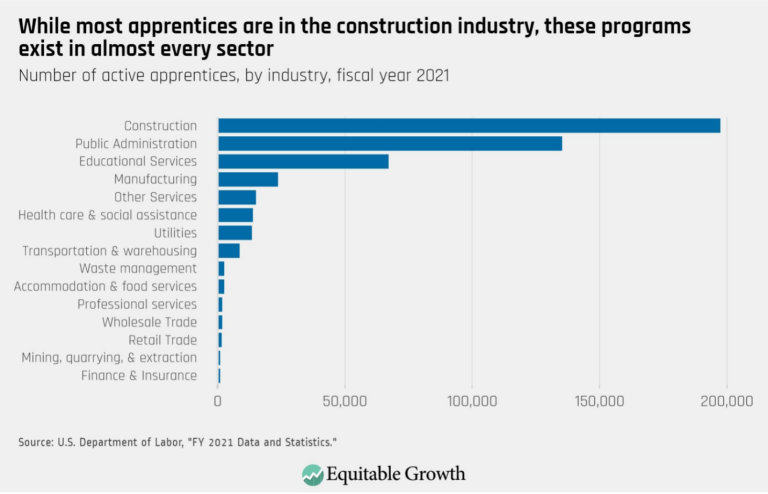
While most apprentices are in the construction industry, these programs exist in almost every sector (opens in a new tab)
Visualizations JUN 29, 2023
 View Chart
(opens in a new tab)
View Chart
(opens in a new tab)
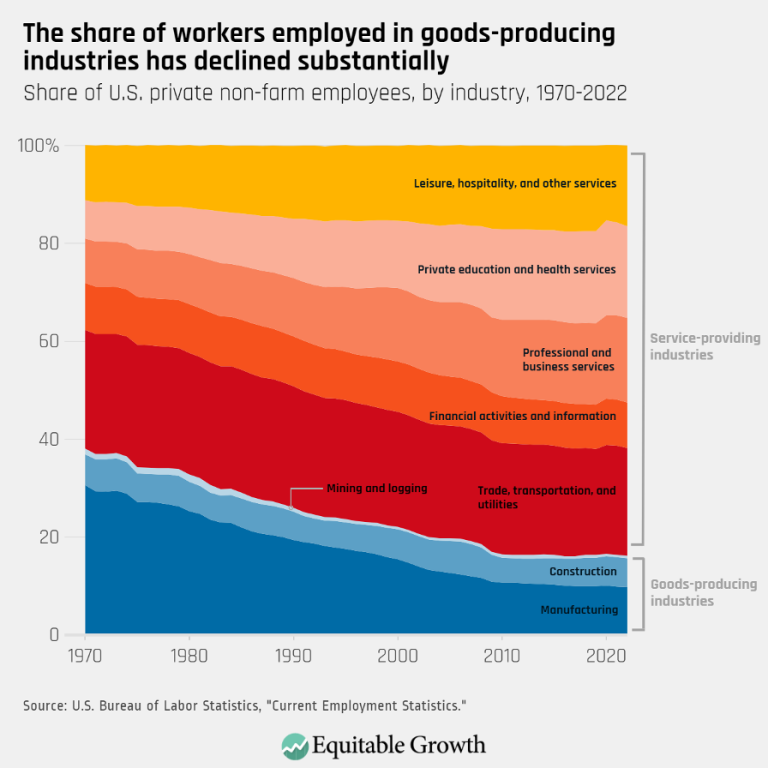
The share of workers employed in goods-producing industries has declined substantially (opens in a new tab)
Visualizations JUN 29, 2023

Paid sick leave means dads can spend more time caring for loved ones and less time worrying about missing work (opens in a new tab)
Blog JUN 15, 2023
The economic story of the United States in the post-WWII era is arguably the dramatic surge in women’s labor force participation. The increases in hours worked and income generated by…
By: Sam Abbott (opens in a new tab)
 View Chart
(opens in a new tab)
View Chart
(opens in a new tab)
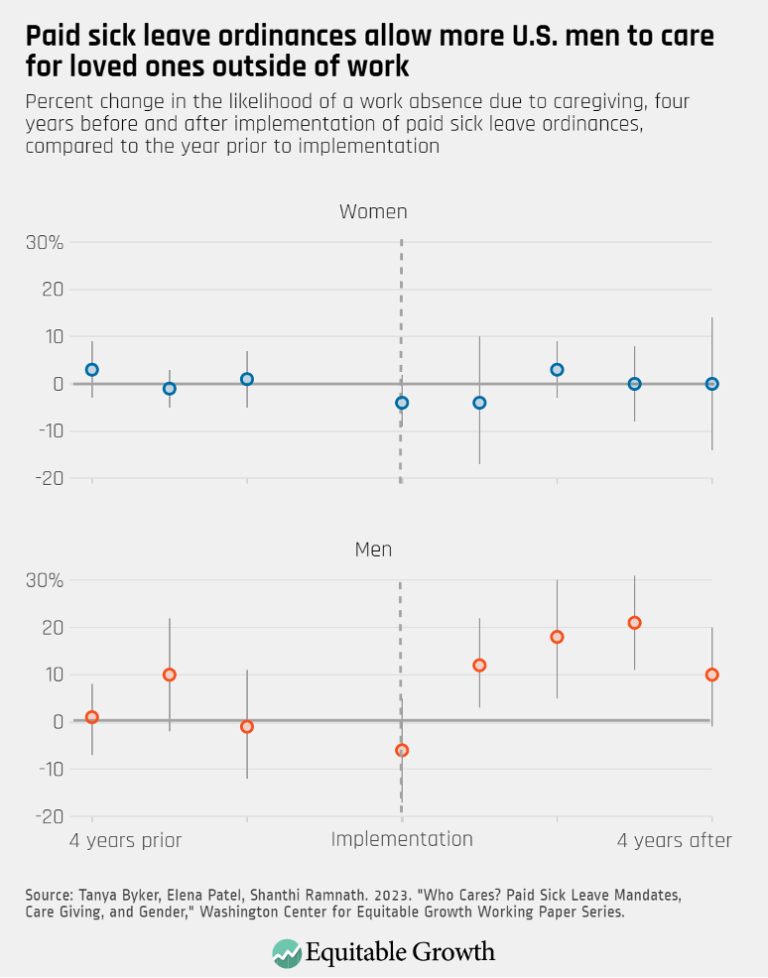
Paid sick leave ordinances allow more U.S. men to care for loved ones outside of work (opens in a new tab)
Visualizations JUN 15, 2023
 View Chart
(opens in a new tab)
View Chart
(opens in a new tab)
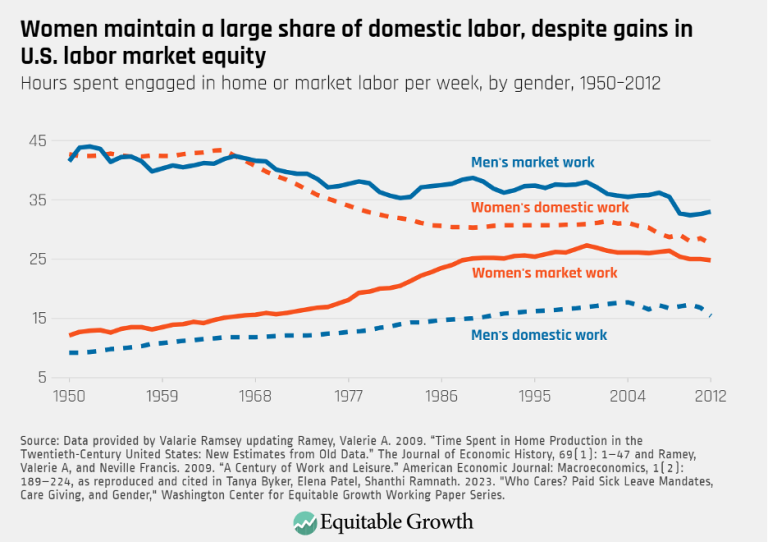
Women maintain a large share of domestic labor, despite gains in U.S. labor market equity (opens in a new tab)
Visualizations JUN 15, 2023
Equitable Growth’s Jobs Day Graphs: May 2023 Report Edition (opens in a new tab)
Blog JUN 2, 2023
On June 2nd, the U.S. Bureau of Labor Statistics released new data on the U.S. labor market during the month of May. Below are five graphs compiled by Equitable Growth…
By: Austin Clemens (opens in a new tab), Carmen Sanchez Cumming (opens in a new tab)
 View Chart
(opens in a new tab)
View Chart
(opens in a new tab)
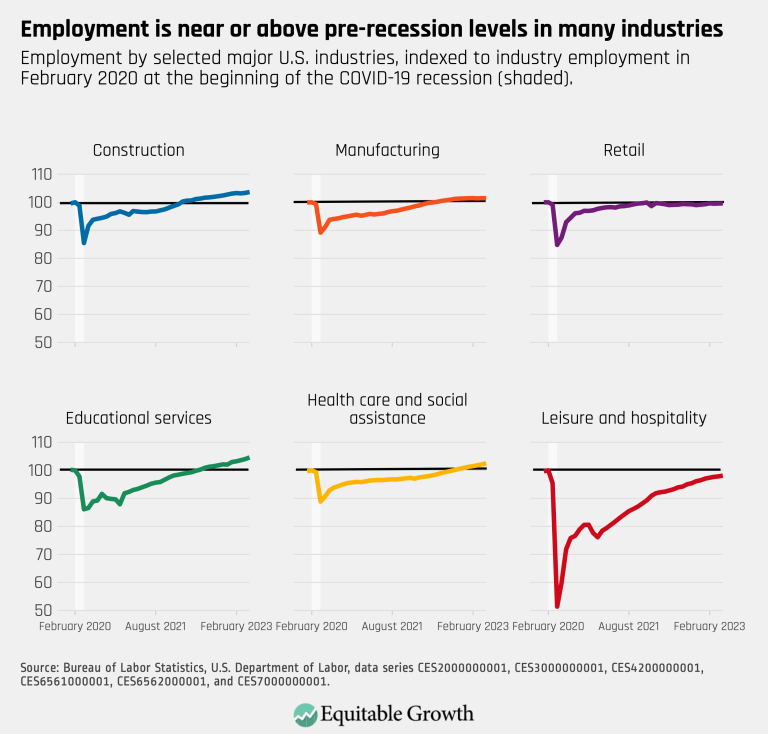
Employment is near or above pre-recession levels in many industries (opens in a new tab)
Visualizations JUN 2, 2023
 View Chart
(opens in a new tab)
View Chart
(opens in a new tab)
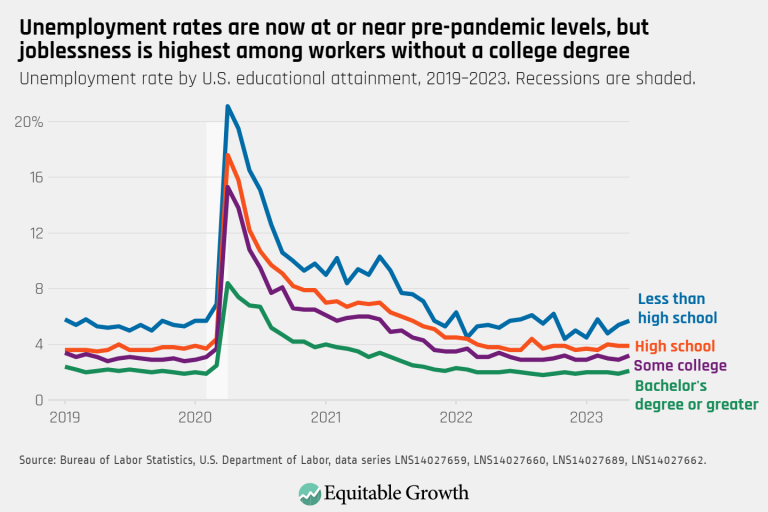
Unemployment rates are now at or near pre-pandemic levels, but joblessness is highest among workers without a college degree (opens in a new tab)
Visualizations JUN 2, 2023
 View Chart
(opens in a new tab)
View Chart
(opens in a new tab)
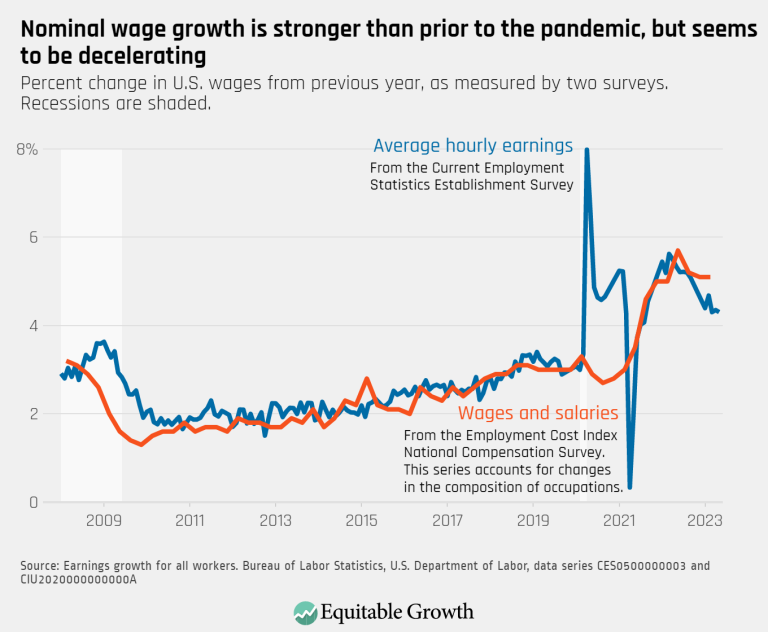
Nominal wage growth is stronger than prior to the pandemic, but seems to be decelerating (opens in a new tab)
Visualizations JUN 2, 2023
 View Chart
(opens in a new tab)
View Chart
(opens in a new tab)
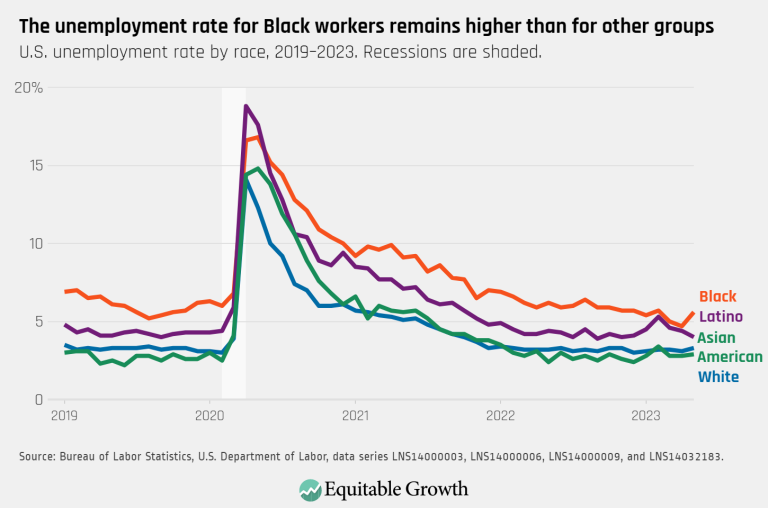
The unemployment rate for Black workers remains higher than for other groups (opens in a new tab)
Visualizations JUN 2, 2023
 View Chart
(opens in a new tab)
View Chart
(opens in a new tab)
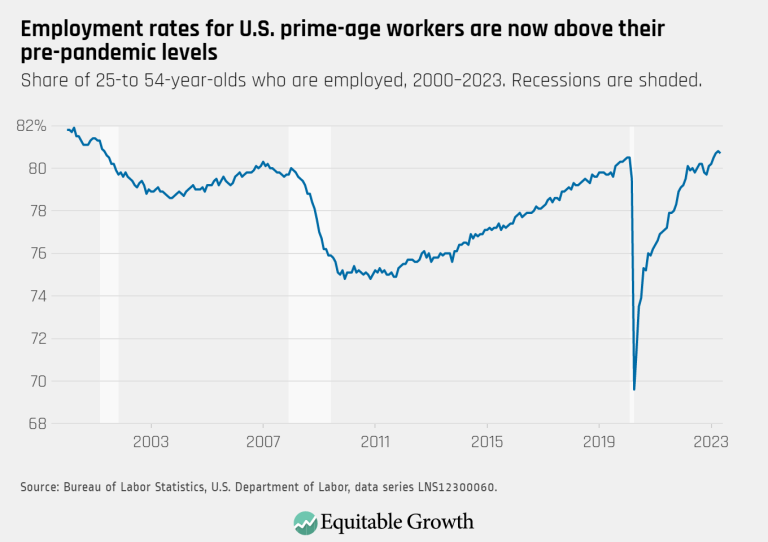
Employment rates for U.S. prime-age workers are now above their pre-pandemic levels (opens in a new tab)
Visualizations JUN 2, 2023
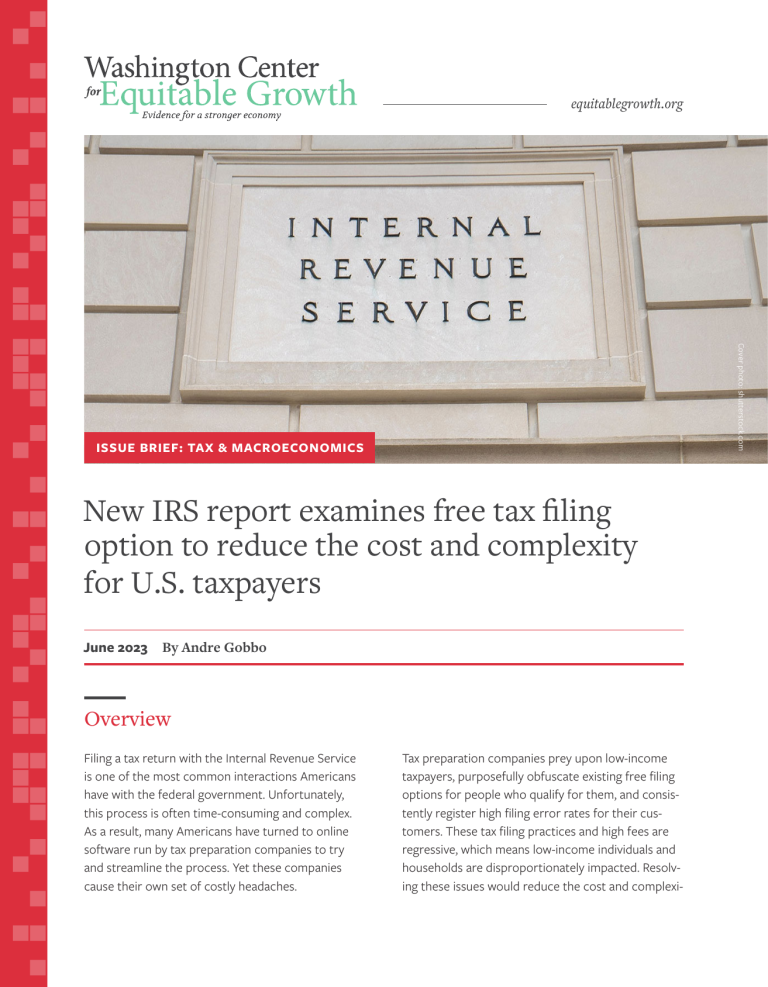
New IRS report examines free tax filing option to reduce the cost and complexity for U.S. taxpayers (opens in a new tab)
Issue Briefs JUN 1, 2023
Filing a tax return with the Internal Revenue Service is one of the most common interactions Americans have with the federal government. Unfortunately, this process is often time-consuming and complex.…
By: Andre Gobbo (opens in a new tab)
 View Chart
(opens in a new tab)
View Chart
(opens in a new tab)
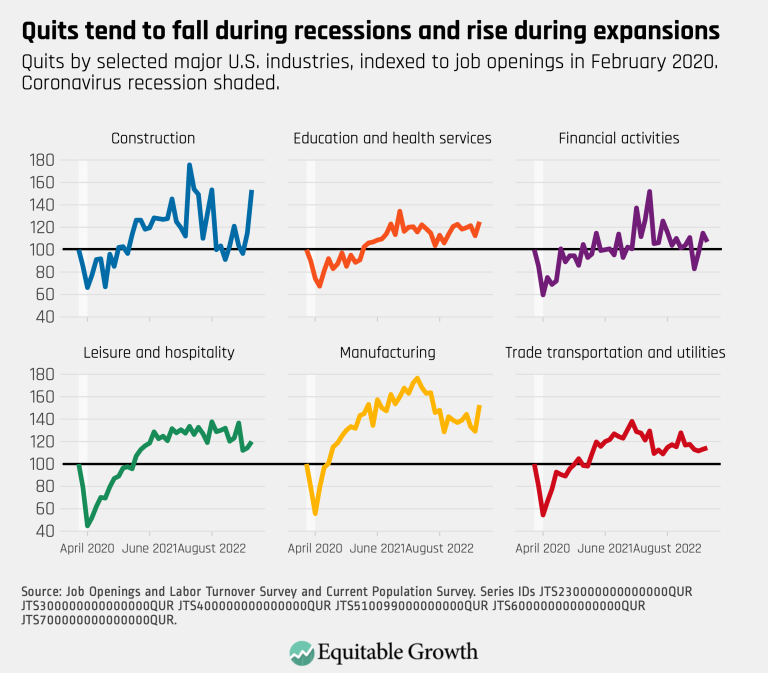
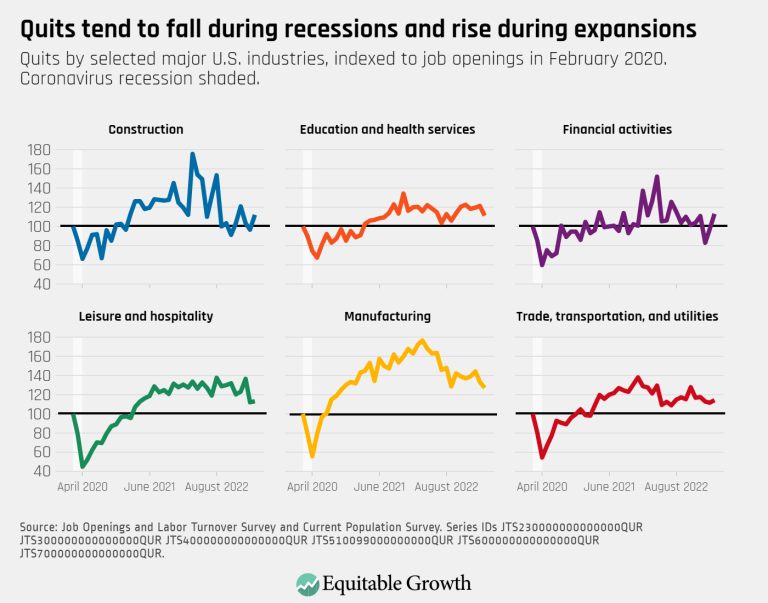
Quits tend to fall during recessions and rise during expansions (opens in a new tab)
Visualizations MAY 31, 2023
JOLTS Day Graphs: April 2023 Edition (opens in a new tab)
Blog MAY 31, 2023
Every month the U.S. Bureau of Labor Statistics releases data on hiring, firing, and other labor market flows from the Job Openings and Labor Turnover Survey, better known as JOLTS.…
By: Carmen Sanchez Cumming (opens in a new tab), Austin Clemens (opens in a new tab)

Equitable Growth grantee Gabriel Zucman awarded the 2023 John Bates Clark Medal (opens in a new tab)
Blog MAY 9, 2023
Earlier this month, associate professor of public policy and economics Gabriel Zucman at the University of California, Berkeley—and a Washington Center for Equitable Growth 2018 grantee—won the 2023 John Bates…
By: Equitable Growth (opens in a new tab)

In Conversation with Daron Acemoglu (opens in a new tab)
In Conversation MAY 8, 2023
Equitable Growth in Conversation is a recurring series where we talk with economists and other academics to help us better understand whether and how economic inequality affects economic growth and…
By: Kathryn Zickuhr (opens in a new tab)
Equitable Growth’s Jobs Day Graphs: April 2023 Report Edition (opens in a new tab)
Blog MAY 5, 2023
On May 5, the U.S. Bureau of Labor Statistics released new data on the U.S. labor market during the month of April. Below are five graphs compiled by Equitable Growth…
By: Raksha Kopparam (opens in a new tab), Kathryn Zickuhr (opens in a new tab)
 View Chart
(opens in a new tab)
View Chart
(opens in a new tab)
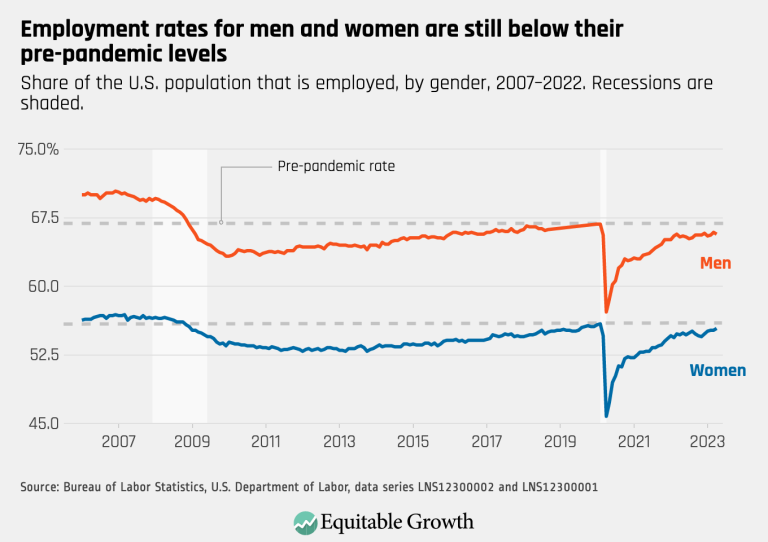
Employment rates for men and women are still below their pre-pandemic levels (opens in a new tab)
Visualizations MAY 5, 2023
 View Chart
(opens in a new tab)
View Chart
(opens in a new tab)
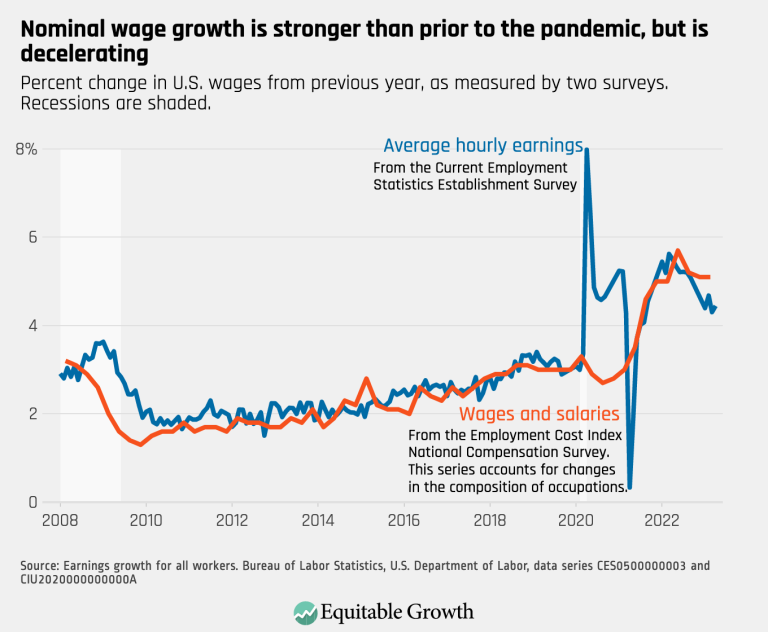
Nominal wage growth is stronger than prior to the pandemic, but is decelerating (opens in a new tab)
Visualizations MAY 5, 2023
 View Chart
(opens in a new tab)
View Chart
(opens in a new tab)
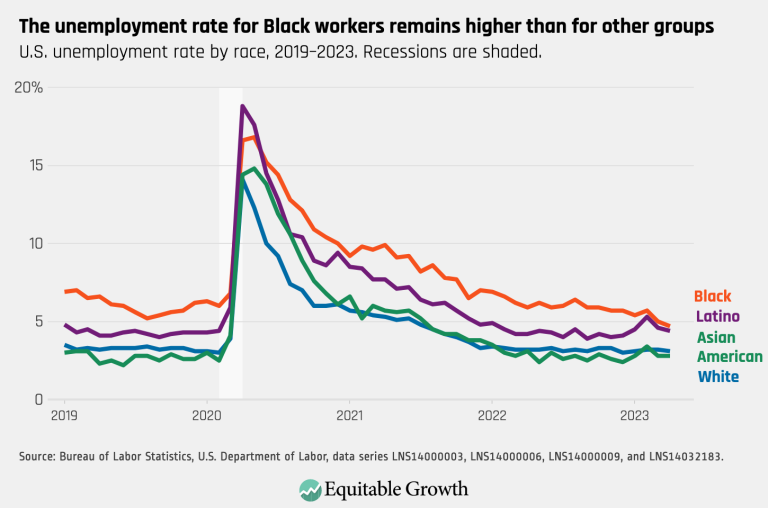
The unemployment rate for Black workers remains higher than for other groups (opens in a new tab)
Visualizations MAY 5, 2023
 View Chart
(opens in a new tab)
View Chart
(opens in a new tab)
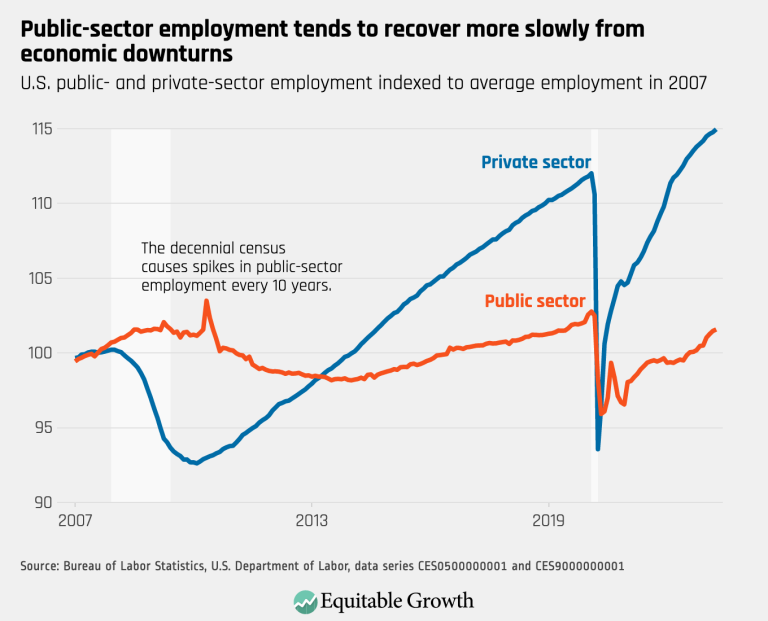
Public-sector employment tends to recover more slowly from economic downturns (opens in a new tab)
Visualizations MAY 5, 2023
 View Chart
(opens in a new tab)
View Chart
(opens in a new tab)
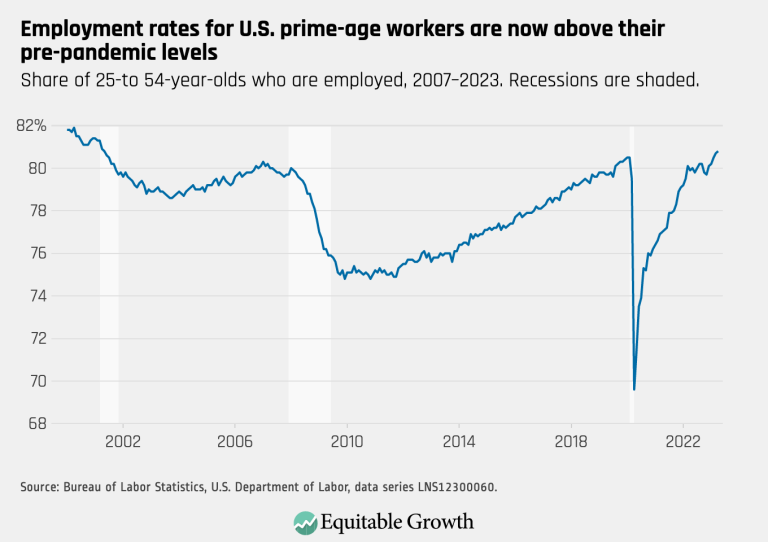
Employment rates for U.S. prime-age workers are now above their pre-pandemic levels (opens in a new tab)
Visualizations MAY 5, 2023
JOLTS Day Graphs: March 2023 Edition (opens in a new tab)
Blog MAY 2, 2023
Every month the U.S. Bureau of Labor Statistics releases data on hiring, firing, and other labor market flows from the Job Openings and Labor Turnover Survey, better known as JOLTS.…
By: Raksha Kopparam (opens in a new tab), Kathryn Zickuhr (opens in a new tab)
 View Chart
(opens in a new tab)
View Chart
(opens in a new tab)
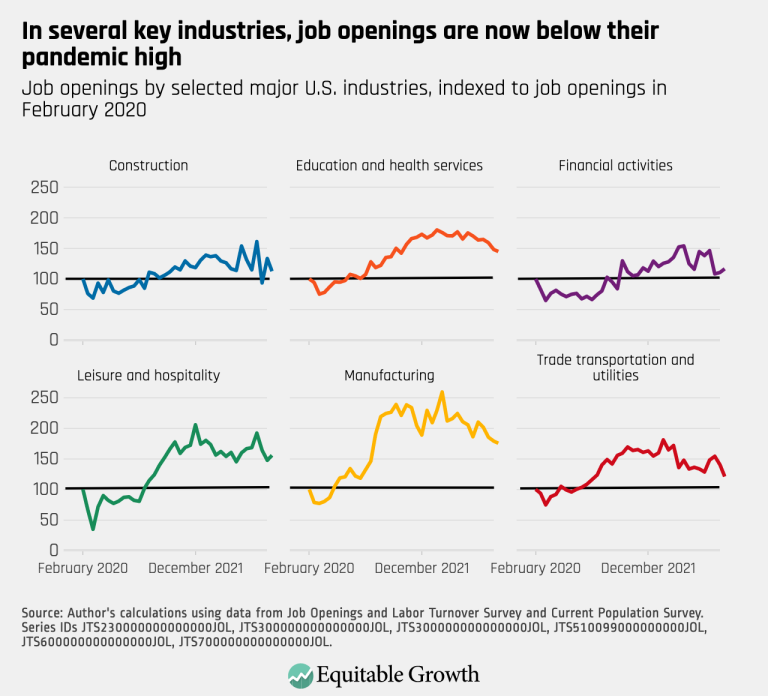
In several key industries, job openings are now below their pandemic high (opens in a new tab)
Visualizations MAY 2, 2023
 View Chart
(opens in a new tab)
View Chart
(opens in a new tab)
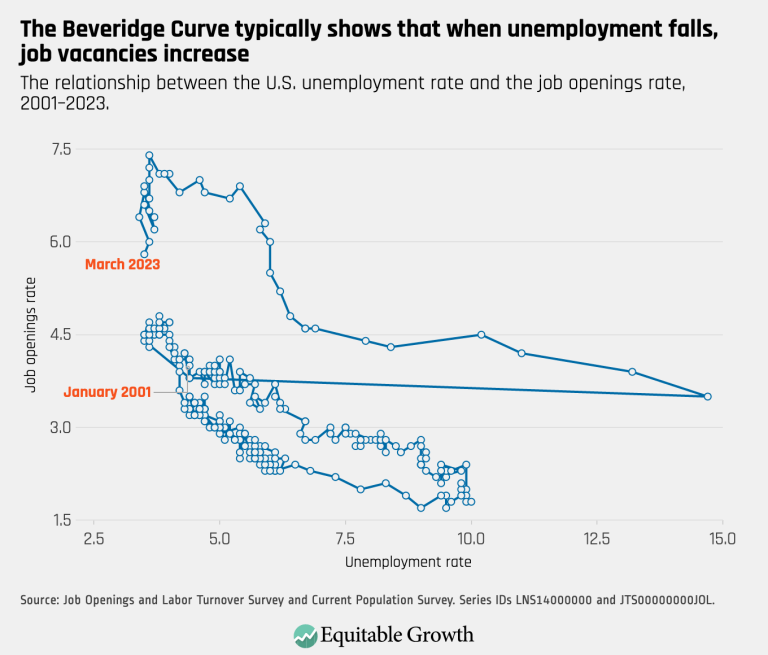
The Beveridge Curve typically shows that when unemployment falls, job vacancies increase (opens in a new tab)
Visualizations MAY 2, 2023
 View Chart
(opens in a new tab)
View Chart
(opens in a new tab)
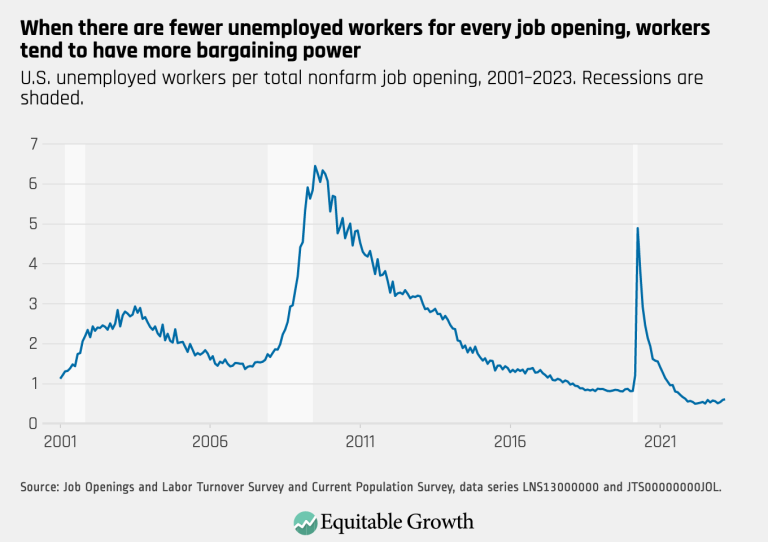
When there are fewer unemployed workers for every job opening, workers tend to have more bargaining power (opens in a new tab)
Visualizations MAY 2, 2023
 View Chart
(opens in a new tab)
View Chart
(opens in a new tab)
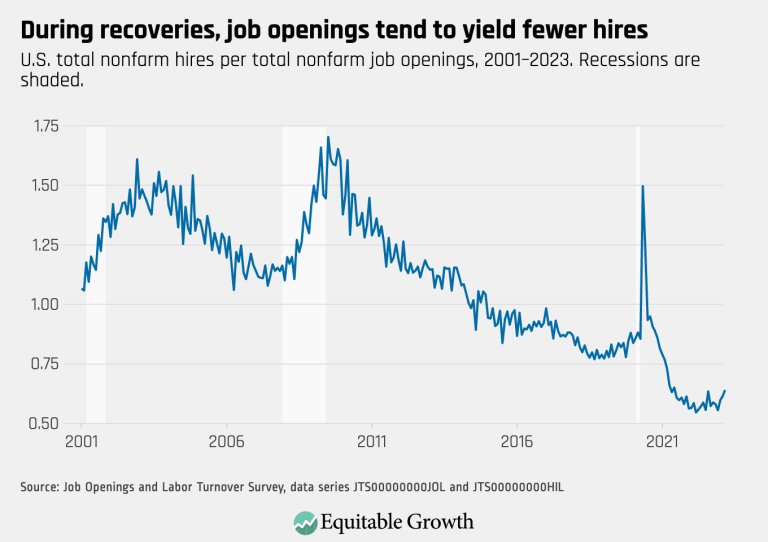
During recoveries, job openings tend to yield fewer hires (opens in a new tab)
Visualizations MAY 2, 2023
 View Chart
(opens in a new tab)
View Chart
(opens in a new tab)
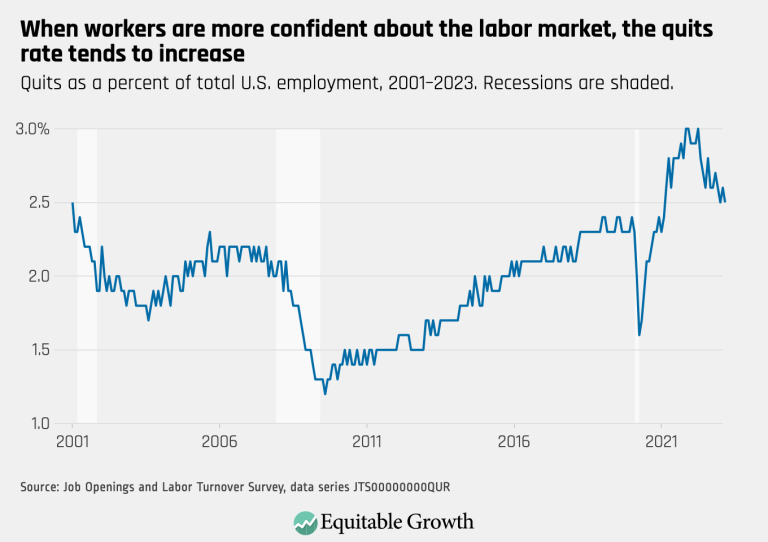
When workers are more confident about the labor market, the quits rate tends to increase (opens in a new tab)
Visualizations MAY 2, 2023

Equitable Growth delivers comment letter responding to the Federal Trade Commission’s Advanced Notice of Proposed Rulemaking on Non-Compete Clauses (opens in a new tab)
Blog APR 20, 2023
The Washington Center for Equitable Growth this week delivered a comment letter responding to the Federal Trade Commission’s Advanced Notice of Proposed Rulemaking on Non-Compete Clauses. In our comment letter,…
By: Equitable Growth (opens in a new tab)

Seven ways the inflation debate in the United States has changed since last year and how the Fed can now recalibrate its monetary policy (opens in a new tab)
Blog APR 12, 2023
Inflation in the United States today is considerably cooler than at its peak in the first half of 2022, but it will remain at the center of the economic policy…
By: Michael Madowitz (opens in a new tab)
Equitable Growth’s Jobs Day Graphs: March 2023 Report Edition (opens in a new tab)
Blog APR 7, 2023
On April 7, the U.S. Bureau of Labor Statistics released new data on the U.S. labor market during the month of March. Below are five graphs compiled by Equitable Growth…
By: Kathryn Zickuhr (opens in a new tab), Carmen Sanchez Cumming (opens in a new tab)
 View Chart
(opens in a new tab)
View Chart
(opens in a new tab)
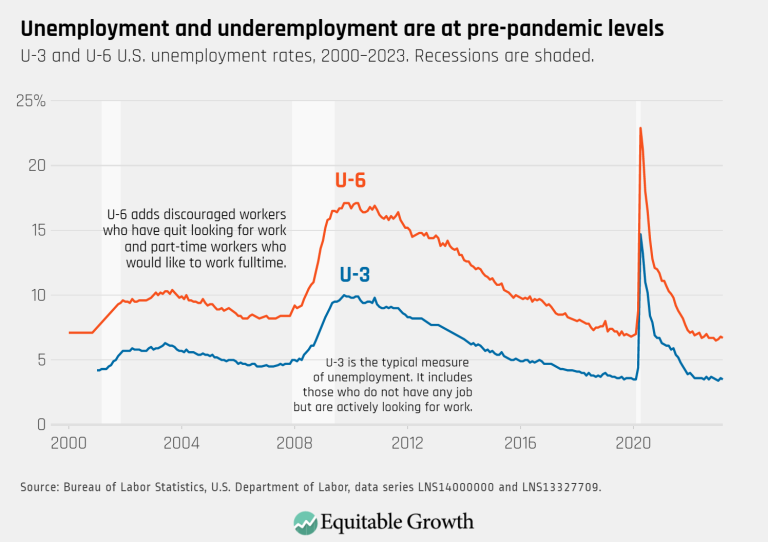
Unemployment and underemployment are now at pre-pandemic levels (opens in a new tab)
Visualizations APR 7, 2023
 View Chart
(opens in a new tab)
View Chart
(opens in a new tab)
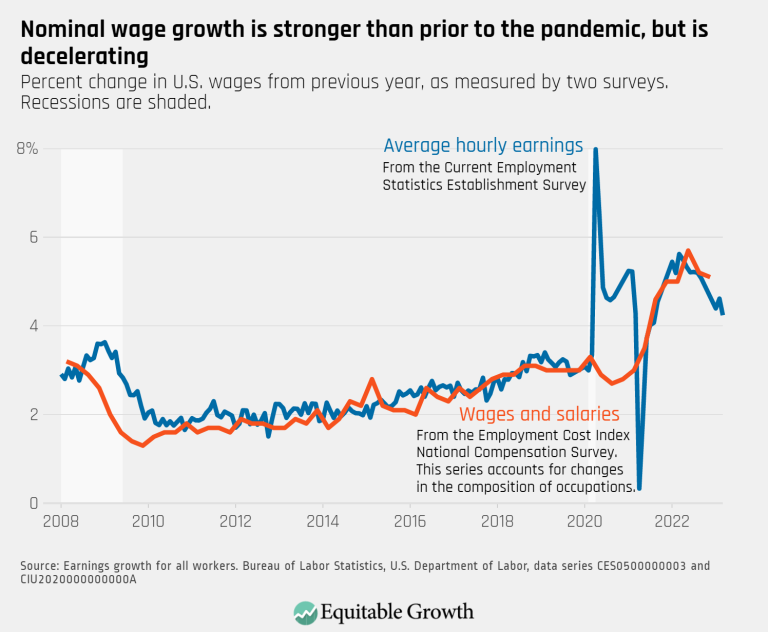
Nominal-wage-growth-is-stronger-than-prior-to-the-pandemic-but-is-be-decelerating (opens in a new tab)
Visualizations APR 7, 2023
 View Chart
(opens in a new tab)
View Chart
(opens in a new tab)
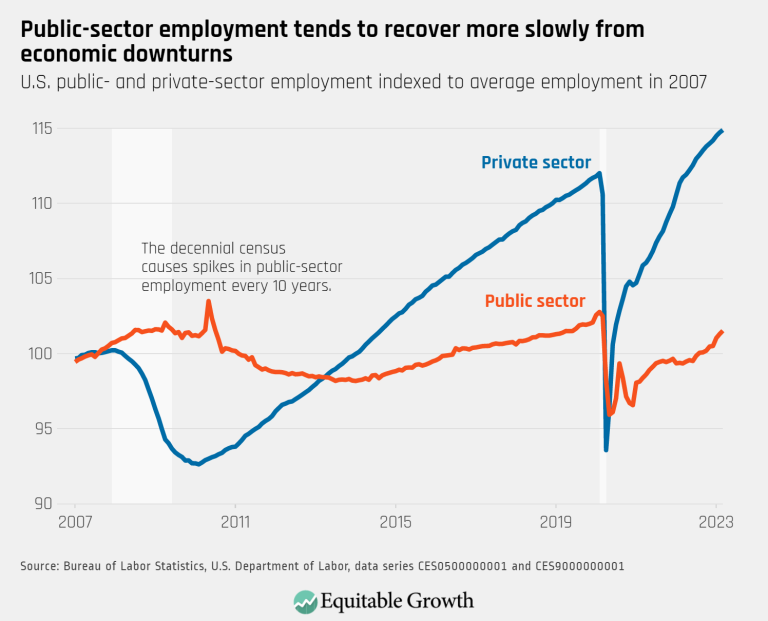
Public-sector employment tends to recover more slowly from economic downturns (opens in a new tab)
Visualizations APR 7, 2023
 View Chart
(opens in a new tab)
View Chart
(opens in a new tab)
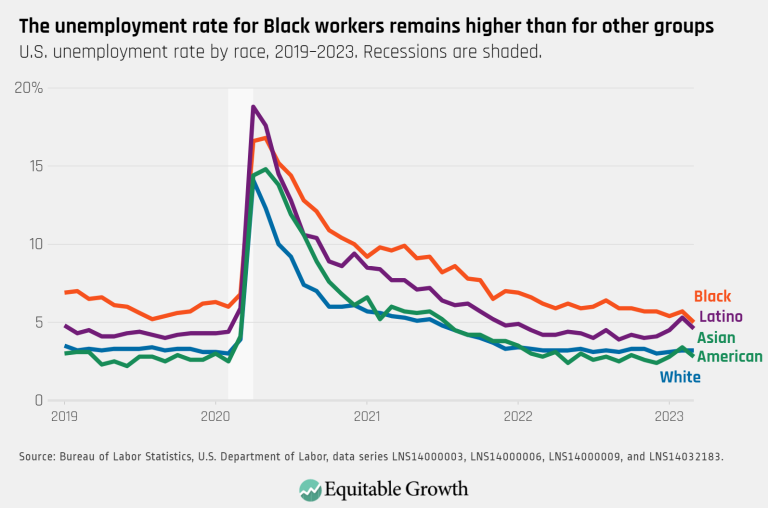
The unemployment rate for Black workers remains higher than for other groups (opens in a new tab)
Visualizations APR 7, 2023
JOLTS Day Graphs: February 2023 Edition (opens in a new tab)
Blog APR 4, 2023
Every month the U.S. Bureau of Labor Statistics releases data on hiring, firing, and other labor market flows from the Job Openings and Labor Turnover Survey, better known as JOLTS.…
By: Kathryn Zickuhr (opens in a new tab), Carmen Sanchez Cumming (opens in a new tab)
 View Chart
(opens in a new tab)
View Chart
(opens in a new tab)
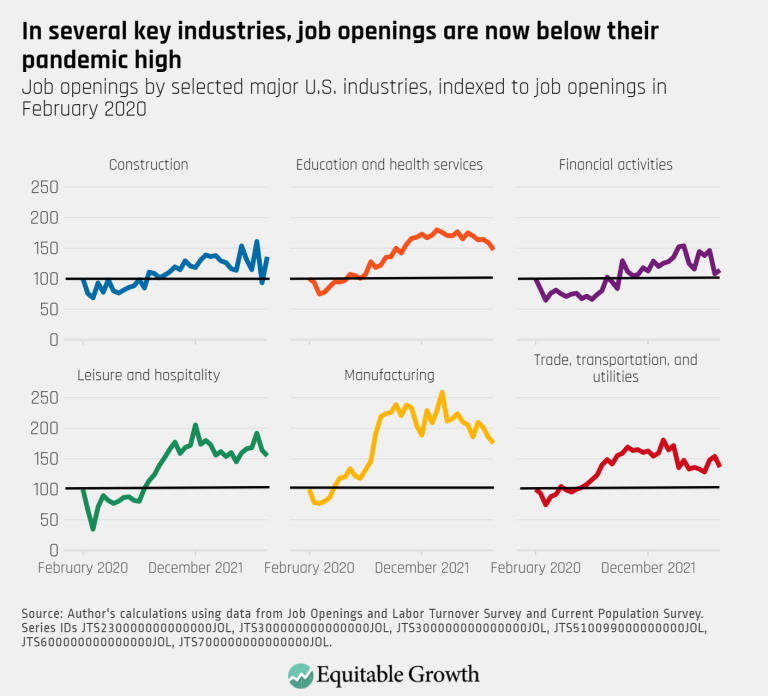
In several key industries, job openings are now below their pandemic high (opens in a new tab)
Visualizations APR 4, 2023
 View Chart
(opens in a new tab)
View Chart
(opens in a new tab)
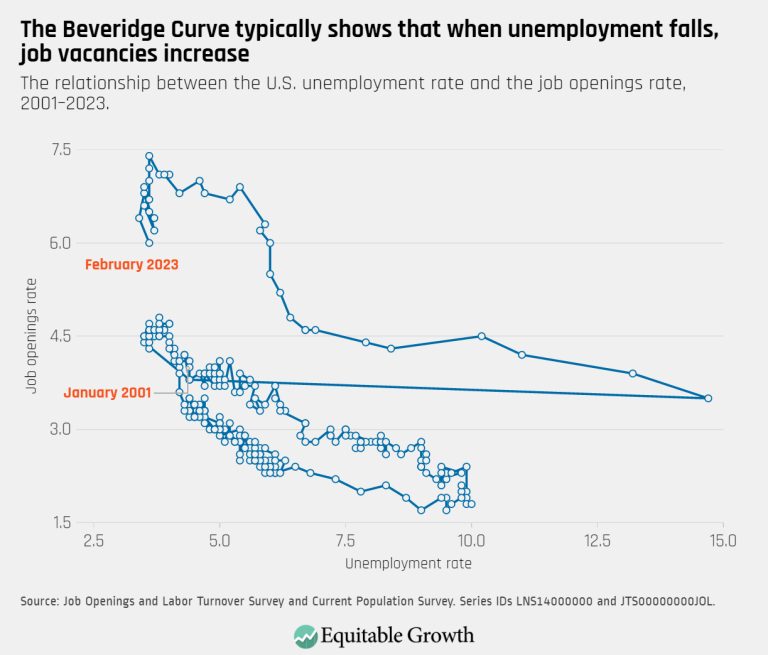
The Beveridge Curve typically shows that when unemployment falls, job vacancies increase (opens in a new tab)
Visualizations APR 4, 2023
 View Chart
(opens in a new tab)
View Chart
(opens in a new tab)
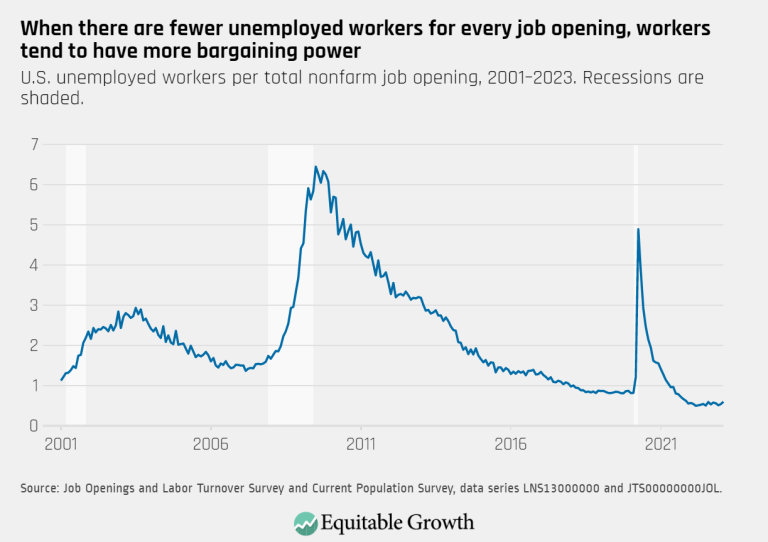
When there are fewer unemployed workers for every job opening, workers tend to have more bargaining power (opens in a new tab)
Visualizations APR 4, 2023
 View Chart
(opens in a new tab)
View Chart
(opens in a new tab)
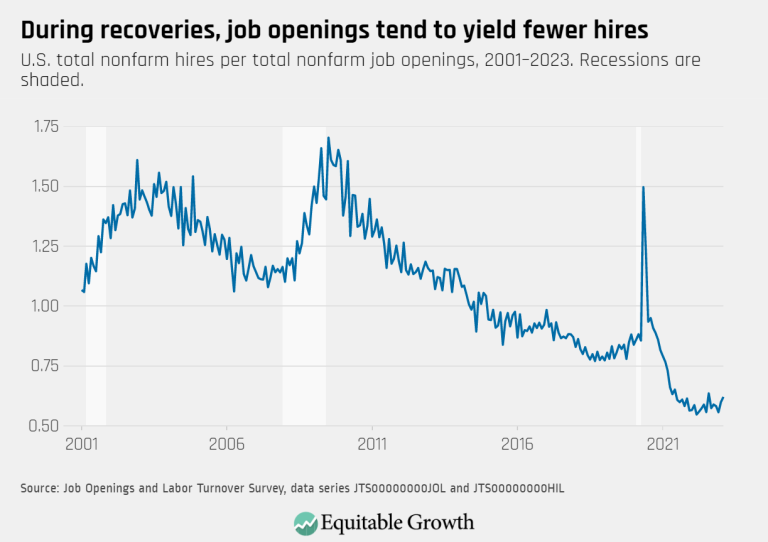
During recoveries, job openings tend to yield fewer hires (opens in a new tab)
Visualizations APR 4, 2023
 View Chart
(opens in a new tab)
View Chart
(opens in a new tab)
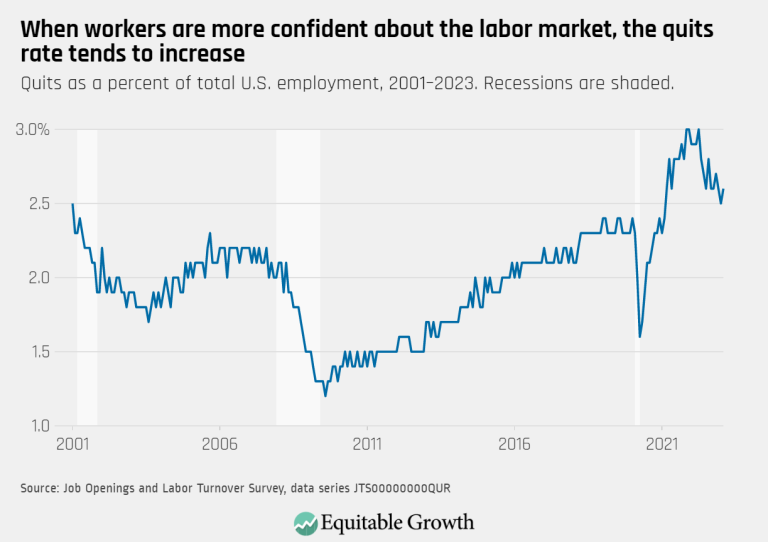
When workers are more confident about the labor market, the quits rate tends to increase (opens in a new tab)
Visualizations APR 4, 2023
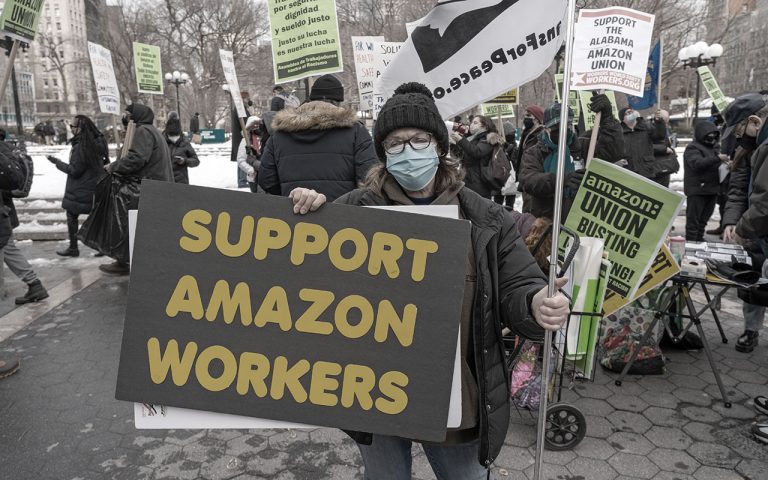
Executive actions to strengthen unions and increase worker power in the United States (opens in a new tab)
Blog APR 3, 2023
Relevant federal agencies: U.S. Department of Labor White House Relevant federal laws: The Fair Labor Standards Act of 1938 (29 U.S.C. § 203) National Labor Relations Act of 1935 (Public…
By: Equitable Growth (opens in a new tab)

Executive actions to reduce inequality and improve job quality for U.S. workers (opens in a new tab)
Blog MAR 16, 2023
Relevant federal agencies: Federal Trade Commission Equal Employment Opportunity Commission Office of Personnel Management Relevant laws: Federal Trade Commission’s Trade Regulation Rule on Commercial Surveillance and Data Security, Commercial Surveillance…
By: Equitable Growth (opens in a new tab)
Equitable Growth’s Jobs Day Graphs: February 2023 Report Edition (opens in a new tab)
Blog MAR 10, 2023
On March 10, the U.S. Bureau of Labor Statistics released new data on the U.S. labor market during the month of February. Below are five graphs compiled by Equitable Growth…
By: Kathryn Zickuhr (opens in a new tab), Carmen Sanchez Cumming (opens in a new tab)
 View Chart
(opens in a new tab)
View Chart
(opens in a new tab)
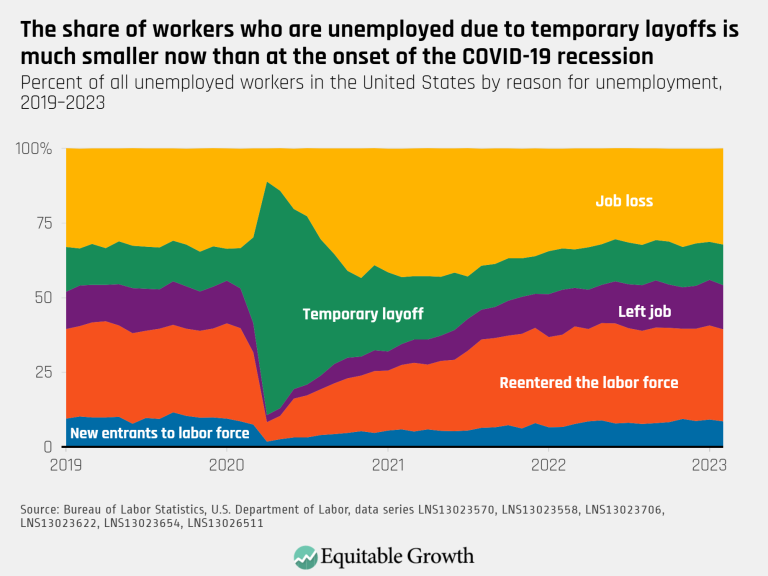
The-share-of-workers-who-are-unemployed-due-to-temporary-layoffs-is-much-smaller-now-than-at-the-onset-of-the-COVID-19-recession (opens in a new tab)
Visualizations MAR 10, 2023
 View Chart
(opens in a new tab)
View Chart
(opens in a new tab)
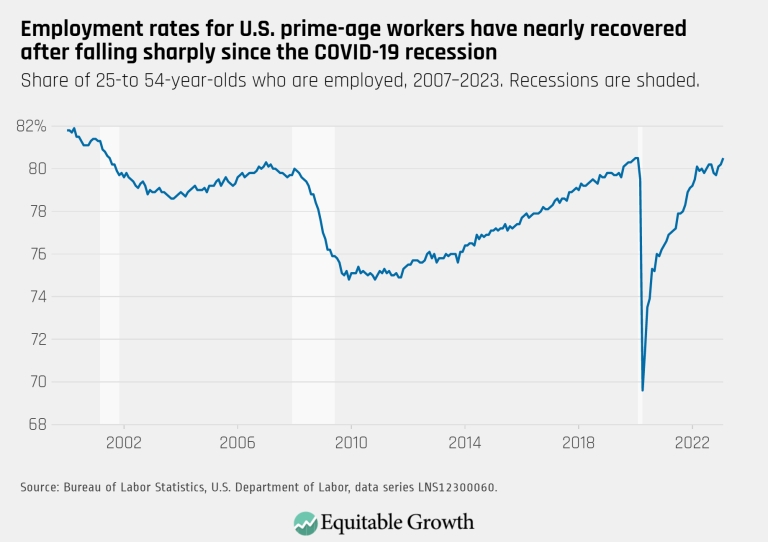
Employment rates for U.S. prime-age workers have nearly recovered after falling sharply since the COVID-19 recession (opens in a new tab)
Visualizations MAR 10, 2023

The importance of the American Rescue Plan for U.S. workers and families on the law’s second anniversary, in 8 charts (opens in a new tab)
Blog MAR 10, 2023
Tomorrow marks 2 years since the American Rescue Plan Act was signed into law. One year after the COVID-19 pandemic that began in early 2020 triggered enormous employment losses and…
By: Carmen Sanchez Cumming (opens in a new tab), Raksha Kopparam (opens in a new tab)
 View Chart
(opens in a new tab)
View Chart
(opens in a new tab)
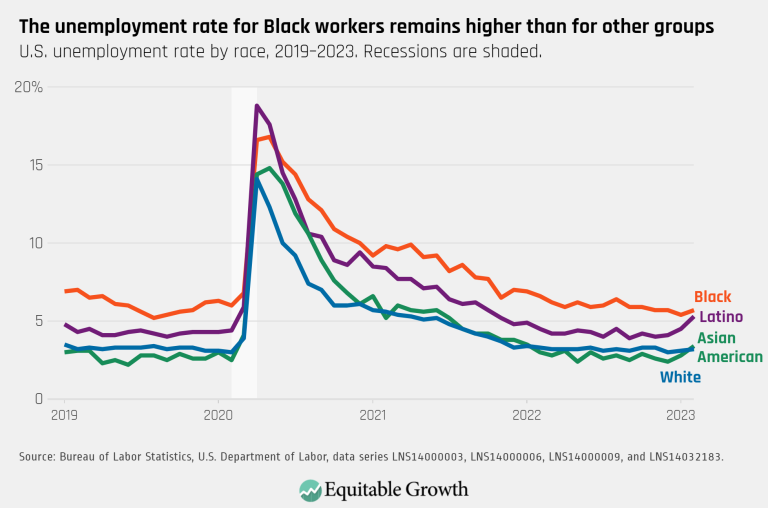
The unemployment rate for Black workers remains higher than for other groups (opens in a new tab)
Visualizations MAR 10, 2023
 View Chart
(opens in a new tab)
View Chart
(opens in a new tab)
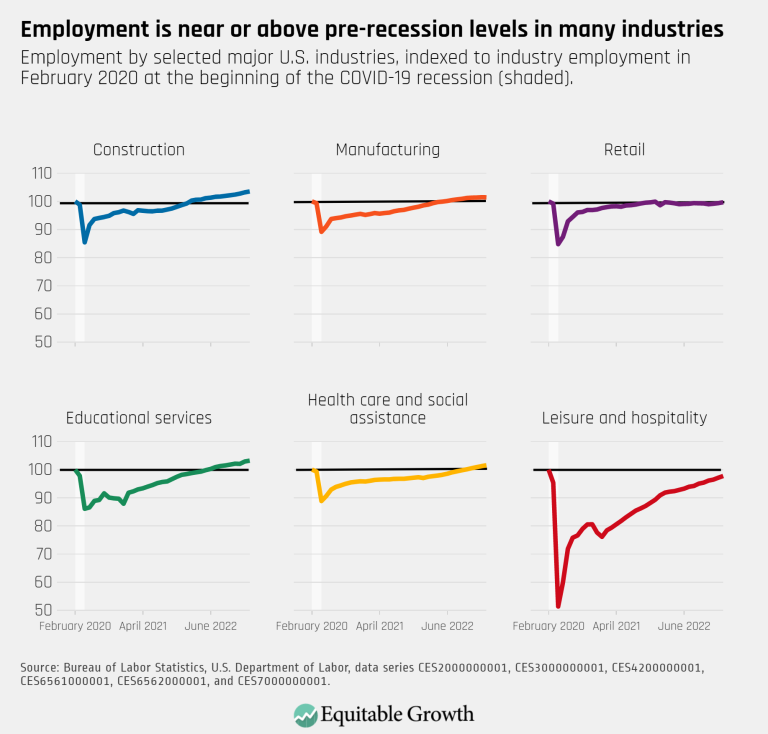
Employment is near or above pre-recession levels in many industries (opens in a new tab)
Visualizations MAR 10, 2023
 View Chart
(opens in a new tab)
View Chart
(opens in a new tab)
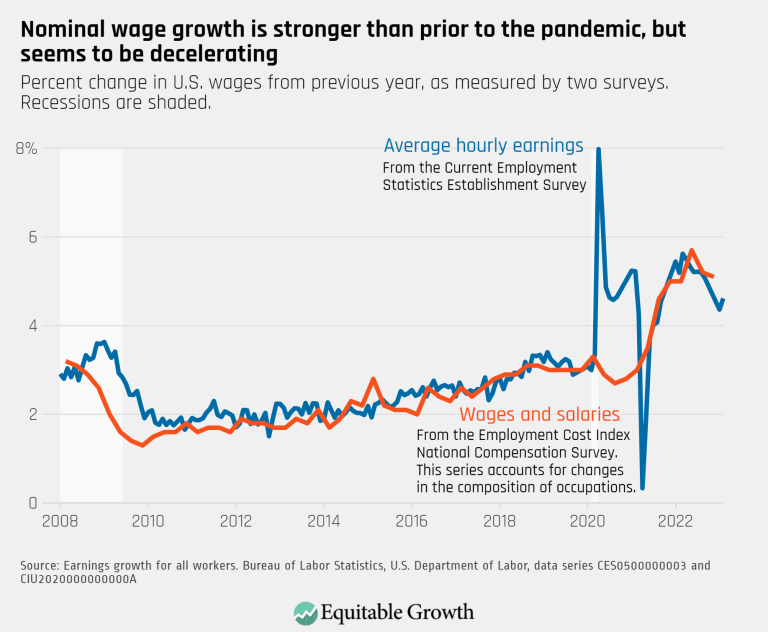
Nominal wage growth is stronger than prior to the pandemic, but seems to be decelerating (opens in a new tab)
Visualizations MAR 10, 2023
JOLTS Day Graphs: January 2023 Edition (opens in a new tab)
Blog MAR 8, 2023
Every month the U.S. Bureau of Labor Statistics releases data on hiring, firing, and other labor market flows from the Job Openings and Labor Turnover Survey, better known as JOLTS.…
By: Kathryn Zickuhr (opens in a new tab), Carmen Sanchez Cumming (opens in a new tab)
 View Chart
(opens in a new tab)
View Chart
(opens in a new tab)
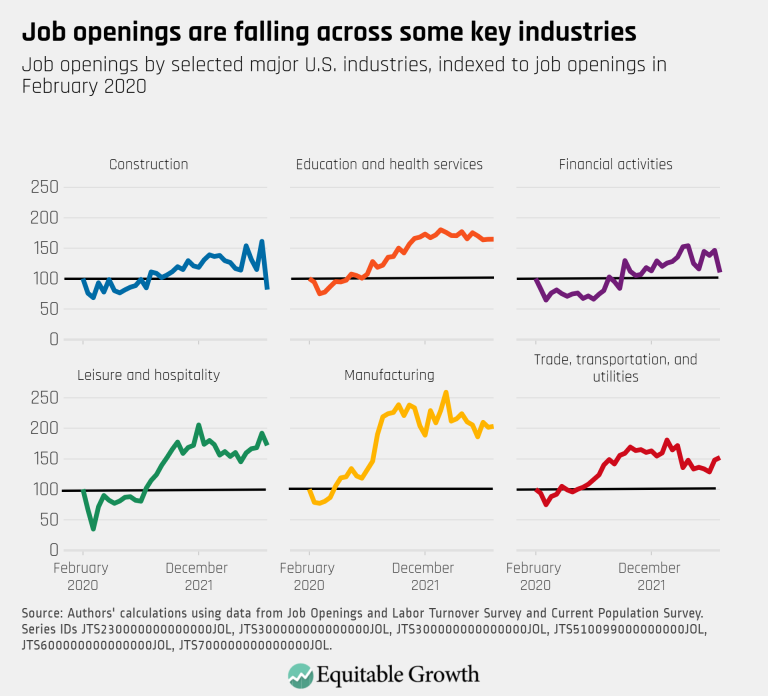
Job openings are falling across some key industries, but generally remain above pre-pandemic levels (opens in a new tab)
Visualizations MAR 8, 2023
 View Chart
(opens in a new tab)
View Chart
(opens in a new tab)
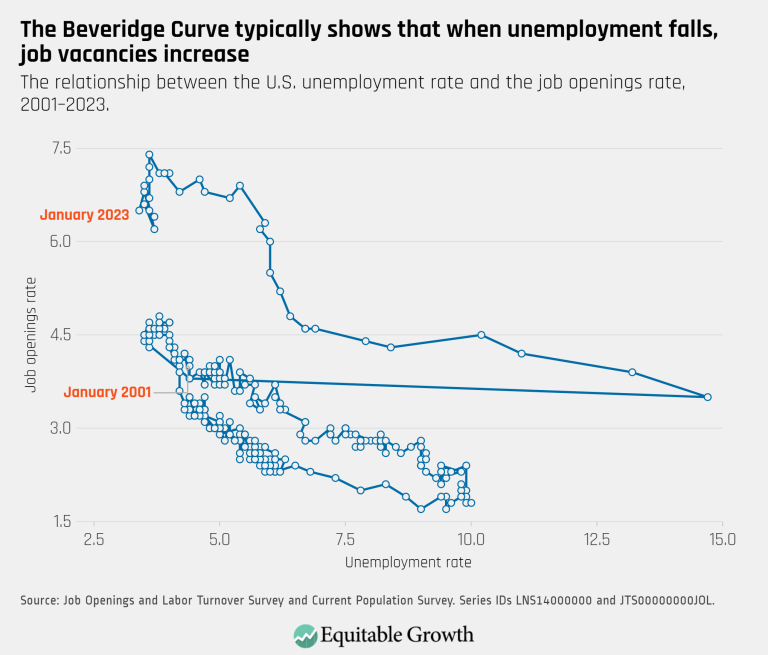
The Beveridge Curve typically shows that when unemployment falls, job vacancies increase (opens in a new tab)
Visualizations MAR 8, 2023
 View Chart
(opens in a new tab)
View Chart
(opens in a new tab)
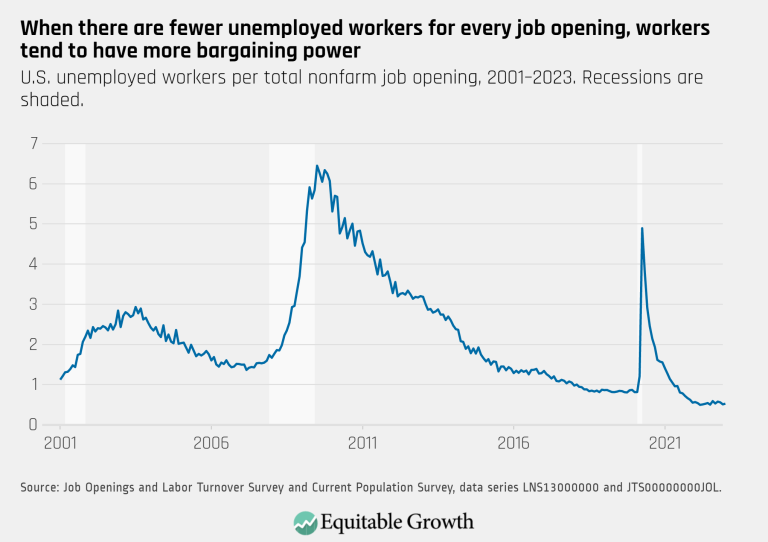
When there are fewer unemployed workers for every job opening, workers tend to have more bargaining power (opens in a new tab)
Visualizations MAR 8, 2023
 View Chart
(opens in a new tab)
View Chart
(opens in a new tab)
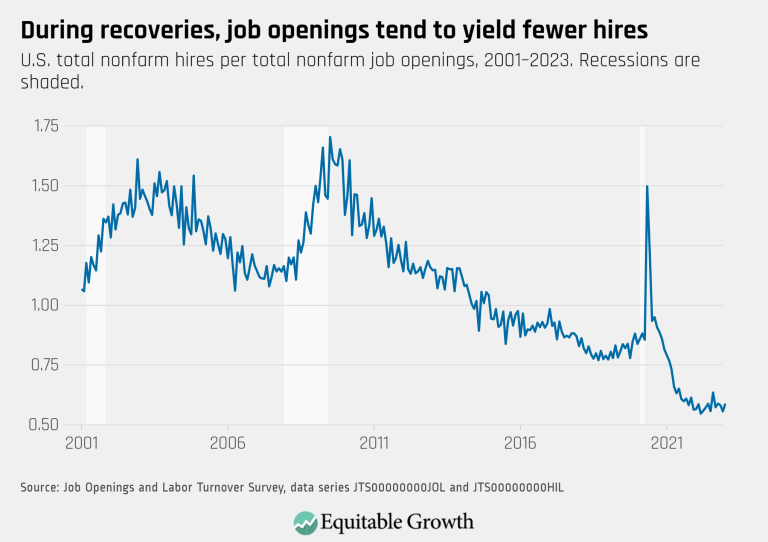
During recoveries, job openings tend to yield fewer hires (opens in a new tab)
Visualizations MAR 8, 2023
 View Chart
(opens in a new tab)
View Chart
(opens in a new tab)
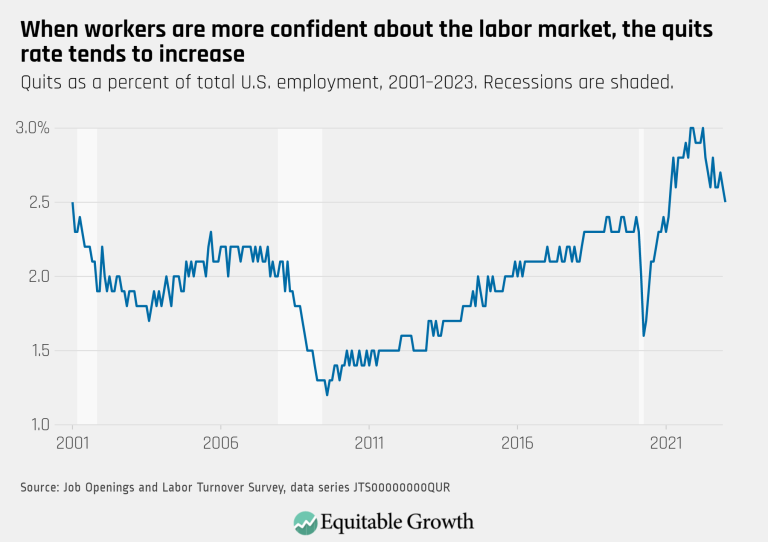
When workers are more confident about the labor market, the quits rate tends to increase (opens in a new tab)
Visualizations MAR 8, 2023

Ahead of new U.S. jobs data releases, here’s what employment growth and job switching mean for wage disparities in the U.S. labor market (opens in a new tab)
Issue Briefs MAR 7, 2023
Later this week, the U.S. Bureau of Labor Statistics will release data on February 2023 job growth through its Employment Situation Summary. It will also release information on job openings,…
By: Carmen Sanchez Cumming (opens in a new tab)
 View Chart
(opens in a new tab)
View Chart
(opens in a new tab)
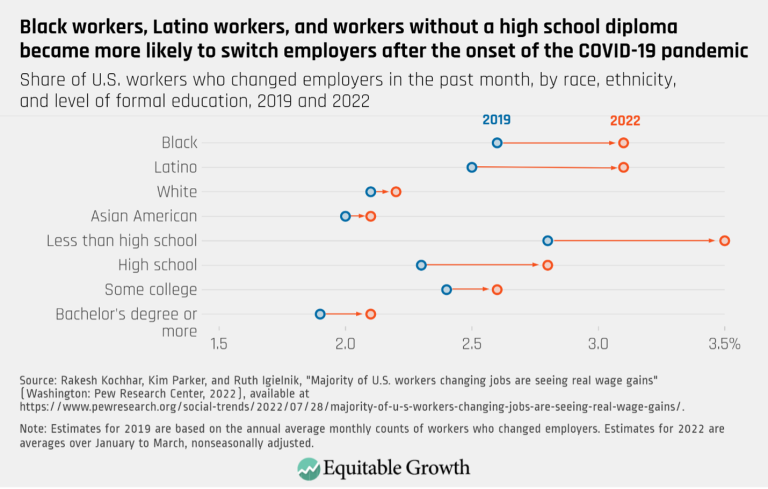
Black workers, Latino workers, and workers without a high school diploma became more likely to switch employers after the onset of the COVID-19 pandemic (opens in a new tab)
Visualizations MAR 7, 2023
 View Chart
(opens in a new tab)
View Chart
(opens in a new tab)
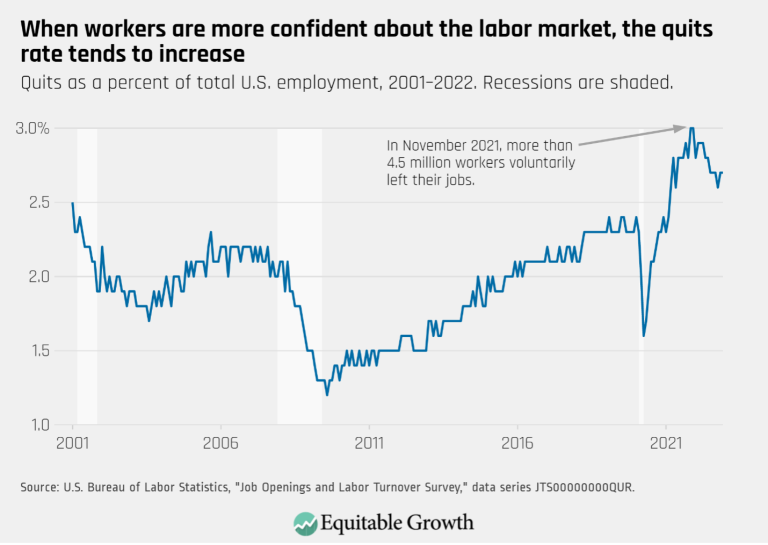
When workers are more confirdent about the labor market, the quits rate tends to increase (opens in a new tab)
Visualizations MAR 7, 2023
 View Chart
(opens in a new tab)
View Chart
(opens in a new tab)
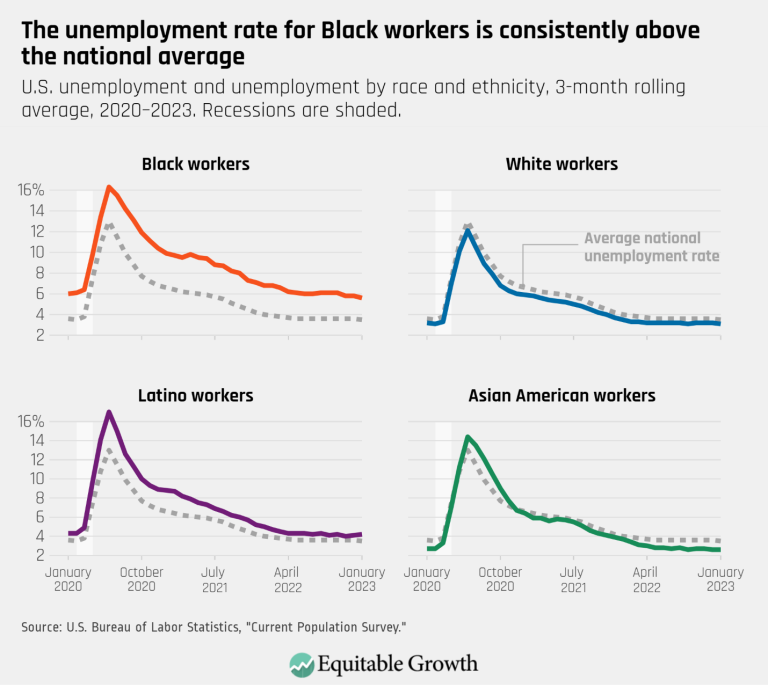
The unemployment rate for Black workers is consistently above the national average (opens in a new tab)
Visualizations MAR 7, 2023
 View Chart
(opens in a new tab)
View Chart
(opens in a new tab)
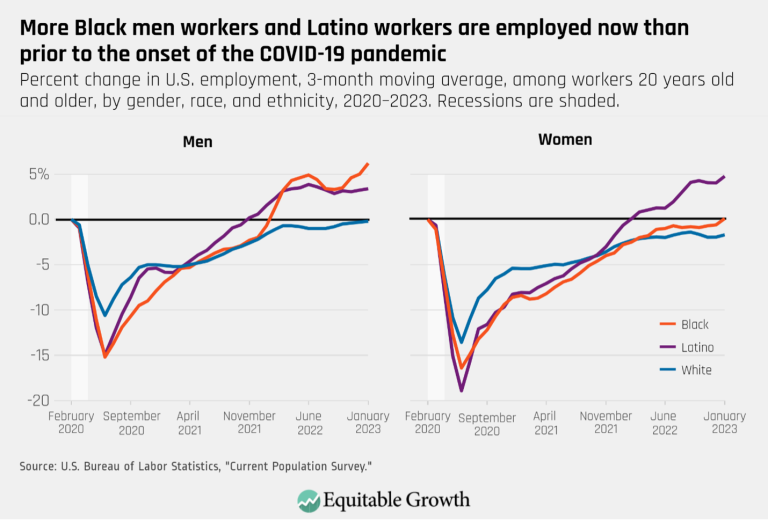
More Black men workers and Latino workers are employed now than prior to the onset of the COVID-19 pandemic (opens in a new tab)
Visualizations MAR 7, 2023
 View Chart
(opens in a new tab)
View Chart
(opens in a new tab)
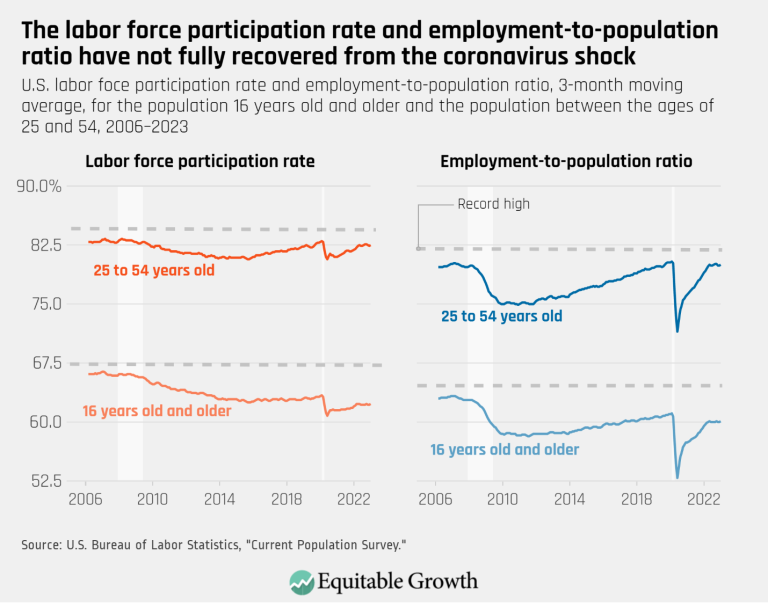
The labor force participation rate and employment-to-population ratio have not fully recovered from the coronavirus shock (opens in a new tab)
Visualizations MAR 7, 2023
 View Chart
(opens in a new tab)
View Chart
(opens in a new tab)
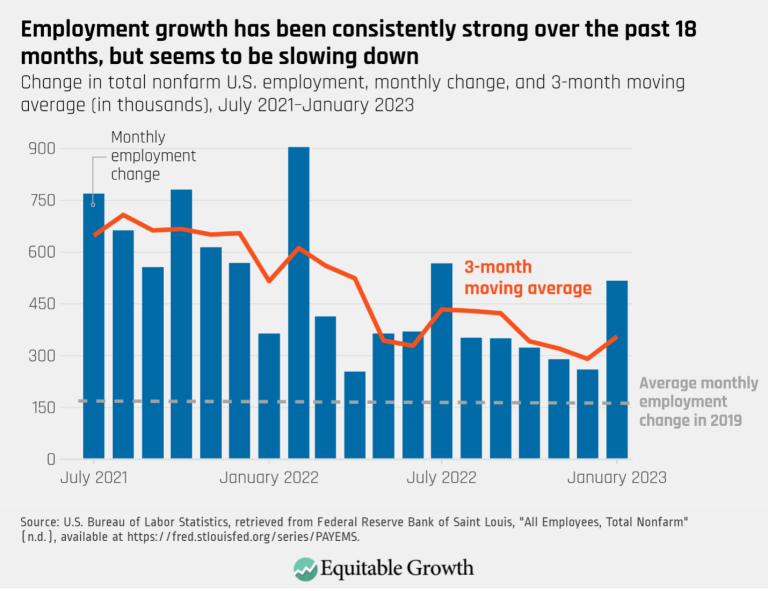
Employment-growth-has-been-consistently-strong-over-the-past-18-months-but-seems-to-be-slowing-down (opens in a new tab)
Visualizations MAR 7, 2023

Equitable Growth delivers letter responding to the NTIA’s Privacy, Equity, and Civil Rights Request for Comment (opens in a new tab)
Blog MAR 6, 2023
The Washington Center for Equitable Growth this week delivered a comment letter responding to the National Telecommunications and Information Administration’s Privacy, Equity, and Civil Rights Request for Comment. Our comment…
By: Kathryn Zickuhr (opens in a new tab)

Access to paid family leave improves U.S. women’s labor market outcomes following a spouse’s health shock (opens in a new tab)
Blog MAR 6, 2023
Women now make up almost half of the U.S. labor force, according to the U.S. Department of Labor, and families are increasingly reliant on women’s earnings. Despite their growing labor…
By: Courtney C. Coile (opens in a new tab), Maya Rossin-Slater (opens in a new tab), Amanda Su (opens in a new tab)

Fair competition in the U.S. labor market is threatened by more than the noncompete clauses targeted by new Federal Trade Commission rule (opens in a new tab)
Blog FEB 23, 2023
When a worker gets a new job, it is normally a cause for celebration and not litigation. Yet noncompetition clauses in employment agreements, and a veil of other threats buried…
By: Peter Norlander (opens in a new tab)

Executive actions to strengthen U.S. income support programs and support research about them (opens in a new tab)
Blog FEB 22, 2023
Relevant federal agencies: U.S. Department of Labor U.S. Department of Agriculture Relevant federal laws: The Agriculture Improvement Act of 2018 (P.L. 115-334) Social Security Act of 1935 (P.L. 74-271) Advisory…
By: Equitable Growth (opens in a new tab)
Equitable Growth’s Jobs Day Graphs: January 2023 Report Edition (opens in a new tab)
Blog FEB 3, 2023
On February 3, the U.S. Bureau of Labor Statistics released new data on the U.S. labor market during the month of January. Below are five graphs compiled by Equitable Growth…
By: Kathryn Zickuhr (opens in a new tab), Austin Clemens (opens in a new tab)
JOLTS Day Graphs: December 2022 Edition (opens in a new tab)
Blog FEB 1, 2023
Every month the U.S. Bureau of Labor Statistics releases data on hiring, firing, and other labor market flows from the Job Openings and Labor Turnover Survey, better known as JOLTS.…
By: Kathryn Zickuhr (opens in a new tab), Carmen Sanchez Cumming (opens in a new tab)

What is social infrastructure, and how does it support economic growth in the United States? (opens in a new tab)
Videos JAN 26, 2023
The word “infrastructure” brings to mind the big physical systems that underpin the U.S. economy, such as highways, bridges, tunnels, and water and sewage systems. Indeed, infrastructure is composed of…
By: Alix Gould-Werth (opens in a new tab), Sam Abbott (opens in a new tab), Emilie Openchowski (opens in a new tab)

Automated and algorithmic management is already here, invisibly shaping job quality for U.S. workers (opens in a new tab)
Blog JAN 24, 2023
Predictions about which jobs may be “lost” in the United States as employers implement new automation and algorithmic technologies often consider management tasks and roles as the least vulnerable to…
By: Kathryn Zickuhr (opens in a new tab)
Equitable Growth’s Jobs Day Graphs: December 2022 Report Edition (opens in a new tab)
Blog JAN 6, 2023
On January 6 the U.S. Bureau of Labor Statistics released new data on the U.S. labor market during the month of December. Below are five graphs compiled by Equitable Growth…
By: Kathryn Zickuhr (opens in a new tab), Austin Clemens (opens in a new tab)
 View Chart
(opens in a new tab)
View Chart
(opens in a new tab)
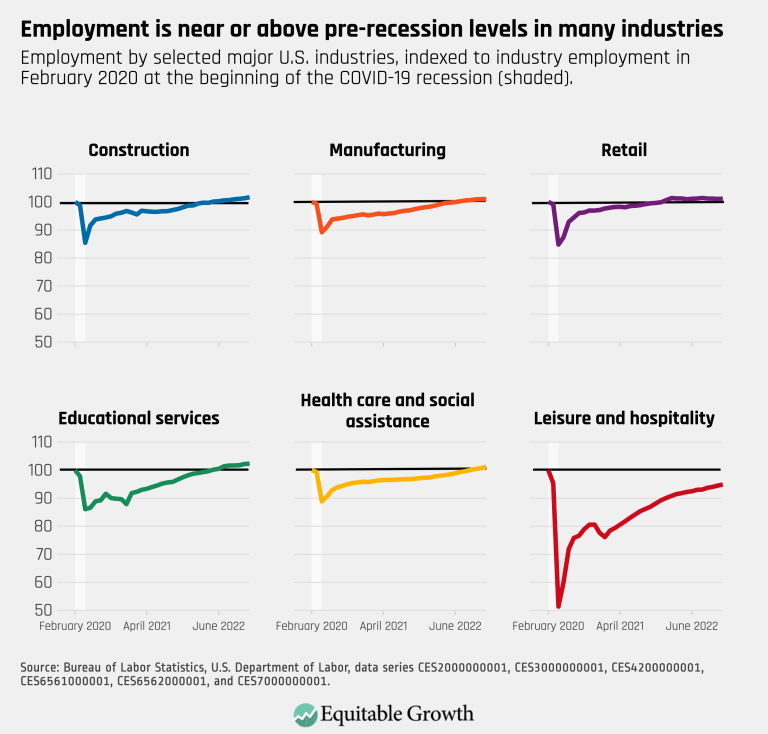
playfair-6 (opens in a new tab)
Visualizations JAN 6, 2023
 View Chart
(opens in a new tab)
View Chart
(opens in a new tab)
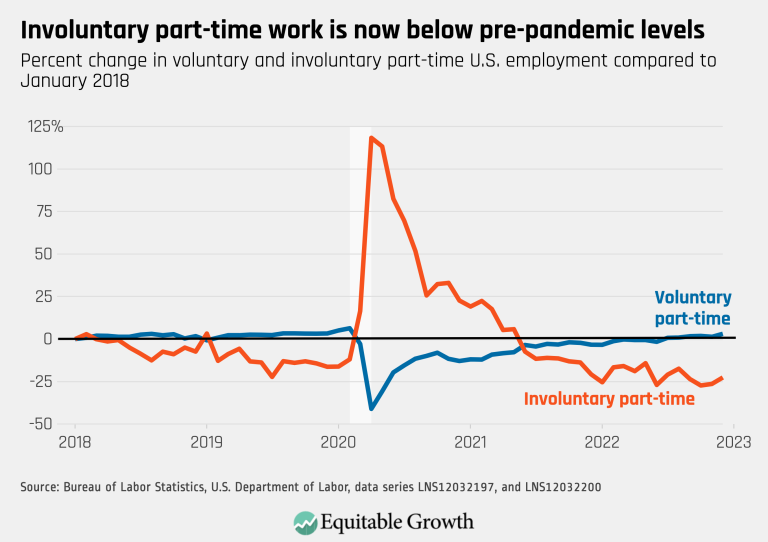
Involuntary part-time work is now below pre-pandemic levels (opens in a new tab)
Visualizations JAN 6, 2023
 View Chart
(opens in a new tab)
View Chart
(opens in a new tab)
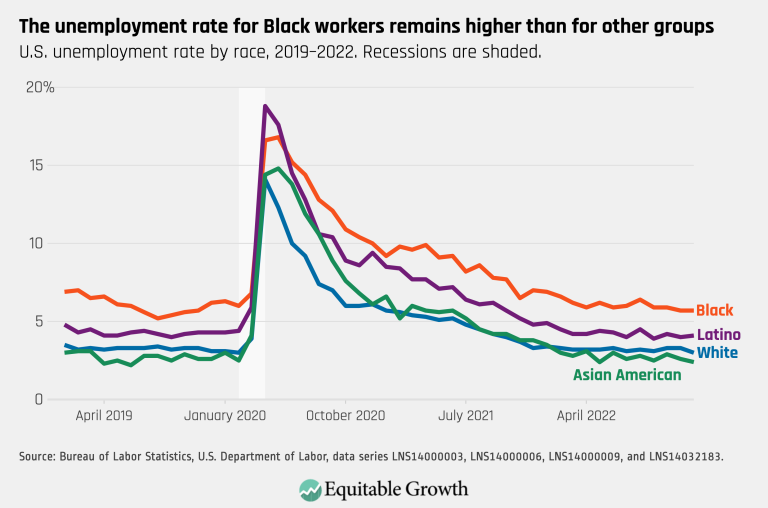
The unemployment rate for Black workers remains higher than for other groups (opens in a new tab)
Visualizations JAN 6, 2023
 View Chart
(opens in a new tab)
View Chart
(opens in a new tab)
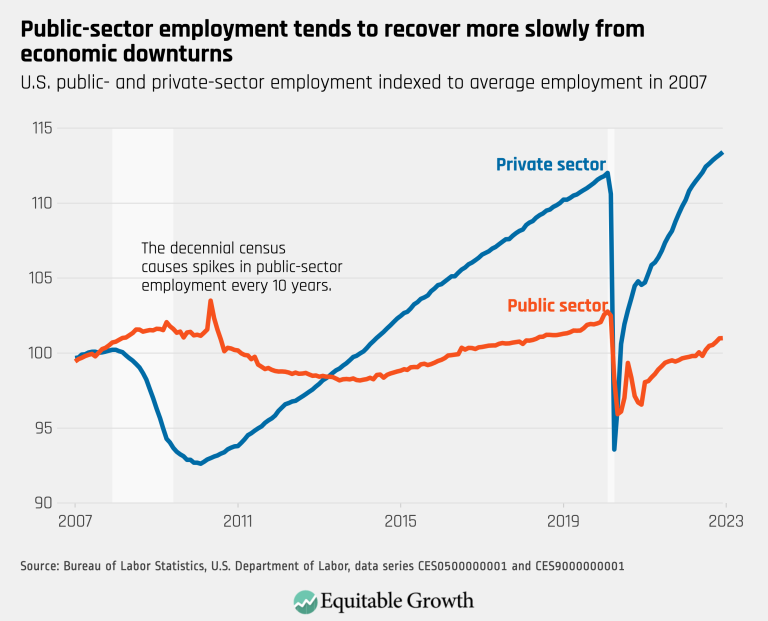
Public-sector employment tends to recover more slowly from economic downturns (opens in a new tab)
Visualizations JAN 6, 2023


Your Direct Line to Cutting Edge Research
Be the first to know about our latest events, research releases, and expert insights. Get exclusive updates delivered right to your inbox and never miss an opportunity to engage with our community.