


Resources
From peer-reviewed research to accessible policy briefs, explore the scholarship that’s shaping debates and driving change.

312 Results

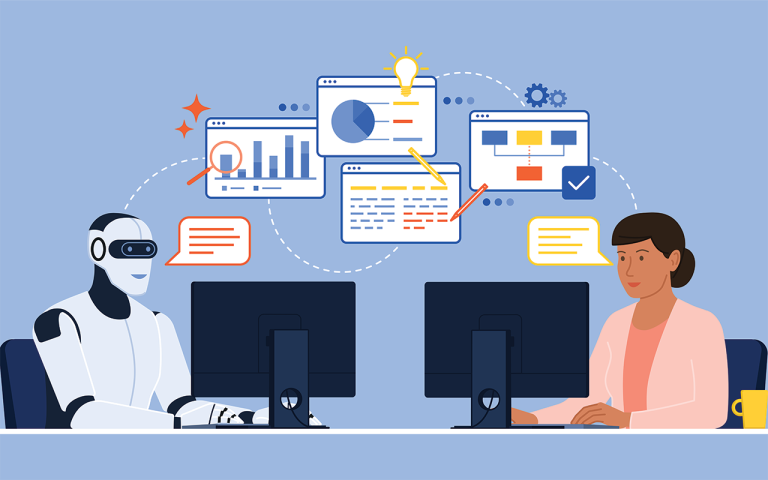
What Work Does Generative AI Do? (opens in a new tab)
Essays SEP 8, 2026
Since August 2024, our Real-Time Population Survey (RPS), a nationally representative survey of U.S. adults ages 18 to 64, has tracked how many Americans use generative artificial intelligence (AI). The adoption…
By: Alexander Bick (opens in a new tab), Adam Blandin (opens in a new tab), David Deming (opens in a new tab), Tyler Schumacher (opens in a new tab)
What Work Does Generative AI Do? (opens in a new tab)
Working Papers SEP 8, 2026
We measure how workers use genAI for their jobs in a nationally representative survey linking genAI adoption to detailed occupations and tasks. Our data provide the first task-level genAI adoption…
By: Alexander Bick (opens in a new tab), Adam Blandin (opens in a new tab), David Deming (opens in a new tab), Tyler Schumacher (opens in a new tab)

What happens to U.S. workers without access to Unemployment Insurance amid economic downturns or disruptions related to AI? (opens in a new tab)
Essays SEP 2, 2026
The adoption of artificial intelligence in the workplace has led to predictions of U.S. labor market disruptions. In response, policymakers have increased attention on the fitness of the nation’s social…
By: Megan Rivera (opens in a new tab)
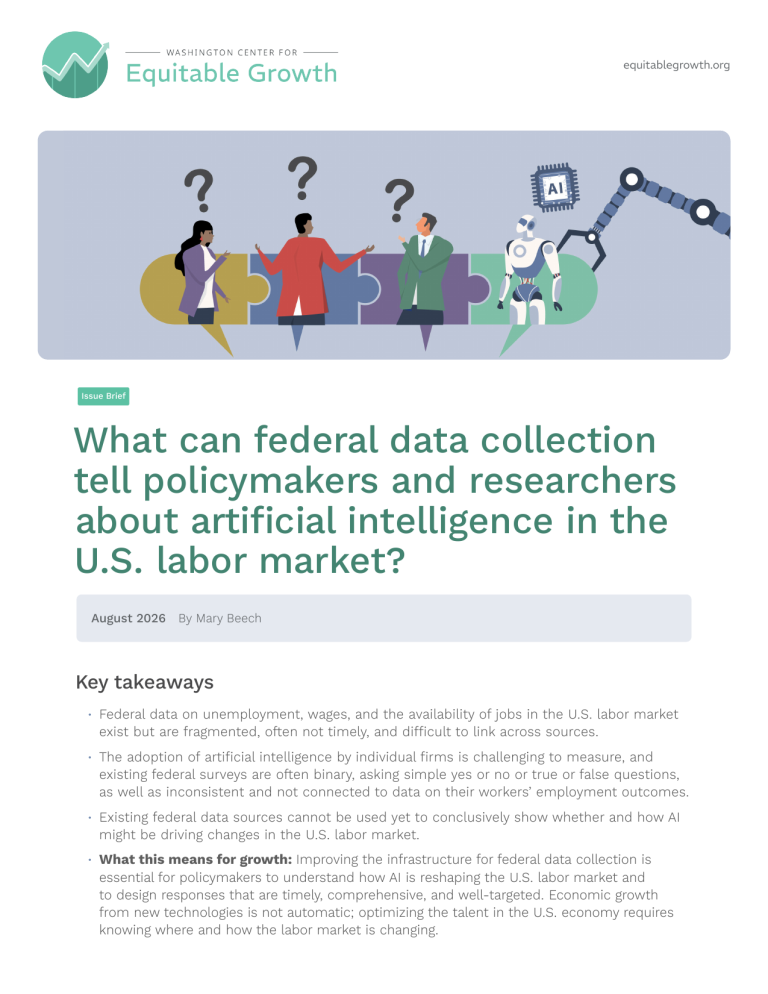
What can federal data collection tell policymakers and researchers about artificial intelligence in the U.S. labor market? (opens in a new tab)
Issue Briefs AUG 24, 2026
It is impossible to perfectly predict how artificial intelligence will affect the U.S. labor market. Policymakers and researchers are grappling with important questions around this topic, including what new opportunities…
By: Mary Beech (opens in a new tab)

Terms and conditions for generative AI users outline a new legal framework that puts U.S. consumers at risk (opens in a new tab)
Essays AUG 20, 2026
Generative AI, or genAI, is a form of artificial intelligence that produces content in response to prompts and includes large language model chatbots such as OpenAI’s ChatGPT or Anthropic’s Claude.…
By: Chiara Chanoi (opens in a new tab)
The Terms and Conditions of Generative AI (opens in a new tab)
Working Papers AUG 20, 2026
Generative AI raises pressing questions for myriad doctrinal areas. Policymakers and scholars have responded rapidly, devoting substantial attention to these difficult legal and policy questions. But, as a practical matter,…
By: John M. Newman, Andres Sawicki (opens in a new tab)

Estimating AI exposure is useful for research but cannot yet tell policymakers the whole story of AI’s impact on the labor market (opens in a new tab)
Essays AUG 7, 2026
Artificial intelligence has the potential to substantially change the nature and availability of work. To effectively manage the transitions this technology might bring to the U.S. economy, policymakers need information…
By: Chiara Chanoi (opens in a new tab)

Tracking new research on artificial intelligence and its impact on the U.S. labor market (opens in a new tab)
Essays AUG 5, 2026
Headlines often paint extreme and dissonant pictures of the future impact of AI on the U.S. economy and labor market, with workers themselves echoing the conflicting feelings of optimism and…
By: Equitable Growth (opens in a new tab)

Why Unemployment Insurance Alone Is Not Enough in the AI Era (opens in a new tab)
Essays JUL 8, 2026
Since the large language model ChatGPT was rolled out in November 2022, artificial intelligence has captured the public’s attention and generated myriad debates over the emerging technology’s potential impacts on…
By: Megan Rivera (opens in a new tab)

Personal Income in the United States nudges up in May but is down 0.76 percent in the past 6 months (opens in a new tab)
Essays JUN 25, 2026
According to today’s release of Personal Income estimates from the U.S. Bureau of Economic Analysis, U.S. household incomes have fallen 0.76 percent in the past 6 months, with month-to-month declines…
By: Austin Clemens (opens in a new tab)
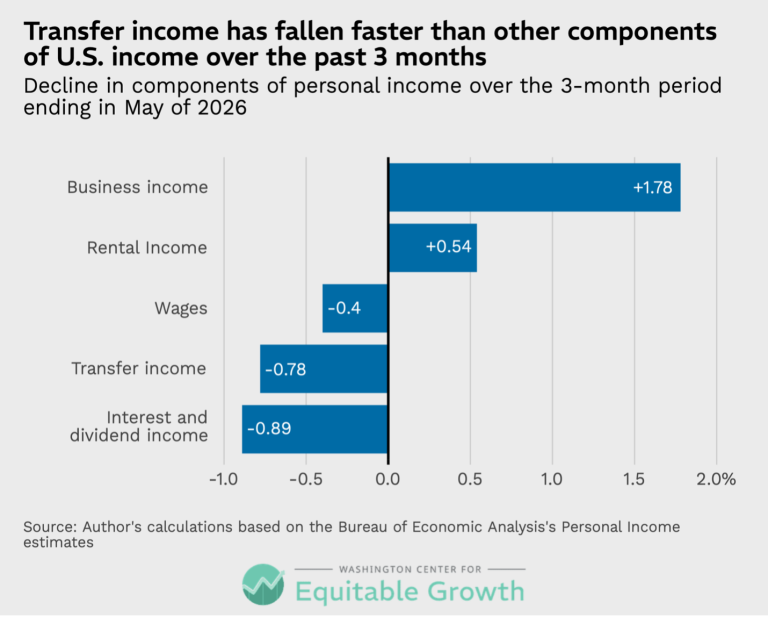 View Chart
(opens in a new tab)
View Chart
(opens in a new tab)
Transfer income has fallen faster than other components of U.S. income over the past 3 months (opens in a new tab)
Visualizations JUN 25, 2026
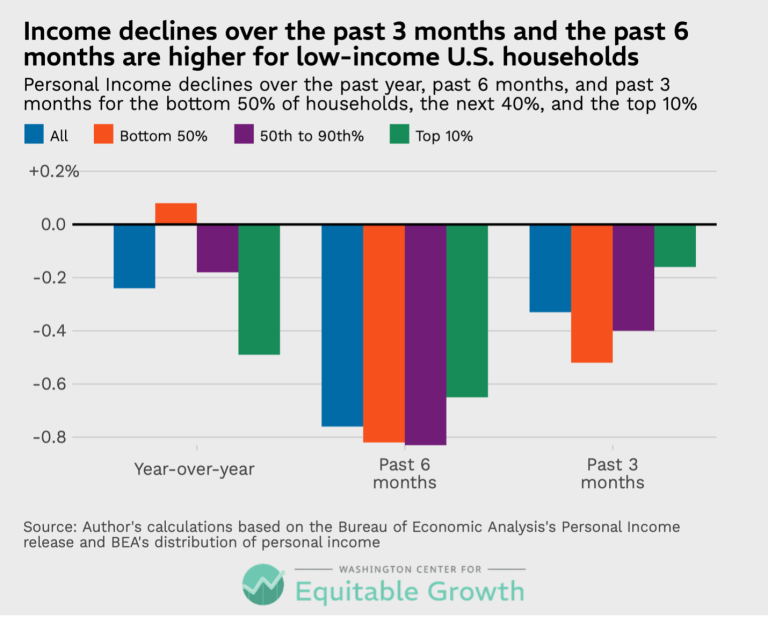 View Chart
(opens in a new tab)
View Chart
(opens in a new tab)
Income declines over the past 3 months and the past 6 months are higher for low-income U.S. households (opens in a new tab)
Visualizations JUN 25, 2026
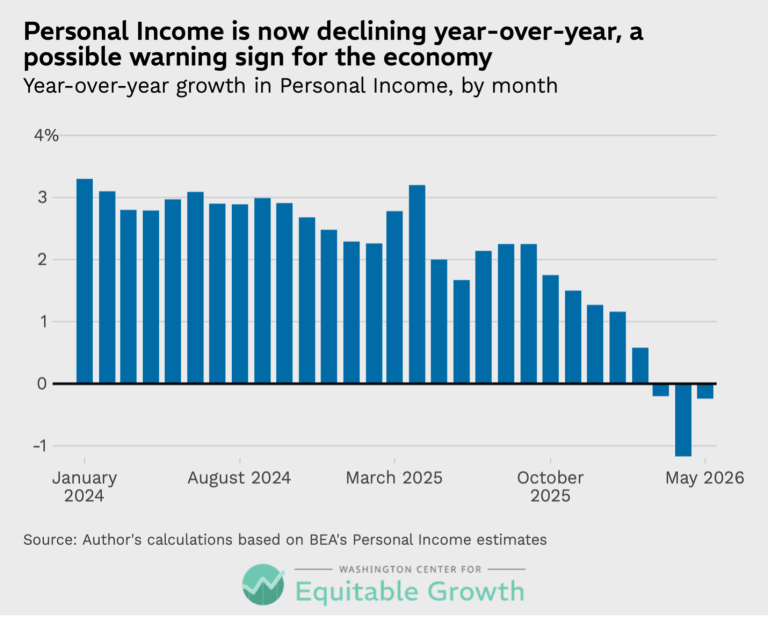 View Chart
(opens in a new tab)
View Chart
(opens in a new tab)
Personal Income is now declining year-over-year, a possible warning sign for the economy (opens in a new tab)
Visualizations JUN 25, 2026

The United States can simultaneously foster an equitable AI boom and a clean energy economy (opens in a new tab)
Videos JUN 12, 2026
The Washington Center for Equitable Growth recently hosted a timely discussion exploring how the rapid expansion of artificial intelligence is colliding with—and reshaping—the clean energy transition. Bringing together researchers and…
By: Equitable Growth (opens in a new tab)

In Conversation with Costa Samaras (opens in a new tab)
In Conversation JUN 2, 2026
Equitable Growth in Conversation is a recurring series where we talk with economists and other academics to help us better understand whether and how economic inequality affects economic growth and…
By: Shayna Strom (opens in a new tab)
Navigating the research on the impacts of AI on work, workers, and the labor market (opens in a new tab)
Research Databases MAY 21, 2026
Artificial intelligence will have a largely unpredictable but potentially profound effect on the labor market. Individuals have speculated how AI will affect the workforce since its earliest developments. But public…
By: Chiara Chanoi (opens in a new tab)

What is the relationship between inflation, interest rates, and economic growth, and what does it mean for the new Federal Reserve chair? (opens in a new tab)
Issue Briefs MAY 18, 2026
Since regaining the Oval Office in early 2025, President Donald Trump has repeatedly called for lower interest rates and severely criticized former Federal Reserve Board Chair Jerome Powell’s cautious approach…
By: Jacob Robbins (opens in a new tab)

Research shows unions dampen support for right-wing populism and help workers navigate technological transitions (opens in a new tab)
Essays MAY 1, 2026
On May 1, much of the world—though not the United States—celebrates International Workers Day to honor the social and economic contributions of workers and labor unions. The May Day holiday began in large part to mark…
By: Christopher Bangert-Drowns (opens in a new tab)
 View Chart
(opens in a new tab)
View Chart
(opens in a new tab)
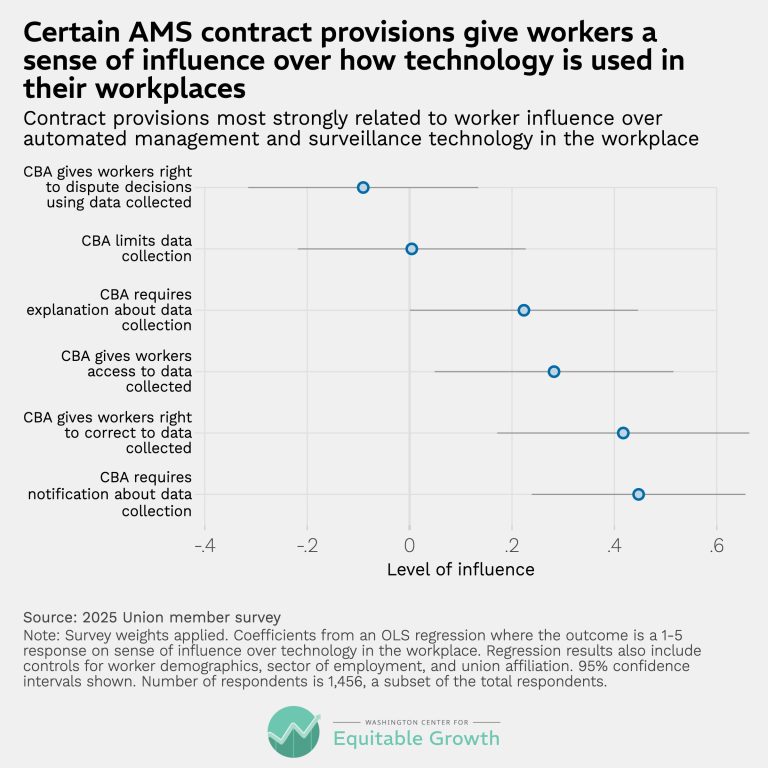
Certain AMS contract provisions give workers a sense of influence over how technology is used in their workplaces (opens in a new tab)
Visualizations MAR 12, 2026
How union contracts are protecting U.S. workers from automated management and surveillance in the workplace (opens in a new tab)
Reports MAR 12, 2026
Employers are increasingly using electronic and automated tools to collect data on their workers on and off the job and then using that data to inform decisions about workers’ pay,…
By: Alexander Hertel-Fernandez (opens in a new tab)
 View Chart
(opens in a new tab)
View Chart
(opens in a new tab)
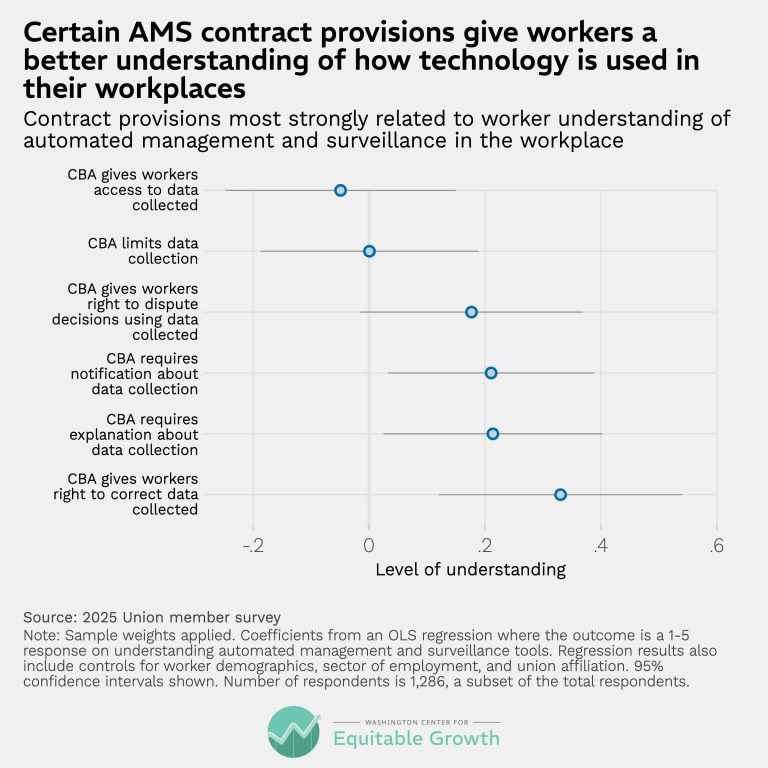
Certain AMS contract provisions give workers a better understanding of how technology is used in their workplaces (opens in a new tab)
Visualizations MAR 12, 2026
 View Chart
(opens in a new tab)
View Chart
(opens in a new tab)
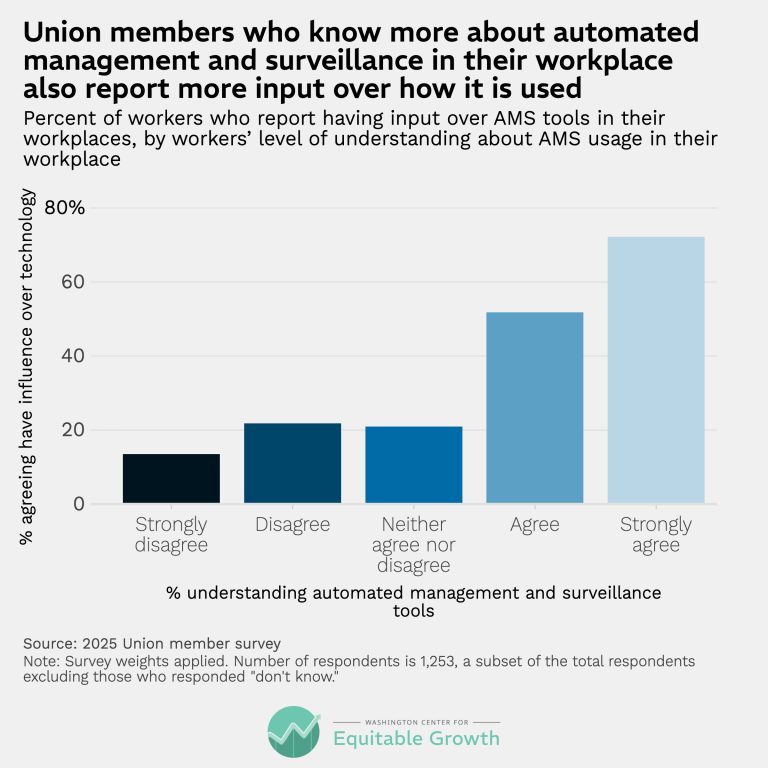
Union members who know more about automated management and surveillance in their workplace also report more input over how it is used (opens in a new tab)
Visualizations MAR 12, 2026
 View Chart
(opens in a new tab)
View Chart
(opens in a new tab)
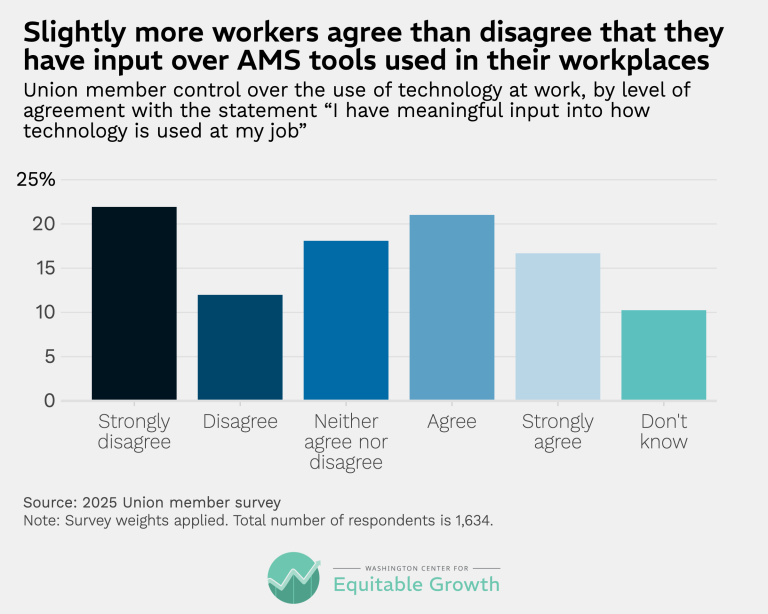
Slightly more workers agree than disagree that they have input over AMS tools used in their workplaces (opens in a new tab)
Visualizations MAR 12, 2026
 View Chart
(opens in a new tab)
View Chart
(opens in a new tab)
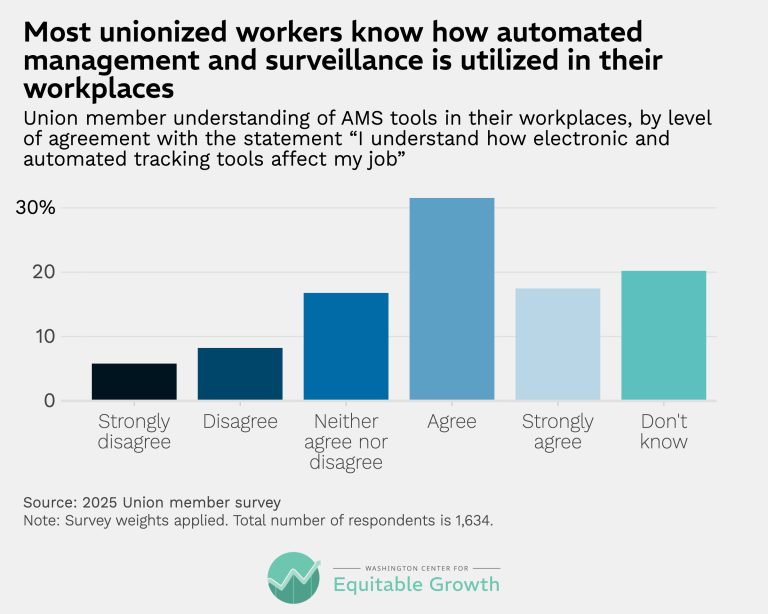
Most unionized workers know how automated management and surveillance are utilized in their workplaces (opens in a new tab)
Visualizations MAR 12, 2026
 View Chart
(opens in a new tab)
View Chart
(opens in a new tab)
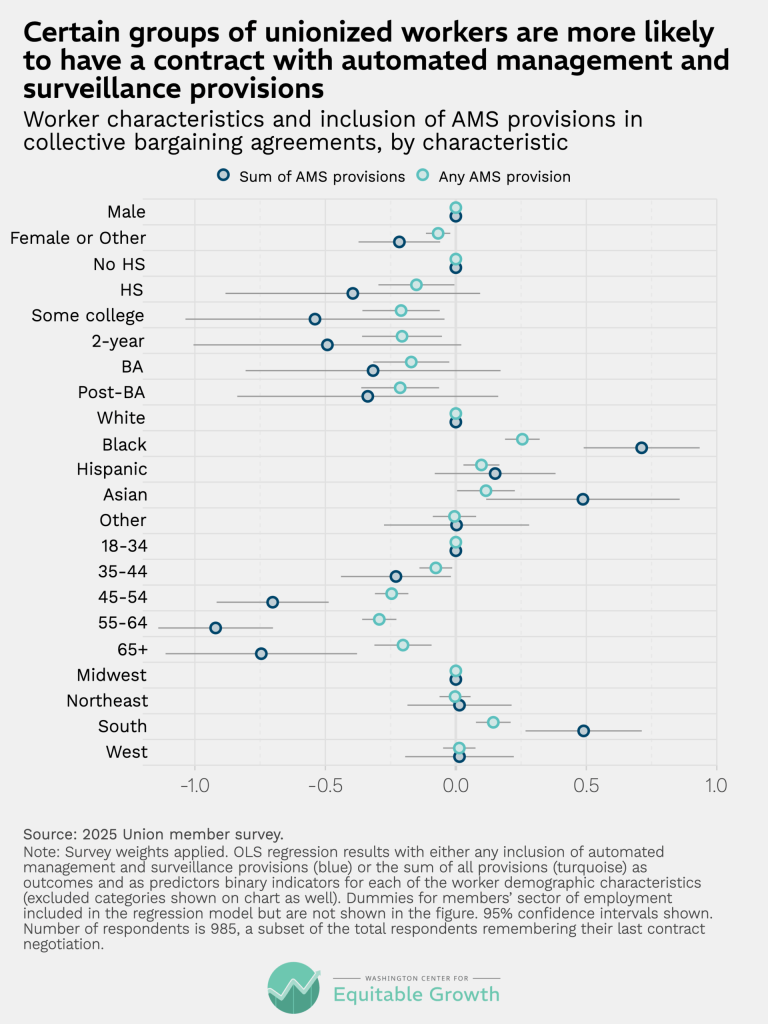
Certain groups of unionized workers are more likely to have a contract with automated management and surveillance provisions (opens in a new tab)
Visualizations MAR 12, 2026
 View Chart
(opens in a new tab)
View Chart
(opens in a new tab)
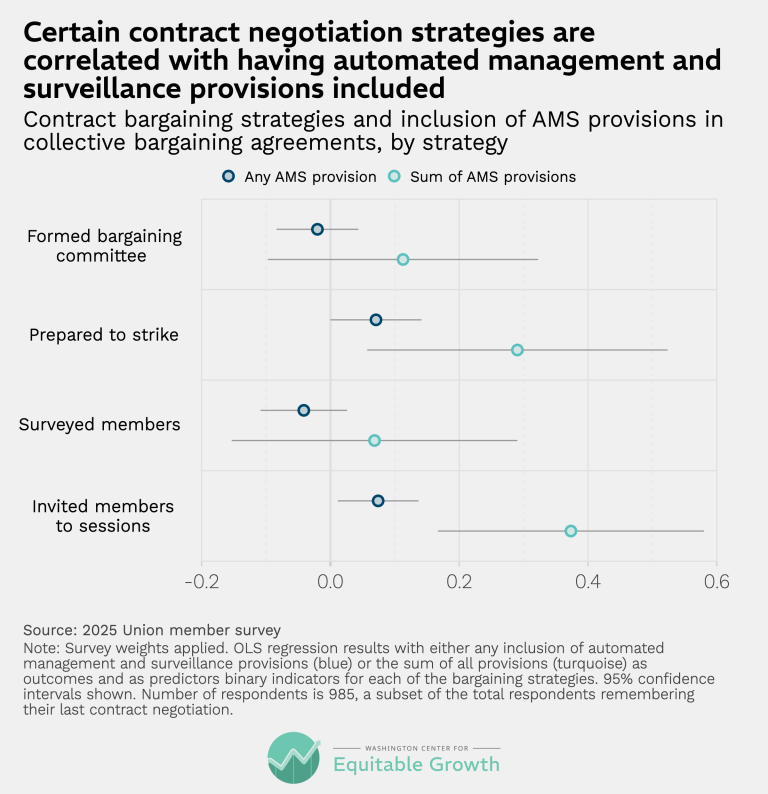
Certain contract negotiation strategies are correlated having automated management and surveillance provisions included (opens in a new tab)
Visualizations MAR 12, 2026
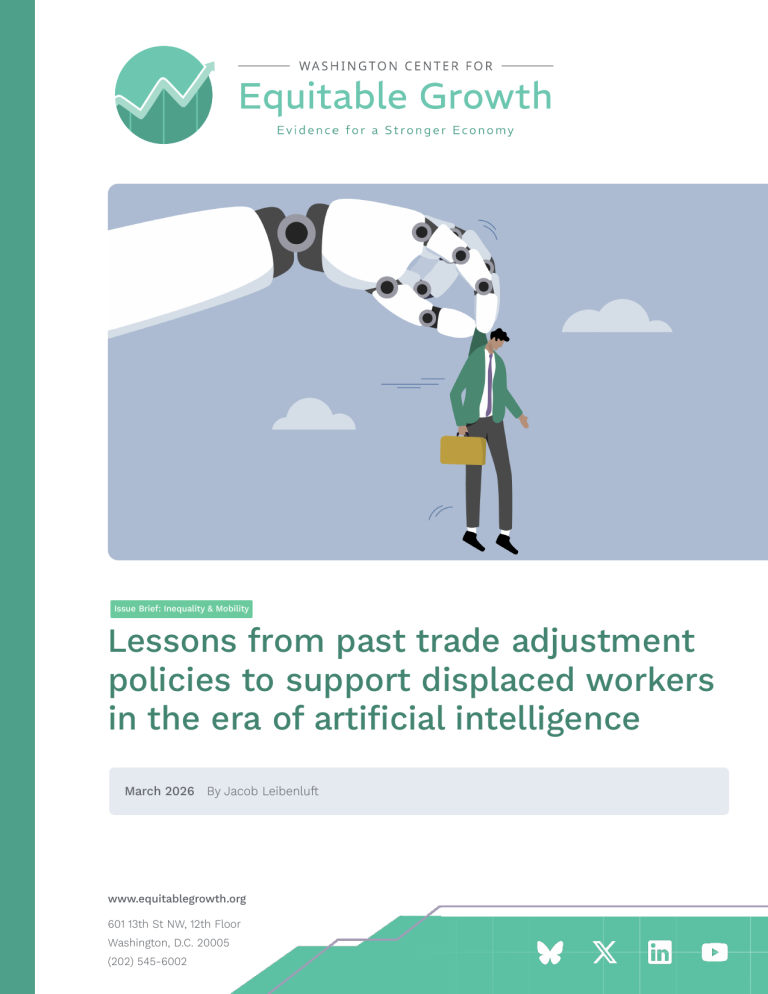
Lessons from past trade adjustment policies to support displaced workers in the era of artificial intelligence (opens in a new tab)
Reports MAR 11, 2026
More than 60 years ago, U.S. policymakers, economists, and labor leaders alike agreed that the potential for new economic forces to strengthen U.S. prosperity and security was just over the…
By: Jacob Leibenluft (opens in a new tab)

Factsheet: Using asset limits in public benefit programs (opens in a new tab)
Factsheets MAR 10, 2026
A household’s assets, or its overall wealth, are the resources required to ensure its family members can weather the financial disruption when unexpected expenses emerge. Yet many U.S. households do…
By: Megan Rivera (opens in a new tab)
ASSA 2026 Round-up: Day 3 (opens in a new tab)
Blog JAN 6, 2026
Yesterday was the third and final day of the 2026 annual meeting of the Allied Social Science Associations, which is organized by the American Economic Association. The 3-day conference, held…
By: Equitable Growth (opens in a new tab)
ASSA 2026 Round-up: Day 2 (opens in a new tab)
Blog JAN 5, 2026
Yesterday was the second day of the 2026 annual meeting of the Allied Social Science Associations, which is organized by the American Economic Association. The 3-day conference, held in Philadelphia…
By: Equitable Growth (opens in a new tab)
ASSA 2026 Round-up: Day 1 (opens in a new tab)
Blog JAN 4, 2026
Yesterday was the first day of the 2026 annual meeting of the Allied Social Science Associations, which is organized by the American Economic Association. The 3-day conference, held in Philadelphia…
By: Equitable Growth (opens in a new tab)

What impact is artificial intelligence having on the U.S. labor market and the nation’s economy? (opens in a new tab)
Essays NOV 14, 2025
As new and groundbreaking technologies emerge, they can function as a blank canvas onto which people project both aspirations and anxieties. Artificial intelligence—despite its quick uptake in broader society and…
By: Megan Rivera (opens in a new tab)

Workplace exposure to artificial intelligence is higher among U.S. workers with higher wages, depending on how AI is used (opens in a new tab)
Essays OCT 23, 2025
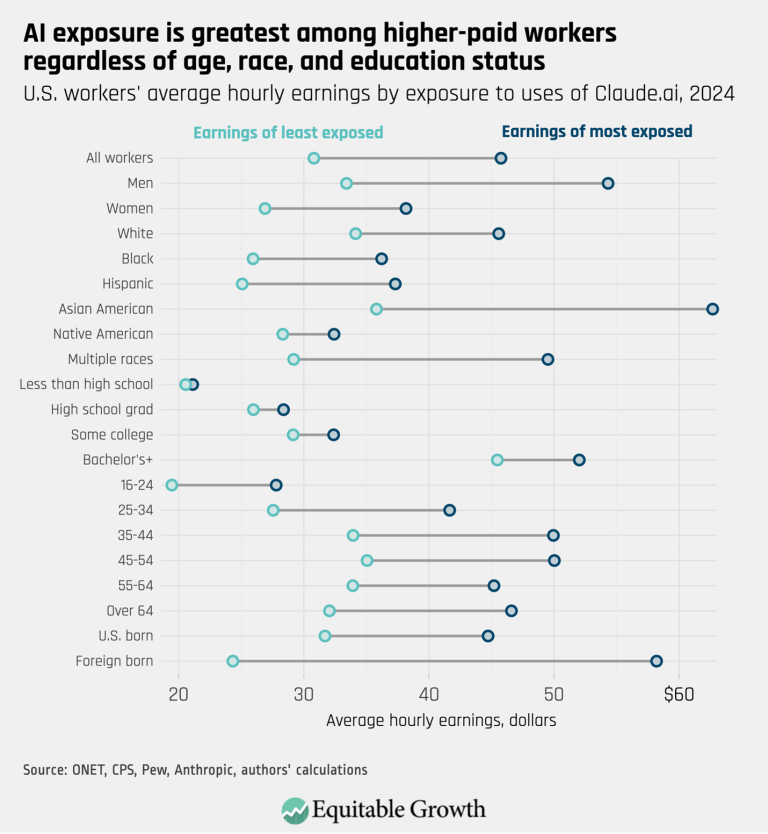
Recent advances using artificial intelligence in workplaces, particularly large language models such as Claude.ai and ChatGPT, are increasingly disrupting the U.S. labor market. The cognitive power of AI has the…
By: Chiara Chanoi (opens in a new tab), Christopher Bangert-Drowns (opens in a new tab)
AI exposure by U.S. occupations and work tasks and the effect on wages (opens in a new tab)
Working Papers OCT 23, 2025
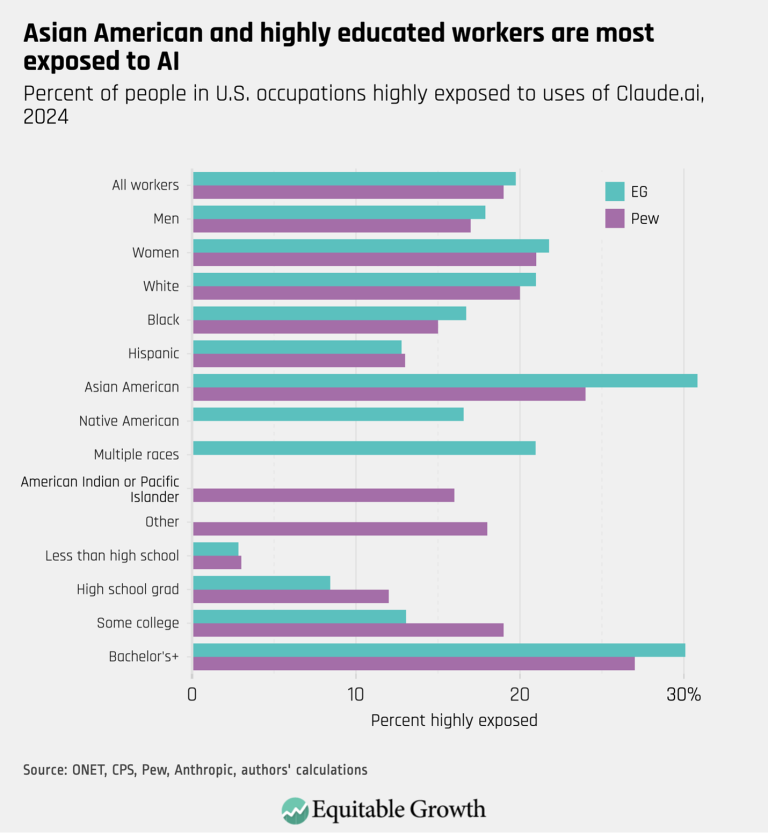
This analysis of labor market AI exposure builds on previous work from the Pew Research Center and the AI firm Anthropic as well as Equitable Growth’s own job quality series,…
By: Chiara Chanoi (opens in a new tab), Chris Bangert-Drowns
 View Chart
(opens in a new tab)
View Chart
(opens in a new tab)
AI exposure is greatest among higher-paid workers regardless of age, race and education status (opens in a new tab)
Visualizations OCT 22, 2025
 View Chart
(opens in a new tab)
View Chart
(opens in a new tab)
Asian American and highly educated workers are most exposed to AI (opens in a new tab)
Visualizations OCT 22, 2025

Equitable Growth supports scholars studying the economics of the energy transition (opens in a new tab)
Essays OCT 22, 2025
The Washington Center for Equitable Growth today announced a new cohort of grantees. These nine scholars will study how the design and implementation of federal policy influences how businesses and…
By: Equitable Growth (opens in a new tab)

Equitable Growth announces funding for research on the impact of AI on U.S. workers and competition (opens in a new tab)
Essays SEP 18, 2025
The Washington Center for Equitable Growth today announced a new cohort of grantees studying how artificial intelligence and new technology can support workers and promote competition across the U.S. economy.…
By: Equitable Growth (opens in a new tab)
How artificial intelligence uncouples hard work from fair wages through ‘surveillance pay’ practices—and how to fix it (opens in a new tab)
Issue Briefs AUG 21, 2025
Correction: Freddie Mac and Udemy contacted the Washington Center for Equitable Growth on March 18, 2026 and April 2, 2026, respectively, to say they no longer had business relationships with…
By: Veena Dubal (opens in a new tab), Wilneida Negrón (opens in a new tab)

Adoption of generative AI will have different effects across jobs in the U.S. logistics workforce (opens in a new tab)
Essays JUL 10, 2025
Generative artificial intelligence promises to profoundly reshape labor markets, much like previous automation waves did, but with clear differences. Unlike earlier technologies, such as computerization, which primarily automated routine administrative…
By: Christophe Combemale (opens in a new tab), Dustin Ferrone (opens in a new tab), Andrew Barber (opens in a new tab), Laurence Ales (opens in a new tab)
 View Chart
(opens in a new tab)
View Chart
(opens in a new tab)
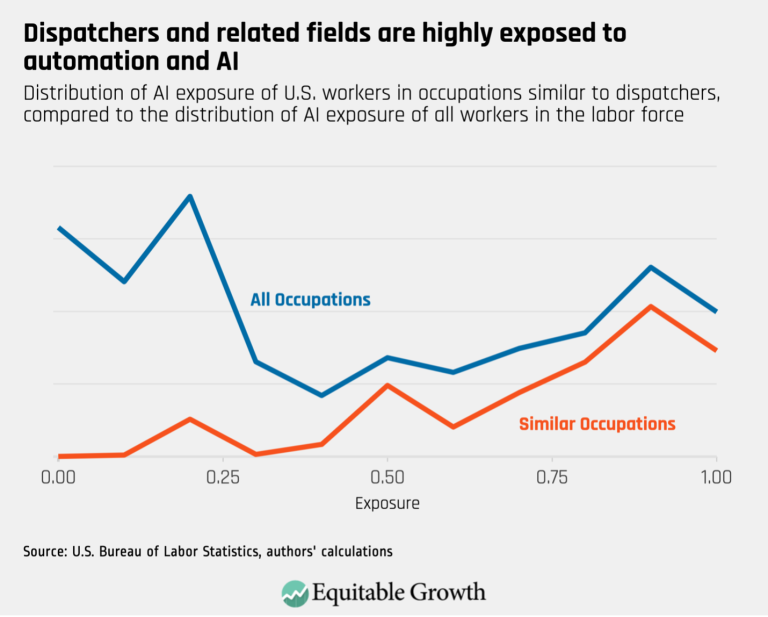
Dispatchers and related fields are highly exposed to automation and AI (opens in a new tab)
Visualizations JUL 10, 2025
 View Chart
(opens in a new tab)
View Chart
(opens in a new tab)
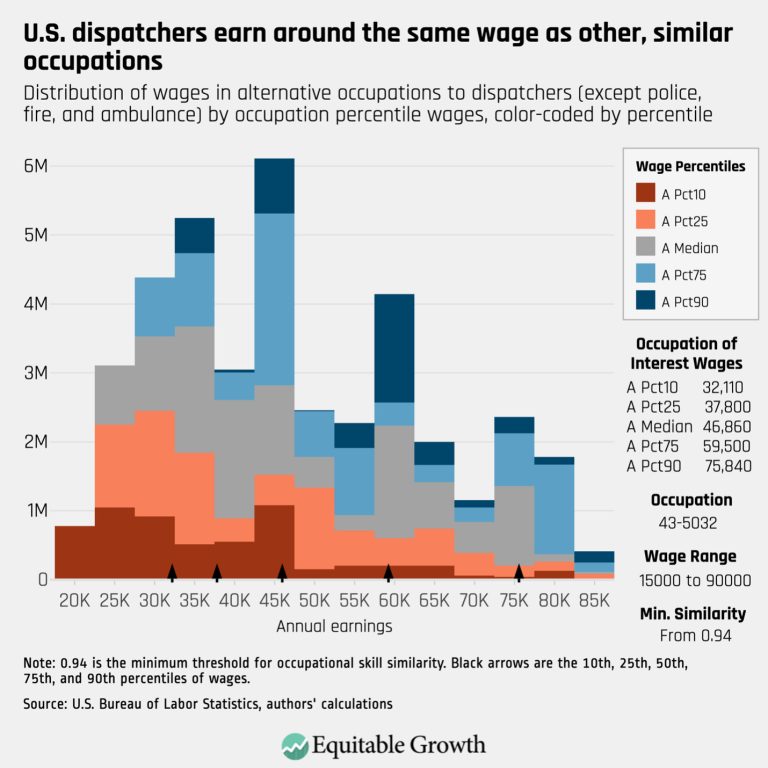
U.S. dispatchers earn around the same wage as other, similar occupations (opens in a new tab)
Visualizations JUL 10, 2025
 View Chart
(opens in a new tab)
View Chart
(opens in a new tab)
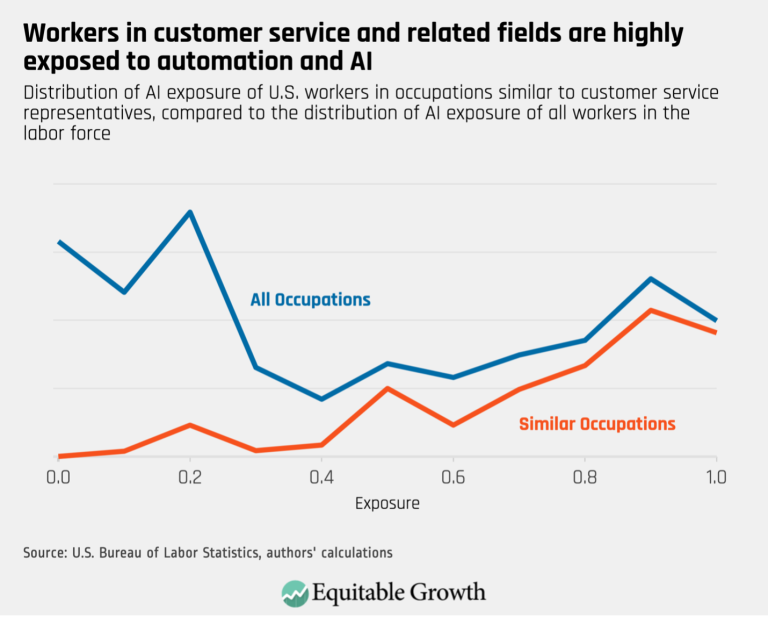
Workers in customer service and related fields are highly exposed to automation and AI (opens in a new tab)
Visualizations JUL 10, 2025
 View Chart
(opens in a new tab)
View Chart
(opens in a new tab)
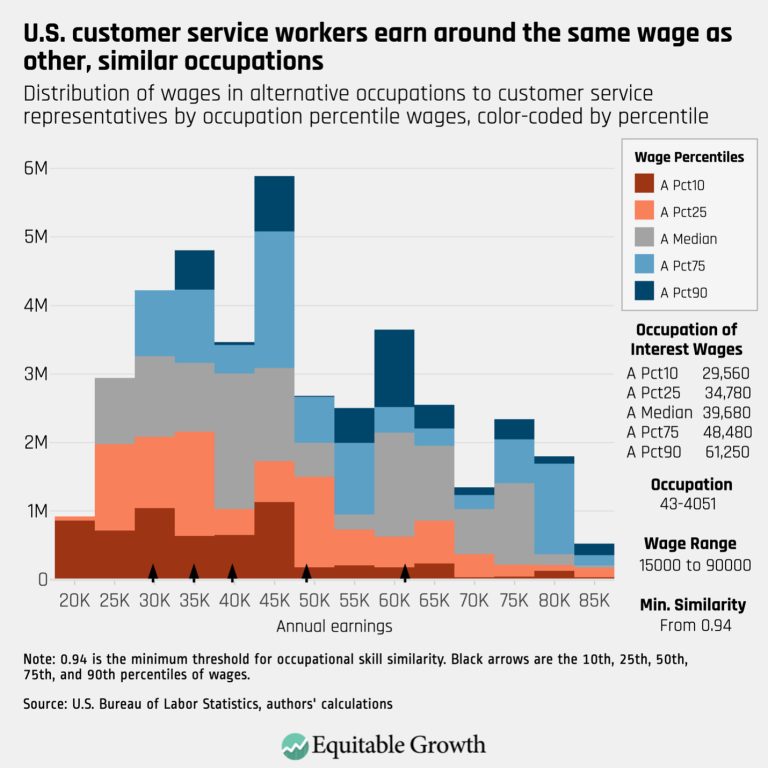
U.S. customer service workers earn around the same wage as other, similar occupations (opens in a new tab)
Visualizations JUL 10, 2025
 View Chart
(opens in a new tab)
View Chart
(opens in a new tab)
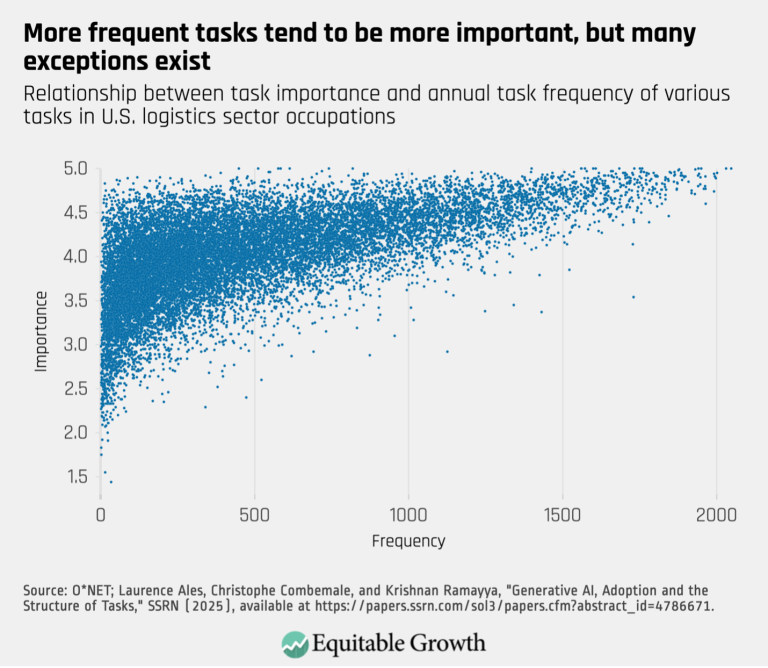
More frequent tasks tend to be more important, but many exceptions exist (opens in a new tab)
Visualizations JUL 9, 2025

Slow wage growth is the key to understanding U.S. inequality in the 21st century (opens in a new tab)
Issue Briefs JUL 8, 2025
The Washington Center for Equitable Growth today launched the U.S. Inequality Tracker, which tracks income and wealth inequality in the United States and highlights how particular components of income and…
By: Austin Clemens (opens in a new tab)
 View Chart
(opens in a new tab)
View Chart
(opens in a new tab)
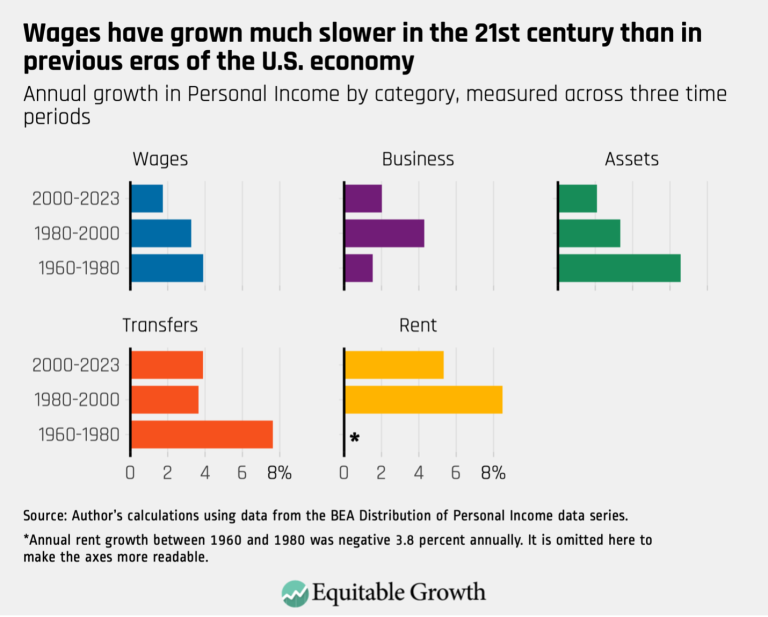
Wages have grown much slower in the 21st century than in previous eras of the U.S. economy (opens in a new tab)
Visualizations JUN 25, 2025
 View Chart
(opens in a new tab)
View Chart
(opens in a new tab)
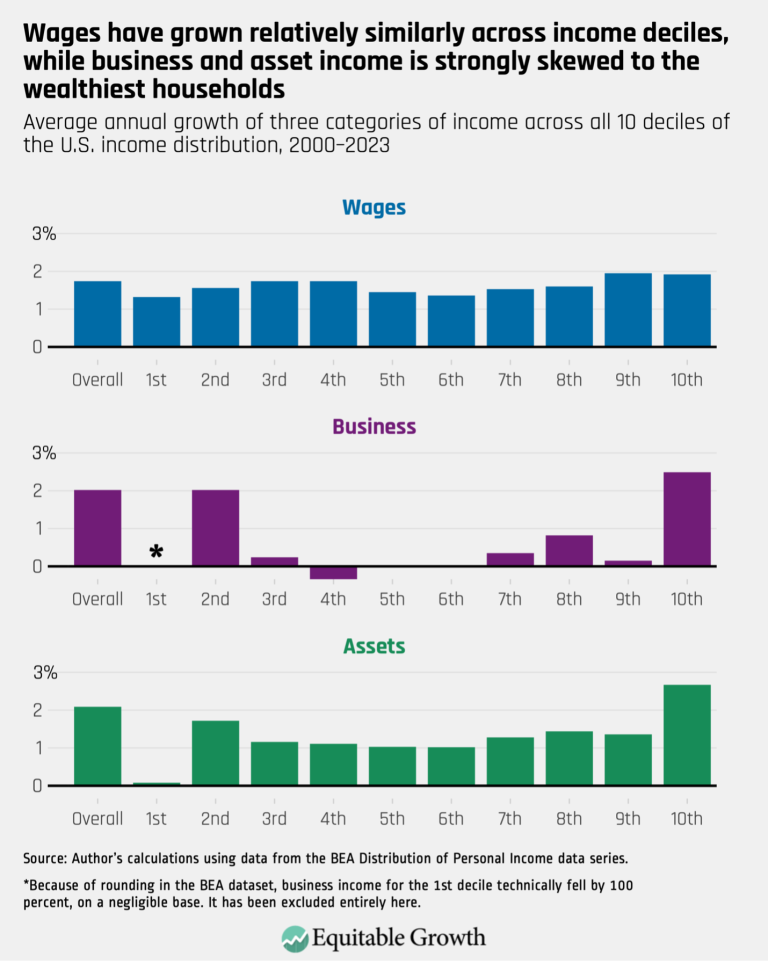
Wages have grown relatively similarly across income deciles, while business and asset income is strongly skewed to the wealthiest households (opens in a new tab)
Visualizations JUN 25, 2025
 View Chart
(opens in a new tab)
View Chart
(opens in a new tab)
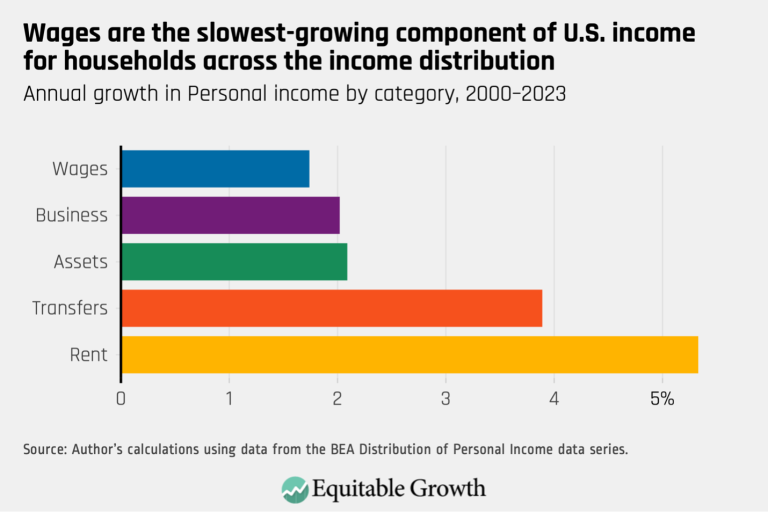
Wages are the slowest-growing component of U.S. income for households across the income distribution (opens in a new tab)
Visualizations JUN 25, 2025
 View Chart
(opens in a new tab)
View Chart
(opens in a new tab)
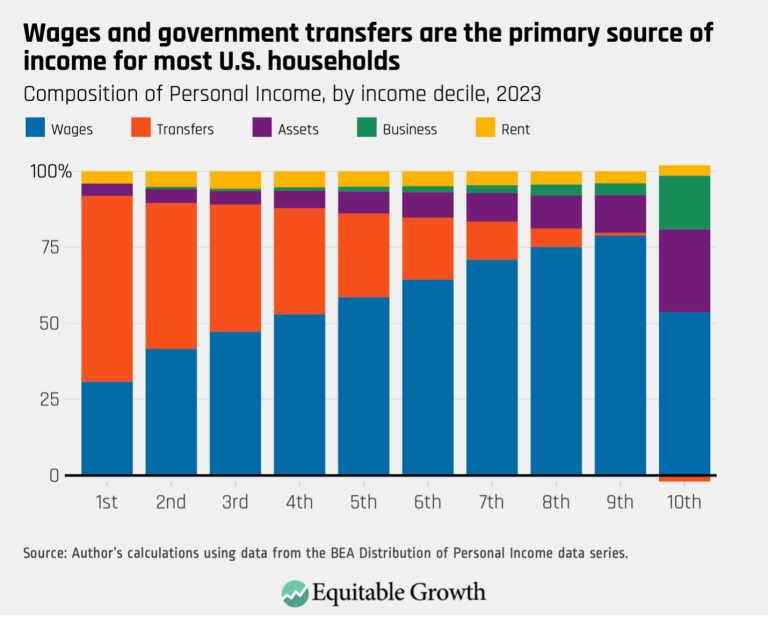
Wages and government transfers are the primary source of income for most U.S. households (opens in a new tab)
Visualizations JUN 25, 2025
 View Chart
(opens in a new tab)
View Chart
(opens in a new tab)
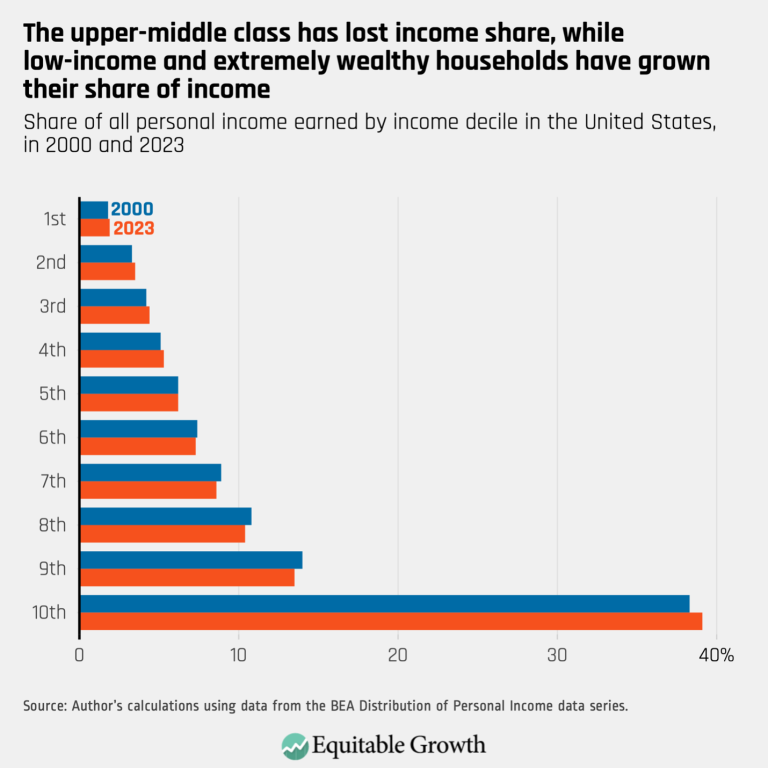
The upper-middle class has lost income share, while low-income and extremely wealthy households have grown their share of income (opens in a new tab)
Visualizations JUN 25, 2025
 View Chart
(opens in a new tab)
View Chart
(opens in a new tab)
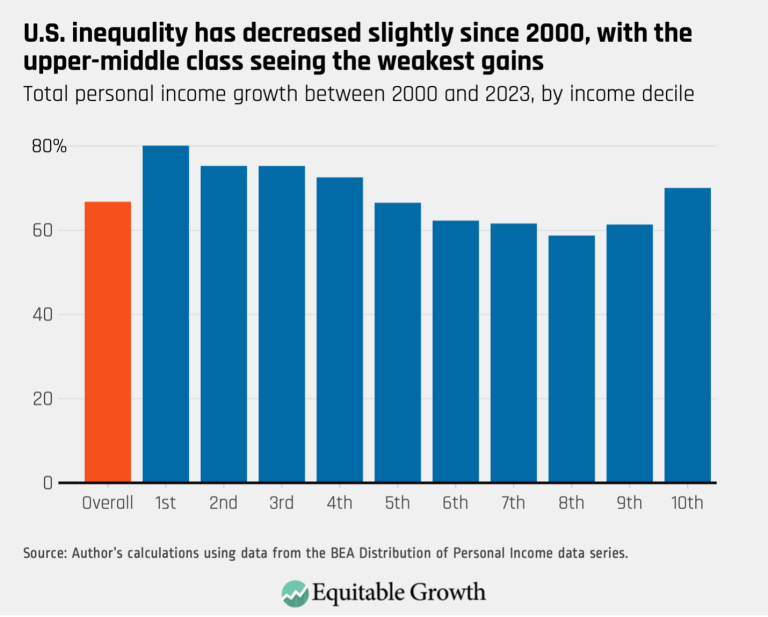
U.S. inequality has decreased slightly since 2000, with the upper-middle class seeing the weakest gains (opens in a new tab)
Visualizations JUN 25, 2025
 View Chart
(opens in a new tab)
View Chart
(opens in a new tab)
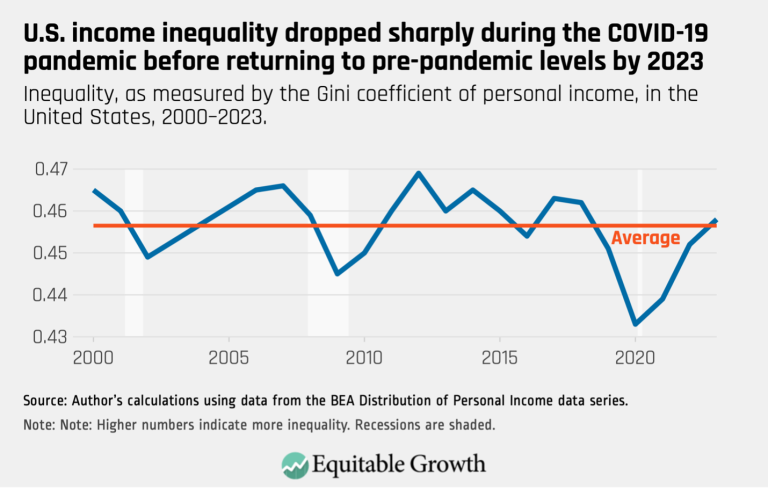
U.S. income inequality dropped sharply during the COVID-19 pandemic before returning to pre-pandemic levels by 2023 (opens in a new tab)
Visualizations JUN 25, 2025

The political implications of bad jobs and the decline of unions (opens in a new tab)
Blog MAY 13, 2025
Bad jobs have become a distinctive feature of the U.S. economy over the past few decades. Globally, a lack of adequate demand, or what economists call “secular stagnation,” has meant…
By: Adam Dean (opens in a new tab), Jamie McCallum (opens in a new tab)

Request for Proposals: The economic effects of the Inflation Reduction Act (opens in a new tab)
RFPs APR 2, 2025
By: Equitable Growth (opens in a new tab)

Analogies for AI policymaking (opens in a new tab)
Blog MAR 27, 2025
As a suite of technologies under the label of artificial intelligence increasingly take center stage, policymakers recognize the need to develop deep technical expertise about the deployment of evolving technologies…
By: Sorelle Friedler (opens in a new tab), Marc Aidinoff (opens in a new tab)

Tackling AI, taxation, and the fair distribution of AI’s benefits (opens in a new tab)
Blog MAR 5, 2025
Artificial intelligence poses significant challenges to income growth, inequality, and meaningful work. At the same time, AI has geopolitical significance, with many national and supranational governments shying away from intervening…
By: Mona Sloane (opens in a new tab), Ekkehard Ernst (opens in a new tab)

Boosting U.S. worker power and voice in the AI-enabled workplace (opens in a new tab)
Blog FEB 19, 2025
The deployment of Artificial Intelligence in the workplace has grown rapidly in the United States. Labor unions have been at the forefront of efforts to encourage more productive and sustainable…
By: Virginia Doellgast (opens in a new tab), Nell Geiser (opens in a new tab)

Understanding market concentration in the AI supply chain (opens in a new tab)
Blog JAN 28, 2025
Artificial intelligence is more than just the applications we use, such as chatbots and predictive algorithms. Beneath the surface of AI lies a technology stack that is increasingly concentrated at…
By: Tejas Narechania (opens in a new tab)
ASSA 2025 Round-up: Day 3 (opens in a new tab)
Blog JAN 6, 2025
Yesterday was the third and final day of the 2025 annual meeting of the Allied Social Science Associations, which is organized by the American Economic Association. The 3-day conference, held…
By: Equitable Growth (opens in a new tab)
ASSA 2025 Round-up: Day 1 (opens in a new tab)
Blog JAN 4, 2025
Yesterday was the first day of the 2025 annual meeting of the Allied Social Science Associations, which is organized by the American Economic Association. The 3-day conference, held in San…
By: Equitable Growth (opens in a new tab)
Accelerating research can help fill the AI knowledge gaps for U.S. policymakers (opens in a new tab)
Issue Briefs DEC 17, 2024
It is hard for policymakers to ignore today’s “AI arms race” and the public debate on the economic and social significance of generative artificial intelligence. The discourse is fueled in…
By: Rohini Kosoglu (opens in a new tab), Christian Edlagan (opens in a new tab)
Request for Proposals: Promoting competition and supporting workers in an era of AI innovation (opens in a new tab)
RFPs NOV 20, 2024
By: Equitable Growth (opens in a new tab)
Request for proposals: Research grants for early career scholars (opens in a new tab)
RFPs OCT 30, 2024
By: Equitable Growth (opens in a new tab)
Estimating the prevalence of automated management and surveillance technologies at work and their impact on workers’ well-being (opens in a new tab)
Reports OCT 1, 2024
Evidence from a new national survey and implications for U.S. federal policy U.S. employers are deploying artificial-intelligence-powered and automated tools to monitor and manage workers, including tracking workers’ locations, activities,…
By: Alexander Hertel-Fernandez (opens in a new tab)
 View Chart
(opens in a new tab)
View Chart
(opens in a new tab)
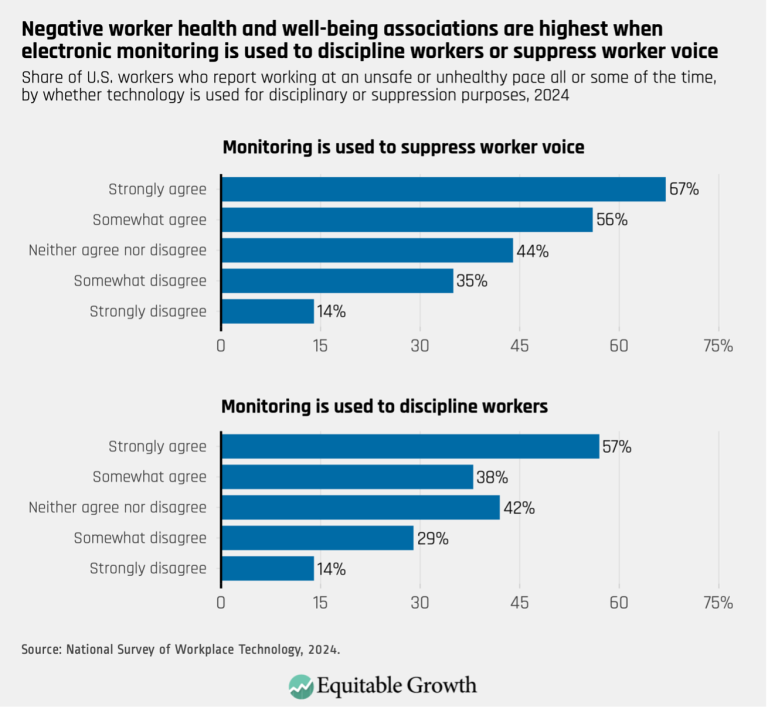
Negative worker health and well-being associations are highest when electronic monitoring is used to discipline workers or suppress worker voice (opens in a new tab)
Visualizations SEP 12, 2024
 View Chart
(opens in a new tab)
View Chart
(opens in a new tab)
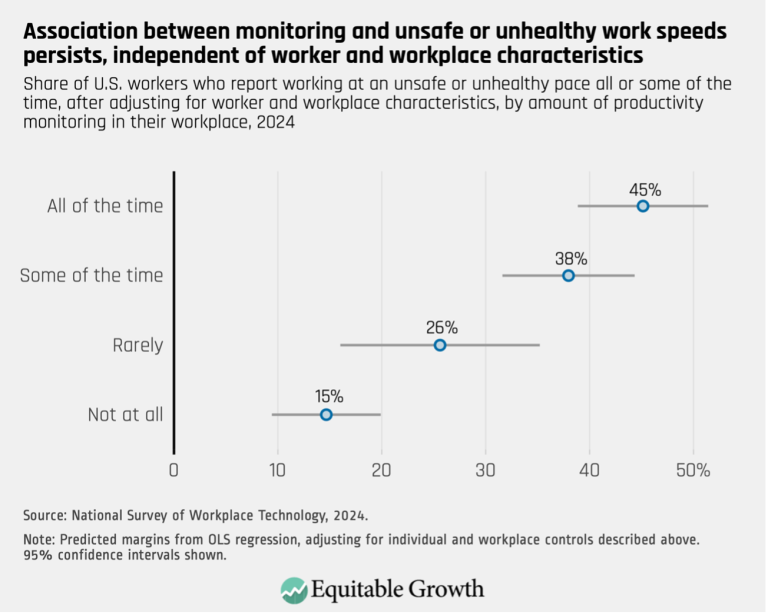
Association between monitoring and unsafe or unhealthy work speeds persists, independent of worker and workplace characteristics (opens in a new tab)
Visualizations SEP 12, 2024
 View Chart
(opens in a new tab)
View Chart
(opens in a new tab)
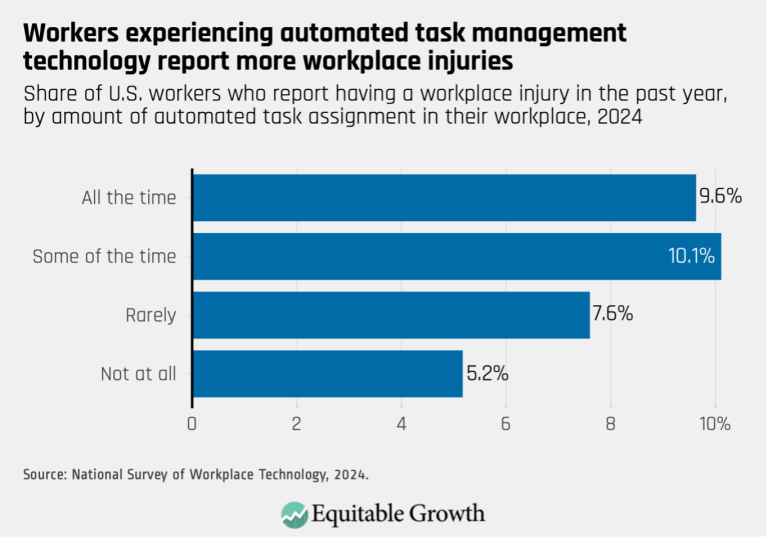
Workers experiencing automated task management technology report more workplace injuries (opens in a new tab)
Visualizations SEP 12, 2024
 View Chart
(opens in a new tab)
View Chart
(opens in a new tab)
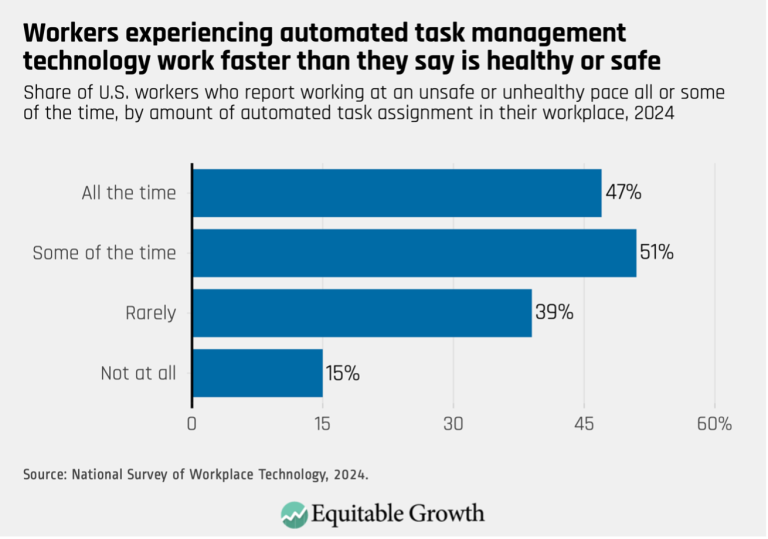
Workers experiencing automated task management technology work faster than they say is healthy or safe (opens in a new tab)
Visualizations SEP 12, 2024
 View Chart
(opens in a new tab)
View Chart
(opens in a new tab)
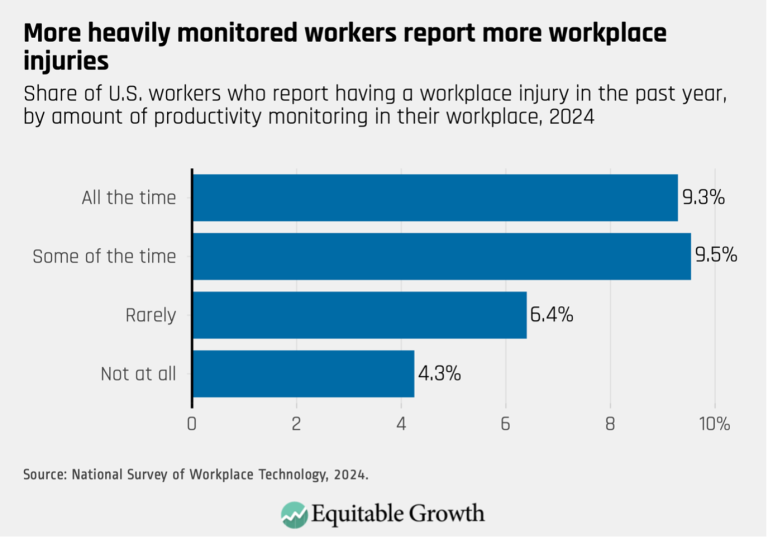
More heavily monitored workers report more workplace injuries (opens in a new tab)
Visualizations SEP 12, 2024
 View Chart
(opens in a new tab)
View Chart
(opens in a new tab)
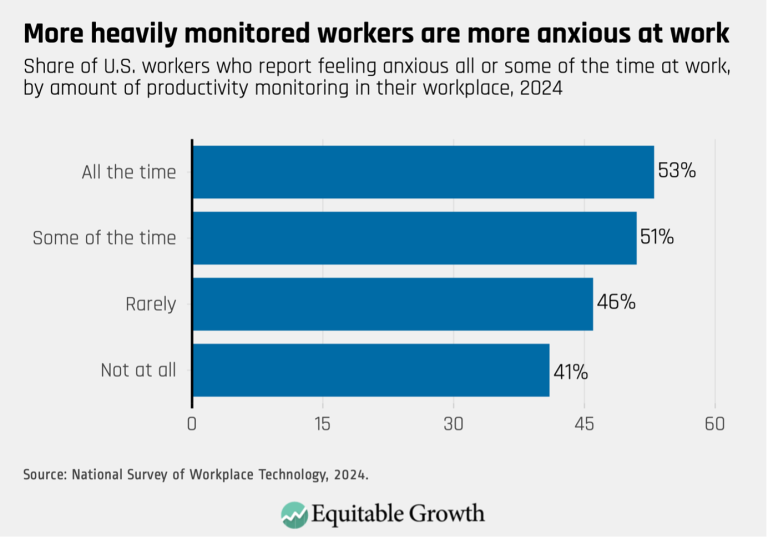
More heavily monitored workers are more anxious at work (opens in a new tab)
Visualizations SEP 12, 2024
 View Chart
(opens in a new tab)
View Chart
(opens in a new tab)
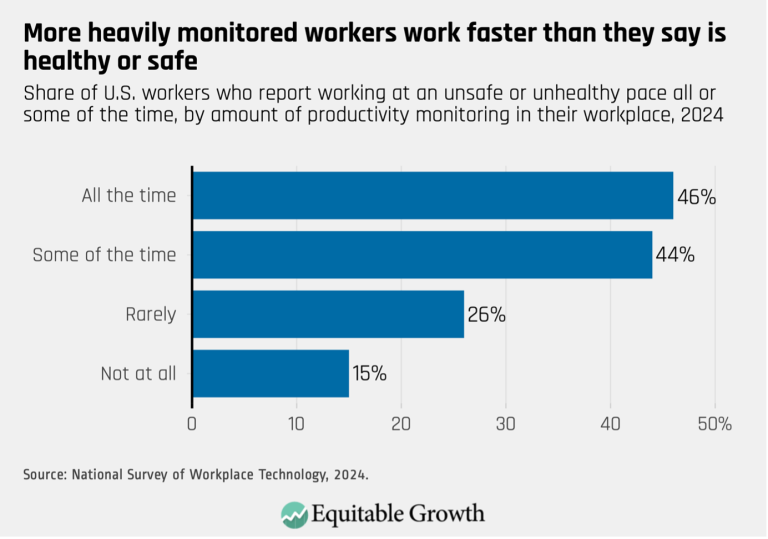
More heavily monitored workers works faster than they say is healthy or safe (opens in a new tab)
Visualizations SEP 12, 2024
 View Chart
(opens in a new tab)
View Chart
(opens in a new tab)
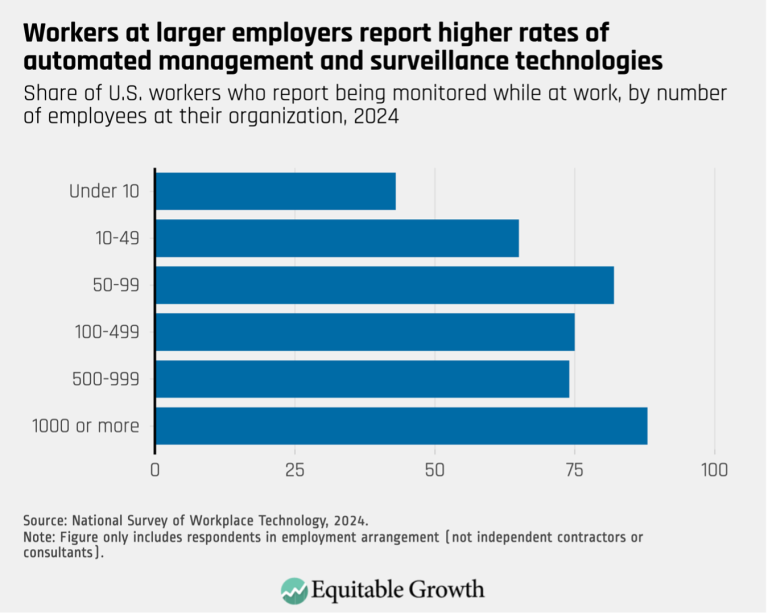
Workers at larger employers report higher rates of automated management and surveillance technologies (opens in a new tab)
Visualizations SEP 12, 2024
 View Chart
(opens in a new tab)
View Chart
(opens in a new tab)
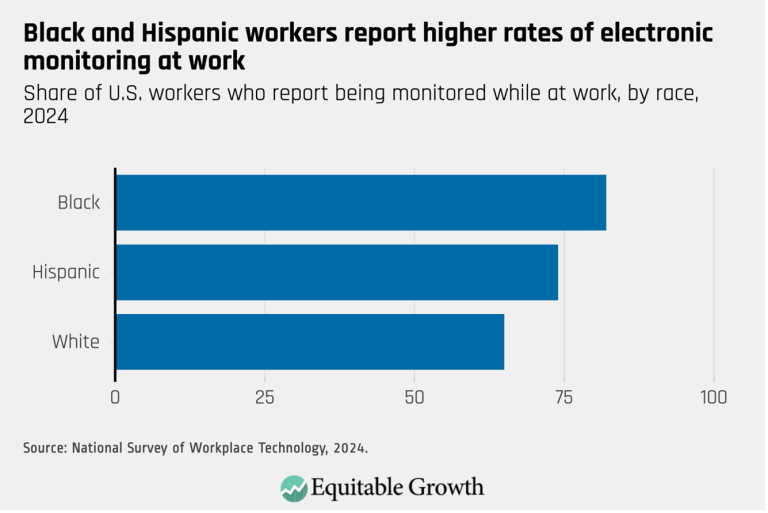
Black and Hispanic workers report higher rates of electronic monitoring at work (opens in a new tab)
Visualizations SEP 12, 2024
 View Chart
(opens in a new tab)
View Chart
(opens in a new tab)
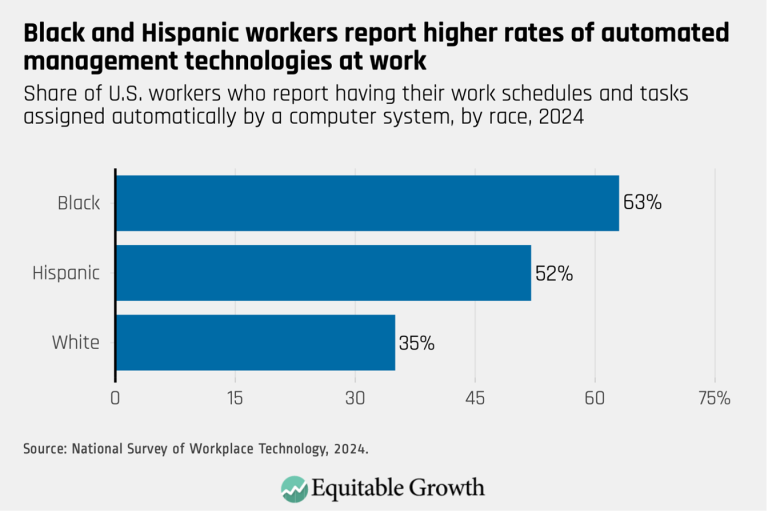
Black and Hispanic workers report higher rates of automated management technologies at work (opens in a new tab)
Visualizations SEP 12, 2024
 View Chart
(opens in a new tab)
View Chart
(opens in a new tab)
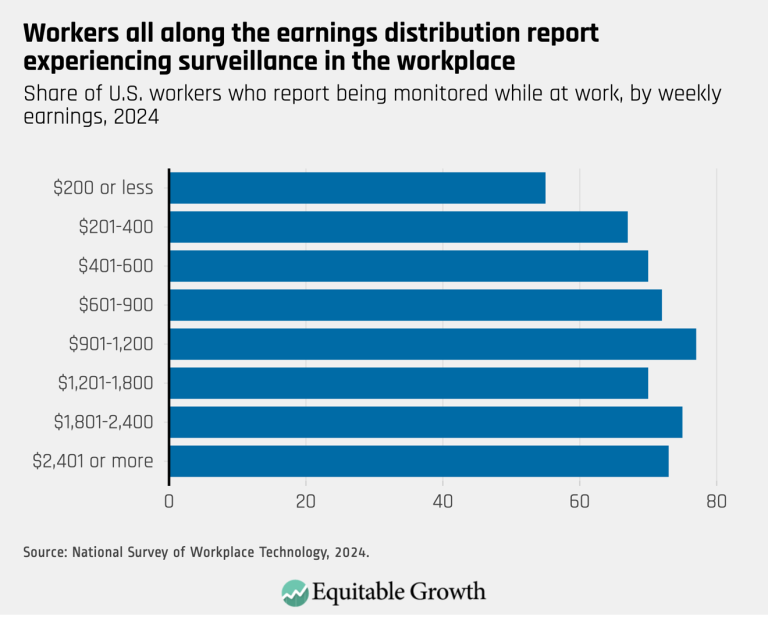
Workers all along the earnings distribution report experiencing surveillance in the workplace (opens in a new tab)
Visualizations SEP 12, 2024
 View Chart
(opens in a new tab)
View Chart
(opens in a new tab)
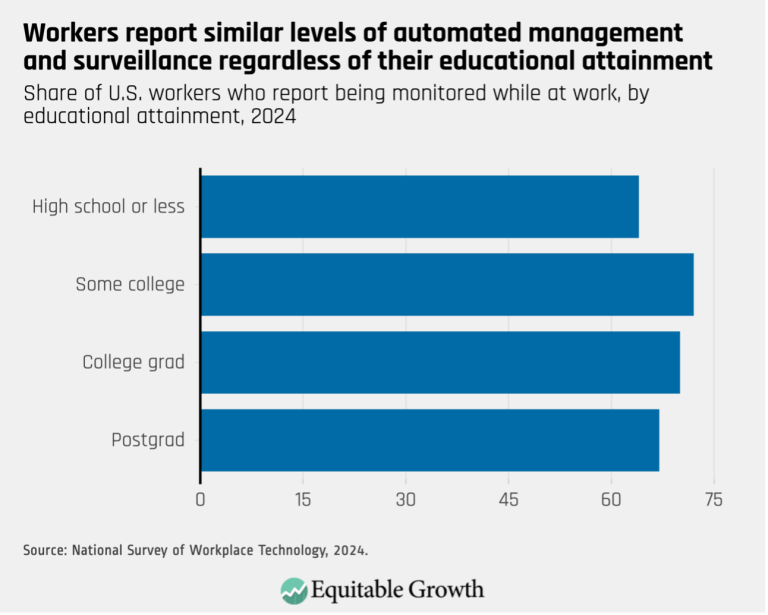
Workers report similar levels of automated management and surveillance regardless of their educational attainment (opens in a new tab)
Visualizations SEP 12, 2024
The upcoming U.S. election’s most important policy effects are under the radar (opens in a new tab)
Blog SEP 3, 2024
Although the old maxim that Labor Day marks the true beginning of U.S. presidential campaigns may no longer hold, the end of summer and beginning of fall remain a period…
By: Kevin Rinz (opens in a new tab)

New federal heat standard will protect U.S. workers from the ill effects of high temperatures amid intensifying climate change (opens in a new tab)
Blog AUG 1, 2024
U.S. workers are more vulnerable than ever to the ill effects of high and rising temperatures as the world continues to shatter heat records this year. Climate-related deaths and injuries…
By: Equitable Growth (opens in a new tab)
Bonus Question: How Does Flexible Incentive Pay Affect Wage Rigidity? (opens in a new tab)
Working Papers JUL 17, 2024
We introduce dynamic incentive contracts into a model of inflation and unemployment dynamics. Our main result is that wage cyclicality from incentives neither affects the slope of the Phillips curve…
By: Meghana Gaur (opens in a new tab), John Grigsby (opens in a new tab), Jonathon Hazell (opens in a new tab), Abdoulaye Ndiaye (opens in a new tab)

New federal heat standard offers novel distributional analysis to determine which workers benefit and how (opens in a new tab)
Blog JUL 16, 2024
The U.S. Department of Labor recently released a much-anticipated proposed rule that promises to protect workers from on-the-job injuries and deaths that result from toiling in the heat. The timing…
By: David S. Mitchell (opens in a new tab)

A researcher’s guide to identifying policy-relevant research questions for the federal government (opens in a new tab)
Essays MAY 30, 2024
Social science researchers play an important role in the policymaking process. Researchers help policymakers at all levels of government to understand key trends and issues in the U.S. economy and…
By: Alexander Hertel-Fernandez (opens in a new tab)

U.S. workers, generative AI, and the future of work (opens in a new tab)
Blog MAY 9, 2024
The launch of ChatGPT in November 2022 captured the world’s attention and illustrated the potential of generative Artificial Intelligence to instantly perform tasks long considered quintessentially “human.” Already, the technology…
By: Molly Kinder (opens in a new tab)

New workplace surveillance bill would protect U.S. workers and address new technological risks (opens in a new tab)
Blog MAY 2, 2024
Across the U.S. economy, the risks posed by unchecked automated surveillance and management technologies are widespread—and growing. These technologies can sometimes be beneficial for workers, customers, and businesses alike. For…
By: Alexander Hertel-Fernandez (opens in a new tab)

Request for Proposals: How effective was the fiscal response to the COVID-19 recession for workers? (opens in a new tab)
RFPs MAR 18, 2024
By: Equitable Growth (opens in a new tab)
Request for proposals: Research grants for early career scholars (opens in a new tab)
RFPs NOV 30, 2023
By: Equitable Growth (opens in a new tab)

Algorithmic wage discrimination requires policy solutions that enforce predictability and the U.S. spirit of equal pay for equal work (opens in a new tab)
Blog JUL 12, 2023
U.S. consumers generally believe that gig workers who labor for companies such as Uber Technologies Inc. and Lyft Inc. are free to set their own hours and thus able to…
By: Veena Dubal (opens in a new tab)
New IRS report examines free tax filing option to reduce the cost and complexity for U.S. taxpayers (opens in a new tab)
Issue Briefs JUN 1, 2023
Filing a tax return with the Internal Revenue Service is one of the most common interactions Americans have with the federal government. Unfortunately, this process is often time-consuming and complex.…
By: Andre Gobbo (opens in a new tab)

Equitable Growth grantee Gabriel Zucman awarded the 2023 John Bates Clark Medal (opens in a new tab)
Blog MAY 9, 2023
Earlier this month, associate professor of public policy and economics Gabriel Zucman at the University of California, Berkeley—and a Washington Center for Equitable Growth 2018 grantee—won the 2023 John Bates…
By: Equitable Growth (opens in a new tab)

In Conversation with Daron Acemoglu (opens in a new tab)
In Conversation MAY 8, 2023
Equitable Growth in Conversation is a recurring series where we talk with economists and other academics to help us better understand whether and how economic inequality affects economic growth and…
By: Kathryn Zickuhr (opens in a new tab)

Seven ways the inflation debate in the United States has changed since last year and how the Fed can now recalibrate its monetary policy (opens in a new tab)
Blog APR 12, 2023
Inflation in the United States today is considerably cooler than at its peak in the first half of 2022, but it will remain at the center of the economic policy…
By: Michael Madowitz (opens in a new tab)

Executive actions to reduce inequality and improve job quality for U.S. workers (opens in a new tab)
Blog MAR 16, 2023
Relevant federal agencies: Federal Trade Commission Equal Employment Opportunity Commission Office of Personnel Management Relevant laws: Federal Trade Commission’s Trade Regulation Rule on Commercial Surveillance and Data Security, Commercial Surveillance…
By: Equitable Growth (opens in a new tab)

The importance of the American Rescue Plan for U.S. workers and families on the law’s second anniversary, in 8 charts (opens in a new tab)
Blog MAR 10, 2023
Tomorrow marks 2 years since the American Rescue Plan Act was signed into law. One year after the COVID-19 pandemic that began in early 2020 triggered enormous employment losses and…
By: Carmen Sanchez Cumming (opens in a new tab), Raksha Kopparam (opens in a new tab)
Equitable Growth delivers letter responding to the NTIA’s Privacy, Equity, and Civil Rights Request for Comment (opens in a new tab)
Blog MAR 6, 2023
The Washington Center for Equitable Growth this week delivered a comment letter responding to the National Telecommunications and Information Administration’s Privacy, Equity, and Civil Rights Request for Comment. Our comment…
By: Kathryn Zickuhr (opens in a new tab)

Automated and algorithmic management is already here, invisibly shaping job quality for U.S. workers (opens in a new tab)
Blog JAN 24, 2023
Predictions about which jobs may be “lost” in the United States as employers implement new automation and algorithmic technologies often consider management tasks and roles as the least vulnerable to…
By: Kathryn Zickuhr (opens in a new tab)

A missed opportunity to expand the Child Tax Credit will affect U.S. families and the broader economy now and for years to come (opens in a new tab)
Blog DEC 21, 2022
Earlier this week, the U.S. Congress released its proposed omnibus bill that funds the federal government through September 2023 and makes various other reforms to the nation’s retirement system, antitrust…
By: Equitable Growth (opens in a new tab)
Early evidence on federal government income supports for U.S. individuals, workers, and families during the COVID-19 pandemic (opens in a new tab)
Reports DEC 13, 2022
This report focuses on preliminary research surrounding the three largest income support programs totaling $1.6 trillion that were paid directly to U.S. individuals, workers, and families amid the first two…
By: Alex Bell (opens in a new tab)

Equitable Growth delivers comment letter responding to FTC’s Advanced Notice of Proposing Rulemaking on Commercial Surveillance and Data Security (opens in a new tab)
Blog NOV 21, 2022
The Washington Center for Equitable Growth this week delivered a comment letter responding to the Federal Trade Commission’s Advanced Notice of Proposing Rulemaking on Commercial Surveillance and Data Security. The…
By: Equitable Growth (opens in a new tab)
 View Chart
(opens in a new tab)
View Chart
(opens in a new tab)
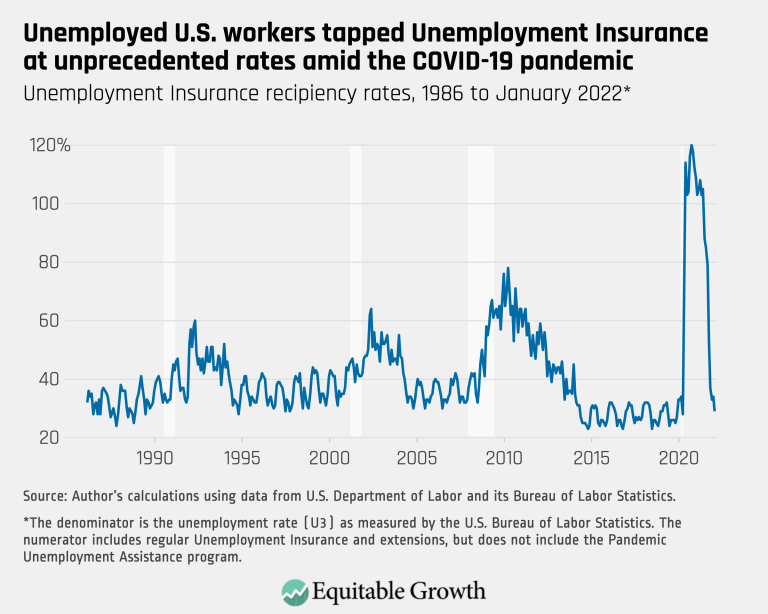
Unemployed U.S. workers tapped Unemployment Insurance at unprecedented rates amid the COVID-19 pandemic (opens in a new tab)
Visualizations NOV 17, 2022

In Conversation with Lenore Palladino (opens in a new tab)
In Conversation NOV 16, 2022
Equitable Growth in Conversation is a recurring series where we talk with economists and other academics to help us better understand whether and how economic inequality affects economic growth and…
By: Kate Bahn (opens in a new tab)
 View Chart
(opens in a new tab)
View Chart
(opens in a new tab)
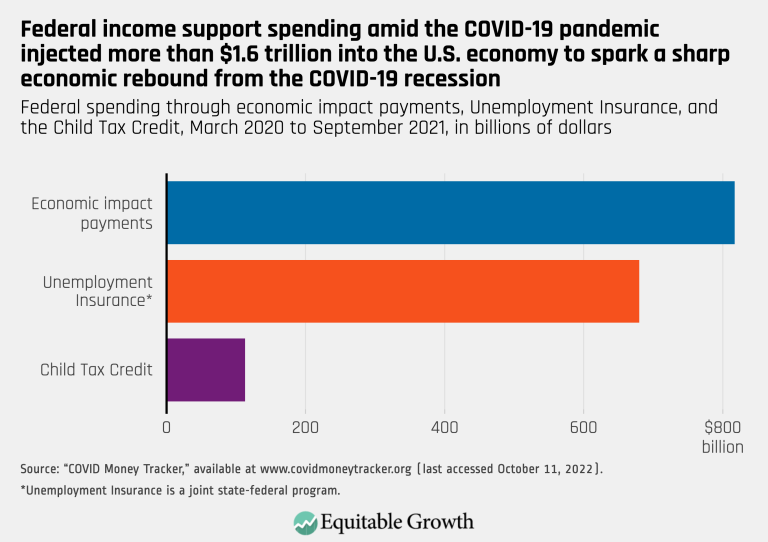
Federal income support spending amid the COVID-19 pandemic injected more than $1.6 trillion into the U.S. economy to spark a sharp economic rebound from the COVID-19 recession (opens in a new tab)
Visualizations NOV 14, 2022

What federal statistical agencies can do to improve survey response rates among Hispanic communities in the United States (opens in a new tab)
Blog OCT 14, 2022
Between 2010 and 2020, the Hispanic American population grew 23 percent, making it one of the fastest-growing communities in the United States. According to the 2020 decennial census, Hispanic Americans…
By: Raksha Kopparam (opens in a new tab)
 View Chart
(opens in a new tab)
View Chart
(opens in a new tab)
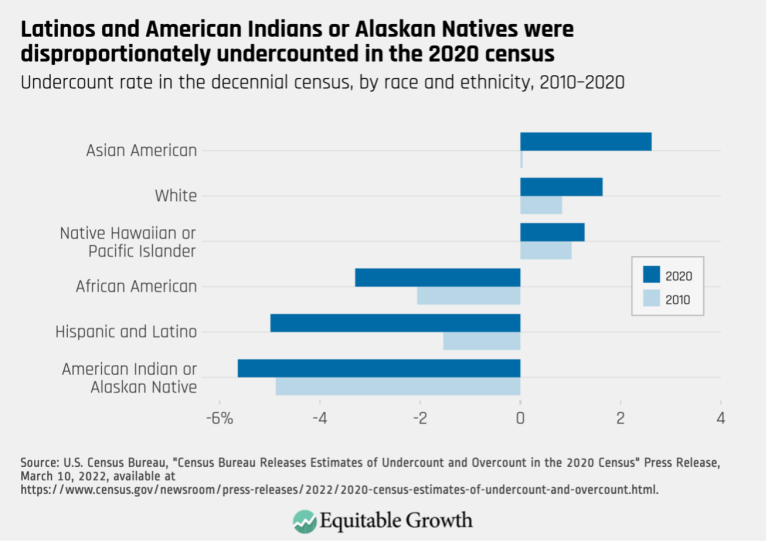
Latinos and American Indians or Alaskan Natives were disproportionately undercounted in the 2020 census (opens in a new tab)
Visualizations OCT 14, 2022
 View Chart
(opens in a new tab)
View Chart
(opens in a new tab)
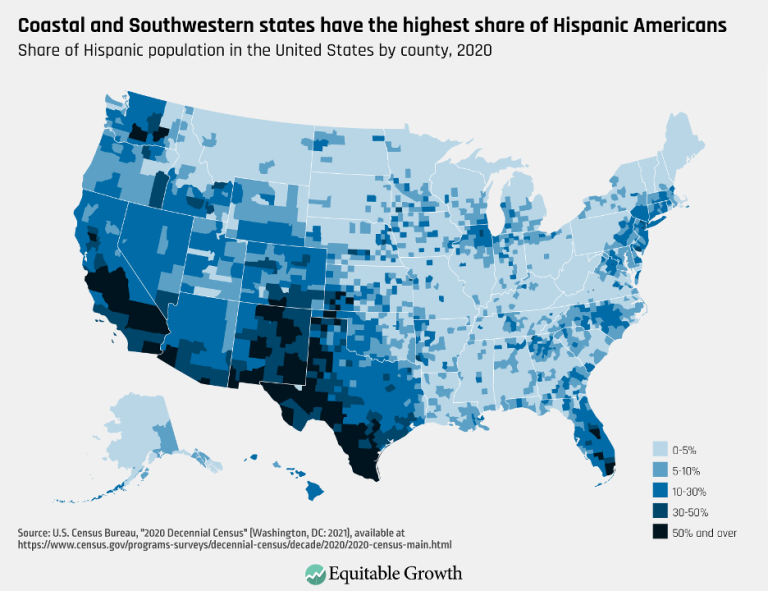
Coastal and Southwestern states have the highest share of Hispanic Americans (opens in a new tab)
Visualizations OCT 14, 2022

Better data collection can help lift the LGBTQ+ community out of economic hardship in the United States (opens in a new tab)
Videos SEP 15, 2022
Over the past 2-plus years amid the COVID-19 pandemic, widespread evidence has underscored the reality that various communities and demographic groups in the United States experience socioeconomic hardships differently. Numerous…
By: Raksha Kopparam (opens in a new tab)
 View Chart
(opens in a new tab)
View Chart
(opens in a new tab)
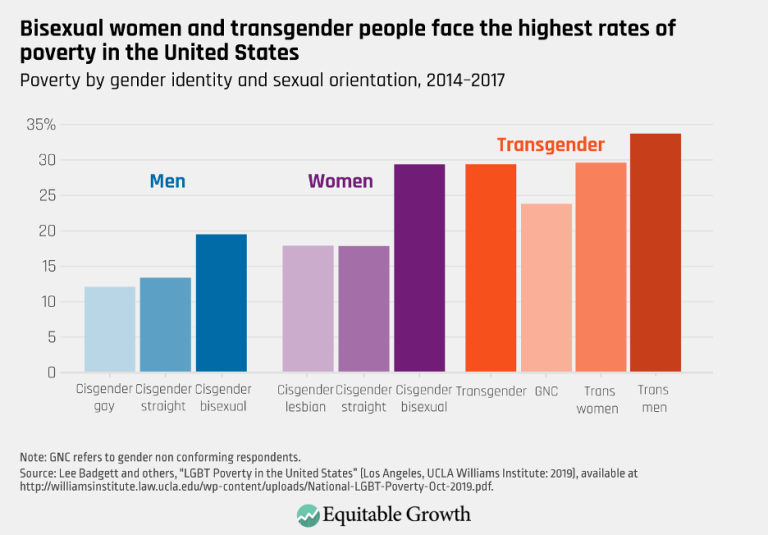
Bisexual women and transgender people face the highest rates of poverty in the United States (opens in a new tab)
Visualizations SEP 15, 2022

Measuring spending inequality in the United States in real time (opens in a new tab)
Blog SEP 8, 2022
The onset of the COVID-19 pandemic and the resulting recession in 2020, followed by a swift U.S. economic recovery, offer lessons today about why real-time data are so crucial to…
By: Loujaina Abdelwahed (opens in a new tab), Jacob Robbins (opens in a new tab), Cole Campbell (opens in a new tab), Shogher Ohannessian (opens in a new tab), Todd Czurylo (opens in a new tab)

Why the Inflation Reduction Act is key to strong, broad-based U.S. economic growth (opens in a new tab)
Blog AUG 16, 2022
The Inflation Reduction Act spells good news for the U.S. economy. The newly signed legislation makes historic investments to combat climate change, lower healthcare costs, and crack down on tax…
By: David S. Mitchell (opens in a new tab)

How to stop a recession by strengthening income supports in the United States (opens in a new tab)
Blog AUG 15, 2022
Income support programs, such as Unemployment Insurance and the Supplemental Nutrition Assistance Program, are powerful tools to deploy when the threat of recession looms and unemployment climbs. By providing income…
By: Alix Gould-Werth (opens in a new tab)
 View Chart
(opens in a new tab)
View Chart
(opens in a new tab)
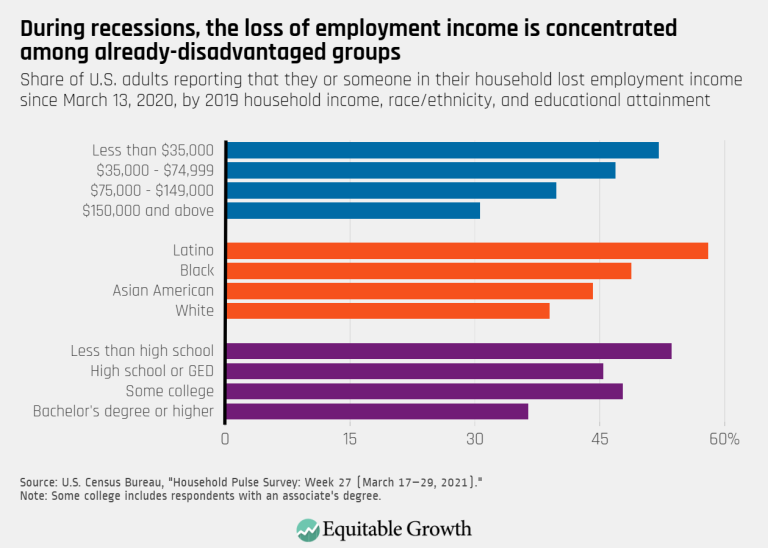
During recessions, the loss of employment income is concentrated among already-disadvantaged groups (opens in a new tab)
Visualizations AUG 12, 2022

The economic evidence behind the Inflation Reduction Act and why it will boost strong, broad-based economic growth (opens in a new tab)
Blog AUG 5, 2022
The Inflation Reduction Act spells good news for the U.S. economy. The proposed legislation now before the U.S. Senate would make historic investments to combat climate change, lower healthcare costs,…
By: David S. Mitchell (opens in a new tab)

The inequitable consequences of ‘heat islands’ within the metropolitan areas of the United States and what to do about it (opens in a new tab)
Blog AUG 3, 2022
Environmental science finds that so-called heat islands occur when urbanized areas experience much higher temperatures than neighboring outlying areas within major metropolitan areas. In and around U.S. cities, more affluent…
By: Michael Garvey (opens in a new tab)

NBER Summer Institute 2022 Round-up: Week 3 (opens in a new tab)
Blog AUG 1, 2022
On July 11, the National Bureau of Economic Research kicked off its summer institute, an annual 3-week conference featuring discussions and paper presentations on various topics in economics, including environmental…
By: Equitable Growth (opens in a new tab)

NBER Summer Institute 2022 Round-up: Week 2 (opens in a new tab)
Blog JUL 26, 2022
On July 11, the National Bureau of Economic Research kicked off its summer institute, an annual 3-week conference featuring discussions and paper presentations on various topics in economics, including disaggregating…
By: Equitable Growth (opens in a new tab)

New working paper examines the evolution of economic thought on the impact of technological change in the labor market (opens in a new tab)
Blog JUL 19, 2022
How have automation and digital technologies contributed to wage inequality in recent decades? It may seem like a straightforward question, but it is one that has been difficult for economists…
By: Kathryn Zickuhr (opens in a new tab)

NBER Summer Institute 2022 Round-up: Week 1 (opens in a new tab)
Blog JUL 18, 2022
On July 11, the National Bureau of Economic Research kicked off its summer institute, an annual 3-week conference featuring discussions and paper presentations on various topics in economics, including monopsony…
By: Equitable Growth (opens in a new tab)
 View Chart
(opens in a new tab)
View Chart
(opens in a new tab)
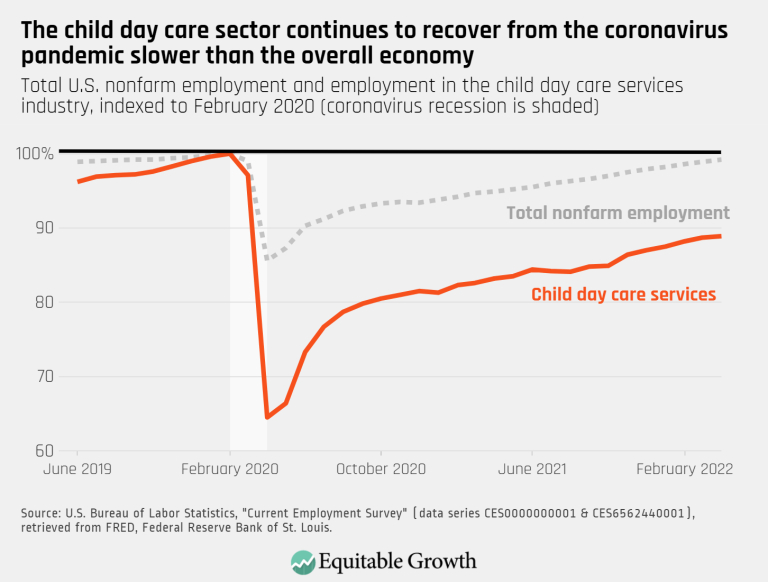
The child day care sector continues to recover from the COVID-19 pandemic slower than the overall economy (opens in a new tab)
Visualizations MAY 20, 2022

Recent working paper explores connection between capital investment and labor demand in the United States (opens in a new tab)
Blog MAY 20, 2022
The increasing visibility of artificial intelligence and other advanced technologies in the workplace is drawing new attention to how employers integrate technology into work processes and what effects these decisions…
By: Kathryn Zickuhr (opens in a new tab)

Child care costs are going to rise, but policymakers can help U.S. families manage these increases (opens in a new tab)
Blog MAY 18, 2022
For decades, the U.S. child care market has been on the verge of a crisis. As any parent knows, child care in the United States has long been too expensive,…
By: Sam Abbott (opens in a new tab)
 View Chart
(opens in a new tab)
View Chart
(opens in a new tab)
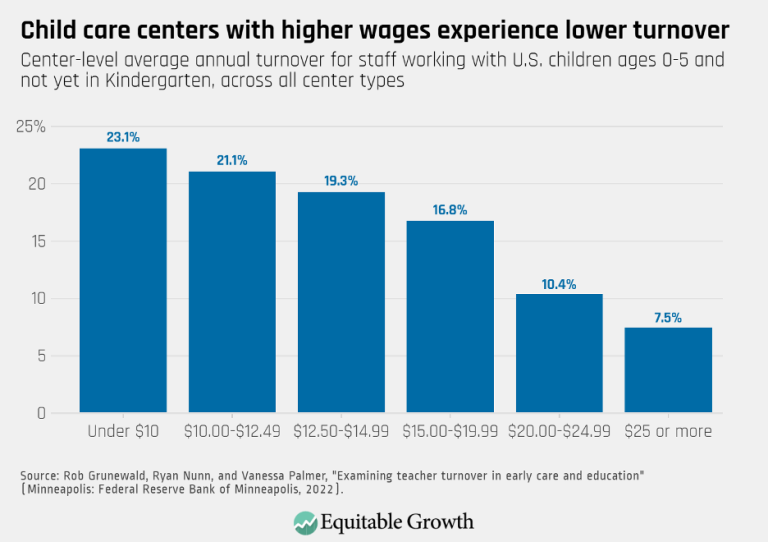
Child care centers with higher wages experience lower turnover (opens in a new tab)
Visualizations MAY 18, 2022
 View Chart
(opens in a new tab)
View Chart
(opens in a new tab)
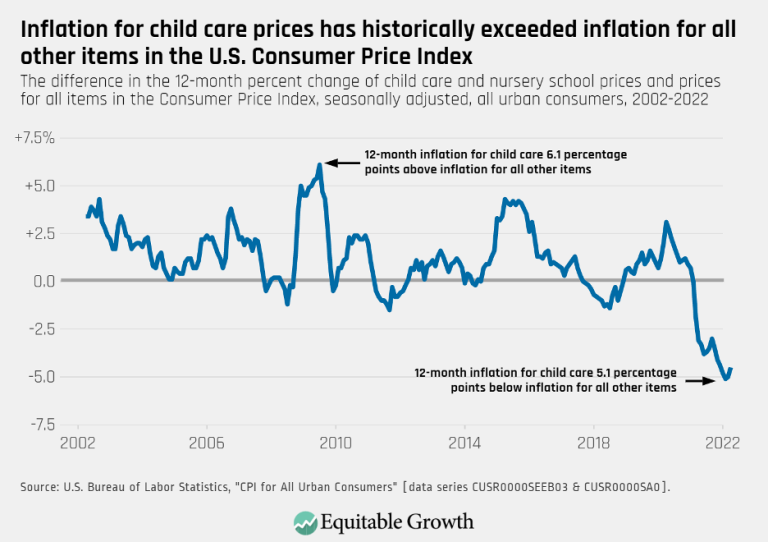
Inflation for child care prices has historically exceeded inflation for all other items in the U.S. Consumer Price Index (opens in a new tab)
Visualizations MAY 18, 2022
 View Chart
(opens in a new tab)
View Chart
(opens in a new tab)
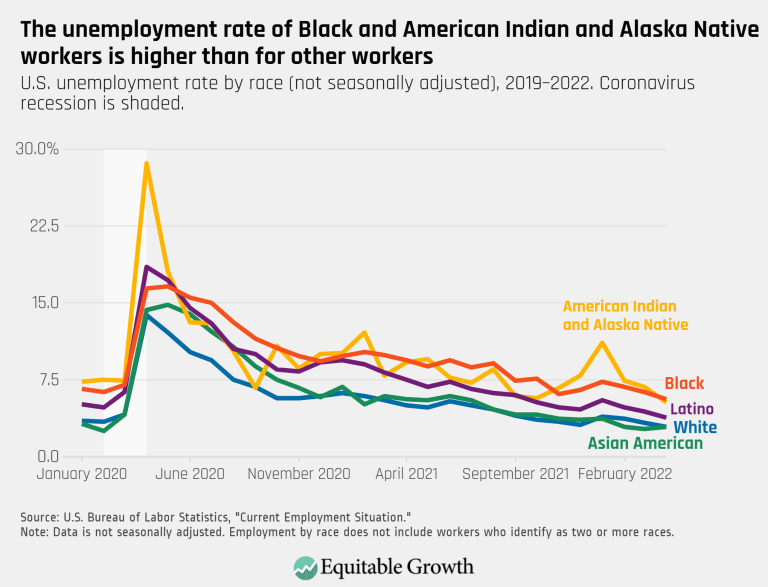
The unemployment rate of Black and American Indian and Alaska Native workers is higher than for other workers (opens in a new tab)
Visualizations MAY 6, 2022

Jobs report: Amid continued job gains, Asian American, Native Hawaiian, and Pacific Islander workers experience the U.S. labor market in different and often hidden ways (opens in a new tab)
Blog MAY 6, 2022
Between mid-March and mid-April, the U.S. economy added a strong 428,000 jobs, making it the 12th consecutive month in which employment growth surpasses 400,000 jobs. In addition, according to the…
By: Carmen Sanchez Cumming (opens in a new tab), Kathryn Zickuhr (opens in a new tab)
 View Chart
(opens in a new tab)
View Chart
(opens in a new tab)
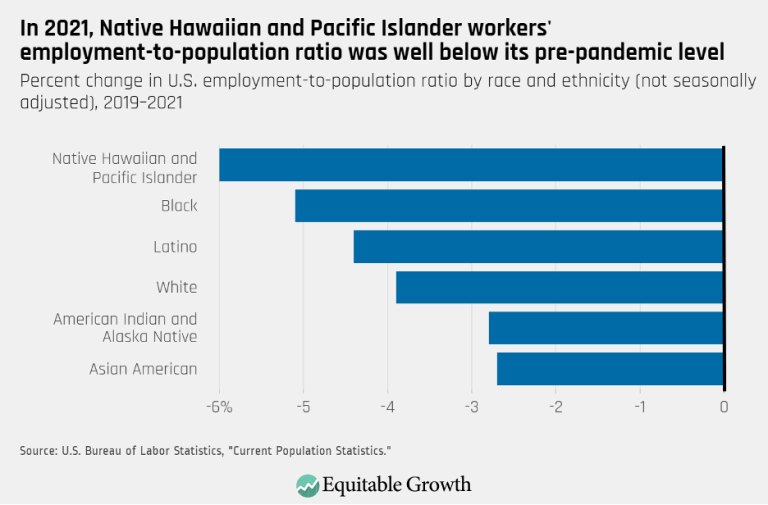
In 2021, Native Hawaiian and Pacific Islander workers’ employment-to-population ratio was well below its pre-pandemic level (opens in a new tab)
Visualizations MAY 6, 2022

In Conversation with Jonathan Fisher (opens in a new tab)
In Conversation DEC 16, 2021
Equitable Growth in Conversation is a recurring series where we talk with economists and other academics to help us better understand whether and how economic inequality affects economic growth and…
By: Kate Bahn (opens in a new tab), Jonathan Fisher (opens in a new tab)

Addressing the ‘double gap’ faced by Black women in the U.S. economy (opens in a new tab)
Blog NOV 30, 2021
In my testimony before the Joint Economic Committee of the U.S. Congress this past summer, I presented some of the findings from my 2020 report, “The “Double Gap” and the…
By: Michelle Holder (opens in a new tab)

The economic evidence behind 10 policies in the Build Back Better Act (opens in a new tab)
Issue Briefs NOV 24, 2021
The U.S. House of Representatives late last week passed a key plank of President Joe Biden’s economic agenda, the Build Back Better Act. Coming on the heels of the president…
By: Maryam Janani-Flores (opens in a new tab), David S. Mitchell (opens in a new tab)
 View Chart
(opens in a new tab)
View Chart
(opens in a new tab)
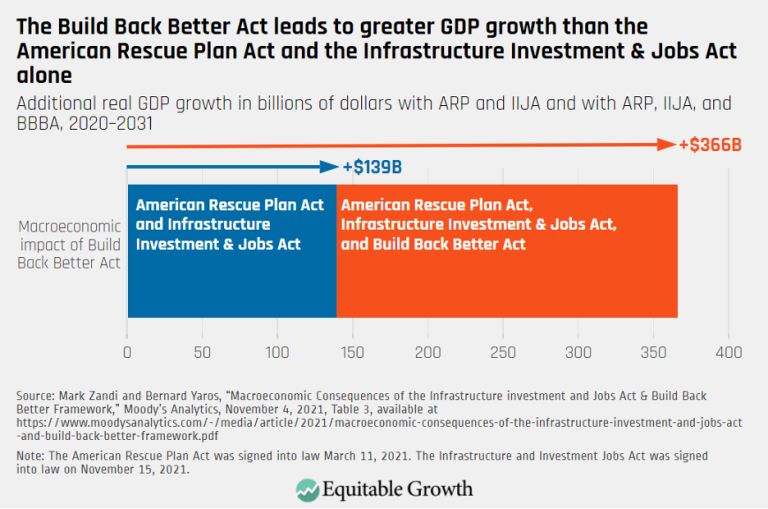
The Build Back Better Act leads to greater GDP growth than the American Rescue Plan Act and the Infrastructure Investment & Jobs Act alone (opens in a new tab)
Visualizations NOV 24, 2021

In Conversation with Erica Groshen (opens in a new tab)
In Conversation OCT 25, 2021
Equitable Growth in Conversation is a recurring series where we talk with economists and other academics to help us better understand whether and how economic inequality affects economic growth and…
By: Austin Clemens (opens in a new tab)

Supporting American Indian tribal sovereignty boosts economic outcomes for those on reservation lands (opens in a new tab)
Videos OCT 21, 2021
American Indian communities over the past 30 years experienced more economic growth and improved well-being than during any other point in the more than five centuries since European colonists and…
By: Equitable Growth (opens in a new tab)
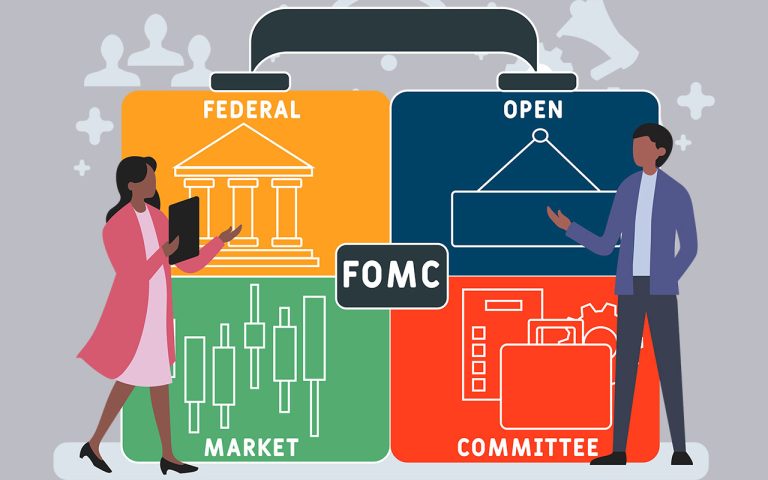
The value of racial and gender diversity at the Federal Reserve (opens in a new tab)
Blog SEP 16, 2021
The Federal Reserve’s so-called dual mandate to maintain overall price stability and maximum sustainable growth in U.S. employment is always on the minds of the U.S. central bank’s Federal Open…
By: Equitable Growth (opens in a new tab)
Diverse Policy Committees Can Reach Underrepresented Groups (opens in a new tab)
Working Papers SEP 16, 2021
In a randomized control trial that varies the salience of female and minority representation on the Federal Reserve’s monetary policy committee, the FOMC, we test whether diversity affects how Fed…
By: Francesco D’Acunto (opens in a new tab), Andreas Fuster (opens in a new tab), Michael Weber (opens in a new tab)

Workplace surveillance is becoming the new normal for U.S. workers (opens in a new tab)
Reports AUG 18, 2021
In the first weeks of the pandemic back in the spring of 2020, as many as half of U.S. workers who remained employed were suddenly working from home. Managers scrambled…
By: Kathryn Zickuhr (opens in a new tab)

NBER Summer Institute 2021 Round-up: Week 2 (opens in a new tab)
Blog JUL 26, 2021
On July 12, the National Bureau of Economic Research kicked off its summer institute, an annual 3-week conference featuring discussions and paper presentations on specific subfields of economics, including wealth…
By: Equitable Growth (opens in a new tab)

NBER Summer Institute 2021 Round-up: Week 1 (opens in a new tab)
Blog JUL 19, 2021
On July 12, the National Bureau of Economic Research kicked off its summer institute, an annual 3-week conference featuring discussions and paper presentations on specific subfields of economics, including inequality…
By: Equitable Growth (opens in a new tab)

Excessive heat harms U.S. workers unequally as the safety risks from climate change soar (opens in a new tab)
Blog JUL 19, 2021
This summer’s West Coast heat waves come as no surprise. But headlines about the various negative effects of excessive heat, including fatal wildfires, often overlook the plight of everyday workers.…
By: Michael Garvey (opens in a new tab)
Temperature, workplace safety, and labor market inequality (opens in a new tab)
Working Papers JUL 19, 2021
Using data covering the universe of injury claims from the nation’s largest worker’s compensation system (2001-2018), we explore the relationship between temperature and workplace safety and its implications for labor…
By: R. Jisung Park (opens in a new tab), Nora Pankratz (opens in a new tab), A. Patrick Behrer (opens in a new tab)
 View Chart
(opens in a new tab)
View Chart
(opens in a new tab)
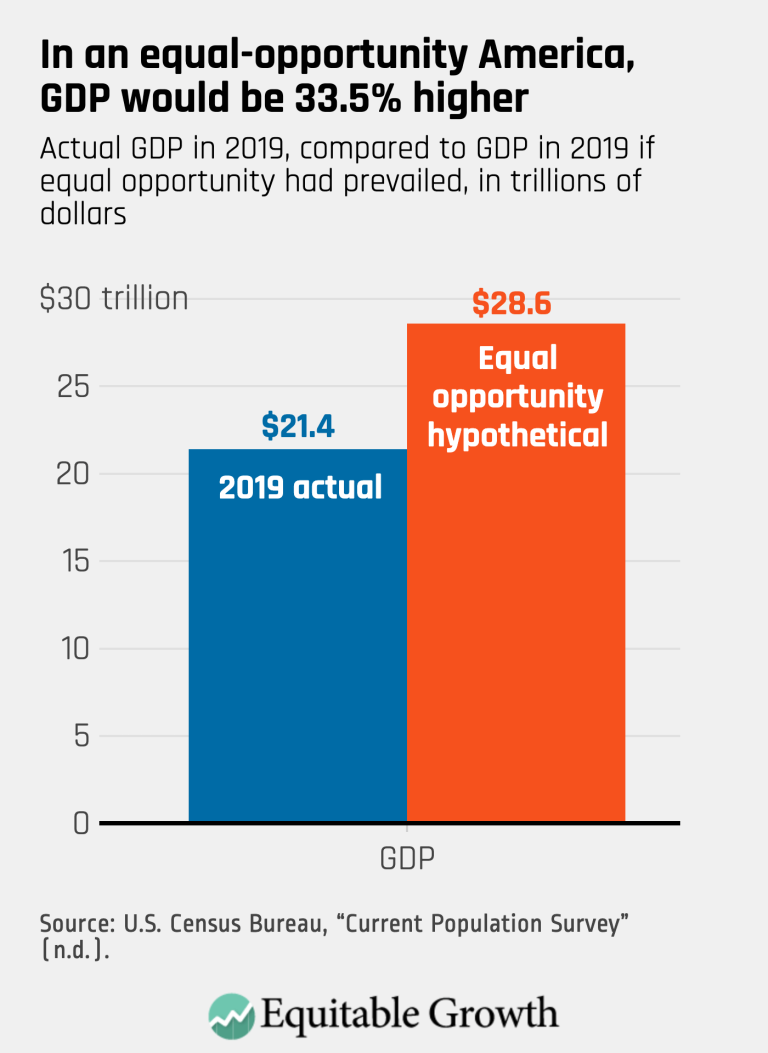
In an equal-opportunity America, GDP would be 33.5% higher (opens in a new tab)
Visualizations JUL 2, 2021
 View Chart
(opens in a new tab)
View Chart
(opens in a new tab)
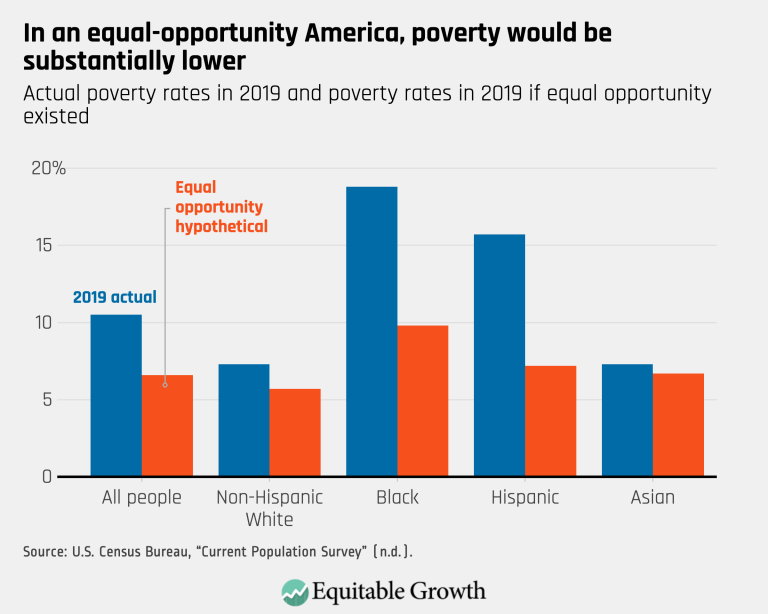
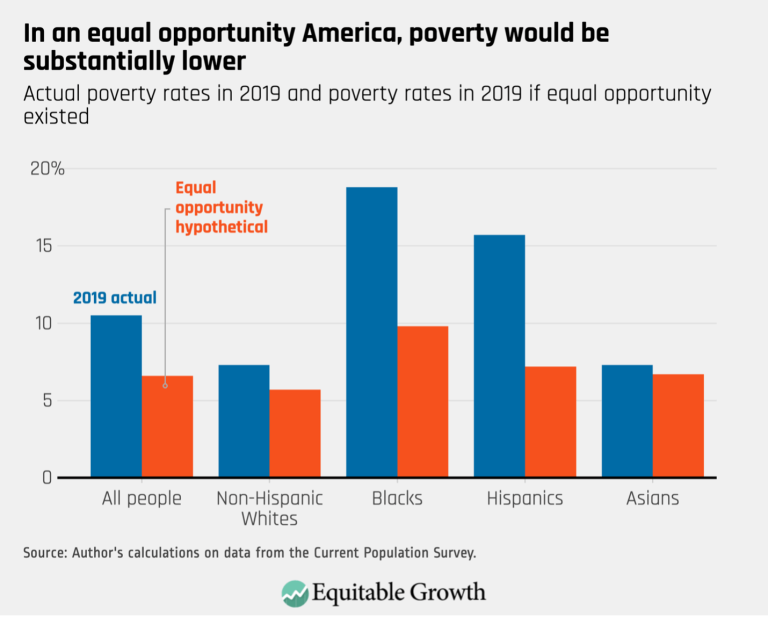
In an equal-opportunity America, poverty would be substantially lower (opens in a new tab)
Visualizations JUL 2, 2021
 View Chart
(opens in a new tab)
View Chart
(opens in a new tab)
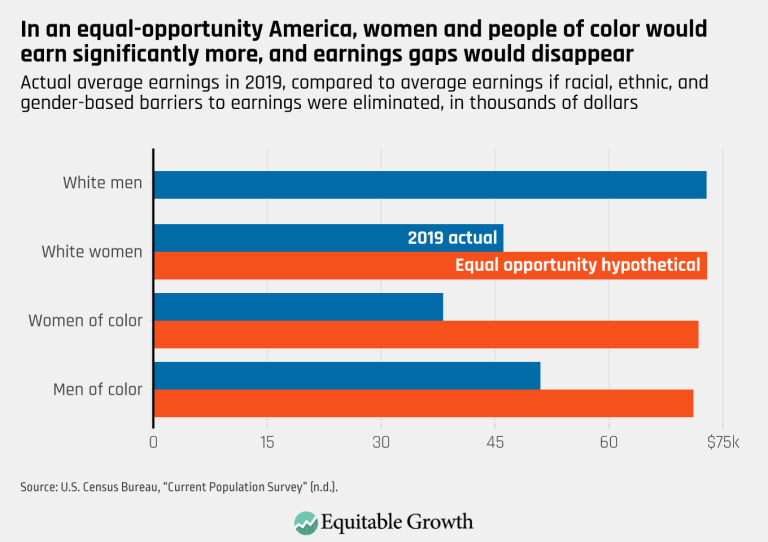
In an equal-opportunity America, women and people of color would earn significantly more, and earnings gaps would disappear (opens in a new tab)
Visualizations JUL 2, 2021
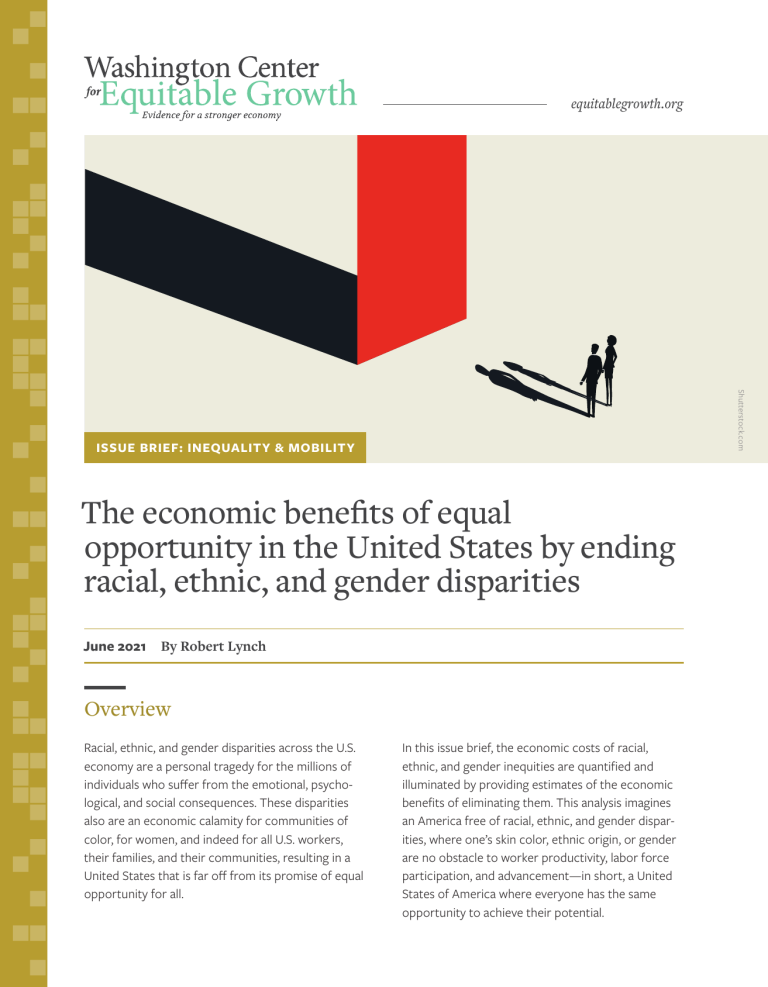
The economic benefits of equal opportunity in the United States by ending racial, ethnic, and gender disparities (opens in a new tab)
Issue Briefs JUN 29, 2021
Racial, ethnic, and gender disparities across the U.S. economy are a personal tragedy for the millions of individuals who suffer from the emotional, psychological, and social consequences. These disparities also…
By: Robert Lynch (opens in a new tab)

A new report lays out the path forward for faltering U.S. Unemployment Insurance system (opens in a new tab)
Blog JUN 24, 2021
Today, experts from seven organizations released a fortuitously timed report charting a path forward for the U.S. Unemployment Insurance program. Unemployment Insurance is the main social insurance program designed to…
By: Alix Gould-Werth (opens in a new tab)
 View Chart
(opens in a new tab)
View Chart
(opens in a new tab)
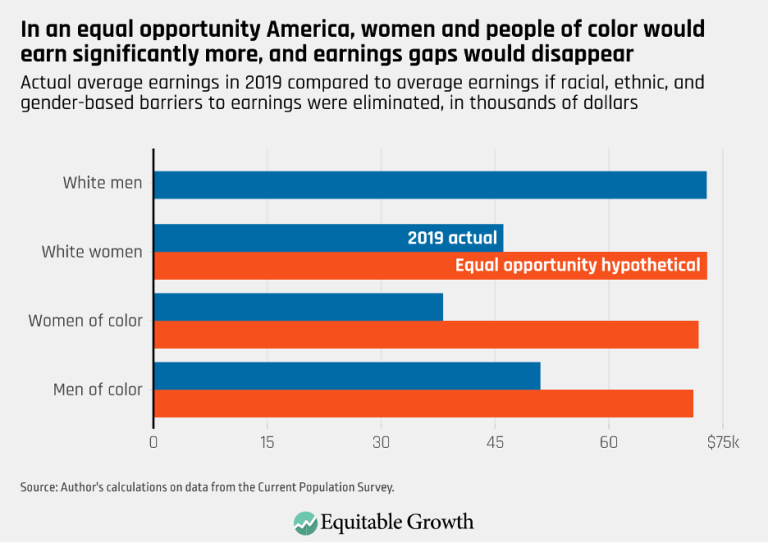
In an equal opportunity America, women and people of color would earn significantly more, and earnings gaps would disappear (opens in a new tab)
Visualizations JUN 7, 2021
 View Chart
(opens in a new tab)
View Chart
(opens in a new tab)
In an equal opportunity America, poverty would be substantially lower (opens in a new tab)
Visualizations JUN 7, 2021
 View Chart
(opens in a new tab)
View Chart
(opens in a new tab)
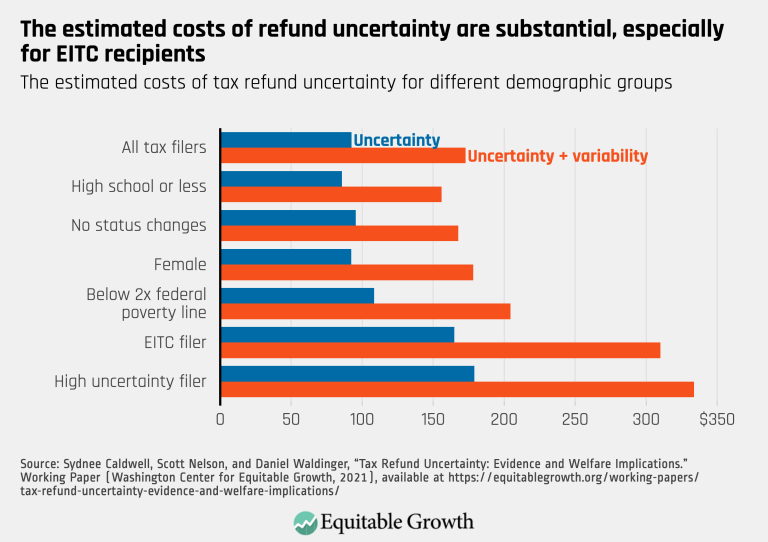
The estimated costs of refund uncertainty are substantial, especially for EITC recipients (opens in a new tab)
Visualizations APR 13, 2021

Uncertainty about the size of annual tax refunds hinders the effectiveness of tax-based U.S. redistribution (opens in a new tab)
Blog APR 8, 2021
Each tax season, many families in the United States receive additional income through refundable tax credits, among them the Earned Income Tax Credit and Child Tax Credit. These two tax…
By: Sydnee Caldwell (opens in a new tab), Scott Nelson (opens in a new tab), Daniel Waldinger (opens in a new tab)
Tax Refund Uncertainty: Evidence and Welfare Implications (opens in a new tab)
Working Papers APR 8, 2021
Transfers paid through annual tax refunds are a large but uncertain source of income for poor households. We document that low-income tax-filers have substantial subjective uncertainty about these refunds. We…
By: Sydnee Caldwell (opens in a new tab), Scott Nelson (opens in a new tab), Daniel Waldinger (opens in a new tab)

New evidence on the success of gig-worker pay standards for ride-hail drivers (opens in a new tab)
Blog MAR 10, 2021
The misclassification of work performed by ride-hailing drivers is rampant in the online platform-based gig economy. Companies such as Uber Technologies Inc. and Lyft Inc. claim their drivers are independent…
By: Kathryn Zickuhr (opens in a new tab)
How to replace COVID relief deadlines with automatic ‘triggers’ that meet the needs of the U.S. economy (opens in a new tab)
Blog FEB 11, 2021
To strengthen the federal government’s response to the coronavirus pandemic and the resulting economic downturn, President Joe Biden seeks to enact his American Rescue Plan to stop the spread of…
By: David S. Mitchell (opens in a new tab), Corey Husak (opens in a new tab)

Collective bargaining as a path to more equitable wage growth in the United States (opens in a new tab)
Blog JAN 14, 2021
This essay is part of Boosting Wages for U.S. Workers in the New Economy, a compilation of 10 essays from leading economic thinkers who explore alternative policies for boosting wages…
By: Benjamin Schoefer (opens in a new tab)
Targeting business tax incentives to realize U.S. wage growth (opens in a new tab)
Blog JAN 14, 2021
This essay is part of Boosting Wages for U.S. Workers in the New Economy, a compilation of 10 essays from leading economic thinkers who explore alternative policies for boosting wages…
By: Juan Carlos Suarez Serrato (opens in a new tab)

Sovereignty and improved economic outcomes for American Indians: Building on the gains made since 1990 (opens in a new tab)
Blog JAN 14, 2021
This essay is part of Boosting Wages for U.S. Workers in the New Economy, a compilation of 10 essays from leading economic thinkers who explore alternative policies for boosting wages…
By: Randall Akee (opens in a new tab)
 View Chart
(opens in a new tab)
View Chart
(opens in a new tab)
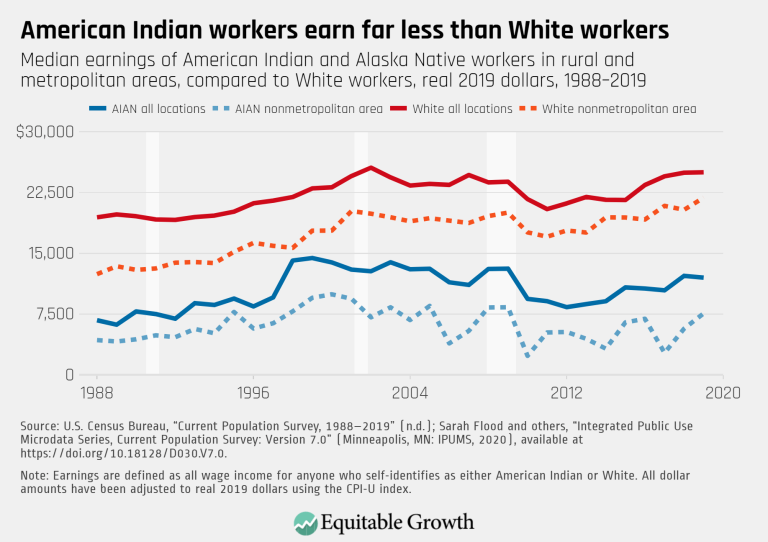
American Indian workers earn far less than White workers (opens in a new tab)
Visualizations JAN 11, 2021
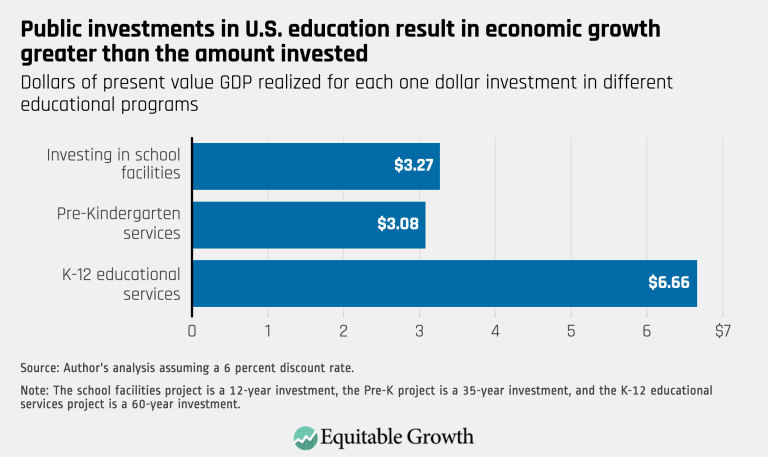
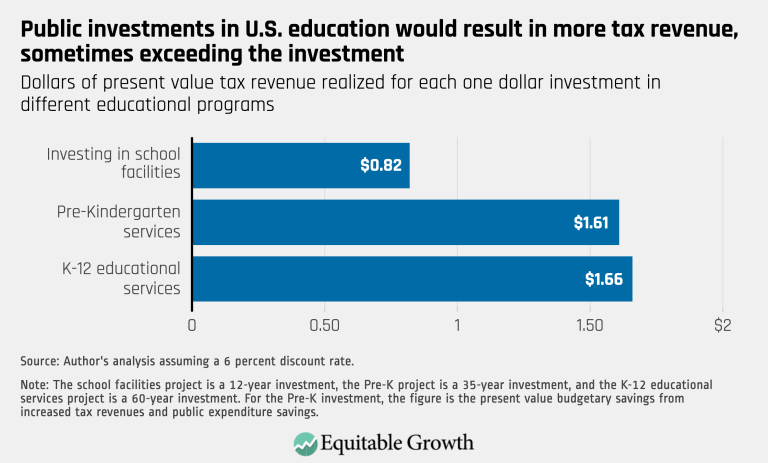
Public investments in education can spur equitable growth, pay for themselves, and create jobs for a stronger economic recovery (opens in a new tab)
Reports OCT 27, 2020
Public investments in education, in both physical structures and in services, are key to long-run economic growth and human well-being. Some of these investments are especially effective in promoting more…
By: Robert Lynch (opens in a new tab)

Testimony by Michael Kades before the Subcommittee on Antitrust, Commercial, and Administrative Law on digital markets (opens in a new tab)
Blog OCT 1, 2020
Michael KadesDirector, Markets and Competition PolicyWashington Center for Equitable Growth“Proposals to Strengthen the Antitrust Laws and Restore Competition Online”Subcommittee on Antitrust, Commercial, and Administrative Law October 1, 2020 Thank you…
By: Michael Kades (opens in a new tab)
 View Chart
(opens in a new tab)
View Chart
(opens in a new tab)
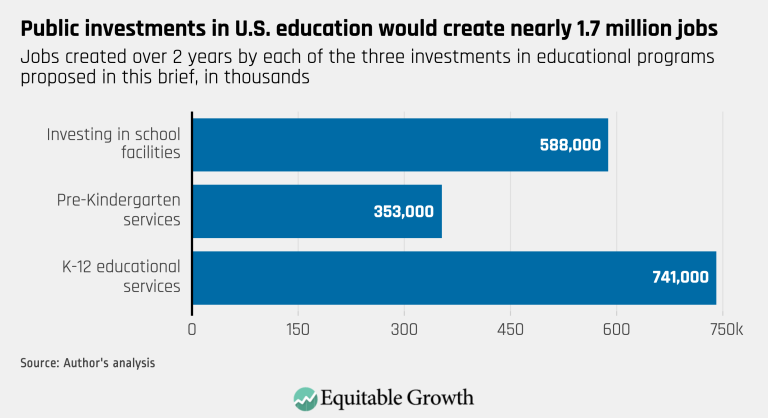
Public investment in U.S. education would create nearly 1.7 million jobs (opens in a new tab)
Visualizations SEP 22, 2020
 View Chart
(opens in a new tab)
View Chart
(opens in a new tab)
Public investment in U.S. education result in economic growth greater than the amount invested (opens in a new tab)
Visualizations SEP 22, 2020
 View Chart
(opens in a new tab)
View Chart
(opens in a new tab)
Public investment in U.S. education would result in more tax revenue, sometimes exceeding the investment (opens in a new tab)
Visualizations SEP 22, 2020

The hidden costs of stock-market-first U.S. economic policies (opens in a new tab)
Blog SEP 22, 2020
The idea that sound U.S. economic policy begins and ends with a strong stock market is becoming pervasive. Advocates of what I call the stock-market-first approach want you to focus…
By: John Sabelhaus (opens in a new tab)
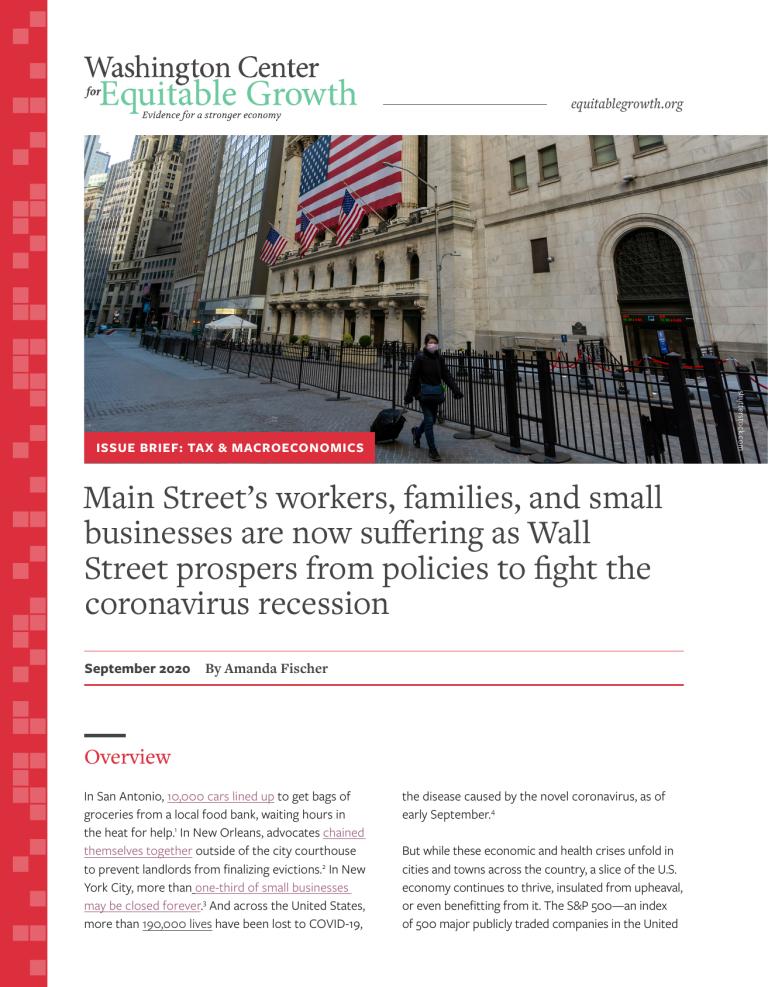
Main Street’s workers, families, and small businesses are now suffering as Wall Street prospers from policies to fight the coronavirus recession (opens in a new tab)
Issue Briefs SEP 17, 2020
In San Antonio, 10,000 cars lined up to get bags of groceries from a local food bank, waiting hours in the heat for help. In New Orleans, advocates chained themselves…
By: Amanda Fischer (opens in a new tab)

Get more money immediately to U.S. families and help them out of the coronavirus recession (opens in a new tab)
Blog SEP 1, 2020
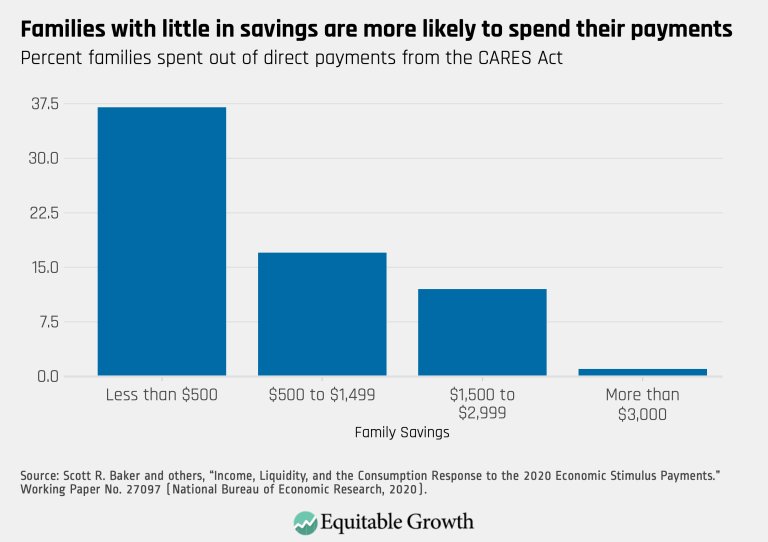
The costs of the deepening coronavirus recession and the benefits of the federal government providing another round of direct economic aid to families are clear. Let’s begin with the mounting…
By: Michael Garvey (opens in a new tab), Claudia Sahm (opens in a new tab)
 View Chart
(opens in a new tab)
View Chart
(opens in a new tab)
Families with little in savings are more likely to spend their payments (opens in a new tab)
Visualizations AUG 31, 2020
 View Chart
(opens in a new tab)
View Chart
(opens in a new tab)
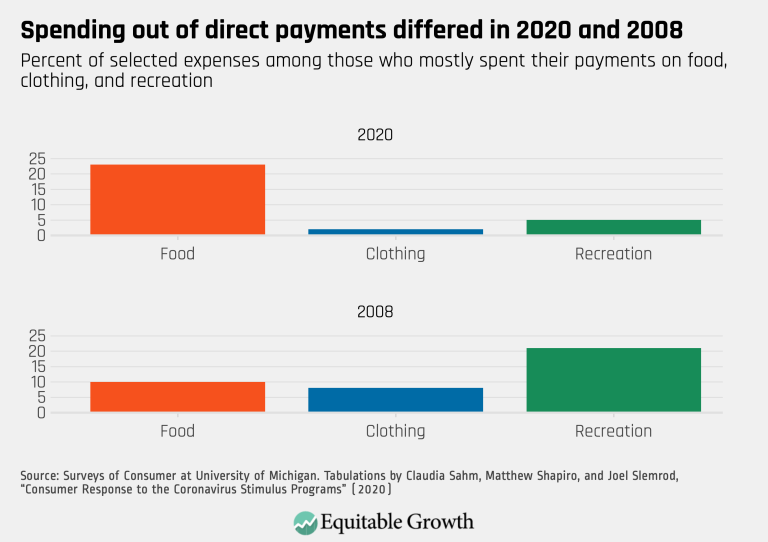
Spending out of direct payments differed in 2020 and 2008 (opens in a new tab)
Visualizations AUG 31, 2020
Equitable Growth announces record $1.07 million in research grants on inequality and broadly shared growth (opens in a new tab)
Blog AUG 31, 2020
The Washington Center for Equitable Growth today announced research grants totaling $1,074,060—our largest year to date—to seek evidence on important issues related to the intersections between economic inequality and growth.…
By: Korin Davis (opens in a new tab)

Revamping U.S. small business rescue programs amid the coronavirus recession (opens in a new tab)
Blog AUG 27, 2020
The coronavirus economic rescue programs enacted by Congress this past spring failed to prevent layoffs and firm bankruptcies among the smallest employers in the United States. Existing resources, such as…
By: Equitable Growth (opens in a new tab)

Achieving universal paid family and medical leave in the United States (opens in a new tab)
Blog AUG 24, 2020
The coronavirus pandemic and the recession it caused lay bare a familiar challenge for U.S. workers—balancing family and job responsibilities without access to paid family and medical leave. When a…
By: Equitable Growth (opens in a new tab)

Disaggregated data on Asian Americans, Native Hawaiians, and Pacific Islanders is crucial amid the coronavirus pandemic (opens in a new tab)
Issue Briefs AUG 20, 2020
The novel coronavirus pandemic and the recession it caused lay bare the clear links between racial and ethnic economic inequities, structural racism, and the outsized harm of these crises on…
By: Christian Edlagan (opens in a new tab), Raksha Kopparam (opens in a new tab)
 View Chart
(opens in a new tab)
View Chart
(opens in a new tab)
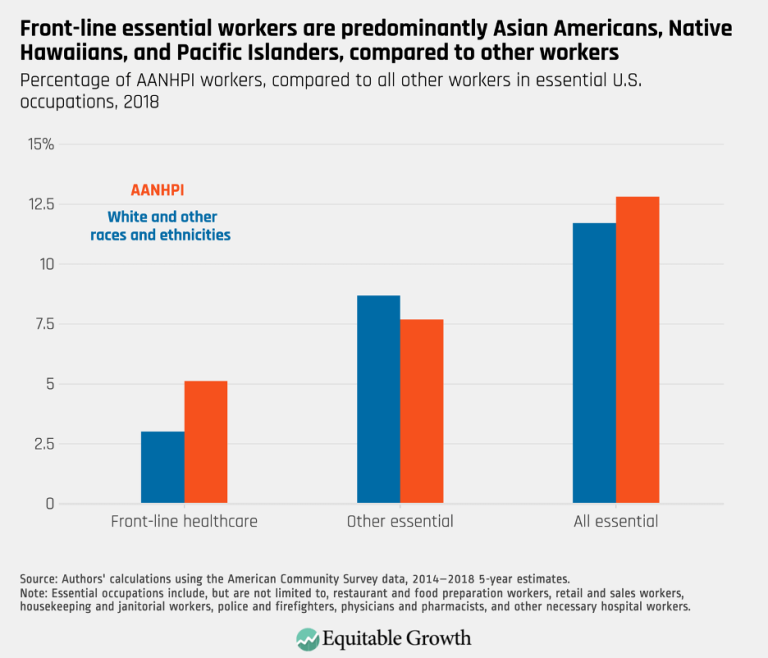
Front-line essential workers are predominately Asian Americans, Native Hawaiians, and Pacific Islanders, compared to other workers (opens in a new tab)
Visualizations AUG 20, 2020


Your Direct Line to Cutting Edge Research
Be the first to know about our latest events, research releases, and expert insights. Get exclusive updates delivered right to your inbox and never miss an opportunity to engage with our community.