


Resources
From peer-reviewed research to accessible policy briefs, explore the scholarship that’s shaping debates and driving change.

138 Results

Housing Wealth Accumulation and Electoral Representation (opens in a new tab)
Working Papers AUG 14, 2026
We document that housing wealth accumulation systematically differs among homeowners by their political participation. Using a nationwide voter-property dataset, we find that realized housing appreciation increases monotonically the more a…
By: Carlos F. Avenancio-León, Yutao He (opens in a new tab), Michael Reher (opens in a new tab)
Multiple Program Participation in the Safety Net: Incidence, Impediments, and Implications (opens in a new tab)
Working Papers JUL 7, 2026
Multiple program participation is a defining feature of the U.S. safety net, with half of recipients enrolling in two or more programs. Yet most research examines programs in isolation, missing…
By: Neil A. Cholli, Derek Wu (opens in a new tab)
Barriers to Benefits: Unemployment Insurance Take-Up and Labor Market Effects (opens in a new tab)
Working Papers MAY 19, 2026
Unemployment insurance (UI) take-up is relatively low in the United States. We implement a large-scale field experiment among 50,000 likely unemployed individuals to study the causes and labor supply implications…
By: Casey McQuillan (opens in a new tab), Brendan Moore (opens in a new tab)
Understanding the Congestion Child Penalty: Can Remote Work Attenuate It? (opens in a new tab)
Working Papers FEB 12, 2026
We study the impact of commuting time on the labor supply of women with children in the United States. We show that congestion and long commutes discourage the labor force…
By: Ilaria D’Angelis (opens in a new tab), Keren Horn (opens in a new tab)

In Conversation with Sabeel Rahman (opens in a new tab)
In Conversation NOV 18, 2025
Equitable Growth in Conversation is a recurring series where we talk with economists and other academics to help us better understand whether and how economic inequality affects economic growth and…
By: Shayna Strom (opens in a new tab)
Changing Opportunity: Sociological Mechanisms Underlying Growing Class Gaps and Shrinking Race Gaps in Economic Mobility (opens in a new tab)
Working Papers OCT 9, 2025
We show that intergenerational mobility changed rapidly by race and class in recent decades and use these trends to study the causal mechanisms underlying changes in economic mobility. For white…
By: Raj Chetty (opens in a new tab), Will Dobbie (opens in a new tab), Benjamin Goldman (opens in a new tab), Sonya R. Porter, Crystal S. Yang
Extracting O*NET Features from the NLx Corpus to Build Public Use Aggregate Labor Market Data (opens in a new tab)
Working Papers OCT 1, 2025
Data from online job postings are difficult to access and are not built in a standard or transparent manner. Data included in the standard taxonomy and occupational information database (O*NET)…
By: Stephen Meisenbacher (opens in a new tab), Svetlozar Nestorov (opens in a new tab), Peter Norlander (opens in a new tab)

In Conversation with Omari Swinton (opens in a new tab)
In Conversation SEP 24, 2025
Equitable Growth in Conversation is a recurring series where we talk with economists and other academics to help us better understand whether and how economic inequality affects economic growth and…
By: Sanjay Supan (opens in a new tab)
Fitting the Bill? The First Federal Paid Leave Mandate (opens in a new tab)
Working Papers SEP 23, 2025
We find that the first federal paid leave mandate in the US, enacted under the Families First Coronavirus Response Act, increased paid leave taking by nearly 200% for eligible workers,…
By: Tanya Byker (opens in a new tab), Elena Patel (opens in a new tab), Kristin Smith (opens in a new tab)
In Her Hands: A Guaranteed Income Initiative (opens in a new tab)
Working Papers SEP 4, 2025
In Her Hands (IHH) is a guaranteed income (GI) initiative aimed at addressing persistent economic insecurity among women in neighborhoods with some of Georgia’s highest poverty rates. Co-designed with local…
By: Laura Brugger (opens in a new tab), Shadonna Davis (opens in a new tab), Desha Elliott (opens in a new tab), Leah Hamilton (opens in a new tab), Stephen Roll (opens in a new tab), Latrice Rollins (opens in a new tab), Simone Smith (opens in a new tab), Aaron Quick (opens in a new tab), Naomi Zewde (opens in a new tab)
Why Financial Crises Recur (opens in a new tab)
Working Papers AUG 5, 2025
Financial crises have occurred around the world for over two centuries. These crises have been so costly and frequent that one wonders why governments cannot prevent them from recurring despite…
By: Gary B. Gorton (opens in a new tab), Jeffery Y. Zhang (opens in a new tab)

Americans Informed About the Distributional Effects of Republicans’ Budget Bill Overwhelmingly Oppose It (opens in a new tab)
Working Papers JUN 25, 2025
Republicans in the Senate are currently considering the One Big Beautiful Bill Act, which, if enacted, would be the most regressive U.S. tax and budget law in at least the…
By: Jacob S. Hacker, Patrick Sullivan (opens in a new tab)
Financial and Transfer Income as Components of the Regional Economic Base (opens in a new tab)
Working Papers JUN 24, 2025
Economists and geographers have long divided industries into “basic” and “nonbasic” sectors depending on whether they bring money into a region from outside or serve local demand. Traditionally, the regional…
By: Robert Manduca (opens in a new tab)

Request for Proposals: The economic effects of the Inflation Reduction Act (opens in a new tab)
RFPs APR 2, 2025
By: Equitable Growth (opens in a new tab)

In Conversation with Fenaba Addo (opens in a new tab)
In Conversation DEC 12, 2024
Equitable Growth in Conversation is a recurring series where we talk with economists and other academics to help us better understand whether and how economic inequality affects economic growth and…
By: Shira Markoff (opens in a new tab)
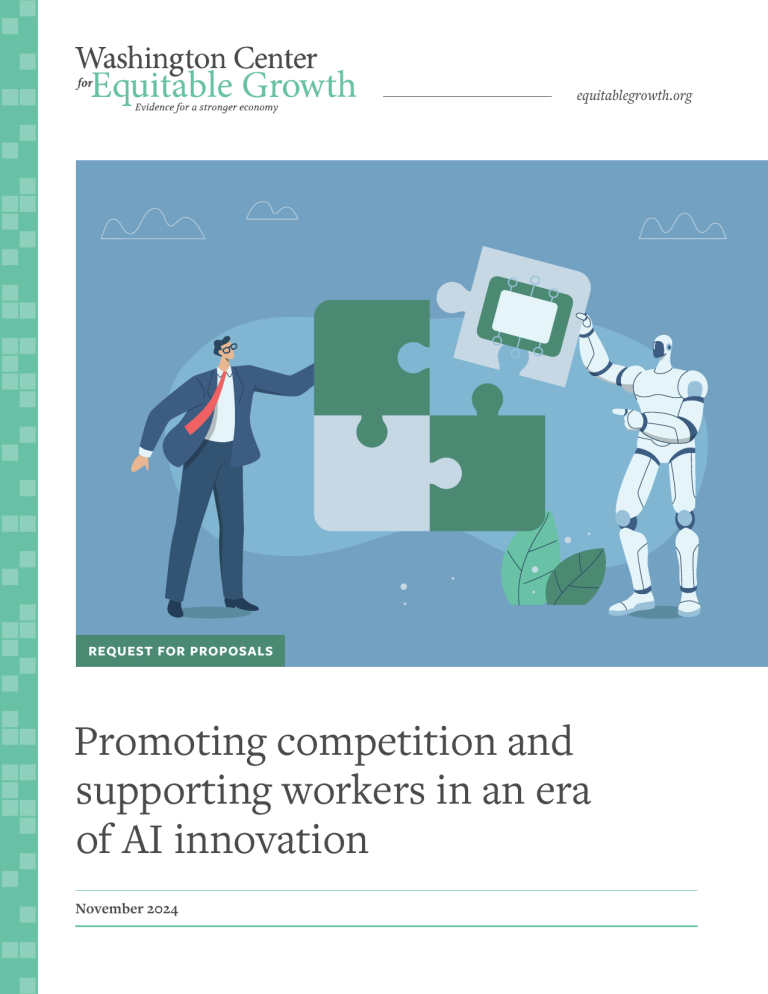
Request for Proposals: Promoting competition and supporting workers in an era of AI innovation (opens in a new tab)
RFPs NOV 20, 2024
By: Equitable Growth (opens in a new tab)
Request for proposals: Research grants for early career scholars (opens in a new tab)
RFPs OCT 30, 2024
By: Equitable Growth (opens in a new tab)

In Conversation with Mishaela Durán (opens in a new tab)
In Conversation SEP 12, 2024
Equitable Growth in Conversation is a recurring series where we talk with economists and other academics to help us better understand whether and how economic inequality affects economic growth and…
By: Shira Markoff (opens in a new tab)

In Conversation with Natalie Foster (opens in a new tab)
In Conversation JUL 2, 2024
Equitable Growth in Conversation is a recurring series where we talk with economists and other academics to help us better understand whether and how economic inequality affects economic growth and…
By: Michael Linden (opens in a new tab)

In Conversation with Miles Corak (opens in a new tab)
In Conversation JUN 6, 2024
Equitable Growth in Conversation is a recurring series where we talk with economists and other academics to help us better understand whether and how economic inequality affects economic growth and…
By: Austin Clemens (opens in a new tab)

Equitable Growth Insights: Synthesizing economic mobility research (opens in a new tab)
Research Databases MAY 15, 2024
Equitable Growth’s Insights newsletter on U.S. economic mobility is a quarterly newsletter that synthesizes research from academia, journalism, and the nonprofit sector. Each edition seeks to distill insights from research…
Spending Responses to the Child Tax Credit Expansions (opens in a new tab)
Working Papers APR 2, 2024
This article summarizes the literature that studied how people used the 2021 advance Child Tax Credit. Four primary findings emerged. Families more frequently reporting paying down debt during the first…
By: Jonathan Fisher (opens in a new tab), Jake Schild (opens in a new tab), David S. Johnson

In Conversation with Sasha Killewald (opens in a new tab)
In Conversation MAR 27, 2024
Equitable Growth in Conversation is a recurring series where we talk with economists and other academics to help us better understand whether and how economic inequality affects economic growth and…
By: Austin Clemens (opens in a new tab)

Request for Proposals: How effective was the fiscal response to the COVID-19 recession for workers? (opens in a new tab)
RFPs MAR 18, 2024
By: Equitable Growth (opens in a new tab)

In Conversation with Timothy Smeeding (opens in a new tab)
In Conversation JAN 16, 2024
Equitable Growth in Conversation is a recurring series where we talk with economists and other academics to help us better understand whether and how economic inequality affects economic growth and…
By: Jonathan Fisher (opens in a new tab)
Request for proposals: Research grants for early career scholars (opens in a new tab)
RFPs NOV 30, 2023
By: Equitable Growth (opens in a new tab)
HBCU Enrollment and Longer-Term Outcomes (opens in a new tab)
Working Papers NOV 20, 2023
Using data from nearly 1.2 million Black SAT takers, we estimate the impacts of initially enrolling in an Historically Black College and University (HBCU) on educational, economic, and financial outcomes.…
By: Ashley Edwards (opens in a new tab), Justin Ortagus (opens in a new tab), Jonathan Smith (opens in a new tab), Andria Smythe (opens in a new tab)
The Effect of Means-Tested Transfers on Work: Evidence from Quasi-Randomly Assigned SNAP Caseworkers (opens in a new tab)
Working Papers NOV 13, 2023
We provide a comprehensive evaluation of the dynamic labor supply effects of the Supplemental Nutrition Assistance Program (SNAP) for a representative population using novel administrative data and an examiner design.…
By: Jason Cook (opens in a new tab), Chloe N. East
The Short-Term Labor Supply Response to the Expanded Child Tax Credit (opens in a new tab)
Working Papers JUL 26, 2023
We estimate the extensive and intensive margin labor supply response to the monthly Child Tax Credit disbursed in 2021 as a part of the American Rescue Plan Act. Using Current…
By: Brandon Enriquez (opens in a new tab), Damon Jones (opens in a new tab), Ernest V. Tedeschi
Disparities in Pollution Capitalization Rates: The Role of Direct and Systemic Discrimination (opens in a new tab)
Working Papers JUL 20, 2023
We examine how exogenous changes in exposure to air pollution over the past two decades have altered the disparities in home values between Black and White homeowners. We find that…
By: Joshua S. Graff Zivin, Gregor Singer (opens in a new tab)
Racial Inequality in the U.S. Unemployment Insurance System (opens in a new tab)
Working Papers JUL 19, 2023
The decentralized US unemployment insurance (UI) system lets states decide on key rules. Decentralization could help states efficiently adapt to local economic conditions, but it could also generate racial inequality.…
By: Daphné Skandalis (opens in a new tab), Ioana Marinescu (opens in a new tab), Maxim Massenkoff (opens in a new tab)
On Algorithmic Wage Discrimination (opens in a new tab)
Working Papers JUL 12, 2023
Recent technological developments related to the extraction and processing of data have given rise to widespread concerns about a reduction of privacy in the workplace. For a growing number of…
By: Veena Dubal (opens in a new tab)
The Impact of Austerity on Gender Inequality in Time Allocation in the United States (opens in a new tab)
Working Papers JUN 8, 2023
The Great Recession of 2007-2009 caused large declines in state revenues, prompting many states to implement austerity measures to meet their balanced budget requirements. Decreases in public spending can have…
By: Anamika Sen (opens in a new tab)
Intergenerational Mobility using Income, Consumption, and Wealth (opens in a new tab)
Working Papers JUN 7, 2023
We use fifty years of the Panel Study of Income Dynamics to study the intergenerational correlation in income, consumption, and wealth to answer the question: is intergenerational mobility similar across…
By: Jonathan Fisher (opens in a new tab), David S. Johnson
The Effectiveness of the Food Stamp Program at Reducing Differences in the Intergenerational Persistence of Poverty (opens in a new tab)
Working Papers MAY 30, 2023
This paper investigates the effects of the Food Stamp Program (FSP) on racial disparities in the intergenerational persistence of poverty. We apply staggered difference-in-difference models that exploit variation in the…
By: Benjamin Glasner (opens in a new tab), Ronald B Mincy, Zachary Parolin (opens in a new tab), Christopher Wimer (opens in a new tab)

In Conversation with Daron Acemoglu (opens in a new tab)
In Conversation MAY 8, 2023
Equitable Growth in Conversation is a recurring series where we talk with economists and other academics to help us better understand whether and how economic inequality affects economic growth and…
By: Kathryn Zickuhr (opens in a new tab)
Who Cares? Paid Sick Leave Mandates, Care-Giving, and Gender (opens in a new tab)
Working Papers MAY 4, 2023
We use employment data from the Current Population Survey to assess the efficacy of state-mandated paid sick leave policies on leave-taking behavior with a focus on any variation by gender.…
By: Tanya Byker (opens in a new tab), Elena Patel (opens in a new tab), Shanthi Ramnath (opens in a new tab)
The Impact of Paid Family Leave on Families with Health Shocks (opens in a new tab)
Working Papers MAR 6, 2023
This paper analyzes the impact of paid family leave (PFL) policies in California, New Jersey, and New York on the labor market and mental health outcomes of individuals whose spouses…
By: Courtney Coile, Maya Rossin-Slater (opens in a new tab), Amanda Su (opens in a new tab)
Wealth as Control of the Future (opens in a new tab)
Working Papers JAN 19, 2023
Wealth inequality has become a major focus of social research in recent years. This research has yielded breakthroughs in describing the present distribution of wealth holdings, the impacts that access…
By: Robert Manduca (opens in a new tab)
Green Energy Jobs in the US: What Are They, and Where Are They? (opens in a new tab)
Working Papers NOV 8, 2022
Does the growth of renewable energy benefit US workers, and which workers stand to benefit the most? Until now, evidence on green energy jobs has been limited due to measurement…
By: E. Mark Curtis (opens in a new tab), Ioana Marinescu (opens in a new tab)
Global Trends in Income Inequality and Income Dynamics: New Insights from GRID (opens in a new tab)
Working Papers NOV 7, 2022
The Global Repository of Income Dynamics (GRID) is a new open-access, crosscountry database that contains a wide range of micro statistics on income inequality, dynamics, and mobility. It has four…
By: Fatih Guvenen (opens in a new tab), Luigi Pistaferri (opens in a new tab), Giovanni L. Violante
Do Minorities Pay More for Congestion Taxes? Evidence from a Tax on Ride-sharing (opens in a new tab)
Working Papers OCT 18, 2022
I study the heterogeneous consequences across areas in which different racial groups are concentrated of a congestion tax on ride-sharing. I find that, on average, the price increase was the…
By: Mario Leccese (opens in a new tab)
Wealth of two nations: The U.S. racial wealth gap, 1860-2020 (opens in a new tab)
Working Papers OCT 5, 2022
The racial wealth gap is the largest of the economic disparities between Black and white Americans, with a white-to-Black per capita wealth ratio of 6 to 1. It is also…
By: Ellora Derenoncourt (opens in a new tab), Chi Hyun Kim (opens in a new tab), Moritz Kuhn (opens in a new tab), Moritz Schularick (opens in a new tab)
Understanding Disparities in Unemployment Insurance Recipiency (opens in a new tab)
Working Papers JUL 13, 2022
Using data from before and during the Covid-19 pandemic, we show that the expansion of benefits under the CARES Act only modestly increased self-reported UI recipiency among UI eligible workers,…
By: Eliza Forsythe (opens in a new tab), Hesong Yang (opens in a new tab)
Socioeconomic Diversity of Economics PhDs (opens in a new tab)
Working Papers JUN 29, 2022
It is well documented that women and racial and ethnic minorities are underrepresented in the economics profession, relative to both the general population and many other academic disciplines. Less is…
By: Robert Schultz (opens in a new tab), Anna Stansbury (opens in a new tab)

In Conversation with Lee Badgett (opens in a new tab)
In Conversation JUN 23, 2022
Equitable Growth in Conversation is a recurring series where we talk with economists and other academics to help us better understand whether and how economic inequality affects economic growth and…
By: Kate Bahn (opens in a new tab)
Black Lives: The High Cost of Segregation (opens in a new tab)
Working Papers MAY 9, 2022
Exploiting the arrangement of railroad tracks in northern cities, we explore the extent to which segregation impacts homicide victimization by race. Our results reveal a robust positive relationship between segregation…
By: Robynn Cox (opens in a new tab), Jamein Cunningham (opens in a new tab), Alberto Ortega (opens in a new tab), Kenneth D. Whaley (opens in a new tab)

In Conversation with Cecilia Conrad (opens in a new tab)
In Conversation APR 26, 2022
Equitable Growth in Conversation is a recurring series where we talk with economists and other academics to help us better understand whether and how economic inequality affects economic growth and…
By: Kate Bahn (opens in a new tab)
Can you move to opportunity? Evidence from the Great Migration (opens in a new tab)
Working Papers FEB 14, 2022
This paper shows that racial composition shocks during the Great Migration (1940-1970) reduced the gains from growing up in the northern United States for Black families and can explain 27%…
By: Ellora Derenoncourt (opens in a new tab)
Why is Workplace Sexual Harassment Underreported? The Value of Outside Options Amid the Threat of Retaliation (opens in a new tab)
Working Papers FEB 10, 2022
Why is workplace sexual harassment chronically underreported? We hypothesize that employers coerce victims into silence through the threat of a retaliatory firing. To test this, we estimate how two external…
By: Gordon B. Dahl (opens in a new tab), Matthew Knepper (opens in a new tab)
Anticipation and Consumption (opens in a new tab)
Working Papers FEB 9, 2022
Cash transfer payments are an increasingly widespread policy tool in developed and developing countries, used for both short-term and long-term objectives. We study the design of these policies by examining…
By: Neil Thakral (opens in a new tab), Linh T. Tô
Money Matters: Consumption Volatility Across the Income Distribution (opens in a new tab)
Working Papers FEB 3, 2022
Using the Consumer Expenditure Survey, we document the level and volatility of quarterly consumption across the socioeconomic distribution. While the measurement of well-being is focused on income, the secular and…
By: Jonathan Fisher (opens in a new tab), Bradley L. Hardy
Closing the Innovation Gap in Pink and Black (opens in a new tab)
Working Papers JAN 10, 2022
Recent research shows the negative impact of discrimination not only on the targets of discrimination but also on the economy as a whole. Racial and gender inequality can limit the…
By: Lisa D. Cook, Janet Gerson (opens in a new tab), Jennifer Kuan (opens in a new tab)

In Conversation with Jonathan Fisher (opens in a new tab)
In Conversation DEC 16, 2021
Equitable Growth in Conversation is a recurring series where we talk with economists and other academics to help us better understand whether and how economic inequality affects economic growth and…
By: Kate Bahn (opens in a new tab), Jonathan Fisher (opens in a new tab)
The impact of affirmative action litigation on police killings of civilians (opens in a new tab)
Working Papers DEC 2, 2021
Although research has shown that court-ordered hiring quotas increase the number of minority police officers in litigated cities, there has been little insight into how workforce diversity, or lack thereof,…
By: Robynn Cox (opens in a new tab), Jamein Cunningham (opens in a new tab), Alberto Ortega (opens in a new tab)
Beyond Health: Non-Health Risk and the Value of Disability Insurance (opens in a new tab)
Working Papers NOV 22, 2021
The public debate over disability insurance has centered on concerns about individuals without severe health conditions receiving benefits. We go beyond health risk alone to quantify the overall insurance value…
By: Manasi Deshpande (opens in a new tab), Lee M. Lockwood (opens in a new tab)

2022 Request for Proposals (opens in a new tab)
RFPs NOV 10, 2021

In Conversation with Erica Groshen (opens in a new tab)
In Conversation OCT 25, 2021
Equitable Growth in Conversation is a recurring series where we talk with economists and other academics to help us better understand whether and how economic inequality affects economic growth and…
By: Austin Clemens (opens in a new tab)

In Conversation with Carlos Fernando Avenancio-León (opens in a new tab)
In Conversation SEP 20, 2021
Equitable Growth in Conversation is a recurring series where we talk with economists and other academics to help us better understand whether and how economic inequality affects economic growth and…
By: David S. Mitchell (opens in a new tab)
Diverse Policy Committees Can Reach Underrepresented Groups (opens in a new tab)
Working Papers SEP 16, 2021
In a randomized control trial that varies the salience of female and minority representation on the Federal Reserve’s monetary policy committee, the FOMC, we test whether diversity affects how Fed…
By: Francesco D’Acunto (opens in a new tab), Andreas Fuster (opens in a new tab), Michael Weber (opens in a new tab)
How Exceptional is American Job Quality? Decent- and Poverty-Pay Rates by Age, Gender, and Education in the U.S., U.K., Canada, Australia, and France* (opens in a new tab)
Working Papers SEP 3, 2021
Social protection for working-age American adults is almost entirely conditional on employment, which makes earnings a particularly important dimension of job quality for workers. This paper employs new indicators (Howell,…
By: David R. Howell
Bring the Households Back In: The Effect of Poverty on the Mobility of Low-Wage Workers to Better Wages (opens in a new tab)
Working Papers AUG 26, 2021
Although eighty percent of low-wage workers are not in poverty, low-wage work and poverty are often conflated. I distinguish the two and investigate how household conditions affect workers’ mobility out…
By: Michael A. Schultz (opens in a new tab)

The Contribution of Enslaved Workers to Output and Growth in the Antebellum United States (opens in a new tab)
Working Papers JUN 24, 2021
This working paper and its accompanying column are now undergoing revisions by the author, with the intention of reposting the updated version of the working paper and a new column…
By: Mark Stelzner (opens in a new tab), Sven Beckert (opens in a new tab)
Equitable Growth’s second annual academic research report (opens in a new tab)
RFPs APR 29, 2021
By: Equitable Growth (opens in a new tab)
Trends in Absolute Income Mobility in North America and Europe (opens in a new tab)
Working Papers APR 28, 2021
We compute rates of absolute upward income mobility for the 1960-1987 birth cohorts in eight countries in North America and Europe. Rates and trends in absolute mobility varied dramatically across…
By: Robert Manduca (opens in a new tab), Maximilian Hell (opens in a new tab), Adrian Adermon, Jo Blanden, Espen Bratberg, Anne C. Gielen, Hans van Kippersluis, Keun Bok Lee, Stephen Machin (opens in a new tab), Martin D. Munk, Martin Nybom, Yuri Ostrovsky, Sumaiya Rahman, Outi Sirniö

In Conversation with Mark Rank (opens in a new tab)
In Conversation APR 14, 2021
Equitable Growth in Conversation is a recurring series where we talk with economists and other academics to help us better understand whether and how economic inequality affects economic growth and…
By: Alix Gould-Werth (opens in a new tab)
Tax Refund Uncertainty: Evidence and Welfare Implications (opens in a new tab)
Working Papers APR 8, 2021
Transfers paid through annual tax refunds are a large but uncertain source of income for poor households. We document that low-income tax-filers have substantial subjective uncertainty about these refunds. We…
By: Sydnee Caldwell (opens in a new tab), Scott Nelson (opens in a new tab), Daniel Waldinger (opens in a new tab)
The Grandkids Aren’t Alright: The Intergenerational Effects of Prenatal Pollution Exposure (opens in a new tab)
Working Papers FEB 11, 2021
Evidence increasingly shows that environmental quality shapes human capital at birth with long-run effects on health and welfare. Do these effects, in turn, affect the economic opportunities of future generations?…
By: Jonathan Colmer (opens in a new tab), John Voorheis (opens in a new tab)
Impact of the COVID-19 Crisis on Family Dynamics in Economically Vulnerable Households (opens in a new tab)
Working Papers DEC 14, 2020
The COVID-19 crisis and its reverberations resulted in levels of economic distress unprecedented since the 1930s. But COVID was a seismic social shock even for families that lost no income,…
By: Ariel Kalil (opens in a new tab), Susan Mayer (opens in a new tab), Rohen Shah (opens in a new tab)
The Intergenerational Transmission of Employers and the Earnings of Young Workers (opens in a new tab)
Working Papers NOV 5, 2020
This paper investigates how the earnings of young workers are affected by the intergenerational transmission of employers, which refers to individuals working for the same employer as a parent. My…
By: Matthew Staiger (opens in a new tab)
The Effect of Political Power on Labor Market Inequality: Evidence from the 1965 Voting Rights Act (opens in a new tab)
Working Papers OCT 16, 2020
A central concern for racial and ethnic minorities is having an equal opportunity to advance group interests via the political process. There remains limited empirical evidence, however, whether democratic policies…
By: Abhay Aneja (opens in a new tab), Carlos Fernando Avenancio-León (opens in a new tab)
The Impact of COVID-19 on the U.S. Child Care Market: Evidence from Stay-at-Home Orders (opens in a new tab)
Working Papers JUL 16, 2020
Stay-at-home orders (SAHOs) have been implemented in most U.S. states to mitigate the spread of COVID-19. This paper quantifies the short-run impact of these containment policies on search behavior and…
By: Umair Ali (opens in a new tab), Chris M. Herbst (opens in a new tab), Christos A. Makridis
The Assessment Gap: Racial Inequalities in Property Taxation (opens in a new tab)
Working Papers JUN 10, 2020
We use panel data covering 118 million homes in the United States, merged with geolocation detail for 75,000 taxing entities, to document a nationwide “assessment gap” which leads local governments…
By: Carlos Avenancio-León, Troup Howard (opens in a new tab)

In Conversation with Mehrsa Baradaran (opens in a new tab)
In Conversation JUN 9, 2020
“Equitable Growth in Conversation” is a recurring series where we talk with economists and other academics to help us better understand whether and how economic inequality affects economic growth and…
By: Amanda Fischer (opens in a new tab)

In Conversation with Trevon Logan (opens in a new tab)
In Conversation MAY 14, 2020
“Equitable Growth in Conversation” is a recurring series where we talk with economists and other academics to help us better understand whether and how economic inequality affects economic growth and…
By: Liz Hipple (opens in a new tab)
Is the social safety net a long-term investment? Large-scale evidence from the food stamps program (opens in a new tab)
Working Papers MAY 11, 2020
We use novel, large-scale data on 43 million Americans from the 2000 Census and the 2001 to 2013 American Communities Survey linked to the Social Security Administration’s NUMIDENT to study…
By: Martha J. Bailey, Hilary W. Hoynes, Maya Rossin-Slater (opens in a new tab), Reed Walker (opens in a new tab)
Redistribution with Performance Pay (opens in a new tab)
Working Papers MAY 6, 2020
This working paper was updated from the April 2020 version to the May 2020 version on May 27. Half of the jobs in the U.S. feature pay-for-performance. We study nonlinear…
By: Pawel Doligalski (opens in a new tab), Abdoulaye Ndiaye (opens in a new tab), Nicolas Werquin (opens in a new tab)
The Matching Multiplier and the Amplification of Recessions (opens in a new tab)
Working Papers APR 8, 2020
This paper shows that the unequal incidence of recessions in the labor market amplifies aggregate shocks. I define the Matching Multiplier as the increase in the output multiplier stemming from…
By: Christina Patterson (opens in a new tab)
An SEIR Infectious Disease Model with Testing and Conditional Quarantine (opens in a new tab)
Working Papers APR 7, 2020
We extend the baseline Susceptible-Exposed-Infectious-Recovered (SEIR) infectious disease epidemiology model to understand the role of testing and case-dependent quarantine. Our model nests the SEIR model. During a period of asymptomatic…
By: David Berger (opens in a new tab), Kyle Herkenhoff (opens in a new tab), Simon Mongey (opens in a new tab)
Reducing maternal labor market detachment: A role for paid family leave (opens in a new tab)
Working Papers MAR 12, 2020
Nearly 30% of working women leave the labor force when they have a child. Ac-cess to paid family leave may allow some women to take temporary leave rather than quitting,…
By: Kelly Jones (opens in a new tab), Britni Wilcher (opens in a new tab)
Baltimore Study: Credit Scores (opens in a new tab)
Working Papers MAR 4, 2020
The Baltimore Project Phase II This report builds upon the original Baltimore study by including credit score questions to the survey instrument conducted on the Phase I sample. In Phase…
By: Mónica García-Pérez (opens in a new tab), Sarah Gaither, William Darity Jr. (opens in a new tab)
Whose News? Class-Biased Economic Reporting in the United States (opens in a new tab)
Working Papers MAR 3, 2020
There is substantial evidence that voters’ choices are shaped by assessments of the state of the economy and that these assessments, in turn, are influenced by the news. But how…
By: Alan M. Jacobs (opens in a new tab), J. Scott Matthews (opens in a new tab), Timothy Hicks (opens in a new tab), Eric Merkley (opens in a new tab)

In Conversation with Adia Harvey Wingfield (opens in a new tab)
In Conversation FEB 25, 2020
“Equitable Growth in Conversation” is a recurring series where we talk with economists and other academics to help us better understand whether and how economic inequality affects economic growth and…
By: Kate Bahn (opens in a new tab)
Unequally Insecure: Rising Black/White Disparities in Job Displacement, 1981-2017 (opens in a new tab)
Working Papers FEB 13, 2020
Social scientists have documented vast racial disparities in labor market outcomes such as hiring and firing decisions, compensation, and opportunities for occupational advancement. Yet little is known about the racial…
By: Elizabeth Wrigley-Field (opens in a new tab), Nathan Seltzer (opens in a new tab)
Minimum Wages and Racial Inequality (opens in a new tab)
Working Papers JAN 14, 2020
The earnings difference between white and black workers fell dramatically in the United States in the late 1960s and early 1970s. This paper shows that the extension of the minimum…
By: Ellora Derenoncourt (opens in a new tab), Claire Montialoux (opens in a new tab)
Inequality and economic growth (opens in a new tab)
RFPs DEC 30, 2019
By: Equitable Growth (opens in a new tab)
Targeted Debt Relief and the Origins of Financial Distress: Experimental Evidence from Distressed Credit Card Borrowers (opens in a new tab)
Working Papers DEC 4, 2019
We study the drivers of financial distress using a large-scale field experiment that offered randomly selected borrowers a combination of (i) immediate payment reductions to target short-run liquidity constraints and…
By: Will Dobbie (opens in a new tab), Jae Song (opens in a new tab)

In Conversation with Fabian Pfeffer (opens in a new tab)
In Conversation NOV 13, 2019
“Equitable Growth in Conversation” is a recurring series where we talk with economists and other academics to help us better understand whether and how economic inequality affects economic growth and…
By: Liz Hipple (opens in a new tab)
Hard Times: Routine Schedule Unpredictability and Material Hardship among Service Sector Workers (opens in a new tab)
Working Papers OCT 16, 2019
American policy-makers have long focused on work as a key means to reduce poverty. And yet work has become increasingly precarious and polarized. This precarity is manifest in low wages,…
By: Daniel Schneider (opens in a new tab), Kristen Harknett (opens in a new tab)
What Explains Race/Ethnic Inequality in Job Quality in the Service Sector? (opens in a new tab)
Working Papers OCT 16, 2019
White workers experience significant advantages in the labor market both in hiring and in compensation compared to their non-white peers. Human capital differences and occupational segregation are commonly offered as…
By: Adam Storer (opens in a new tab), Daniel Schneider (opens in a new tab), Kristen Harknett (opens in a new tab)
From Decent to Lousy Jobs: New Evidence on the Decline in American Job Quality, 1979-2017 (opens in a new tab)
Working Papers AUG 30, 2019
A defining feature of the post-1970s American economy has been unshared growth, strikingly illustrated by the absolute decline in average incomes for the bottom 50 percent of working-age adults. This…
By: David R. Howell

In Conversation with Gabriel Zucman (opens in a new tab)
In Conversation AUG 7, 2019
“Equitable Growth in Conversation” is a recurring series where we talk with economists and other academics to help us better understand whether and how economic inequality affects economic growth and…
By: Heather Boushey (opens in a new tab)

In Conversation with Leemore Dafny (opens in a new tab)
In Conversation JUL 10, 2019
“Equitable Growth in Conversation” is a recurring series where we talk with economists and other academics to help us better understand whether and how economic inequality affects economic growth and…
By: Heather Boushey (opens in a new tab)

In Conversation with Janet Currie (opens in a new tab)
In Conversation MAY 21, 2019
“Equitable Growth in Conversation” is a recurring series where we talk with economists and other academics to help us better understand whether and how economic inequality affects economic growth and…
By: Heather Boushey (opens in a new tab)

In Conversation with Raj Chetty (opens in a new tab)
In Conversation APR 24, 2019
“Equitable Growth in Conversation” is a recurring series where we talk with economists and other academics to help us better understand whether and how economic inequality affects economic growth and…
By: Heather Boushey (opens in a new tab)

In Conversation with Bhash Mazumder (opens in a new tab)
In Conversation MAR 4, 2019
“Equitable Growth in Conversation” is a recurring series where we talk with economists and other academics to help us better understand whether and how economic inequality affects economic growth and…
By: Liz Hipple (opens in a new tab)
Economic change and the social safety net: Are rural Americans still behind? (opens in a new tab)
Working Papers FEB 1, 2019
This aim of this paper is to assess the economic status of rural people five decades after The People Left Behind, with a particular focus on how changes in employment,…
By: James P. Ziliak
Simplified distributional national accounts (opens in a new tab)
Working Papers JAN 28, 2019
This paper develops a simplified methodology that starts from the fiscal income top income share series and makes very basic assumptions on how each income component from national income that…
By: Thomas Piketty (opens in a new tab), Emmanuel Saez (opens in a new tab), Gabriel Zucman (opens in a new tab)

In Conversation with Karen Dynan (opens in a new tab)
In Conversation DEC 12, 2018
Equitable Growth Executive Director and Chief Economist Heather Boushey talks with Equitable Growth Steering Committee member Karen Dynan, a professor of the practice of economics at Harvard University.
By: Heather Boushey (opens in a new tab)
Job quality and the educational gradient in entry into marriage and cohabitation (opens in a new tab)
Working Papers NOV 27, 2018
Men’s and women’s economic resources are important determinants of marriage timing. Prior demographic and sociological literature has often measured resources in narrow terms, considering employment and earnings and not more…
By: Daniel Schneider (opens in a new tab), Kristen Harknett (opens in a new tab), Matthew Stimpson (opens in a new tab)
Returns in the labor market: A nuanced view of penalties at the intersection of race and gender (opens in a new tab)
Working Papers AUG 7, 2018
There have been decades of research on wage gaps for groups based on their socially salient identities such as race and gender, but little empirical investigation on the effects of…
By: Mark Paul (opens in a new tab), Khaing Zaw (opens in a new tab), Darrick Hamilton (opens in a new tab), William Darity Jr. (opens in a new tab)

In Conversation with Michael Strain (opens in a new tab)
In Conversation JUN 14, 2018
“Equitable Growth in Conversation” is a recurring series where we talk with economists and other social scientists to help us better understand whether and how economic inequality affects economic growth…
By: Heather Boushey (opens in a new tab)
New technologies and the labor market (opens in a new tab)
Working Papers MAY 1, 2018
Using newspaper job ad text from 1960 to 2000, we measure job tasks and the adoption of individual information and communication technologies (ICTs). Most new technologies are associated with an…
By: Enghin Atalay (opens in a new tab), Phai Phongthiengtham (opens in a new tab), Sebastian Sotelo (opens in a new tab), Daniel Tannenbaum (opens in a new tab)
Estimating the marginal propensity to consume using the distributions of income, consumption, and wealth (opens in a new tab)
Working Papers APR 19, 2018
Recent studies of economic inequality almost always separately examine income inequality, consumption and wealth inequality, and hence, these studies miss the important synergy between the three measures explicit in the…
By: Jonathan Fisher (opens in a new tab), David Johnson (opens in a new tab), Jonathan Latner (opens in a new tab), Timothy Smeeding (opens in a new tab), Jeffrey Thompson (opens in a new tab)
Who becomes an inventor in America? The importance of exposure to innovation (opens in a new tab)
Working Papers FEB 27, 2018
Download File 02272018-WP-inventor-america-exposure Read the full PDF in your browser We characterize the factors that determine who becomes an inventor in America by using deidentified data on 1.2 million inventors…
By: Alex Bell (opens in a new tab), Raj Chetty (opens in a new tab), Xavier Jaravel (opens in a new tab), Neviana Petkova (opens in a new tab), John Van Reenen (opens in a new tab)
Inequality and aggregate demand (opens in a new tab)
Working Papers FEB 19, 2018
Download File 02192018-WP-inequality-aggregate-demand Read the full PDF in your browser We explore the transmission mechanism of income inequality to output. In the short run, higher inequality reduces output because marginal…
By: Adrien Auclert (opens in a new tab), Matthew Rognlie (opens in a new tab)
Sources of displaced workers’ long-term earnings losses (opens in a new tab)
Working Papers FEB 1, 2018
We estimate the magnitudes of lost earnings, reduced work hours, and lower wage rates of workers displaced during the Great Recession using linked employer-employee panel data. We find that displaced…
By: Marta Lachowska (opens in a new tab), Alexandre Mas (opens in a new tab), Stephen A. Woodbury

In Conversation with Richard Reeves (opens in a new tab)
In Conversation DEC 26, 2017
“Equitable Growth in Conversation” is a recurring series where we talk with economists and other social scientists to help us better understand whether and how economic inequality affects economic growth…
By: Elisabeth Jacobs (opens in a new tab)


Your Direct Line to Cutting Edge Research
Be the first to know about our latest events, research releases, and expert insights. Get exclusive updates delivered right to your inbox and never miss an opportunity to engage with our community.