


Resources
From peer-reviewed research to accessible policy briefs, explore the scholarship that’s shaping debates and driving change.

300 Results

Trump’s trade war with Canada grows increasingly costly as Section 338 tariffs harm both economies (opens in a new tab)
Essays SEP 22, 2026
President Donald Trump continues to escalate his administration’s perplexing trade spat with Canada through the expanded use of novel tariff powers in Section 338 of the Tariff Act of 1930.…
By: Christopher Bangert-Drowns (opens in a new tab)

New research shows how U.S. homeownership and the accumulation of housing wealth are linked to political participation (opens in a new tab)
Essays AUG 14, 2026
Persistent affordability pressures have driven up housing costs for millions of U.S. families in recent years. Home prices remain near record highs relative to incomes, mortgage rates and associated costs…
By: Carlos Fernando Avenancio-Leon (opens in a new tab)

Defining extreme wealth is more complicated than it looks (opens in a new tab)
Videos AUG 13, 2026
Facing high levels of income and wealth inequality and shrinking tax revenues, U.S. policymakers are showing increased interest in proposals to tax the richest households. Yet determining which households fall into that category is complex and changes based…
By: Equitable Growth (opens in a new tab)
The debt-to-wealth ratio: A missing lens on the U.S. government’s fiscal capacity (opens in a new tab)
Reports JUL 30, 2026
Few statistics shape the fiscal debate in the United States as powerfully as the ratio of federal debt-to-Gross Domestic Product. Debt held by the public recently surpassed 100 percent of…
By: Austin Clemens (opens in a new tab), David S. Mitchell (opens in a new tab)

The costs of the Trump administration’s tariffs diverge for countries and industries so far in 2026 (opens in a new tab)
Essays JUL 14, 2026
The first 4 months of 2026 saw continued seismic changes in U.S. trade policy. In late February, the U.S. Supreme Court struck down the Trump administration’s use of the International…
By: Christopher Bangert-Drowns (opens in a new tab)

U.S. workers will be hurt by immigration enforcement overreach (opens in a new tab)
Essays JUN 17, 2026
President Donald Trump last week signed the $70 billion Secure America Act, a budget reconciliation package that boosts funding for immigration and border enforcement agencies while imposing no limits on their authority.…
By: Christopher Bangert-Drowns (opens in a new tab)

Factsheet: Defining top U.S. income and wealth thresholds for tax policy (opens in a new tab)
Factsheets MAY 27, 2026
Federal and state policymakers in the United States, responding to high levels of income and wealth inequality and shrinking tax revenues, are increasingly interested in proposals to tax households with…
By: Austin Clemens (opens in a new tab)
Defining top wealth and income thresholds for U.S. tax policy design and analysis (opens in a new tab)
Reports MAY 27, 2026
Wealth and income inequality are an ongoing area of interest for policymakers. In particular, the rise of the richest of the rich—not just the top 1 percent, but also the…
By: Austin Clemens (opens in a new tab)

Is Taxing Wealth Possible? Practical? Desirable? Yes, if we’re smart about it (opens in a new tab)
Essays MAY 7, 2026
While the American economy has outperformed much of the industrialized world in recent years, there are good reasons to be deeply concerned about its long-term prospects. It is dogged by…
By: David S. Mitchell (opens in a new tab)

The other two-tiered U.S. tax system: How pass-through businesses let the ultra-wealthy dodge federal taxes (opens in a new tab)
Essays APR 15, 2026
Many Americans likely remember when the legendary value investor Warren Buffett drew attention to a glaring unfairness in the tax code by pointing out that he paid a lower effective…
By: David S. Mitchell (opens in a new tab)
Equitable Growth event covers tariffs, tariff uncertainties, and the limits of U.S. trade policy (opens in a new tab)
Videos APR 1, 2026
The Washington Center for Equitable Growth recently hosted a webinar examining the economic, fiscal, and labor‑market effects of evolving U.S. tariff laws and regulations, particularly in the wake of the…
By: Christopher Bangert-Drowns (opens in a new tab)
Tariff policies in 2025 increased input costs for key U.S. industries, threatening growth and investment (opens in a new tab)
Essays MAR 24, 2026
All tariffs are not created equal. Throughout U.S. history, policymakers have imposed import taxes for a variety of economic and ideological reasons, with varying impacts. Targeted tariffs have been effective…
By: Christopher Bangert-Drowns (opens in a new tab)

Factsheet: Using asset limits in public benefit programs (opens in a new tab)
Factsheets MAR 10, 2026
A household’s assets, or its overall wealth, are the resources required to ensure its family members can weather the financial disruption when unexpected expenses emerge. Yet many U.S. households do…
By: Megan Rivera (opens in a new tab)

U.S. businesses report that tariff policies will likely lead to price increases and labor market impacts in 2026 (opens in a new tab)
Essays JAN 15, 2026
As 2026 begins, U.S. manufacturers are contending with a varied and uncertain economic environment. Many are weighing growth driven by domestic investments in data centers and artificial intelligence against the…
By: Christopher Bangert-Drowns (opens in a new tab)
ASSA 2026 Round-up: Day 3 (opens in a new tab)
Blog JAN 6, 2026
Yesterday was the third and final day of the 2026 annual meeting of the Allied Social Science Associations, which is organized by the American Economic Association. The 3-day conference, held…
By: Equitable Growth (opens in a new tab)
ASSA 2026 Round-up: Day 2 (opens in a new tab)
Blog JAN 5, 2026
Yesterday was the second day of the 2026 annual meeting of the Allied Social Science Associations, which is organized by the American Economic Association. The 3-day conference, held in Philadelphia…
By: Equitable Growth (opens in a new tab)
Uncertainty created by ever-changing tariff policies harms U.S. economic growth (opens in a new tab)
Essays NOV 20, 2025
The approaches to international trade taken by the first and now second Trump administrations have been an endless jumble of tariff negotiations and ever-changing policies. Since 2018, duties have been…
By: Nirupama Rao (opens in a new tab)
Tariff costs impact industries with mostly White, male, and noncitizen workers (opens in a new tab)
Essays NOV 4, 2025
The U.S. economy is flying blind, with most economic-data publications paused indefinitely due to the shutdown of the federal government amid a general U.S. labor market slowdown and just as…
By: Christopher Bangert-Drowns (opens in a new tab)

Equitable Growth supports scholars studying the economics of the energy transition (opens in a new tab)
Essays OCT 22, 2025
The Washington Center for Equitable Growth today announced a new cohort of grantees. These nine scholars will study how the design and implementation of federal policy influences how businesses and…
By: Equitable Growth (opens in a new tab)

How U.S. tax policies have fueled right-wing populism (opens in a new tab)
Essays SEP 11, 2025
Among the many factors fueling support for right-wing populism in the United States is federal tax policies. The nation’s tax system confuses, frustrates, and angers many citizens in ways that…
By: Andrea Louise Campbell (opens in a new tab)
To restore democracy, end shareholder primacy at U.S. corporations and on Wall Street (opens in a new tab)
Essays SEP 11, 2025
Workers in the United States have no say over business decisions made in their workplaces by corporate America. Unions, of course, are important for workers’ ability to exercise power over…
By: Lenore Palladino (opens in a new tab)

Tariffs impact U.S. industries differently, with manufacturing the most exposed (opens in a new tab)
Issue Briefs JUL 29, 2025
Estimates in this brief were generated July 21, before the announcement of trade deals with Japan and the European Union. All data and code used in the Equitable Growth tariff…
By: Christopher Bangert-Drowns (opens in a new tab)

Accounting for capital gains in income significantly increases U.S. inequality (opens in a new tab)
Blog JUL 15, 2025
The Washington Center for Equitable Growth’s recently launched U.S. Inequality Tracker uses data from the U.S. Bureau of Economic Analysis to show how income and wealth inequality have evolved in…
By: Austin Clemens (opens in a new tab)

The 10 worst policies for equitable economic growth in the 2025 budget reconciliation law (opens in a new tab)
Essays JUL 14, 2025
The 2025 budget reconciliation law that was enacted earlier this month is a sprawling piece of legislation, touching almost every corner of the federal budget and the U.S. economy. It…
By: David S. Mitchell (opens in a new tab)

Equitable Growth responds to passage of the federal budget bill (opens in a new tab)
Blog JUL 7, 2025
On Friday, President Donald Trump signed the 2025 federal budget bill, cementing into law the most regressive piece of tax and budget legislation to be passed in the United States…
By: Equitable Growth (opens in a new tab)

Americans informed about the distributional effects of Republicans’ tax and budget bill overwhelmingly oppose it (opens in a new tab)
Essays JUL 3, 2025
Republicans in the U.S. Senate recently passed a version of the One Big Beautiful Bill Act, championed by President Donald Trump. The House of Representatives passed an earlier version of…
By: Jacob Hacker (opens in a new tab), Patrick Sullivan (opens in a new tab)

Congressional Republicans’ budget bill is the most regressive in at least 40 years (opens in a new tab)
Essays JUN 25, 2025
The U.S. Congress is in the midst of debating a budget bill that would make massive changes to U.S. tax and spending policy over the course of the next decade…
By: Jacob Hacker (opens in a new tab), Patrick Sullivan (opens in a new tab)

Medicaid and SNAP cuts in congressional Republicans’ budget bill will negatively impact local economies (opens in a new tab)
Essays JUN 24, 2025
The budget reconciliation bill recently passed by the U.S. House of Representatives proposes to make large cuts to Medicaid, the Supplemental Nutrition Assistance Program, and other social programs to pay…
By: Robert Manduca (opens in a new tab)

Testimony by Michael Linden on “The Big Beautiful Betrayal—Working Folks Pay While The Mega Rich Profit” (opens in a new tab)
Essays JUN 17, 2025
Senator Kaine, Senator Murphy, and members of the Forum, thank you for the opportunity to be here today. I’m going to make three key points. First, the Republican budget bill…
By: Michael Linden (opens in a new tab)

Factsheet: U.S. economic mobility and policies to increase upward mobility (opens in a new tab)
Factsheets JUN 17, 2025
The United States often has been touted as a land of opportunity, where hard work leads to success and children do better than their parents. But increasingly, these notions of…
By: Shira Markoff (opens in a new tab), Melissa Grober-Morrow (opens in a new tab)
The ‘funny math’ of top U.S. tax rates (opens in a new tab)
Essays JUN 11, 2025
The current reconciliation bill now before Congress won’t correct for the low tax rates paid by the richest Americans Overview Calculating the effective tax rate of the richest Americans can…
By: Patrick Driessen (opens in a new tab), David S. Mitchell (opens in a new tab)

Business owners often use their firms as tax shelters, reducing government revenue and reported income inequality (opens in a new tab)
Blog MAY 22, 2025
Picture this scene: After sharing a meal with friends, someone in the group grabs the check and says, “I’ll take this so I can expense it through my company.” It…
By: David Leite (opens in a new tab)

Advancing economic research on the Inflation Reduction Act: Q&A with Heather Boushey (opens in a new tab)
Issue Briefs APR 23, 2025
The Inflation Reduction Act of 2022 is the most significant economic and clean energy jobs program the United States has ever initiated. To improve overall understanding of whether the new…
By: Equitable Growth (opens in a new tab)

Factsheet: What we know about the federal employer-provided child care credit and how can it be better used by businesses (opens in a new tab)
Factsheets APR 22, 2025
The employer-provided child care credit, also referred to as Section 45F in the Internal Revenue Code, provides a limited subsidy to businesses in the United States that provide child care…
By: Megan Rivera (opens in a new tab)

“Econ 101” briefing on taxing multinationals brings Hill staffers up to speed on U.S. role in coordinating global crack-down on tax avoidance (opens in a new tab)
Blog APR 3, 2025
The Washington Center for Equitable Growth last week hosted a briefing for Capitol Hill staffers on multinational corporate tax trends and policies—another in our “Econ 101” series for Hill staffers.…
By: Elena Patel (opens in a new tab)
The qualified small business stock exclusion overwhelmingly benefits the wealthy and should be reformed in 2025 (opens in a new tab)
Issue Briefs APR 1, 2025
This year’s debate over the expiring personal income and estate tax provisions of the 2017 Tax Cuts and Jobs Act provides an opportunity for reforming the qualified small business stock…
By: Jean Ross (opens in a new tab)

Equitable Growth hosts Hill briefing on proliferation and taxation of U.S. pass-through businesses (opens in a new tab)
Blog MAR 13, 2025
On March 7, the Washington Center for Equitable Growth hosted a briefing—part of a series we call “Econ 101”—for Hill staffers curious about the proliferation of pass-through businesses and how…
By: Equitable Growth (opens in a new tab)

New research finds capital gains are highly concentrated and hardly taxed, underscoring widespread U.S. inequality (opens in a new tab)
Blog FEB 26, 2025
For two decades, booming stock, housing, and private business markets have driven large capital gains in the United States. Real capital gains, which are the inflation-adjusted appreciation of a financial…
By: Jacob Robbins (opens in a new tab), Cole Campbell (opens in a new tab), Sam Wylde (opens in a new tab)
Tax avoidance among large, complex partnerships in the United States (opens in a new tab)
Reports FEB 12, 2025
Decades-old conventional wisdom held that businesses organized as partnerships in the United States were mostly small enterprises with a handful of active individuals sharing personal liability for the businesses they…
By: David S. Mitchell (opens in a new tab)

Pro-growth tax reform in 2025 would boost the U.S. economy for years to come (opens in a new tab)
Videos JAN 15, 2025
In the aftermath of the presidential election in 2024, it’s clear that many Americans feel like the U.S. economy is not working for them. Even though policymakers on both sides…
By: Shayna Strom (opens in a new tab)

ASSA 2025 Round-up: Day 3 (opens in a new tab)
Blog JAN 6, 2025
Yesterday was the third and final day of the 2025 annual meeting of the Allied Social Science Associations, which is organized by the American Economic Association. The 3-day conference, held…
By: Equitable Growth (opens in a new tab)

ASSA 2025 Round-up: Day 2 (opens in a new tab)
Blog JAN 5, 2025
Yesterday was the second day of the 2025 annual meeting of the Allied Social Science Associations, which is organized by the American Economic Association. The 3-day conference, held in San…
By: Equitable Growth (opens in a new tab)

New U.S. Treasury Department research shows that it pays to be an S corporation (opens in a new tab)
Blog DEC 16, 2024
Businesses that are organized as so-called pass-through entities for tax purposes—meaning their profits show up on the owners’ personal tax returns rather than on an entity-based tax return—pay a lower…
By: Michael Linden (opens in a new tab)

Addressing pervasive tax evasion by cryptocurrency users (opens in a new tab)
Blog NOV 21, 2024
The price of bitcoin and other cryptocurrencies reached record highs last week, buoyed by the U.S. election of Donald Trump, who is seen as friendly to this novel asset class,…
By: Magne Mogstad (opens in a new tab), Tom Meling (opens in a new tab), Arnstein Vestre (opens in a new tab)
Equitable Growth virtual event details how tax policies affect U.S. economic growth and could combat income and wealth inequality (opens in a new tab)
Blog OCT 23, 2024
The Washington Center for Equitable Growth recently held the second in a two-part event series on tax policies for congressional staffers interested in learning more about using persuasive, evidence-backed arguments…
By: Equitable Growth (opens in a new tab)
The promise of equitable and pro-growth tax reform (opens in a new tab)
Reports OCT 16, 2024
The impending expiration of large portions of the 2017 Tax Cuts and Jobs Act at the end of 2025 presents federal policymakers with a significant opportunity to reform the federal…
By: Michael Linden (opens in a new tab), David S. Mitchell (opens in a new tab), Shayna Strom (opens in a new tab)
Allowing the 2017 estate tax changes to expire will reduce U.S. inequality and promote economic growth and opportunity (opens in a new tab)
Reports OCT 9, 2024
The 2017 Tax Cuts and Jobs Act made deep cuts to the personal income, estate, and corporate income taxes that were costly and heavily skewed toward the very wealthy. The…
By: Jean Ross (opens in a new tab)

End Ineffective Business Tax Breaks Before Creating New Ones (opens in a new tab)
Blog OCT 7, 2024
(This opinion piece first appeared in Tax Notes Federal on September 23, 2024.) Vice President Kamala Harris recently proposed an expanded tax benefit for start-up businesses, aimed at helping fledgling…
By: David S. Mitchell (opens in a new tab)

Equitable Growth’s ‘Econ 101’ offered congressional staffers a rundown of the contours of U.S. tax policy (opens in a new tab)
Blog OCT 2, 2024
The Washington Center for Equitable Growth recently hosted a congressional briefing—part of a series we call “Econ 101”—for Hill staffers interested in learning more about the ins and outs of…
By: Equitable Growth (opens in a new tab)

The unequal impact of the Federal Reserve’s monetary tightening and easing on firms in the United States (opens in a new tab)
Blog SEP 16, 2024
The easing of inflation in the U.S. economy beginning in 2022 and recent signs of weakness in the U.S. labor market over the past several quarters have led households and…
By: Ezgi Kurt (opens in a new tab)
The upcoming U.S. election’s most important policy effects are under the radar (opens in a new tab)
Blog SEP 3, 2024
Although the old maxim that Labor Day marks the true beginning of U.S. presidential campaigns may no longer hold, the end of summer and beginning of fall remain a period…
By: Kevin Rinz (opens in a new tab)
New economic analyses of the 2017 Trump tax cuts find mixed effects that policymakers should consider when those tax cuts expire in 2025 (opens in a new tab)
Blog AUG 22, 2024
Former President Donald Trump’s hallmark economic policy was a swathe of tax cuts for the wealthy and big corporations in 2017. His Tax Cuts and Jobs Act, or TCJA, supercharged…
By: Rakeen Mabud (opens in a new tab), Janelle Jones (opens in a new tab), Michael Linden (opens in a new tab)
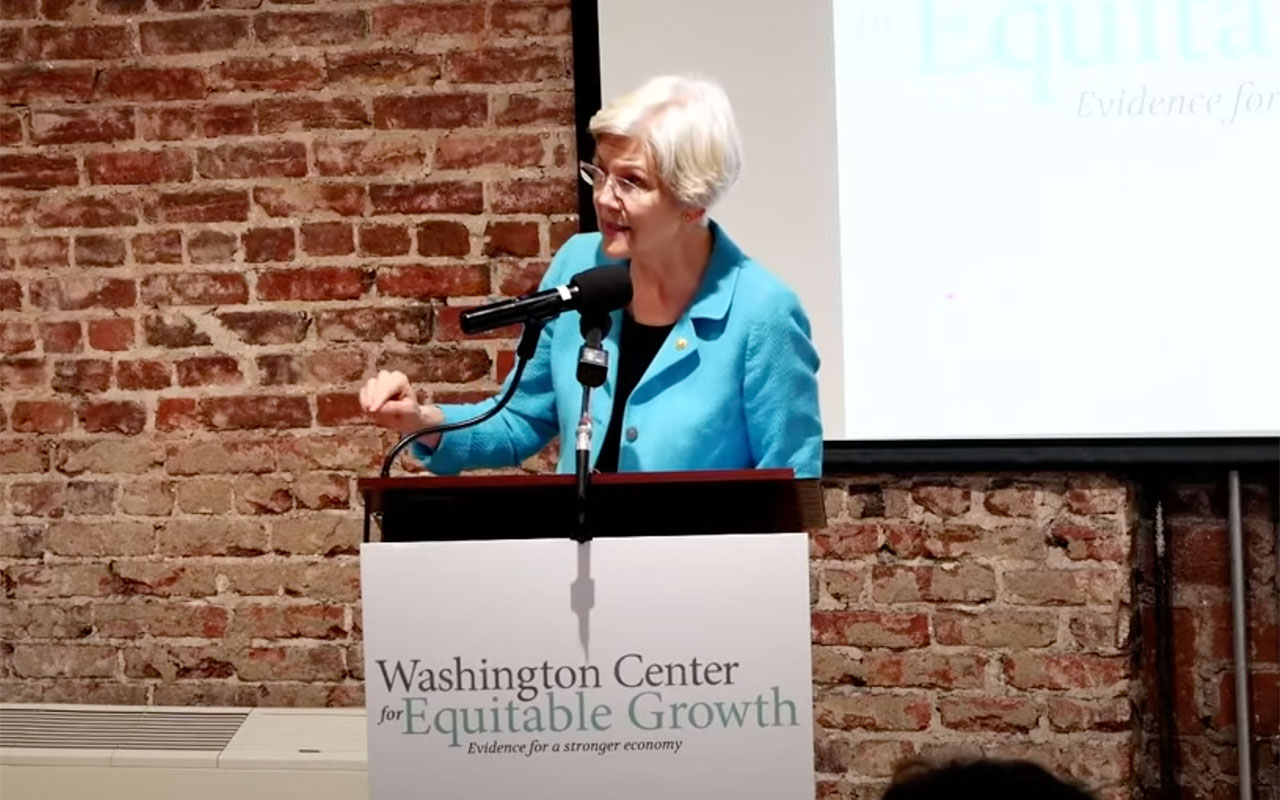
Equitable Growth hosts event featuring Sen. Elizabeth Warren on pro-growth tax reform in 2025 (opens in a new tab)
Videos JUN 20, 2024
Several provisions of former President Donald Trump’s 2017 tax cuts are set to expire next year, providing an opportunity to reimagine how federal taxes can both raise additional revenue for…
By: Equitable Growth (opens in a new tab)

A researcher’s guide to identifying policy-relevant research questions for the federal government (opens in a new tab)
Essays MAY 30, 2024
Social science researchers play an important role in the policymaking process. Researchers help policymakers at all levels of government to understand key trends and issues in the U.S. economy and…
By: Alexander Hertel-Fernandez (opens in a new tab)
2017 tax cut for pass-through business owners exacerbated inequality and failed to deliver economic benefits (opens in a new tab)
Issue Briefs MAY 1, 2024
Among the many regressive and ineffective elements of the Trump administration’s Tax Cuts and Jobs Act of 2017, one provision stands out as the most convoluted, unfair, and ripe for…
By: David S. Mitchell (opens in a new tab)
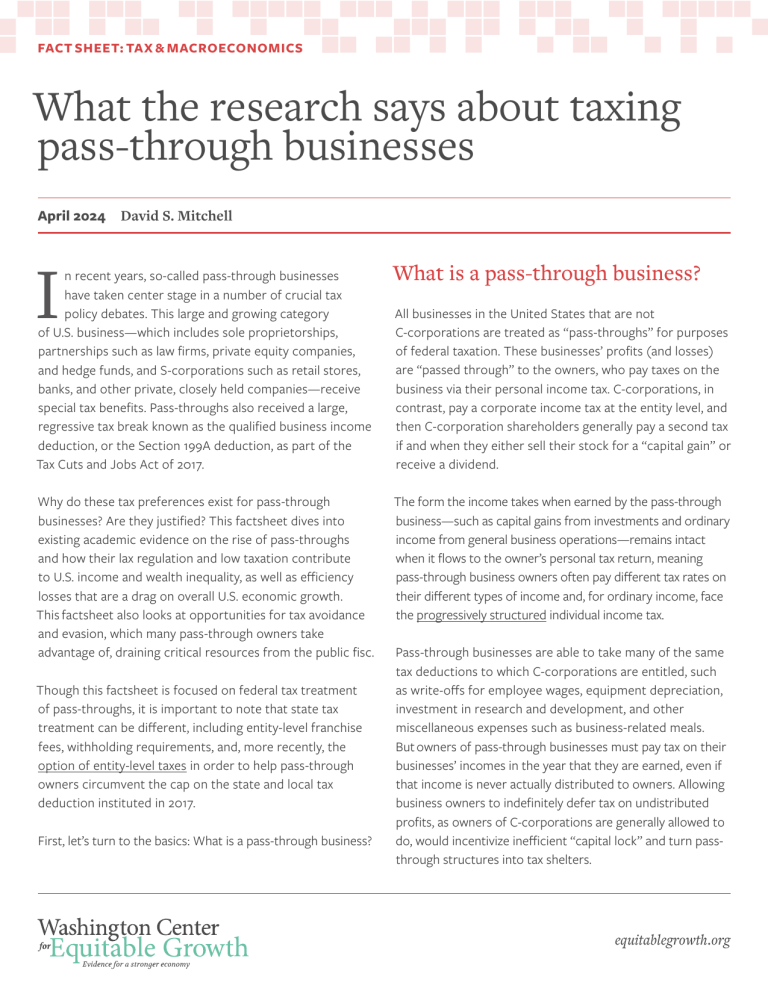
Factsheet: What the research says about taxing pass-through businesses (opens in a new tab)
Factsheets APR 30, 2024
In recent years, so-called pass-through businesses have taken center stage in a number of crucial tax policy debates. This large and growing category of U.S. business—which includes sole proprietorships, partnerships…
By: David S. Mitchell (opens in a new tab)

Combating market power through a graduated U.S. corporate income tax (opens in a new tab)
Issue Briefs APR 15, 2024
Editor’s note: This version has been updated from the original publication on April 15, 2024. The update corrects a prior underestimate of the revenue potential from graduated corporate tax rates…
By: Kimberly Clausing (opens in a new tab)
Enhanced Child Tax Credit helped U.S. families afford life-enhancing necessities and cope with inflation (opens in a new tab)
Blog APR 2, 2024
Amid ongoing congressional debate over expanding the Child Tax Credit for U.S. families, it’s important to understand why the fears about the expansion of that tax credit in 2021 were…
By: David S. Mitchell (opens in a new tab)

Closing the billionaire borrowing loophole would strengthen the progressivity of the U.S. tax code (opens in a new tab)
Issue Briefs FEB 5, 2024
The vast majority of Americans are concerned that some wealthy people don’t pay their “fair share” of federal taxes. They’re right to be bothered: Loopholes in the U.S. tax code…
By: Edward Fox (opens in a new tab), Zachary Liscow (opens in a new tab)

Doubling down on cuts to the IRS is bad for the federal budget and for tax fairness in the United States (opens in a new tab)
Blog JAN 9, 2024
The U.S. Congress recently announced a bipartisan budget deal for fiscal year 2024 appropriations for the U.S. federal government. The budget is largely consistent with the framework agreed to in…
By: David S. Mitchell (opens in a new tab)
Six years later, more evidence shows the Tax Cuts and Jobs Act benefits U.S. business owners and executives, not average workers (opens in a new tab)
Blog DEC 20, 2023
When policymakers were debating the Tax Cuts and Jobs Act of 2017, many proponents claimed that average U.S. workers would benefit via wage increases. These adherents of trickle-down economic theory…
By: David S. Mitchell (opens in a new tab)

New evidence shows that limiting a tax break for highly leveraged firms doesn’t hurt the U.S. economy (opens in a new tab)
Blog NOV 21, 2023
Does increasing taxes on businesses reduce private-sector investment? Most economists agree that investment in new projects and technologies is a key driver of economic growth. While the tax code plays…
By: David S. Mitchell (opens in a new tab)
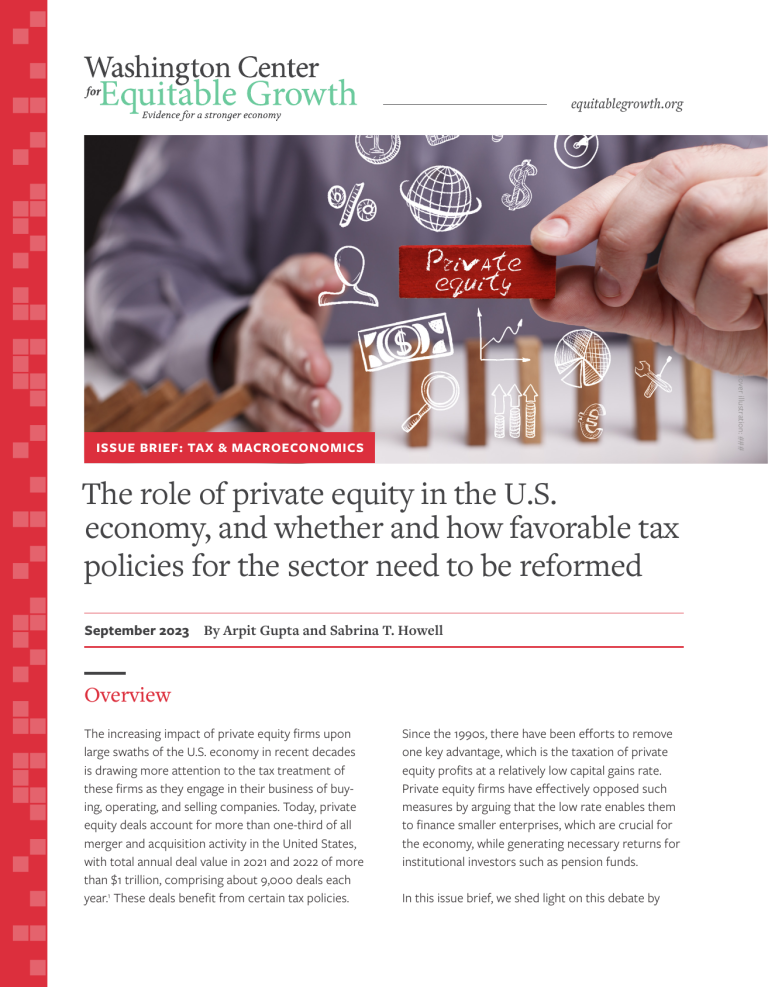
The role of private equity in the U.S. economy, and whether and how favorable tax policies for the sector need to be reformed (opens in a new tab)
Issue Briefs SEP 14, 2023
The increasing impact of private equity firms upon large swaths of the U.S. economy in recent decades is drawing more attention to the tax treatment of these firms as they…
By: Arpit Gupta (opens in a new tab), Sabrina Howell (opens in a new tab)
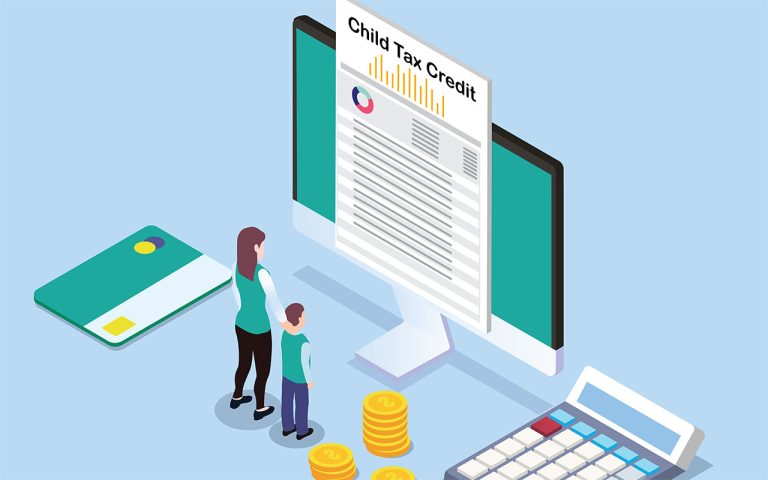
The effects of the expanded Child Tax Credit on low-income families in the United States (opens in a new tab)
Blog AUG 2, 2023
Childhood poverty is a stubborn problem in the United States. About 11 million U.S. children lived in poverty prior to the COVID-19 pandemic, accounting for nearly one-third of the impoverished…
By: Jesus Torres (opens in a new tab)

Short-term effects of the expanded Child Tax Credit on U.S. labor force participation amid the COVID-19 pandemic (opens in a new tab)
Blog JUL 26, 2023
There is a common politicized thread to arguments against expanding the federal antipoverty Child Tax Credit program permanently and to the justifications that a majority of the U.S. Supreme Court…
By: Sullivan Anderson (opens in a new tab)

The historical lessons from the U.S. General Property Tax (opens in a new tab)
Blog JUL 5, 2023
In the early 19th century, a new type of property tax system emerged in the United States, distinguishing itself from its European counterparts by encompassing all forms of property. This…
By: Sacha Dray (opens in a new tab), Camille Landais (opens in a new tab), Stefanie Stantcheva (opens in a new tab)
Money for nothing: The Qualified Small Business Stock capital gains exclusion is a giveaway to wealthy investors, startup founders, and their employees (opens in a new tab)
Issue Briefs JUN 8, 2023
The Qualified Small Business Stock exclusion, enshrined in Section 1202 of the Internal Revenue Code, permits early-stage venture capital firms and angel investors in high-tech startups, those startups’ founders, and…
By: Manoj Viswanathan (opens in a new tab)
New IRS report examines free tax filing option to reduce the cost and complexity for U.S. taxpayers (opens in a new tab)
Issue Briefs JUN 1, 2023
Filing a tax return with the Internal Revenue Service is one of the most common interactions Americans have with the federal government. Unfortunately, this process is often time-consuming and complex.…
By: Andre Gobbo (opens in a new tab)

Equitable Growth grantee Gabriel Zucman awarded the 2023 John Bates Clark Medal (opens in a new tab)
Blog MAY 9, 2023
Earlier this month, associate professor of public policy and economics Gabriel Zucman at the University of California, Berkeley—and a Washington Center for Equitable Growth 2018 grantee—won the 2023 John Bates…
By: Equitable Growth (opens in a new tab)

A missed opportunity to expand the Child Tax Credit will affect U.S. families and the broader economy now and for years to come (opens in a new tab)
Blog DEC 21, 2022
Earlier this week, the U.S. Congress released its proposed omnibus bill that funds the federal government through September 2023 and makes various other reforms to the nation’s retirement system, antitrust…
By: Equitable Growth (opens in a new tab)
Fighting tax evasion by the wealthy can raise revenue and restore the integrity of the U.S. tax system (opens in a new tab)
Blog DEC 20, 2022
Recent estimates suggest that as much as $36 billion a year in taxes are unpaid by Americans hiding wealth abroad, and more than $50 billion more is lost due to…
By: Jeanne Bomare (opens in a new tab), Daniel Reck (opens in a new tab)
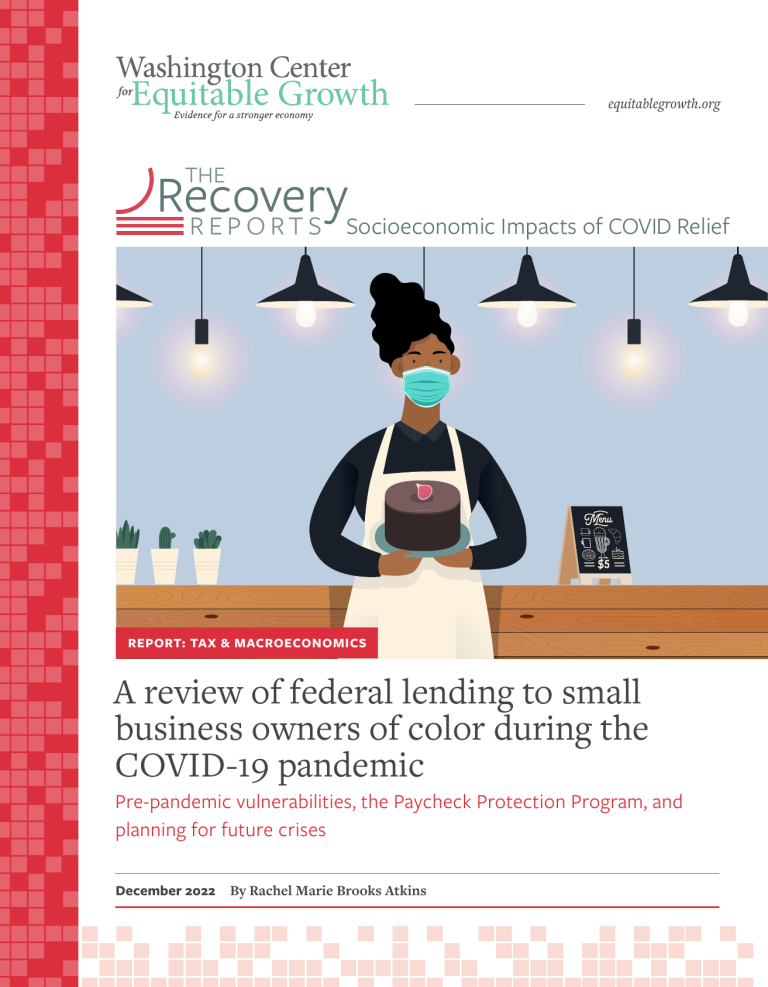
A review of federal lending to small business owners of color during the COVID-19 pandemic (opens in a new tab)
Reports DEC 13, 2022
The COVID-19 pandemic that began in early 2020 hammered small businesses across the globe. The number of active businesses declined precipitously, supply chain interruptions reduced business operations, and global trade…
By: Rachel Marie Brooks Atkins (opens in a new tab)
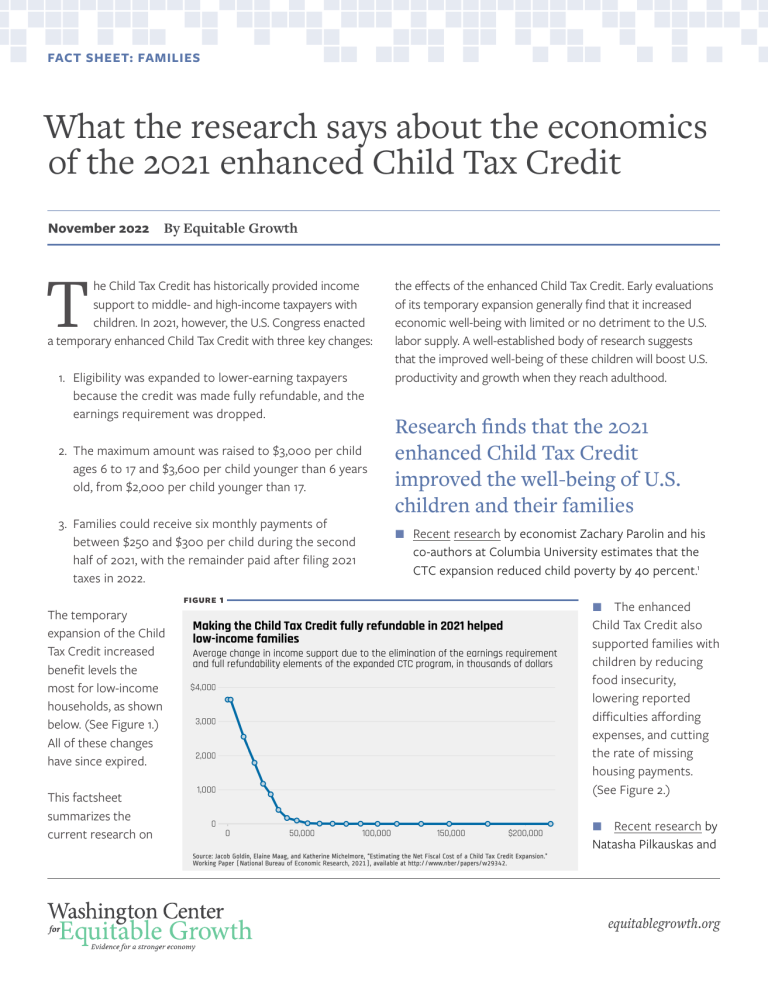
Factsheet: What the research says about the economics of the 2021 enhanced Child Tax Credit (opens in a new tab)
Factsheets NOV 29, 2022
The Child Tax Credit has historically provided income support to middle- and high-income taxpayers with children. In 2021, however, the U.S. Congress enacted a temporary enhanced Child Tax Credit with…
By: Equitable Growth (opens in a new tab)

How the Infrastructure Investment and Jobs Act of 2021 is promoting sustainable U.S. economic growth and mitigating climate change (opens in a new tab)
Issue Briefs NOV 18, 2022
In an issue brief earlier this year, Equitable Growth discussed how the Infrastructure Investment and Jobs Act of 2021 rests on sound economic principles and analyzed the ways that its…
By: Michael Madowitz (opens in a new tab), Shaun Harrison (opens in a new tab)

What are the distributional effects of monetary policy? (opens in a new tab)
Blog NOV 17, 2022
The Washington Center for Equitable Growth recently announced our 2023 Request for Proposals to support research investigating the various channels through which economic inequality, in all its forms, may or…
By: Shaun Harrison (opens in a new tab)

Consumers initially spend less than a third of their stimulus checks, on average, amid recessions (opens in a new tab)
Blog SEP 12, 2022
Economists and policymakers alike generally agree on the effectiveness of sending out direct stimulus checks to individuals to help reverse an economic downturn by encouraging more consumer spending. But they…
By: Equitable Growth (opens in a new tab)

The inequitable consequences of ‘heat islands’ within the metropolitan areas of the United States and what to do about it (opens in a new tab)
Blog AUG 3, 2022
Environmental science finds that so-called heat islands occur when urbanized areas experience much higher temperatures than neighboring outlying areas within major metropolitan areas. In and around U.S. cities, more affluent…
By: Michael Garvey (opens in a new tab)

NBER Summer Institute 2022 Round-up: Week 3 (opens in a new tab)
Blog AUG 1, 2022
On July 11, the National Bureau of Economic Research kicked off its summer institute, an annual 3-week conference featuring discussions and paper presentations on various topics in economics, including environmental…
By: Equitable Growth (opens in a new tab)

Taxing the rich: The effect of tax reform and the COVID-19 pandemic on tax flight among U.S. millionaires (opens in a new tab)
Blog JUL 28, 2022
Taxing the rich is one of the central policy debates in this time of rising inequality. Elite taxation can change the distribution of income in society, support equitable growth, and…
By: Cristobal Young (opens in a new tab), Ithai Lurie (opens in a new tab)

NBER Summer Institute 2022 Round-up: Week 2 (opens in a new tab)
Blog JUL 26, 2022
On July 11, the National Bureau of Economic Research kicked off its summer institute, an annual 3-week conference featuring discussions and paper presentations on various topics in economics, including disaggregating…
By: Equitable Growth (opens in a new tab)

In Conversation with R. Jisung Park (opens in a new tab)
In Conversation JUL 25, 2022
Equitable Growth in Conversation is a recurring series where we talk with economists and other academics to help us better understand whether and how economic inequality affects economic growth and…
By: Michael Garvey (opens in a new tab)

NBER Summer Institute 2022 Round-up: Week 1 (opens in a new tab)
Blog JUL 18, 2022
On July 11, the National Bureau of Economic Research kicked off its summer institute, an annual 3-week conference featuring discussions and paper presentations on various topics in economics, including monopsony…
By: Equitable Growth (opens in a new tab)

Recent working paper explores connection between capital investment and labor demand in the United States (opens in a new tab)
Blog MAY 20, 2022
The increasing visibility of artificial intelligence and other advanced technologies in the workplace is drawing new attention to how employers integrate technology into work processes and what effects these decisions…
By: Kathryn Zickuhr (opens in a new tab)
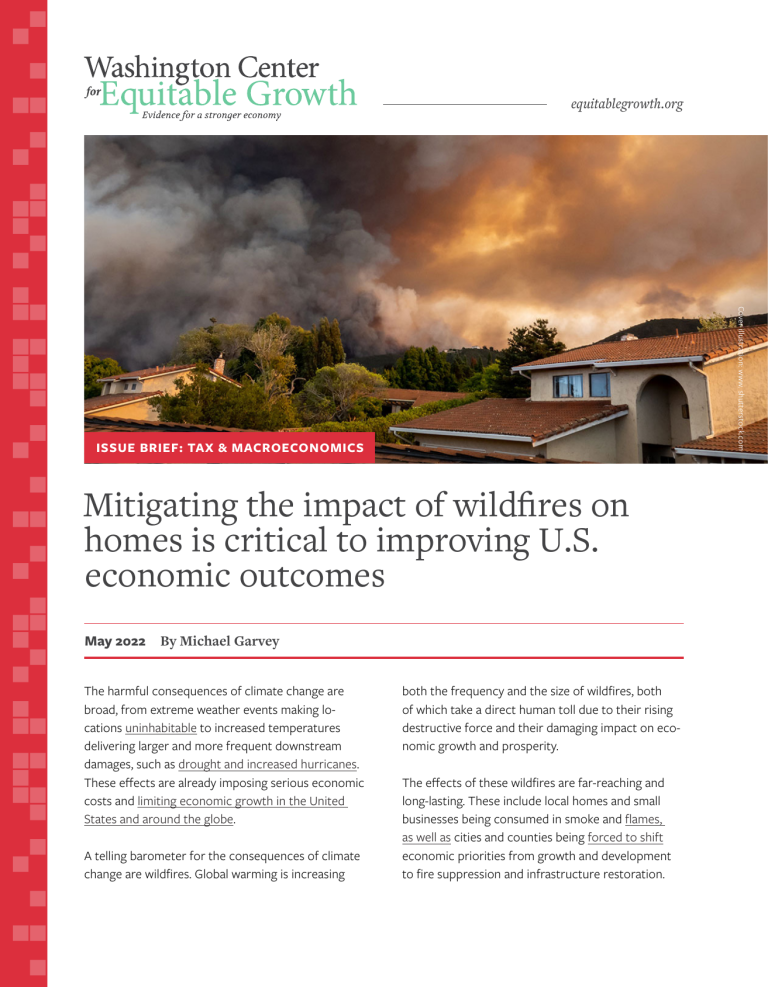
Mitigating the impact of wildfires on homes is critical to improving U.S. economic outcomes (opens in a new tab)
Issue Briefs MAY 10, 2022
The harmful consequences of climate change are broad, from extreme weather events making locations uninhabitable to increased temperatures delivering larger and more frequent downstream damages, such as drought and increased…
By: Michael Garvey (opens in a new tab)

Modeling future economic damages from climate change is an important and underdeveloped area of research (opens in a new tab)
Blog APR 22, 2022
This year’s Earth Day celebrations come on the heels of yet another devastating UN report detailing the consequences of climate change—and the global lack of action to mitigate its effects—for…
By: Michael Garvey (opens in a new tab)
Retirement tax incentives supercharge the fortunes of wealthy Americans (opens in a new tab)
Issue Briefs MAR 17, 2022
The conventional wisdom is that the nation’s system of retirement tax incentives, built around 401(k)s and Individual Retirement Accounts, is geared at helping the middle class build a small nest…
By: David S. Mitchell (opens in a new tab)
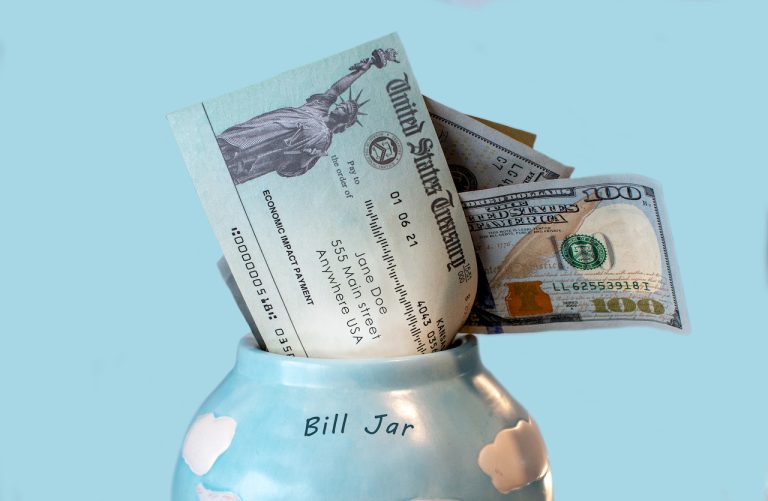
Fostering academic research on U.S. economic impact payments that goes beyond the marginal propensity to consume (opens in a new tab)
Blog JAN 18, 2022
Direct government payments to individuals are now a standard part of U.S. fiscal policymakers’ recession-fighting toolkit. Three rounds of so-called economic impact payments from the federal government have been paid…
By: Karen Dynan (opens in a new tab)

Billionaires Income Tax proposal seeks to ensure that U.S. ultra-wealthy pay their fair share in taxes (opens in a new tab)
Blog DEC 17, 2021
There is a growing recognition among policymakers in Washington that something must be done to address the ever-widening U.S. wealth divide, which is especially dramatic when broken out by race.…
By: David S. Mitchell (opens in a new tab)

The economic evidence behind 10 policies in the Build Back Better Act (opens in a new tab)
Issue Briefs NOV 24, 2021
The U.S. House of Representatives late last week passed a key plank of President Joe Biden’s economic agenda, the Build Back Better Act. Coming on the heels of the president…
By: Maryam Janani-Flores (opens in a new tab), David S. Mitchell (opens in a new tab)

In Conversation with Carlos Fernando Avenancio-León (opens in a new tab)
In Conversation SEP 20, 2021
Equitable Growth in Conversation is a recurring series where we talk with economists and other academics to help us better understand whether and how economic inequality affects economic growth and…
By: David S. Mitchell (opens in a new tab)
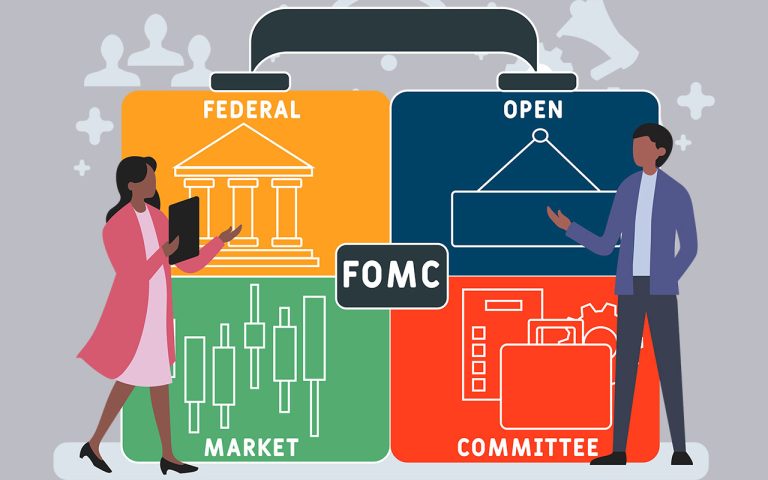
The value of racial and gender diversity at the Federal Reserve (opens in a new tab)
Blog SEP 16, 2021
The Federal Reserve’s so-called dual mandate to maintain overall price stability and maximum sustainable growth in U.S. employment is always on the minds of the U.S. central bank’s Federal Open…
By: Equitable Growth (opens in a new tab)
Completing the unfinished New Deal to overcome 21st century U.S. economic inequality (opens in a new tab)
Blog AUG 31, 2021
President Joe Biden wants Congress to enact his two signature legislative packages—the $1 trillion bipartisan physical infrastructure plan passed by the U.S. Senate earlier in August and a $3.5 trillion…
By: David S. Mitchell (opens in a new tab)

Congress needs distribution analyses to make informed, equitable policy choices, and the CBO FAIR Scoring Act would deliver it (opens in a new tab)
Blog AUG 11, 2021
Before voting on legislation, members of Congress usually receive a cost estimate, or score, for that legislation from the Congressional Budget Office. This score provides nonpartisan CBO analysts’ best estimate…
By: Corey Husak (opens in a new tab)

NBER Summer Institute 2021 Round-up: Week 2 (opens in a new tab)
Blog JUL 26, 2021
On July 12, the National Bureau of Economic Research kicked off its summer institute, an annual 3-week conference featuring discussions and paper presentations on specific subfields of economics, including wealth…
By: Equitable Growth (opens in a new tab)

NBER Summer Institute 2021 Round-up: Week 1 (opens in a new tab)
Blog JUL 19, 2021
On July 12, the National Bureau of Economic Research kicked off its summer institute, an annual 3-week conference featuring discussions and paper presentations on specific subfields of economics, including inequality…
By: Equitable Growth (opens in a new tab)

Climate change among many issues discussed at annual Western Economic Association International conference (opens in a new tab)
Blog JUL 15, 2021
The Western Economic Association International at the end of June held its 96th annual conference, bringing audiences together for more than 280 concurrent sessions to collaborate, share, and learn from…
By: Equitable Growth (opens in a new tab)
The relationship between taxation and U.S. economic growth (opens in a new tab)
Issue Briefs JUN 30, 2021
The relationship between taxation and economic growth is hotly debated in economics. Free market economic ideology is based on the premise that constraining “the market” through policies such as increased…
By: Corey Husak (opens in a new tab)
The economic benefits of equal opportunity in the United States by ending racial, ethnic, and gender disparities (opens in a new tab)
Issue Briefs JUN 29, 2021
Racial, ethnic, and gender disparities across the U.S. economy are a personal tragedy for the millions of individuals who suffer from the emotional, psychological, and social consequences. These disparities also…
By: Robert Lynch (opens in a new tab)

COVID-19 lockdown policy in the United States: Past, present, and future trends (opens in a new tab)
Blog MAY 27, 2021
The onset of the coronavirus pandemic and the rising death toll from COVID-19, the disease caused by the virus, initiated an unprecedented decline in consumer spending in the United States,…
By: Jacob Robbins (opens in a new tab)
The sources and size of tax evasion in the United States (opens in a new tab)
Issue Briefs MAY 14, 2021
Tens of millions of Americans will duly pay the taxes they owe and file for their refunds by Tax Day in 2021, which was delayed until May 17. Meanwhile, some…
By: Corey Husak (opens in a new tab)

How inequities in U.S. taxation can perpetuate systemic racism (opens in a new tab)
Blog APR 20, 2021
The history of discriminatory taxation in the United States is long and storied. Writing on county governments in his in 1901 study, “The Negro Landholder of Georgia,” scholar W.E.B. Du…
By: Shaun Harrison (opens in a new tab)

Policy workshop addressed promises and challenges of using carbon pricing to combat climate change (opens in a new tab)
Blog APR 15, 2021
Climate change might be the world’s most complex public policy problem. It is more global, more long-term, more irreversible, and more uncertain than most other policy challenges and probably unique…
By: Gernot Wagner (opens in a new tab)

Uncertainty about the size of annual tax refunds hinders the effectiveness of tax-based U.S. redistribution (opens in a new tab)
Blog APR 8, 2021
Each tax season, many families in the United States receive additional income through refundable tax credits, among them the Earned Income Tax Credit and Child Tax Credit. These two tax…
By: Sydnee Caldwell (opens in a new tab), Scott Nelson (opens in a new tab), Daniel Waldinger (opens in a new tab)

Tax evasion at the top of the U.S. income distribution and how to fight it (opens in a new tab)
Blog MAR 22, 2021
How much taxes do high-income Americans evade? And what kinds of evasion tactics do they use? These questions are important for tax enforcement policies and the measurement of income inequality…
By: Daniel Reck (opens in a new tab), Max Risch (opens in a new tab), Gabriel Zucman (opens in a new tab)

Executive actions to reform the cost-benefit analysis of U.S. tax regulations (opens in a new tab)
Blog FEB 24, 2021
Relevant federal offices and agencies: Office of Information and Regulatory Affairs U.S. Department of the Treasury Relevant laws and guidance: Executive Order 12866 Memorandum of Agreement, Review of Tax Regulations…
By: Equitable Growth (opens in a new tab)

Understanding the macroeconomic consequences of rising income and wealth inequality in the United States (opens in a new tab)
Blog JAN 15, 2021
One of the big questions in economics today is to understand how rising inequality matters for the U.S. economy as a whole. There has been a sharp increase in income…
By: Atif Mian (opens in a new tab)

Collective bargaining as a path to more equitable wage growth in the United States (opens in a new tab)
Blog JAN 14, 2021
This essay is part of Boosting Wages for U.S. Workers in the New Economy, a compilation of 10 essays from leading economic thinkers who explore alternative policies for boosting wages…
By: Benjamin Schoefer (opens in a new tab)
Targeting business tax incentives to realize U.S. wage growth (opens in a new tab)
Blog JAN 14, 2021
This essay is part of Boosting Wages for U.S. Workers in the New Economy, a compilation of 10 essays from leading economic thinkers who explore alternative policies for boosting wages…
By: Juan Carlos Suarez Serrato (opens in a new tab)
Public investments in education can spur equitable growth, pay for themselves, and create jobs for a stronger economic recovery (opens in a new tab)
Reports OCT 27, 2020
Public investments in education, in both physical structures and in services, are key to long-run economic growth and human well-being. Some of these investments are especially effective in promoting more…
By: Robert Lynch (opens in a new tab)
Why cost-benefit analysis of tax regulations has failed, and how to fix it (opens in a new tab)
Blog SEP 30, 2020
When President Donald Trump signed the Tax Cuts and Jobs Act into law in December 2017, he kicked off an incredible period of regulatory activity at the U.S. Department of…
By: Greg Leiserson (opens in a new tab)
Cost-benefit analysis of U.S. tax regulations has failed. What should come next? (opens in a new tab)
Reports SEP 30, 2020
In December 2017, President Donald Trump signed into law the Tax Cuts and Jobs Act, the most significant tax legislation in 30 years. The rushed passage of the law meant…
By: Greg Leiserson (opens in a new tab)

Equitable Growth announces record $1.07 million in research grants on inequality and broadly shared growth (opens in a new tab)
Blog AUG 31, 2020
The Washington Center for Equitable Growth today announced research grants totaling $1,074,060—our largest year to date—to seek evidence on important issues related to the intersections between economic inequality and growth.…
By: Korin Davis (opens in a new tab)
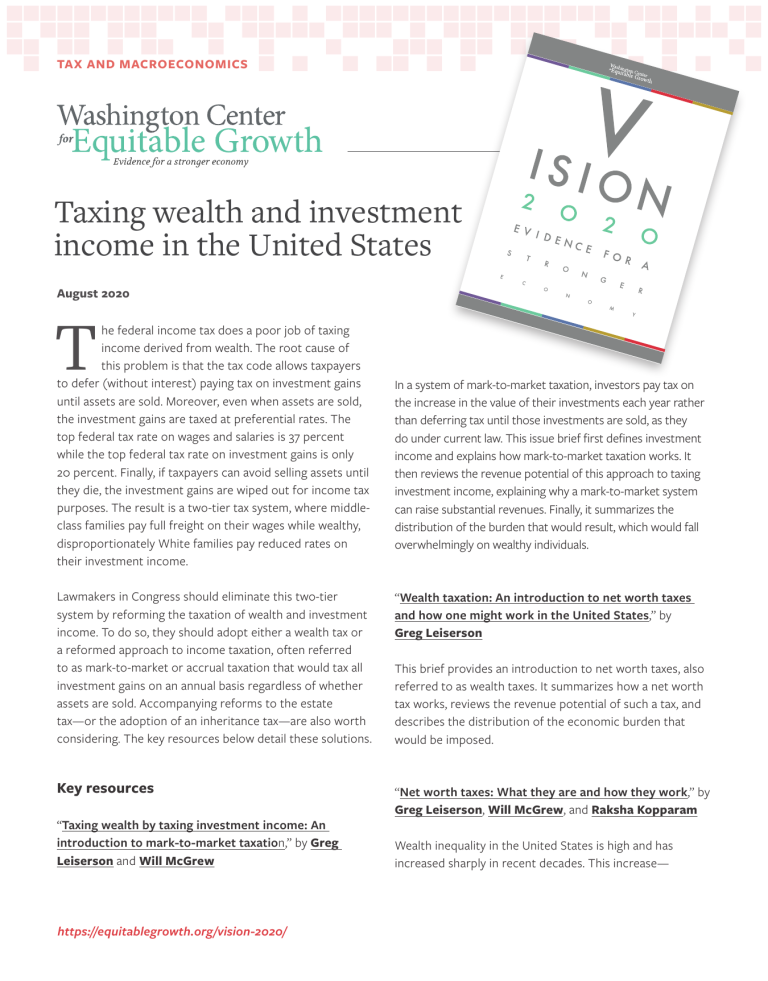
Taxing wealth and investment income in the United States (opens in a new tab)
Issue Briefs AUG 25, 2020
The federal income tax does a poor job of taxing income derived from wealth. The root cause of this problem is that the tax code allows taxpayers to defer (without…
By: Equitable Growth (opens in a new tab)

Restoring the federal estate tax is a proven way to raise revenue and address wealth inequality (opens in a new tab)
Issue Briefs AUG 14, 2020
Wealth inequality in the United States is rising more steeply to the already very rich, even more than the well-known rise in income inequality. The wealthiest 1 percent of families…
By: John Sabelhaus (opens in a new tab)

Experts discuss transformative ideas for 2020 U.S. economic policy debate at Vision 2020 event (opens in a new tab)
Videos JUL 2, 2020
Eliminate banks as the “middleman” for federal anti-recession aid. Cancel all student loan debt. Give workers a say in how their workplaces reopen and empower them to form unions. Provide…
By: Equitable Growth (opens in a new tab)
Equitable Growth and The Hamilton Project bring together policymakers and academics to discuss how to fight the coronavirus recession (opens in a new tab)
Videos JUN 11, 2020
At a June 8 online event sponsored by the Washington Center for Equitable Growth and The Brookings Institution’s The Hamilton Project, key policymakers and academics discussed how the coronavirus recession…
By: David S. Mitchell (opens in a new tab)

Misvaluations in local property tax assessments cause the tax burden to fall more heavily on Black, Latinx homeowners (opens in a new tab)
Blog JUN 10, 2020
Authors’ note: We stand in solidarity with all who speak up, all who are hurting, and all who are combating racism and fighting to advance justice. Violence against Black bodies…
By: Carlos Fernando Avenancio-Leon (opens in a new tab), Troup Howard (opens in a new tab)

In Conversation with Mehrsa Baradaran (opens in a new tab)
In Conversation JUN 9, 2020
“Equitable Growth in Conversation” is a recurring series where we talk with economists and other academics to help us better understand whether and how economic inequality affects economic growth and…
By: Amanda Fischer (opens in a new tab)
Policy options for building resilient U.S. medical supply networks (opens in a new tab)
Issue Briefs MAY 29, 2020
U.S. policymakers in Congress across the political spectrum, from Sen. Marco Rubio (R-FL) to Rep. Elissa Slotkin (D-MI) to Sen. Bernie Sanders (I-VT), all agree that the United States is…
By: David Adler (opens in a new tab), Dan Breznitz (opens in a new tab), Susan Helper (opens in a new tab)
U.S. income inequality is worse and rising faster than policymakers probably realize (opens in a new tab)
Issue Briefs MAY 27, 2020
The use of U.S. administrative income tax data for research purposes over the past two decades has led to an ongoing debate about levels and trends in U.S. income inequality.…
By: John Sabelhaus (opens in a new tab), Somin Park (opens in a new tab)

Global medical trade in the time of the coronavirus pandemic (opens in a new tab)
Blog MAY 6, 2020
The coronavirus pandemic has placed the opportunities and challenges of our intensely integrated world economy in stark relief. The movement of people across borders generates fear of contagion. And the…
By: Kimberly Clausing (opens in a new tab)

Good U.S. fiscal policy could have made us stronger before the coronavirus recession and can make us stronger afterward (opens in a new tab)
Blog APR 28, 2020
When U.S. policymakers seek to restore the U.S. economy in the wake of the coronavirus recession, what will constitute success? Returning the economy to its prepandemic state is not sufficient.…
By: John Sabelhaus (opens in a new tab)

Where should the marginal dollar go in U.S. fiscal policy—to testing or to the safety net—amid a pandemic-induced economic downturn? (opens in a new tab)
Blog APR 27, 2020
In our recent working paper, “An SEIR Infectious Disease Model with Testing and Conditional Quarantine,” the two of us and Simon Mongey, an assistant professor of economics at the University…
By: David Berger (opens in a new tab), Kyle Herkenhoff (opens in a new tab)
The coronavirus recession and economic inequality: A roadmap to recovery and long-term structural change (opens in a new tab)
Issue Briefs APR 16, 2020
This post reflects our organization’s overall guiding policy principles for confronting the coronavirus recession and its relationship to U.S. economic inequality as detailed on April 16. These principles still hold…
By: Heather Boushey (opens in a new tab), Somin Park (opens in a new tab)

Two things state and local governments can do to mitigate the coronavirus recession in the United States (opens in a new tab)
Blog APR 2, 2020
The U.S. economy is infected by the coronavirus pandemic, and a deep recession is practically inevitable. Congress and the Federal Reserve will lead the effort to fix the economy with…
By: Yair Listokin (opens in a new tab)
Creative economic solutions could help us avoid the next Great Depression (opens in a new tab)
Blog MAR 21, 2020
Policymakers across the United States are imposing ever more stringent restrictions on economic and social activities to combat the spread of the new coronavirus. “Flattening the curve” to lower the…
By: Susan Helper (opens in a new tab)

Coronavirus recession layoffs require reforms to the Unemployment Insurance program now to fully protect all U.S. workers (opens in a new tab)
Blog MAR 20, 2020
(This piece has been updated to reflect the release of Sen. Michael Bennet’s Unemployment Insurance reform proposal on March 24, 2020.) In the midst of the first layoffs in the…
By: David S. Mitchell (opens in a new tab)

International trade policy that works for U.S. workers (opens in a new tab)
Blog FEB 18, 2020
This essay is part of Vision 2020: Evidence for a stronger economy, a compilation of 21 essays presenting innovative, evidence-based, and concrete ideas to shape the 2020 policy debate. The…
By: Kimberly Clausing (opens in a new tab)

A modest tax reform proposal to roll back federal tax policy to 1997 (opens in a new tab)
Blog FEB 18, 2020
This essay is part of Vision 2020: Evidence for a stronger economy, a compilation of 21 essays presenting innovative, evidence-based, and concrete ideas to shape the 2020 policy debate. The…
By: Owen Zidar (opens in a new tab), Eric Zwick (opens in a new tab)

Good U.S. monetary policy can’t fix bad U.S. fiscal policy (opens in a new tab)
Blog FEB 18, 2020
This essay is part of Vision 2020: Evidence for a stronger economy, a compilation of 21 essays presenting innovative, evidence-based, and concrete ideas to shape the 2020 policy debate. The…
By: John Sabelhaus (opens in a new tab)

Fighting the next recession in the United States with law and regulation, not just fiscal and monetary policies (opens in a new tab)
Blog FEB 18, 2020
This essay is part of Vision 2020: Evidence for a stronger economy, a compilation of 21 essays presenting innovative, evidence-based, and concrete ideas to shape the 2020 policy debate. The…
By: Yair Listokin (opens in a new tab)

The logistics of a reparations program in the United States (opens in a new tab)
Blog FEB 18, 2020
This essay is part of Vision 2020: Evidence for a stronger economy, a compilation of 21 essays presenting innovative, evidence-based, and concrete ideas to shape the 2020 policy debate. The…
By: Dania Francis (opens in a new tab)

“Taxing Wealth” (opens in a new tab)
Blog JAN 28, 2020
In “Taxing Wealth,” Equitable Growth’s Director of Tax Policy and chief economist Greg Leiserson outlines the case for major reforms to the taxation of wealth in the United States, details…
By: Greg Leiserson (opens in a new tab)

Understanding the economic effects of federal tax changes (opens in a new tab)
Blog DEC 20, 2019
The primary purpose of taxation is to fund public spending in a fair manner. When analyzing proposed tax changes, tax economists must make complex assumptions about how people would respond…
By: Corey Husak (opens in a new tab)

Vision 2020 conference probes inequality’s effects on the U.S. economy and policy changes to counteract them (opens in a new tab)
Videos NOV 26, 2019
A spirit of optimism about the ability of government to address fundamental issues underlying U.S. economic inequality and a determination to advance evidence-based policies for broad-based economic growth infused an…
By: Equitable Growth (opens in a new tab)

New board member Mehrsa Baradaran brings expertise on economic inequality and the racial wealth gap (opens in a new tab)
Videos OCT 31, 2019
The Washington Center for Equitable Growth is pleased to announce that Mehrsa Baradaran, professor at University of California, Irvine School of Law, will join the Board of Directors. Baradaran is…
By: Heather Boushey (opens in a new tab), Somin Park (opens in a new tab)
Equitable Growth hosts Vision 2020 Conference in Washington, highlighting connection between economic inequality and growth (opens in a new tab)
Blog OCT 30, 2019
Economic inequality in the United States has grown over the past few decades to levels not seen in nearly a century. As a result, more than any presidential election in…
By: Equitable Growth (opens in a new tab)

Why a wealth tax in the United States might increase efficiency (opens in a new tab)
Blog OCT 10, 2019
The well-documented rise in wealth inequality in the United States since the 1980s has sparked debate on wealth taxes as a tool to raise revenue and reduce wealth disparities. Contributing…
By: Somin Park (opens in a new tab)

Public investment is crucial to strengthening U.S. economic growth and tackling inequality (opens in a new tab)
Blog SEP 23, 2019
Despite policymakers’ oft-repeated promises of more spending on infrastructure and other key investments, U.S. public investment has reached new lows. Public investment is a key driver of long-term productivity and…
By: Somin Park (opens in a new tab)
Taxing wealth by taxing investment income: An introduction to mark-to-market taxation (opens in a new tab)
Issue Briefs SEP 11, 2019
The sharp increase in U.S. wealth inequality in recent decades has spurred interest in increasing taxes on wealth. This issue brief introduces mark-to-market taxation, one approach to raising taxes on…
By: Greg Leiserson (opens in a new tab), Will McGrew (opens in a new tab)

In Conversation with Gabriel Zucman (opens in a new tab)
In Conversation AUG 7, 2019
“Equitable Growth in Conversation” is a recurring series where we talk with economists and other academics to help us better understand whether and how economic inequality affects economic growth and…
By: Heather Boushey (opens in a new tab)

Neither history nor research supports supply-side economics (opens in a new tab)
Blog JUL 2, 2019
President Donald Trump last month awarded Arthur Laffer—father of the Laffer Curve and the godfather of supply-side economics—the nation’s highest civilian honor, the Medal of Freedom. Relatively few economists have…
By: Heather Boushey (opens in a new tab)

Why it’s important to pay attention to distributional consequences of economic policies (opens in a new tab)
Blog JUN 12, 2019
In the decades following the 1980s, free market policies dominated policy agendas across the world. The gains from growth, however, were not broadly shared within countries, as evidenced by the…
By: Somin Park (opens in a new tab)

Wealthier individuals receive higher returns to wealth (opens in a new tab)
Blog JUN 11, 2019
Wealth inequality has soared in the United States over the past three decades. Today, the top 1 percent own about 40 percent of the nation’s wealth, levels last seen during…
By: Somin Park (opens in a new tab)


Your Direct Line to Cutting Edge Research
Be the first to know about our latest events, research releases, and expert insights. Get exclusive updates delivered right to your inbox and never miss an opportunity to engage with our community.