



Policy
What Work Does Generative AI Do?
Essays SEP 8, 2026
By: Alexander Bick, Adam Blandin, David Deming, Tyler Schumacher
AI, Tech & Energy
Labor, Wages & Worker Power
 Browse All Resources
JUL 28, 2017
By: Bridget Ansel

This is a weekly post we publish on Fridays with links to articles that touch on economic inequality and growth. The first section is a round-up of what Equitable Growth published this week and the second is the work we’re highlighting from elsewhere. We won’t be the first to share these articles, but we hope by taking a look back at the whole week, we can put them in context.
Equitable Growth released a new report (opens in a new tab) this week (along with an issue brief outlining key findings) by John Kwoka, the Neal F. Finnegan Distinguished Professor of Economics at Northeastern University, on how changes in U.S. merger enforcement policy have contributed to rising concentration and reduced competition.
As a growing number of states prove that paid leave based on a social insurance model works for businesses and workers, the momentum around a national paid leave policy grows.
Timely and accurate data is critical to diagnosing and responding to policy problems that affect millions of people across the country. But with U.S. statistical agencies facing major cuts, Austin Clemens asks: Will the United States give up on data collection?
The debate around antitrust policy has officially entered the mainstream with the inclusion of this issue in congressional Democrats’ “Better Deal” policy blueprint, which some on the right have branded as #hipsterantitrust. Chris Sagers writes specifically about one promising tenant of the Better Deal antitrust platform: “frequent, independent reviews” of merged firms’ performance along with a “consumer competition advocate.” [slate (opens in a new tab)]
After JP Morgan Chase & Co. Categorized a male employee as a “secondary caregiver,” thus not allowing him to take advantage of 16 weeks of paid leave that it provides to women, Bryce Covert discusses why family leave’s “sexism problem” is bad for men—and women. [elle (opens in a new tab)]
Even among legislators on Capitol Hill who ardently raise the alarm about growing inequality, the discussions around tax reform tend to focus on closing loopholes in the current system. Max Ehrenfreund dives into the research on why a fundamental overhaul of the federal tax system is needed to meaningfully address inequality. [wonkblog (opens in a new tab)]
Macroeconomic models tend to be blind to race and gender, assuming that macroeconomic policies affect everyone equally. Former Minneapolis Fed President and current Professor of Economics at the University of Rochester, Narayana Kocherlakota, writes about two new papers highlighting how “quantitative models that ignore such differences can be poor guides to understanding the impact of government programs.” [bloomberg view (opens in a new tab)]
Alvin Chang writes about how many parents are legally gerrymandering school districts in order to separate their kids away from their “less desirable” peers, which he writes has “resulted in the biggest setback to school integration since Brown v. Board of Education. [vox (opens in a new tab)]
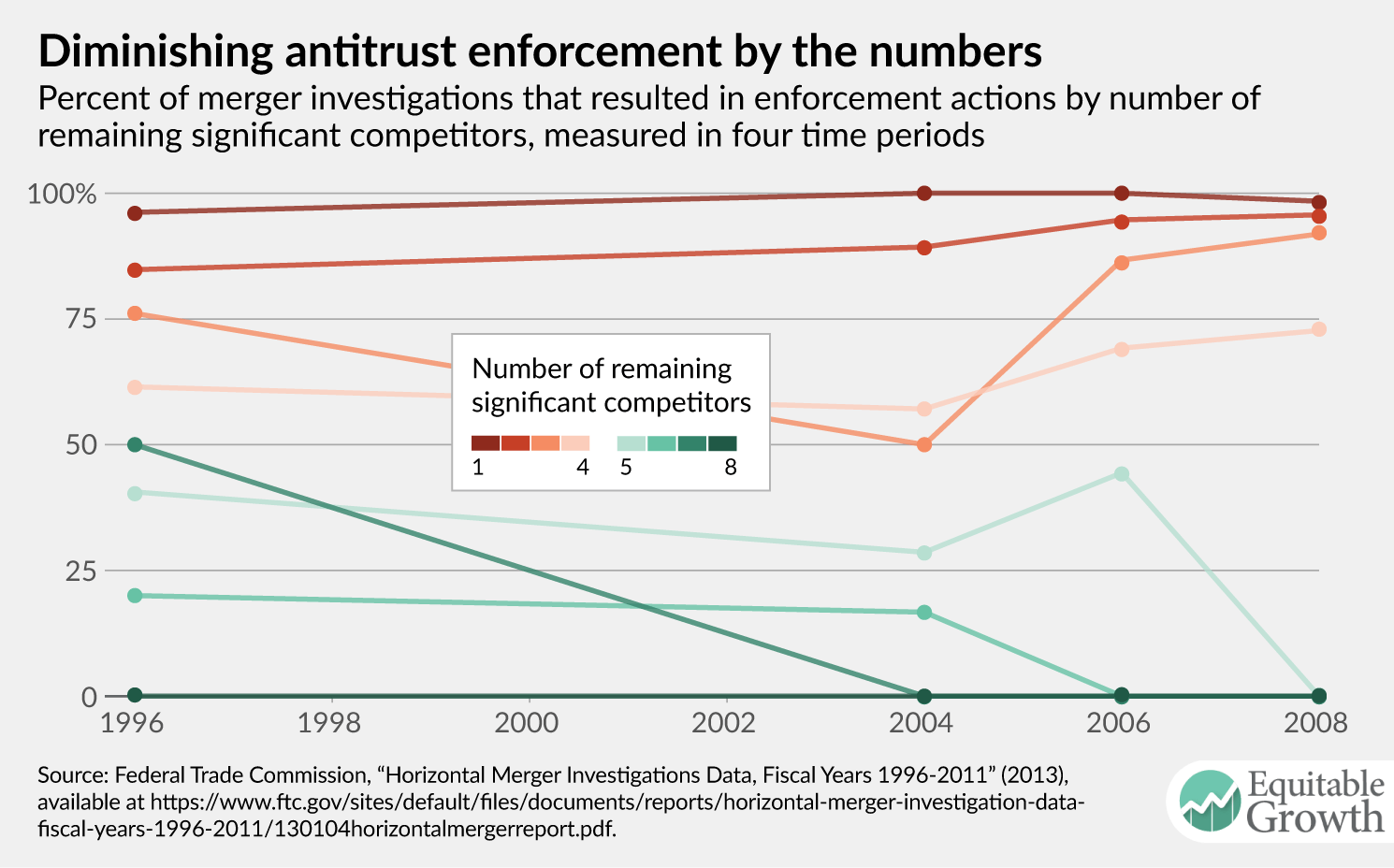
From “U.S. antitrust and competition policy amid the new merger wage” (opens in a new tab) by John E. Kwoka.
Essays SEP 8, 2026
By: Alexander Bick, Adam Blandin, David Deming, Tyler Schumacher

Essays SEP 2, 2026
By: Megan Rivera

Essays AUG 31, 2026
By: Christopher Bangert-Drowns
Get updates on our latest research, event announcements, and policy insights delivered straight to your inbox. Stay connected with the leading voices on equitable growth.


