


Resources
From peer-reviewed research to accessible policy briefs, explore the scholarship that’s shaping debates and driving change.

86 Results

Multiple Program Participation in the Safety Net: Incidence, Impediments, and Implications (opens in a new tab)
Working Papers JUL 7, 2026
Multiple program participation is a defining feature of the U.S. safety net, with half of recipients enrolling in two or more programs. Yet most research examines programs in isolation, missing…
By: Neil A. Cholli, Derek Wu (opens in a new tab)
Barriers to Benefits: Unemployment Insurance Take-Up and Labor Market Effects (opens in a new tab)
Working Papers MAY 19, 2026
Unemployment insurance (UI) take-up is relatively low in the United States. We implement a large-scale field experiment among 50,000 likely unemployed individuals to study the causes and labor supply implications…
By: Casey McQuillan (opens in a new tab), Brendan Moore (opens in a new tab)
Understanding the Congestion Child Penalty: Can Remote Work Attenuate It? (opens in a new tab)
Working Papers FEB 12, 2026
We study the impact of commuting time on the labor supply of women with children in the United States. We show that congestion and long commutes discourage the labor force…
By: Ilaria D’Angelis (opens in a new tab), Keren Horn (opens in a new tab)
Dissecting Racial Politicization: Long-Run Evidence from the Food Stamp Program (opens in a new tab)
Working Papers FEB 2, 2026
We explore long-run racial polarization induced by the original Food Stamps Program: a major policy choice to expand the social safety net in the United States in the 1960s and…
By: Carlos F. Avenancio-León, Troup Howard (opens in a new tab), William Mullins (opens in a new tab)

In Conversation with Omari Swinton (opens in a new tab)
In Conversation SEP 24, 2025
Equitable Growth in Conversation is a recurring series where we talk with economists and other academics to help us better understand whether and how economic inequality affects economic growth and…
By: Sanjay Supan (opens in a new tab)
Fitting the Bill? The First Federal Paid Leave Mandate (opens in a new tab)
Working Papers SEP 23, 2025
We find that the first federal paid leave mandate in the US, enacted under the Families First Coronavirus Response Act, increased paid leave taking by nearly 200% for eligible workers,…
By: Tanya Byker (opens in a new tab), Elena Patel (opens in a new tab), Kristin Smith (opens in a new tab)
In Her Hands: A Guaranteed Income Initiative (opens in a new tab)
Working Papers SEP 4, 2025
In Her Hands (IHH) is a guaranteed income (GI) initiative aimed at addressing persistent economic insecurity among women in neighborhoods with some of Georgia’s highest poverty rates. Co-designed with local…
By: Laura Brugger (opens in a new tab), Shadonna Davis (opens in a new tab), Desha Elliott (opens in a new tab), Leah Hamilton (opens in a new tab), Stephen Roll (opens in a new tab), Latrice Rollins (opens in a new tab), Simone Smith (opens in a new tab), Aaron Quick (opens in a new tab), Naomi Zewde (opens in a new tab)

Americans Informed About the Distributional Effects of Republicans’ Budget Bill Overwhelmingly Oppose It (opens in a new tab)
Working Papers JUN 25, 2025
Republicans in the Senate are currently considering the One Big Beautiful Bill Act, which, if enacted, would be the most regressive U.S. tax and budget law in at least the…
By: Jacob S. Hacker, Patrick Sullivan (opens in a new tab)
Financial and Transfer Income as Components of the Regional Economic Base (opens in a new tab)
Working Papers JUN 24, 2025
Economists and geographers have long divided industries into “basic” and “nonbasic” sectors depending on whether they bring money into a region from outside or serve local demand. Traditionally, the regional…
By: Robert Manduca (opens in a new tab)

Request for Proposals: The economic effects of the Inflation Reduction Act (opens in a new tab)
RFPs APR 2, 2025
By: Equitable Growth (opens in a new tab)

In Conversation with Fenaba Addo (opens in a new tab)
In Conversation DEC 12, 2024
Equitable Growth in Conversation is a recurring series where we talk with economists and other academics to help us better understand whether and how economic inequality affects economic growth and…
By: Shira Markoff (opens in a new tab)
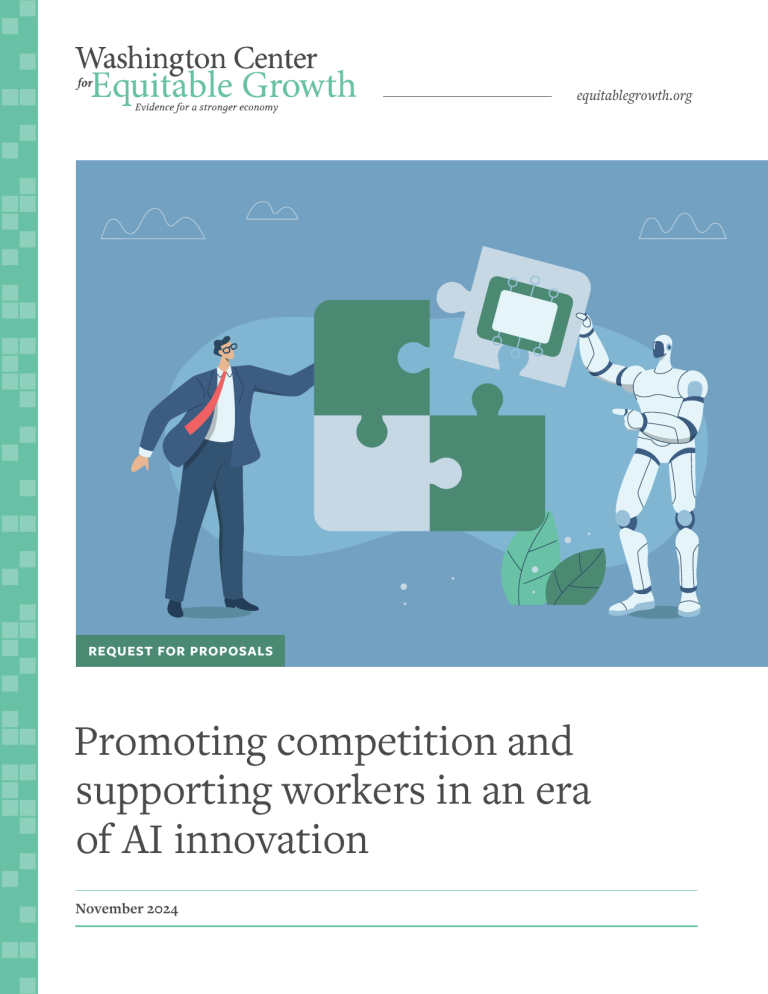
Request for Proposals: Promoting competition and supporting workers in an era of AI innovation (opens in a new tab)
RFPs NOV 20, 2024
By: Equitable Growth (opens in a new tab)
Request for proposals: Research grants for early career scholars (opens in a new tab)
RFPs OCT 30, 2024
By: Equitable Growth (opens in a new tab)

In Conversation with Mishaela Durán (opens in a new tab)
In Conversation SEP 12, 2024
Equitable Growth in Conversation is a recurring series where we talk with economists and other academics to help us better understand whether and how economic inequality affects economic growth and…
By: Shira Markoff (opens in a new tab)

In Conversation with Natalie Foster (opens in a new tab)
In Conversation JUL 2, 2024
Equitable Growth in Conversation is a recurring series where we talk with economists and other academics to help us better understand whether and how economic inequality affects economic growth and…
By: Michael Linden (opens in a new tab)
Spending Responses to the Child Tax Credit Expansions (opens in a new tab)
Working Papers APR 2, 2024
This article summarizes the literature that studied how people used the 2021 advance Child Tax Credit. Four primary findings emerged. Families more frequently reporting paying down debt during the first…
By: Jonathan Fisher (opens in a new tab), Jake Schild (opens in a new tab), David S. Johnson

Request for Proposals: How effective was the fiscal response to the COVID-19 recession for workers? (opens in a new tab)
RFPs MAR 18, 2024
By: Equitable Growth (opens in a new tab)
Request for proposals: Research grants for early career scholars (opens in a new tab)
RFPs NOV 30, 2023
By: Equitable Growth (opens in a new tab)
The Effect of Means-Tested Transfers on Work: Evidence from Quasi-Randomly Assigned SNAP Caseworkers (opens in a new tab)
Working Papers NOV 13, 2023
We provide a comprehensive evaluation of the dynamic labor supply effects of the Supplemental Nutrition Assistance Program (SNAP) for a representative population using novel administrative data and an examiner design.…
By: Jason Cook (opens in a new tab), Chloe N. East
The Short-Term Labor Supply Response to the Expanded Child Tax Credit (opens in a new tab)
Working Papers JUL 26, 2023
We estimate the extensive and intensive margin labor supply response to the monthly Child Tax Credit disbursed in 2021 as a part of the American Rescue Plan Act. Using Current…
By: Brandon Enriquez (opens in a new tab), Damon Jones (opens in a new tab), Ernest V. Tedeschi
Racial Inequality in the U.S. Unemployment Insurance System (opens in a new tab)
Working Papers JUL 19, 2023
The decentralized US unemployment insurance (UI) system lets states decide on key rules. Decentralization could help states efficiently adapt to local economic conditions, but it could also generate racial inequality.…
By: Daphné Skandalis (opens in a new tab), Ioana Marinescu (opens in a new tab), Maxim Massenkoff (opens in a new tab)
On Algorithmic Wage Discrimination (opens in a new tab)
Working Papers JUL 12, 2023
Recent technological developments related to the extraction and processing of data have given rise to widespread concerns about a reduction of privacy in the workplace. For a growing number of…
By: Veena Dubal (opens in a new tab)
The Impact of Austerity on Gender Inequality in Time Allocation in the United States (opens in a new tab)
Working Papers JUN 8, 2023
The Great Recession of 2007-2009 caused large declines in state revenues, prompting many states to implement austerity measures to meet their balanced budget requirements. Decreases in public spending can have…
By: Anamika Sen (opens in a new tab)
Intergenerational Mobility using Income, Consumption, and Wealth (opens in a new tab)
Working Papers JUN 7, 2023
We use fifty years of the Panel Study of Income Dynamics to study the intergenerational correlation in income, consumption, and wealth to answer the question: is intergenerational mobility similar across…
By: Jonathan Fisher (opens in a new tab), David S. Johnson
The Effectiveness of the Food Stamp Program at Reducing Differences in the Intergenerational Persistence of Poverty (opens in a new tab)
Working Papers MAY 30, 2023
This paper investigates the effects of the Food Stamp Program (FSP) on racial disparities in the intergenerational persistence of poverty. We apply staggered difference-in-difference models that exploit variation in the…
By: Benjamin Glasner (opens in a new tab), Ronald B Mincy, Zachary Parolin (opens in a new tab), Christopher Wimer (opens in a new tab)
Fitting the Bill? The First Federal Paid Leave Mandate (opens in a new tab)
Working Papers MAY 4, 2023
We find that the first federal paid leave mandate in the US, enacted under the Families First Coronavirus Response Act, increased paid leave taking by nearly 200% for eligible workers,…
By: Tanya Byker (opens in a new tab), Elena Patel (opens in a new tab), Kristin Smith (opens in a new tab)
Who Cares? Paid Sick Leave Mandates, Care-Giving, and Gender (opens in a new tab)
Working Papers MAY 4, 2023
We use employment data from the Current Population Survey to assess the efficacy of state-mandated paid sick leave policies on leave-taking behavior with a focus on any variation by gender.…
By: Tanya Byker (opens in a new tab), Elena Patel (opens in a new tab), Shanthi Ramnath (opens in a new tab)
Families First Coronavirus Response Act: Effect on Paid Leave Taking During the Early Pandemic (opens in a new tab)
Working Papers NOV 3, 2022
We study the effect of access to Emergency Paid Sick and Family Leave on leave-taking behavior during the early months of the pandemic. We compare monthly paid absence from January…
By: Tanya Byker (opens in a new tab), Elena Patel (opens in a new tab), Kristin Smith (opens in a new tab)
The effects of income on the economic wellbeing of families with low incomes: Evidence from the 2021 expanded Child Tax Credit (opens in a new tab)
Working Papers OCT 3, 2022
We examine the effects of an unconditional cash transfer on the economic wellbeing (material hardship, ability to meet needs, money on hand, use of friends and family for assistance, and…
By: Natasha Pilkauskas (opens in a new tab), Katherine Michelmore (opens in a new tab), Nicole Kovski (opens in a new tab), H. Luke Shaefer (opens in a new tab)
Marginal Propensity to Consume in Recessions: a Meta-analysis (opens in a new tab)
Working Papers SEP 12, 2022
This paper assembles a dataset of 1244 estimates of marginal propensities to consume (MPC) out of stimulus checks and other small transitory or predictable payments—as reported by 40 studies. I…
Understanding Disparities in Unemployment Insurance Recipiency (opens in a new tab)
Working Papers JUL 13, 2022
Using data from before and during the Covid-19 pandemic, we show that the expansion of benefits under the CARES Act only modestly increased self-reported UI recipiency among UI eligible workers,…
By: Eliza Forsythe (opens in a new tab), Hesong Yang (opens in a new tab)
Socioeconomic Diversity of Economics PhDs (opens in a new tab)
Working Papers JUN 29, 2022
It is well documented that women and racial and ethnic minorities are underrepresented in the economics profession, relative to both the general population and many other academic disciplines. Less is…
By: Robert Schultz (opens in a new tab), Anna Stansbury (opens in a new tab)
Compensation for Unstable and Unpredictable Work Schedules: Evidence from the National Longitudinal Survey of Youth 1997 Cohort (opens in a new tab)
Working Papers APR 15, 2022
Prior research shows unpredictable and unstable work schedules are associated with negative health, family, and economic outcomes. But little research has examined what, if anything, workers gain from such schedule…
By: Peter J. Fugiel (opens in a new tab)
Can you move to opportunity? Evidence from the Great Migration (opens in a new tab)
Working Papers FEB 14, 2022
This paper shows that racial composition shocks during the Great Migration (1940-1970) reduced the gains from growing up in the northern United States for Black families and can explain 27%…
By: Ellora Derenoncourt (opens in a new tab)
Anticipation and Consumption (opens in a new tab)
Working Papers FEB 9, 2022
Cash transfer payments are an increasingly widespread policy tool in developed and developing countries, used for both short-term and long-term objectives. We study the design of these policies by examining…
By: Neil Thakral (opens in a new tab), Linh T. Tô
Money Matters: Consumption Volatility Across the Income Distribution (opens in a new tab)
Working Papers FEB 3, 2022
Using the Consumer Expenditure Survey, we document the level and volatility of quarterly consumption across the socioeconomic distribution. While the measurement of well-being is focused on income, the secular and…
By: Jonathan Fisher (opens in a new tab), Bradley L. Hardy
Support for Paid Family Leave among Small Employers Increases during the COVID-19 Pandemic (opens in a new tab)
Working Papers JAN 14, 2022
The United States is one of the few countries that does not guarantee paid family leave (PFL) to workers. Proposals for PFL legislation are often met with opposition from employer…
By: Ann P. Bartel, Maya Rossin-Slater (opens in a new tab), Christopher J. Ruhm, Meredith Slopen (opens in a new tab), Jane Waldfogel (opens in a new tab)
Mandated Sick Pay: Coverage, Utilization, and Welfare Effects (opens in a new tab)
Working Papers JAN 12, 2022
To enable more employees to take paid sick leave, a dozen states have passed sick leave mandates over the past decade in the United States. This paper evaluates empirically and…
By: Catherine Maclean (opens in a new tab), Stefan Pichler (opens in a new tab), Nicolas R. Ziebarth (opens in a new tab)
Cyclical Demand Shifts and Cost of Living Inequality (opens in a new tab)
Working Papers JAN 11, 2022
This paper examines the cyclical behavior of low-income versus high-income household price indices and documents two new facts: (1) during recessions prices rise more for products purchased relatively more by…
By: Jacob Orchard (opens in a new tab)
Beyond Health: Non-Health Risk and the Value of Disability Insurance (opens in a new tab)
Working Papers NOV 22, 2021
The public debate over disability insurance has centered on concerns about individuals without severe health conditions receiving benefits. We go beyond health risk alone to quantify the overall insurance value…
By: Manasi Deshpande (opens in a new tab), Lee M. Lockwood (opens in a new tab)
How Exceptional is American Job Quality? Decent- and Poverty-Pay Rates by Age, Gender, and Education in the U.S., U.K., Canada, Australia, and France* (opens in a new tab)
Working Papers SEP 3, 2021
Social protection for working-age American adults is almost entirely conditional on employment, which makes earnings a particularly important dimension of job quality for workers. This paper employs new indicators (Howell,…
By: David R. Howell
Does Paid Sick Leave Affect Job Turnover? (opens in a new tab)
Working Papers AUG 31, 2021
An updated version of this paper was uploaded on May 17, 2022. This paper examines the impact of Seattle’s 2012 paid sick leave law on job turnover using unique administrative…
By: Hilary Wething (opens in a new tab)
Temperature, workplace safety, and labor market inequality (opens in a new tab)
Working Papers JUL 19, 2021
Using data covering the universe of injury claims from the nation’s largest worker’s compensation system (2001-2018), we explore the relationship between temperature and workplace safety and its implications for labor…
By: R. Jisung Park (opens in a new tab), Nora Pankratz (opens in a new tab), A. Patrick Behrer (opens in a new tab)

In Conversation with Mark Rank (opens in a new tab)
In Conversation APR 14, 2021
Equitable Growth in Conversation is a recurring series where we talk with economists and other academics to help us better understand whether and how economic inequality affects economic growth and…
By: Alix Gould-Werth (opens in a new tab)
Tax Refund Uncertainty: Evidence and Welfare Implications (opens in a new tab)
Working Papers APR 8, 2021
Transfers paid through annual tax refunds are a large but uncertain source of income for poor households. We document that low-income tax-filers have substantial subjective uncertainty about these refunds. We…
By: Sydnee Caldwell (opens in a new tab), Scott Nelson (opens in a new tab), Daniel Waldinger (opens in a new tab)
Caregiving in a Pandemic: COVID-19 and the Well-being of Family Caregivers 55+ in the U.S. (opens in a new tab)
Working Papers APR 7, 2021
Little is known about the effects of COVID-19 on family caregivers in the US. Using data from a national sample of 2,485 US adults aged ≥55, we aimed to describe…
By: Yulya Truskinovsky (opens in a new tab), Jessica Finlay (opens in a new tab), Lindsay Kobayashi (opens in a new tab)
Dual-Earner Migration Decisions, Earnings, and Unemployment Insurance (opens in a new tab)
Working Papers MAR 16, 2021
Dual-earner couples’ decisions of where to live and work often result in one spouse-—the trailing spouse—-experiencing earnings losses at the time of a move. This paper examines how married couples’…
By: Joanna Venator (opens in a new tab)
The Grandkids Aren’t Alright: The Intergenerational Effects of Prenatal Pollution Exposure (opens in a new tab)
Working Papers FEB 11, 2021
Evidence increasingly shows that environmental quality shapes human capital at birth with long-run effects on health and welfare. Do these effects, in turn, affect the economic opportunities of future generations?…
By: Jonathan Colmer (opens in a new tab), John Voorheis (opens in a new tab)


Your Direct Line to Cutting Edge Research
Be the first to know about our latest events, research releases, and expert insights. Get exclusive updates delivered right to your inbox and never miss an opportunity to engage with our community.