



Policy
What Work Does Generative AI Do?
Essays SEP 8, 2026
By: Alexander Bick, Adam Blandin, David Deming, Tyler Schumacher
AI, Tech & Energy
Labor, Wages & Worker Power
 Browse All Resources
SEP 22, 2017
By: Nick Bunker

This is a weekly post we publish on Fridays with links to articles that touch on economic inequality and growth. The first section is a round-up of what Equitable Growth published this week and the second is the work we’re highlighting from elsewhere. We won’t be the first to share these articles, but we hope by taking a look back at the whole week, we can put them in context.
The Federal Reserve announced on Wednesday that it would start shrinking its balance sheet. This is not the first time it has unwound a large amount of its excess reserves. There may be lessons from the U.S. central bank’s experience in the 1930s.
As issues of market concentration and power become more prominent, analysts thinking about how to update U.S. antitrust policy have to consider whether to tweak existing doctrine or create a new one. Liz Hipple looks at a set of policy proposals that tries to take a “both/and” approach.
Distribution tables are the most common way of analyzing how tax reforms could affect income distribution. Many analysts argue that traditional distribution tables are flawed because they don’t account for the consequences of economic growth. Greg Leiserson rebuts that view (opens in a new tab) and argues in favor of using “static” tables for evaluating tax reform plans.
As U.S. policymakers consider reforms to the tax code, Nisha Chikhale points out why they shouldn’t forget the Earned Income Tax Credit. She takes a look at a bill that would significantly increase the value of the tax credit for low- and moderate-income workers.
The decline in the start-up firms across the U.S. economy is now a well-documented and troubling trend. Ben Casselman reports on how rising concentration and stronger market power for older companies may be responsible for the dearth of new companies. [nyt (opens in a new tab)]
The median white family in the United States has 13 time more wealth than the median black family. Gillian White reports on a new book that argues efforts to combat this wealth gap via self-sufficiency and “black capitalism” have fallen flat. [the atlantic (opens in a new tab)]
The statutory U.S. corporate income tax rate masks over a lot of variance in how much taxes companies in different industries pay. Jordan Weissmann argues that many of the current proposals to reform the corporate tax will make this variation even more severe. [slate (opens in a new tab)]
Do Americans change their opinions when they are exposed to information about trends in economic inequality? Leslie McCall and Jennifer Richeson discuss their research, which shows such information changes people’s feelings about economic opportunity. [wapo (opens in a new tab)]
As the Federal Reserve unwinds the financial assets it accumulated during its quantitative easing, some economists and investors fear a smaller balance sheet might be a drag on the economy. David Beckworth argues that the effect shouldn’t be very large, looking at the effects of QE2 and QE3. [macro musings (opens in a new tab)]
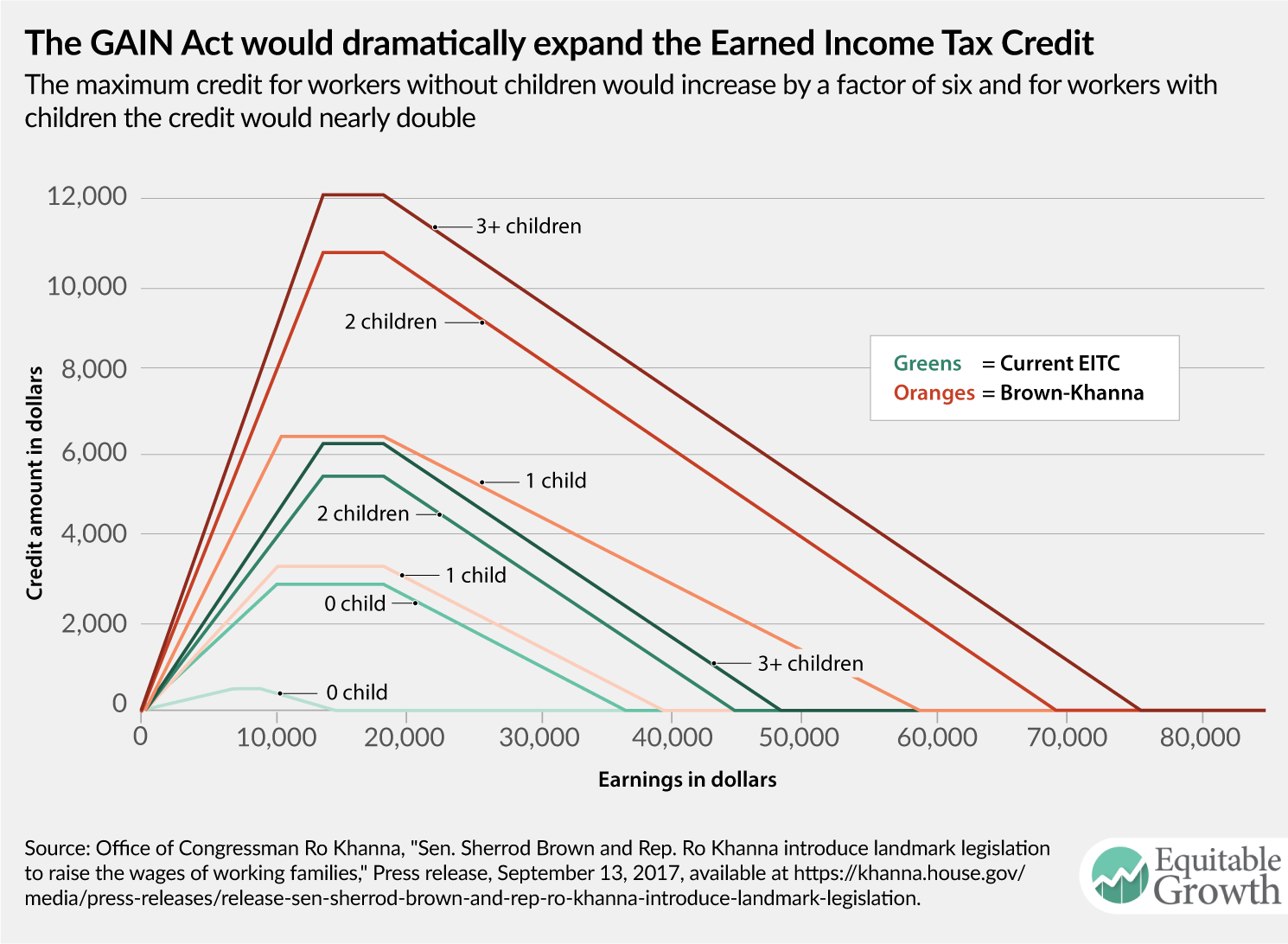
Figure is from “Expanding the Earned Income Tax Credit is worth exploring in the U.S. tax reform debate,” by Nisha Chikhale
Essays SEP 8, 2026
By: Alexander Bick, Adam Blandin, David Deming, Tyler Schumacher

Essays SEP 2, 2026
By: Megan Rivera

Essays AUG 31, 2026
By: Christopher Bangert-Drowns
Get updates on our latest research, event announcements, and policy insights delivered straight to your inbox. Stay connected with the leading voices on equitable growth.


