
Skip to content
Browse All Resources
Essays

SEP 20, 2017

New federal antitrust legislation recognizes U.S. workers are not only consumers

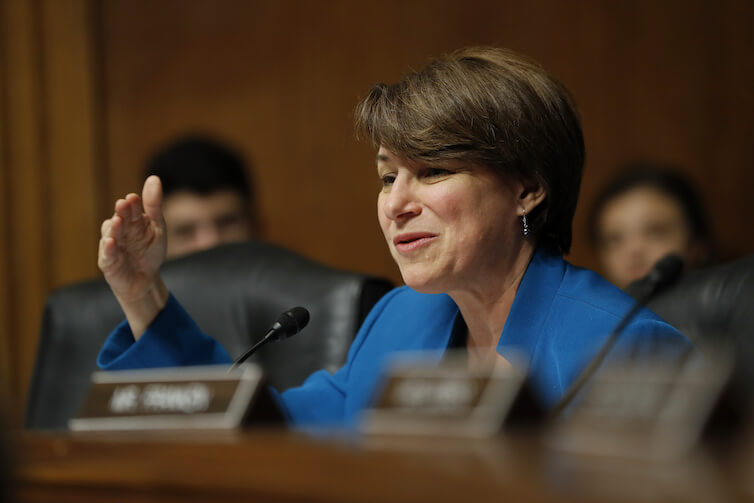
(AP Photo/Pablo Martinez Monsivais)

Abstract

The introduction of two (opens in a new tab) new (opens in a new tab) antitrust bills by Sen. Amy Klobuchar, D-MN, last week indicates that Democrats are serious about making antitrust enforcement a central plank in their economic policy platform. In July, congressional Democrats released “A Better Deal (opens in a new tab),” intended to be the jumping off point for their policy agenda for the 2018 elections, and antitrust was a major plank (opens in a new tab). Sen. Klobuchar’s bills would implement many of the antitrust policy issues highlighted in “A Better Deal.”

The increased interest in issues of competition and antitrust enforcement on the policy side is matched by that on the research side. As examples of market concentration (opens in a new tab) mount, researchers are increasingly asking whether any number of the economic ills we’re experiencing—from the rise in inequality (opens in a new tab) to decreased business investment (opens in a new tab), stagnant wages for less-educated workers (opens in a new tab), and the decline in startups (opens in a new tab)—are perhaps all related to one underlying cause: the growth in market power of a small handful of “superstar” firms in their fields.

Equitable Growth has done a lot of work (opens in a new tab) on the subject of competition and antitrust recently, including analyses of some of the most (opens in a new tab) recent (opens in a new tab) research on the subject, as well as a case study of the telecommunications (opens in a new tab) industry and data analysis of merger enforcement (opens in a new tab) actions. A critical question is what the relationship is between companies’ market power and inequality. There seem to be multiple channels through which greater market power and lower competition could increase economic inequality. While antitrust issues have generally been viewed from a consumer perspective over the past 30 years, focusing on the consumer price effects of mergers, this emphasis on whether sellers create monopolies for their products ignores that buyers can also create a monopsonic market for the prices they pay.

A monopsonic (opens in a new tab) market is one in which a buyer of a good or service has the power to pay lower prices than he or she would have to in a competitive market. In the case of a labor market, monopsony refers to a firm or firms’ ability to restrict wages below what they would be in a competitive market. If an increasingly smaller handful of firms are dominating their industries, then they have fewer competing buyers for labor. The classic and most extreme example of this phenomenon is the “company town,” in which there is only one employer and therefore workers are easily exploited. Of course, that rarely happens today—though companies (opens in a new tab) do have varying degrees of monopsonic power.

The Clayton Act of 1914—one of the foundational antitrust laws in the United States—bans mergers that would create a monopoly, but there is no explicit reference to monopsony. Sen. Klobuchar’s Consolidation Prevention and Competition Promotion Act of 2017 proposes to make explicit that monopsony should be treated the same way. By incorporating monopsony into Clayton’s legislative language, mergers that allow a company to unfairly lower the prices it pays its employees or suppliers would not be allowed.

The explicit incorporation of monopsony into an existing statute is an example of one of the central tensions (opens in a new tab) in the debate among think tank scholars, policymakers, and federal antitrust enforcers. The question is whether policymakers already have (opens in a new tab) the proper antitrust tools they need and just need to enforce them more strenuously, or whether new companies and business models (opens in a new tab) in the 21st century economy demand new tools. Sen. Klobuchar’s bills seem to take a “both/and” approach, calling for greater resources for our existing enforcement agencies, as well as the creation of new antitrust tools. These tools include the explicit incorporation of “monopsony” into the Clayton Act’s text, as well as the creation of a new Office of the Competition Advocate along the lines of the Consumer Financial Protection Bureau.

More work is needed to understand how either updated or new antitrust policies could be implemented and might play out in the economy. That’s why Equitable Growth is proud to announce that we’re partnering with American University’s Washington College of Law to host an event on October 27, 2017, in Washington, D.C. “Unlocking the Promise of Antitrust Enforcement (opens in a new tab)” will feature presentations by leading scholars in antitrust law and economics, along with discussion by prominent antitrust practitioners to explore whether there is scope for more vigorous enforcement of existing law. You can can register to attend and learn more here (opens in a new tab).

Related

ASSA 2026 Round-up: Day 3
Policy

ASSA 2026 Round-up: Day 3

Blog JAN 6, 2026

By: Equitable Growth

AI, Tech & Energy Competition & Economic Dynamism Economic Equity & Opportunity Labor, Wages & Worker Power Macroeconomics & Economic Measurement Taxation
ASSA 2026 Round-up: Day 2
Policy

ASSA 2026 Round-up: Day 2

Blog JAN 5, 2026

By: Equitable Growth

AI, Tech & Energy Competition & Economic Dynamism Economic Equity & Opportunity Household Economic Security Labor, Wages & Worker Power Macroeconomics & Economic Measurement Taxation

Your Direct Line to Cutting-Edge Research

Get updates on our latest research, event announcements, and policy insights delivered straight to your inbox. Stay connected with the leading voices on equitable growth.