


Policy
What Work Does Generative AI Do?
Essays SEP 8, 2026
By: Alexander Bick, Adam Blandin, David Deming, Tyler Schumacher
AI, Tech & Energy
Labor, Wages & Worker Power
 Browse All Resources
AUG 20, 2026
By: Chiara Chanoi
Generative AI, or genAI, is a form of artificial intelligence that produces content in response to prompts and includes large language model chatbots such as OpenAI’s ChatGPT or Anthropic’s Claude. Often, users of this technology will provide inputs to these products for analysis or manipulation, such as written materials, data, or images.
The ways in which generative AI products upend traditional concepts of creation, authorship, and ownership—alongside their sudden ubiquity—demonstrate the need for a regulatory framework for this new technology. Questions concerning the implications of genAI for intellectual property, free speech, and privacy, as well as legal tort, contract, antitrust issues, have so far largely gone unanswered by the courts.
GenAI firms are currently addressing this uncertainty themselves, answering the legal questions inherent to their products via the terms and conditions that users agree to before initially using the tools. Terms and conditions, or T&Cs, are contracts between businesses and their customers, written by providers and agreed to by users on a take-it-or-leave-it basis. These documents often establish expectations and dictate the rules for the use of genAI products and consumers’ behaviors. Crucially, they also allow genAI providers to assign intellectual property rights, limit liability, and specify the terms for dispute resolutions as they wish.
As AI firms use T&Cs to fill regulatory gaps to their advantage, there is a distinct potential that U.S. consumers will be left unprotected. In a new working paper John Newman at the University of Memphis School of Law and Andres Sawicki at the Miami School of Law systematically evaluate the terms and conditions of genAI providers, identifying trends in how such documents license copyrighted material, allocate risk, and set protocols for dispute resolution.
Newman and Sawicki are the first to examine the “digital strings” attached to genAI products via a large-scale survey and warn about what they find. By and large, they write, these T&Cs dictate a legal framework that advantages genAI providers, often to the detriment of their users. They divide their findings into three categories of legal concerns: control over copyrighted materials, exposure to copyright liability, and dispute resolution.
This column will review each of these buckets before summarizing the authors’ recommendations for policymakers to protect the increasing number of users of genAI technology in the United States.
Generally speaking, there are two aspects where copyright and licensing terms are typically laid out in genAI providers’ T&C contracts. The first is related to inputs, or what users provide to genAI tools in their prompts, and the second is outputs, or what genAI tools produce in response to prompts. Let’s first turn to inputs.
Often, when consumers use a generative AI tool, they guide the content that is generated by first inputting materials themselves. A user might submit a document and request a grammar check, for example, or upload a picture and ask that the system remove strangers in the image’s background.
In the United States, creators automatically own the copyright to most original content they create. When a user submits materials they own to a genAI platform, therefore, the platform’s providers need to acquire a license to make copies of their user’s intellectual property to make the requested changes. The extent of these licenses, when they exist, vary by platform and T&C language, but they broadly establish provider-friendly terms. By agreeing to these terms, users may be unwittingly granting providers permission to use their copyrighted materials beyond a single prompt, and providers may exploit such licenses for their own gain without the knowledge of or payment to users.
In their study, Newman and Sawicki review 100 genAI T&C contracts. Of these, 84.9 percent explicitly grant genAI providers permission to use customer materials via a nonexclusive license. In these cases, users retain their copyright interests while allowing providers some access to their materials. But these T&Cs often go further than allowing the genAI system to copy user inputs to produce outputs: 63 percent of the T&Cs studied not only granted the genAI provider its own use of copyrighted materials but also allowed the firm to sublicense its license to others. Furthermore, 30.1 percent of T&Cs reviewed stipulate that genAI providers can deploy user-submitted materials for any business purpose, while 13.7 percent do not limit provider use at all. (See Figure 1.)
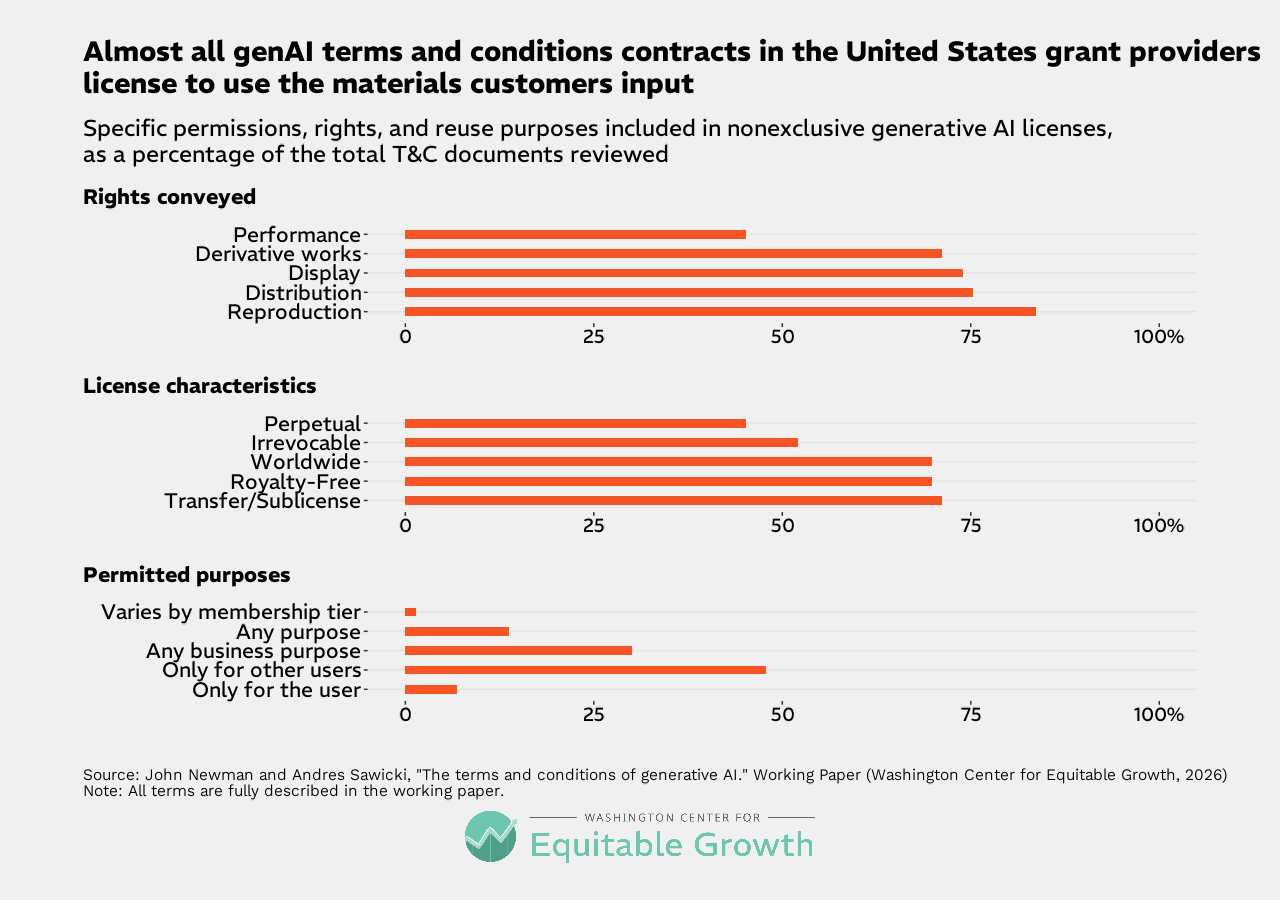
Specific permission, rights, and reuse purposes included in nonexclusive generative AI licenses, as a percentage of the total T&C documents reviewed
The characteristics of each license, and the rights each of them convey, are variable, but Newman and Sawicki’s research finds that most T&Cs stack provider-friendly terms to the combined detriment of the users. Many licenses grant providers the irrevocable and perpetual ability to reproduce, display, or distribute copyrighted materials, without paying royalties to their users.
There is also a question about which party owns the rights to any materials that a genAI system produces. If a genAI product edits a photo that a phographer submitted, for example, does the AI firm retain the copyright for that picture, or does the user?
Some companies assign ownership of genAI system outputs via their T&Cs, though not all companies convey these interests. Of T&Cs that are explicit about output ownership, around two-thirds name the user as the owner while maintaining the provider’s right to use the AI system’s outputs. (See Figure 2.)
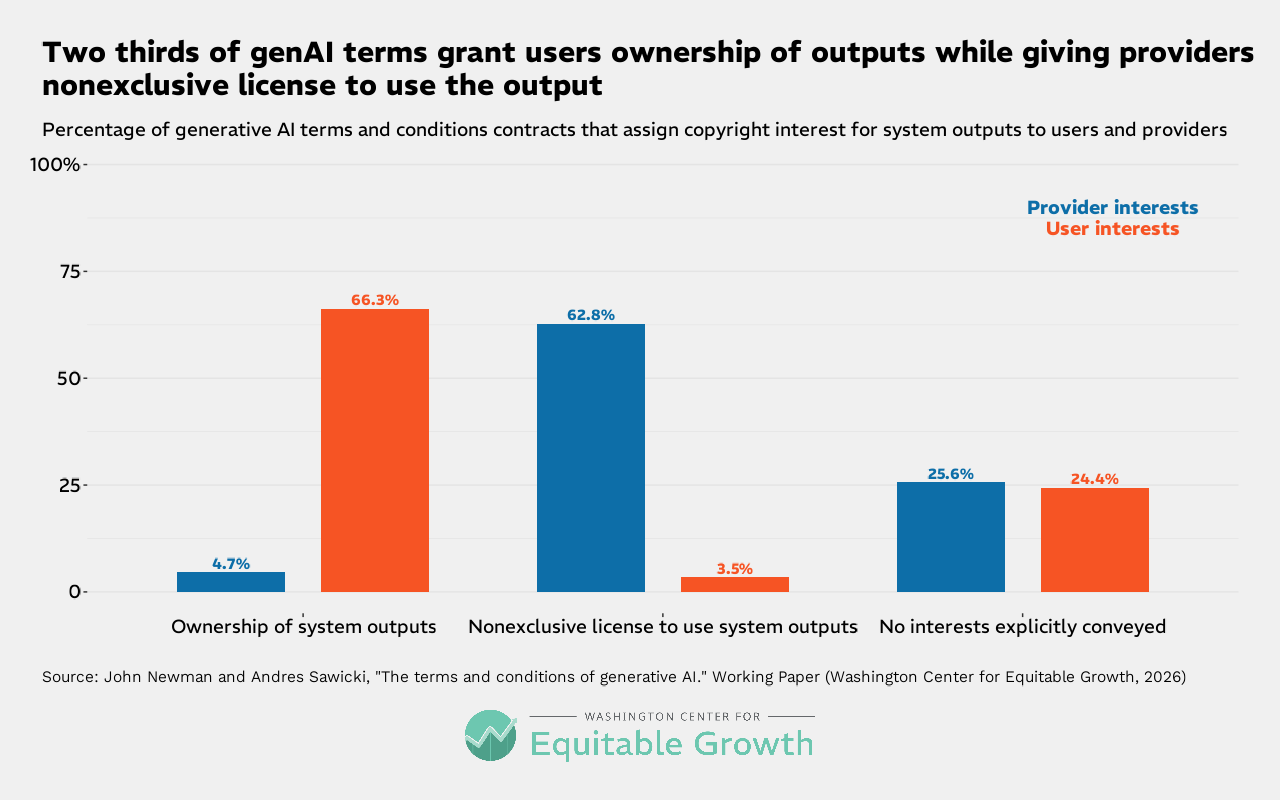
Percentage of generative AI terms and conditions contracts that assign copyright interest for system outputs to users and providers
Newman and Sawicki warn, however, that users should not conflate ownership of their original work with exclusive control over its use. These broad, nonexclusive licenses grant genAI providers the ability to use system outputs “pretty much however they please,” according to their review of T&Cs.
Beyond the basic question of output ownership, there is an additional risk. If a genAI system produces new work that is perilously similar to other copyrighted content, is the firm or the user responsible for such a violation?
Troublingly, the authors find that genAI terms and conditions often turn users into what they refer to as “copyright crumple zones.” Because generative AI is unpredictable, even users who try to avoid copyright infringement may not be able to do so effectively. What’s more, in 69.8 percent of the T&Cs reviewed, users promise to pay when their use of the genAI service leads to copyright claims against the provider. Such terms expose users to significant liability risk.
When genAI users and providers come into conflict, T&Cs can determine how these disputes are resolved, where that resolution takes place, and what remedies are ultimately available to aggrieved parties. Newman and Sawicki identify several methods by which genAI terms and conditions mandate dispute resolution proceedings that advantage providers at the expense of users.
Some T&Cs make it harder for users to sue providers at all, for example, either by making the process cost-prohibitive for the average user or by blocking their ability to go to court in the first place. Other one-sided terms can prevent users from pursuing common or well-established legal claims, waive jury trials only for claims brought by users against providers (and not vice versa), or limit the amounts that claimants can be awarded even if they win their cases.
Collectively, these restrictive and one-sided terms set by genAI terms and condtions shift the balance of power to providers, particularly when it comes to dispute terms, where the rules can put the average consumer at an even bigger disadvantage. The authors find that 96 percent of T&Cs in their sample allow providers to modify terms without obtaining the other party’s consent, while 88 percent of T&Cs allow providers but not users to modify their terms. Close to half of T&Cs studied (42 percent) do not require genAI providers to meaningfully inform their users of such changes, if they are obligated to give notice at all.
When users agree to the terms and conditions set by genAI providers, they may unknowingly be relinquishing control over their creative works, opening themselves up to copyright infringement risk, and limiting their long-established legal rights. Newman and Sawicki therefore express the need for a “rapid forceful policy response” to void some of the more one-sided provisions in these documents and disincentivize the use of multiple provider-friendly terms that add up to harm consumers, including banning T&Cs that limit individual user power and benefit large firms in cases of conflict resolution.
The authors also recommend that genAI firms, not individual users, should be legally responsible when copyrighted materials are used without permission. Firms have more resources and influence than individual users and are thus in a better position to participate in legislative discussions on the use of copyrighted material. But these firms will only be incentivized to participate in such discussions if they themselves are vulnerable without them.
Because generative AI terms and conditions unilaterally answer questions about ownership, licensing, liability, and dispute resolution, they are establishing the foundation for future genAI regulation. In their working paper, the authors stress that if the regulation of generative AI is left to the fine print, the development of legal doctrine for this new technology will be stunted and skewed. They emphasize that questions of creative ownership and liability should be answered for genAI users and providers through an “open, deliberative process,” and that courts should have the opportunity to consider these issues and establish precedents that will underpin common law and, in turn, impact legislation.
As the authors remind us, none of what these contracts currently promise is inevitable. “Legal policies permitted—and indeed incentivized—the current state of affairs,” they write. “New policies could steer a different course.” For individual consumers to safely access, use, and benefit from this emergent technology, laws must restrain overly broad firm power and promote equitable, AI-driven growth. Without these interventions, control over the creativity and productivity made possible by generative AI will not be equitably shared between AI corporations and the public.
 Did you find this content informative and engaging?
Get Updates
Did you find this content informative and engaging?
Get Updates
Essays SEP 8, 2026
By: Alexander Bick, Adam Blandin, David Deming, Tyler Schumacher
Working Papers SEP 8, 2026
By: Alexander Bick, Adam Blandin, David Deming, Tyler Schumacher

Essays SEP 2, 2026
By: Megan Rivera
Get updates on our latest research, event announcements, and policy insights delivered straight to your inbox. Stay connected with the leading voices on equitable growth.


