



Policy
What Work Does Generative AI Do?
Essays SEP 8, 2026
By: Alexander Bick, Adam Blandin, David Deming, Tyler Schumacher
AI, Tech & Energy
Labor, Wages & Worker Power
 Browse All Resources
APR 16, 2020
By: Heather Boushey and Somin Park
This post reflects our organization’s overall guiding policy principles for confronting the coronavirus recession and its relationship to U.S. economic inequality as detailed on April 16. These principles still hold as there remains much to be done across communities and workplaces throughout the United States now and in the weeks and months ahead. Our coronavirus recession page (opens in a new tab) provides updated analysis and policy resources from Equitable Growth.
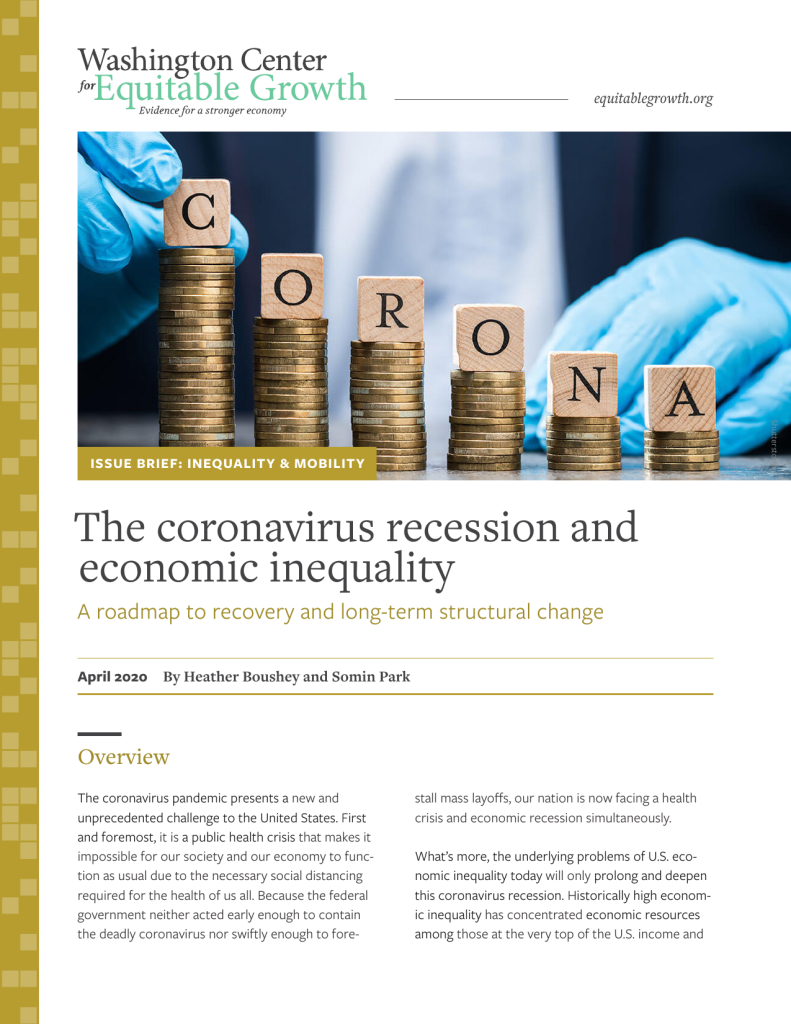
The coronavirus pandemic presents a new and unprecedented challenge to the United States. First and foremost, it is a public health crisis that makes it impossible for our society and our economy to function as usual due to the necessary social distancing required for the health of us all. Because the federal government neither acted early enough to contain the deadly coronavirus nor swiftly enough to forestall mass layoffs, our nation is now facing a health crisis and economic recession simultaneously.
What’s more, the underlying problems of U.S. economic inequality today will only prolong and deepen this coronavirus recession. Historically high economic inequality has concentrated economic resources among those at the very top of the U.S. income and wealth ladders while leading to fewer and fewer protections for the economic security of workers and their families. This has left the United States particularly vulnerable to shocks such as health, climate, and economic crises.
Only a decade has passed since the end of the previous global financial crisis, from which U.S. working- and middle-class families had barely recovered despite a record run of economic growth. Indeed, younger generations and many families, especially families of color, never recovered.449 To avoid that same outcome on the other side of the coronavirus recession, policymakers’ response today will be most effective if directed at the roots of these underlying problems of economic inequality.
Decades of failed economic policies, based on ideology instead of evidence, and a blind adherence to the idea that markets can solve every problem, have made our economy and our society more vulnerable. Our nation now faces a grave economic challenge and concentrated efforts to weaken public institutions and leave decisions up to the market over the past 40 years mean our policymakers and society are ill-equipped to handle it. Disparities by income, race, ethnicity, and gender are inevitably exacerbated by this shift of social and economic risk from collective institutions to individuals—rendering any response to a deep recession and eventual recovery all the more difficult.
An economy only functions when there are people who are able to act as producers and consumers. The first principle of a strong and stable U.S. economy is to ensure the ability of people to secure a good, steady job that provides enough income for people to support their family and buy goods and services. The new coronavirus has uncovered how even as one of the richest economies in the world, the United States remains incredibly fragile.
This issue brief diagnoses why high and rising economic inequality left our economy and our society particularly unprepared to cope with the coronavirus pandemic and ensuing recession. Six key points of vulnerability are then detailed—ranging across inequalities in health, wages, purchasing power, worker power, and government investments—followed by a roadmap of broad policy principles to help guide policymakers as they consider long-term structural changes for the U.S. economy. These principles are detailed toward the end of this issue brief. But briefly, they are:
The coronavirus recession is exacting a large human toll across our nation. This toll is all the more insidious due to the economic inequalities that cause the health and economic damages to fall unequally and inequitably among us. To have any chance of emerging on a stronger footing as a nation with less economic inequality and more sustainable economic growth, policymakers need to enact a robust set of protections that will ensure high-end inequality is contained, build counterweights to concentrated power, and provide economic security for all now and going forward.
There are six key factors that made the United States and the U.S. economy particularly susceptible to the coronavirus pandemic and COVID-19, the disease delivered by the new coronavirus. Each of them, when examined together, are not only a problem today but also threaten to become even more enduring as our economy goes through a wrenching recession and continues to confront the very real consequences of climate change. If these are not corrected, the United States is likely to experience a slow and inequitable economic recovery. These six factors are:
Let’s now look at each of them in turn.
Too many people lack the basic protections that would have slowed the spread of the virus
The gaps in our social insurance systems and labor market regulations to protect workers and families, including the lack of paid leave, unstable schedules, and limited access to childcare, both exacerbated the spread of the virus and left millions of workers highly at risk of not only contracting COVID-19 themselves but also spreading it further to their own families and wider communities. Compounding the problem is the lack of health insurance or fear of high medical bills, both of which kept—and are still keeping—those who feel sick from seeing a doctor, placing a serious burden on these individuals, as well as raising rates of transmission.457
Research is already showing the significant economic and psychological toll this pandemic is taking on these workers. These stresses are heightened for people at the intersection of these eroded protections and institutional discrimination. People of color and immigrants, for example, are often foreclosed from accessing the limited protections that do exist, or are forced by their already precarious economic straits to succumb to workplace abuses at the hands of their employers.458
Workers lack the power to share in the gains of the economic expansion that would have given them protections and security
Civic institutions—especially labor unions, which once served as voices for many wage-earning workers (though never representing all workers)—have suffered a long decline. Now, only 1 out of every 15 (opens in a new tab) private-sector workers belongs to a union. On top of this, labor laws and policies have failed to reflect the growing role of the fissured workplace in our modern-day economy, where firms subcontract pieces of their work so they can avoid responsibility for workers and working conditions.459
These two debilitating trends in our labor market mean that corporations that are ultimately in charge of labor practices and that make the largest profits are not liable for maintaining 21st century workplace standards. The coronavirus pandemic exposed the failure of these labor market inequalities and the need for them to manage health crises and family care, as well as protect workers against layoffs and the loss of these key health and family benefits.460
Decades of stagnant wages and meager workplace benefits leave many families without enough savings to weather the coronavirus recession
At the onset of the coronavirus pandemic in the United States at the beginning of the year, millions of people across the country were one paycheck away from financial catastrophe, even after a decade of economic expansion and historically low unemployment. Case in point: Four in 10 adults (opens in a new tab) in the United States said that if they had a $400 emergency expense, they would have to borrow, sell something, or would not be able to pay it.461
As the coronavirus recession continues, more and more workers and their families who are most likely to spend money are robbed of buying power, which will undermine one of the key drivers of economic growth—the stable incomes that drive consumer spending. Today, less-well-off workers in sectors of the economy most immediately exposed to the consequences of necessary self-distancing, such as food services, hotels and accommodations, and general services, are now joining Unemployment Insurance telephone queues alongside millions of other workers who have been let go or furloughed by a broader array of firms, which will further crimp consumer spending.462
Policymakers starve public goods of investments that would have enabled better protections from the coronavirus pandemic and ensuing recession
Decades of tax cuts, culminating in the sharply regressive Tax Cuts and Jobs Act of 2017, have fueled a long-term decline in federal revenue that has starved resources that can be used to fund critical public investments and basic governmental functions, including in public health. High concentrations of income and wealth hamstring our political system because the wealthy dictate the legislative agenda (opens in a new tab) and shape news headlines.463
Yet these same wealthy elites don’t prioritize (opens in a new tab) investments in public health infrastructure or other public goods, such as an effective Internal Revenue Service or the provision of paid leave or wage replacements during emergencies—even though the lack of these policies have accelerated the spread of the new coronavirus, endangering us all. Case in point: even as people at the top end of the wealth distribution can retreat to their private enclaves with concierge medicine, too many others cannot access high quality care amid this crisis. The government is the only entity with the power and scope to dismantle the control that the economic elite have over our political system.464
States and localities don’t have the resources to deal with a pandemic or a recession
During and after the Great Recession of 2007–2009, hard-hit state and local governments saw large drops in capacity as Medicaid rolls rose and tax revenues fell. The decline in resources and staffing continued (opens in a new tab) in the 2010s even as the economy recovered. Yet the critical role that states and localities play in addressing the coronavirus pandemic are clearly emerging in community after community. From ensuring hospitals are prepared to putting in place and enforcing stay-at-home orders, the importance of effective local policymakers is abundantly clear.465
Now, state and local governments are likely to experience sharper drops in their capacity (opens in a new tab) to provide the services needed to cope with the coronavirus recession, which will surely induce further cuts to health and education and exacerbate the ongoing weaknesses. If this happens, it will not only starve communities of the investments they need to thrive but also leave the nation even less prepared for the next crisis. Austerity in state governments likewise disproportionately harms people of color, as public-sector jobs (opens in a new tab) form the basis of a strong middle class for black and Latino workers.466
Business concentration across markets increases consumer and small business vulnerabilities just when those threats are most dire
Wealthy and powerful corporations use their status to maintain dominance in the marketplace. Large businesses and monopolies muscle competitors out of business, suppress wages, and hobble innovation. These companies are also precisely the ones that will thrive after the coronavirus pandemic passes. Strong cash reserves combined with political influence allow entrenched businesses to swoop in when asset prices are low and reshape rules of entire markets in the aftermath. The collapse of small businesses will disproportionately hurt people of color for whom business ownership (opens in a new tab) is an especially important route to wealth creation and to closing the racial wealth gap.467
We can see how these fragilities created by inequality are playing out right now by looking at the healthcare industry having to cope with the coronavirus pandemic. Hospital consolidation resulted in higher costs, decreased quality of care, and fewer worker protections, leaving staff less able to deal most effectively with the surge of incoming COVID-19 patients alongside the collapse in other hospital procedures that provide key sources of revenue. Similarly, private-equity backed (opens in a new tab) clinics and doctors—alongside profit and nonprofit hospitals more generally—fought against surprise billing (opens in a new tab) legislation, which would limit patients from being hit by huge out-of-network fees for care, a problem whose impact will increase as more people need care.468
Huge pharmaceutical companies have likewise used their market power to suppress low-cost competition from generic alternatives by preventing the development of generic medicines, paying generics companies to delay launching their products, and excluding competition by other anticompetitive conduct. And they have offshored the production of these drugs and their key ingredients, leaving our healthcare system very vulnerable to a pandemic. Developing a coronavirus vaccine or treatment is paramount, but it is also critical that we ensure such solutions are affordable and readily accessible to prevent unequal access to life-saving medicine.469
The failure to prevent coronavirus infections and deaths and the ensuing recession
President Donald Trump’s focus is and always has been on the stock market rather than conceiving of and effectively implementing a comprehensive and fully thought out federal plan to address the coronavirus pandemic and its economic effects. Case in point: Though the administration knew about the threat of the virus in early January (opens in a new tab) and took an early effort to limit the transmission into the United States by halting travel from China, where the virus first emerged, it did not use that time (opens in a new tab) to prepare sufficient stockpiles of medical and protective supplies.470
Nor did the Trump administration put in place an economic plan to limit the transmission, such as immediately requiring all firms to provide paid sick time (opens in a new tab) or ensure access to free test kits (opens in a new tab), let alone free healthcare. These failures are now distorting our economy and seriously undermining our economic stability—failures that are further fueled by the key vulnerabilities detailed above that are intertwined and ensconced across the breadth of our society and economy.471
The incidences of the coronavirus in the United States have surpassed every other nation, and the underlying fragilities may make our economic crisis equally uniquely bad. Some economists and policymakers argue that these fragilities were the inevitable result of globalization, technological innovation, or economies of scale, and that the result in the end will be better for both workers and consumers. But the role of policy choices in arranging our market structure—from the choice to bailout Wall Street rather than save homeowners (opens in a new tab) a decade ago, to a long history of declining antitrust enforcement, to policy choices and court decisions that make it harder to join a union (opens in a new tab)—are unmistakable and remain enduring.472
Unless policymakers actively address all of these structural issues detailed in this issue brief, the United States will experience continued increases in income and wealth inequality amid the coronavirus recession and coming out of it. This is exactly what happened after the Great Recession, when the U.S. economy lost 8.7 million jobs and $12 trillion in total household net worth. One group emerged as strong as ever: the wealthiest 1 percent, who regained what they had lost (opens in a new tab) by 2012. That year, their inflation-adjusted average wealth (not including any funds hidden in overseas accounts) was $13.8 million (opens in a new tab)—just 3.5 percent below the 2007 peak. Middle-class families, meanwhile, were still recovering in March of this year.486
The United States was founded on a set of principles that a democratically elected government could act in the interest of the general welfare. That faith has proved tremendously powerful over the course of our history, when we have shown the ability to come together as a nation to address sweeping structural crises. Crises have a way of bringing us together. We must now act as one to make our nation stronger, more resilient, and more equitable today and for generations to come.
—Heather Boushey is the president and CEO of the Washington Center for Equitable Growth and the author of Unbound: How Inequality Constricts Our Economy and What We Can Do about It (opens in a new tab) (2019, Harvard University Press) and Finding Time: The Economics of Work-Life Conflict (opens in a new tab) (2016, Harvard University Press). Somin Park is a research assistant to the president and CEO of Equitable Growth.
Essays SEP 8, 2026
By: Alexander Bick, Adam Blandin, David Deming, Tyler Schumacher
Working Papers SEP 8, 2026
By: Alexander Bick, Adam Blandin, David Deming, Tyler Schumacher

Essays SEP 2, 2026
By: Megan Rivera
Get updates on our latest research, event announcements, and policy insights delivered straight to your inbox. Stay connected with the leading voices on equitable growth.


