



Policy
What Work Does Generative AI Do?
Essays SEP 8, 2026
By: Alexander Bick, Adam Blandin, David Deming, Tyler Schumacher
AI, Tech & Energy
Labor, Wages & Worker Power
 Browse All Resources
MAR 25, 2019

Disparities between men’s and women’s wages in the United States hinders economic growth by constraining family incomes and spending power. When comparing average full-time year-round incomes of men to those of women, research indicates that women make only 80.5 percent of men’s wages, a gap that is even larger when accounting for race. In the long run, these disparities heighten the risks of financial stress and inadequate retirement savings at times of economic shocks. While a majority of women suffer from unequal wages, the persistence of gender wage inequality heavily affects low-income and single-income families in addition to families of color.
In a 2018 report for the Washington Center for Equitable Growth, “Gender wage inequality: What we know and how we can fix it,” sociologist Sarah Jane Glynn breaks the contributing factors to gender wage inequality into two groups:
This factsheet presents a snapshot of each of these findings and then presents a variety of policy solutions, among them legislation at the federal level, examples of state and municipal laws that could be replicated in other areas of the country and by the federal government, and federal agency rules and regulations that could be implemented or expanded.
“Unequal pay between men and women drags down the growth of the U.S. economy.”
—Sarah Jane Glynn, “Gender wage inequality: What we know and how we can fix it.”
Glynn breaks down the supply-side explanations for gender wage inequality into six groups: work experience, industry and occupation, unionization, education, race, and region. For each group, all of the statistics of gender wage inequality and policies to amend this inequality were pulled from Glynn’s report and Blau and Kahn’s paper.
Work experience
Policies supporting workers’ access to paid family care hold the potential to increase wages and allow more women to stay connected to the workforce, thus reducing the work-experience gap between men and women. Here are five potential policy solutions.
Potential policy recommendation 1: Child Care for Working Families Act
The Child Care for Working Families Act, introduced by Sen. Patty Murray (D-WA) and Rep. Bobby Scott (D-VA), gives guaranteed childcare assistance to families earning up to 150 percent of their state’s median income. In addition, it limits families’ childcare spending to 7 percent of household income and promises improved wages for childcare providers. This policy, which would be paid for by employee and employer payroll contributions, has the potential to create 2.3 million new jobs and increase childcare providers’ wages by 26 percent.742
Potential policy recommendation 2: FAMILY Act
The FAMILY Act, introduced by Sen. Kirsten Gillibrand (D-NY) and Rep. Rosa DeLauro (D-CT), outlines a national, gender-neutral social insurance program that would fund two-thirds of a parent’s wage for up to 12 weeks of paid leave. The program, which will be paid for by employee and employer payroll contributions, sets qualifications and eligibility conditions that will be determined by language of the Family and Medical Leave Act of 1993. Research indicates that a national paid leave program boosts women’s wages by 7 percent.743
Potential policy recommendation 3: The Trump administration’s proposed plan
The Trump administration proposed a plan to create a federal paid parental leave program, administered through states’ unemployment insurance systems, that provides parents up to six weeks of paid leave. While this idea grants new parents the ability to take time off without any employment consequences, it would deduct from their Social Security retirement income, thus leaving parents at risk of financial insecurity when their retirement approaches. Unemployment insurance systems are already extremely underfunded and would struggle to implement such a program. In addition, this plan prioritizes parental leave for a new child, thus ignoring family caregiving needs.744
Potential policy recommendation 4: The Schedules That Work Act
The Schedules That Work Act, written by Sen. Elizabeth Warren (D-MA) and Rep. Rosa DeLauro (D-CT), puts forth protocols—such as requiring clear scheduling expectations from the start of employment—that allow workers to request flexibility from their employers, while protecting workers from financial retaliation or employment discrimination. This policy will allow workers to manage family care needs without risking their income and financial stability.745
Potential policy recommendation 5: State-specific paid family leave policies
Five states—California, New Jersey, Rhode Island, New York, and Washington state—and the District of Columbia have instituted paid family leave laws, though Washington state and D.C. will not activate the law until January 1, 2020. Studies conducted by Jean Kimmel of Western Michigan University and Catalina Amuedo-Dorantes of San Diego State University found that access to parental leave correlated with a 7 percent increase in women’s earnings and shrank motherhood wage inequality by two-thirds. Research on California’s paid family leave system found it has increased mothers’ work hours by 10 percent to 17 percent.746
Industry and occupation
Policies that increase wages in industries and occupations that women are currently overrepresented in, as well as policies that enhance access to high-paying jobs in traditionally male-dominated industries, would address some of the pay gap caused by occupational segregation. Here are three potential policy solutions.
Potential policy recommendation 1: Funding for programs such as Women in Apprenticeship and Nontraditional Occupations
The federal Women in Apprenticeships and Nontraditional Occupations program provides resources to diversify the gender distribution of apprenticeship programs, which tend to be male-dominated. Funding for it should remain in order to maintain current apprenticeship programs and create new programs to decrease the gender differences. In 2017, the U.S. Department of Labor announced a $1.9 million investment to “recruit, train, and retain women in high-skill occupations” in a way to increase diversity within the manufacturing, technology, energy, and construction industries. The Trump administration canceled many of these contracts and pledges shortly after President Donald Trump took office. The 2018 and 2019 federal budgets eliminated this grant program funding, which would hurt the administration’s own goal of creating 5 million new apprenticeships over the span of 5 years.747
Potential policy recommendation 2: Expand the National Science Foundation’s ADVANCE grant-making program
Expanding the NSF’s ADVANCE grant-making program to provide competitive grants to univerisities to brainstorm proceeses that promote gender equity in STEM fields, which are highly male-dominated, would increase the representation of women in such fields and encourage pay equity between men and women.
Potential policy recommendation 3: Fully implement the Obama administration’s overtime rule
Full implementation of the Department of Labor’s already promulgated overtime-expansion rule, which would increase the minimum salary for workers exempt from overtime standards to $47,476, would address some of the gender wage gap because the majority of affected workers are women: One-quarter of all mothers and almost 33 percent of single working mothers have salaries at this level. Implementation at the federal level has been stalled by lawsuits by 21 states and more than 55 business groups, but some states have taken action. California, for example, set the threshold to $45,760 for salaried workers, and their wages are linked to the minimum wage, thus the two wages grow in accordance with one another.748
Unionization
Policies that protect and strengthen collective bargaining rights can improve gender pay equity by raising overall wages and setting standard wages based on occupation rather than gender. Here are two potential policy solutions.
“Comprehensive labor-law reform legislation should create meaningful penalties for employers who violate the NLRA so that there is a greater disincentive for bad employer behavior.”
—Sarah Jane Glynn, “Gender wage inequality: What we know and how we can fix it.”
Potential policy recommendation 1: The Workplace Action for a Growing Economy (WAGE) Act
The WAGE Act, introduced in Congress by Sen. Patty Murray (D-WA) and Rep. Bobby Scott (D-VA), creates new protections for workers attempting to unionize, including making it an individual right to join a union, which would allow workers not covered by the National Labor Relations Act to organize. It would also impose stricter punishments for employers who violate the NLRA by firing or punishing workers engaged in union organizing.750
Potential policy recommendation 2: Collective bargaining for freelance economy workers
Between 54 million and 68 million Americans work in the freelance economy, according to the McKinsey Global Institute, yet they are not protected by the NLRA due to their classification as independent contractors.751 States and cities are taking initiatives to create fair labor standards for those working in the freelance economy. In 2015, Seattle’s city council passed a rule that grants drivers for Uber Technologies, Inc. And Lyft, Inc. The ability to unionize, though it was being appealed at the time of this writing. In 2016, New York state’s Department of Labor ruled that these drivers are employees rather than independent contractors, allowing them to qualify for greater worker protections and benefits.752
Education
Policies to make college affordable and help nontraditional undergraduates would facilitate higher completion rates of postsecondary education. In addition, policies that increase the number of women pursuing degrees in fields historically dominated by men would increase the chances that women would be employed in higher-paying fields after graduation. Here are three potential policy solutions.
Potential policy recommendation 1: The INSPIRE Women Act and other legislation to increase the representation of women in STEM fields
Legislation such as Inspiring the Next Space Pioneers, Innovators, Researchers, and Explorers, or INSPIRE Women Act, passed in February 2017, as well as Sen. Catherine Cortez Mastro (D-NV) and Rep. Jackie Rosen (D-NV)’s Code Like a Girl Act and Sen. Mazie Hirono (D-HI) and Rep. Carolyn Maloney (D-NY)’s Women and Minorities in STEM Booster Act of 2017, are all examples of legislation intended to increase the representation of women in fields where they are currently underrepresented.753
Potential policy recommendation 2: Increase college affordability
Expansion of the federal Pell Grants program would make college more affordable for students, as they do not have to be repaid. In addition, many states and cities are initiating various programs aimed at making community colleges tuition free for low-income students. Tennessee, Oregon, Rhode Island, and San Francisco already allow residents who qualify as low income to attend community college for free. In addition, beginning in 2017, all City University of New York and State University of New York two- and four-year universities will allow students from households making less than $125,000 annually to attend tuition free.754
Potential policy recommendation 3: On-campus childcare for student parents
The number of student parents enrolled in two- and four-year universities has been on the rise. To keep these students enrolled through graduation, states are investing in on-campus childcare centers for students and faculty. In California, Hawaii, Idaho, Illinois, Nevada, New York, Rhode Island, Utah, and Washington state, 70 percent of all public universities have campus childcare available for students. The investment in on-campus childcare can result in positive returns of a better-educated workforce, higher wages, and greater innovation.755
Race
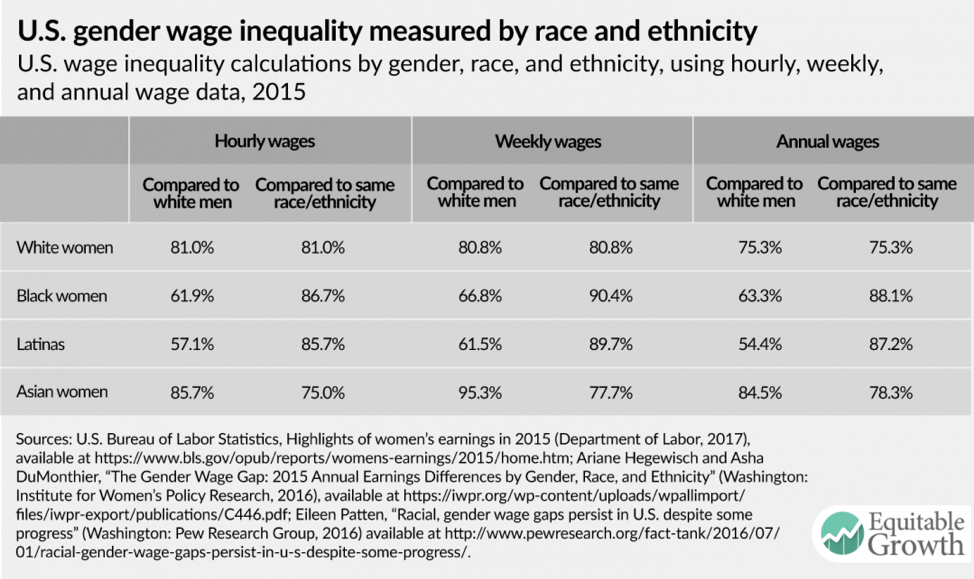
Policies to increase wages and promote educational attainment would help improve women of color’s wages but are insufficient on their own. Policies are also needed to address persistent racial wage and hiring discrimination. Here’s one potential policy solution.
Potential policy recommendation: Collect data to understand problems facing workers of color
Title VII of the Civil Rights Act of 1964, overseen by the Equal Employment Opportunity Commission, prohibits employers from discriminating employers based on race, color, religion, sex, and national origin. Collecting firm-specific employment and pay data would allow the EEOC to better enforce Title VII, but it is not currently collected. In September 2016, the EEOC did announce it would begin collecting summary pay data and aggregate hours worked by pay bands, gender, race, and ethnicity for businesses with more than 100 employees. In August 2017, however, the Trump administration issued a stay before it got underway.756
Regions
While the cost of living varies across state lines, wages usually reflect that region’s cost of living and should be relatively equal between men and women. Policies such as increasing the federal minimum wage would help eliminate gender wage inequality as a result of regional differences. Here’s one potential policy solution.
Potential policy recommendation 1: Increase the federal minimum wage
A 2014 Obama administration analysis found that raising the federal minimum wage to $10.10 per hour would narrow gender wage inequality by 5 percent, which would translate to an additional $24 billion in wages.
Most of the factors that contribute to the gender wage gap can be explained by the supply-side causes, yet the source of 38 percent of the wage gap is largely unquantified because of the difficulties in modeling socially constructed gender norms, according to Glynn. All of the statistics of gender wage inequality and the policies to amend this inequality included in this section were pulled from Glynn’s report and Blau and Kahn’s paper.
Socially constructed gender norms and internalized expectations about their behavior play a role in influencing women’s decisions about what education or occupation to pursue. Even the supply-side factors outlined above are seemingly easy to observe and measure, but might be less explanatory than estimated in the Blau and Kahn model. A study on engineering students, for example, found that more women than men changed their majors because the women were more likely to negatively interpret their grades, have lower self-confidence, and have less faculty and peer support compared to their male peers, limiting career prospects in a lucrative field.757
Discrimination also plays a role in the unexplained portion of gender wage inequality. Because earnings at a new job are often based on earnings at a prior job, any discrimination a woman experienced in what she was paid in the past will carry forward and compound in future jobs. After accounting for observable characteristics, Blau and Kahn found that 38 percent of gender wage inequality remains unexplained, which accounts for $303.7 billion in the difference between men’s and women’s wages in 2016. Economists interpret this unexplained portion as discrimination.
“The unexplained [portion of the gender wage] gap will also understate discrimination if some of the explanatory variables such as experience, occupation, industry, or union status have themselves been influenced by discrimination—either directly through the discriminatory actions of employers, coworkers, or customers or indirectly through feedback effects.”
—Francine D. Blau and Lawrence M. Kahn, “The gender wage gap: Extent, trends, and explanations.”
Policies that increase pay transparency, combat discrimination, and ensure that data about pay differences is collected will help address some of the “unexplainable” differences in men and women’s wages. Here are five potential policy soultions.
Potential policy recommendation 1: Fair Pay Act
The Fair Pay Act, reintroduced by Rep. Eleanor Holmes Norton (D-DC), would expand prohibitions against sex discrimination from “equal work” to “equivalent work,” clarify that any differences in pay must be justified by legitimate business interests, protect workers who share their pay information, and increase damages available to victims of wage discrimination.758
Potential policy recommendation 2: Paycheck Fairness Act
The Paycheck Fairness Act, introduced by Sen. Patty Murray (D-WA) and Rep. Rosa DeLauro (D-CT) in 2017, requires employers to prove that differences in pay were a result of business-related factors. This rule would protect workers who disclose pay to other workers, increase employer transparency regarding pay inequities, and hold employers accountable for pay discriminations.759
Potential policy recommendation 3: Workplace Advancement Act
The Workplace Advancement Act, introduced by Sen. Deb Fischer (R-NE) and Rep. Stephen Knight (R-CA), would amend the Fair Labor Standards Act by protecting workers from retaliation for discussing their wages if they do so in order to discover pay inequity among co-workers.760
Potential policy recommendation 4: Eliminate questions about past wages during the application process
Policies that ban employers from asking about wages earned at prior jobs will mitigate the impact of pay discrimination experienced in the past by preventing it from carrying forward to future earnings. The states of Massachusetts, California, Oregon, Delaware, and New York, the U.S. territory of Puerto Rico, and the cities of San Francisco, Pittsburgh, and New Orleans have all passed measures to ban the practice.761
Potential policy recommendation 5: Improve data availability on wages by gender
Other countries have laws requiring employers to collect data on their employees’ wages to determine whether male and female employees are being paid differently for the same work. The collection of wage data by gender, race, and ethnicity is necessary to measure what is actually happening and to assess whether policies intended to address gender wage inequality are working, as well as to ensure compliance with those policies.762
To learn more about the research and policy recommendations behind the information summarized here, you can read Sarah Jane Glynn’s full report, “Gender wage inequality: What we know and how we can fix it.”
Essays SEP 8, 2026
By: Alexander Bick, Adam Blandin, David Deming, Tyler Schumacher
Working Papers SEP 8, 2026
By: Alexander Bick, Adam Blandin, David Deming, Tyler Schumacher

Essays SEP 2, 2026
By: Megan Rivera
Get updates on our latest research, event announcements, and policy insights delivered straight to your inbox. Stay connected with the leading voices on equitable growth.


