


Policy
The American anti-austerity tradition
Blog MAY 20, 2021
By: Robert Manduca
Economic Equity & Opportunity
Macroeconomics & Economic Measurement
 Browse All Resources
JUN 11, 2021
By: Michael Garvey
When President Joe Biden made the case before a joint session of Congress in the spring for two new economic investment packages—a $2 trillion American Jobs Plan (opens in a new tab) and a $1.8 trillion American Families Plan (opens in a new tab)—the question in the minds of policymakers and the American public alike was whether this new round of investment spending would result in sustained equitable economic growth.
After all, Congress over the past year had already approved $5.3 trillion (opens in a new tab) in economic relief amid the swift and steep coronavirus recession. These funds came in successive COVID-19 legislative relief packages. They included:
Even with all of these aid packages, though, the U.S. labor market is far from fully recovered (opens in a new tab). What’s more, the rapid rollout of COVID-19 vaccines in the United States has been matched by quickly evolving new and more infectious strains of the novel coronavirus (opens in a new tab) here and around the world. Businesses small, medium, and large are still grappling with how their customers are going to respond as the pandemic continues (opens in a new tab). And the ongoing coronavirus recession continues to lay bare (opens in a new tab) the deep economic inequalities that stand in the way of a robust, equitable economic recovery that is more stable and sustainable than the halfhearted recovery that followed the Great Recession.
President Biden’s two new economic stimulus proposals will be measured by their effectiveness in addressing these immediate and long-term conditions facing the nation. One broad way to establish this benchmark is simply to look at the growth in Gross Domestic Product over the past year and projections for the rest of 2021. (See Figure 1.)
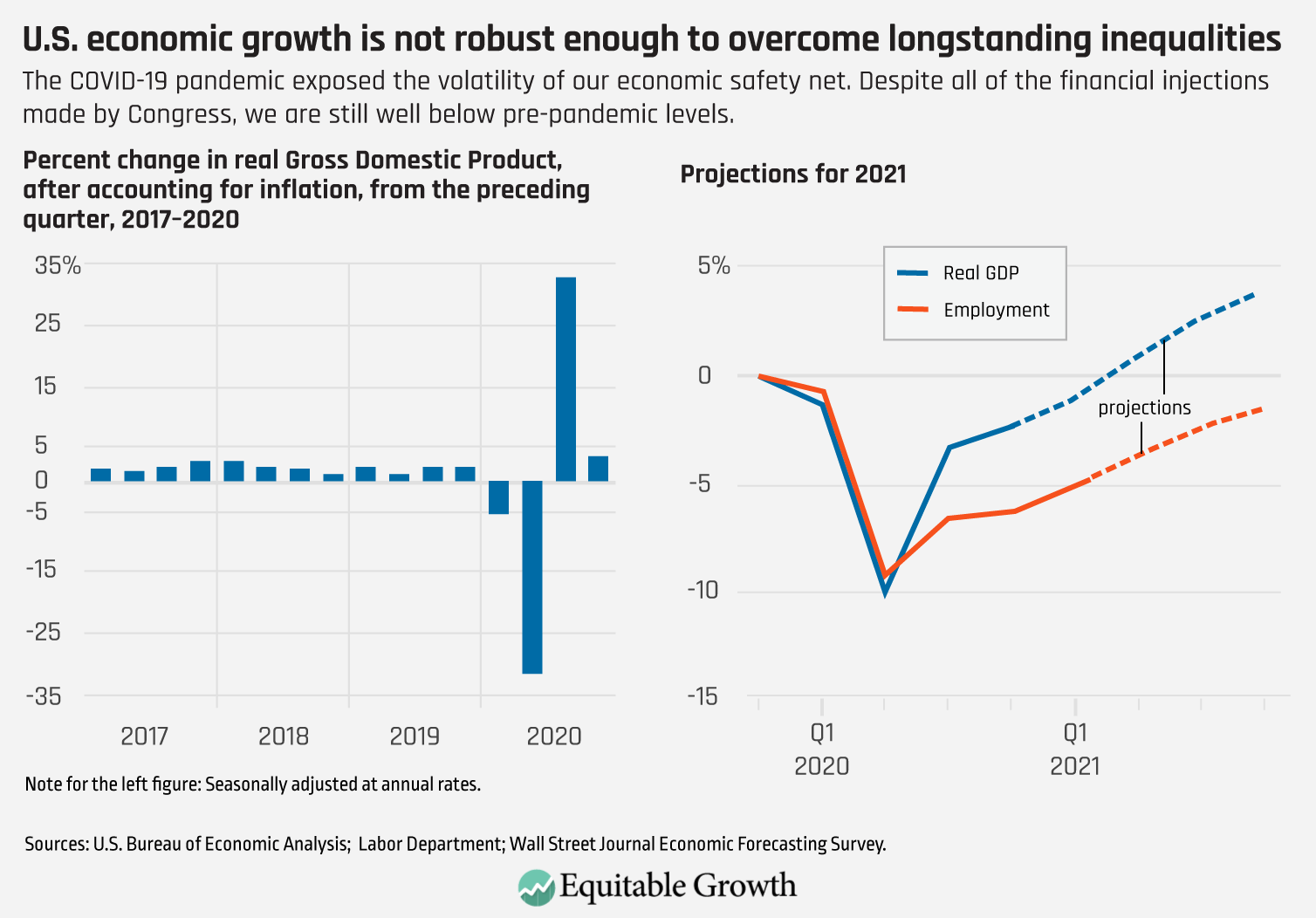
The COVID-19 pandemic exposed the volatility of our economic safety net. Despite all of the financial injections made by Congress, we are still well below pre-pandemic levels
Growth in aggregate GDP, however, fails to disaggregate that growth (opens in a new tab) by income and wealth, race and ethnicity, and other measures. Those measurements should help guide policymakers who want to ensure the economic recovery from the coronavirus recession is more equitable than the recovery from the Great Recession a decade ago. That’s why the details of the previous COVID-19 relief packages passed by Congress become so important.
So, let’s break out those details. Specifically, let’s look at three major relief initiatives: Unemployment Insurance, the Paycheck Protection Program, and direct aid to key sectors of the U.S. economy. Whether these investment programs were effective in 2020 and into 2021, and whether the continuation of these kinds of investments under the Biden administration this year and beyond keeps the U.S. economy on the path toward more equitable economic growth, may well determine just how sustained U.S. economic growth will be over the course of the next decade.
Will President Biden’s American Jobs Plan and American Families Plan lay the foundation for more sustained and equitable economic growth? These two economic investment packages are each large and complex. Examining several key elements within them, however, provides a window into their anticipated effectiveness. By taking a look back at what worked in the prior coronavirus relief packages, we can see specific evidence emerge as to what may be the best solution regarding new and long-term investments.
Let’s first examine the Unemployment Insurance program. Extended Unemployment Insurance and additional pandemic-related unemployment benefits for gig workers certainly are having their intended macroeconomic impact, boosting consumer spending (opens in a new tab) and keeping workers engaged in looking for the best jobs (opens in a new tab) as employment options return, as is now happening across various sectors of the economy. President Biden’s American Families Plan makes provisions for continued UI support as we near the September 5, 2021 expiration date. Should this plan get enacted by Congress more or less as proposed, one key addition should be a reformed UI program that looks to enact so-called automatic stabilizers (opens in a new tab), which proactively prepare the U.S. economy for the inevitable next recession.
Another key element of the American Rescue Plan was the expanded Child Tax Credit (opens in a new tab), which will start to be distributed monthly to families beginning in July, yet this is not envisioned as a permanent program in the Biden administration’s latest two plans. Congress should consider making these tax credits to families permanent, which would go a long way toward making the CTC program more effective at lowering the U.S. poverty rate (opens in a new tab) and ensuring new generations of U.S. workers are more productive (opens in a new tab).
Other key programs in the American Jobs Plan include (opens in a new tab) the Neighborhood Homes Tax Credit (opens in a new tab), the Community Revitalization Fund (opens in a new tab), and the Unlocking Possibilities Program (opens in a new tab). Efforts to disaggregate data by income, race, and ethnicity will also be important to understand the composition of the recovery and inform future policymaking efforts. These are just select examples of programs in President Biden’s two 2021 economic development plans that bear watching for their expected efficacy in creating a more equitable and sustained economic recovery this year and into 2022.
The coronavirus recession exposed several ways in which policymakers can invest in meaningful and sustained equitable economic growth. Even after the current pandemic subsides, the United States as a nation is not at all immune to pandemics or other possible future financial catastrophes. The one immediate lesson learned after spending $5.3 trillion in coronavirus aid and relief over the past year is that Congress can act quickly and in a bipartisan fashion when a crisis strikes. Now, policymakers in Congress need to consider the medium- and long-term investments in President Biden’s new economic plans with equal vigor. Policymakers should above all pay attention to how those investments foster broad-based and sustained economic growth well into the 2020s.
Blog MAY 20, 2021
By: Robert Manduca

Issue Briefs APR 30, 2020
By: Alix Gould-Werth

Blog MAR 1, 2021
By: Alix Gould-Werth
Get updates on our latest research, event announcements, and policy insights delivered straight to your inbox. Stay connected with the leading voices on equitable growth.


