A college degree is not the solution to U.S. wage inequality
Issue Briefs JUL 20, 2020
By: Kathryn Zickuhr
JUN 3, 2022
By: Kate Bahn and Kathryn Zickuhr
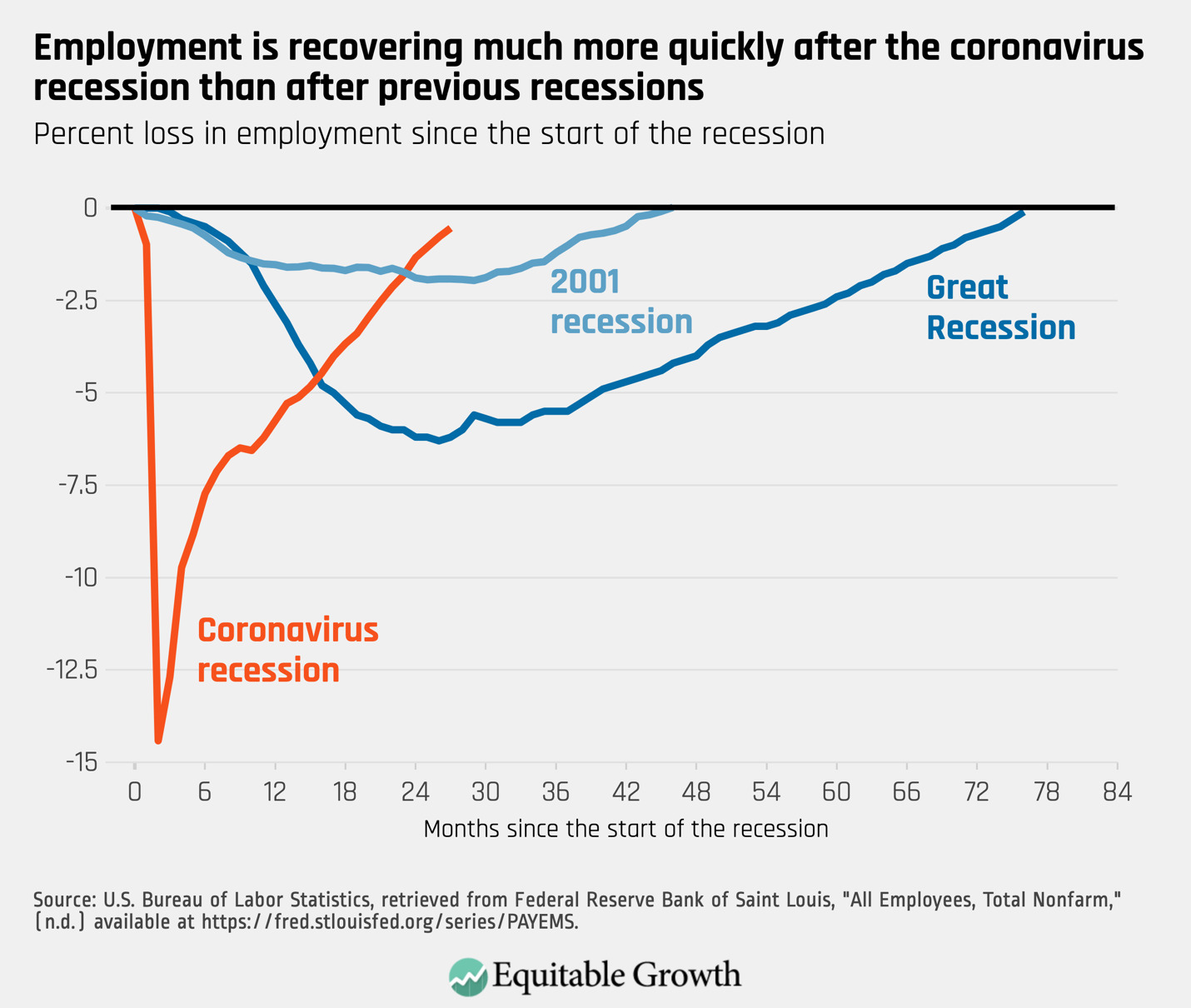
The recovery in the U.S. labor market continued in May, with 390,000 jobs added and the unemployment rate holding steady at nearly its pre-pandemic level at 3.6 percent, according to the Bureau of Labor Statistics Employment Situation Summary released today. After 12 consecutive months of adding more than 400,000 jobs per month, that level decreased slightly last month, but continues to be above the pace of job growth pre-pandemic. And while earnings growth has averaged 5.2 percent over the past year, the annualized 3-month moving average for March to May was 4.5 percent compared to 4.8 percent for the prior three months.
In short, the jobs recovery amid the economic impact of the pandemic has been remarkable, but gains have been uneven and it is unclear whether continued fast-paced gains will continue.
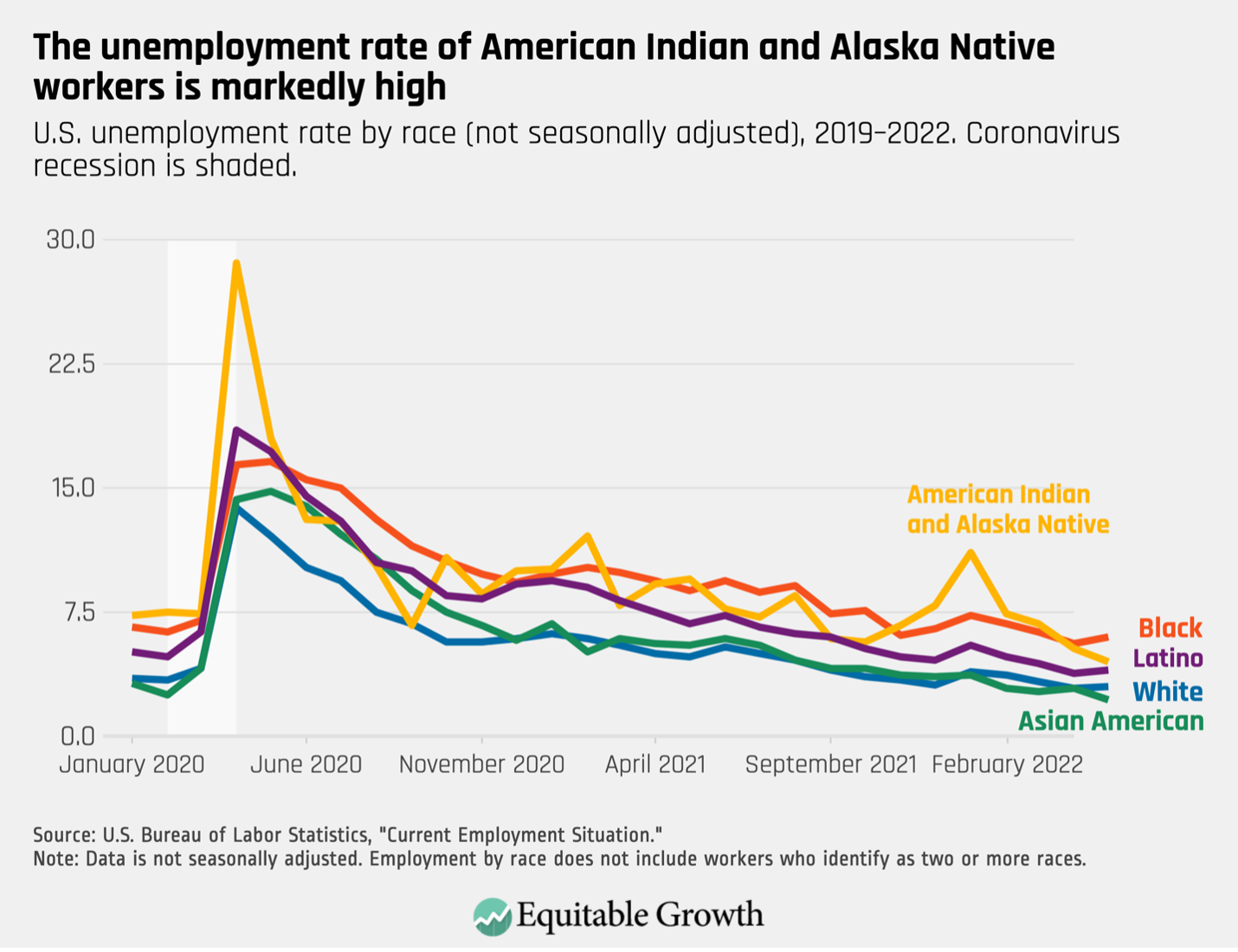
A slowing pace of recovery could also mean that the persistent disparities experienced by workers who face historical barriers to opportunity will likely be more difficult to overcome without the tailwind of a tight labor market. The non-seasonally adjusted unemployment rate for Black workers, at 3.0 percent, is nearly twice that of White workers, at 6.0 percent. American Indian and Alaska Native workers are facing an unemployment rate of 4.5 percent while Latino workers, who were among the hardest hit in the pandemic, are facing an unemployment rate of 4.0 percent. (The Bureau of Labor Statistics began publishing monthly data on American Indian and Alaska Native workers in February 2022 (opens in a new tab), but does not report that data on a seasonally adjusted basis.)
The unemployment rate for Asian American workers is lower than the rate for White workers, at 2.2 percent. But our analysis of the April jobs report noted that Asian American workers experience significantly elevated levels of long-term unemployment compared to other workers.
Each of these realities demonstrate how market forces alone are not sufficient to resolve long-standing labor market inequalities. (See Figure 1.)
Figure 1

U.S. unemployment rate by race (not seasonally adjusted), 2019-2022. Coronavirus recession is shaded.
The jobs market today for young workers presents its own unique challenges and opportunities. With end of the school year, and with high school and college graduations now in train, many young workers are entering the job market at an unprecedented time.
The unemployment rate of workers ages 16 to 19 was 10.4 percent in May, up from 9.6 percent one year prior, but remarkably low compared to the historical average (opens in a new tab). The most recent Job Openings and Labor Turnover Survey from April released earlier this week found that there are 11.4 million job openings, a slight decrease from one month prior but above historical averages. As young workers may be finishing their school years, these conditions could have long-lasting impacts on their economic security.
A body of economics research finds that entering the U.S. labor market during a recession has impacts on young workers that can last long after the recession has abated. The long-run effects of an economic shock is known in economics as “hysteresis,” which describes negative effects that persist past the event causing the shock. Research by Kevin Rinz of the U.S. Census Bureau found that during the Great Recession of 2007–2009, younger workers recovered their levels of employment more quickly than other generations, but they faced both large and persistent earnings losses for up to 10 years following the initial shock.
Workers cannot choose when they were born, but the precise timing of their initial entry into the labor market has long-term impacts. Jesse Rothstein of University of California, Berkeley, finds that college graduates (opens in a new tab) who entered the labor market during the end of the Great Recession in 2009 through the initial tepid recovery into 2011 had lower employment and earnings by 2017 compared to college graduates who entered the labor market immediately prior to the recession or post-2012.
What’s more, hysteresis is an enduring historical problem for young workers. Hannes Schwandt of Northwestern University and Till von Wachter of the University of California, Los Angeles, find that these “unlucky-cohorts (opens in a new tab)” effects were common across business cycles in the modern U.S. labor market from 1976 to 2015, and particularly scarring for workers who face other disadvantages, such as non-white workers and those without a high school degree.
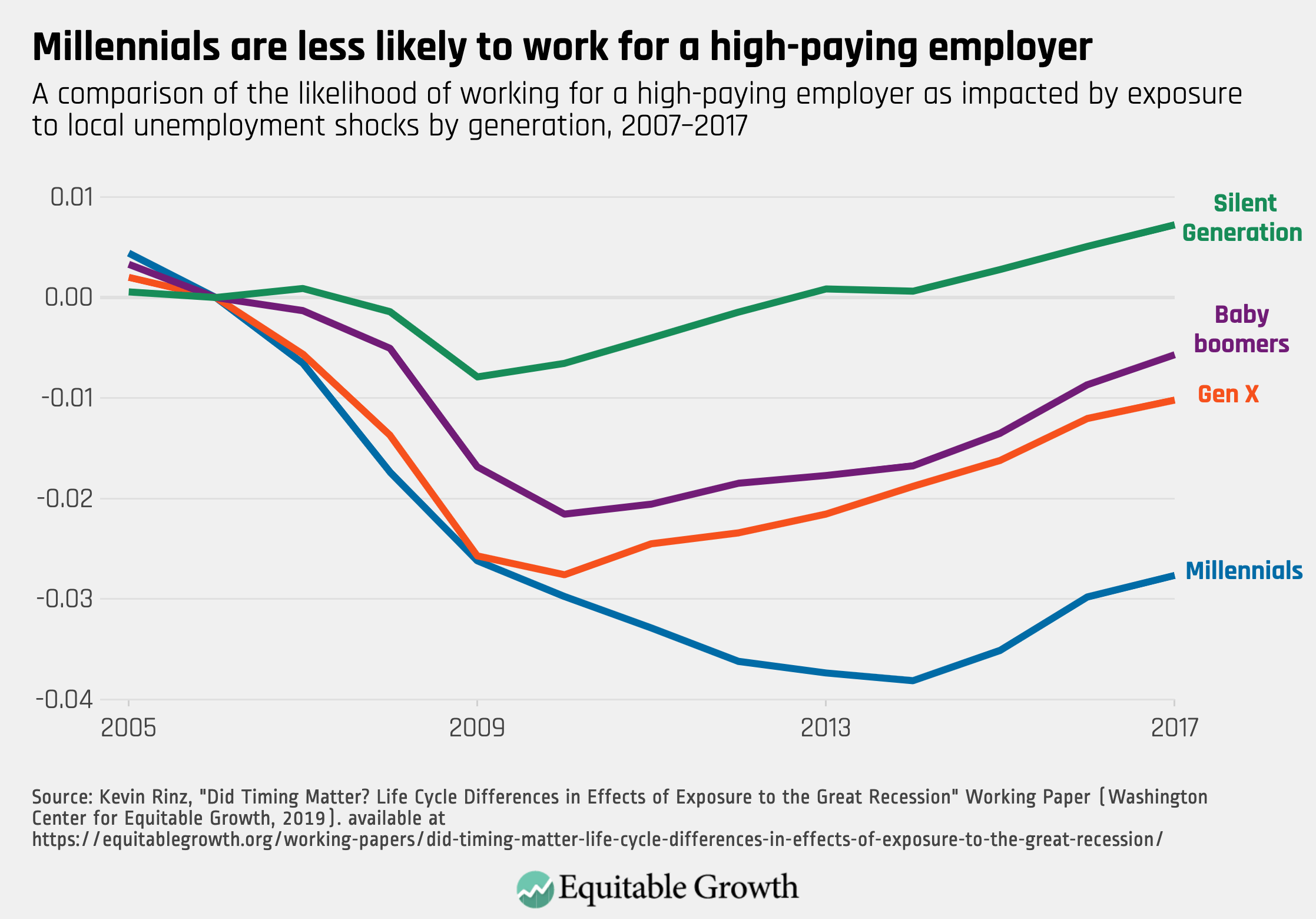
One of the critical factors in shaping these scars of recessions is where re-employment occurs. Rinz finds that younger workers are more likely to work for lower-paying employers following initial local unemployment shocks. (See Figure 2.)

A comparison of the likelihood of working for a high-paying employer as impacted by exposure to local unemployment shocks by generation, 2007–2017
Examined in a different way, Christopher Huckfeldt of Cornell University finds that (opens in a new tab) increased hiring selectivity in recessions leads a situation in which it may be the optimal choice for a worker to switch into a lower-paying occupation when there are few other better alternatives. Workers who switch into lower paying occupations during a recession face earnings losses for a decade after the economic shock compared to workers who are also displaced in their jobs but stay in their occupation, the latter of whom recover their earnings within four years of an economic shock.
Then there’s the unique occupational impact of the coronavirus pandemic. It led to a sharp decline in in-person services followed by high labor demand now, and may shape the impact of this unique recession on the outcomes of younger workers.
The likely long-term effects of the coronavirus pandemic on young workers’ outcomes remain unclear. The sudden and deep shocks of 2020 may have greater long-term effects for young workers entering the job market or making decisions about higher education that year, but the faster recovery may offset those harms to some extent. This suggests the need for policy interventions that both address the immediate harms for the most vulnerable young workers and strengthen our systems to be prepared for future shocks.
The experience of the first two years of the pandemic demonstrate how income supports and a stronger social infrastructure provide stability for weathering economic upheavals that reduce long-term negative consequences. Yet there are still gaps in the current system. For instance, as the Economic Policy Institute notes (opens in a new tab), expanded Unemployment Insurance benefits were not available to young people who were unable to enter the workforce. Policymakers should reform Unemployment Insurance and invest in building the administrative infrastructure for promising related programs, such as Short-Time Compensation, to protect vulnerable workers from sudden economic upheavals and mitigate the effects on their careers and on their households’ economic security.
Furthermore, developing a proposed job seekers allowance (opens in a new tab) separate from the Unemployment Insurance system would help those who would remain ineligible for UI benefits as they initially enter the labor force following graduation.
As young workers drive unionization efforts across the country, policymakers also should strengthen workers’ bargaining power and worker protections, which research shows are especially crucial for improving earnings and reducing inequality for young workers without college degrees. At the same time, policymakers should make college more affordable and accessible for those who pursue higher education.
Canceling student loan debt also would provide much-needed relief to students and young workers as they navigate a changing labor market, and make them and their households more resilient down the road. Rebalancing economic power toward workers and young people would provide a foundation for future broadly shared growth.
Issue Briefs JUL 20, 2020
By: Kathryn Zickuhr
Blog NOV 7, 2019
Issue Briefs OCT 21, 2020
By: Raksha Kopparam, Austin Clemens
Get updates on our latest research, event announcements, and policy insights delivered straight to your inbox. Stay connected with the leading voices on equitable growth.