




Policy
What Work Does Generative AI Do?
Essays SEP 8, 2026
By: Alexander Bick, Adam Blandin, David Deming, Tyler Schumacher
AI, Tech & Energy
Labor, Wages & Worker Power
 Browse All Resources
JUL 20, 2020
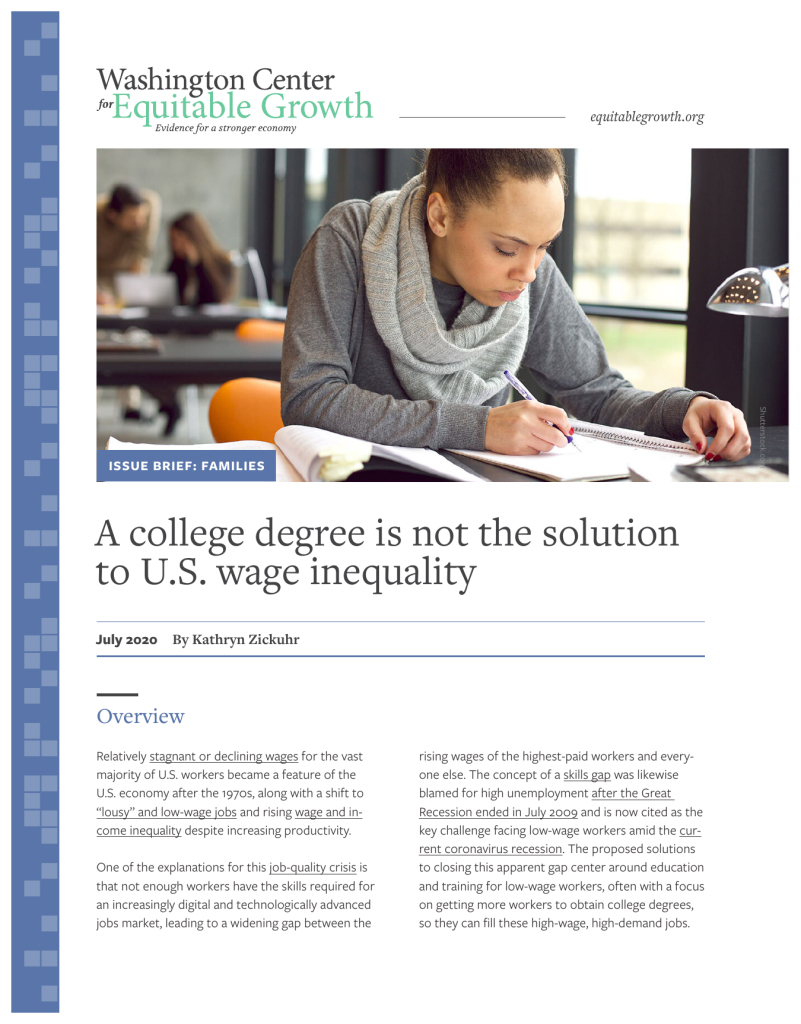
Relatively stagnant or declining wages (opens in a new tab) for the vast majority of U.S. workers became a feature of the U.S. economy after the 1970s, along with a shift to “lousy” and low-wage jobs and rising wage and income inequality despite increasing productivity.
One of the explanations for this job-quality crisis (opens in a new tab) is that not enough workers have the skills required for an increasingly digital and technologically advanced jobs market, leading to a widening gap between the rising wages of the highest-paid workers and everyone else. The concept of a skills gap was likewise blamed for high unemployment after the Great Recession ended in July 2009 and is now cited as the key challenge facing low-wage workers amid the current coronavirus recession (opens in a new tab). The proposed solutions to closing this apparent gap center around education and training for low-wage workers, often with a focus on getting more workers to obtain college degrees, so they can fill these high-wage, high-demand jobs.
Yet this focus on individual workers misses the structural conditions that constrain workers’ options and ability to share in economic growth. This issue brief examines recent data-driven research that demonstrates the skills gap is only a small and relatively unimportant explanation for the college wage premium because it fails to account for declining worker power and the role of monopsony in the labor market. These more important explanations for the college wage premium—and its recent decline—underscore why policymakers need to improve the underlying labor market conditions for all workers, instead of shifting responsibility to those already struggling in an uneven playing field.
One of the factors complicating a straightforward interpretation of the college wage premium is that employers often require college degrees for positions for reasons other than the content of the role’s duties. One way this is evident is when employers often raise job education requirements (opens in a new tab) during times of high unemployment, when there are many candidates for jobs, but may also drop these requirements when the labor market tightens. Over time, as a greater share of workers earns college degrees, education requirements may continue to rise—but, crucially, not because the duties of the job require greater skill or education levels.
As a paper (opens in a new tab) by Paul Beaudry of the University of British Columbia and the National Bureau of Economic Research, David A. Green of the University of British Columbia and Institute for Fiscal Studies, and Benjamin M. Sand of York University found, the decline in demand for college degrees since 2000 led many college-educated workers to take jobs that did not require a degree, which, in turn, pushed workers without degrees down into even lower-wage jobs. The Roosevelt Institute also notes (opens in a new tab) that requiring unnecessary degrees drives more students to attend college, often taking on large amounts of debt in the process, because they’ve been told they can’t afford not to.
The evidence is clear that while a college degree is increasingly a requirement for middle- and high-wage jobs, it is not a guarantee of higher earnings, especially for people of color. Discrimination and occupational segregation continue to limit wages and economic opportunity for Black and Latinx workers and intersect with gender discrimination to additionally lower wages for Black women and Latinas. The new NBER working paper by Autor, Goldin, and Katz examined in the previous section of this issue brief did not break out college wage premiums by race and ethnicity, but other research shows that Black and Latinx workers with college degrees continue to earn lower wages than White workers with college degrees.
In addition, Black workers with college degrees experience higher unemployment rates (opens in a new tab) compared with White workers with college degrees, as shown by economists Jhacova Williams and Valerie Wilson of the Economic Policy Institute. The two economists also find that Black workers are more likely to be underutilized in jobs that do not require a college degree.
Then, there’s evidence that shows how external factors limit the role of a college degree in driving economic mobility. As economist Brad Hershbein writes for The Brookings Institution (opens in a new tab), a college degree is still associated with higher earnings, on average, but actually benefits the wages of those from lower-income backgrounds less. Hershbein finds that college graduates from very low-income backgrounds—those from families below 185 percent of the federal povery level—see less of a relative income bump from their degree over the course of their careers than college graduates from higher-income backgrounds.
College graduates from very low-income families go on to earn 91 percent more than people from the same income background who only graduated high school, but college graduates from families with higher incomes earned 162 percent more compared with high school graduates from that income background. If the content of a college degree is the key to skilled work and greater economic mobility, then these findings should be the reverse. Instead, these findings—along with research on the role of household wealth (opens in a new tab) and of student debt (opens in a new tab)—show that the college wage premium is not a straightforward story.
The new NBER paper by Autor, Goldin, and Katz demonstrates that the college wage premium declined when unions were strong and the real minimum wage was at its peak. The research shows that the college wage premium is less a story of supply and demand—let alone about the inherent value of a college degree—and more about other U.S. labor market factors such as the underlying dynamics of job quality and worker power. It is also the story of the opportunities for workers without a degree and the protections they have.
We see the importance of these factors in another recent NBER working paper (opens in a new tab), by Matthias Doepke of Northwestern University and Ruben Gaetani of the University of Toronto, which sheds more light on the intersection of skills, job quality, and worker protections. Comparing college differentials in the United States and Germany since 1980, the paper’s findings suggest that a major reason why the college wage premium has risen in our nation compared to Germany is that German employment protections reduce the number of worker separations from their employers and encourages employers to invest in workers.
Doepke and Gaetani’s model suggests that the very precarity and lower-quality of jobs in the United States do not allow these workers to develop skills over time in the same way that college-educated workers can. This bolsters the idea that part of the cause for the college wage premium is higher-wage workers’ bargaining power.
Ultimately, the skills-focused competitive market approach (opens in a new tab) needs more than a tweak to fully capture the forces shaping earnings for workers. As Equitable Growth Labor Market Policy Director Kate Bahn explains, the idea that a skills gap is at the root of wage inequality ultimately ignores the role of unions, worker power, and the broader policy decisions affecting low-wage workers. In a recent Equitable Growth working paper by Bahn and Mark Stelzner of Connecticut College, the authors demonstrate how barriers to job search by race and ethnicity, particularly lack of access to wealth for workers of color and women workers, means that these workers face more difficulty managing their lives and job searches while being unemployed longer without earnings.
Because workers from marginalized groups can’t afford to wait for better job opportunities, employers wield a greater ability to offer lower (discriminatory) wages. Fostering worker bargaining power through pro-labor institutions, such as supporting union organizing and enforcing anti-discrimination laws, reduces the ability of employers to use their monopsony power to exploit workers by race and gender. Similarly, other research shows that raising the minimum wage directly benefits low-wage workers, reducing income inequality and narrowing racial wage disparities.
As Equitable Growth noted in 2014, one of the results of assuming that education differences provide the main explanation for rising wage inequality in the United States is to lead policymakers to view college as a blanket solution for inequality. But the evidence from the Great Recession shows that the apparent skills gap is often driven by greater employer power in times of high unemployment, and that a college degree does not protect workers from low-paying, low-quality job options with no bargaining power and no opportunities to learn and grow. Focusing on education as the first and leading solution to wage inequality ignores the larger issues that undercut workers’ options and further racial disparities. While education and training are often part of what workers need to access quality jobs, they will not be sufficient (opens in a new tab) without worker power to ensure they share in the productivity gains their value-added inputs create.
If past trends continue, policymakers can expect employers to respond to the current record-setting unemployment levels by continuing to raise education requirements. And many policymakers will attempt to respond to this sudden skills gap (opens in a new tab) with calls for more education and training (opens in a new tab). But the solution to today’s dismal jobs numbers is not tell workers to go into debt acquiring credentials only to be rehired at the same types of jobs that had not previously required a degree. Instead, policymakers need to address the structural conditions shaping jobs and wages across the board, focusing on the needs of workers at the bottom of the income ladder. This will require raising the minimum wage to improve outcomes for the country’s most vulnerable workers, actually enforcing anti-discrimination laws (opens in a new tab) to reduce pay disparities by race and gender, strengthening unions to give workers a voice in their working conditions and training opportunities, and checking the rising monopsony power that prevents workers from sharing economic growth.
Essays SEP 8, 2026
By: Alexander Bick, Adam Blandin, David Deming, Tyler Schumacher
Working Papers SEP 8, 2026
By: Alexander Bick, Adam Blandin, David Deming, Tyler Schumacher

Essays SEP 2, 2026
By: Megan Rivera
Get updates on our latest research, event announcements, and policy insights delivered straight to your inbox. Stay connected with the leading voices on equitable growth.


