

What happens to U.S. workers without access to Unemployment Insurance amid economic downturns or disruptions related to AI?
Essays SEP 2, 2026
By: Megan Rivera
DEC 8, 2021
Hearing on “Growing our Economy by Investing in Families: How Supporting Family Caregiving Expands Economic Opportunity and Benefits All Americans”
Testimony by Michelle Holder, President and CEO of the Washington Center for Equitable Growth
December 8, 2021
Thank you, Chair Himes and Ranking Member Steil, for inviting me to speak today. It’s an honor to be here virtually.
My name is Michelle Holder, and I am president and CEO of the Washington Center for Equitable Growth, an organization that seeks to advance evidence-backed ideas and policies that promote strong, stable, and broad-based economic growth. I also serve as an associate professor of economics at John Jay College, which is part of the City University of New York.
In addition to the work I perform in the paid labor market as an economist, I also do work every day as a mother of two young children and as a caregiver to my elderly mother, who recently suffered a serious injury and is currently in the hospital under intensive care, which is why I can’t be in Washington with you today. My dual roles, as economist and as care provider, equip me well to speak to you today about what the care economy is and how it affects our nation’s macroeconomic outlook.
So, what is the care economy? This term was popularized by University of Massachusetts Amherst economist Nancy Folbre (opens in a new tab) and usually refers to the system through which services vital to caring for the U.S. population are delivered.1 This care work (opens in a new tab) is both paid and unpaid, and encompasses tasks ranging from the delivery of specialized medical care to the folding of laundry.2
One in five people in this country are in a caregiving relationship (opens in a new tab), and this number will grow as our population ages.3 As my fellow witness Ai-Jen Poo often says, this care work is the work that makes all other work possible. Workers will not report to office desks or construction sites, medical clinics or restaurant kitchens, if their loved ones are not safe and cared for.
Yet large segments of the care economy are invisible in our normal accounting frameworks because it can be difficult to accurately value care work. When we provide care for our loved ones, and no money changes hands, it is difficult to put a price tag on this essential labor. Many families also supplement the care they provide to their loved ones with services they purchase. These services are expensive. So, when we leave it to families and individuals to shoulder these costs, many forego the supports they need. But it’s not just families and individuals who lose out when this happens. Our whole society suffers when families and individuals lack the care they need. Historically, there has been a lack of government support for care provision despite broad benefits to the entire U.S. economy. Economists call this state of affairs a market failure.4
Today, I will discuss the consequences of this market failure—a failure that leads to the dampening of economic growth. We can see this market failure playing out in care-economy institutions ranging from our systems for providing home- and community-based services and supports to older adults and people with disabilities to the important, but undervalued, work of cleaning homes.
For today’s hearing, I will illustrate the relationship between investments in the care economy and economic growth by examining two case studies. First, I will discuss paid family and medical leave. When we underinvest in paid leave, we see drops in labor force participation, productivity, and levels of human capital development, which constricts economic growth. Second, I will show how a similar story plays out in the case of child care.
I will then present and solve a puzzle: Given the common-sense justification for investments in care, why do we underinvest in care? Biases toward economic inputs that are easily quantifiable, against women, and against women of color in particular, have led us to undervalue care, underinvest in this bedrock component of our economic infrastructure, and constrict growth.
I will close by offering an alternative path forward. We can take off the blinders that are created by our biases and invest in vibrant care economy institutions. We have a roadmap for these investments in the Build Back Better legislation now before Congress, and there is still more that we can do to fully invest in care and allow our economy to achieve its full growth potential.
Fully investing in paid leave will spur economic growth through increased labor force participation and improved productivity today, and through enhanced human capital in the workers of tomorrow. Many people in the United States play dual roles as workers in the paid labor force and as unpaid caregivers to their loved ones. Occasionally, workers need weeks or months away from work to devote themselves fully to caregiving, such as when a new child enters a family through birth, adoption, or foster placement, or when a loved one struggles with a serious medical condition such as cancer, or even when workers themselves experience a serious medical need.
But bills don’t stop coming when our loved ones need us, and 1 in 5 unpaid family caregivers in the United States say that they have left bills unpaid or have paid them late. Moreover, about half of caregivers (opens in a new tab) have experienced financial difficulties—from stopping saving to taking on debt—as a result of their caregiving obligations.5 And despite the overwhelming evidence that you and I and most every other worker in the United States will encounter these caregiving needs at some point in our lives, the United States is the only wealthy nation in the world that does not provide its workforce with any type of paid family and medical leave, forcing workers to leave well-matched jobs prematurely and forcing us all to pay the price of the harm done to our economy.
Paid family and medical leave provides wage replacement to workers who take time off from work to attend to the needs of a loved one or their own serious medical condition. But when it comes to family leave, just 1 in 5 workers (opens in a new tab) has access to paid family leave through their employers, and the figure is closer to 1 in 20 for the lowest-paid workers, who are disproportionately workers of color and especially women workers of color.6
If the private market is correcting this problem, then the correction is occurring at a glacial pace. Between 2010 and 2020, the United States added an average of just 1 percentage point of paid family leave coverage across the labor force each year—and much less than that for the lowest-paid workers. As Vicki Shabo at New America has shown, if we continue at this pace, the average worker won’t have access to paid leave from their employer until the year 2100, and the lowest-paid workers will have to wait even longer.7
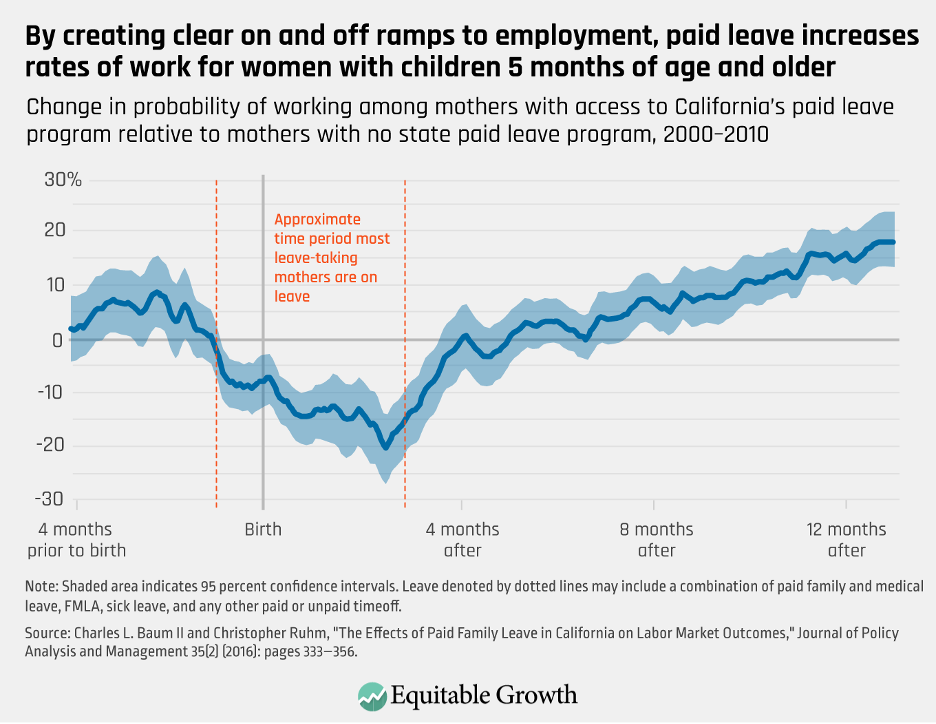
But in six states and the District of Columbia, workers aren’t waiting for their employers. Today, they can access comprehensive paid family and medical leave programs through their state governments. Research conducted on these state programs shows that paid leave fuels our major engines of economic growth. Research consistently shows that paid leave increases the likelihood of maternal labor force participation after the birth of a child, likely because it provides clear on and off ramps to work, as shown in Figure 1.8

Change in probability of working among mothers with access to California’s paid leave program relative to mothers with no state paid leave program, 2000-2010
Looking beyond leave to bond with a new child to broader leave for caregiving, one recent (opens in a new tab) study found a similar increase in labor force participation associated with caregiving leave, while another (opens in a new tab) found that when spouses of people with serious health conditions live in states with paid caregiving leave programs, they reduce their work hours less than similar spouses in states without these programs.9
Paid leave also allows workers to address their own health conditions so that they can be fully present at work. The cost of presenteeism—or working while sick, which ill workers must do when they can’t take time off—should not be minimized. A study of the Dow Chemical Company (opens in a new tab) found that presenteeism resulted in diminished productivity that cost employers more than the combined cost of productivity losses from work absences and employer expenditures on medical treatment.10
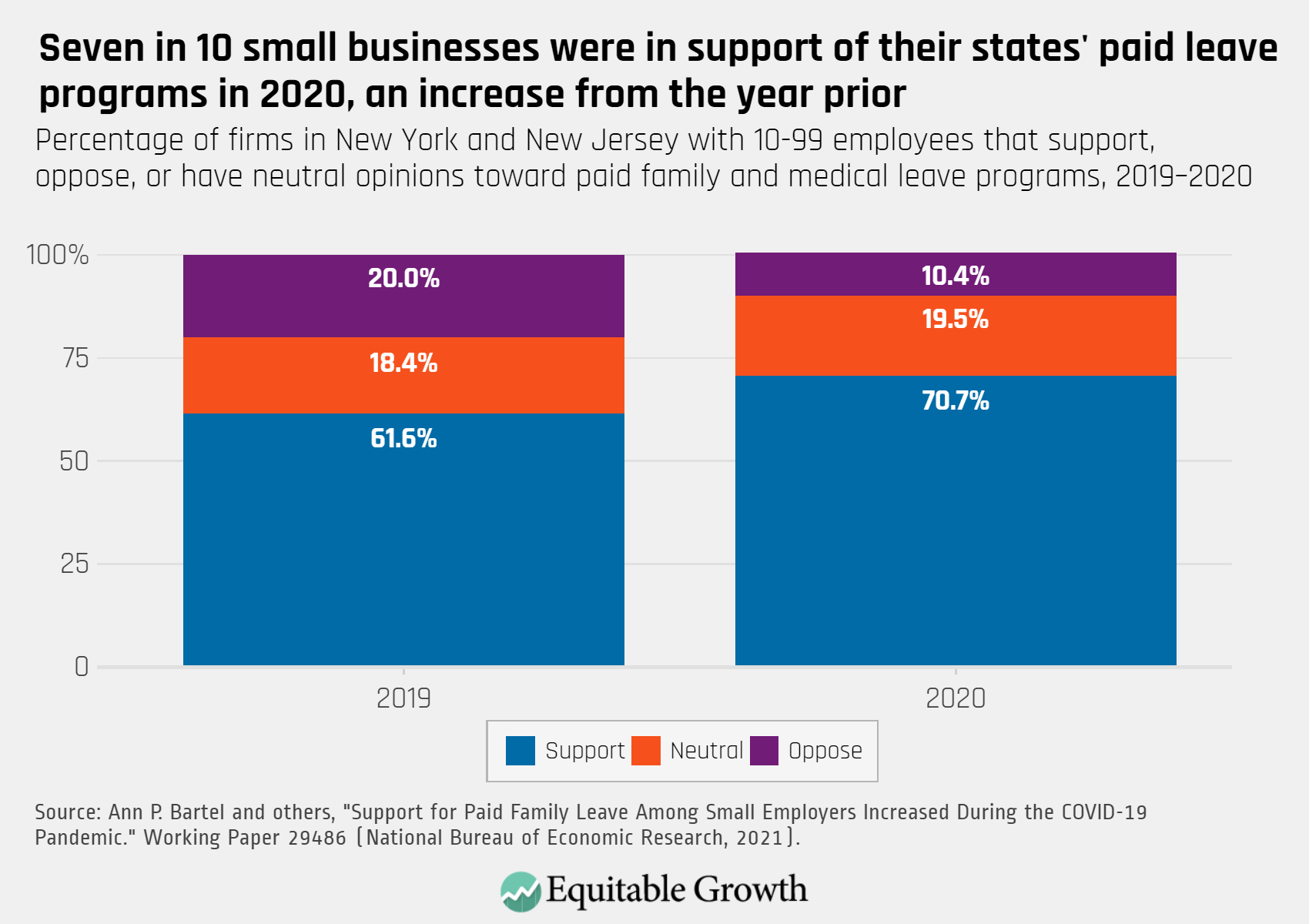
These improvements to workforce participation and productivity appeal to employers, which might be one reason that a working paper (opens in a new tab) recently released on the National Bureau of Economic Research website finds that 7 out of 10 small employers in two states with paid family and medical leave programs expressed support for the policy in 2020, an increase from the prior year.11 (See Figure 2.)

Percentage of firms in New York and New Jersey with 10-99 employees that support, oppose, or have neutral opinions toward paid family and medical leave programs, 2019-2020
And when employers use their state paid leave programs, they like paid leave programs more, not less. Increases in employee use of paid leave are associated with increases in employer support for the program.12 Support for paid leave programs among small employers makes sense, since a public program takes the costly and complicated task of setting up your own paid leave program off small business owners’ already very full plates. And a universal paid leave benefit allows small firms to compete for talent on an even playing field with the bigger guys, who today use their considerable resources (opens in a new tab) to offer paid leave at higher rates than small businesses.13
Paid leave programs aren’t just associated with economic growth today. A large body of evidence shows that paid leave for new parents leads to improvements in child well-being (opens in a new tab). When paid leave is available, rates of attention deficit/hyperactivity disorder, obesity, ear infections, and the hearing problems they cause decrease.14 So, too, do hospital admissions (opens in a new tab)for the head trauma that indicates child abuse.15 At the same time, rates of breastfeeding increase (opens in a new tab), as does the amount of time (opens in a new tab) parents spend reading and working on homework with their children.16
Those improvements in well-being for today’s children translates to improved human capital and increased productivity for the workers of tomorrow. Despite these benefits, workers in 44 states do not currently have access to a public paid family and medical leave program, thus depressing labor force participation, decreasing productivity, dampening the development of human capital, and ultimately constricting the growth of our economy.
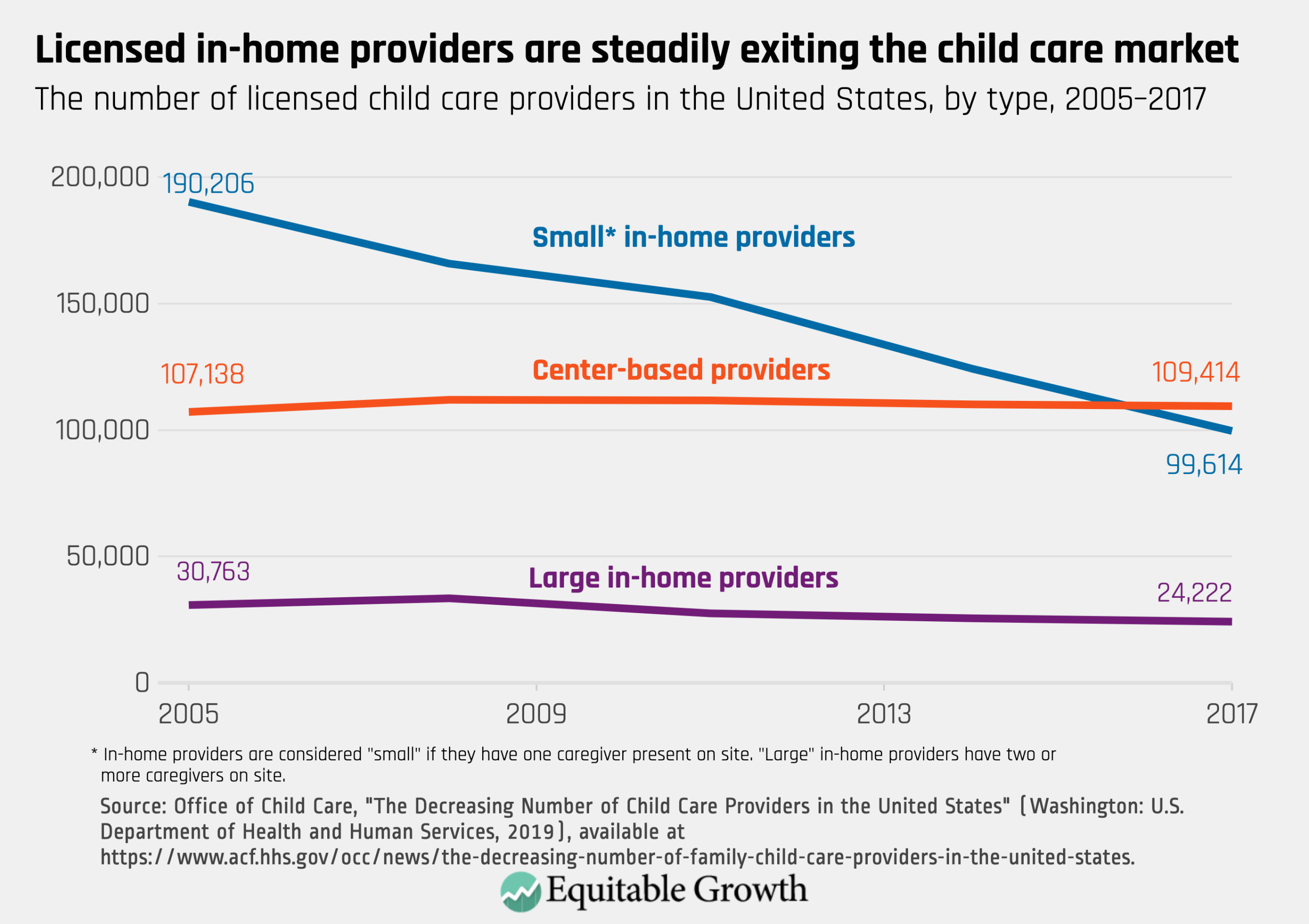
Paid leave programs typically provide time off to care for a new child in their first year of life, but the need to provide care does not end at a child’s first birthday. Most parents need help with child care, either from providers or relatives (opens in a new tab), but that help can be hard to find.17 Overall, the number of licensed child care facilities shrunk (opens in a new tab) by nearly 32 percent in recent decades, primarily due to small in-home providers exiting the market.18 (See Figure 3.)

The number of licensed child care providers in the United States, by type, 2005–2017
In 2019, even before the pandemic’s devastating effects on the child care industry, roughly half of U.S. families lived in “child care deserts (opens in a new tab),” defined as U.S. Census Bureau tracts where there are three young children for every licensed child care slot.19 The coronavirus pandemic only worsened these supply challenges. Further, at an average cost of more than $9,000 annually, the price tag of care puts child care out of reach for many U.S. families (opens in a new tab).20
Moreover, when families can access child care, the quality of care is inconsistent. The caregiver turnover rate is one important indicator of care quality. Consistent relationships with caring adults is crucial to healthy child development, and research has demonstrated that teacher turnover can have negative impacts on a child’s cognitive (opens in a new tab) and social development (opens in a new tab).21 While rates vary widely, average caregiver turnover rates (opens in a new tab) are high: For every four child care workers employed at the beginning of a year, one will leave before the year’s end.22 Research (opens in a new tab) has consistently shown that when pay is low, turnover increases, and that turnover rates for workers who care for young children—whose needs are greater—are higher than for older children.23
The inability to access affordable, high-quality child care is devastating for families. It also constricts our economy’s ability to grow. Research (opens in a new tab) shows that when the supply of child care in a community increases, so too does that community’s parental labor supply.24 Likewise, when the cost of child care decreases, time and again, researchers find an associated increase in parental labor supply.
Recent studies (opens in a new tab) in the U.S. context find that a 10 percent reduction in child care costs increases maternal employment by between 0.5 percent and 2.5 percent.25 To put that in more concrete terms, in a state such as West Virginia, where about 136,000 women have children at home and participate in the civilian labor force, a 10 percent reduction in child care costs would lead to around 3,400 women entering the labor force. That’s 3,400 more breadwinners for families with children, 3,400 more productive workers, and more dollars in the pockets of 3,400 consumers to support local businesses.
More research is needed to understand how the quality and continuity of available child care options affects parental labor force participation. But a 2008 study of mothers (opens in a new tab) in low-wage jobs found that 19 percent stopped working entirely in the same quarter in which they experienced a disruption to their child care arrangements, compared to only 9 percent who did not experience such a disruption.26 The evidence strongly suggests that when child care is available, affordable, and high-quality, more parents get jobs and keep them.
As a result, our economy grows (opens in a new tab). Employers have access to a larger workforce from which to select talent, and workers are less likely to leave well-matched jobs prematurely, which saves firms rehiring and retraining costs (opens in a new tab). And it’s not just workers who are brought off the sidelines, but entrepreneurs (opens in a new tab) as well.27 Parents with winning business ideas will be freed to launch ventures and pursue the American Dream, household incomes rise and drive consumer spending, and the tax base from which we can fund pro-growth government programs grows.
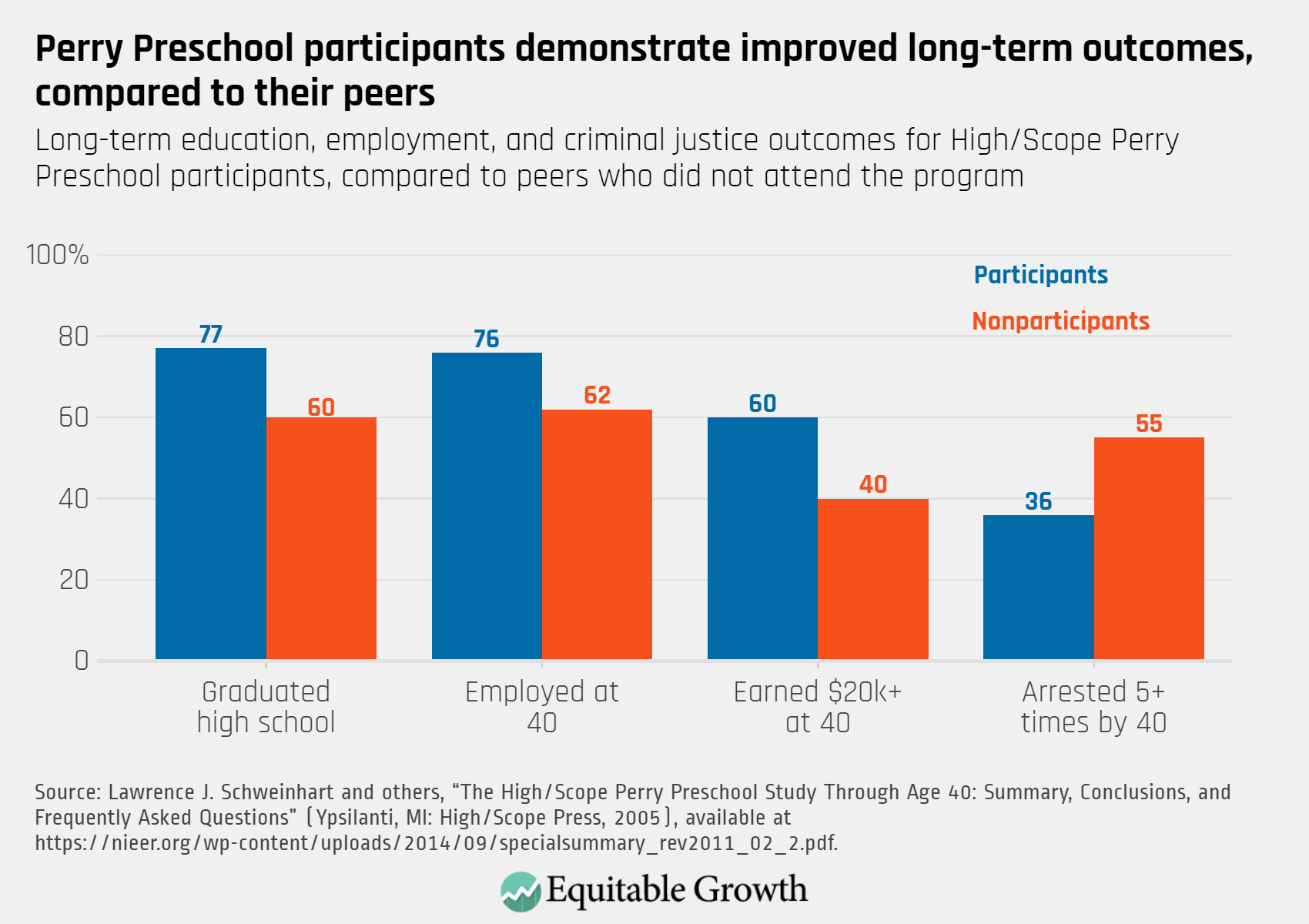
And, similarly to paid leave, the provision of child care, including pre-Kindergarten, affects the economic growth of tomorrow by increasing human capital for the next generation of workers.28 Research (opens in a new tab) on high-quality preschool programs consistently shows that participation in these programs lead to improved outcomes in high school, college, and in the adult workforce.29 Compared to their peers who did not participate in early childhood education, participants in one closely studied, high-quality early childhood education program were 17 percentage points more likely to graduate high school, 14 percentage points more likely to be employed at age 40, 20 percentage points more likely to have yearly earnings of more than $20,000 at age 40, and 19 percentage points less likely to have had significant contact with the criminal justice system. (See Figure 4.)

Long-term education, employment, and criminal justice outcomes for High/Scope Perry Preschool participants, compared to peers who did not attend the program
As we have recently seen all too clearly, child care also has an important role to play in stabilizing the macroeconomy. The child care market is fragile. A combination of reliance on out-of-pocket payments that strain parents’ budgets and slim profit margins means that even a small downturn in the economy can cause a damaging and persistent ripple through the child care sector as parents pull their children out of child care. This pushes providers into the red, which results in layoffs, reduced capacity, and permanent closures from which it can be difficult or impossible to rebound.
We’ve seen this play out during the coronavirus pandemic, as well as prior economic recessions. When unemployment rates increase in the broad labor market, they increase more quickly (opens in a new tab) in the child care sector: Every 1 percent decline in a state’s overall employment is associated with a 1.04 percent decline in child care employment.30 But when the economy rebounds, the child care sector lags: every 1 percent increase in a state’s overall employment is only associated with a 0.75 percent increase in child care employment.31 This lag can be a drag on reemployment, as we are seeing today: Parents who seek to return to work after a period of unemployment must be able to secure child care, which will be out of reach without greater public investment.
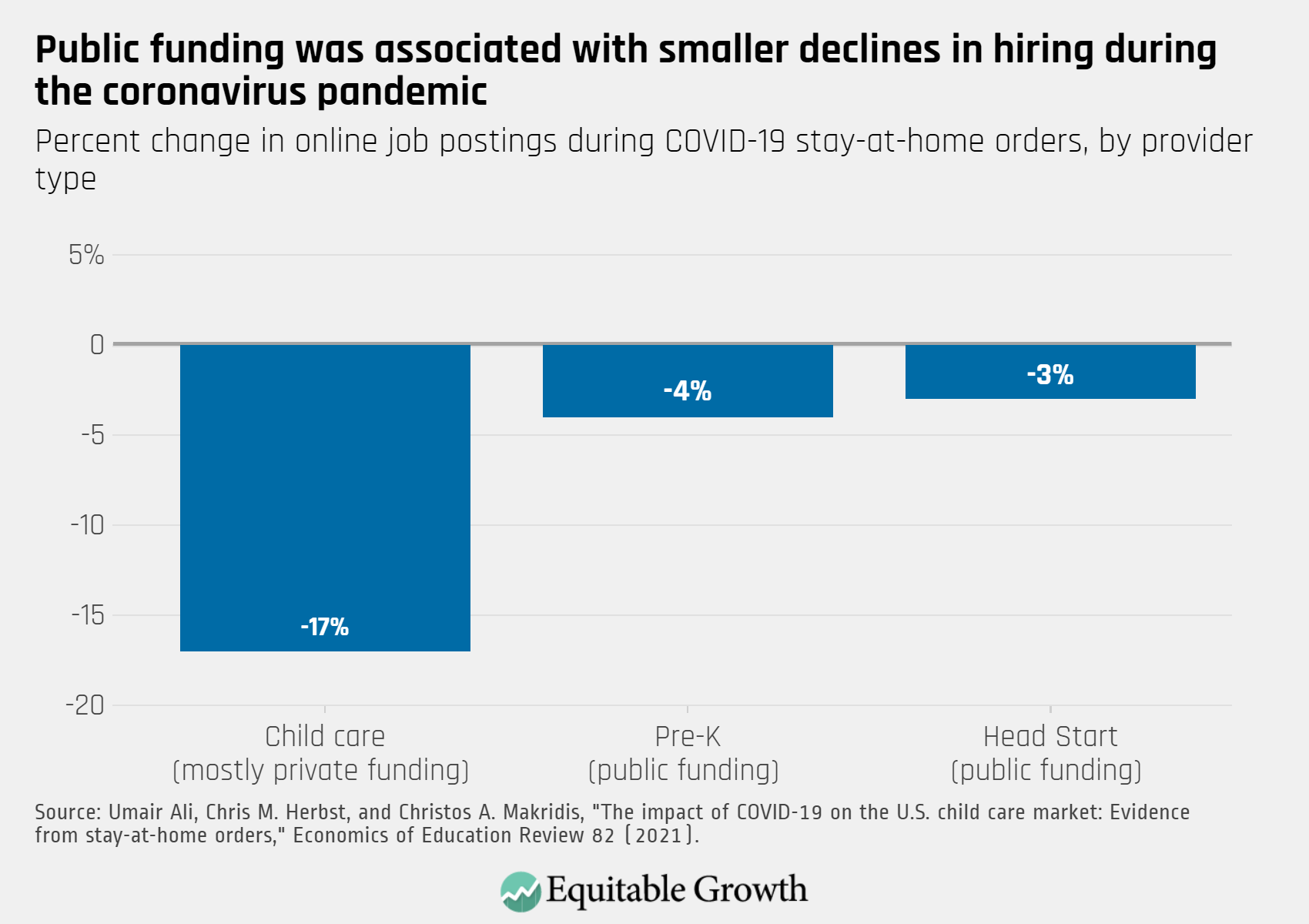
In fact, even during the coronavirus recession, child care and early education programs that had access to public investment—such as pre-K and Head Start providers and child care programs engaged with the subsidy system—were better able to weather the financial crisis of the pandemic. (See Figure 5.)

Percent change in online job posting during COVID-19 stay-at-home orders, by provider type
These providers (opens in a new tab) were able to maintain enrollment, staffing, and hiring at higher rates (opens in a new tab) than those providers relying solely or primarily on private dollars.32 Additional public investment in this area—especially programs that lower families’ costs while also subsidizing and expanding access to providers—will not just help this key part of our social infrastructure remain intact during downturns, but also will help fuel an equitable recovery and a competitive economy in the future.
Indeed, while the United States once held a competitive edge in the global economy due to growth in women’s labor force participation over the past century, that growth has since stagnated, and the labor force participation rate in the United States now falls below the average for OECD nations (opens in a new tab).33 During the first year of the coronavirus pandemic, when families struggled without adequate access to paid leave and child care, women’s labor force participation fell— hitting a low we haven’t seen since 1988 (opens in a new tab).34
There is another, longer-run trend that also merits our attention: The birth rate in the United States has been falling for 6 years, and hit a record low (opens in a new tab) in 2020.35 Our birth rate is barely outpacing (opens in a new tab) that of China, and the birth rates of other nations, such as Israel, India, and France, position them to better maintain their labor forces, creating a new competitive disadvantage for the United States.36 Having a smaller family is a rational response to broken care infrastructure, and while methodological challenges make it difficult to determine the precise effect that programs such as child care have on total fertility rates, evidence from Europe suggests that investing in the care economy meaningfully increases fertility (opens in a new tab), thus helping countries to maintain their labor forces and keep their economies growing.37
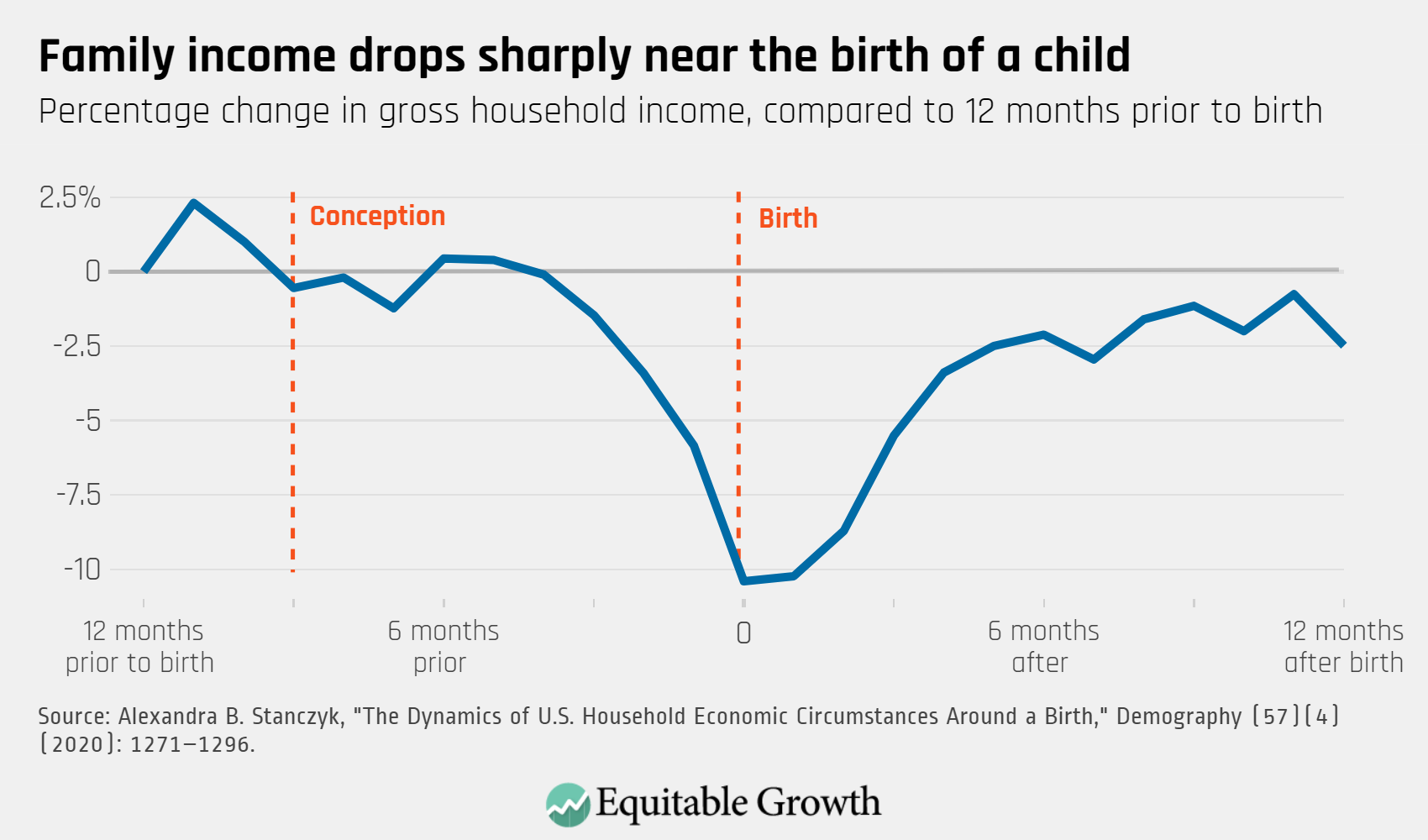
The economic case is clear: Underinvesting in care harms families and prevents our economy from reaching its full potential. But our decision-makers largely see the provision of care as a private responsibility rather than recognizing it as a public good. When a new child is born, parents are asked to take unpaid leave or pay high child care costs when they can least afford it. Research shows (opens in a new tab) that across the socioeconomic spectrum, the birth of a child is accompanied by drastic decreases in family income as parents reduce their labor force participation to care for a child at the same time as families face new expenses such as diapers and formula.38 (See Figure 6.)

Percentage change in gross household income, compared to 12 months prior to birth
When we leave these caregiving costs to be shouldered by parents facing new financial constraints, they may exit the labor market entirely rather than place their child in a high-quality, but expensive, care setting. This creates a drag on growth for the economy today, when employers don’t have enough workers to meet demand and households have to tighten their belts in response to lost income.
Additionally, when a lack of paid leave forces parents to return to work early in order to make the rent, children miss out on care from their parents that fosters their development and human capital, reducing the productivity and potential of tomorrow’s workforce. Care infrastructure that supports parental bonding and child development in the child’s first year of life and accessible, high-quality child care that removes barriers to work for parents would mitigate these drags on our economy’s growth, as well as improving family well-being.
Analogs can be drawn to care for one’s own serious medical condition and care for older adults and people with disabilities, whose families are often financially constrained and facing new expenses at the same time as they are looking at high price tags for medical care and home- and community-based services and supports. Workers with temporary disabilities pay about one-fifth of their medical costs out of pocket, and older adults and people with disabilities who need home- and community-based services and supports pay $50,000 a year on average (opens in a new tab).39 These costs are out of reach for people who are approaching the age of retirement, one-third of whom have no retirement savings at all and almost all of whom are looking at a significant drop (opens in a new tab) in household income as their earning years sunset.40
Why have decision-makers allowed these market failures that straitjacket our economy to occur? The answer is simple: They have been blinded by their biases. This includes biases toward economic inputs that are easily quantifiable, as opposed to care work, which is often “invisible” in the market because no money is changing hands. Just one case in point: Unpaid work is not counted in Gross Domestic Product calculations, despite the important services being provided.
As feminist economist Marilyn Waring noted (opens in a new tab), “Every time I see a mother with an infant, I know I am seeing a woman at work … but, again, I seem to be at odds with economics as a discipline.”41 Indeed, excluding this work from official national income and product accounts makes it more difficult for policymakers to clearly understand the trade-offs between the societal and broad economic benefits of caregiving and the costs associated with adequately supporting care needs.
These biases against women, and women of color in particular, have led decision-makers to undervalue the care work that they perform. Both paid and unpaid care work—from child care to provision of supports for adults with disabilities to domestic labor—have been disproportionately performed by women, and by women of color in particular.
A 2020 report by the AARP (opens in a new tab) estimates that more than 60 percent of unpaid caregivers are women.42 Women tend to spend more time (opens in a new tab)engaged in unpaid care work than men, and this is especially true for women of color.43 For instance, Latina women perform almost twice the amount of hourly unpaid care work per week as White men. Unpaid caregiving responsibilities pose a particular strain on Black mothers (opens in a new tab), two-thirds of whom are the equal, primary, or sole earners in their household.44
When it comes to paid care work, the overwhelming majority (opens in a new tab) of domestic workers are women. More than half of domestic workers are Black, Latina, or Asian American/Pacific Islander women, with some studies finding that more than 90 percent of domestic workers are women of color.45
The overrepresentation of women of color in care work is rooted deeply in our history and the way people in the United States have thought about the home, the market, the state, and personhood over time. For example, in the mid-19th century, Black women’s enslavement and exclusion from White society’s definition of womanhood and personhood created a cultural context in which it was easy to push Black women into precarious and dangerous work.46 Then, when Black women were concentrated in precarious occupations, the quality of these jobs further decreased. Black women were excluded from early minimum wage laws (opens in a new tab) through the Fair Labor Standards Act’s exclusion of agriculture and domestic work—industries in which Black women were overrepresented.
This interplay between decreasing job quality and occupational segregation is an ongoing vicious cycle that perpetuates the long afterlife of slavery. Today, occupational integration remains stalled (opens in a new tab), and Black women remain overrepresented among those engaged in precarious work, including care work. One in three nursing assistants, for example, is a Black woman.47
These historic racial biases reverberate forward to affect the view of caregiving work itself today. To be blunt, when decision-makers see Black women performing work, they decide that the labor itself must not be valuable. Indeed, regardless of their race or gender or education level, any worker who does a job that involves the provision of care receives wages that are 5 percent to 6 percent less than those paid for similar work that does not involve the provision of care. This phenomenon is called the care penalty (opens in a new tab).48
One place where the care penalty is obvious is in the way we compensate child care providers. Researchers at the University of California, Berkeley find that the median wage (opens in a new tab) for a preschool teacher is $15 per hour.49 Child care workers make even less, with median wages of $12 per hour. This undercompensation story is similar for home care workers. In 2018, the most recent year for which we have data, home care workers earned (opens in a new tab)$11.52 per hour, which translates to $16,200 per year after accounting for inconsistent scheduling.50
In addition to not paying child care workers sufficiently, we do not invest enough in child care overall. When you look at the share of expenditures (opens in a new tab) that each member nation of the Organisation for Economic Co-operation and Development spends on children and families when children are very young, the United States ranks 37 out of 38.51
It is likely that this undervaluation of care in the paid labor force reinforces our attitudes about the value of unpaid care work. Though norms are shifting, and both men and women provide important care to their loved ones—today 2 in 5 unpaid family caregivers are men (opens in a new tab)—we have repeatedly chosen not to invest in a federal paid leave program despite the benefits it would bring to the economy and its widespread popularity (opens in a new tab).52
Today is an exciting day to be speaking with all of you because we are on the cusp of change. After decades of choosing not to invest in paid leave at the federal level, a bill that includes a national paid leave program has passed the House of Representatives and is under consideration in the Senate.
And this isn’t just about passing a paid leave program. It’s about taking our blinders off and accurately valuing care, so that our economy can reach its full growth potential. This bill also:
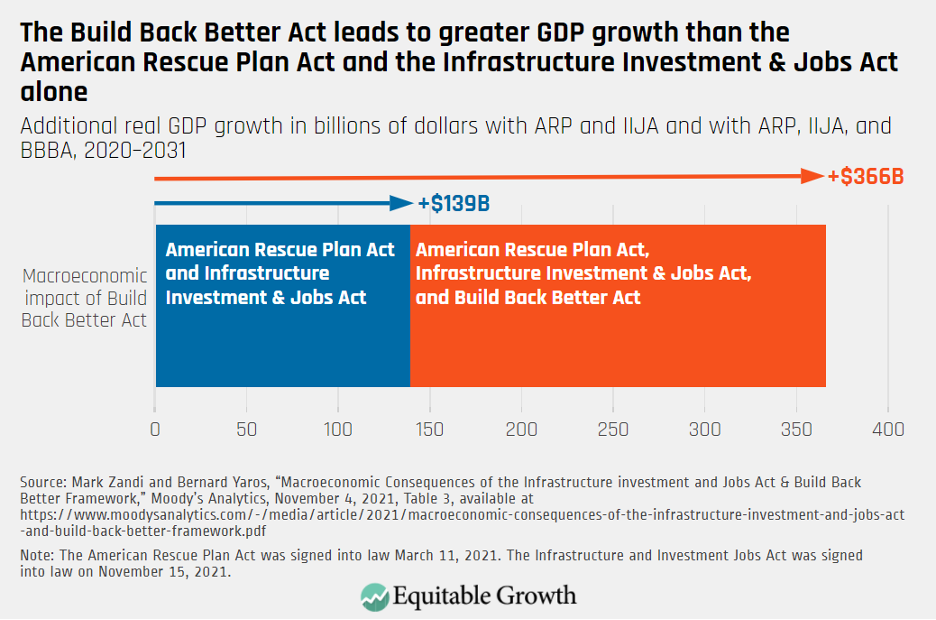
These changes would represent a sea change and move us toward a nation and an economy that accurately value care work, corrects market failures, and allows the economy to grow unfettered (opens in a new tab).53 (See Figure 7.)

Additional real GDP growth in billions of dollars with ARP and IIJA and with ARP, IIJA, and BBBA, 2020-2031
Of course, being on the cusp of real change doesn’t mean that we’ve made it. If we want economic growth, now is the time to invest in the care economy smartly, strategically, and without cutting corners. That means that a federal paid family and medical leave program should be comprehensive—covering leave to bond with a new child, care for a loved one with a serious medical condition, or address one’s own serious medical need. It should have a progressive wage replacement structure, so that low-income people aren’t priced out of participation. And it should recognize the full range of loving relationships through which care is provided.
We need a child care program in which no family is asked to pay more than is manageable to ensure that their child is safe and nurtured during the work day, that ensures that early care educators can focus on the children they care for without being distracted by their own financial hardship, and that the system has the resources it needs to ensure that children are receiving high-quality care. While temporary programs will substantially help families and the economy, and provide proof of concept for those skeptical of the government’s ability to deliver these benefits, the need for paid leave and child care will not disappear in 3, 5, or 10 years, so it is my hope that Congress will eventually make these programs permanent.
When the supports we deliver to families to ensure that care is adequate meet these benchmarks, when we have built a policy environment that values care for all people who need it—whether it’s people with disabilities who need professional supports to fully engage in their communities; young children who should be able to grow up in households that are economically secure, so that their parents can meet the family’s basic needs and focus on parenting; or older adults who have spent their lives providing care for others and now need support themselves—when this happens we will know that we have sufficiently shifted our orientation to care to correct our market failure and allow our economy to grow. If we miss the opportunity that is before us today, our loved ones will struggle to access the care they need and our economy will remain constrained.
As a mother of two young children and the daughter of a mother experiencing a health crisis, I can tell you that families are desperately in need of support when it comes to the provision of care. This is about creating vibrant and loving environments for children, for older adults, and for people who live with disabilities, and ensuring their safety and health. And as a tenured professor of economics, I can tell you that our country is desperately in need of an economic system that correctly values care. This is about increasing labor force participation, developing human capital, and increasing productivity. It is about building a more vibrant economy.
Our biases against women and people of color, and our bias toward easily measured economic quantities, have led us to underinvest in a bedrock component of our economy: care. Now is the time to take off our blinders and make the investments that will allow our economy to grow to its full potential.
Essays SEP 2, 2026
By: Megan Rivera
Essays AUG 31, 2026
By: Christopher Bangert-Drowns
Essays AUG 14, 2026
By: Carlos Fernando Avenancio-Leon
Get updates on our latest research, event announcements, and policy insights delivered straight to your inbox. Stay connected with the leading voices on equitable growth.