

Skip to content
Browse All Resources
Factsheets

SEP 15, 2021

Factsheet: What the research says about the economics of early care and education

Shutterstock

Abstract

Despite the important role that child care plays in the lives of many U.S. families, the private child care market is not meeting their needs. This is not just an issue for families with young children in the United States—accessible, affordable, and high-quality care also has the potential to generate substantial economic activity and growth that benefits the entire economy.109

Public investments in child care can help eliminate the drag on growth that the lack of child care options creates. These investments, in turn, facilitate economic gains for families, businesses, and the U.S. economy as a whole.

This factsheet will review the research on the short- and long-term economic growth potential of a high-quality, accessible, and affordable early care and education system as well as the evidence supporting greater public investment in this market. For more information, see Equitable Growth’s companion report on the child care economy.

The current child care market doesn’t meet U.S. families’ needs

  • In recent years, it has gotten even harder to find licensed child care options. Overall, the number of licensed child care facilities shrunk by nearly 32 percent in recent decades, primarily due to small in-home providers exiting the market. From 2005 through 2017, nearly half of these providers left the market (opens in a new tab).111 The coronavirus pandemic has only worsened these supply challenges.

Accessible and affordable early care and education options can help parents who wish to work do so, promoting economic growth in the short term

  • When more child care options are available, labor force participation increases. A 2007 study using data (opens in a new tab) from Maryland finds that when there are more child care options nearby, women’s labor supply increases. For every 100 additional child care slots, the women’s labor force participation rate goes up by 0.3 percentage points.116
  • When the price of child care decreases, maternal employment increases. Studies generally find (opens in a new tab) that a 10 percent reduction in child care costs increases maternal employment between 0.25 percent and 11 percent, with more precise estimates suggesting a 0.5 percent to 2.5 percent increase.117 This leads to greater household economic security and higher consumer spending, a larger labor pool from which employers can find workers, and, ultimately, short- and long-term economic growth.
  • Dependable and affordable child care options keep parents in the workforce, which benefits employers who count on dependable workers. A 2008 study (opens in a new tab) of mothers in low-wage jobs found that 19 percent stopped working entirely in the same quarter in which they experienced a disruption to their child care arrangements, compared to only 9 percent who did not experience such a disruption.118

High-quality early care and education promotes long-term economic growth because the workers of tomorrow develop their skills early

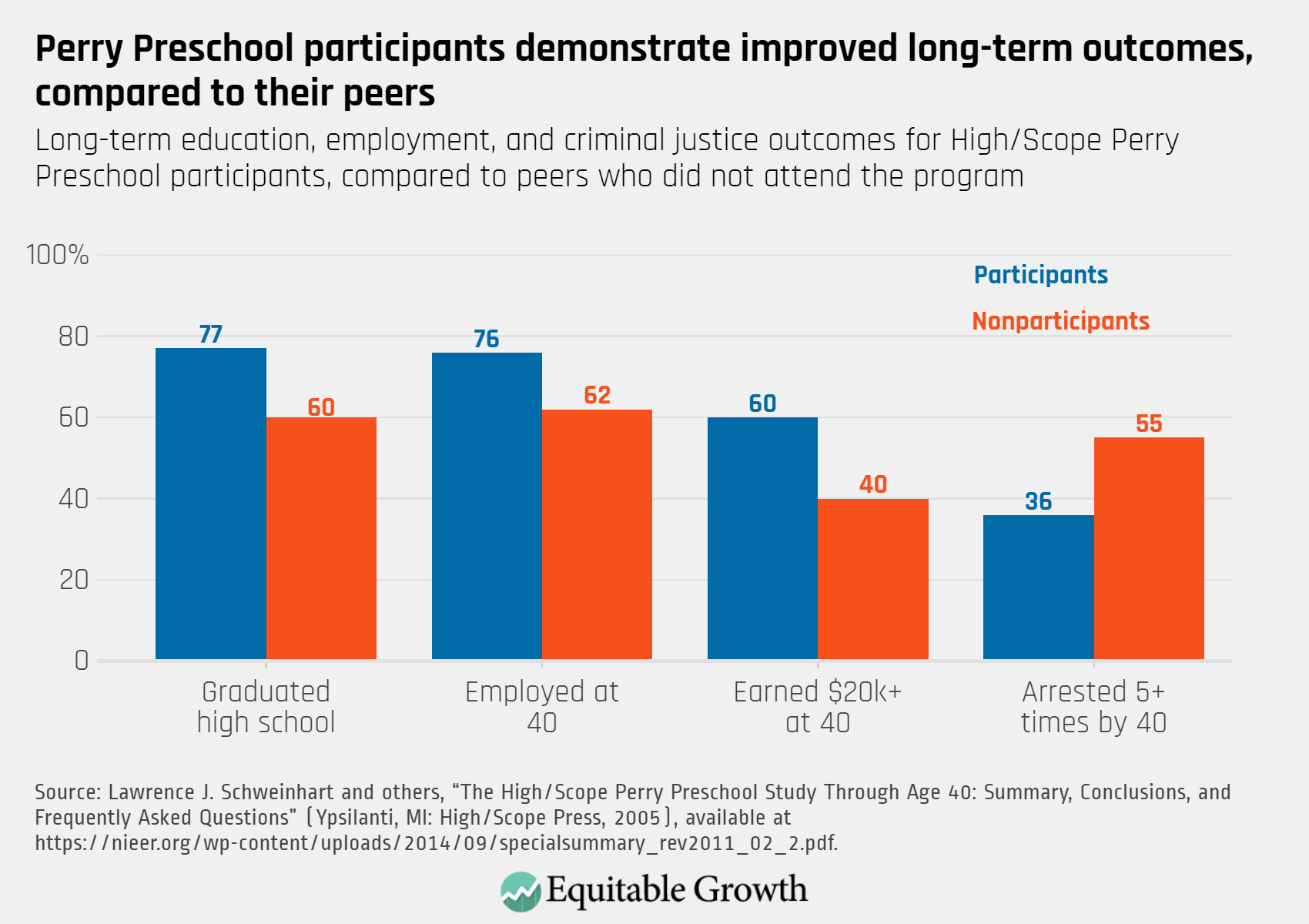
Long-term education, employment, and criminal justice outcomes for High/Scope Perry Preschool participants, compared to peers who did not attend the program

  • Similarly, enrollment in Boston’s universal preschools (opens in a new tab) increases the likelihood of high school graduation by 6 percentage points, SAT completion by 9 percentage points, and on-time college enrollment by 8 percentage points, as well as decreases the likelihood of juvenile justice system involvement and school suspensions by 1 percentage point and 2 percentage points, respectively.123

Greater public investment is needed to unlock the full economic potential of high-quality early care and education

  • Child care subsidies can increase employment among mothers. In one 2020 study (opens in a new tab), a 10 percent increase in child care subsidies was associated with a 2 percent increase in employment among married mothers. Prior research (opens in a new tab) also indicates that a $100 increase in child care subsidies could increase employment among single mothers by 2 percentage points.124
  • Adequate funding is necessary for human capital development. Subsidy dollar amounts are generally low (opens in a new tab) and primarily cover staffing costs, leaving insufficient funds to invest meaningfully (opens in a new tab)in the activities and materials that promote quality care and education for young children.125 Fully funding the subsidy programs and devoting resources for state-level agencies to assist providers in qualifying for subsidies are two ways in which greater public investment could increase child care availability and quality.
  • Supporting child care workers is crucial for promoting quality care and human capital development. Child care workers (opens in a new tab) have a median hourly wage of $12.88, or $26,970 per year.126 Low pay leads to high turnover and high stress in the profession, which can undermine the quality of care that children receive. Using public funds to support higher compensation would help stabilize the child care workforce (opens in a new tab), ensuring that these workers can afford to stay in their jobs.127
  • Investing in the nation’s children is one of the safest bets policymakers can make. Research (opens in a new tab) on early care and education programs finds that $1 in spending generates $8.60 in economic activity. The work (opens in a new tab) of Nobel Prize-winning macroeconomist Paul Romer and others suggests that spending on human capital is one of the most effective ways to use government dollars to strengthen the economy and should be a priority for policymakers who seek to spur economic growth.128

By neglecting the child care market for decades, policymakers have shifted the burden of child care onto the shoulders of U.S. families already bearing the weight of childrearing, employment, and other responsibilities at home—despite research showing that the U.S. economy has much to gain from a functional and equitable child care system.

Addressing the child care crisis has the potential to improve families’ economic security and well-being in the United States, all while accelerating economic growth in the short- and long-term. To do so, policymakers must unburden families with meaningful, targeted, and evidence-based investments in the nation’s early care and education system.

 For more information, see Equitable Growth’s report on the child care economy.

Related

Your Direct Line to Cutting-Edge Research

Get updates on our latest research, event announcements, and policy insights delivered straight to your inbox. Stay connected with the leading voices on equitable growth.