



Policy
What Work Does Generative AI Do?
Essays SEP 8, 2026
By: Alexander Bick, Adam Blandin, David Deming, Tyler Schumacher
AI, Tech & Energy
Labor, Wages & Worker Power
 Browse All Resources
FEB 18, 2020


This essay is part of Vision 2020: Evidence for a stronger economy (opens in a new tab), a compilation of 21 essays presenting innovative, evidence-based, and concrete ideas to shape the 2020 policy debate. The authors in the new book include preeminent economists, political scientists, and sociologists who use cutting-edge research methods to answer some of the thorniest economic questions facing policymakers today.
To read more about the Vision 2020 book and download the full collection of essays, click here.
In 2017–2018, most children in the United States under 6 years of age—68 percent of those in single-mother households and 57 percent in married-couple households—lived in homes in which all parents were employed (opens in a new tab).189 Most of these families require nonparental early care and education, such as childcare centers, preschools, family childcare homes, or informal arrangements with relatives or neighbors, to care for their children while at work. In a typical week in 2011, the most recent year for which complete data are available from the U.S. Census Bureau, 12.5 million of the 20.4 million children under the age of 5 living in the United States (61 percent) attended some type of regular childcare arrangement (opens in a new tab).190
Unfortunately, on average, the early care and education settings attended by many young children, particularly low-income children or children of color, provide quality at levels too low to adequately promote children’s learning and development.191 This exacerbates socioeconomic and racial and ethnic inequalities. At the same time, in most regions of the country, families with young children are spending more on childcare (opens in a new tab) than they are on housing, food, or healthcare.192
In this essay, I argue that greater policy attention to early childcare and education is warranted for three reasons:
I then provide the research underlying these three statements, and follow with a discussion of several policy solutions to address the current problems of affordability, quality, and supply of early care and education in the United States. The overwhelming evidence shows that more public investment is needed to help ease the cost burden for families and ensure that a trained, stable workforce has adequate compensation. A universal early care and education plan, particularly one with a sliding income scale to provide progressive benefits, may not pay for itself in the short term, but will very likely do so in the long term by boosting broad-based U.S. economic growth and stability while narrowing economic inequality.
Early childhood, especially the first 3 years of life, constitutes a sensitive period of the life course, one during which caregiver warmth, responsiveness, and developmentally appropriate stimulation are vital (opens in a new tab) for (opens in a new tab) development.193 Experiences during early childhood—whether positive, such as language exposure, or negative, such as high and chronic levels of stress or deprivation—have lasting (opens in a new tab) effects (opens in a new tab).194 Research demonstrates that socioeconomic disparities in cognitive skills and physical development are (opens in a new tab) apparent (opens in a new tab) in infancy.195
Over the past five decades, a wealth of research has examined how early care and education affects children’s development. Most studies find that the majority of the intensive, high-quality, at-scale model programs promote children’s academic school readiness in the short term. These include the Abecedarian project (studying a set of children born between 1972 and 1977 into their adult years), the Perry Preschool project (studying of a select group of children born between 1962 and 1967), the Infant Health and Development Program (a 1980s program that studied low birth-weight children in their first 3 years), and longstanding federal at-scale early care and education programs such as Head Start, state pre-Kindergarten programs, and high-quality center-based programs.196 Effects are generally strongest for disadvantaged children, suggesting that early care and education may help to narrow socioeconomic, racial, and ethnic disparities in achievement.197
Among the early care and education programs in existence long enough to have data on long-term effects, research finds substantial and lasting benefits for educational and economic outcomes, including higher rates of high school completion, college attendance, and earnings, and reduced criminal activity and public assistance reliance into adulthood.198 There also is emerging evidence for intergenerational benefits (opens in a new tab).199 Yet the research is somewhat mixed for the mid-term effects of early care and education programs. Research finds benefits (opens in a new tab) of participation for reduced grade retention, or repeating a grade in school.200 The short-term benefits (opens in a new tab) on test scores, however, appear to “fade out” or converge with children who did not attend early care and education programs as they age.201 But some research (opens in a new tab) suggests (opens in a new tab) that may be due to the quality of the schools attended after early childhood.202
A largely separate body of research (opens in a new tab) examines the health effects of early care and education. Studies find that the initial entrance of young children into group care is associated with a short-term increase in the incidence of communicable diseases.203 But there are substantial and lasting benefits of early care and education participation for health (opens in a new tab), including increased on-time immunization rates, early screening rates, improved cardiovascular and metabolic health, and reduced smoking.204
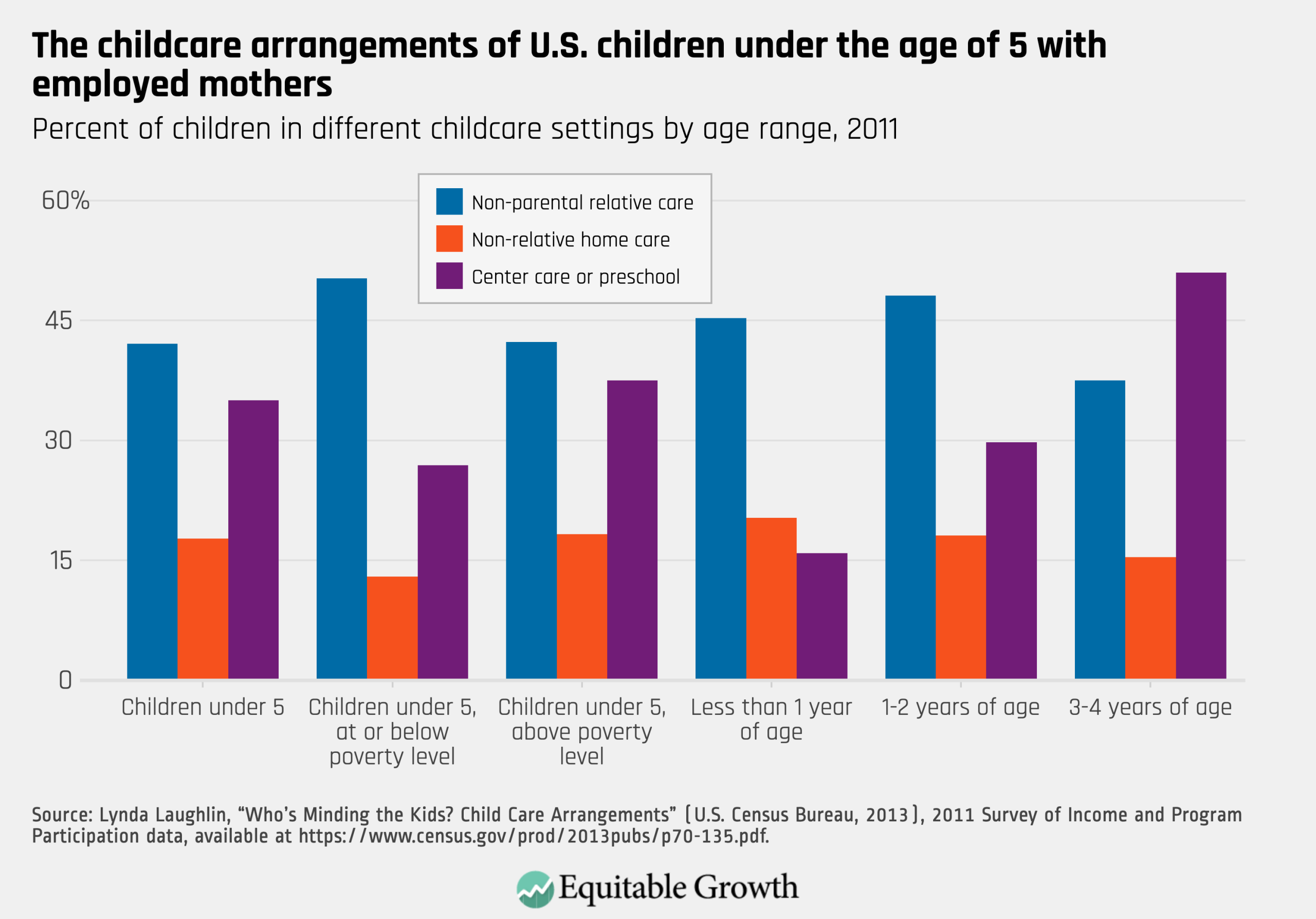
Early care and education provides a context for child development, as well as temporary relief to parents for childcare, allowing them to work. Indeed, increased access to affordable childcare increases parents’ labor force participation, particularly among single mothers. A recent review (opens in a new tab) of the labor effects of childcare estimates that a 10 percent decrease in childcare costs would lead to a 0.25 percent to 1.25 percent increase in parental labor force participation.205 Research finds that public preschool programs, which typically offer part-day, school-year programming, have some but potentially limited effects on parental employment.206 But full-day, full-year early care and education—particularly for infants and toddlers for whom care is expensive and hard to find, and who are less likely to attend center-based care (See Figure 1)—would likely have larger effects on parental labor force participation.207
Childcare can be considered an infrastructure component akin to transportation. Without reliable, affordable sources, workers cannot regularly get to work or stay there. In the short term, early care and education settings support the productivity of two types of workers: employed parents and childcare workers. Research (opens in a new tab) by University of Chicago economist and Nobel Laureate James Heckman and others suggests that many early childhood programs pay for themselves before children begin kindergarten via increased maternal employment, which generates both household income and tax revenue.208 Further, research (opens in a new tab) from the early 2000s suggests that investments in childcare have strong local economic development effects, or multiplier effects, because much of those dollars are spent on childcare worker wages that they, in turn, spend locally.209
In the long term, early care and education supports the preparedness and skills development of the future workforce of the country. Benefit-cost analyses of several intensive model programs and public early care and education programs indicate that the benefits—such as improved educational, economic, and health outcomes, and reduced criminal activity and receipt of public assistance—outweigh the initial program costs, demonstrating positive returns for participants, as well as the public.210
Unfortunately, families with young children today face barriers in accessing and paying for the opportunities offered by early care and education. High-quality early care and education is expensive and hard to find, particularly for infants and toddlers.211 Families with young children spend about 10 percent of their incomes on childcare expenses, but families in poverty—families below 100 percent of the Federal Poverty Level of about $12,000 per year for a family of three—spend 30 percent.212 These expenses represent families’ actual expenses at a mix of regulated centers and homes and informal lower-cost arrangements with relatives, not necessarily what they may choose to spend if more options were available.
In 2017, infant childcare at centers or licensed homes cost an average of $9,000 to $12,000 per year across the country, more than public college tuition in most states.213 These high childcare costs accrue (opens in a new tab) during a period when parents are at the lowest earning years of their careers and when the financing mechanisms of grants and low-interest loans are unavailable.214 The public programs that exist to help families access early care and education—namely the Early Head Start/Head Start program and childcare subsidies provided under the federal and state Child Care and Development Block Grant program—serve a small fraction (opens in a new tab) of those eligible. In 2016–2017, 35 percent of 3- to 5-year-old children in poverty attended Head Start, and 10 percent of children under age 3 in poverty attended Early Head Start.215 In 2015, of the 13.5 million children eligible for childcare subsidies under federal rules, only 15 percent (opens in a new tab) received them.216
Public investments in preschool contribute to dramatic increases in participation in early learning programs in the year or two prior to children’s entry into kindergarten. Whereas in 1970, about 1.09 million (27 percent) 3- to 5-year old children in the United States attended preschool, by 2016, 4.701 million (60 percent) were enrolled (opens in a new tab).217 Yet these overall rates mask disparities in attendance. While income-based gaps in enrollment in preschool narrowed in recent decades, children in low-income families continue to be less likely (opens in a new tab) to attend center-based care than their higher-income peers.218 As shown in Figure 1, among children under age 5 with employed mothers, only 28 percent of those in homes under the poverty line attend center-based care, versus 39 percent of those above the poverty line. This is problematic, as center-based settings tend to provide higher-quality, more stable care, on average, than unregulated arrangements.219
Further, centers that low-income children attend provide lower quality care, on average, than those attended by their higher-income peers.220 Research shows that higher-income families are enrolling children in formal early care and education programs at increasingly younger ages.221 In 2005, for example (opens in a new tab), 22 percent of 1-year-olds from families with incomes above 200 percent of the federal poverty line (at that time, about $32,000 per year for a family of three) attended center-based settings, compared to just 11 percent of 1-year-olds from families with incomes below 200 percent of the federal poverty line.222 Our system’s reliance on private family investment in early childhood is a driver of inequality, putting children on unequal playing fields well before they walk through the doors of their kindergarten classrooms.223
Despite their high expense, early care and education programs should actually cost more, not less. The quality of early care and education depends on the warmth and responsiveness of teachers and caregivers and on the strength and consistency of caregiver-child relationships, which means economies of scale do not apply to childcare in the same way as with other economic sectors. For good reason, state and local regulations set child-adult ratios and group sizes and teacher training requirements. In turn, most childcare costs are directed to labor expenses.224
Yet, despite parents paying as much (or more) than they can afford, childcare workers are paid little. In 2018, the median hourly wage for childcare workers (opens in a new tab) was $11.17 ($23,240 per year).225 This is considerably less than the $16.56 median hourly wage for bus drivers (opens in a new tab) ($34,450 per year).226 What’s more, there are wide racial and ethnic gaps in teacher pay and benefits (opens in a new tab) such as health insurance coverage or paid sick leave.227 Many workers earn so little that they rely on public assistance. Between 2014 and 2016, more than half (53 percent) of childcare workers lived in families that participated in one or more of four public programs.228 This compares to 21 percent in the general population (opens in a new tab).229
Low pay and few benefits present barriers in attracting and retaining a skilled early care and education workforce. Teacher educational qualifications and stability are associated with the quality of early childhood settings and, in turn, a wide range of children’s outcomes.230 In 2012, 25 percent of childcare centers had turnover rates (opens in a new tab) of 20 percent or higher.231 A 2018 study found that 10 percent of children in Head Start (whose teachers average lower pay than those at public preschool programs) had a teacher who left Head Start entirely during the program year, with harmful consequences for children’s outcomes.232 Adequate caregiver and teacher compensation and training is necessary for supporting quality and stability in, and augmenting the supply of, early care and education.
This lack of reliable, affordable childcare has reverberating effects for parents, employers, and the U.S. economy. Interrupting a career due to a lack of adequate childcare—something more often done by mothers—has both short- and long-term economic ramifications for families in terms of lost wages, retirement savings, and other benefits, with an estimated average reduction of 19 percent in lifetime earnings.233 Even when maintaining labor force participation, working parents and their employers feel the economic consequences of childcare inadequacy. A 2018 survey found that workers with children under the age of 3 lose an average of 2 hours per week of work time due to childcare problems, such as leaving early or arriving late. One-quarter of respondents reported they reduced regular work hours, turned down further education or training, or turned down a job offer due to childcare problems.234 One recent study (opens in a new tab) estimated that the childcare crisis results in $57 billion in lost earnings, productivity, and revenue each year.235
Most early care and education policies are designed for one or both of two purposes: to provide care while parents work or to promote children’s readiness to enter kindergarten by supporting cognitive, social-emotional, and behavioral development. This is a false dichotomy. As detailed above, high-quality, affordable, reliable programs accomplish both purposes. Yet there are simply too few high-quality, affordable, reliable programs in the United States today, and most are out of reach for low- and middle-income families.
In order to address families’ and employers’ early care and education needs, policies must address the affordability, quality, and supply problems in our current system. More public investment is needed to help ease the cost burden for families and ensure that a trained, stable workforce has adequate compensation, which will promote affordability and quality. Low-income families disproportionately shoulder the economic and other burdens caused by the lack of childcare, although middle-income families are also economically squeezed during the years in which their children are young.
A universal plan, particularly one with a sliding income scale to provide progressive benefits, may not pay for itself in the short term, but will likely do so in the long term.236 A universal plan that offers benefits such as mixed-income classrooms may have beneficial peer effects (opens in a new tab).237 And these kinds of plans have fewer (opens in a new tab) administrative barriers and stigma, and a broader base of political support.238 Further, an analysis of the Infant Health and Development Program estimates that socioeconomic achievement gaps would be substantially narrowed from universal programs.239 Policies should be flexible enough to meet families’ diverse needs, address the overall supply of early care and education, and cope with the gaps that are particularly troublesome for families today, such as care during nonstandard hours and for children with special needs.240
Two examples of universal policy solutions that would improve affordability, quality, and supply are the Child Care for Working Families Act and the Universal Child Care and Early Learning Act. Both of these proposed bills would increase public investment in early care and education to limit families’ out-of-pocket payments to 7 percent of family income (the threshold recommended by the U.S. Department of Health and Human Services), increase childcare worker compensation and training, and expand public preschool and the supply of childcare for infants and toddlers. The Child Care for Working Families Act does so by expanding childcare subsidies, nearly doubling (opens in a new tab) the number of children eligible.241 The Universal Child Care and Early Learning Act relies more on (opens in a new tab) public provision, expanding a network of early care and education options through federal-state or federal-local partnerships.242
Both bills, if passed by Congress and signed into law, would lead to substantial increases in the availability of high-quality, affordable early care and education programs. An analysis (opens in a new tab) of the Child Care for Working Families Act estimated that, at full implementation, the availability of new childcare subsidies and reduced childcare costs would lead to 1.6 million more parents joining the labor force, the bill would create 700,000 new jobs in the childcare sector, and pay among teachers and caregivers would increase by 26 percent.243
The recent increases in state and local paid family leave programs in a handful of states and cities are laudable and help parents manage their own health and their newborns’ needs, while maintaining their jobs and a basic income.244 Likewise, federal and state public preschool programs and Head Start serve increasing numbers of children, with 44 percent of 4-year-olds and 16 percent of 3-year-olds enrolled in public programs across the country.245 But in the years following the (relatively brief) period of paid leave and preceding the availability of preschool, families require affordable, high-quality, stable early care and education arrangements that match their working hours.
To ignore early care and education policy means to ignore a major expense and pressing concern for families and employers across the nation. Moreover, the research shows that early care and education can promote children’s cognitive and other outcomes, narrowing disparities and leading to greater economic growth.246 Our nation’s current lack of investment in early care and education—unique among our peer countries—constitutes a lost economic opportunity to enhance our global competitiveness, as well as a lost opportunity for narrowing pervasive social and economic inequalities among families today.
—Taryn Morrissey is an associate professor at the School of Public Affairs at American University.
Essays SEP 8, 2026
By: Alexander Bick, Adam Blandin, David Deming, Tyler Schumacher
Working Papers SEP 8, 2026
By: Alexander Bick, Adam Blandin, David Deming, Tyler Schumacher

Essays SEP 2, 2026
By: Megan Rivera
Get updates on our latest research, event announcements, and policy insights delivered straight to your inbox. Stay connected with the leading voices on equitable growth.


