


Skip to content
Browse All Resources
Essays

OCT 27, 2022

Expert Focus: Researchers advancing our understanding of U.S. child care policy and how to improve the early care and education system

Expert Focus: Examining the implications of financial well-being and asset building

Abstract

Equitable Growth is committed to building a community of scholars working to understand how inequality affects broadly shared growth and stability. To that end, we have created the series “Expert Focus (opens in a new tab).” This series highlights scholars in the Equitable Growth network and beyond who are at the frontier of social science research. We encourage you to learn more about both the researchers featured below and our broader network of experts (opens in a new tab). If you are looking for support to investigate the U.S. child care policy and the early care and education system, please see our funding opportunities and stay tuned for our next Request for Proposals in November 2022.

Child care and early education underpins the U.S. labor force and the overall economy. Yet broad investment in U.S. social infrastructure, including in child care, is often overlooked as a contributor to creating a strong, stable, equitable, and prosperous labor force and economy.  When the COVID-19 pandemic hit, many early care and education providers closed their doors and schooling became virtual, forcing millions of workers—many of them women and mothers (opens in a new tab)—to stretch themselves thin balancing child care and work or even to leave the workforce entirely.

Child care workers also are severely underpaid and have one of the highest turnover rates in the U.S. labor market, leading to unstable and inadequate care environments for many children and a dearth of quality, affordable providers for many others. Despite these challenges—all of which were exposed and worsened by the pandemic—policymakers have, year after year, failed to make the necessary public investments in early care and education and its workforce.

There is a broad base of evidence showing the importance of these investments (opens in a new tab) and how they more than pay for themselves by boosting economic growth in both the short and long term. U.S. child care policy remains inadequate for how vital this industry is to the functioning of the overall economy. Research shows that the U.S. child care sector remains woefully unprepared to navigate future economic downturns and is on the brink of a potential crisis.

This month’s Expert Focus highlights scholars whose research will help inform U.S. early education and child care policy. The body of work put out by these and other early childhood experts shows that policy interventions will not only offer much-needed support to the child care workforce, but also strengthen family economic security and well-being, improve children’s future economic and health outcomes, and boost the broader U.S. economy.

Lea Austin

Center for the Study of Child Care Employment

Lea J.E. Austin (opens in a new tab) is the executive director of the Center for the Study of Child Care Employment (opens in a new tab) at the University of California, Berkeley, where she leads the center’s work to ensure the well-being of U.S. early educators. She is an expert on the U.S. early care and education system and its workforce, and has extensive research experience in the areas of compensation (opens in a new tab), preparation (opens in a new tab), working conditions (opens in a new tab), and racial equity (opens in a new tab) in the child care sector. Recently, she has explored the effects of the COVID-19 pandemic (opens in a new tab) on the child care sector and early care workforce (opens in a new tab), finding that preexisting disparities and challenges in the industry were deeply exacerbated by the economic and public health crises.

Quote from Lea Austin

Jessica Brown

University of South Carolina

Jessica H. Brown (opens in a new tab) is an assistant professor of economics at the University of South Carolina’s Darla Moore School of Business. Her primary research interests are in public and labor economics and the economics of the child care market. Her recent co-authored research (opens in a new tab) looks into the impact of increased public investment in early childhood education, finding, for instance, that subsidizing families’ child care payments would increase mothers’ employment by 6 percentage points and full-time employment by around 10 percentage points, with most increases occurring among low-income families. Another recent paper (opens in a new tab), co-authored with Chris Herbst of Arizona State University, examines the effects of macroeconomic cycles on the child care industry, finding that child care employment requires more time than other low-wage industries to recover from downturns. Her investigations (opens in a new tab) into how the child care market responds to early care and education policy change have helped inform policymakers and advocates in crafting policy solutions that promote the stability of the entire early care and education market.

Quote from Jessica Brown

William Gormley

Georgetown University

William T. Gormley (opens in a new tab) is university professor and professor of government and public policy at Georgetown University, as well as the co-director of the university’s Center for Research on Children in the United States (opens in a new tab). For nearly two decades, Gormley has worked to shape early childhood education and child care policy. His extensive work on the Tulsa preschool project (opens in a new tab)—which began in 2001 to track (opens in a new tab) the effects (opens in a new tab) of Oklahoma’s universal pre-Kindergarten program—has been covered (opens in a new tab) by many popular media outlets and academic journals. He also has recently written (opens in a new tab) on universal pre-K and how to make it work in the U.S. context, analyzing President Joe Biden’s calls on Congress in 2021 to pass a nationwide public preschool program.

Quote from William Gormley

Julia Henly

University of Chicago

Julia R. Henly (opens in a new tab) is a professor in the Crown Family School of Social Work, Policy, and Practice at the University of Chicago, where she also serves as deputy dean for research and faculty development. Her research interests lie in the economic and caregiving strategies of low-income families and the design, implementation, and effectiveness of employment and child care policy and programs. Her ongoing projects include investigations into how COVID-19 impacted (opens in a new tab) center- and home-based child care programs, equity (opens in a new tab) in child care subsidy access and the effects of recent subsidy policy changes on program participation, child care decision-making of low-income families who use child care subsidies (opens in a new tab) and families seeking care in Latino communities (opens in a new tab), and the effects of work schedule precarity (opens in a new tab) and workplace flexibility (opens in a new tab) on worker and family well-being. In 2021, Henly was awarded an Equitable Growth grant with David Alexander of Illinois Action for Children to further her work on child care subsidies and the home-based child care sector, particularly amid the COVID-19 pandemic.

Quote from Julia Henly

Taryn Morrissey

American University

Taryn Morrissey (opens in a new tab) is a professor in the Department of Public Administration and Policy at American University. In the spring and summer of 2022, she was on leave from her faculty position to work at the Office of Child Care at the U.S. Department of Health and Human Services. Her research focuses on public policies for children and families, including early care and education, nutrition and income assistance, and paid family leave, as well as family economic instability. Recent co-authored research includes a paper (opens in a new tab) that looks into the connection between parent economic stability and the stability of children’s child care subsidy receipt, as well as another paper (opens in a new tab) on access to early care and education in rural communities. In 2020, Morrissey contributed a chapter to Vision 2020: Evidence for a stronger economy (opens in a new tab), a compilation of 21 essays to shape the policy debate published by Equitable Growth. Her essay examined the need for affordable, high-quality, and universal early care and education in the United States.

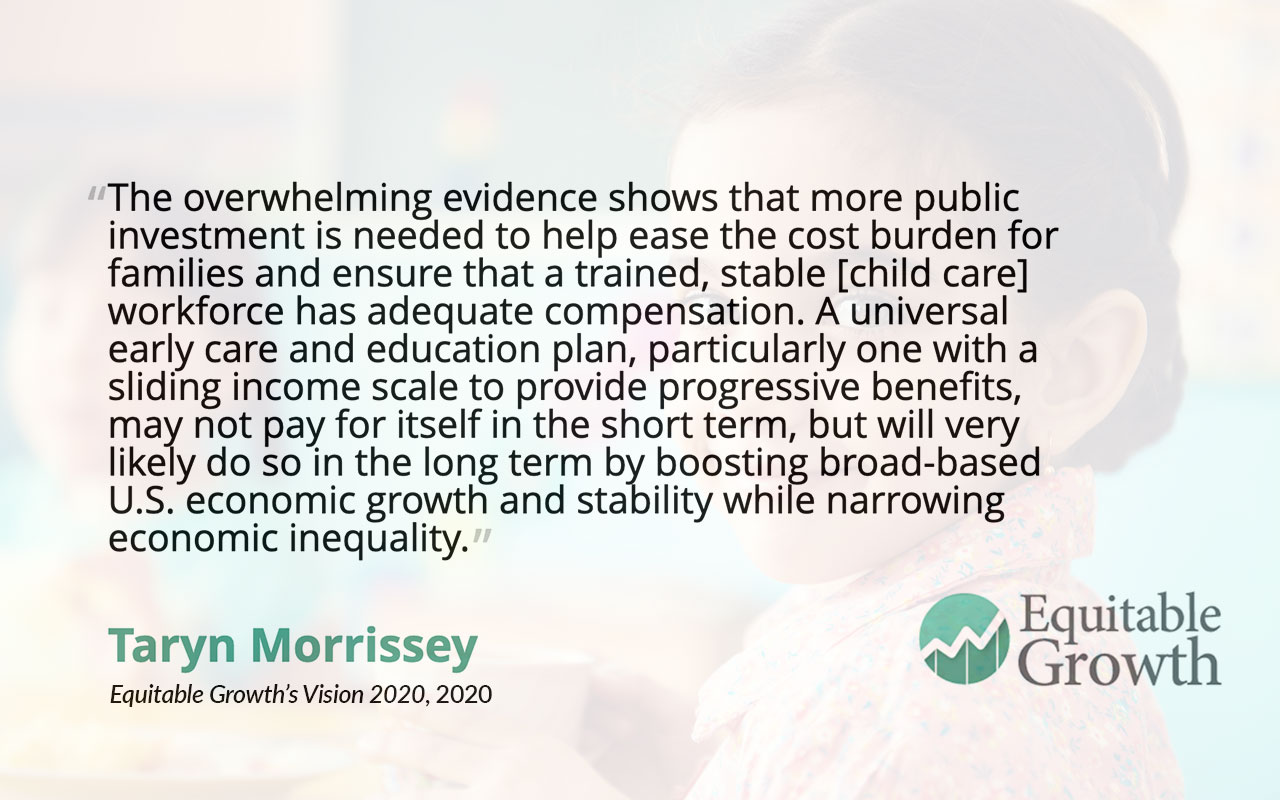
Quote from Taryn Morrissey

Corey Shdaimah

University of Maryland, Baltimore

Corey Shdaimah (opens in a new tab) is the Daniel Thursz Distinguished Professor of Social Justice at the University of Maryland School of Social Work. Her research focuses on the policy implications of child care, dependency court, and street-based sex work. Recent media appearances focus on the U.S. child care sector, including the failure to support families and providers (opens in a new tab) who bear care responsibilities. In 2021, she received an Equitable Growth grant, alongside Bweikia Steen of George Mason University and Elizabeth Palley of Adelphi University, to study the various challenges facing informal, home-based child care providers in the United States—a relatively unstudied group. She is also the co-author, with Palley, of In Our Hands: The Struggle for U.S. Child Care Policy (opens in a new tab) (NYU Press, 2017), a book that explores why there hasn’t been much policy action to improve the U.S. child care industry.

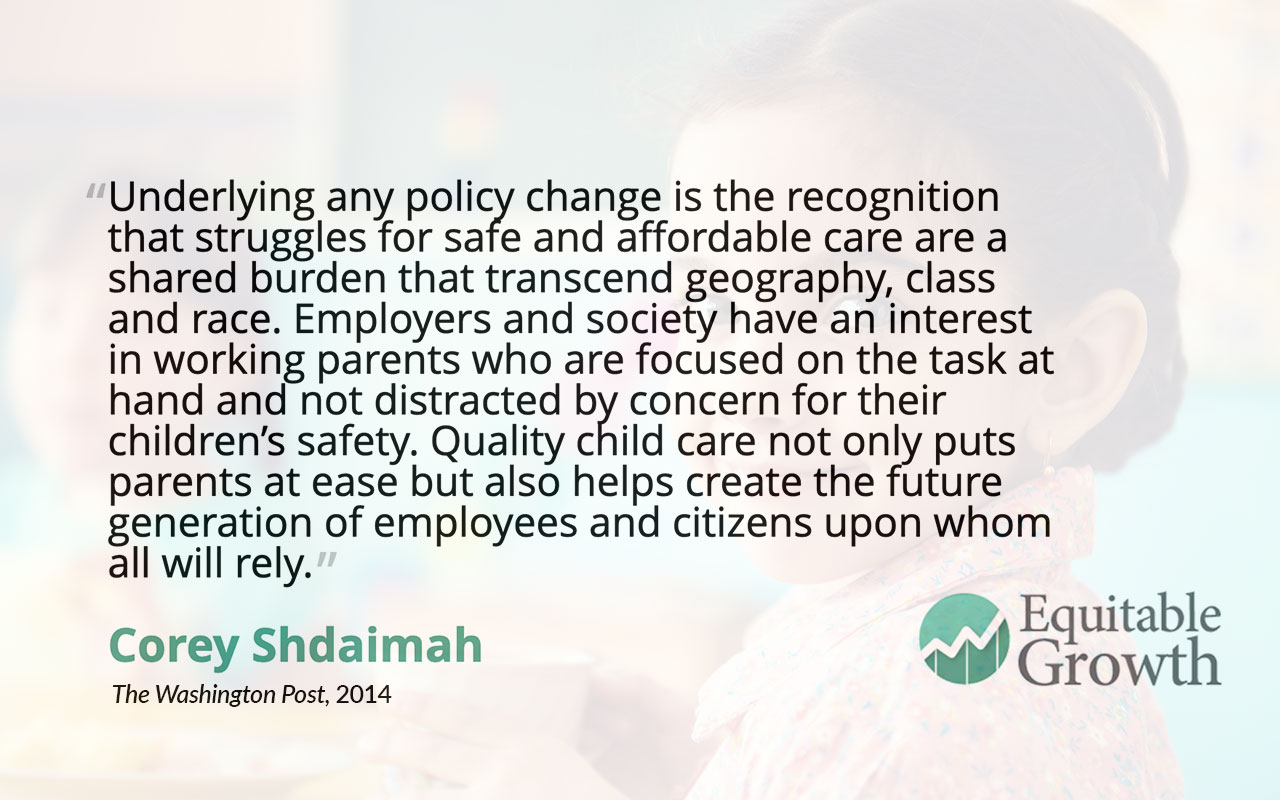
Quote from Corey Shdaimah

Equitable Growth is building a network of experts across disciplines and at various stages in their career who can exchange ideas and ensure that research on inequality and broadly shared growth is relevant, accessible, and informative to both the policymaking process and future research agendas. Explore the ways you can connect with our network or take advantage of the support we offer here (opens in a new tab).

Related

Your Direct Line to Cutting-Edge Research

Get updates on our latest research, event announcements, and policy insights delivered straight to your inbox. Stay connected with the leading voices on equitable growth.