


Terms and conditions for generative AI users outline a new legal framework that puts U.S. consumers at risk
Essays AUG 20, 2026
By: Chiara Chanoi
MAY 7, 2019

Antitrust and competition issues are receiving renewed interest, and for good reason. So far, the discussion has occurred at a high level of generality. To address important specific antitrust enforcement and competition issues, the Washington Center for Equitable Growth has launched this blog, which we call “Competitive Edge (opens in a new tab).” This series features leading experts in antitrust enforcement on a broad range of topics: potential areas for antitrust enforcement, concerns about existing doctrine, practical realities enforcers face, proposals for reform, and broader policies to promote competition. Jonathan B. Baker, Nancy L. Rose, Steven C. Salop, and Fiona Scott Morton have authored this month’s contribution.
The octopus image, above, updates an iconic editorial cartoon (opens in a new tab) first published in 1904 in the magazine Puck to portray the Standard Oil monopoly. Please note the harpoon. Our goal for Competitive Edge is to promote the development of sharp and effective tools to increase competition in the United States economy.

Jonathan B. Baker

Nancy L. Rose

Steven C. Salop

Fiona Scott Morton
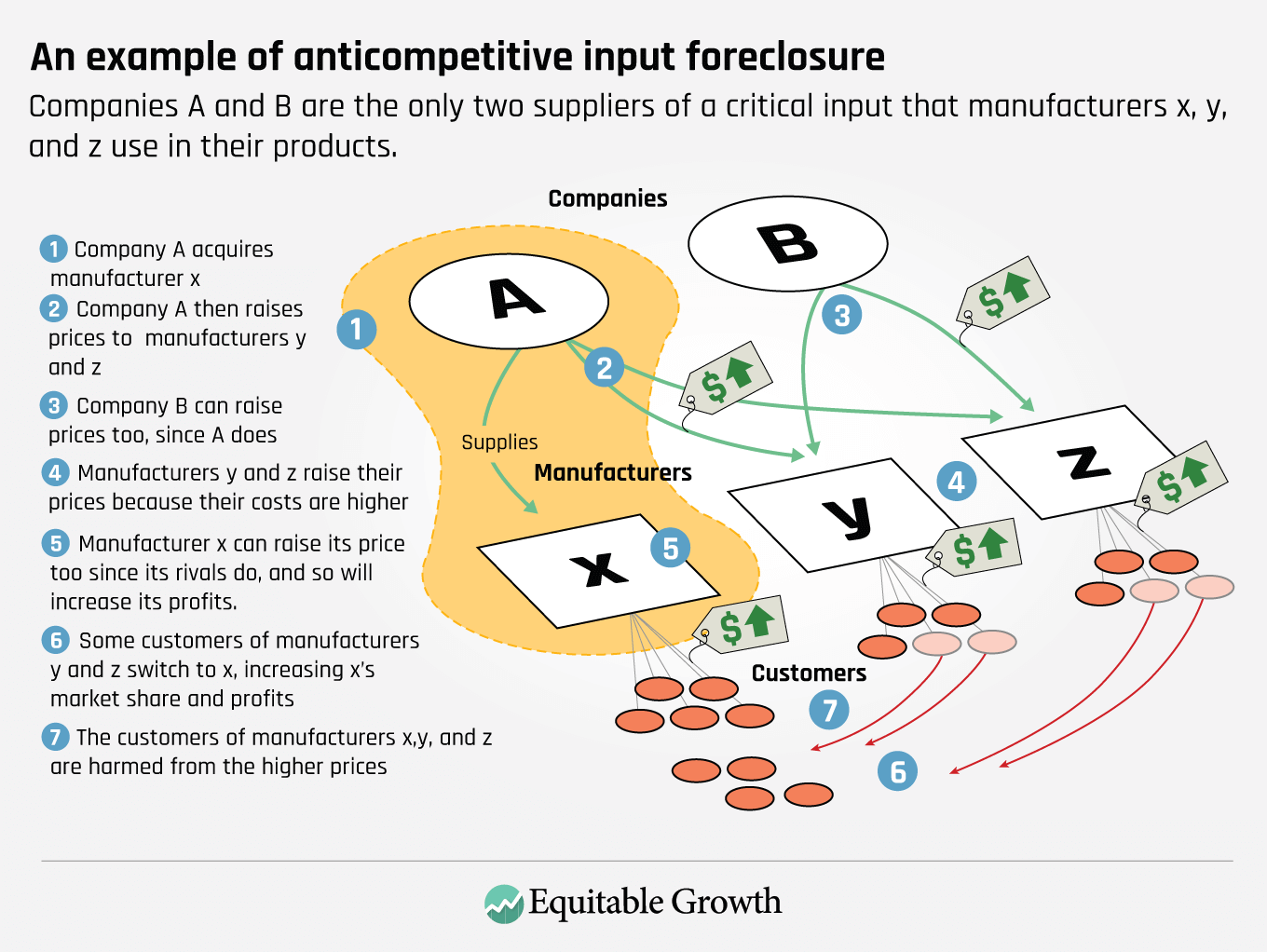
Most discussions of U.S. merger policy focus on horizontal mergers. These are transactions that combine firms at the same level of production, such as would have occurred in the wireless phone telecommunications sector when AT&T Inc. Attempted to acquire T-Mobile US, Inc. By contrast, vertical mergers combine firms at different levels of production, such as when AT&T acquired Time Warner in 2018. Vertical merger analysis also applies to the combination of firms producing complementary products, such as when Ticketmaster Entertainment LLC acquired the live events promotion company LiveNation.
U.S. antitrust laws cover vertical mergers, and the Federal Trade Commission and the Antitrust Division of the U.S. Department of Justice investigate them. Until the recent AT&T/Time Warner case, however, the agencies had not litigated a vertical merger in court for 40 years (opens in a new tab). There are only about two vertical merger enforcement actions per year across the two agencies. These are seldom resolved with divestitures or merger abandonments, but rather are routinely settled with consent decrees that regulate behavior (opens in a new tab).
There seems to be consensus that the DOJ’s 1984 Vertical Merger Guidelines (opens in a new tab), now 35 years old, reflect neither modern theoretical and empirical economic analysis nor current agency enforcement policy (opens in a new tab). There also is little dispute that antitrust enforcement should be based on rigorous economic analysis. Yet widely divergent views of preferred enforcement policies were expressed by the FTC’s commissioners when resolving office supply company Staples, Inc.’s acquisition of Essendant (opens in a new tab) and Fresenius Medical Care AG’s acquisition of NxStage (opens in a new tab), by the various amicus briefs filed in connection with the appellate review of the Justice Department’s unsuccessful challenge to AT&T’s acquisition of Time Warner (here (opens in a new tab), here (opens in a new tab), and here (opens in a new tab)), by Assistant Attorney General Makan Delrahim (opens in a new tab), by the participants the FTC’s competition policy hearing on vertical mergers (opens in a new tab), and by two of us (here (opens in a new tab), here (opens in a new tab), and here (opens in a new tab)).
This broad range of views suggests the difficulty that the two federal antitrust enforcement agencies will face in formulating new vertical merger guidelines. The D.C. Circuit’s decision in United States v. AT&T (opens in a new tab) offered some guidance by applying the same legal standards for vertical mergers as are applied to horizontal mergers, but the court left substantial gaps that the agencies will need to fill.
Based on our review of the economic literature on vertical integration and our experience analyzing vertical mergers, we are concerned that there is too little vertical merger enforcement. Recent empirical studies have identified a number of cases in which vertical mergers have led to higher prices (opens in a new tab). And a recent private antitrust case successfully attacked a merger (opens in a new tab) that was both vertical and horizontal and had been cleared by the Justice Department in 2012 with no remedy.
We recommend an approach to reduce false negatives, which erroneously allow mergers that harm competition, while keeping low the risk of false positives, which erroneously condemn mergers that are pro-competitive. Our analysis focuses on oligopoly markets where vertical mergers are most likely to raise concerns and most likely to be subject to agency investigation and enforcement. Oligopoly markets are those with a small number of competitors and barriers to entry, where the firms take rivals’ responses into account when making market decisions. These include digital markets where production economies of scale and network effects can create oligopoly structures and entry barriers, leading to the exercise of market power and raising competitive concerns with vertical mergers.
We recommend that the two antitrust agencies adopt the following five principles to guide vertical merger enforcement, which we discuss in more detail in our longer article (opens in a new tab).
We set out several possible presumptions here that could be invoked when at least one of the markets is concentrated. These identify conditions under which economic analysis suggests that the merger creates the greatest likelihood of anti-competitive effects. By successfully establishing a presumption, the plaintiff would satisfy its prima facie case, thereby shifting the burden of production to the merging firms. These presumptions are:

If the two antitrust enforcement agencies adopt any or all of the presumptions, then they should allow them to be rebutted by evidence showing that anti-competitive effects are unlikely. Hence none of the presumptions would create a per se prohibition of vertical mergers. The agencies also should continue to investigate vertical mergers that raise competitive concerns even if these presumptions are not applied. These presumptions set out conditions where concerns are greatest. These are not the only conditions where there are potential concerns.
Vertical mergers can substantially harm competition. Adopting these five principles will anchor effective vertical merger enforcement by reducing false negatives while keeping false positives low. We hope the agencies will follow our recommendations. These recommendations also could be useful to the courts, or if the Congress decides to amend Section 7 of the Clayton Antitrust Act.
The authors are: Jonathan Baker (research professor of law, American University Washington College of Law; chief economist, Federal Communications Commission, 2009–2011; director, Bureau of Economics, Federal Trade Commission, 1995–1998); Nancy L. Rose (Charles P. Kindleberger Professor of applied economics and department head, Massachusetts Institute of Technology; deputy assistant attorney general for Economic Analysis, U.S. Department of Justice, 2014–2016); Steven C. Salop (professor of economics and law, Georgetown University Law Center); and Fiona Scott Morton (Theodore Nierenberg Professor of economics at the Yale School of Management; deputy assistant attorney general for Economic Analysis, U.S. Department of Justice, 2011–2012). The issues discussed in this column are examined in more detail in the authors’ longer article that will be published this summer in Antitrust magazine (opens in a new tab).
Essays AUG 20, 2026
By: Chiara Chanoi
Blog JAN 6, 2026
By: Equitable Growth
Blog JAN 5, 2026
By: Equitable Growth
Get updates on our latest research, event announcements, and policy insights delivered straight to your inbox. Stay connected with the leading voices on equitable growth.