


Skip to content
Browse All Resources
Blog

MAR 27, 2019

Competitive Edge: Crafting a monopolization law for our time

Competitive Edge: Crafting a monopolization law for our time

Abstract

Antitrust and competition issues are receiving renewed interest, and for good reason. So far, the discussion has occurred at a high level of generality. To address important specific antitrust enforcement and competition issues, the Washington Center for Equitable Growth has launched this blog, which we call “Competitive Edge (opens in a new tab).” This series features leading experts in antitrust enforcement on a broad range of topics: potential areas for antitrust enforcement, concerns about existing doctrine, practical realities enforcers face, proposals for reform, and broader policies to promote competition. Andrew I. Gavil has authored this month’s contribution.

The octopus image, above, updates an iconic editorial cartoon (opens in a new tab) first published in 1904 in the magazine Puck to portray the Standard Oil monopoly. Please note the harpoon. Our goal for Competitive Edge is to promote the development of sharp and effective tools to increase competition in the United States economy.


Andrew I. Gavil

Antitrust policy is not a typical candidate for vibrant public debate, but these are not typical times. Concerns about rising corporate concentration (opens in a new tab), an increased incidence of market power (opens in a new tab) in some sectors of the U.S. economy, and evidence of growing wealth and income inequality (opens in a new tab) are the triggers for this debate—one that pits advocates of radical reforms against defenders of the status quo.

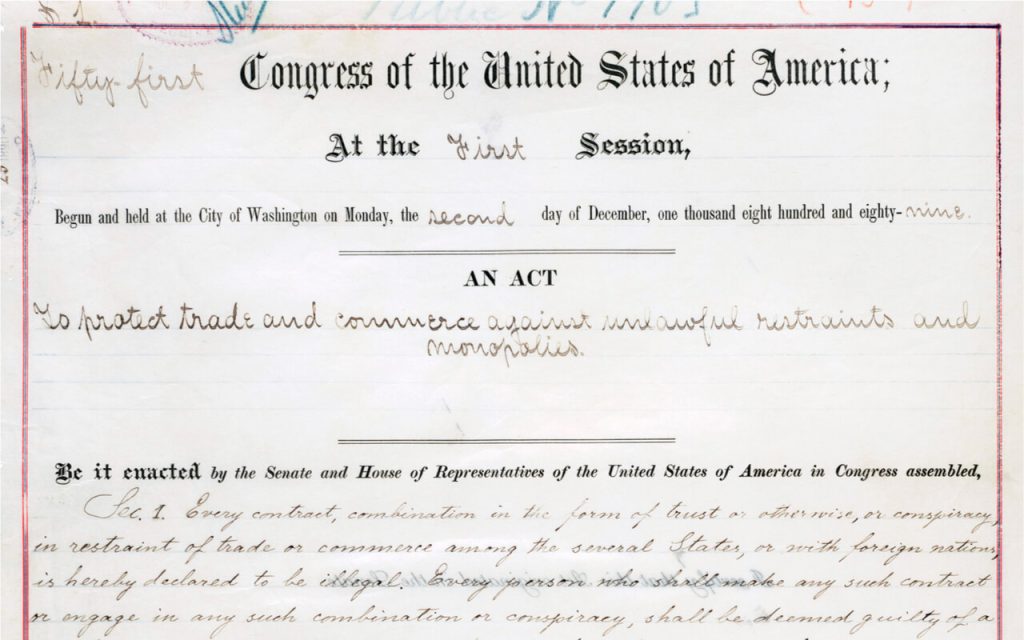
Much of the debate is focused on the effectiveness of Section 2 of the Sherman Antitrust Act of 1890, the first federal law to outlaw monopolistic business practices by single, powerful firms. As it has been interpreted by the Supreme Court over many decades, however, Section 2 has been largely circumscribed to the point where major government prosecutions are rare and few private challenges succeed.

If Section 2 is to be an effective tool for policing and deterring anti-competitive conduct in today’s economy, then it will need to be adjusted for the needs of our time. But first it is important to understand how Section 2 became so limited in scope, beginning with the origins of the Sherman Act.

Fear of “false positives” led the Supreme Court to further constrain Section 2

The Court acknowledged and endorsed this “gap” between Sections 1 and 2 of the Sherman Act in its 1984 Copperweld Corporation v. Independence Tube Corporation (opens in a new tab) decision. In its view, the Sherman Act’s framers intended it by design, so unilateral conduct would be treated more permissively than the concerted conduct prohibited by Section 1, for fear of discouraging aggressive but competitive conduct by single firms. But that proposition was wholly at odds with Standard Oil’s view that Sections 1 and 2 were intended to be complementary, leaving no gap at all.

Copperweld more so reflected the 1980s Supreme Court’s perception that prior decisions of the Court had established standards of conduct that were too strict, as well as its fear of false positives, than anything intended by the 1890 Congress. Nevertheless, this view of Section 2 as it applies to the attempt-to-monopolize offense was cemented into contemporary law by the Supreme Court in Spectrum Sports, Inc. V. McQuillan (opens in a new tab) (1993), where, citing Swift and Copperweld, the Court held that “the plaintiff charging attempted monopolization must prove dangerous probability of actual monopolization, which has generally required a definition of the relevant market and examination of market power.”

This preference for circumstantial evidence was arguably extended even further by the Supreme Court’s recent 2018 decision in State of Ohio v. American Express, which appeared to conclude in a controversial footnote that defining a relevant market and inferring market power are necessary prerequisites to the assessment of the competitive impact of all “vertical” conduct, even under Section 1, regardless of the availability of more direct evidence that it has had an adverse impact on competition.

The Alcoa decision also had endorsed some of the most important and equally durable propositions about Section 2—that “monopoly” alone is not an offense of Section 2 and that to “monopolize” also requires exclusionary conduct, which must be distinguished from “superior skill, foresight and industry.” Judge Hand proclaimed in that ruling that “[t]he successful competitor, having been urged to compete, must not be turned upon when he wins.” But Hand also famously observed that “possession of unchallenged power deadens initiative, discourages thrift and depresses energy; that immunity from competition is a narcotic, and rivalry a stimulant, to industrial progress.”

The Court in Alcoa expressed the view that it might be necessary to tolerate monopoly occasionally, but that was not to say it was desirable. Although Judge Hand’s application of these principles to the facts of Alcoa has been criticized and might not be followed today, these core principles have largely proved enduring and have guided the law of monopolization for more than seven decades in cases such as Aspen Skiing Company v. Aspen Highlands Skiing Corporation (opens in a new tab) (1985) and United States v. Microsoft Corporation (opens in a new tab) (2001).

More recent pronouncements from the Supreme Court addressing exclusionary conduct, however, embrace a different and far more cautious narrative. Like Copperweld, Brooke Group Ltd. V. Brown & Williamson Tobacco Corporation (opens in a new tab) (1993) and Verizon Communications, Inc. V. Law Offices of Curtis V. Trinko, LLP (opens in a new tab) (2004) have emphasized concern for false positives and fear that liability standards that are too easy to satisfy will inhibit competition, especially innovation, by both dominant incumbents and rivals alike. And, in contrast to Alcoa, the Court in Trinko reasoned that “the opportunity to charge monopoly prices—at least for a short period—is what attracts ‘business acumen’ in the first place.” This supposition about monopoly transforms Alcoa’s grudging acceptance into a near embrace and ignores that the dream of monopoly is hardly the motivation that drives most firms to compete. Profits, maybe, but true “monopoly prices?” The embedded assumptions in such cases, layered onto the highly formalistic framework established by Swift and Alcoa, have no doubt limited the reach of Section 2.

Time to reinterpret exclusionary conduct to account for the challenges of the 21st century U.S. economy

Fortunately, our understanding of “exclusionary” conduct has advanced, as has our understanding of market power. Exclusionary conduct cases such as Microsoft have provided a structured, burden-shifting framework for evaluating claims of exclusionary conduct within the reasonableness framework first identified by Standard Oil. In addition, the federal government’s Horizontal Merger Guidelines (opens in a new tab) aptly identify the focus of most of modern competition law when they state that their “unifying theme” is that “mergers should not be permitted to create, enhance, or entrench market power or to facilitate its exercise.”

A modern approach to unilateral conduct could draw upon these advances. It might start by revisiting and refreshing the meaning of the common law terminology of Section 2. Such a modern framework could:

Such an approach would prohibit exclusionary conduct (unilateral or concerted) that significantly contributes to the creation, entrenchment, or enhancement of market power, allowing for methods of proving power through alternatives to defining markets and calculating market shares.

This more contemporary approach would be more consonant with trends in most other modern antitrust law. It would untether the law of exclusionary conduct from blind and formalistic reliance on market-share benchmarks, while also allowing for cognizable and verifiable efficiency justifications. In theory, Section 2’s common law origins should allow for this kind of evolution in the courts (opens in a new tab), but it might instead require legislative reform. In the end, under either approach, change would open up needed space for Section 2 to begin to evolve once again, as has Section 1, so it could adapt to the needs of our time.

Conclusion

In support of their current-day agendas, some of the most vocal advocates in today’s debates have turned to the past, invoking the words and ideas of former Supreme Court Justice Louis D. Brandeis, who championed progressive competition-law reforms in the early part of the 20th century, and former U.S. Court of Appeals Judge Robert H. Bork, one of the principal proponents of the Chicago School of Antitrust, who, in the late 1970s, influenced the modern shift toward a more economic approach to antitrust analysis, including a pronounced concern for false positives.

Although the collective wisdom of the past can surely inform today’s policy discussion, as smart as Brandeis and Bork were, they are best understood in the context of their own times, when they were responding to the issues and antitrust doctrine of their day. The economy of 2019 is not the economy of 1912 or 1978, and the antitrust doctrine of 2019 is not the same as that of 1912 or 1978.

To address the challenge of designing a monopolization law for our era, policymakers, advocates, and the courts will need to do more than selectively borrow from the ghosts of past antitrust debates to advance current-day agendas. What is required instead is the construction of a new and balanced consensus that can address the needs of this time.

—Andrew I. Gavil is a professor of law at Howard University School of Law. This posting is adapted from remarks delivered at the American Antitrust Institute’s Competition Roundtable, Challenging Monopolies in Court: Where Have We Been and Where Are We Going? (opens in a new tab), on March 14, 2019. The views expressed here are his own.

Related

ASSA 2026 Round-up: Day 3
Policy

ASSA 2026 Round-up: Day 3

Blog JAN 6, 2026

By: Equitable Growth

AI, Tech & Energy Competition & Economic Dynamism Economic Equity & Opportunity Labor, Wages & Worker Power Macroeconomics & Economic Measurement Taxation
ASSA 2026 Round-up: Day 2
Policy

ASSA 2026 Round-up: Day 2

Blog JAN 5, 2026

By: Equitable Growth

AI, Tech & Energy Competition & Economic Dynamism Economic Equity & Opportunity Household Economic Security Labor, Wages & Worker Power Macroeconomics & Economic Measurement Taxation

Your Direct Line to Cutting-Edge Research

Get updates on our latest research, event announcements, and policy insights delivered straight to your inbox. Stay connected with the leading voices on equitable growth.