


Resources
From peer-reviewed research to accessible policy briefs, explore the scholarship that’s shaping debates and driving change.

502 Results


Trump’s trade war with Canada grows increasingly costly as Section 338 tariffs harm both economies (opens in a new tab)
Essays SEP 22, 2026
President Donald Trump continues to escalate his administration’s perplexing trade spat with Canada through the expanded use of novel tariff powers in Section 338 of the Tariff Act of 1930.…
By: Christopher Bangert-Drowns (opens in a new tab)

New research shows how U.S. homeownership and the accumulation of housing wealth are linked to political participation (opens in a new tab)
Essays AUG 14, 2026
Persistent affordability pressures have driven up housing costs for millions of U.S. families in recent years. Home prices remain near record highs relative to incomes, mortgage rates and associated costs…
By: Carlos Fernando Avenancio-Leon (opens in a new tab)
Housing Wealth Accumulation and Electoral Representation (opens in a new tab)
Working Papers AUG 14, 2026
We document that housing wealth accumulation systematically differs among homeowners by their political participation. Using a nationwide voter-property dataset, we find that realized housing appreciation increases monotonically the more a…
By: Carlos F. Avenancio-León, Yutao He (opens in a new tab), Michael Reher (opens in a new tab)

Defining extreme wealth is more complicated than it looks (opens in a new tab)
Videos AUG 13, 2026
Facing high levels of income and wealth inequality and shrinking tax revenues, U.S. policymakers are showing increased interest in proposals to tax the richest households. Yet determining which households fall into that category is complex and changes based…
By: Equitable Growth (opens in a new tab)
The debt-to-wealth ratio: A missing lens on the U.S. government’s fiscal capacity (opens in a new tab)
Reports JUL 30, 2026
Few statistics shape the fiscal debate in the United States as powerfully as the ratio of federal debt-to-Gross Domestic Product. Debt held by the public recently surpassed 100 percent of…
By: Austin Clemens (opens in a new tab), David S. Mitchell (opens in a new tab)
 View Chart
(opens in a new tab)
View Chart
(opens in a new tab)
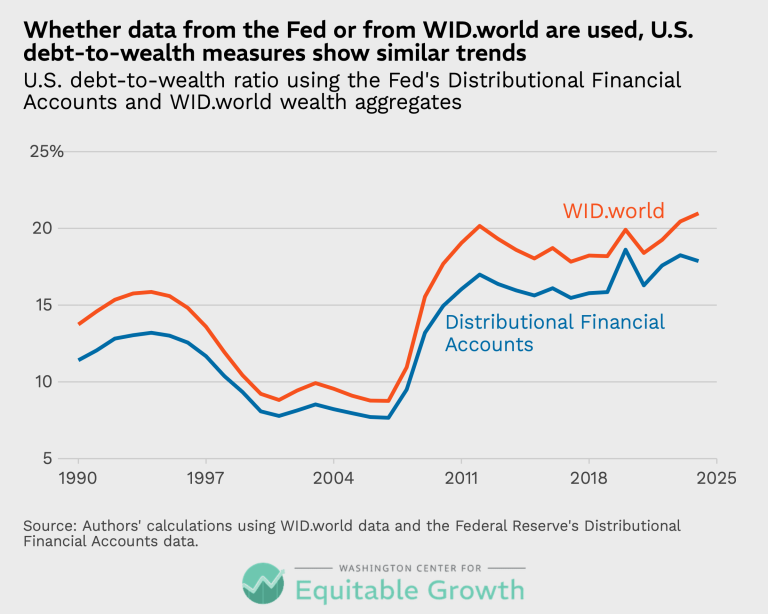
Whether data from the Fed or from WID.world are used, U.S. debt-to-wealth measures show similar trends (opens in a new tab)
Visualizations JUL 22, 2026
 View Chart
(opens in a new tab)
View Chart
(opens in a new tab)
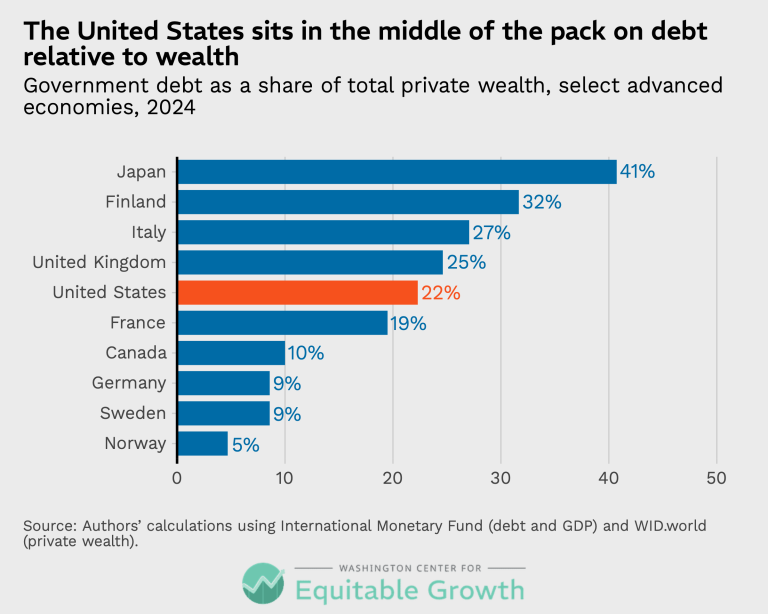
The United States sits in the middle of the pack on debt relative to wealth (opens in a new tab)
Visualizations JUL 22, 2026
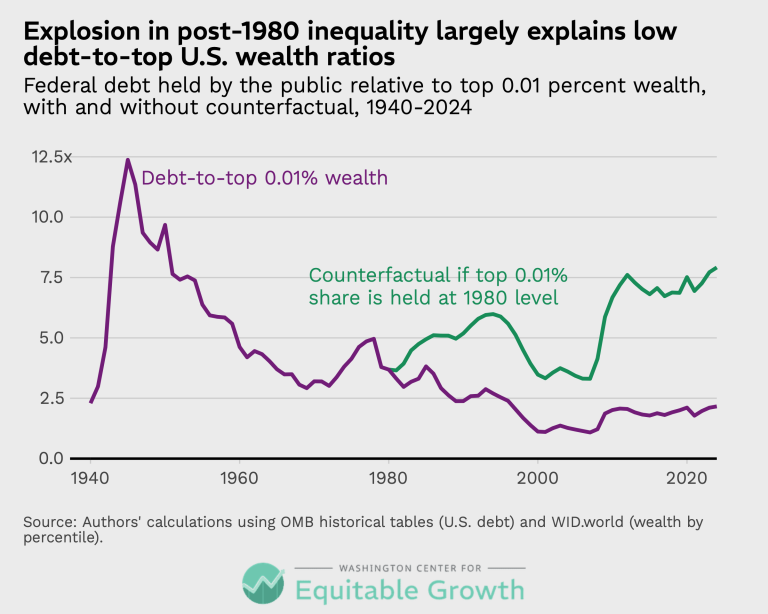 View Chart
(opens in a new tab)
View Chart
(opens in a new tab)
Explosion in post-1980 inequality largely explains low debt-to-top U.S. wealth ratios (opens in a new tab)
Visualizations JUL 22, 2026
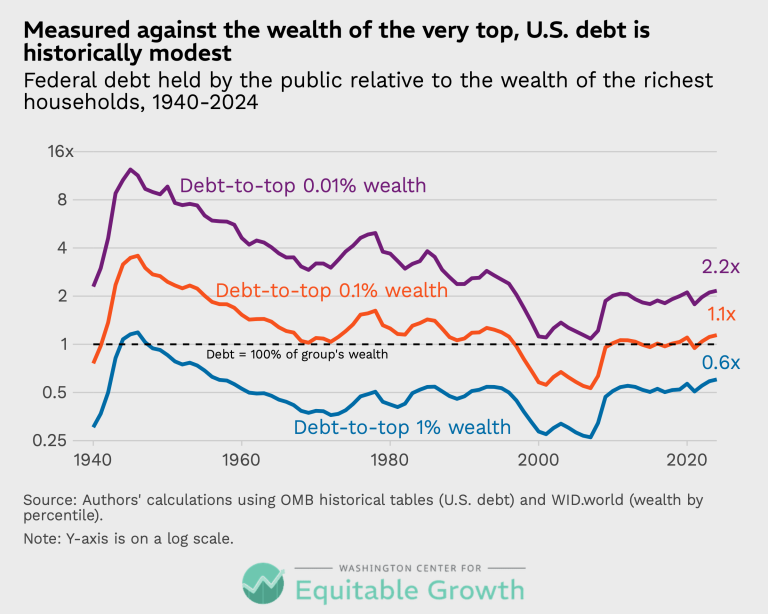 View Chart
(opens in a new tab)
View Chart
(opens in a new tab)
Measured against the wealth of the very top, U.S. debt is historically modest (opens in a new tab)
Visualizations JUL 22, 2026
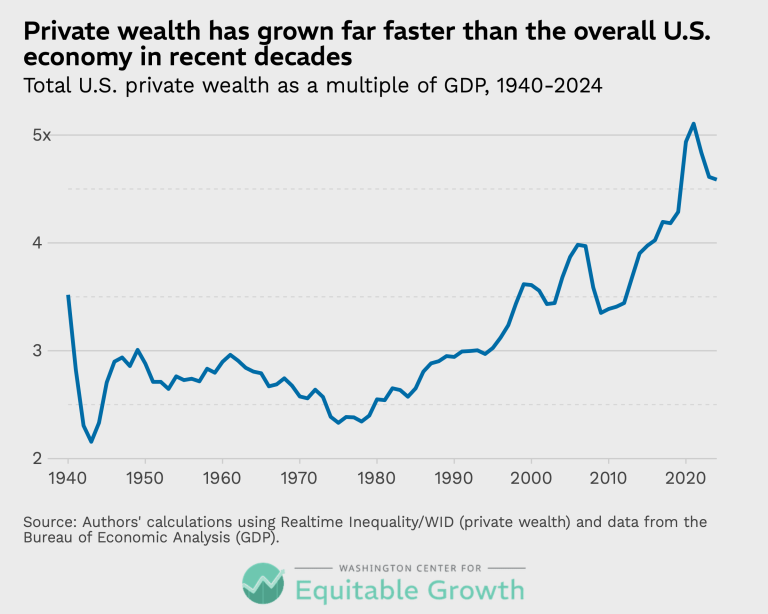 View Chart
(opens in a new tab)
View Chart
(opens in a new tab)
Private wealth has grown far faster than the overall U.S. economy in recent decades (opens in a new tab)
Visualizations JUL 22, 2026
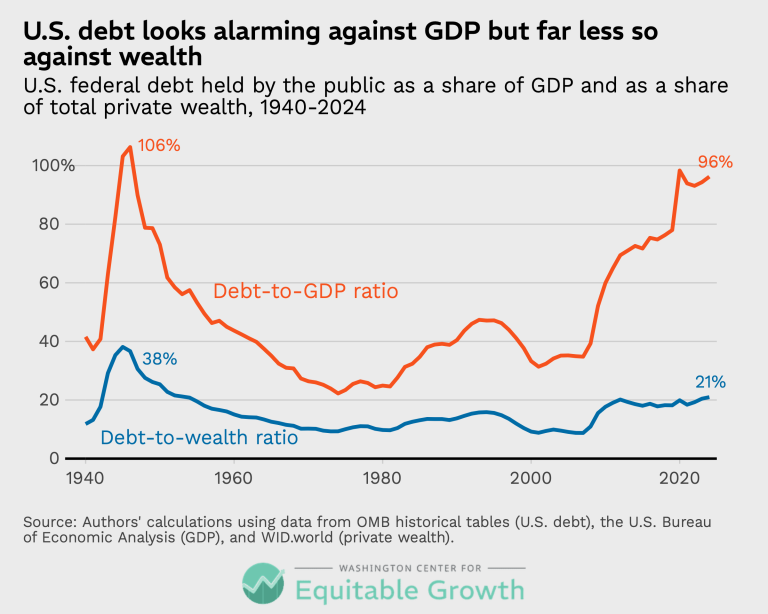 View Chart
(opens in a new tab)
View Chart
(opens in a new tab)
U.S. debt looks alarming against GDP but far less so against wealth (opens in a new tab)
Visualizations JUL 22, 2026

The costs of the Trump administration’s tariffs diverge for countries and industries so far in 2026 (opens in a new tab)
Essays JUL 14, 2026
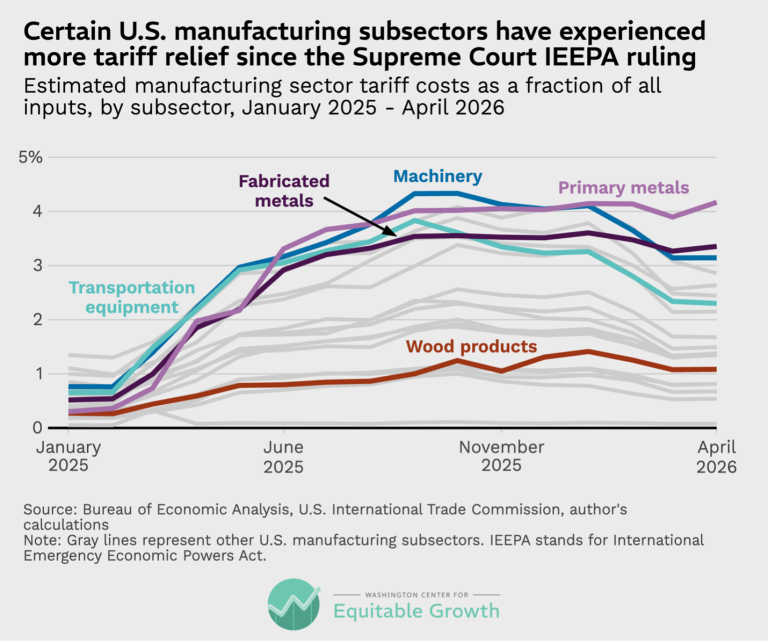
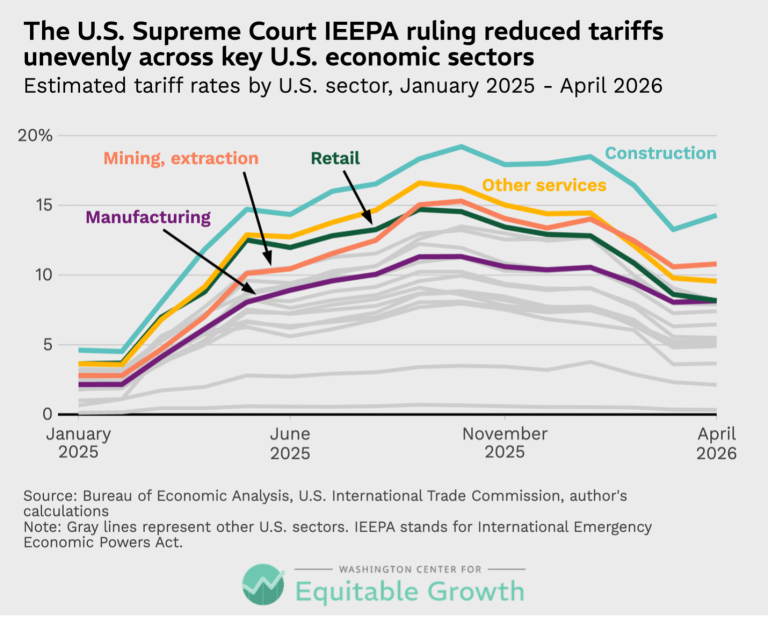
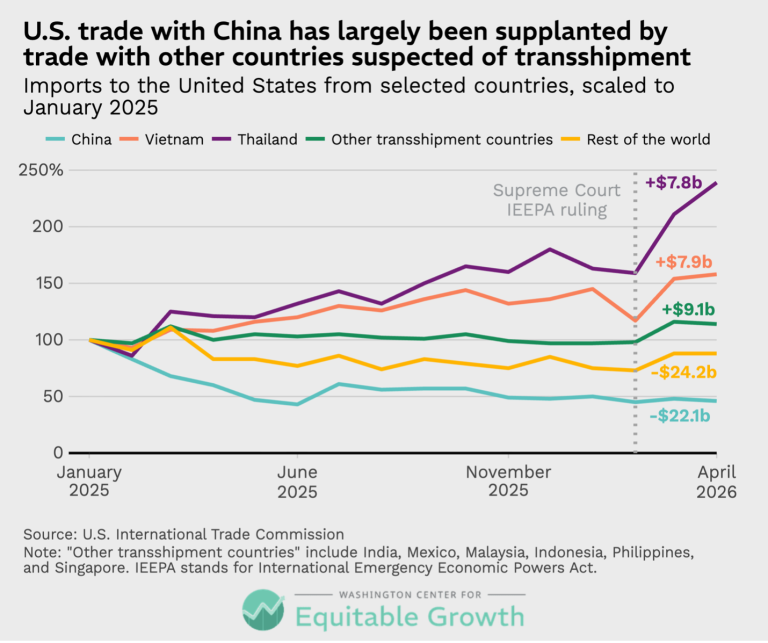
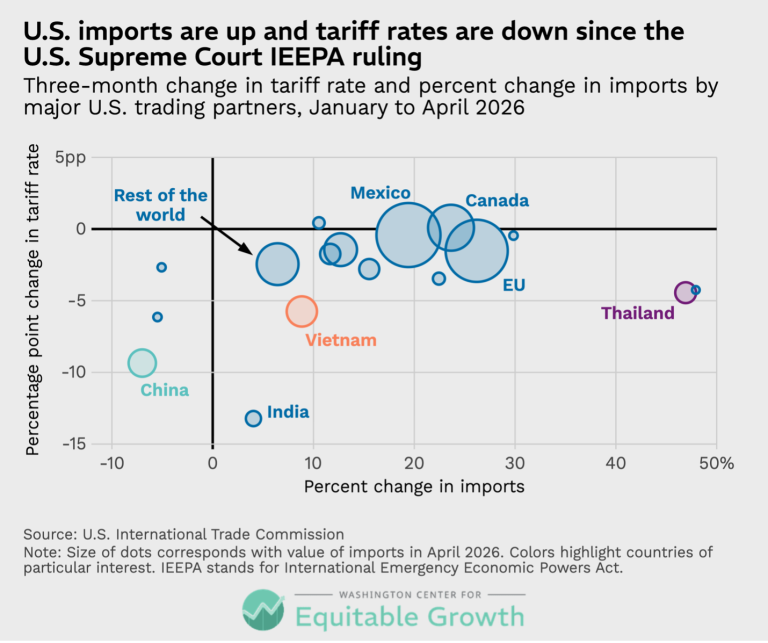
The first 4 months of 2026 saw continued seismic changes in U.S. trade policy. In late February, the U.S. Supreme Court struck down the Trump administration’s use of the International…
By: Christopher Bangert-Drowns (opens in a new tab)
 View Chart
(opens in a new tab)
View Chart
(opens in a new tab)
Certain U.S. manufacturing subsectors have experienced more tariff relief since the Supreme Court IEEPA ruling (opens in a new tab)
Visualizations JUL 13, 2026
 View Chart
(opens in a new tab)
View Chart
(opens in a new tab)
The U.S. Supreme Court IEEPA ruling reduced tariffs unevenly across key U.S. economic sectors (opens in a new tab)
Visualizations JUL 13, 2026
 View Chart
(opens in a new tab)
View Chart
(opens in a new tab)
U.S. trade with China has largely been supplanted by trade with other countries suspected of transshipment (opens in a new tab)
Visualizations JUL 13, 2026
 View Chart
(opens in a new tab)
View Chart
(opens in a new tab)
U.S. imports are up and tariff rates are down since the U.S. Supreme Court IEEPA ruling (opens in a new tab)
Visualizations JUL 13, 2026

U.S. workers will be hurt by immigration enforcement overreach (opens in a new tab)
Essays JUN 17, 2026
President Donald Trump last week signed the $70 billion Secure America Act, a budget reconciliation package that boosts funding for immigration and border enforcement agencies while imposing no limits on their authority.…
By: Christopher Bangert-Drowns (opens in a new tab)

Factsheet: Defining top U.S. income and wealth thresholds for tax policy (opens in a new tab)
Factsheets MAY 27, 2026
Federal and state policymakers in the United States, responding to high levels of income and wealth inequality and shrinking tax revenues, are increasingly interested in proposals to tax households with…
By: Austin Clemens (opens in a new tab)
Defining top wealth and income thresholds for U.S. tax policy design and analysis (opens in a new tab)
Reports MAY 27, 2026
Wealth and income inequality are an ongoing area of interest for policymakers. In particular, the rise of the richest of the rich—not just the top 1 percent, but also the…
By: Austin Clemens (opens in a new tab)
 View Chart
(opens in a new tab)
View Chart
(opens in a new tab)
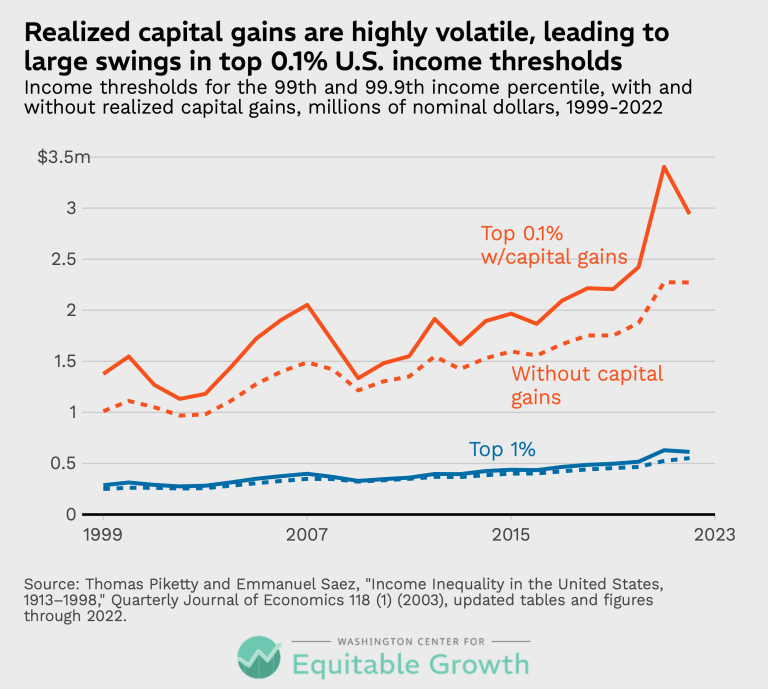
Realized capital gains are highly volatile, leading to large swings in the top 0.1% U.S. income thresholds (opens in a new tab)
Visualizations MAY 26, 2026

Is Taxing Wealth Possible? Practical? Desirable? Yes, if we’re smart about it (opens in a new tab)
Essays MAY 7, 2026
While the American economy has outperformed much of the industrialized world in recent years, there are good reasons to be deeply concerned about its long-term prospects. It is dogged by…
By: David S. Mitchell (opens in a new tab)
 View Chart
(opens in a new tab)
View Chart
(opens in a new tab)
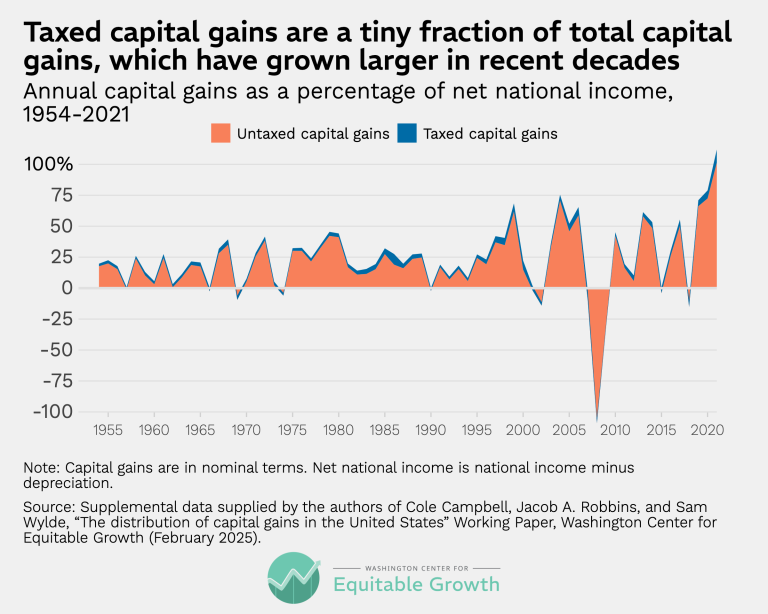
Taxed capital gains are a tiny fraction of total capital gains, which have grown larger in recent decades (opens in a new tab)
Visualizations MAY 6, 2026
 View Chart
(opens in a new tab)
View Chart
(opens in a new tab)
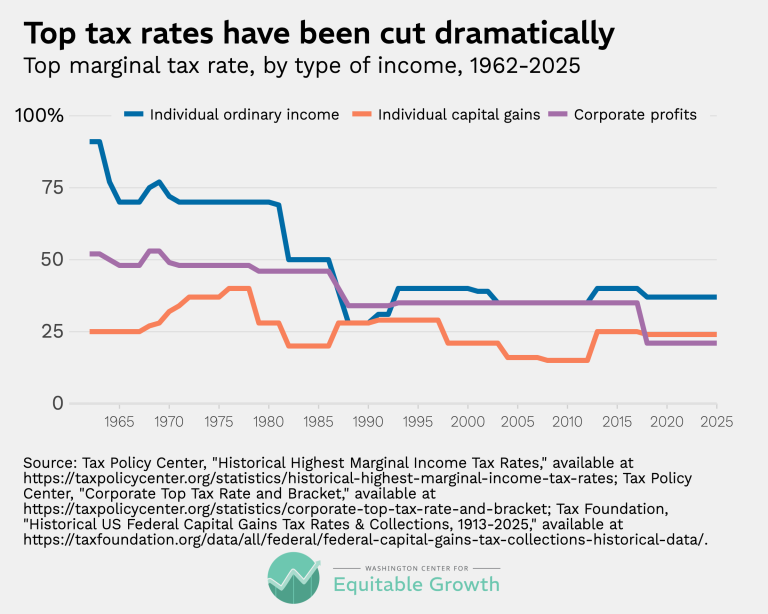
Top tax rates have been cut dramatically (opens in a new tab)
Visualizations MAY 6, 2026
 View Chart
(opens in a new tab)
View Chart
(opens in a new tab)
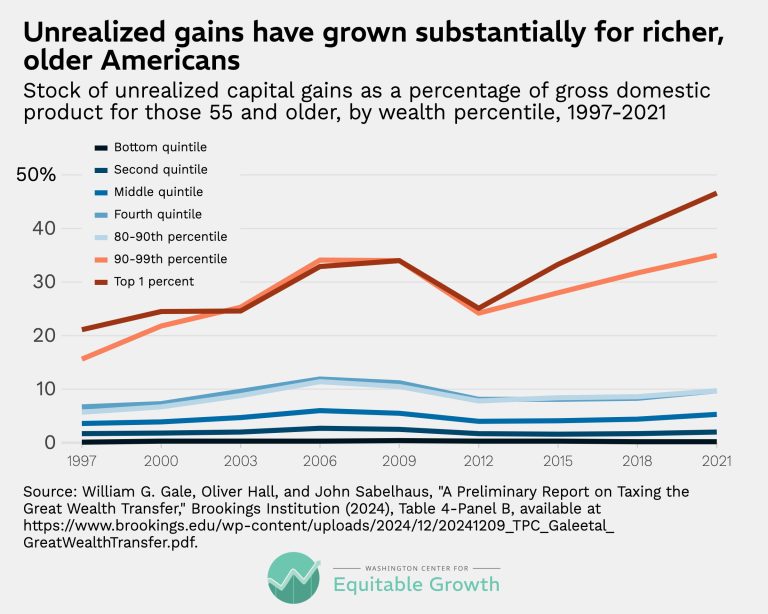
Unrealized gains have grown substantially for richer, older Americans (opens in a new tab)
Visualizations MAY 6, 2026
 View Chart
(opens in a new tab)
View Chart
(opens in a new tab)
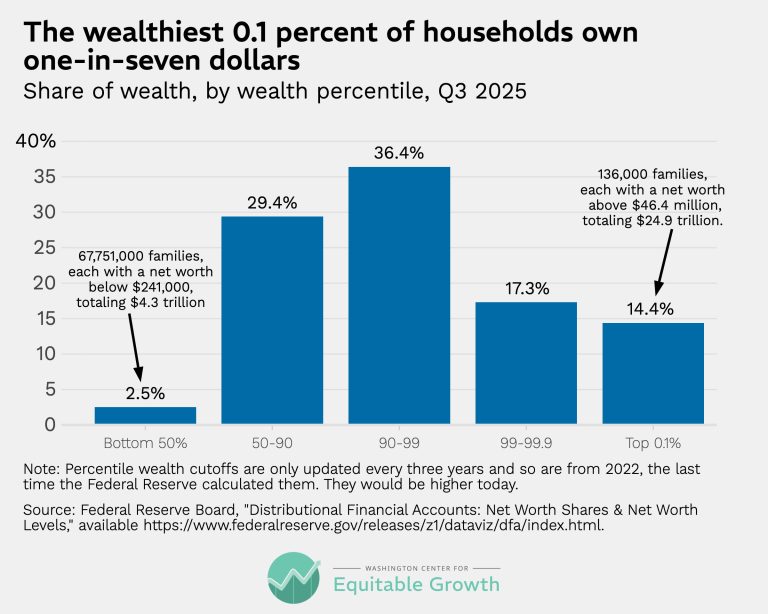
The wealthiest 0.1 percent of households own one-in-seven dollars (opens in a new tab)
Visualizations MAY 6, 2026
 View Chart
(opens in a new tab)
View Chart
(opens in a new tab)
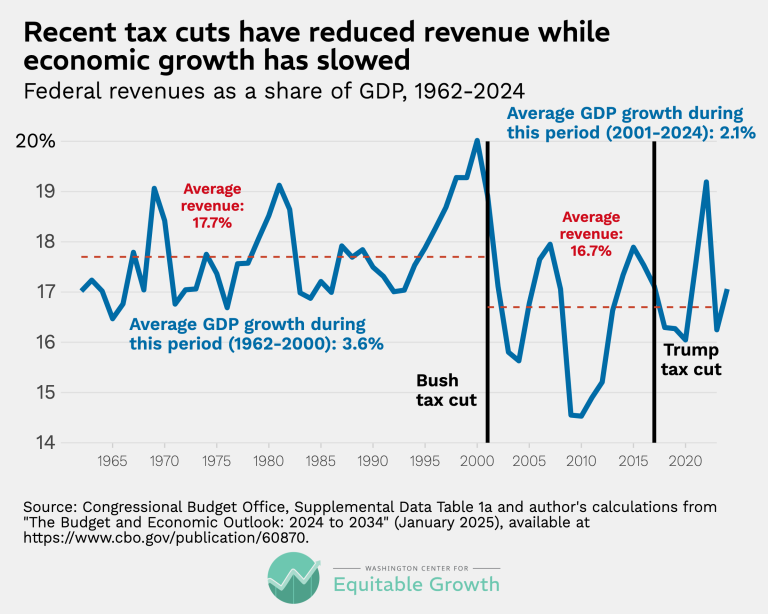
Recent tax cuts have reduced revenue while economic growth has slowed (opens in a new tab)
Visualizations MAY 6, 2026
 View Chart
(opens in a new tab)
View Chart
(opens in a new tab)
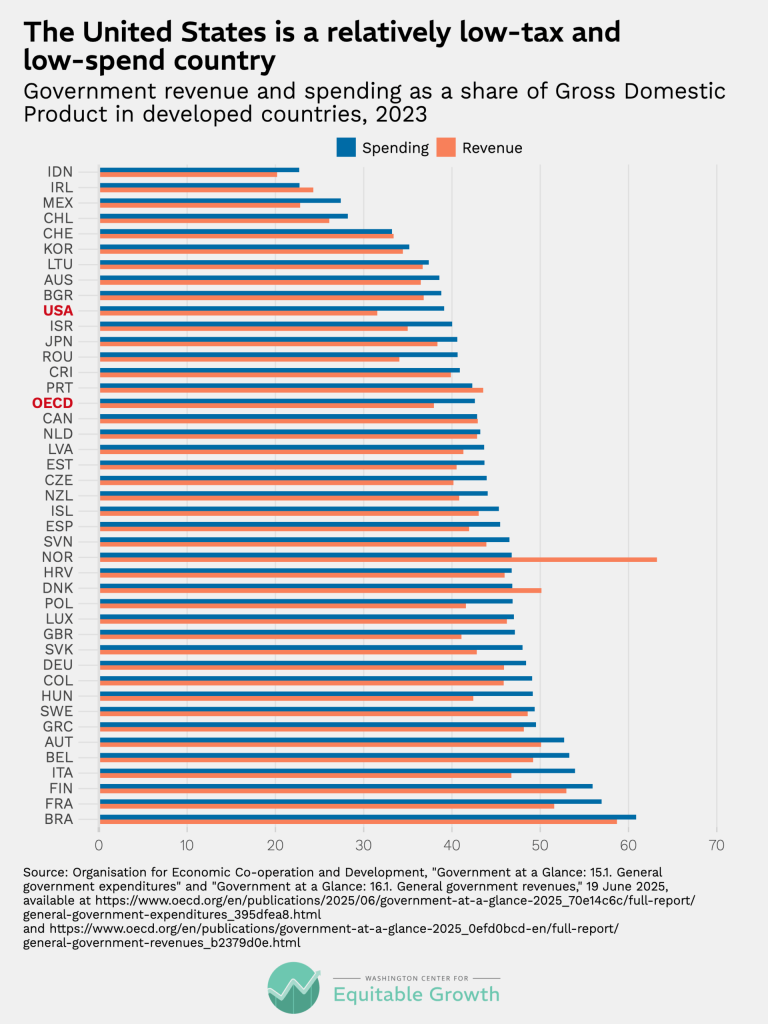
The United States is a relatively low-tax and low-spend country (opens in a new tab)
Visualizations MAY 6, 2026
 View Chart
(opens in a new tab)
View Chart
(opens in a new tab)
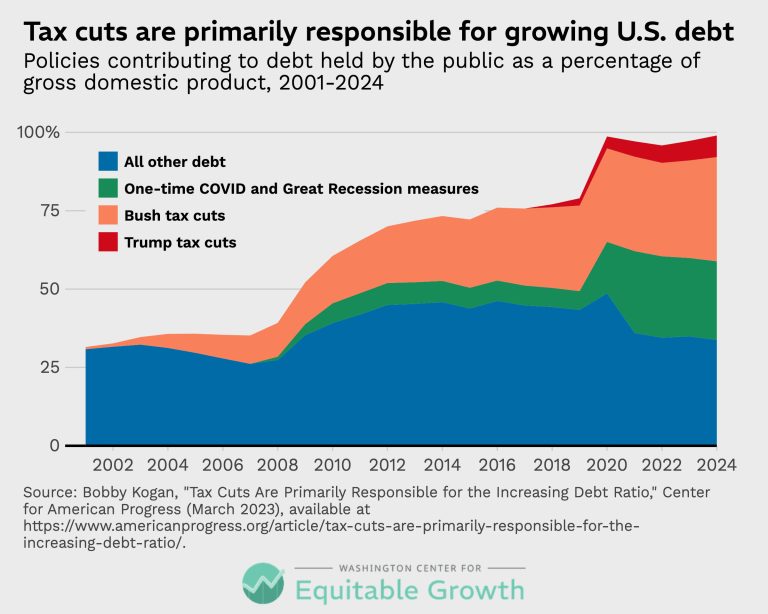
Tax cuts are primarily responsible for the growing U.S. debt (opens in a new tab)
Visualizations MAY 6, 2026
 View Chart
(opens in a new tab)
View Chart
(opens in a new tab)
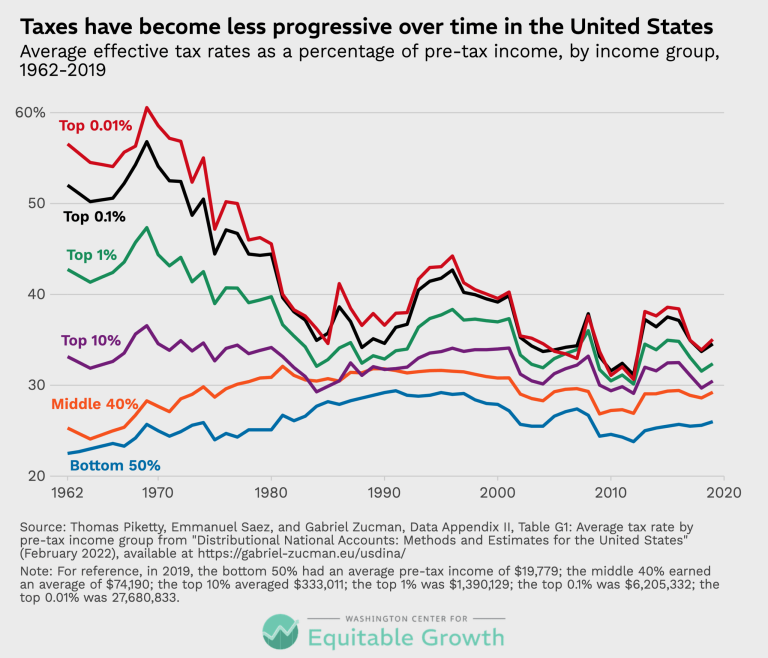
Taxes have become less progressive over time in the United States (opens in a new tab)
Visualizations MAY 6, 2026
 View Chart
(opens in a new tab)
View Chart
(opens in a new tab)
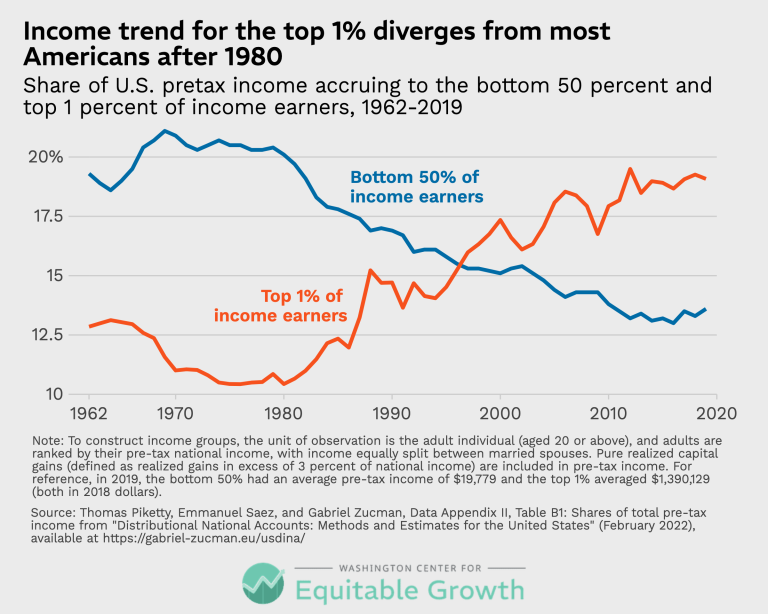
Income trend for the top 1% diverges from most Americans after 1980 (opens in a new tab)
Visualizations MAY 6, 2026

The other two-tiered U.S. tax system: How pass-through businesses let the ultra-wealthy dodge federal taxes (opens in a new tab)
Essays APR 15, 2026
Many Americans likely remember when the legendary value investor Warren Buffett drew attention to a glaring unfairness in the tax code by pointing out that he paid a lower effective…
By: David S. Mitchell (opens in a new tab)
 View Chart
(opens in a new tab)
View Chart
(opens in a new tab)
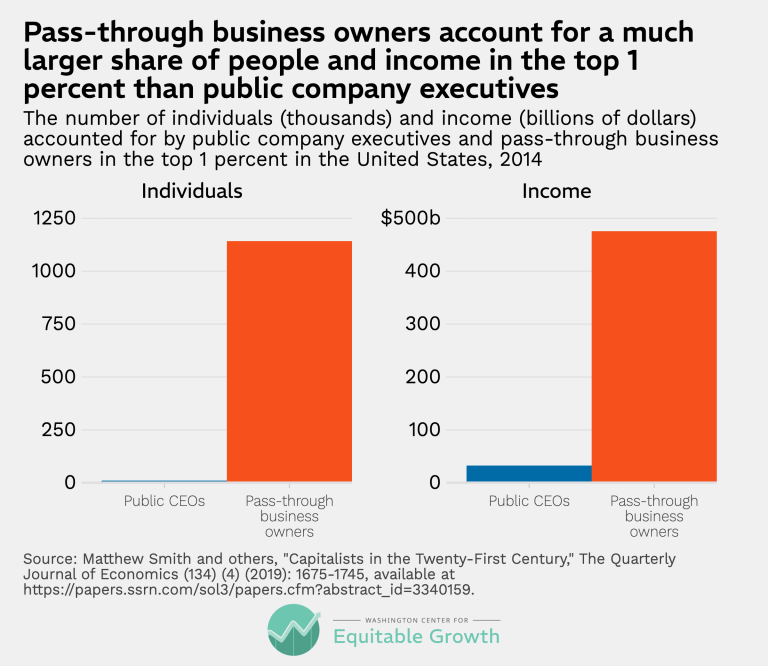
Pass-through business owners account for a much larger share of people and income in the top 1 percent than public company executives (opens in a new tab)
Visualizations APR 14, 2026
 View Chart
(opens in a new tab)
View Chart
(opens in a new tab)
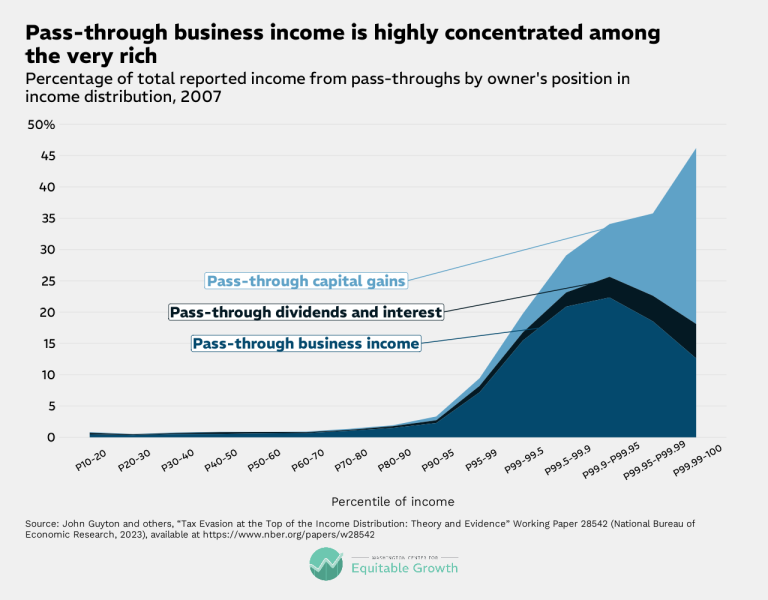
Pass-through business income is highly concentrated among the very rich (opens in a new tab)
Visualizations APR 14, 2026
Equitable Growth event covers tariffs, tariff uncertainties, and the limits of U.S. trade policy (opens in a new tab)
Videos APR 1, 2026
The Washington Center for Equitable Growth recently hosted a webinar examining the economic, fiscal, and labor‑market effects of evolving U.S. tariff laws and regulations, particularly in the wake of the…
By: Christopher Bangert-Drowns (opens in a new tab)

Tariff policies in 2025 increased input costs for key U.S. industries, threatening growth and investment (opens in a new tab)
Essays MAR 24, 2026
All tariffs are not created equal. Throughout U.S. history, policymakers have imposed import taxes for a variety of economic and ideological reasons, with varying impacts. Targeted tariffs have been effective…
By: Christopher Bangert-Drowns (opens in a new tab)
 View Chart
(opens in a new tab)
View Chart
(opens in a new tab)
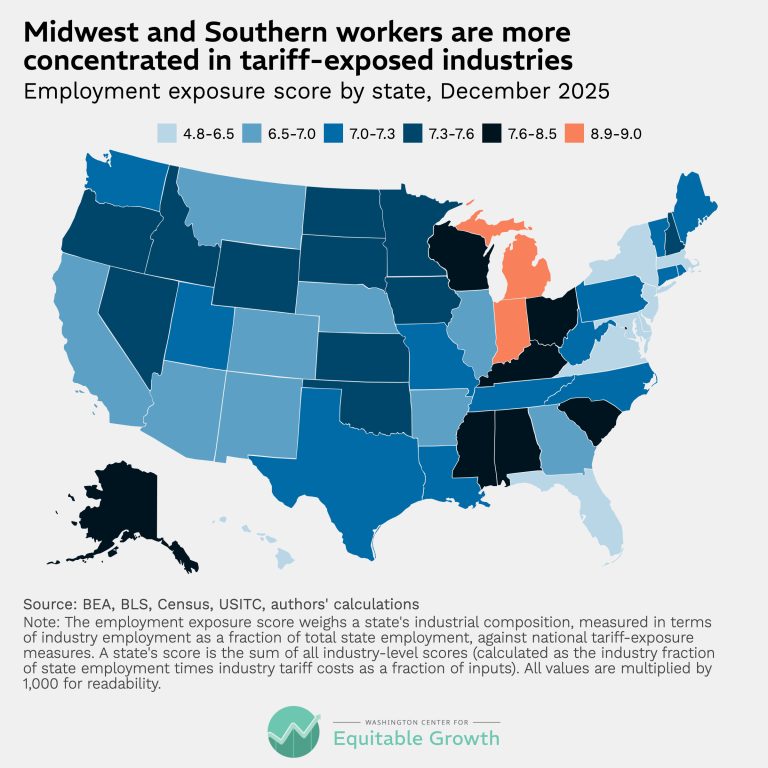
Midwest and Southern workers are more concentrated in tariff-exposed industries (opens in a new tab)
Visualizations MAR 17, 2026
 View Chart
(opens in a new tab)
View Chart
(opens in a new tab)
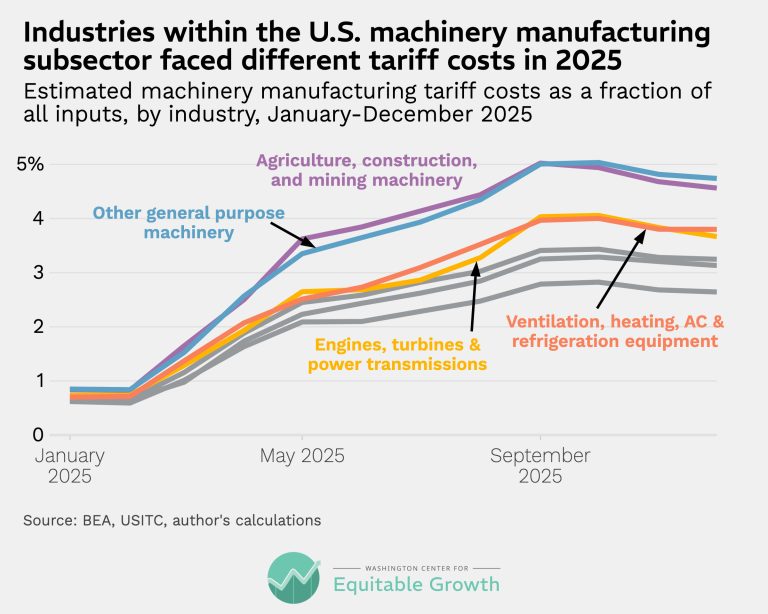
Industries within the U.S. machinery manufacturing subsector faced different tariff costs in 2025 (opens in a new tab)
Visualizations MAR 17, 2026
 View Chart
(opens in a new tab)
View Chart
(opens in a new tab)
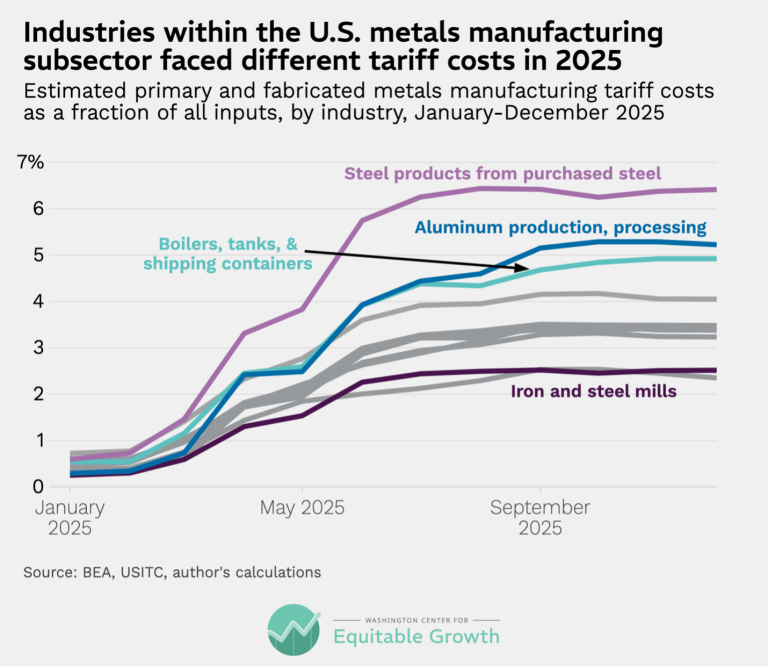
Industries within the U.S. metals manufacturing subsector faced different tariff costs in 2025 (opens in a new tab)
Visualizations MAR 17, 2026
 View Chart
(opens in a new tab)
View Chart
(opens in a new tab)
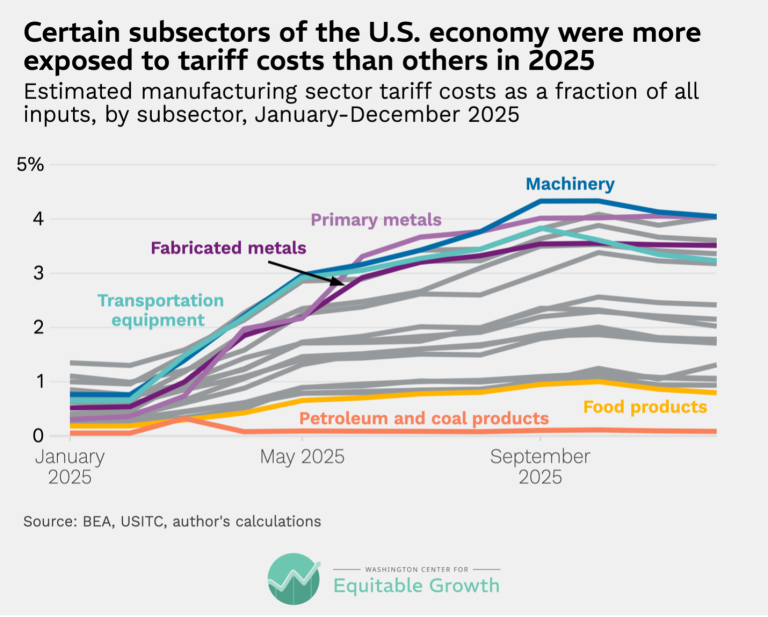
Certain subsectors of the U.S. economy were more exposed to tariff costs than others in 2025 (opens in a new tab)
Visualizations MAR 17, 2026
 View Chart
(opens in a new tab)
View Chart
(opens in a new tab)
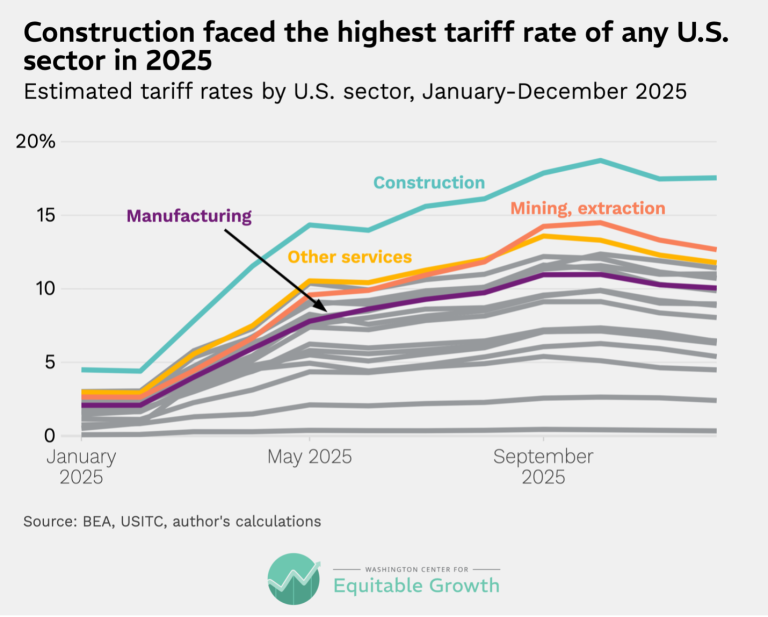
Construction faced the highest tariff rate of any U.S. sector in 2025 (opens in a new tab)
Visualizations MAR 17, 2026

Factsheet: Using asset limits in public benefit programs (opens in a new tab)
Factsheets MAR 10, 2026
A household’s assets, or its overall wealth, are the resources required to ensure its family members can weather the financial disruption when unexpected expenses emerge. Yet many U.S. households do…
By: Megan Rivera (opens in a new tab)

U.S. businesses report that tariff policies will likely lead to price increases and labor market impacts in 2026 (opens in a new tab)
Essays JAN 15, 2026
As 2026 begins, U.S. manufacturers are contending with a varied and uncertain economic environment. Many are weighing growth driven by domestic investments in data centers and artificial intelligence against the…
By: Christopher Bangert-Drowns (opens in a new tab)
ASSA 2026 Round-up: Day 3 (opens in a new tab)
Blog JAN 6, 2026
Yesterday was the third and final day of the 2026 annual meeting of the Allied Social Science Associations, which is organized by the American Economic Association. The 3-day conference, held…
By: Equitable Growth (opens in a new tab)
ASSA 2026 Round-up: Day 2 (opens in a new tab)
Blog JAN 5, 2026
Yesterday was the second day of the 2026 annual meeting of the Allied Social Science Associations, which is organized by the American Economic Association. The 3-day conference, held in Philadelphia…
By: Equitable Growth (opens in a new tab)
Uncertainty created by ever-changing tariff policies harms U.S. economic growth (opens in a new tab)
Essays NOV 20, 2025
The approaches to international trade taken by the first and now second Trump administrations have been an endless jumble of tariff negotiations and ever-changing policies. Since 2018, duties have been…
By: Nirupama Rao (opens in a new tab)

Tariff costs impact industries with mostly White, male, and noncitizen workers (opens in a new tab)
Essays NOV 4, 2025
The U.S. economy is flying blind, with most economic-data publications paused indefinitely due to the shutdown of the federal government amid a general U.S. labor market slowdown and just as…
By: Christopher Bangert-Drowns (opens in a new tab)
 View Chart
(opens in a new tab)
View Chart
(opens in a new tab)
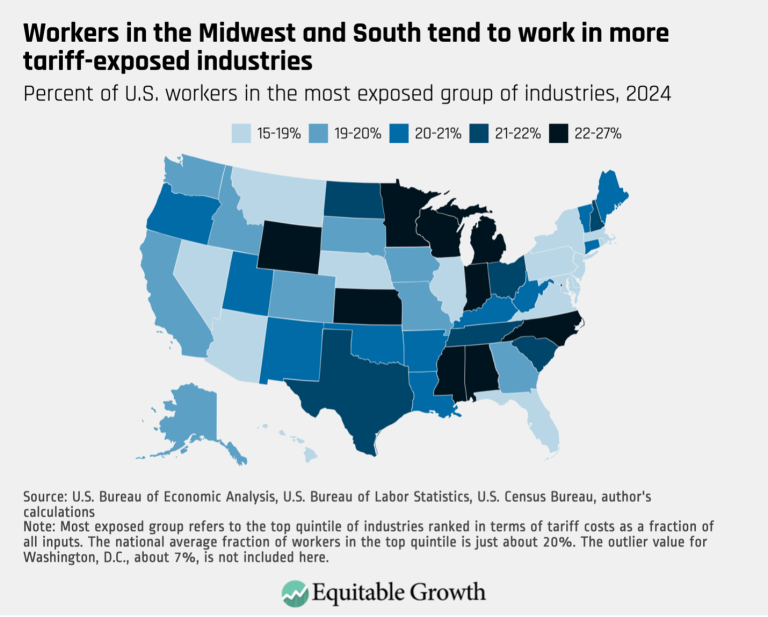
Workers in the Midwest and South tend to work in more tariff-exposed industries (opens in a new tab)
Visualizations NOV 3, 2025
 View Chart
(opens in a new tab)
View Chart
(opens in a new tab)
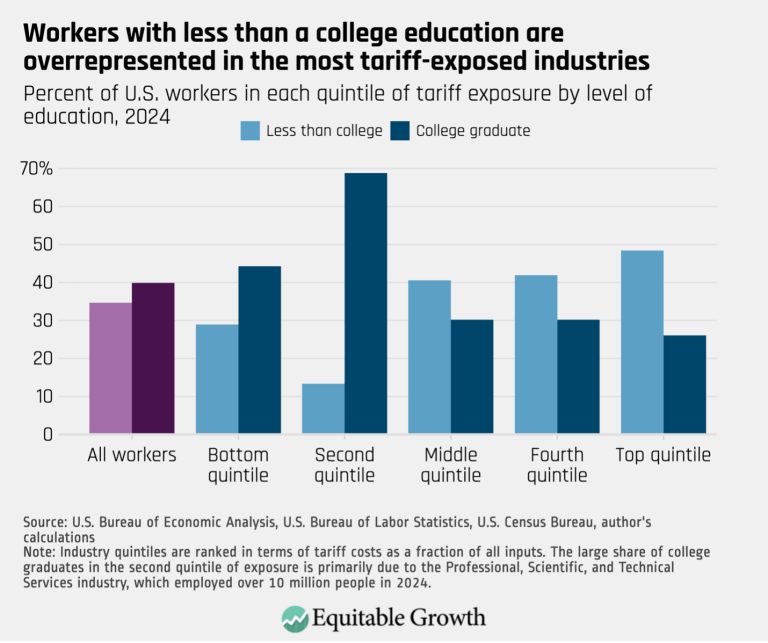
Workers with less than a college education are overrepresented in the most tariff-exposed industries (opens in a new tab)
Visualizations NOV 3, 2025
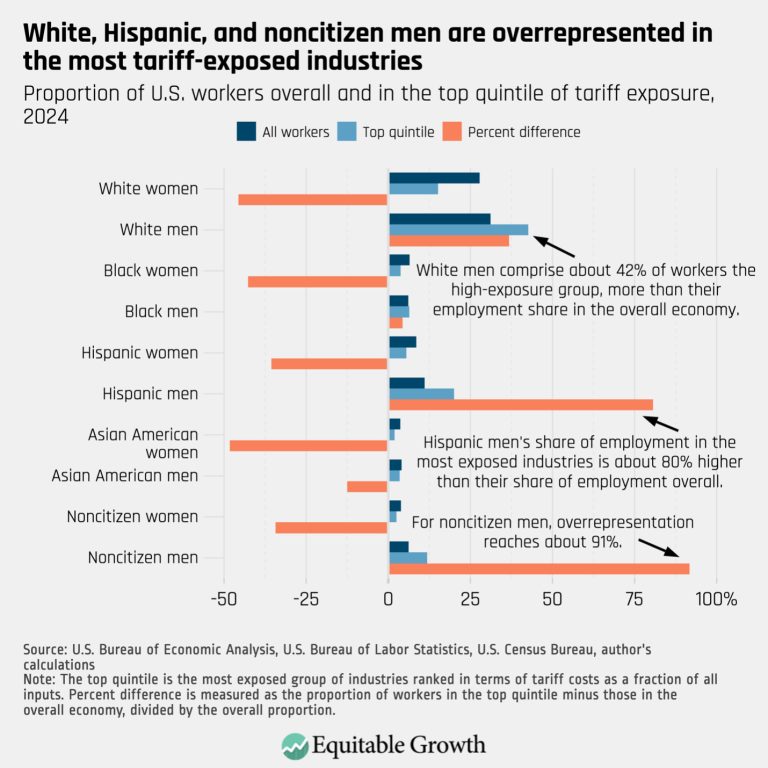 View Chart
(opens in a new tab)
View Chart
(opens in a new tab)
White, Hispanic, and noncitizen men are overrepresented in the most tariff-exposed industries (opens in a new tab)
Visualizations NOV 3, 2025
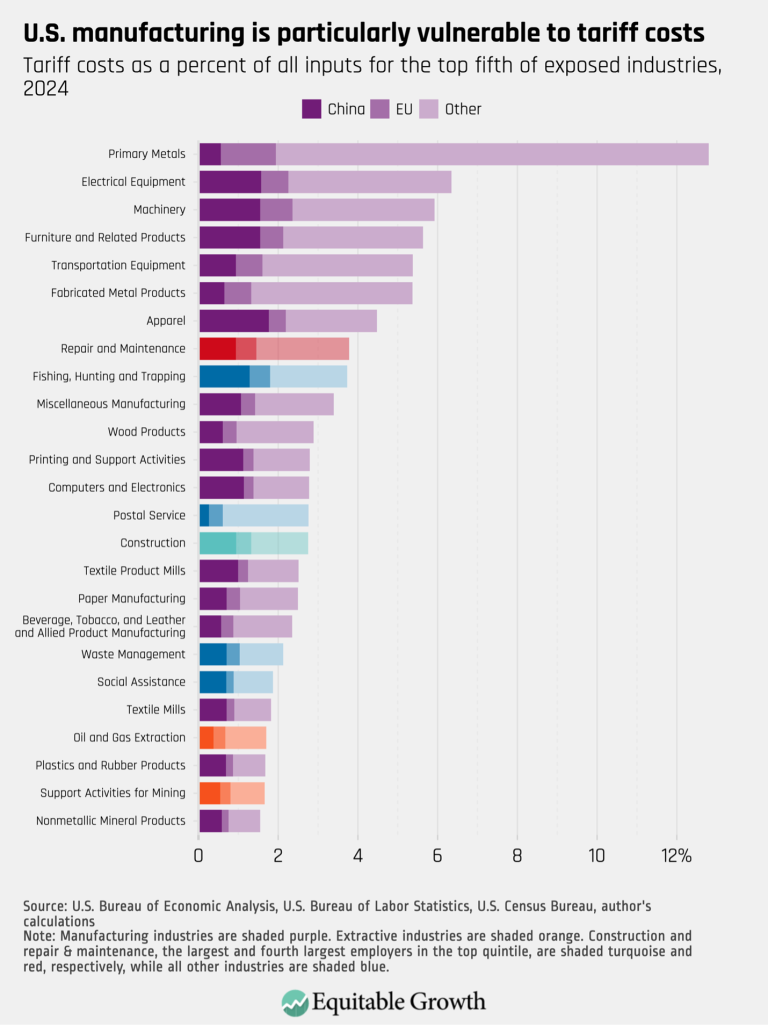 View Chart
(opens in a new tab)
View Chart
(opens in a new tab)
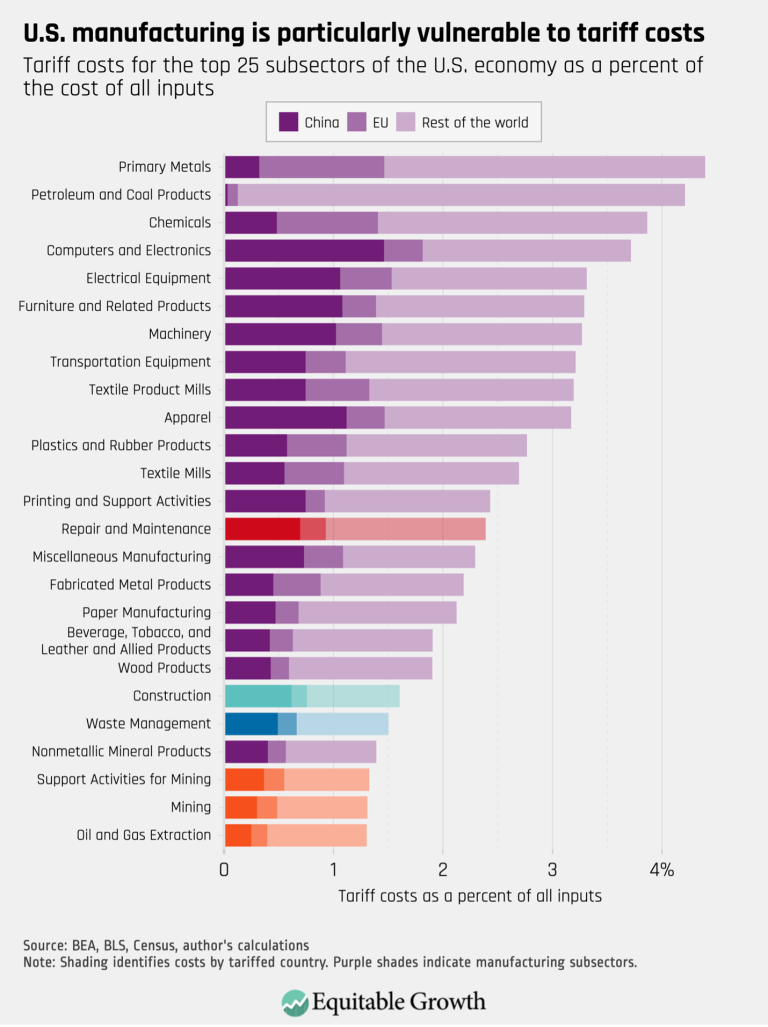
U.S. manufacturing is particularly vulnerable to tariff costs (opens in a new tab)
Visualizations NOV 3, 2025

Equitable Growth supports scholars studying the economics of the energy transition (opens in a new tab)
Essays OCT 22, 2025
The Washington Center for Equitable Growth today announced a new cohort of grantees. These nine scholars will study how the design and implementation of federal policy influences how businesses and…
By: Equitable Growth (opens in a new tab)

How U.S. tax policies have fueled right-wing populism (opens in a new tab)
Essays SEP 11, 2025
Among the many factors fueling support for right-wing populism in the United States is federal tax policies. The nation’s tax system confuses, frustrates, and angers many citizens in ways that…
By: Andrea Louise Campbell (opens in a new tab)

To restore democracy, end shareholder primacy at U.S. corporations and on Wall Street (opens in a new tab)
Essays SEP 11, 2025
Workers in the United States have no say over business decisions made in their workplaces by corporate America. Unions, of course, are important for workers’ ability to exercise power over…
By: Lenore Palladino (opens in a new tab)
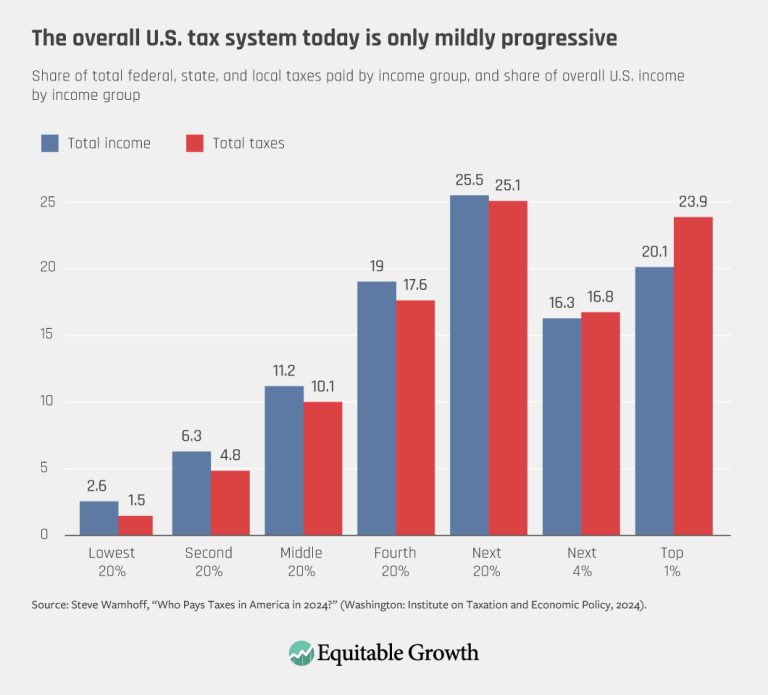 View Chart
(opens in a new tab)
View Chart
(opens in a new tab)
The overall U.S. tax system today is only mildly progressive (opens in a new tab)
Visualizations SEP 10, 2025
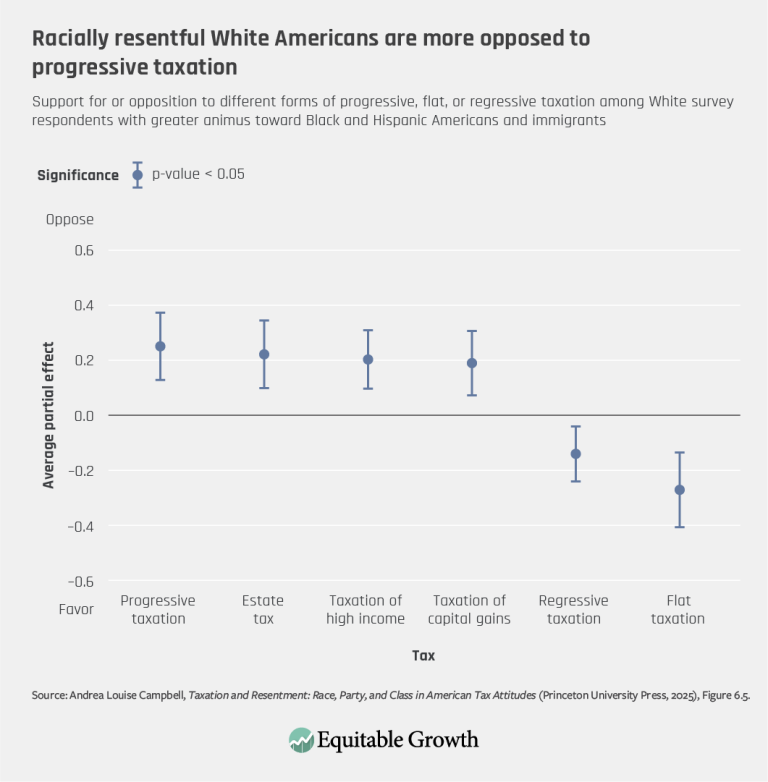 View Chart
(opens in a new tab)
View Chart
(opens in a new tab)
Racially resentful White Americans are more opposed to progressive taxation (opens in a new tab)
Visualizations SEP 9, 2025

Tariffs impact U.S. industries differently, with manufacturing the most exposed (opens in a new tab)
Issue Briefs JUL 29, 2025
Estimates in this brief were generated July 21, before the announcement of trade deals with Japan and the European Union. All data and code used in the Equitable Growth tariff…
By: Christopher Bangert-Drowns (opens in a new tab)
 View Chart
(opens in a new tab)
View Chart
(opens in a new tab)
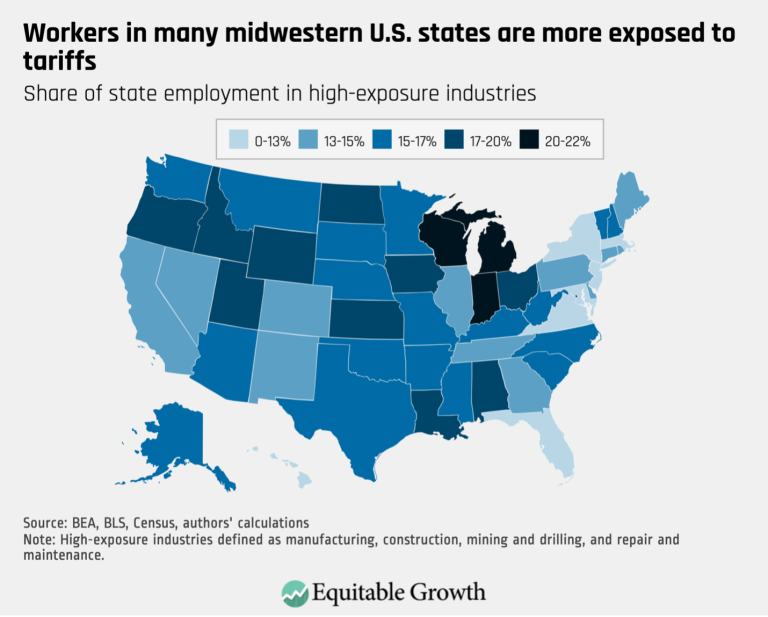
Workers in many midwestern U.S. states are more exposed to tariffs (opens in a new tab)
Visualizations JUL 28, 2025
 View Chart
(opens in a new tab)
View Chart
(opens in a new tab)
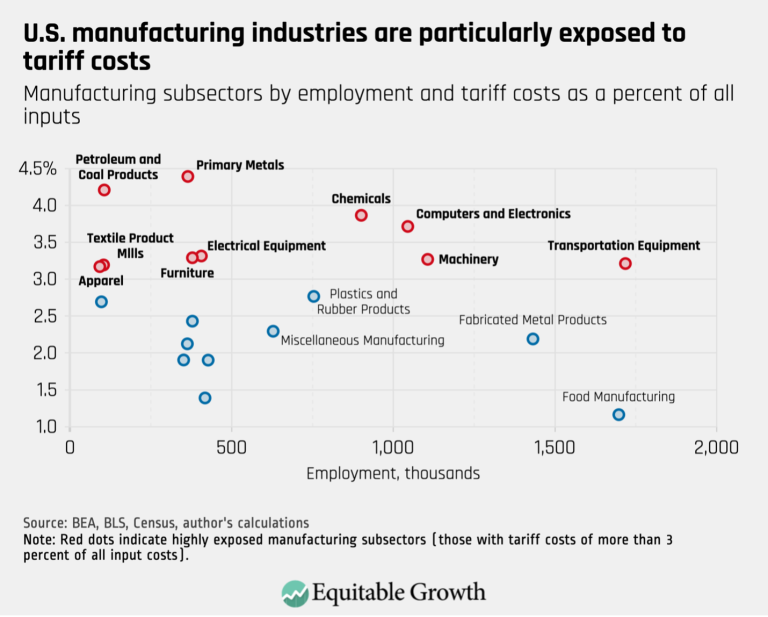
U.S. manufacturing industries are particularly exposed to tariff costs (opens in a new tab)
Visualizations JUL 28, 2025
 View Chart
(opens in a new tab)
View Chart
(opens in a new tab)
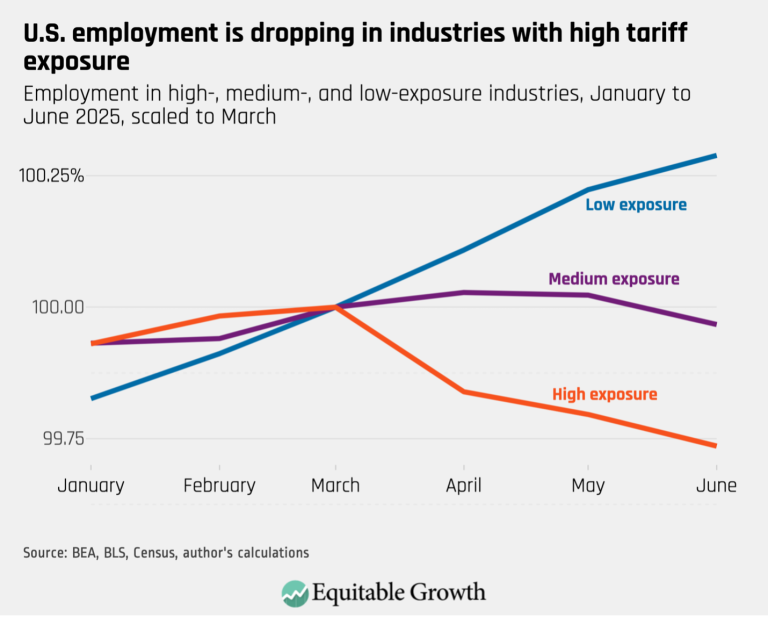
U.S. employment is dropping in industries with high tariff exposure (opens in a new tab)
Visualizations JUL 28, 2025
 View Chart
(opens in a new tab)
View Chart
(opens in a new tab)
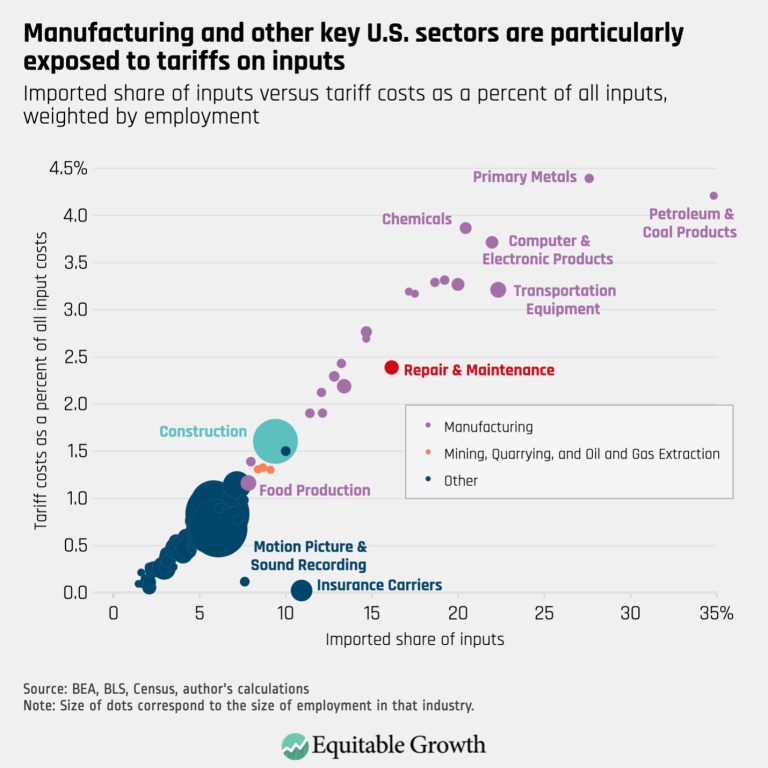
Manufacturing and other key U.S. sectors are particularly exposed to tariffs on inputs (opens in a new tab)
Visualizations JUL 28, 2025
 View Chart
(opens in a new tab)
View Chart
(opens in a new tab)
U.S. manufacturing is particularly vulnerable to tariff costs (opens in a new tab)
Visualizations JUL 28, 2025
Equity Prices, Market Power, and Optimal Corporate Tax Policy (opens in a new tab)
Working Papers JUL 22, 2025
We study the optimal design of corporate tax policy in a textbook life-cycle model featuring two key deviations: (i) firms are imperfectly competitive and (ii) households save by purchasing equity…
By: Ignacio González (opens in a new tab), Juan A. Montecino (opens in a new tab), Joseph E. Stiglitz

Accounting for capital gains in income significantly increases U.S. inequality (opens in a new tab)
Blog JUL 15, 2025
The Washington Center for Equitable Growth’s recently launched U.S. Inequality Tracker uses data from the U.S. Bureau of Economic Analysis to show how income and wealth inequality have evolved in…
By: Austin Clemens (opens in a new tab)
 View Chart
(opens in a new tab)
View Chart
(opens in a new tab)
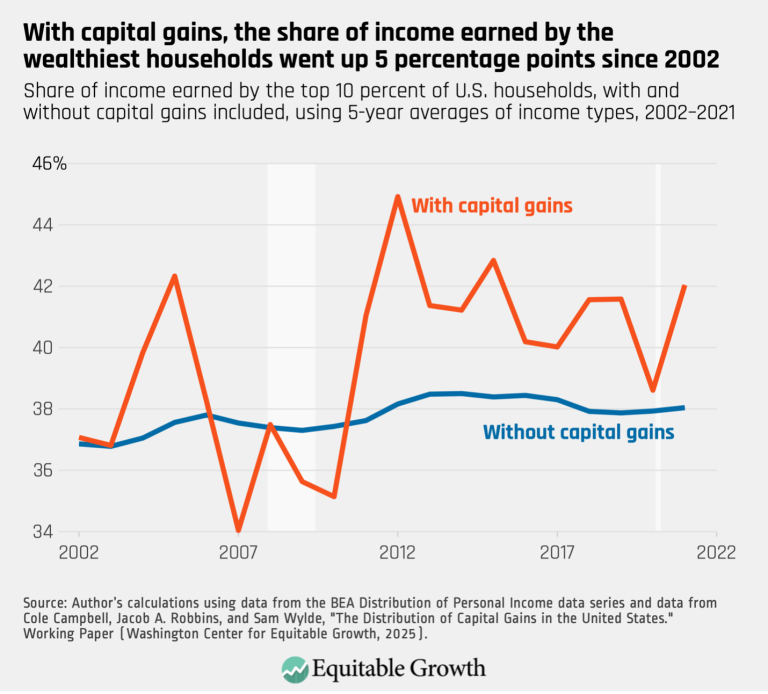
With capital gains, the share of income earned by the wealthiest households went up 5 percentage points since 2002 (opens in a new tab)
Visualizations JUL 14, 2025
 View Chart
(opens in a new tab)
View Chart
(opens in a new tab)
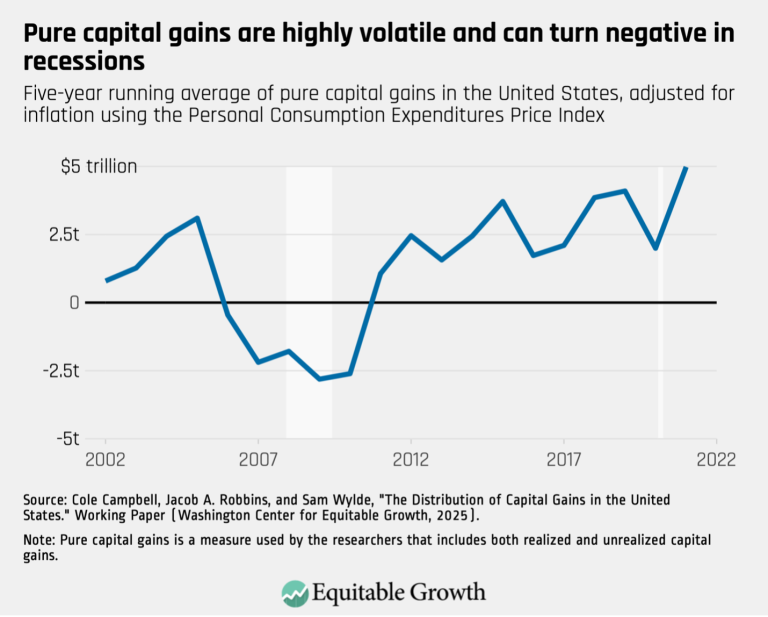
Pure capital gains are highly volatile and can turn negative in recessions (opens in a new tab)
Visualizations JUL 14, 2025

The 10 worst policies for equitable economic growth in the 2025 budget reconciliation law (opens in a new tab)
Essays JUL 14, 2025
The 2025 budget reconciliation law that was enacted earlier this month is a sprawling piece of legislation, touching almost every corner of the federal budget and the U.S. economy. It…
By: David S. Mitchell (opens in a new tab)

Equitable Growth responds to passage of the federal budget bill (opens in a new tab)
Blog JUL 7, 2025
On Friday, President Donald Trump signed the 2025 federal budget bill, cementing into law the most regressive piece of tax and budget legislation to be passed in the United States…
By: Equitable Growth (opens in a new tab)

Americans informed about the distributional effects of Republicans’ tax and budget bill overwhelmingly oppose it (opens in a new tab)
Essays JUL 3, 2025
Republicans in the U.S. Senate recently passed a version of the One Big Beautiful Bill Act, championed by President Donald Trump. The House of Representatives passed an earlier version of…
By: Jacob Hacker (opens in a new tab), Patrick Sullivan (opens in a new tab)
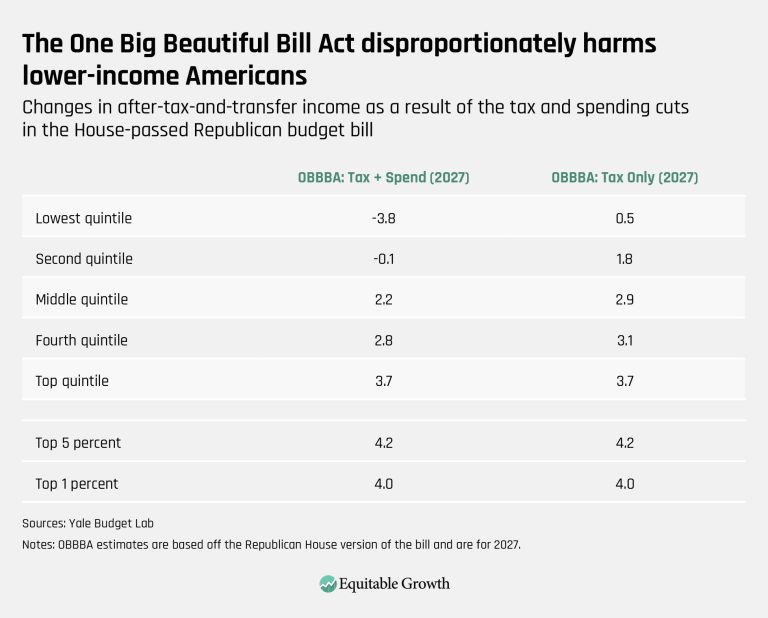 View Chart
(opens in a new tab)
View Chart
(opens in a new tab)
The One Big Beautiful Bill Act disproportionately harms lower-income Americans (opens in a new tab)
Visualizations JUL 3, 2025
Americans Informed About the Distributional Effects of Republicans’ Budget Bill Overwhelmingly Oppose It (opens in a new tab)
Working Papers JUN 25, 2025
Republicans in the Senate are currently considering the One Big Beautiful Bill Act, which, if enacted, would be the most regressive U.S. tax and budget law in at least the…
By: Jacob S. Hacker, Patrick Sullivan (opens in a new tab)

Congressional Republicans’ budget bill is the most regressive in at least 40 years (opens in a new tab)
Essays JUN 25, 2025
The U.S. Congress is in the midst of debating a budget bill that would make massive changes to U.S. tax and spending policy over the course of the next decade…
By: Jacob Hacker (opens in a new tab), Patrick Sullivan (opens in a new tab)
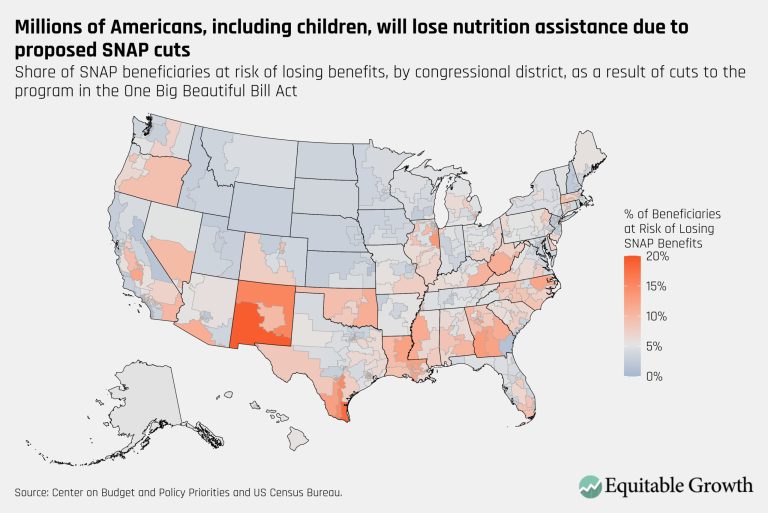 View Chart
(opens in a new tab)
View Chart
(opens in a new tab)
Millions of Americans, including children, will lose nutrition assistance due to proposed SNAP cuts – updated (opens in a new tab)
Visualizations JUN 24, 2025

Medicaid and SNAP cuts in congressional Republicans’ budget bill will negatively impact local economies (opens in a new tab)
Essays JUN 24, 2025
The budget reconciliation bill recently passed by the U.S. House of Representatives proposes to make large cuts to Medicaid, the Supplemental Nutrition Assistance Program, and other social programs to pay…
By: Robert Manduca (opens in a new tab)
Financial and Transfer Income as Components of the Regional Economic Base (opens in a new tab)
Working Papers JUN 24, 2025
Economists and geographers have long divided industries into “basic” and “nonbasic” sectors depending on whether they bring money into a region from outside or serve local demand. Traditionally, the regional…
By: Robert Manduca (opens in a new tab)
 View Chart
(opens in a new tab)
View Chart
(opens in a new tab)
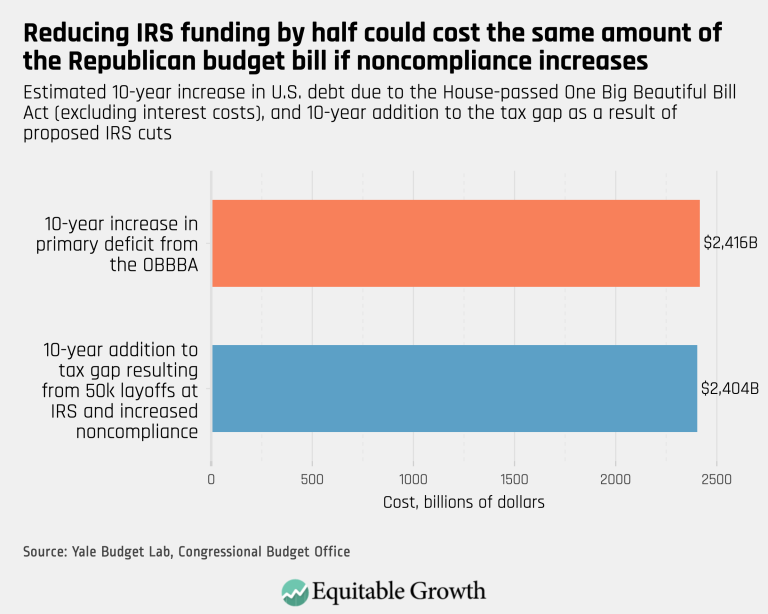
Reducing IRS funding by half could cost the same amount of the Republican budget bill in noncompliance increases (opens in a new tab)
Visualizations JUN 23, 2025
 View Chart
(opens in a new tab)
View Chart
(opens in a new tab)
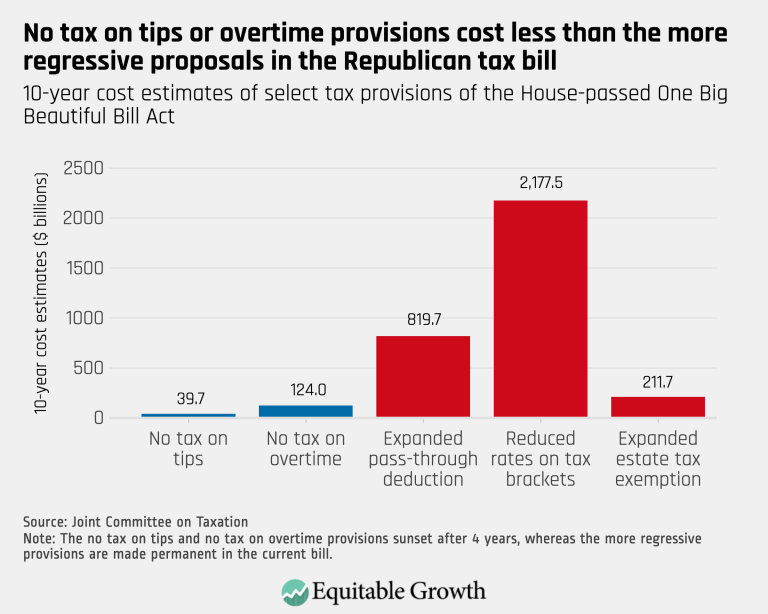
No tax on tips or overtime provisions cost less than the more regressive proposals in the Republican tax bill (opens in a new tab)
Visualizations JUN 23, 2025
 View Chart
(opens in a new tab)
View Chart
(opens in a new tab)
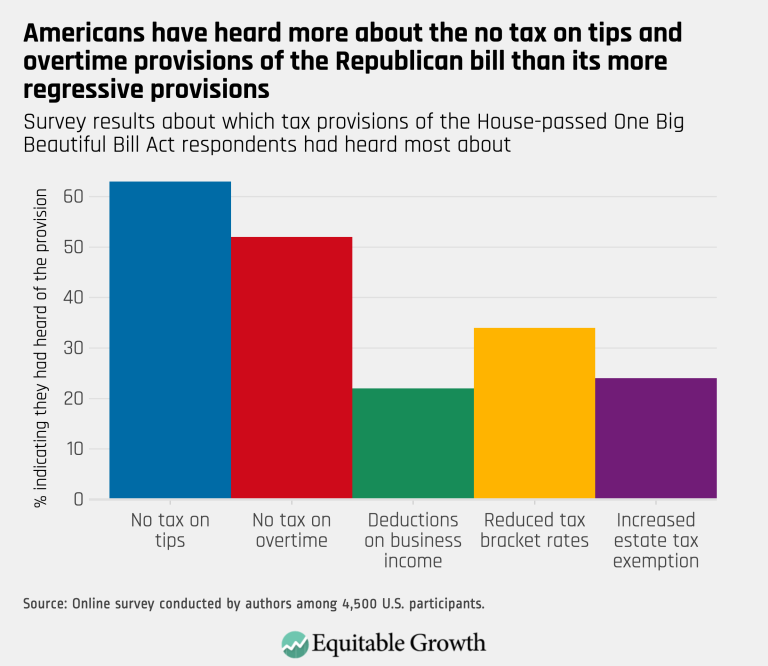
Americans have heard more about the no tax on tips and overtime provisions of the Republican bill than its more regressive provisions (opens in a new tab)
Visualizations JUN 23, 2025
 View Chart
(opens in a new tab)
View Chart
(opens in a new tab)
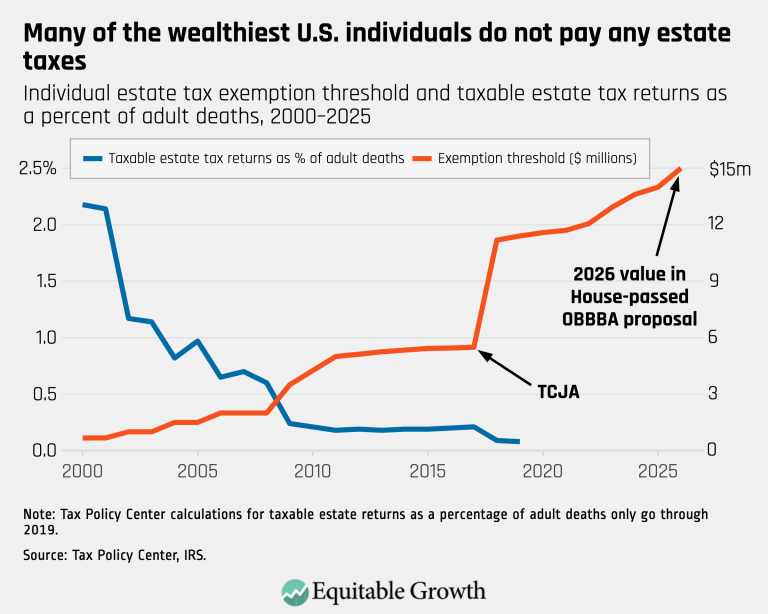
Many of the wealthiest U.S. individuals do not pay any estate taxes (opens in a new tab)
Visualizations JUN 23, 2025
 View Chart
(opens in a new tab)
View Chart
(opens in a new tab)
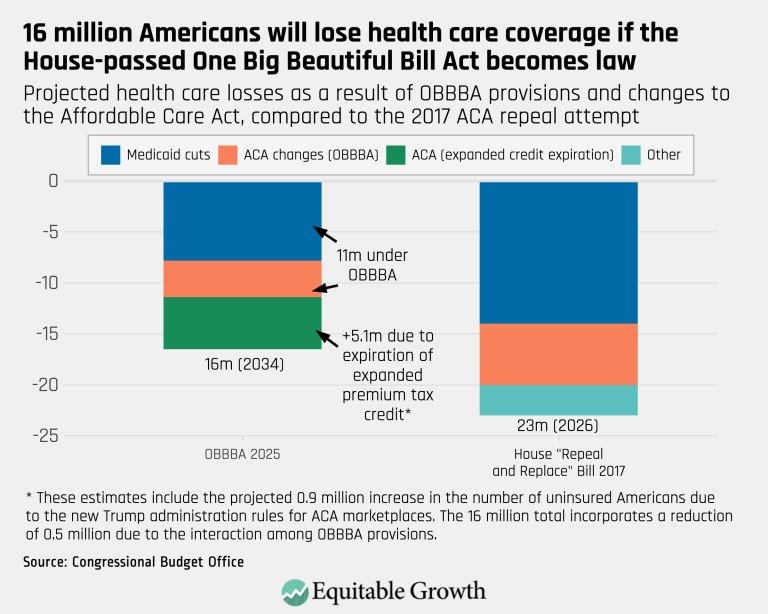
16 million Americans will lose health care coverage if the House-passed One Big Beautiful Bill Act becomes law (opens in a new tab)
Visualizations JUN 23, 2025

Testimony by Michael Linden on “The Big Beautiful Betrayal—Working Folks Pay While The Mega Rich Profit” (opens in a new tab)
Essays JUN 17, 2025
Senator Kaine, Senator Murphy, and members of the Forum, thank you for the opportunity to be here today. I’m going to make three key points. First, the Republican budget bill…
By: Michael Linden (opens in a new tab)

Factsheet: U.S. economic mobility and policies to increase upward mobility (opens in a new tab)
Factsheets JUN 17, 2025
The United States often has been touted as a land of opportunity, where hard work leads to success and children do better than their parents. But increasingly, these notions of…
By: Shira Markoff (opens in a new tab), Melissa Grober-Morrow (opens in a new tab)

The ‘funny math’ of top U.S. tax rates (opens in a new tab)
Essays JUN 11, 2025
The current reconciliation bill now before Congress won’t correct for the low tax rates paid by the richest Americans Overview Calculating the effective tax rate of the richest Americans can…
By: Patrick Driessen (opens in a new tab), David S. Mitchell (opens in a new tab)
 View Chart
(opens in a new tab)
View Chart
(opens in a new tab)
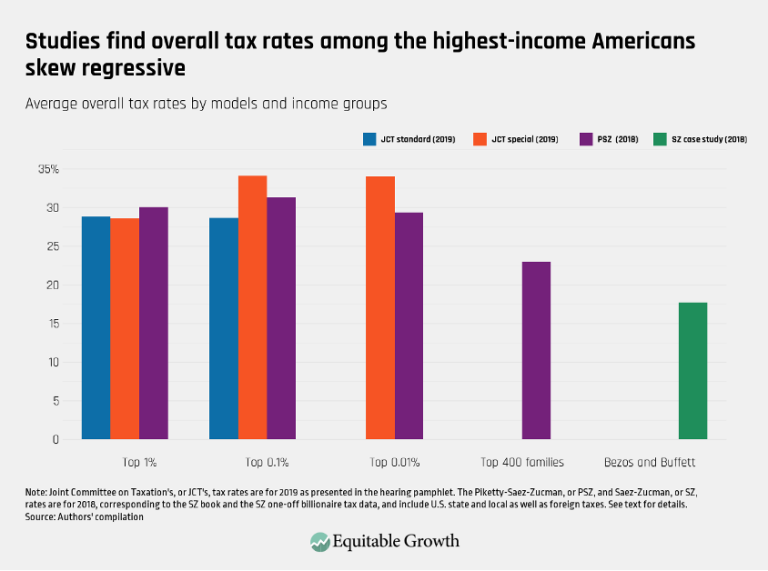
Studies find overall tax rates among the highest-income Americans skew regressive (opens in a new tab)
Visualizations JUN 10, 2025
 View Chart
(opens in a new tab)
View Chart
(opens in a new tab)
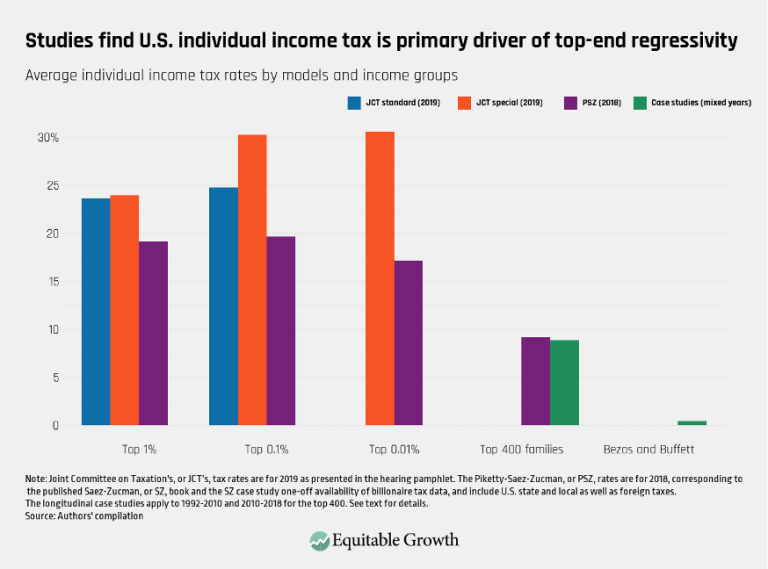
Studies find U.S. individual income tax is primary driver of top-end regressivity (opens in a new tab)
Visualizations JUN 10, 2025
 View Chart
(opens in a new tab)
View Chart
(opens in a new tab)
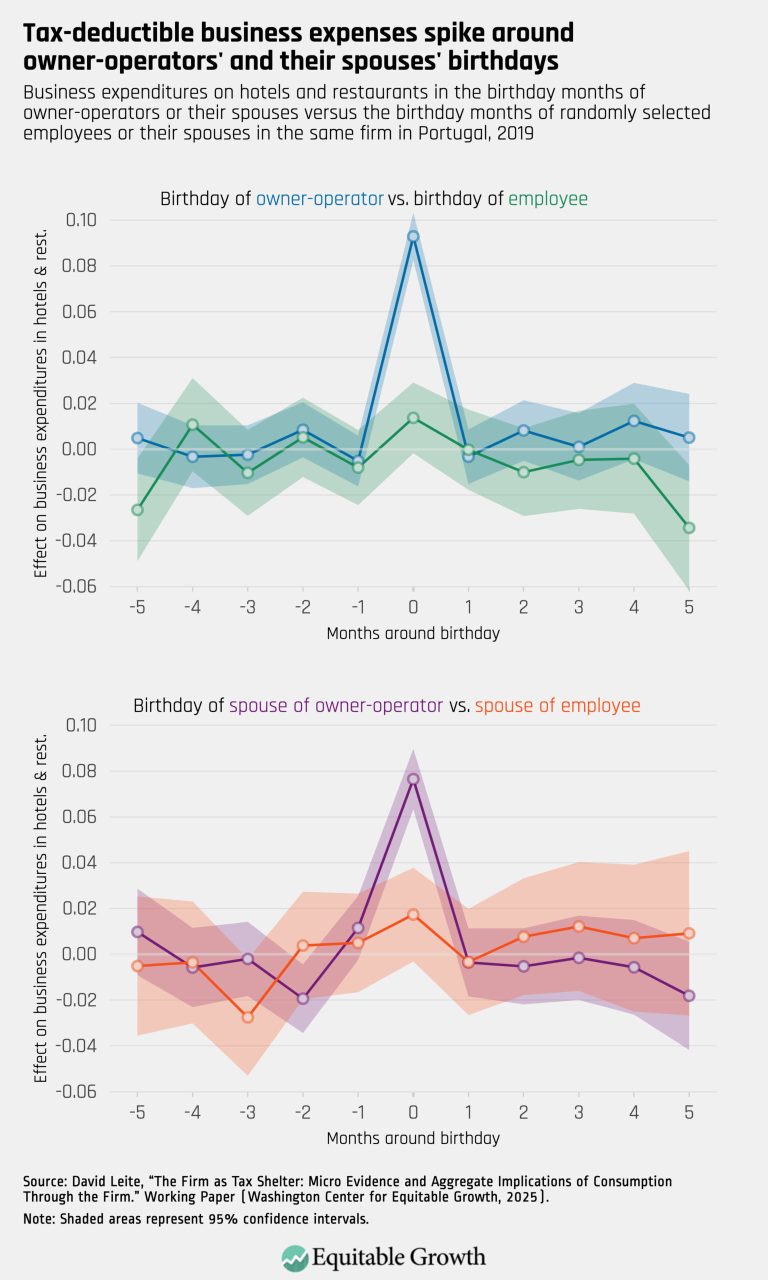
Tax-deductible business expenses spike around owner-operators’ and their spouses’ birthdays – updated (opens in a new tab)
Visualizations JUN 5, 2025

Business owners often use their firms as tax shelters, reducing government revenue and reported income inequality (opens in a new tab)
Blog MAY 22, 2025
Picture this scene: After sharing a meal with friends, someone in the group grabs the check and says, “I’ll take this so I can expense it through my company.” It…
By: David Leite (opens in a new tab)
The Firm as Tax Shelter (opens in a new tab)
Working Papers MAY 22, 2025
I present evidence that firms serve as tax-free consumption vehicles. Drawing on a unique combination of data from an electronic invoicing program in Portugal (e-Fatura), I show that individuals who…
By: David Leite (opens in a new tab)
 View Chart
(opens in a new tab)
View Chart
(opens in a new tab)
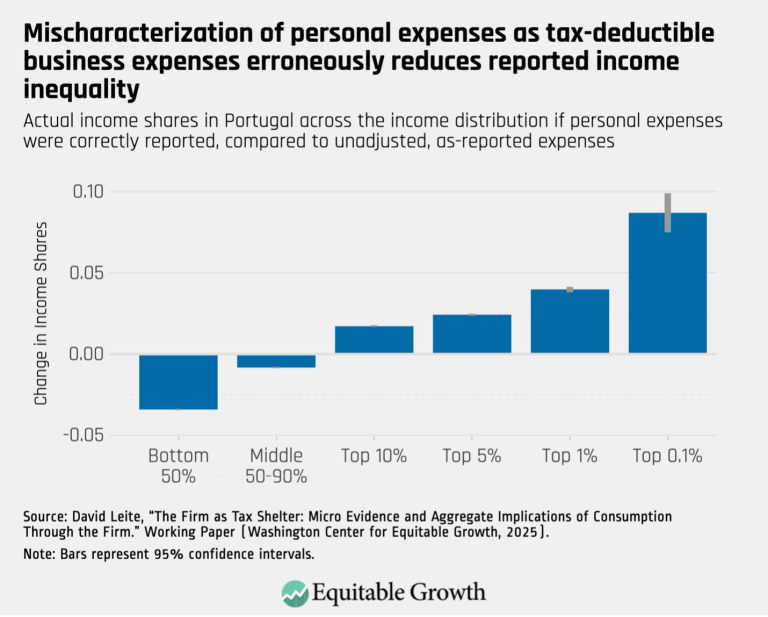
Mischaracterization of personal expenses as tax-deductible business expenses erroneously reduces reported income inequality (opens in a new tab)
Visualizations MAY 22, 2025
 View Chart
(opens in a new tab)
View Chart
(opens in a new tab)
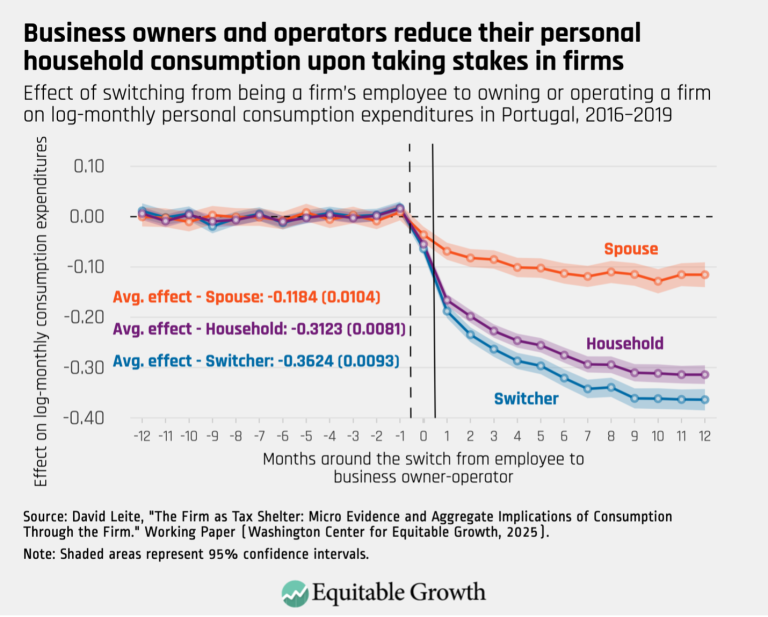
Business owners and operators reduce their personal household consumption upon taking stakes in firms (opens in a new tab)
Visualizations MAY 21, 2025
 View Chart
(opens in a new tab)
View Chart
(opens in a new tab)
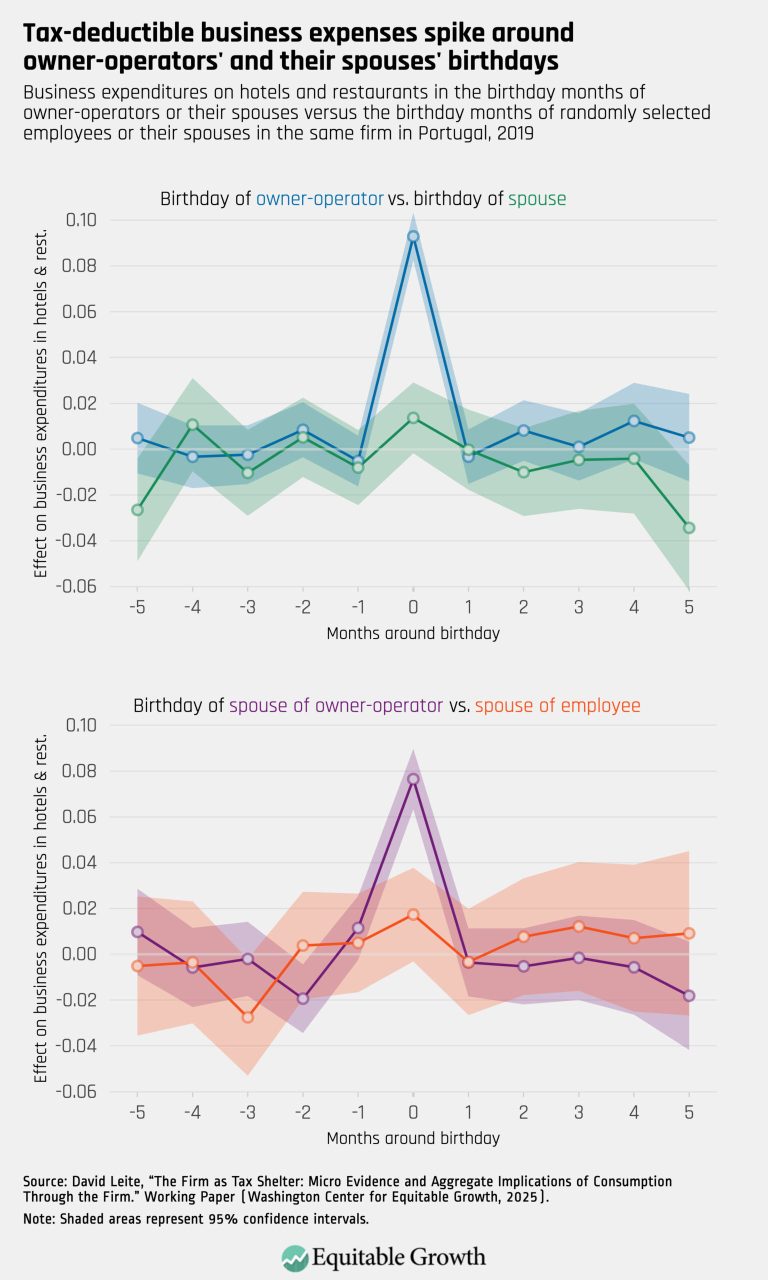
Tax-deductible business expenses spike around owner-operators’ and their spouses’ birthdays (opens in a new tab)
Visualizations MAY 21, 2025

Advancing economic research on the Inflation Reduction Act: Q&A with Heather Boushey (opens in a new tab)
Issue Briefs APR 23, 2025
The Inflation Reduction Act of 2022 is the most significant economic and clean energy jobs program the United States has ever initiated. To improve overall understanding of whether the new…
By: Equitable Growth (opens in a new tab)

Factsheet: What we know about the federal employer-provided child care credit and how can it be better used by businesses (opens in a new tab)
Factsheets APR 22, 2025
The employer-provided child care credit, also referred to as Section 45F in the Internal Revenue Code, provides a limited subsidy to businesses in the United States that provide child care…
By: Megan Rivera (opens in a new tab)

“Econ 101” briefing on taxing multinationals brings Hill staffers up to speed on U.S. role in coordinating global crack-down on tax avoidance (opens in a new tab)
Blog APR 3, 2025
The Washington Center for Equitable Growth last week hosted a briefing for Capitol Hill staffers on multinational corporate tax trends and policies—another in our “Econ 101” series for Hill staffers.…
By: Elena Patel (opens in a new tab)

Request for Proposals: The economic effects of the Inflation Reduction Act (opens in a new tab)
RFPs APR 2, 2025
By: Equitable Growth (opens in a new tab)
The qualified small business stock exclusion overwhelmingly benefits the wealthy and should be reformed in 2025 (opens in a new tab)
Issue Briefs APR 1, 2025
This year’s debate over the expiring personal income and estate tax provisions of the 2017 Tax Cuts and Jobs Act provides an opportunity for reforming the qualified small business stock…
By: Jean Ross (opens in a new tab)

Equitable Growth hosts Hill briefing on proliferation and taxation of U.S. pass-through businesses (opens in a new tab)
Blog MAR 13, 2025
On March 7, the Washington Center for Equitable Growth hosted a briefing—part of a series we call “Econ 101”—for Hill staffers curious about the proliferation of pass-through businesses and how…
By: Equitable Growth (opens in a new tab)

New research finds capital gains are highly concentrated and hardly taxed, underscoring widespread U.S. inequality (opens in a new tab)
Blog FEB 26, 2025
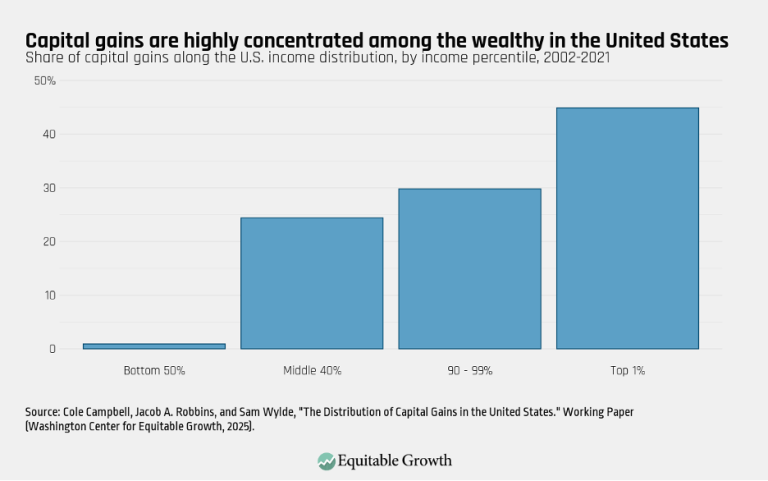
For two decades, booming stock, housing, and private business markets have driven large capital gains in the United States. Real capital gains, which are the inflation-adjusted appreciation of a financial…
By: Jacob Robbins (opens in a new tab), Cole Campbell (opens in a new tab), Sam Wylde (opens in a new tab)
The distribution of capital gains in the United States (opens in a new tab)
Working Papers FEB 26, 2025
Booming stock, housing, and private business markets have driven large capital gains in the United States, averaging 20% of national income over the past two decades. Using internal IRS tax…
By: Cole Campbell (opens in a new tab), Jacob A. Robbins, Sam Wylde (opens in a new tab)
 View Chart
(opens in a new tab)
View Chart
(opens in a new tab)
Capital gains are highly concentrated among the wealthy in the United States (opens in a new tab)
Visualizations FEB 26, 2025
Tax avoidance among large, complex partnerships in the United States (opens in a new tab)
Reports FEB 12, 2025
Decades-old conventional wisdom held that businesses organized as partnerships in the United States were mostly small enterprises with a handful of active individuals sharing personal liability for the businesses they…
By: David S. Mitchell (opens in a new tab)
The Spiderweb of Partnership Tax Structures (opens in a new tab)
Working Papers FEB 12, 2025
U.S. partnerships control more than $40 trillion in assets, vastly outnumber U.S. public firms, and contribute significantly to the U.S. tax non-compliance of pass-through entities, which is larger than the…
By: Ryan Hess (opens in a new tab), Emily Black (opens in a new tab), Zaynah Javed (opens in a new tab), Jonathan Hennessy (opens in a new tab), Rebecca Lester (opens in a new tab), Jacob Goldin (opens in a new tab), Daniel E. Ho, Annette Portz (opens in a new tab)

Pro-growth tax reform in 2025 would boost the U.S. economy for years to come (opens in a new tab)
Videos JAN 15, 2025
In the aftermath of the presidential election in 2024, it’s clear that many Americans feel like the U.S. economy is not working for them. Even though policymakers on both sides…
By: Shayna Strom (opens in a new tab)

ASSA 2025 Round-up: Day 3 (opens in a new tab)
Blog JAN 6, 2025
Yesterday was the third and final day of the 2025 annual meeting of the Allied Social Science Associations, which is organized by the American Economic Association. The 3-day conference, held…
By: Equitable Growth (opens in a new tab)

ASSA 2025 Round-up: Day 2 (opens in a new tab)
Blog JAN 5, 2025
Yesterday was the second day of the 2025 annual meeting of the Allied Social Science Associations, which is organized by the American Economic Association. The 3-day conference, held in San…
By: Equitable Growth (opens in a new tab)

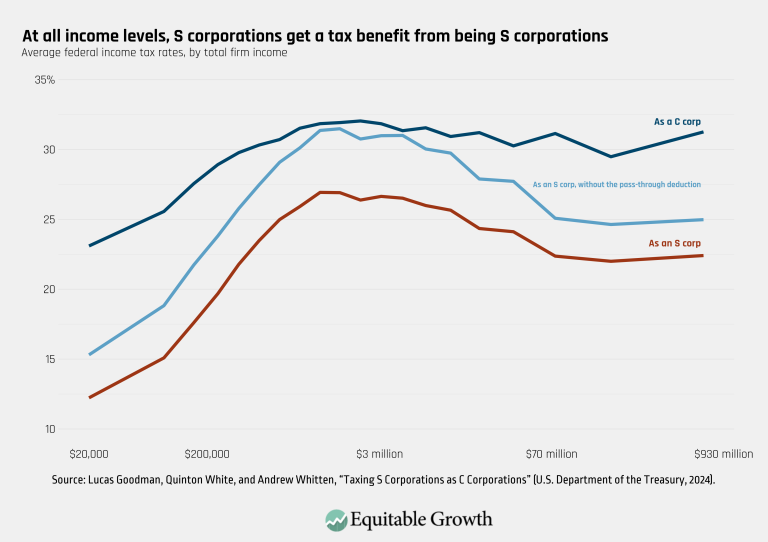
New U.S. Treasury Department research shows that it pays to be an S corporation (opens in a new tab)
Blog DEC 16, 2024
Businesses that are organized as so-called pass-through entities for tax purposes—meaning their profits show up on the owners’ personal tax returns rather than on an entity-based tax return—pay a lower…
By: Michael Linden (opens in a new tab)
 View Chart
(opens in a new tab)
View Chart
(opens in a new tab)
At all income levels, S corporations get a tax benefit from being S corporations (opens in a new tab)
Visualizations DEC 16, 2024
Who Gains from Corporate Tax Cuts? (opens in a new tab)
Working Papers NOV 27, 2024
Goods producers increase their capital expenditure and employment in response to a cut in marginal corporate income tax rates or an increase in investment tax credits. In contrast, companies in…
By: James Cloyne (opens in a new tab), Ezgi Kurt (opens in a new tab), Paolo Surico (opens in a new tab)

Addressing pervasive tax evasion by cryptocurrency users (opens in a new tab)
Blog NOV 21, 2024
The price of bitcoin and other cryptocurrencies reached record highs last week, buoyed by the U.S. election of Donald Trump, who is seen as friendly to this novel asset class,…
By: Magne Mogstad (opens in a new tab), Tom Meling (opens in a new tab), Arnstein Vestre (opens in a new tab)
Crypto Tax Evasion (opens in a new tab)
Working Papers NOV 21, 2024
We quantify the extent of crypto tax noncompliance and evasion, and assess the efficacy of alternative tax enforcement interventions. The context of the study is Norway. This context allows us…
By: Tom G. Meling, Magne Mogstad (opens in a new tab), Arnstein Vestre (opens in a new tab)
 View Chart
(opens in a new tab)
View Chart
(opens in a new tab)
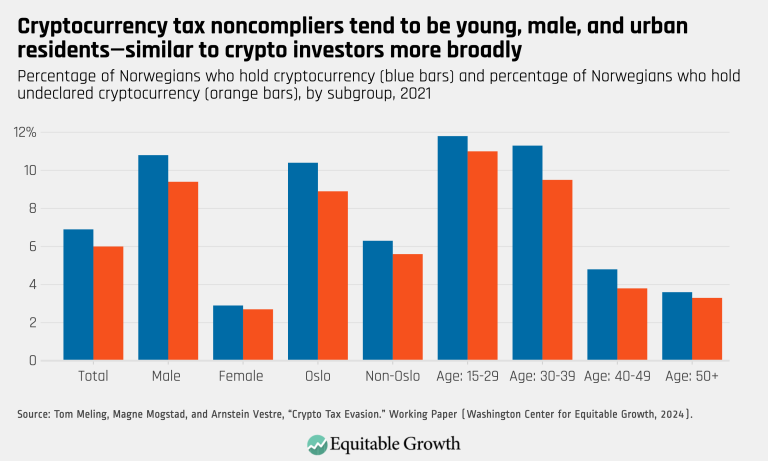
Cryptocurrency tax noncompliers tend to be young, male, and urban residents-similar to crypto investors more broadly (opens in a new tab)
Visualizations NOV 20, 2024
Request for Proposals: Promoting competition and supporting workers in an era of AI innovation (opens in a new tab)
RFPs NOV 20, 2024
By: Equitable Growth (opens in a new tab)

Request for proposals: Research grants for early career scholars (opens in a new tab)
RFPs OCT 30, 2024
By: Equitable Growth (opens in a new tab)
Equitable Growth virtual event details how tax policies affect U.S. economic growth and could combat income and wealth inequality (opens in a new tab)
Blog OCT 23, 2024
The Washington Center for Equitable Growth recently held the second in a two-part event series on tax policies for congressional staffers interested in learning more about using persuasive, evidence-backed arguments…
By: Equitable Growth (opens in a new tab)
The promise of equitable and pro-growth tax reform (opens in a new tab)
Reports OCT 16, 2024
The impending expiration of large portions of the 2017 Tax Cuts and Jobs Act at the end of 2025 presents federal policymakers with a significant opportunity to reform the federal…
By: Michael Linden (opens in a new tab), David S. Mitchell (opens in a new tab), Shayna Strom (opens in a new tab)
 View Chart
(opens in a new tab)
View Chart
(opens in a new tab)
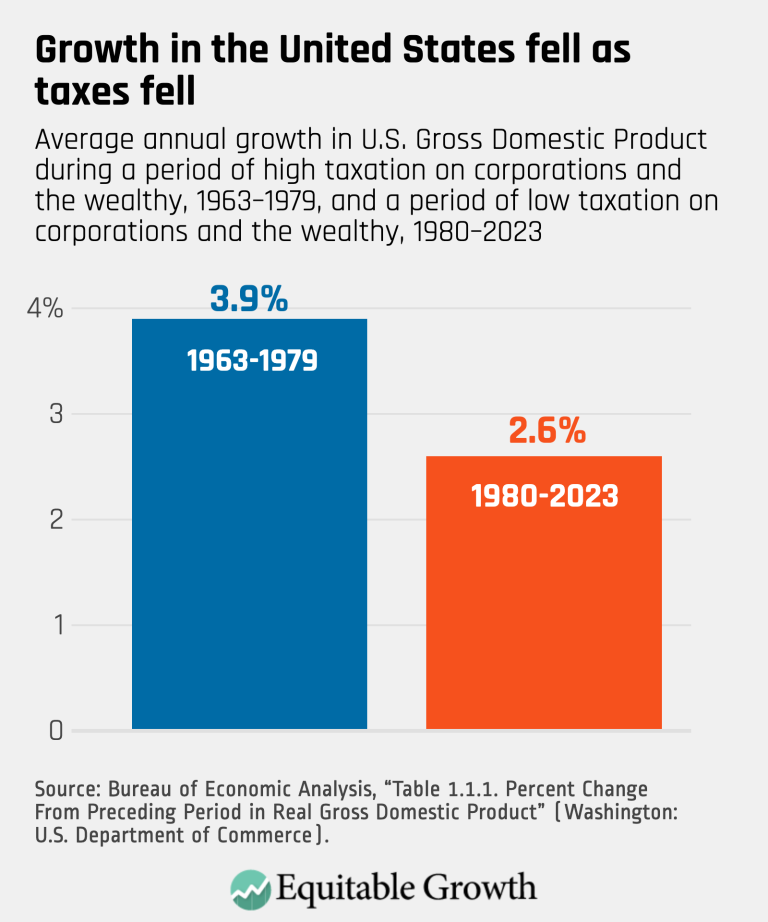
Growth in the United States fell as taxes fell – updated (opens in a new tab)
Visualizations OCT 15, 2024
 View Chart
(opens in a new tab)
View Chart
(opens in a new tab)
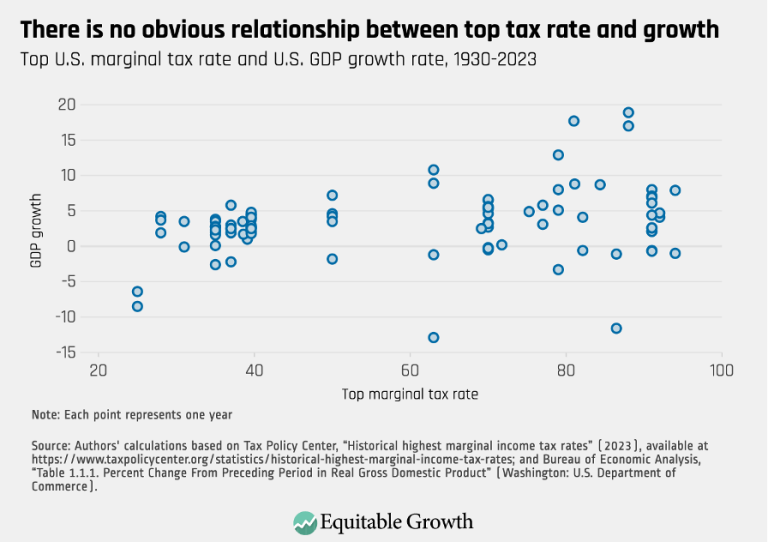
There is no obvious relationship between top tax rate and growth rate (opens in a new tab)
Visualizations OCT 15, 2024
 View Chart
(opens in a new tab)
View Chart
(opens in a new tab)
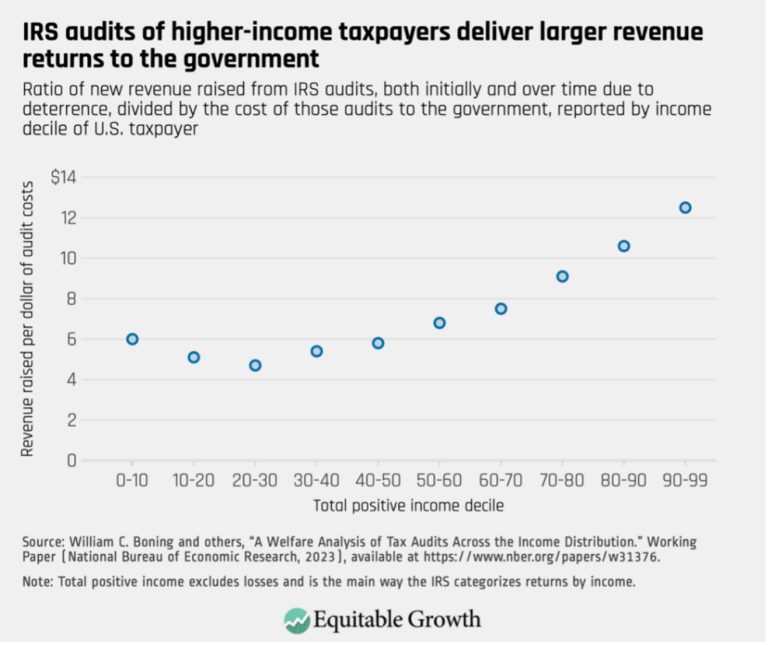
IRS audits of higher-income taxpayers deliver larger revenue returns to the government (opens in a new tab)
Visualizations OCT 15, 2024
 View Chart
(opens in a new tab)
View Chart
(opens in a new tab)
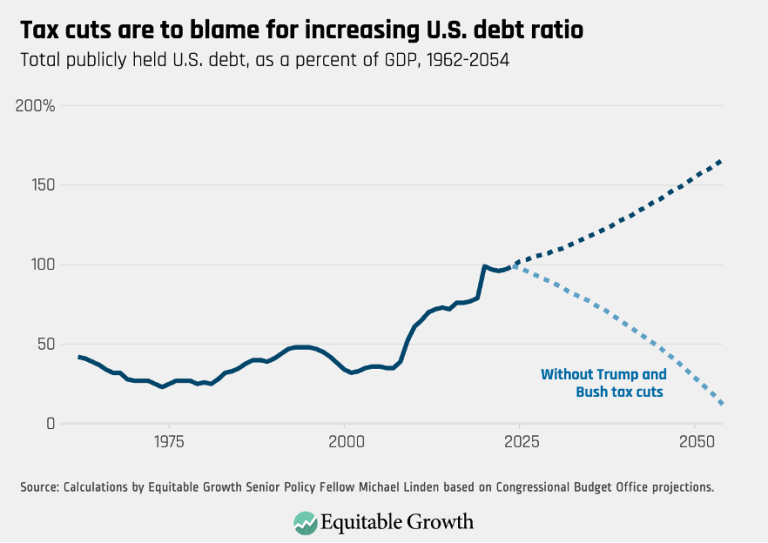
Tax cuts are to blame for increasing U.S. debt ratio (opens in a new tab)
Visualizations OCT 15, 2024
 View Chart
(opens in a new tab)
View Chart
(opens in a new tab)
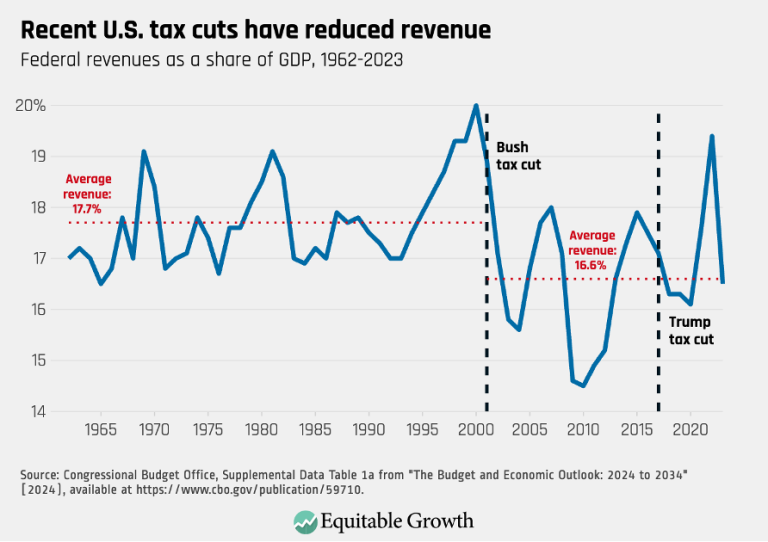
Recent U.S. tax cuts have reduced revenue (opens in a new tab)
Visualizations OCT 15, 2024
 View Chart
(opens in a new tab)
View Chart
(opens in a new tab)
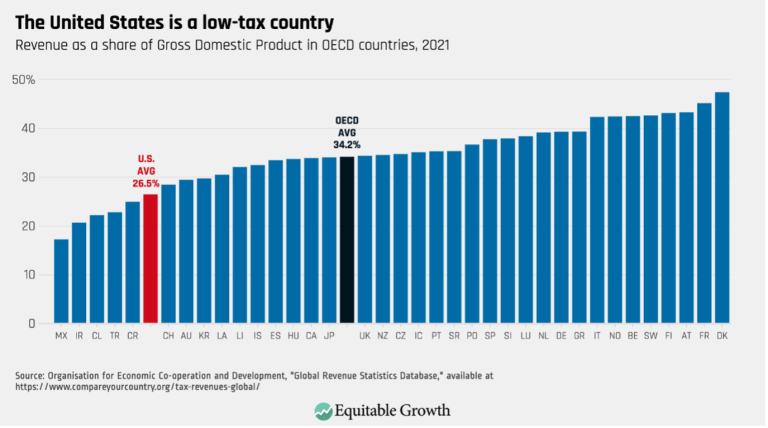
The United States is a low-tax country (opens in a new tab)
Visualizations OCT 15, 2024
 View Chart
(opens in a new tab)
View Chart
(opens in a new tab)
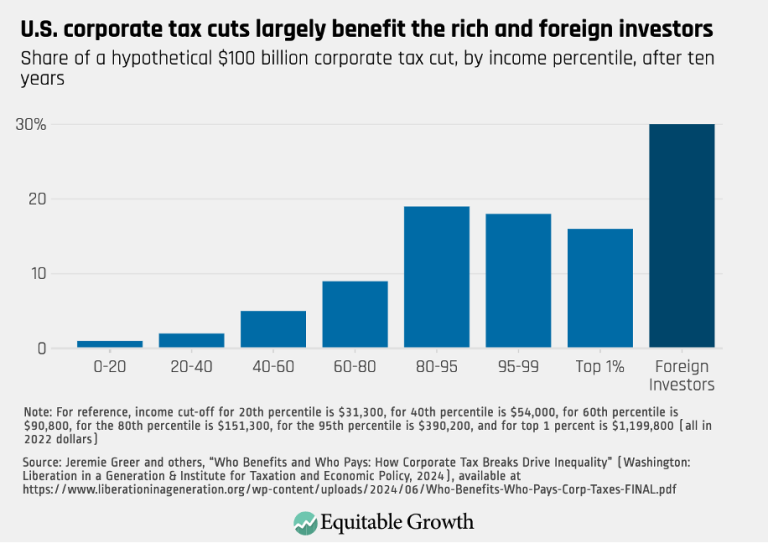
U.S. corporate tax cuts largely benefit the rich and foreign investors (opens in a new tab)
Visualizations OCT 15, 2024
 View Chart
(opens in a new tab)
View Chart
(opens in a new tab)
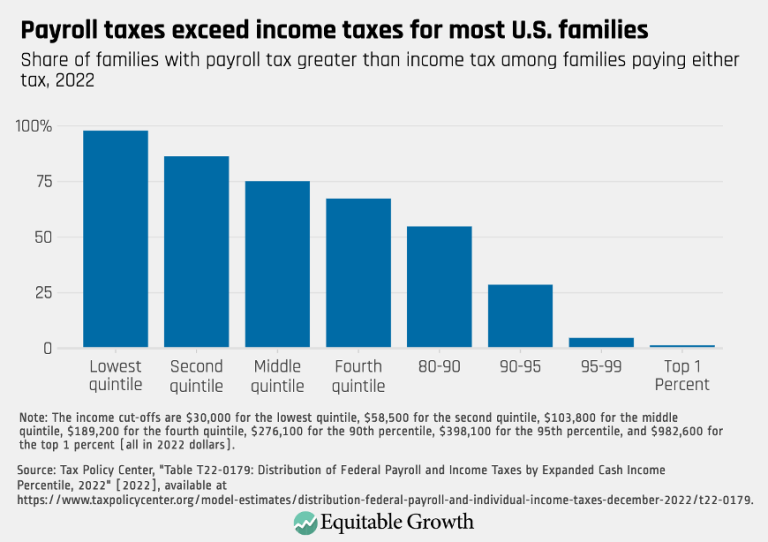
Payroll taxes exceed income taxes for most U.S. families (opens in a new tab)
Visualizations OCT 15, 2024
 View Chart
(opens in a new tab)
View Chart
(opens in a new tab)
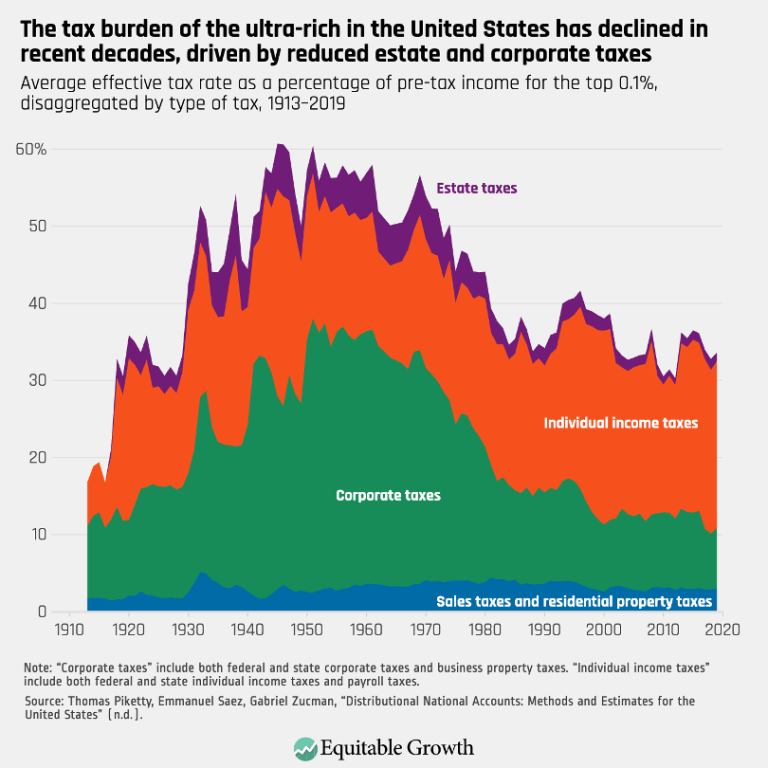
The Tax burden of the ultra-rich in the United States has declined in recent decades, driven by reduced estate and corporate taxes (opens in a new tab)
Visualizations OCT 15, 2024
 View Chart
(opens in a new tab)
View Chart
(opens in a new tab)
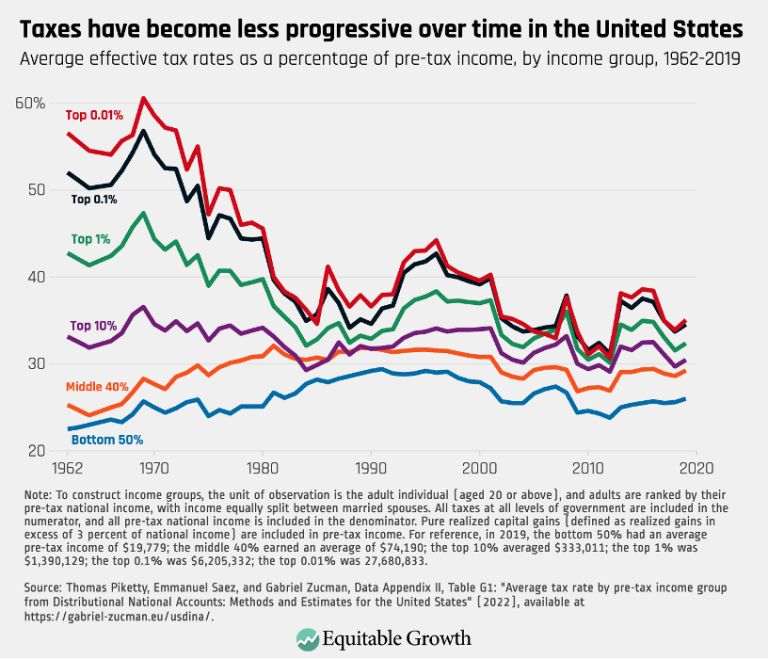
Taxes have become less progressive over time in the United States (opens in a new tab)
Visualizations OCT 15, 2024
 View Chart
(opens in a new tab)
View Chart
(opens in a new tab)
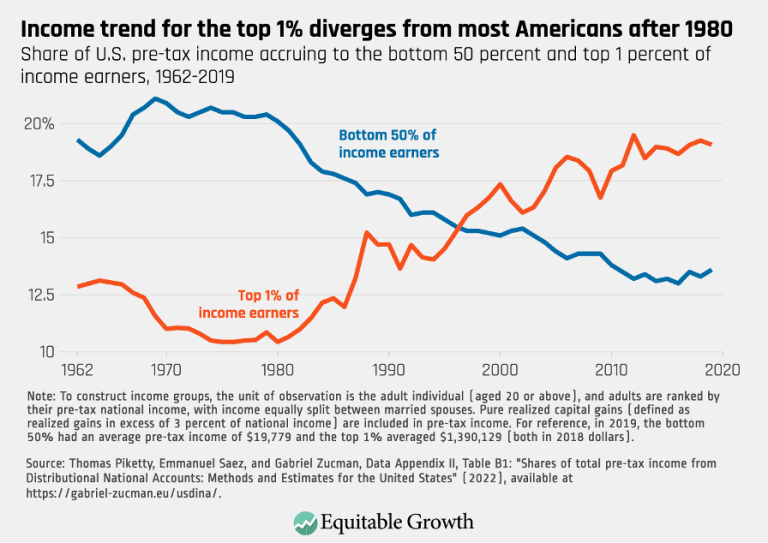
Income trend for the top 1% diverges from most Americans after 1980 (opens in a new tab)
Visualizations OCT 15, 2024
Allowing the 2017 estate tax changes to expire will reduce U.S. inequality and promote economic growth and opportunity (opens in a new tab)
Reports OCT 9, 2024
The 2017 Tax Cuts and Jobs Act made deep cuts to the personal income, estate, and corporate income taxes that were costly and heavily skewed toward the very wealthy. The…
By: Jean Ross (opens in a new tab)
 View Chart
(opens in a new tab)
View Chart
(opens in a new tab)
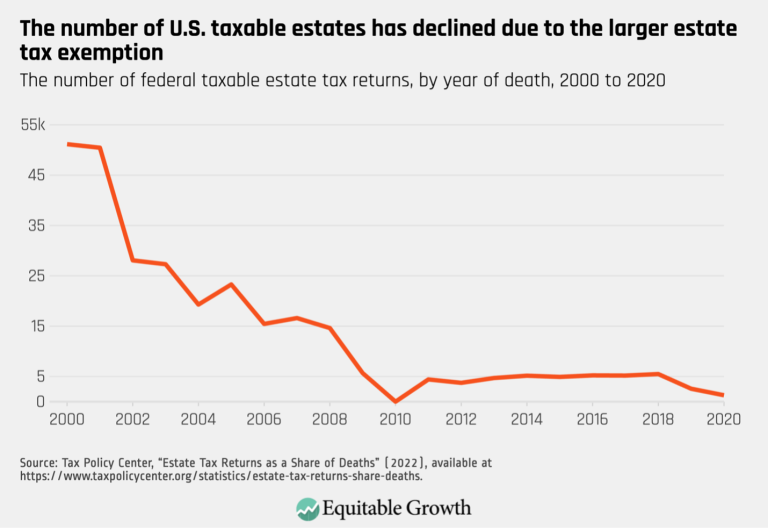
The number of U.S. taxable estates has declined due to the larger estate tax exemption (opens in a new tab)
Visualizations OCT 8, 2024
 View Chart
(opens in a new tab)
View Chart
(opens in a new tab)
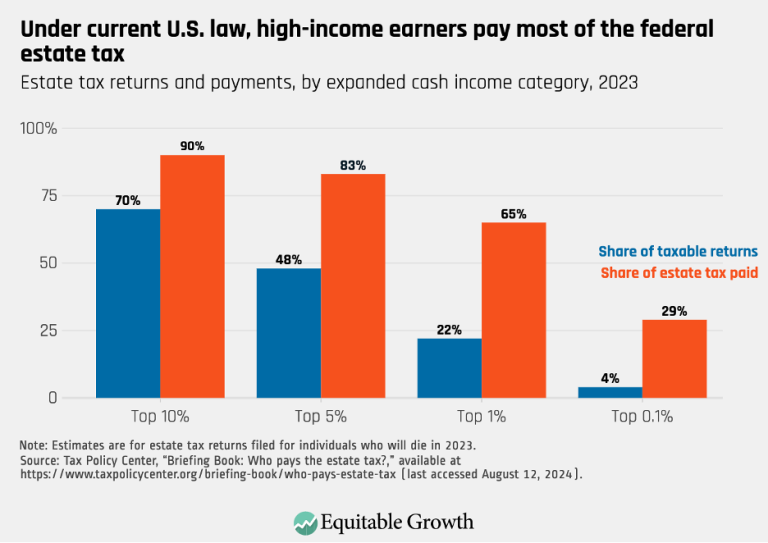
Under current U.S. law, high-income earners pay most of the federal estate tax (opens in a new tab)
Visualizations OCT 8, 2024
 View Chart
(opens in a new tab)
View Chart
(opens in a new tab)
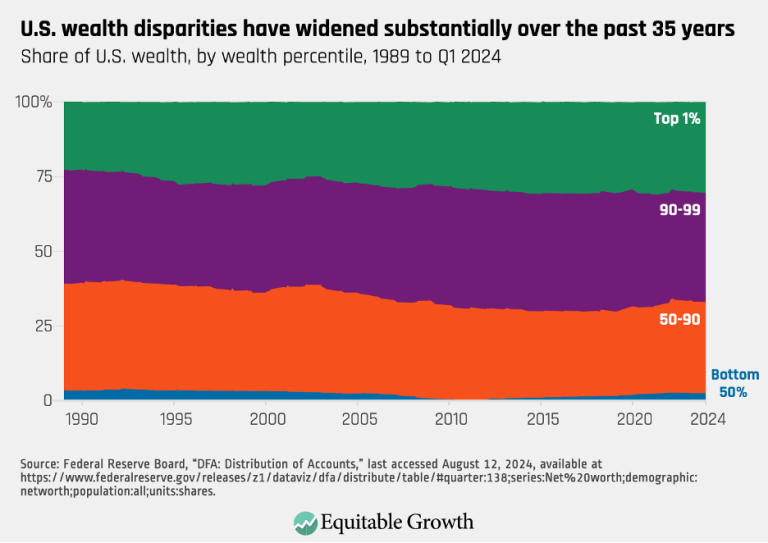
U.S. wealth disparities have widened substantially over the past 35 years (opens in a new tab)
Visualizations OCT 8, 2024
 View Chart
(opens in a new tab)
View Chart
(opens in a new tab)
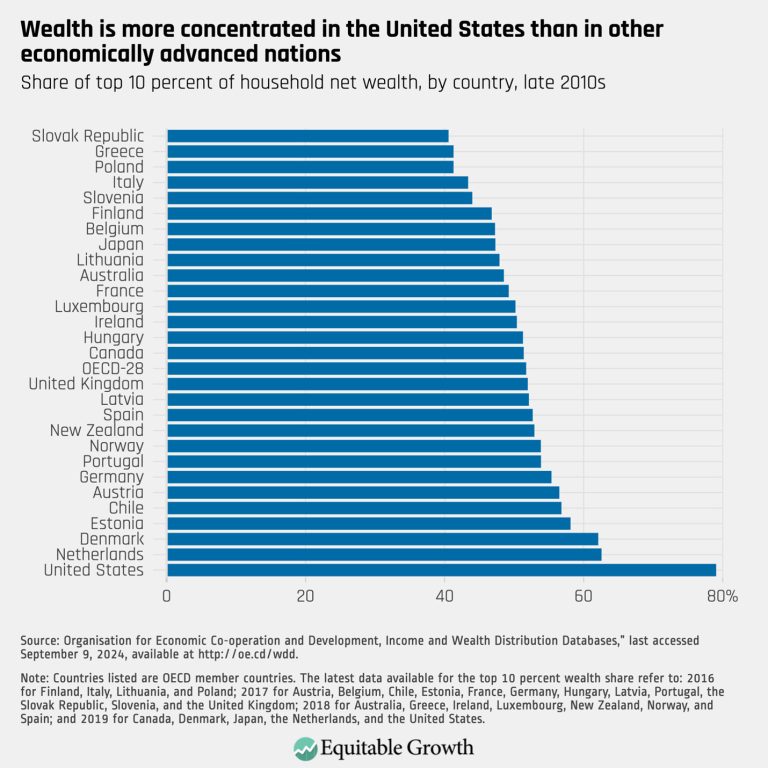
Wealth is more concentrated in the United States than in other economically advanced nations (opens in a new tab)
Visualizations OCT 8, 2024
 View Chart
(opens in a new tab)
View Chart
(opens in a new tab)
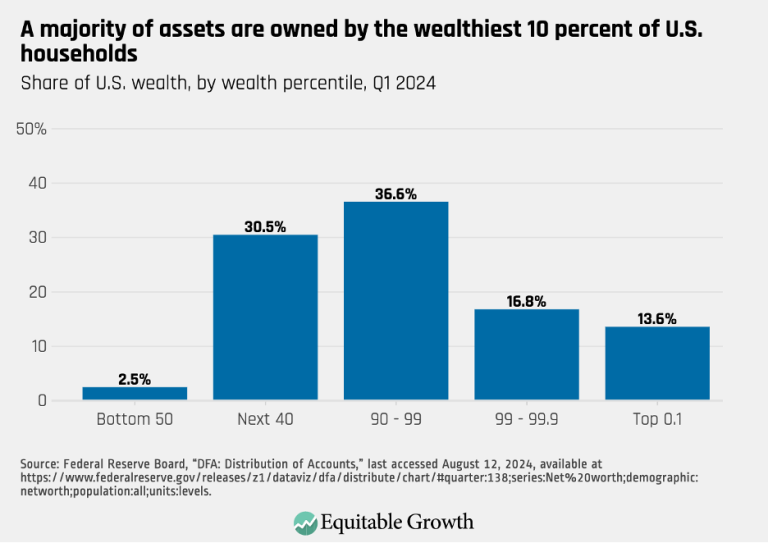
A majority of assets are owned by the wealthiest 10 percent of U.S. households (opens in a new tab)
Visualizations OCT 8, 2024

End Ineffective Business Tax Breaks Before Creating New Ones (opens in a new tab)
Blog OCT 7, 2024
(This opinion piece first appeared in Tax Notes Federal on September 23, 2024.) Vice President Kamala Harris recently proposed an expanded tax benefit for start-up businesses, aimed at helping fledgling…
By: David S. Mitchell (opens in a new tab)

Equitable Growth’s ‘Econ 101’ offered congressional staffers a rundown of the contours of U.S. tax policy (opens in a new tab)
Blog OCT 2, 2024
The Washington Center for Equitable Growth recently hosted a congressional briefing—part of a series we call “Econ 101”—for Hill staffers interested in learning more about the ins and outs of…
By: Equitable Growth (opens in a new tab)

The unequal impact of the Federal Reserve’s monetary tightening and easing on firms in the United States (opens in a new tab)
Blog SEP 16, 2024
The easing of inflation in the U.S. economy beginning in 2022 and recent signs of weakness in the U.S. labor market over the past several quarters have led households and…
By: Ezgi Kurt (opens in a new tab)
Asymmetric Effects of Monetary Policy on Firms (opens in a new tab)
Working Papers SEP 16, 2024
This paper documents firm-level evidence on the asymmetric effects of monetary policy in the US. Focusing on the 1980q3-2019q4 period, I find that monetary tightenings show larger effects on firms’…
By: Ezgi Kurt (opens in a new tab)
 View Chart
(opens in a new tab)
View Chart
(opens in a new tab)
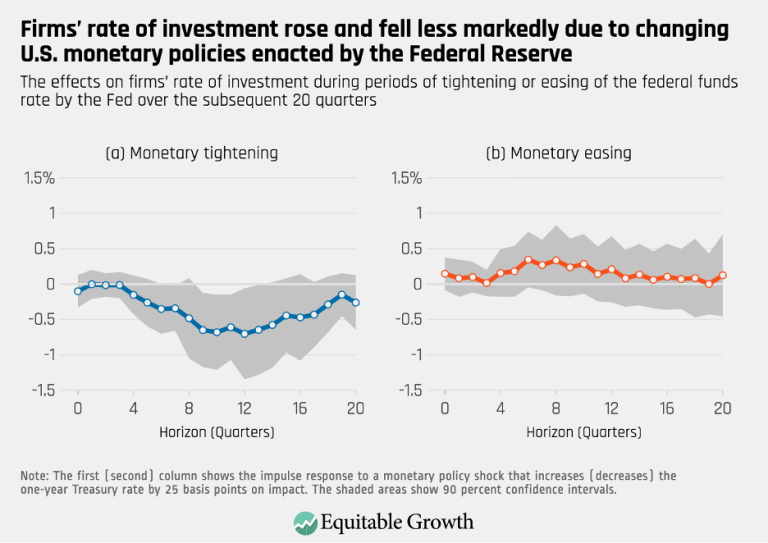
Firms’ rate of investment rose and fell less markedly due to changing U.S. monetary policies enacted by the Federal Reserve (opens in a new tab)
Visualizations SEP 15, 2024
 View Chart
(opens in a new tab)
View Chart
(opens in a new tab)
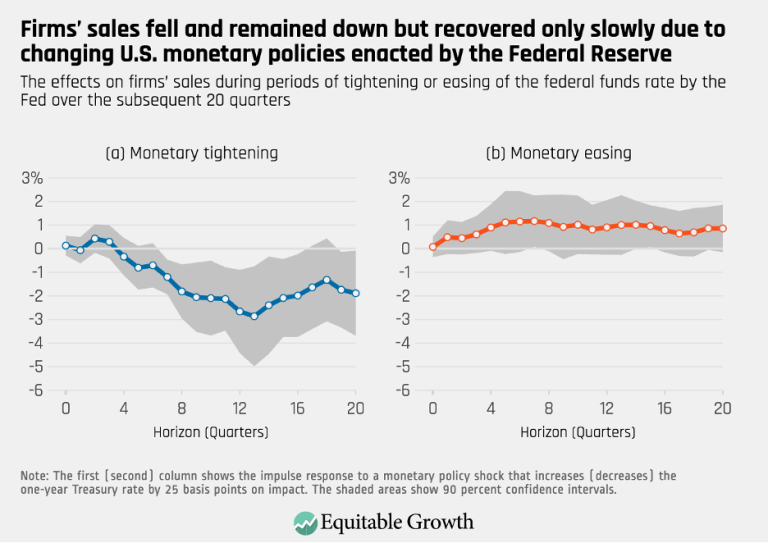
Firms’ sales fell and remained down but recovered only slowly due to changing U.S. monetary policies enacted by the Federal Reserve (opens in a new tab)
Visualizations SEP 15, 2024
 View Chart
(opens in a new tab)
View Chart
(opens in a new tab)
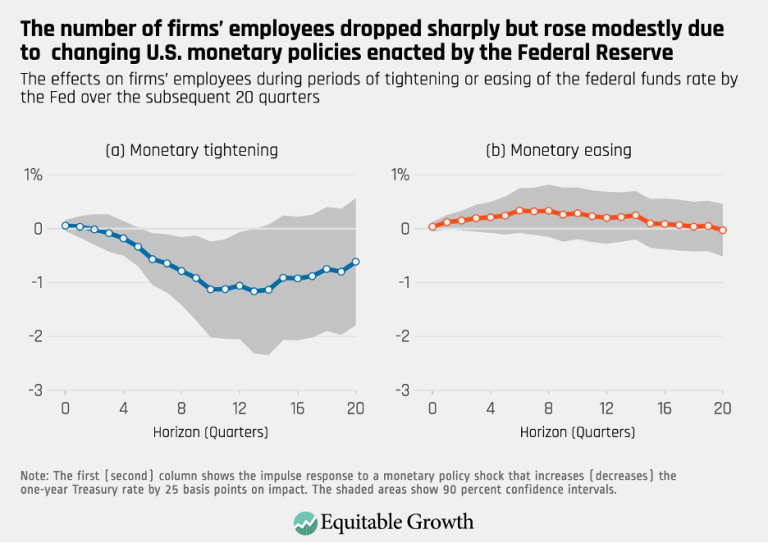
The number of firms’ employees dropped sharply but rose modestly due to changing U.S. monetary policies enacted by the Federal Reserve (opens in a new tab)
Visualizations SEP 15, 2024

The upcoming U.S. election’s most important policy effects are under the radar (opens in a new tab)
Blog SEP 3, 2024
Although the old maxim that Labor Day marks the true beginning of U.S. presidential campaigns may no longer hold, the end of summer and beginning of fall remain a period…
By: Kevin Rinz (opens in a new tab)

New economic analyses of the 2017 Trump tax cuts find mixed effects that policymakers should consider when those tax cuts expire in 2025 (opens in a new tab)
Blog AUG 22, 2024
Former President Donald Trump’s hallmark economic policy was a swathe of tax cuts for the wealthy and big corporations in 2017. His Tax Cuts and Jobs Act, or TCJA, supercharged…
By: Rakeen Mabud (opens in a new tab), Janelle Jones (opens in a new tab), Michael Linden (opens in a new tab)
Bonus Question: How Does Flexible Incentive Pay Affect Wage Rigidity? (opens in a new tab)
Working Papers JUL 17, 2024
We introduce dynamic incentive contracts into a model of inflation and unemployment dynamics. Our main result is that wage cyclicality from incentives neither affects the slope of the Phillips curve…
By: Meghana Gaur (opens in a new tab), John Grigsby (opens in a new tab), Jonathon Hazell (opens in a new tab), Abdoulaye Ndiaye (opens in a new tab)

Equitable Growth hosts event featuring Sen. Elizabeth Warren on pro-growth tax reform in 2025 (opens in a new tab)
Videos JUN 20, 2024
Several provisions of former President Donald Trump’s 2017 tax cuts are set to expire next year, providing an opportunity to reimagine how federal taxes can both raise additional revenue for…
By: Equitable Growth (opens in a new tab)

A researcher’s guide to identifying policy-relevant research questions for the federal government (opens in a new tab)
Essays MAY 30, 2024
Social science researchers play an important role in the policymaking process. Researchers help policymakers at all levels of government to understand key trends and issues in the U.S. economy and…
By: Alexander Hertel-Fernandez (opens in a new tab)
Behavioral Responses to Wealth Taxation: Evidence from Colombia (opens in a new tab)
Working Papers MAY 14, 2024
We study behavioral responses to personal wealth taxes in Colombia. We utilize tax microdata from 1993 to 2016 linked with the leaked Panama Papers to investigate offshoring to the country’s…
By: Juliana Londoño-Vélez (opens in a new tab), Javier Avila-Mahecha (opens in a new tab)
2017 tax cut for pass-through business owners exacerbated inequality and failed to deliver economic benefits (opens in a new tab)
Issue Briefs MAY 1, 2024
Among the many regressive and ineffective elements of the Trump administration’s Tax Cuts and Jobs Act of 2017, one provision stands out as the most convoluted, unfair, and ripe for…
By: David S. Mitchell (opens in a new tab)
 View Chart
(opens in a new tab)
View Chart
(opens in a new tab)
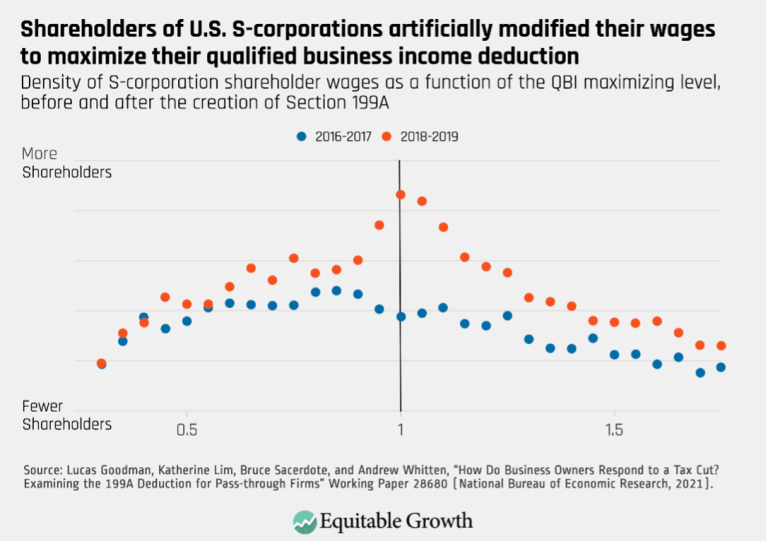
Shareholders of U.S. S-corporations artificially modified their wages to maximize their qualified business income deduction (opens in a new tab)
Visualizations APR 30, 2024
 View Chart
(opens in a new tab)
View Chart
(opens in a new tab)
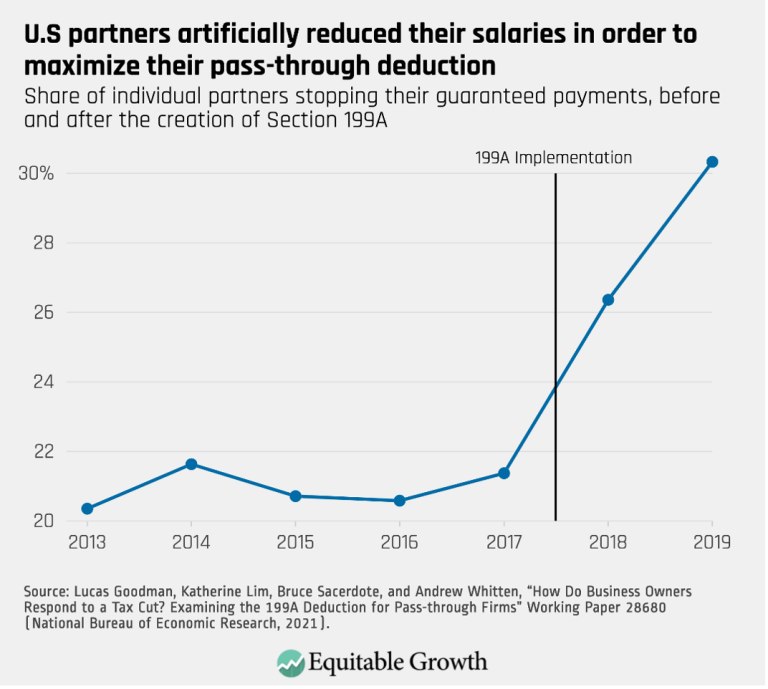
U.S. partners artificially reduced their salaries in order to maximize their pass-through deduction (opens in a new tab)
Visualizations APR 30, 2024
 View Chart
(opens in a new tab)
View Chart
(opens in a new tab)
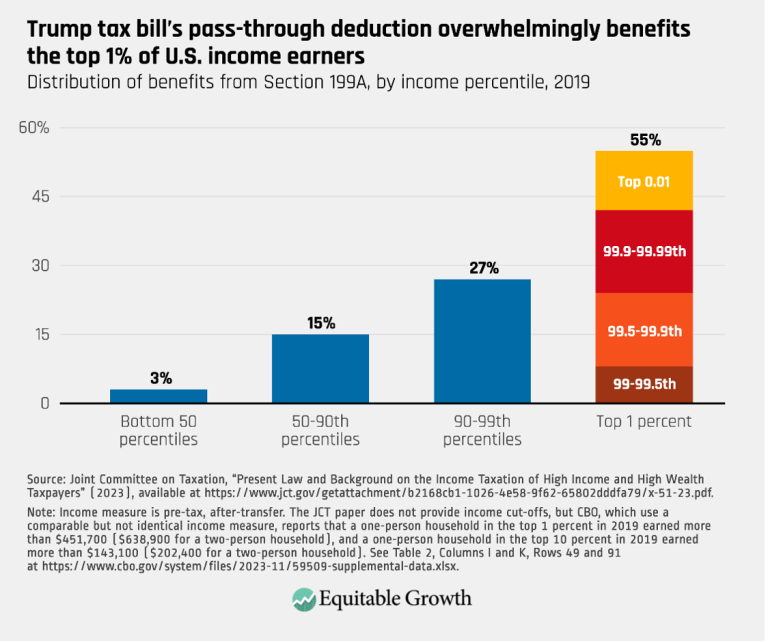
Trump tax bill’s pass-through deduction overwhelmingly benefits the top 1% of U.S. income earners (opens in a new tab)
Visualizations APR 30, 2024
 View Chart
(opens in a new tab)
View Chart
(opens in a new tab)
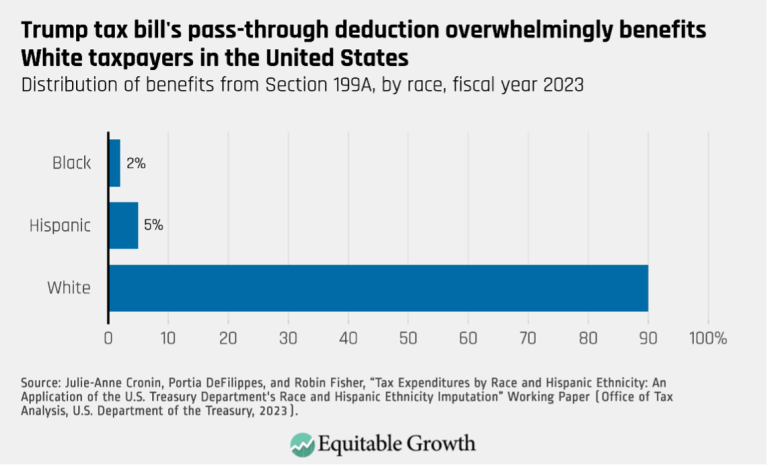
Trump tax bill’s pass-through deduction overwhelmingly benefits White taxpayers in the United States (opens in a new tab)
Visualizations APR 30, 2024
 View Chart
(opens in a new tab)
View Chart
(opens in a new tab)
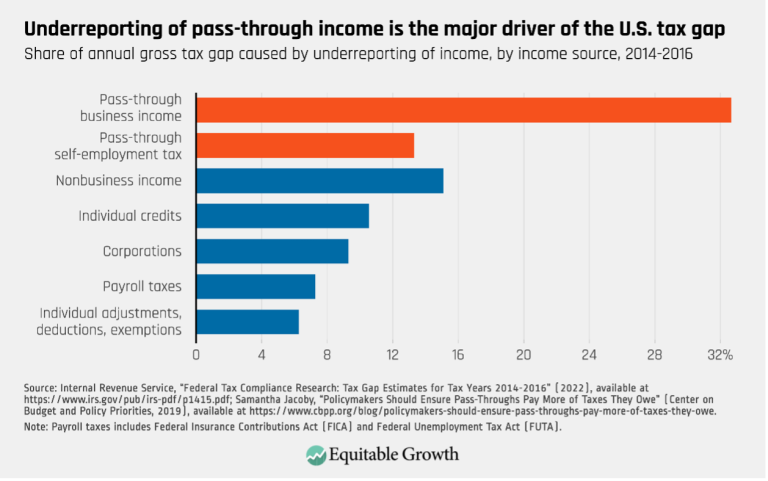
Underreporting of pass-through income is the major driver of the U.S. tax gap (opens in a new tab)
Visualizations APR 30, 2024
 View Chart
(opens in a new tab)
View Chart
(opens in a new tab)
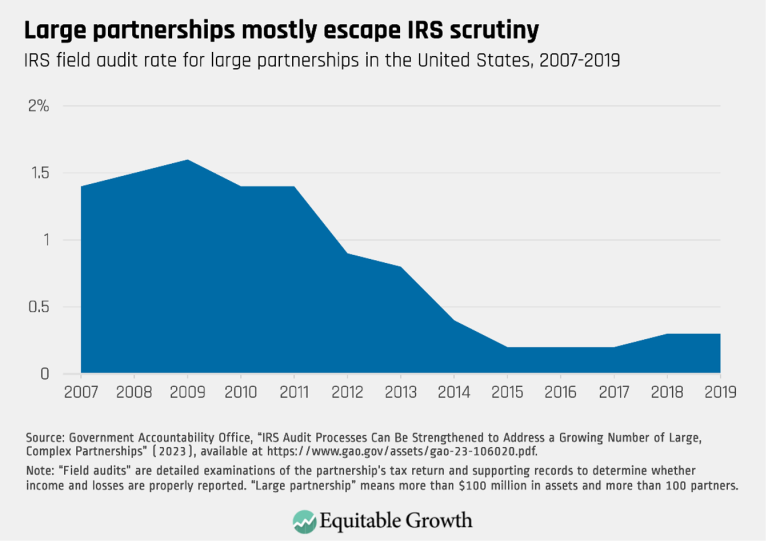
Large partnerships mostly escape IRS scrutiny (opens in a new tab)
Visualizations APR 30, 2024
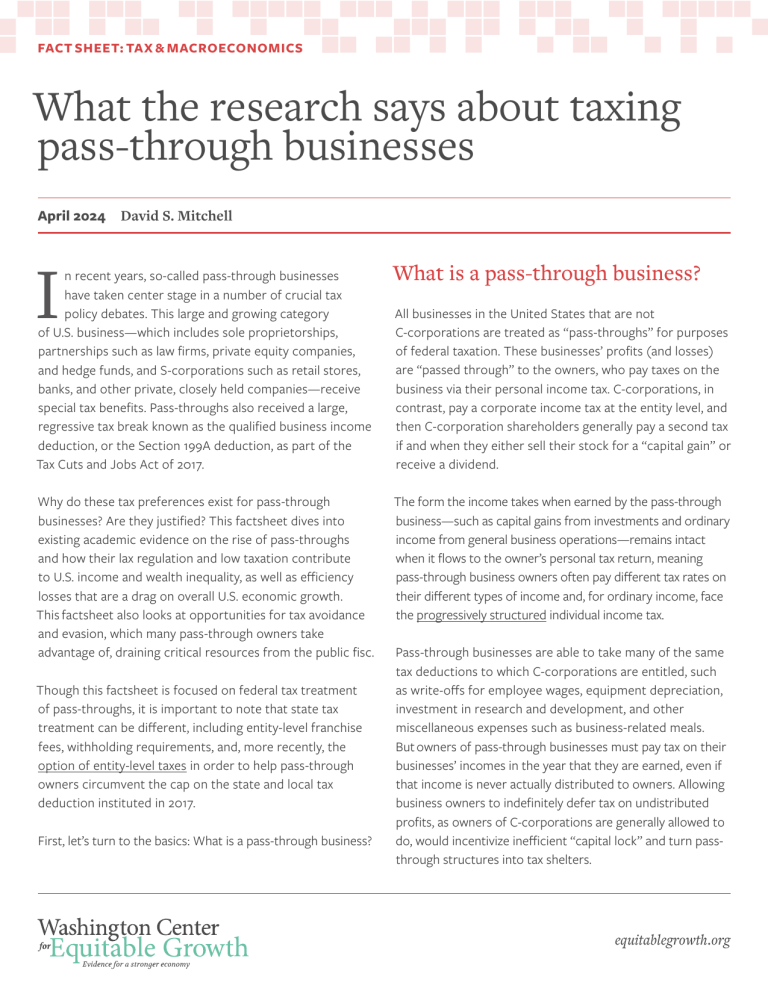
Factsheet: What the research says about taxing pass-through businesses (opens in a new tab)
Factsheets APR 30, 2024
In recent years, so-called pass-through businesses have taken center stage in a number of crucial tax policy debates. This large and growing category of U.S. business—which includes sole proprietorships, partnerships…
By: David S. Mitchell (opens in a new tab)
 View Chart
(opens in a new tab)
View Chart
(opens in a new tab)
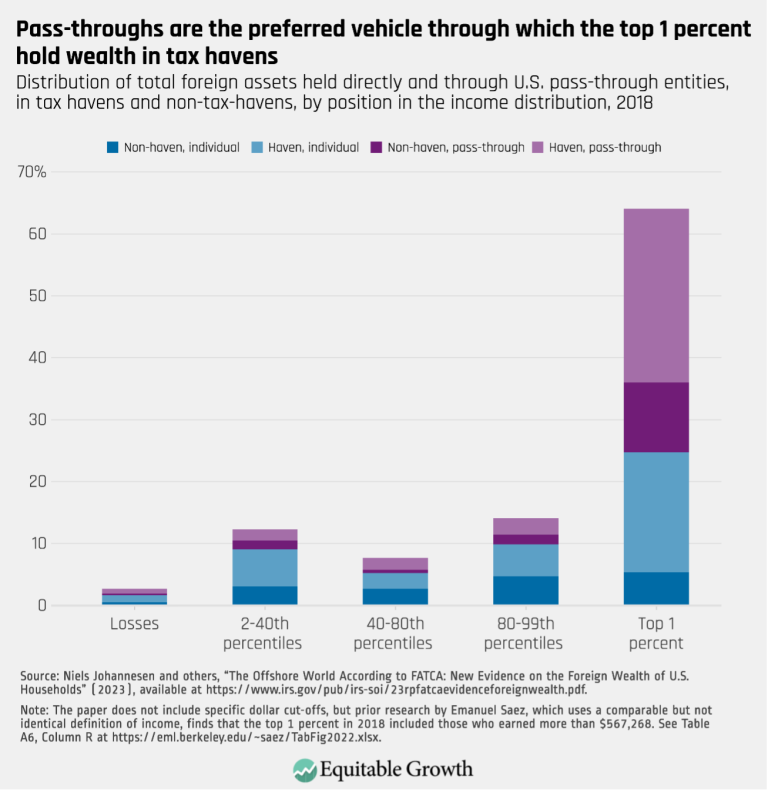
Pass-throughs are the preferred vehicle through which the top 1 percent hold wealth in tax havens (opens in a new tab)
Visualizations APR 30, 2024
 View Chart
(opens in a new tab)
View Chart
(opens in a new tab)
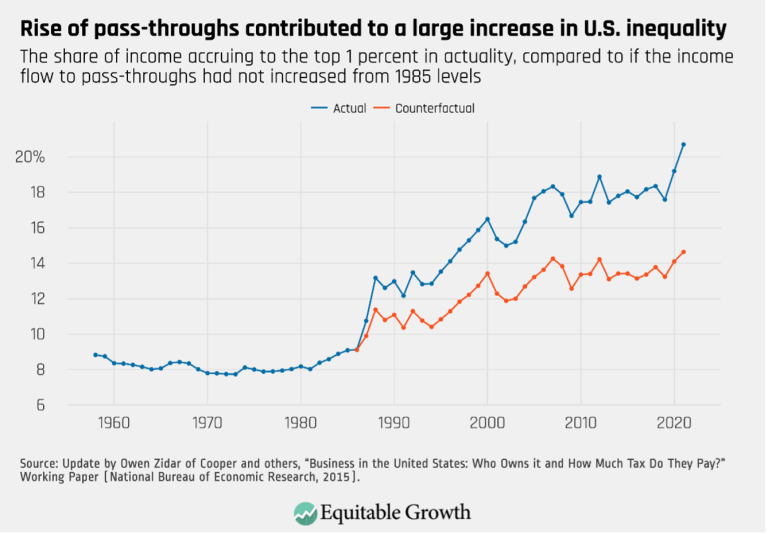
Rise of pass-throughs contributed to a large increase in U.S. inequality (opens in a new tab)
Visualizations APR 30, 2024
 View Chart
(opens in a new tab)
View Chart
(opens in a new tab)
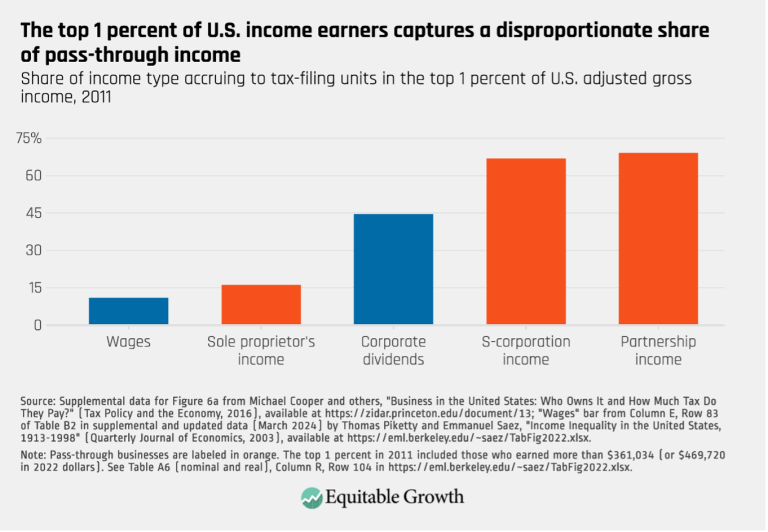
The top 1 percent of U.S. income earners captures a disproportionate share of pas-through income (opens in a new tab)
Visualizations APR 29, 2024
 View Chart
(opens in a new tab)
View Chart
(opens in a new tab)
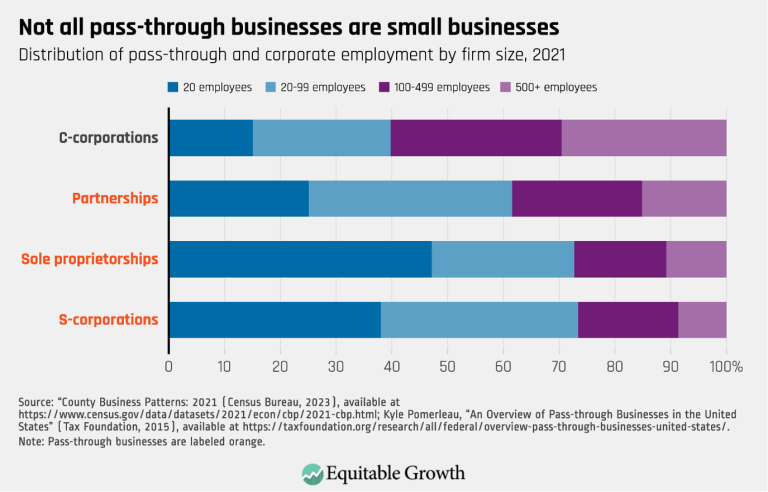
Not all pass-through businesses are small businesses (opens in a new tab)
Visualizations APR 29, 2024
 View Chart
(opens in a new tab)
View Chart
(opens in a new tab)
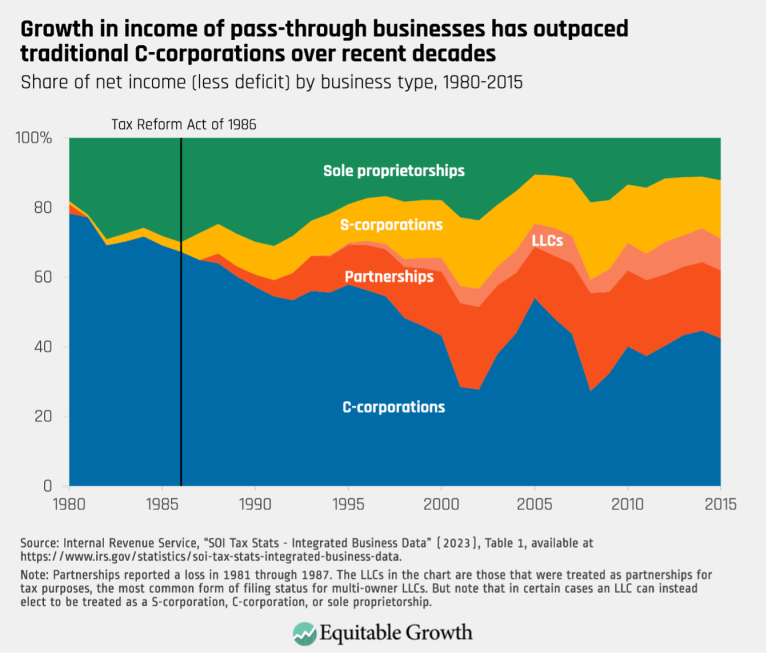
Growth in income of pass-through businesses has outpaced traditional C-corporations over recent decades (opens in a new tab)
Visualizations APR 29, 2024
 View Chart
(opens in a new tab)
View Chart
(opens in a new tab)
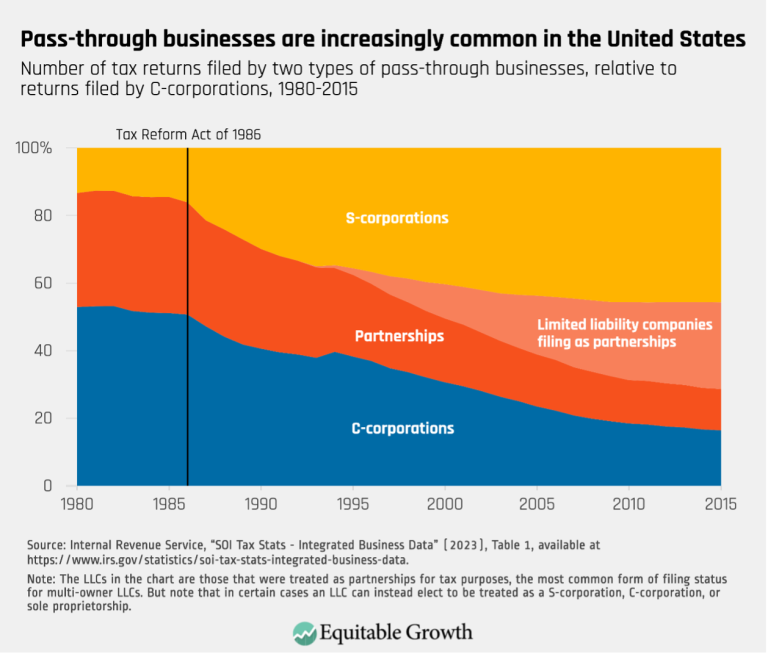
Pass-through businesses are increasingly common in the United States (opens in a new tab)
Visualizations APR 29, 2024

Combating market power through a graduated U.S. corporate income tax (opens in a new tab)
Issue Briefs APR 15, 2024
Editor’s note: This version has been updated from the original publication on April 15, 2024. The update corrects a prior underestimate of the revenue potential from graduated corporate tax rates…
By: Kimberly Clausing (opens in a new tab)
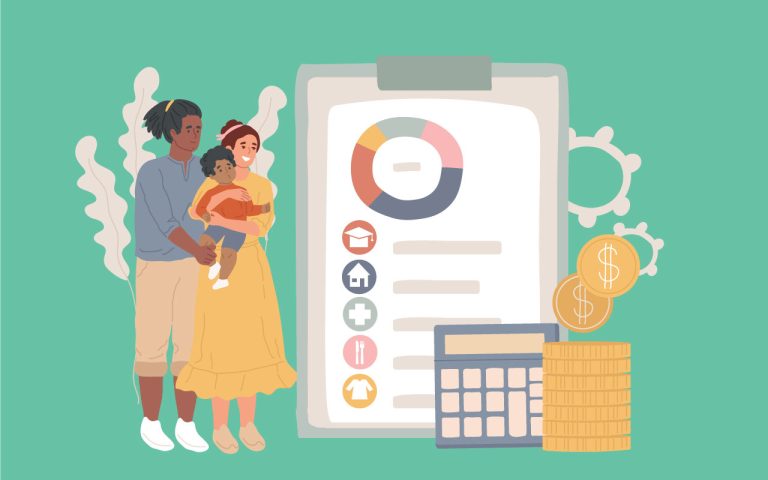
Enhanced Child Tax Credit helped U.S. families afford life-enhancing necessities and cope with inflation (opens in a new tab)
Blog APR 2, 2024
Amid ongoing congressional debate over expanding the Child Tax Credit for U.S. families, it’s important to understand why the fears about the expansion of that tax credit in 2021 were…
By: David S. Mitchell (opens in a new tab)
Spending Responses to the Child Tax Credit Expansions (opens in a new tab)
Working Papers APR 2, 2024
This article summarizes the literature that studied how people used the 2021 advance Child Tax Credit. Four primary findings emerged. Families more frequently reporting paying down debt during the first…
By: Jonathan Fisher (opens in a new tab), Jake Schild (opens in a new tab), David S. Johnson

Request for Proposals: How effective was the fiscal response to the COVID-19 recession for workers? (opens in a new tab)
RFPs MAR 18, 2024
By: Equitable Growth (opens in a new tab)

Closing the billionaire borrowing loophole would strengthen the progressivity of the U.S. tax code (opens in a new tab)
Issue Briefs FEB 5, 2024
The vast majority of Americans are concerned that some wealthy people don’t pay their “fair share” of federal taxes. They’re right to be bothered: Loopholes in the U.S. tax code…
By: Edward Fox (opens in a new tab), Zachary Liscow (opens in a new tab)

Doubling down on cuts to the IRS is bad for the federal budget and for tax fairness in the United States (opens in a new tab)
Blog JAN 9, 2024
The U.S. Congress recently announced a bipartisan budget deal for fiscal year 2024 appropriations for the U.S. federal government. The budget is largely consistent with the framework agreed to in…
By: David S. Mitchell (opens in a new tab)
 View Chart
(opens in a new tab)
View Chart
(opens in a new tab)
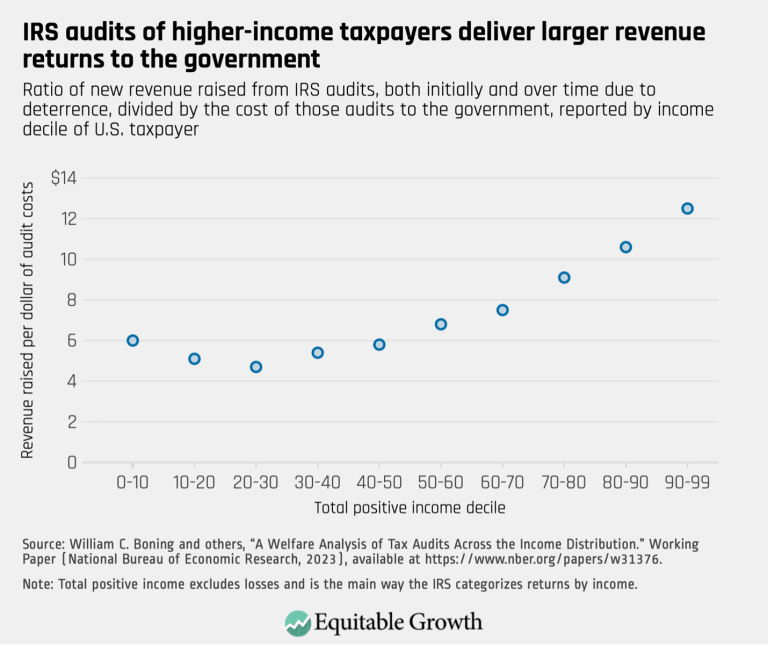
IRS audits of higher-income taxpayers deliver larger revenue returns to the government (opens in a new tab)
Visualizations JAN 9, 2024
Six years later, more evidence shows the Tax Cuts and Jobs Act benefits U.S. business owners and executives, not average workers (opens in a new tab)
Blog DEC 20, 2023
When policymakers were debating the Tax Cuts and Jobs Act of 2017, many proponents claimed that average U.S. workers would benefit via wage increases. These adherents of trickle-down economic theory…
By: David S. Mitchell (opens in a new tab)
Request for proposals: Research grants for early career scholars (opens in a new tab)
RFPs NOV 30, 2023
By: Equitable Growth (opens in a new tab)

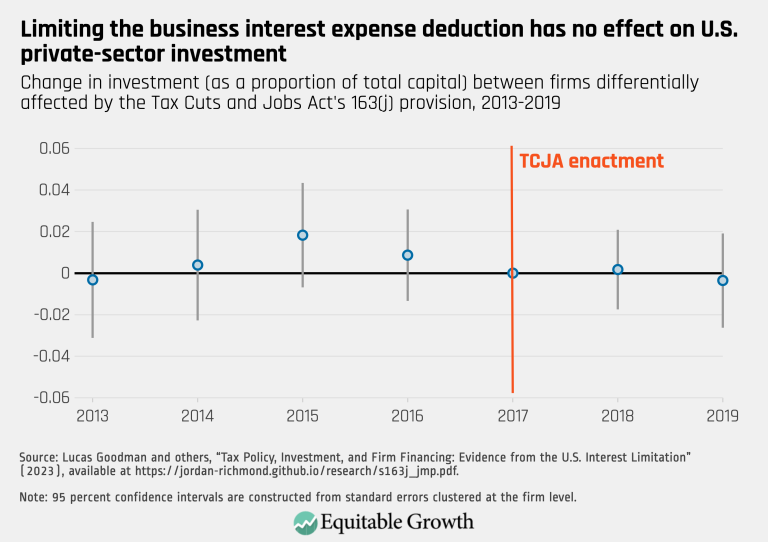
New evidence shows that limiting a tax break for highly leveraged firms doesn’t hurt the U.S. economy (opens in a new tab)
Blog NOV 21, 2023
Does increasing taxes on businesses reduce private-sector investment? Most economists agree that investment in new projects and technologies is a key driver of economic growth. While the tax code plays…
By: David S. Mitchell (opens in a new tab)
 View Chart
(opens in a new tab)
View Chart
(opens in a new tab)
Investment Rate EG Graph 04 (opens in a new tab)
Visualizations NOV 20, 2023

The Rise of Pass-Throughs: an Empirical Investigation (opens in a new tab)
Working Papers SEP 26, 2023
Pass-through entities have emerged as the leading U.S. business organization form in recent decades. Using comprehensive confidential administrative data, this paper highlights five core findings: (1) the rise in pass-throughs…
By: Sebastian Dyrda (opens in a new tab), Benjamin Pugsley (opens in a new tab)
The New Economics of Industrial Policy (opens in a new tab)
Working Papers SEP 19, 2023
We discuss the considerable literature that has developed in recent years providing rigorous evidence on how industrial policies work. This literature is a significant improvement over the earlier generation of…
By: Réka Juhász (opens in a new tab), Nathan Lane, Dani Rodrik (opens in a new tab)
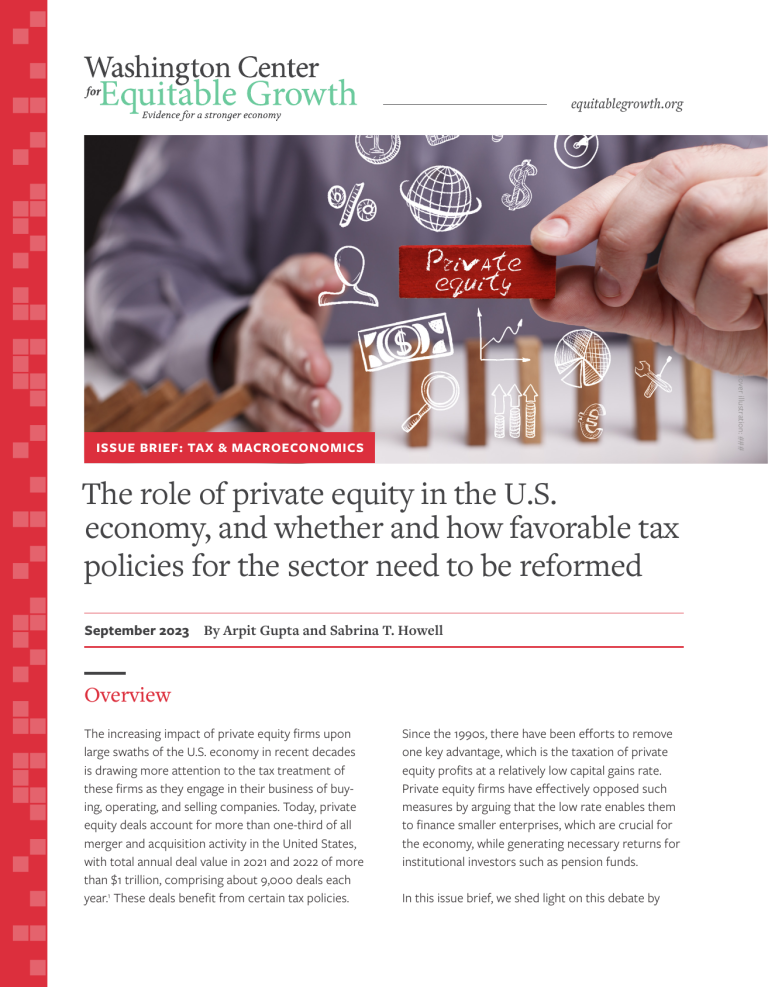
The role of private equity in the U.S. economy, and whether and how favorable tax policies for the sector need to be reformed (opens in a new tab)
Issue Briefs SEP 14, 2023
The increasing impact of private equity firms upon large swaths of the U.S. economy in recent decades is drawing more attention to the tax treatment of these firms as they…
By: Arpit Gupta (opens in a new tab), Sabrina Howell (opens in a new tab)
The effects of the expanded Child Tax Credit on low-income families in the United States (opens in a new tab)
Blog AUG 2, 2023
Childhood poverty is a stubborn problem in the United States. About 11 million U.S. children lived in poverty prior to the COVID-19 pandemic, accounting for nearly one-third of the impoverished…
By: Jesus Torres (opens in a new tab)

Short-term effects of the expanded Child Tax Credit on U.S. labor force participation amid the COVID-19 pandemic (opens in a new tab)
Blog JUL 26, 2023
There is a common politicized thread to arguments against expanding the federal antipoverty Child Tax Credit program permanently and to the justifications that a majority of the U.S. Supreme Court…
By: Sullivan Anderson (opens in a new tab)
The Short-Term Labor Supply Response to the Expanded Child Tax Credit (opens in a new tab)
Working Papers JUL 26, 2023
We estimate the extensive and intensive margin labor supply response to the monthly Child Tax Credit disbursed in 2021 as a part of the American Rescue Plan Act. Using Current…
By: Brandon Enriquez (opens in a new tab), Damon Jones (opens in a new tab), Ernest V. Tedeschi

The historical lessons from the U.S. General Property Tax (opens in a new tab)
Blog JUL 5, 2023
In the early 19th century, a new type of property tax system emerged in the United States, distinguishing itself from its European counterparts by encompassing all forms of property. This…
By: Sacha Dray (opens in a new tab), Camille Landais (opens in a new tab), Stefanie Stantcheva (opens in a new tab)
Wealth and Property Taxation in the United States (opens in a new tab)
Working Papers JUL 5, 2023
We study the history and geography of wealth accumulation in the US, using newly collected historical property tax records since the early 1800s. The US General Property Tax was a…
By: Sacha Dray (opens in a new tab), Camille Landais (opens in a new tab), Stefanie Stantcheva (opens in a new tab)
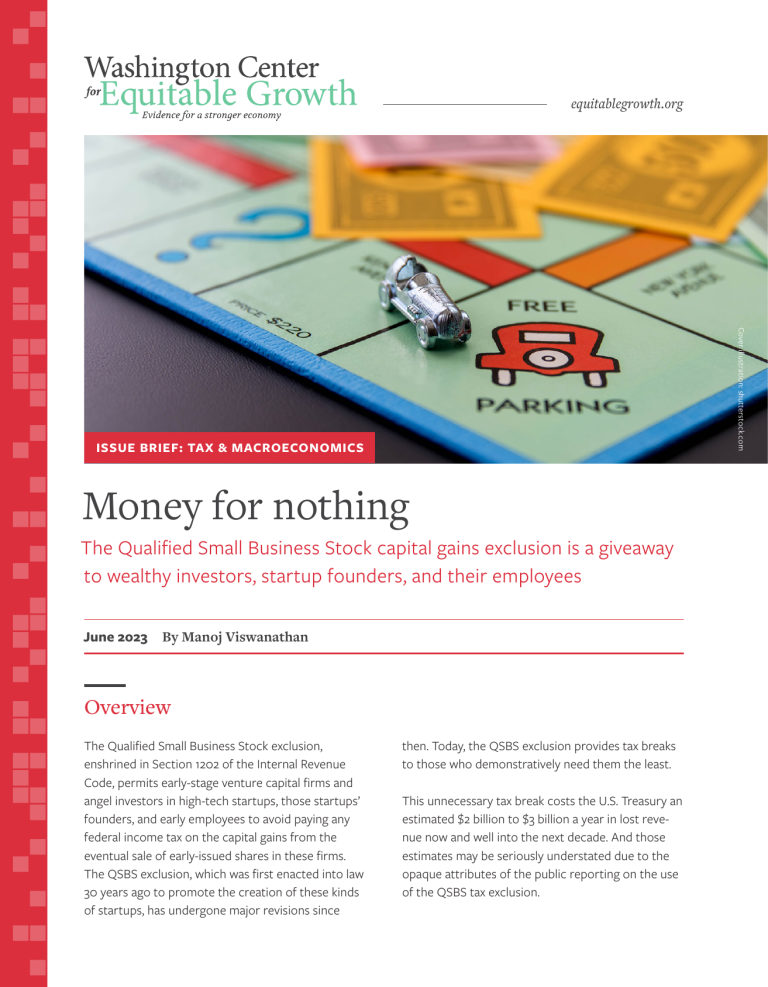
Money for nothing: The Qualified Small Business Stock capital gains exclusion is a giveaway to wealthy investors, startup founders, and their employees (opens in a new tab)
Issue Briefs JUN 8, 2023
The Qualified Small Business Stock exclusion, enshrined in Section 1202 of the Internal Revenue Code, permits early-stage venture capital firms and angel investors in high-tech startups, those startups’ founders, and…
By: Manoj Viswanathan (opens in a new tab)
New IRS report examines free tax filing option to reduce the cost and complexity for U.S. taxpayers (opens in a new tab)
Issue Briefs JUN 1, 2023
Filing a tax return with the Internal Revenue Service is one of the most common interactions Americans have with the federal government. Unfortunately, this process is often time-consuming and complex.…
By: Andre Gobbo (opens in a new tab)

Equitable Growth grantee Gabriel Zucman awarded the 2023 John Bates Clark Medal (opens in a new tab)
Blog MAY 9, 2023
Earlier this month, associate professor of public policy and economics Gabriel Zucman at the University of California, Berkeley—and a Washington Center for Equitable Growth 2018 grantee—won the 2023 John Bates…
By: Equitable Growth (opens in a new tab)

A missed opportunity to expand the Child Tax Credit will affect U.S. families and the broader economy now and for years to come (opens in a new tab)
Blog DEC 21, 2022
Earlier this week, the U.S. Congress released its proposed omnibus bill that funds the federal government through September 2023 and makes various other reforms to the nation’s retirement system, antitrust…
By: Equitable Growth (opens in a new tab)
Fighting tax evasion by the wealthy can raise revenue and restore the integrity of the U.S. tax system (opens in a new tab)
Blog DEC 20, 2022
Recent estimates suggest that as much as $36 billion a year in taxes are unpaid by Americans hiding wealth abroad, and more than $50 billion more is lost due to…
By: Jeanne Bomare (opens in a new tab), Daniel Reck (opens in a new tab)
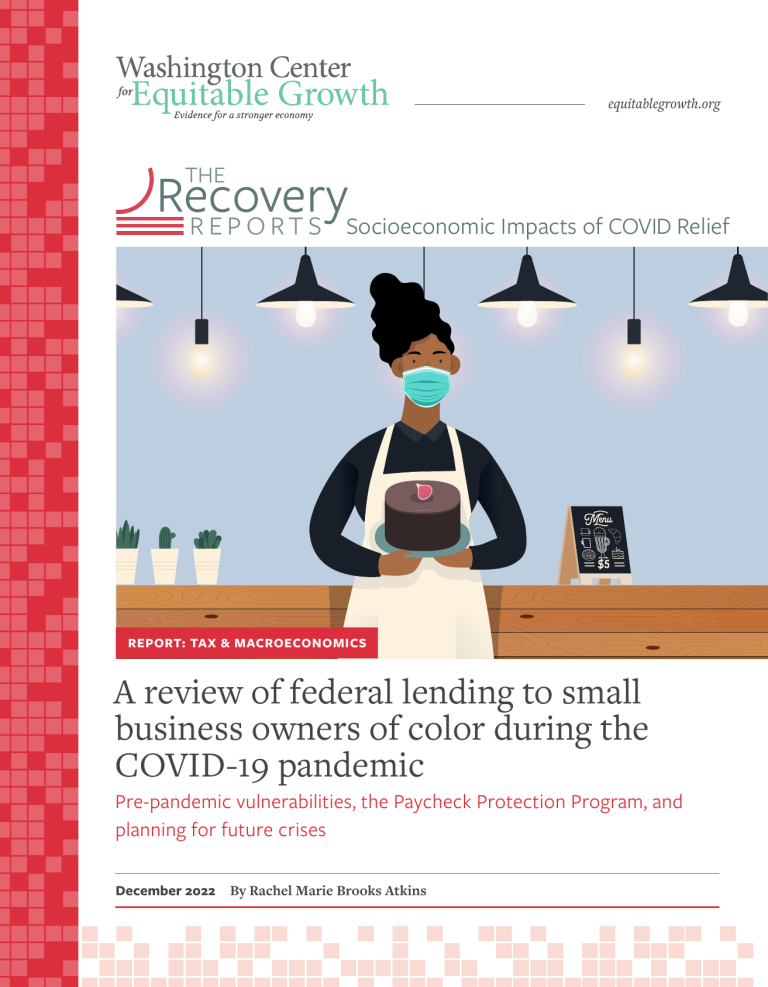
A review of federal lending to small business owners of color during the COVID-19 pandemic (opens in a new tab)
Reports DEC 13, 2022
The COVID-19 pandemic that began in early 2020 hammered small businesses across the globe. The number of active businesses declined precipitously, supply chain interruptions reduced business operations, and global trade…
By: Rachel Marie Brooks Atkins (opens in a new tab)
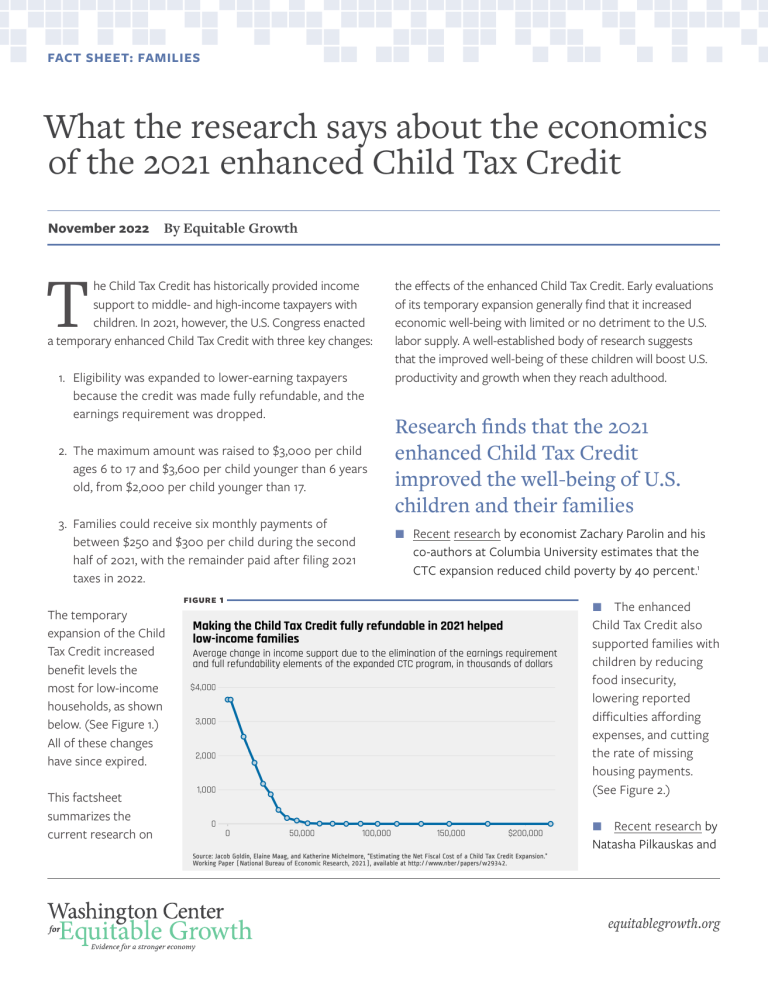
Factsheet: What the research says about the economics of the 2021 enhanced Child Tax Credit (opens in a new tab)
Factsheets NOV 29, 2022
The Child Tax Credit has historically provided income support to middle- and high-income taxpayers with children. In 2021, however, the U.S. Congress enacted a temporary enhanced Child Tax Credit with…
By: Equitable Growth (opens in a new tab)
 View Chart
(opens in a new tab)
View Chart
(opens in a new tab)
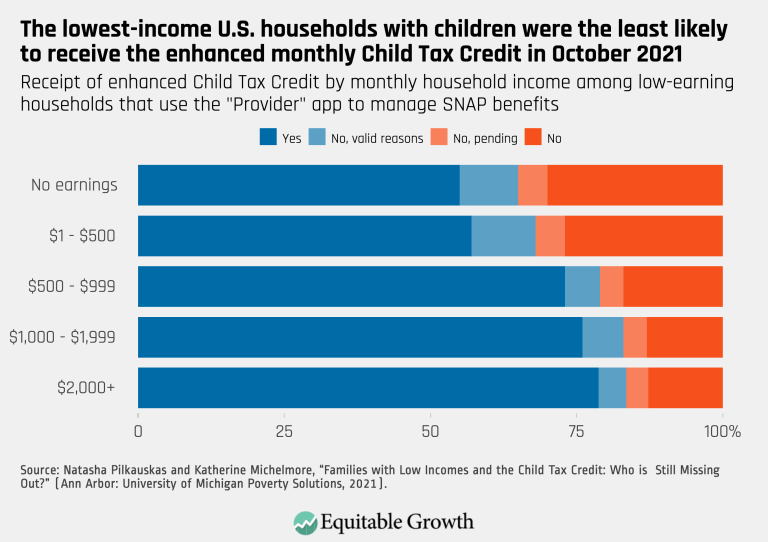
The lowest-income U.S. households with children were the least likely to receive the enhanced monthly Child Tax Credit in October 2021 (opens in a new tab)
Visualizations NOV 28, 2022
 View Chart
(opens in a new tab)
View Chart
(opens in a new tab)
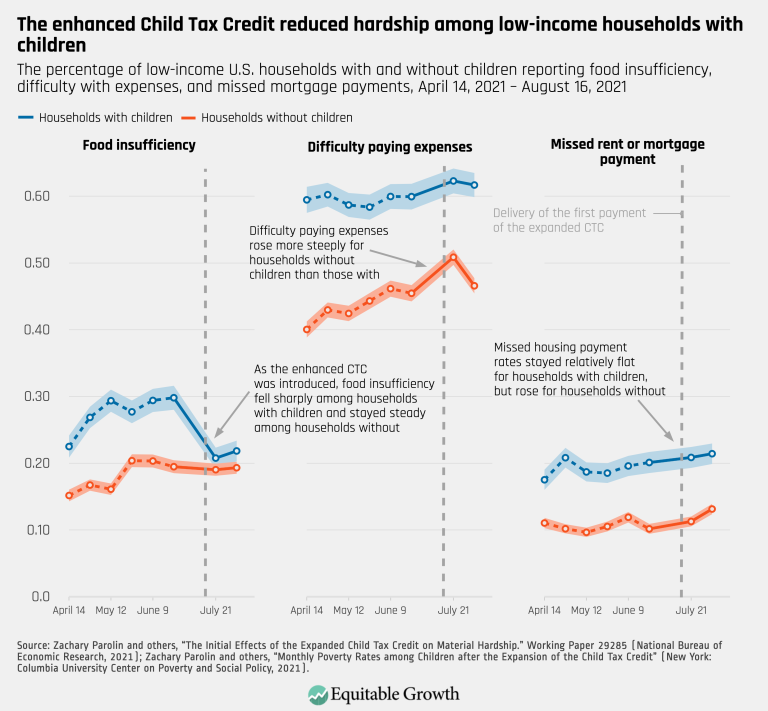
The enhanced Child Tax Credit reduced hardship among low-income households with children (opens in a new tab)
Visualizations NOV 28, 2022

How the Infrastructure Investment and Jobs Act of 2021 is promoting sustainable U.S. economic growth and mitigating climate change (opens in a new tab)
Issue Briefs NOV 18, 2022
In an issue brief earlier this year, Equitable Growth discussed how the Infrastructure Investment and Jobs Act of 2021 rests on sound economic principles and analyzed the ways that its…
By: Michael Madowitz (opens in a new tab), Shaun Harrison (opens in a new tab)

What are the distributional effects of monetary policy? (opens in a new tab)
Blog NOV 17, 2022
The Washington Center for Equitable Growth recently announced our 2023 Request for Proposals to support research investigating the various channels through which economic inequality, in all its forms, may or…
By: Shaun Harrison (opens in a new tab)
Monetary Policy, Labor Income Redistribution and the Credit Channel: Evidence from Matched Employer-Employee and Credit Registers (opens in a new tab)
Working Papers NOV 17, 2022
We document the redistributive effects of monetary policy on labor market outcomes via the credit channel. For identification, we exploit matched administrative datasets in Portugal – employee-employer and credit registers…
By: Martina Jasova (opens in a new tab), Caterina Mendicino (opens in a new tab), Ettore Panetti (opens in a new tab), José-Luis Peydró (opens in a new tab), Dominik Supera (opens in a new tab)

Consumers initially spend less than a third of their stimulus checks, on average, amid recessions (opens in a new tab)
Blog SEP 12, 2022
Economists and policymakers alike generally agree on the effectiveness of sending out direct stimulus checks to individuals to help reverse an economic downturn by encouraging more consumer spending. But they…
By: Equitable Growth (opens in a new tab)
Marginal Propensity to Consume in Recessions: a Meta-analysis (opens in a new tab)
Working Papers SEP 12, 2022
This paper assembles a dataset of 1244 estimates of marginal propensities to consume (MPC) out of stimulus checks and other small transitory or predictable payments—as reported by 40 studies. I…
 View Chart
(opens in a new tab)
View Chart
(opens in a new tab)
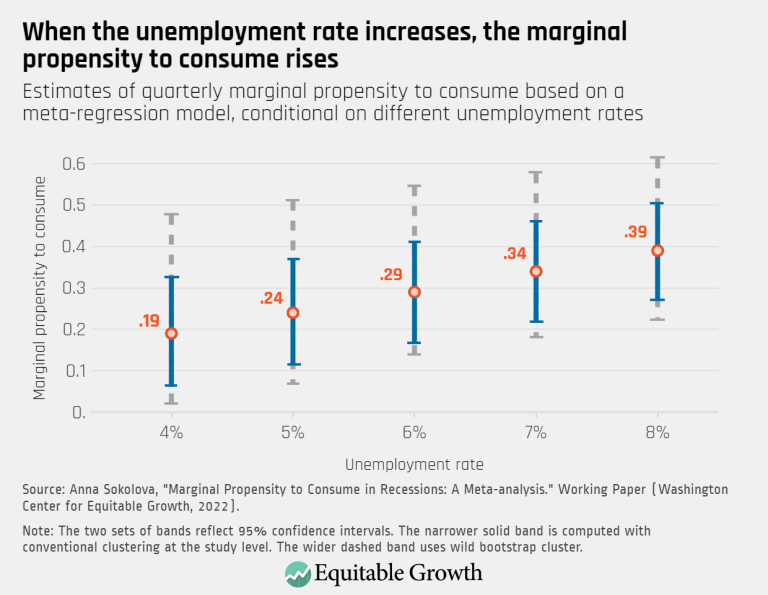
When the unemployment rate increases, the marginal propensity to consume rises (opens in a new tab)
Visualizations SEP 8, 2022
 View Chart
(opens in a new tab)
View Chart
(opens in a new tab)
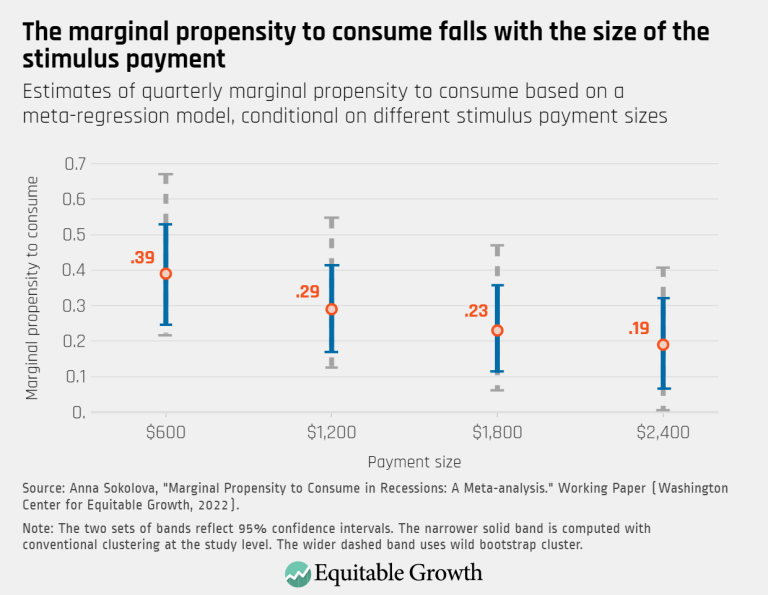
The marginal propensity to consume falls with the size of the stimulus payment (opens in a new tab)
Visualizations SEP 8, 2022

The inequitable consequences of ‘heat islands’ within the metropolitan areas of the United States and what to do about it (opens in a new tab)
Blog AUG 3, 2022
Environmental science finds that so-called heat islands occur when urbanized areas experience much higher temperatures than neighboring outlying areas within major metropolitan areas. In and around U.S. cities, more affluent…
By: Michael Garvey (opens in a new tab)

NBER Summer Institute 2022 Round-up: Week 3 (opens in a new tab)
Blog AUG 1, 2022
On July 11, the National Bureau of Economic Research kicked off its summer institute, an annual 3-week conference featuring discussions and paper presentations on various topics in economics, including environmental…
By: Equitable Growth (opens in a new tab)
 View Chart
(opens in a new tab)
View Chart
(opens in a new tab)
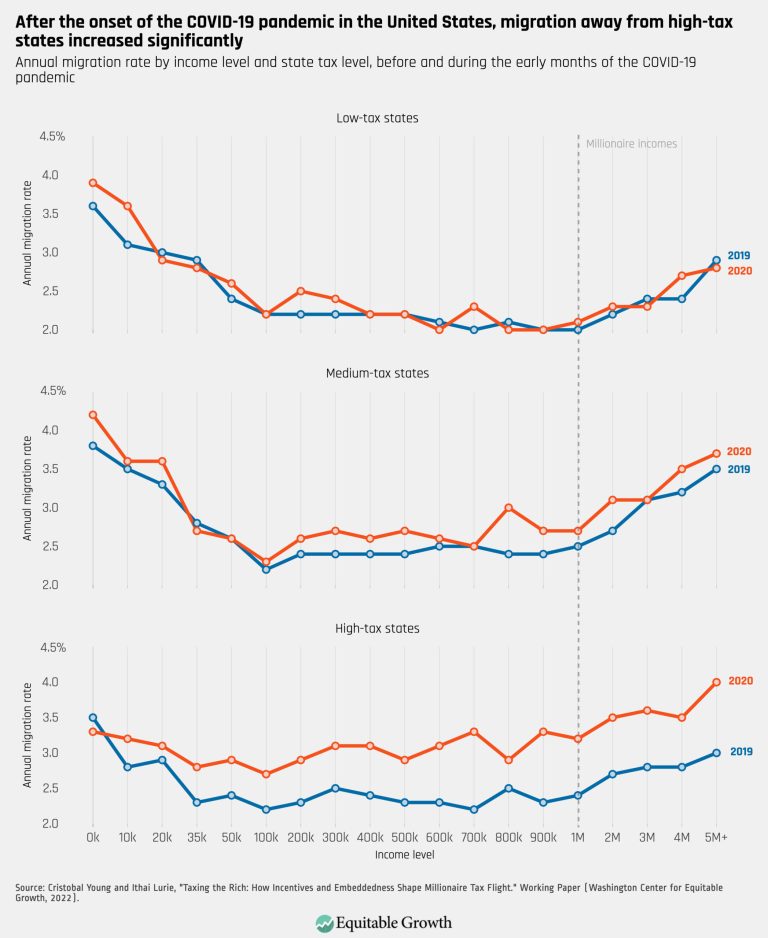
After the onset of the COVID-19 pandemic in the United States, migration away from high-tax states increased significantly – updated (opens in a new tab)
Visualizations JUL 28, 2022
 View Chart
(opens in a new tab)
View Chart
(opens in a new tab)
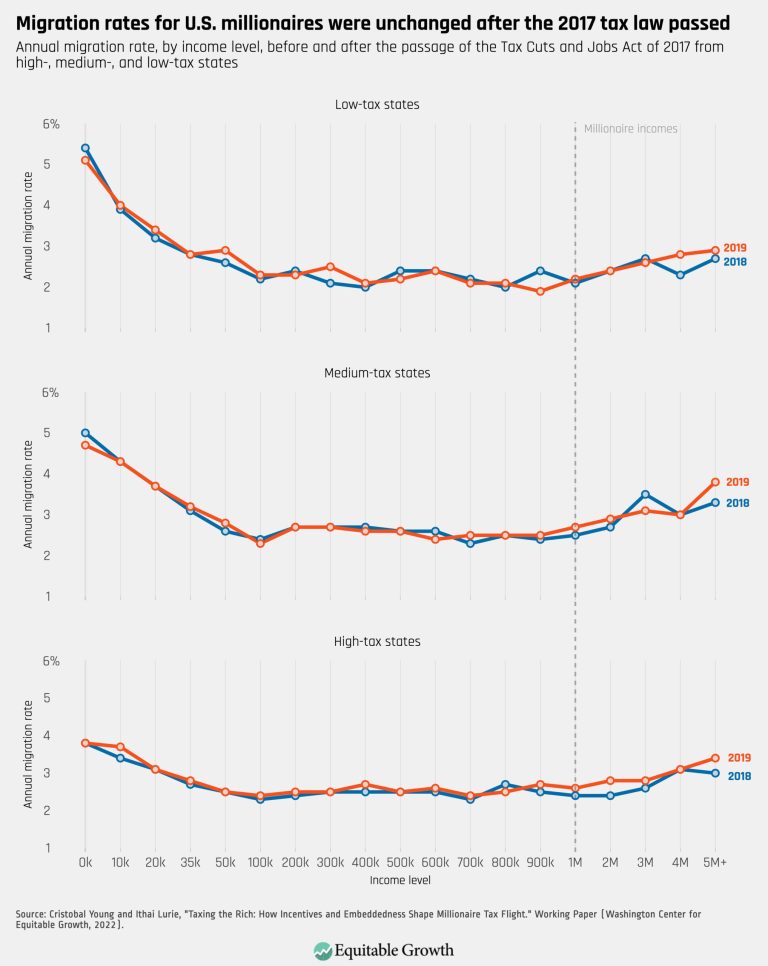
Migration rates for U.S. millionaires were unchanged after the 2017 tax law passed (opens in a new tab)
Visualizations JUL 28, 2022

Taxing the rich: The effect of tax reform and the COVID-19 pandemic on tax flight among U.S. millionaires (opens in a new tab)
Blog JUL 28, 2022
Taxing the rich is one of the central policy debates in this time of rising inequality. Elite taxation can change the distribution of income in society, support equitable growth, and…
By: Cristobal Young (opens in a new tab), Ithai Lurie (opens in a new tab)
Taxing the Rich: How Incentives and Embeddedness Shape Millionaire Tax Flight (opens in a new tab)
Working Papers JUL 28, 2022
Taxing the rich is one of the central debates in this era of rising inequality. Elite taxation can alleviate income disparities and fund public investments. Yet, if top earners engage…
By: Cristobal Young (opens in a new tab), Ithai Lurie (opens in a new tab)

NBER Summer Institute 2022 Round-up: Week 2 (opens in a new tab)
Blog JUL 26, 2022
On July 11, the National Bureau of Economic Research kicked off its summer institute, an annual 3-week conference featuring discussions and paper presentations on various topics in economics, including disaggregating…
By: Equitable Growth (opens in a new tab)

In Conversation with R. Jisung Park (opens in a new tab)
In Conversation JUL 25, 2022
Equitable Growth in Conversation is a recurring series where we talk with economists and other academics to help us better understand whether and how economic inequality affects economic growth and…
By: Michael Garvey (opens in a new tab)

NBER Summer Institute 2022 Round-up: Week 1 (opens in a new tab)
Blog JUL 18, 2022
On July 11, the National Bureau of Economic Research kicked off its summer institute, an annual 3-week conference featuring discussions and paper presentations on various topics in economics, including monopsony…
By: Equitable Growth (opens in a new tab)

Recent working paper explores connection between capital investment and labor demand in the United States (opens in a new tab)
Blog MAY 20, 2022
The increasing visibility of artificial intelligence and other advanced technologies in the workplace is drawing new attention to how employers integrate technology into work processes and what effects these decisions…
By: Kathryn Zickuhr (opens in a new tab)
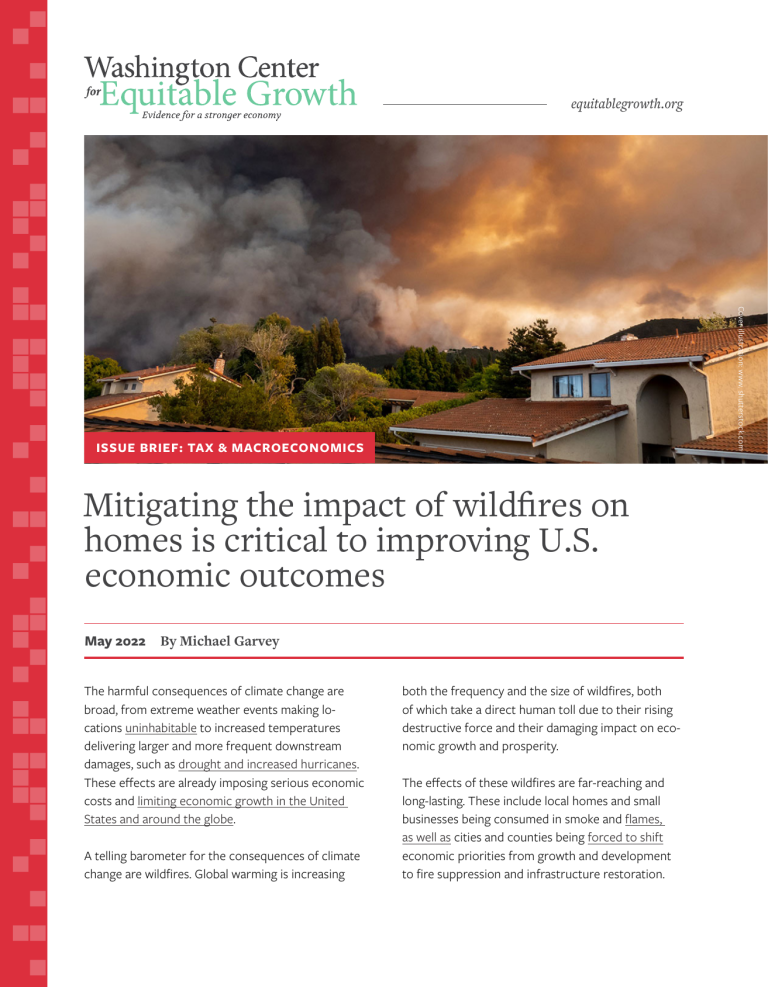
Mitigating the impact of wildfires on homes is critical to improving U.S. economic outcomes (opens in a new tab)
Issue Briefs MAY 10, 2022
The harmful consequences of climate change are broad, from extreme weather events making locations uninhabitable to increased temperatures delivering larger and more frequent downstream damages, such as drought and increased…
By: Michael Garvey (opens in a new tab)

Modeling future economic damages from climate change is an important and underdeveloped area of research (opens in a new tab)
Blog APR 22, 2022
This year’s Earth Day celebrations come on the heels of yet another devastating UN report detailing the consequences of climate change—and the global lack of action to mitigate its effects—for…
By: Michael Garvey (opens in a new tab)
Understanding Climate Damages: Consumption versus Investment (opens in a new tab)
Working Papers APR 22, 2022
Existing climate-economy models use aggregate damage functions to model the effects of climate change. This approach assumes climate change has equal impacts on the productivity of firms that produce consumption…
By: Gregory P. Casey (opens in a new tab), Stephie Fried (opens in a new tab), Matthew Gibson (opens in a new tab)
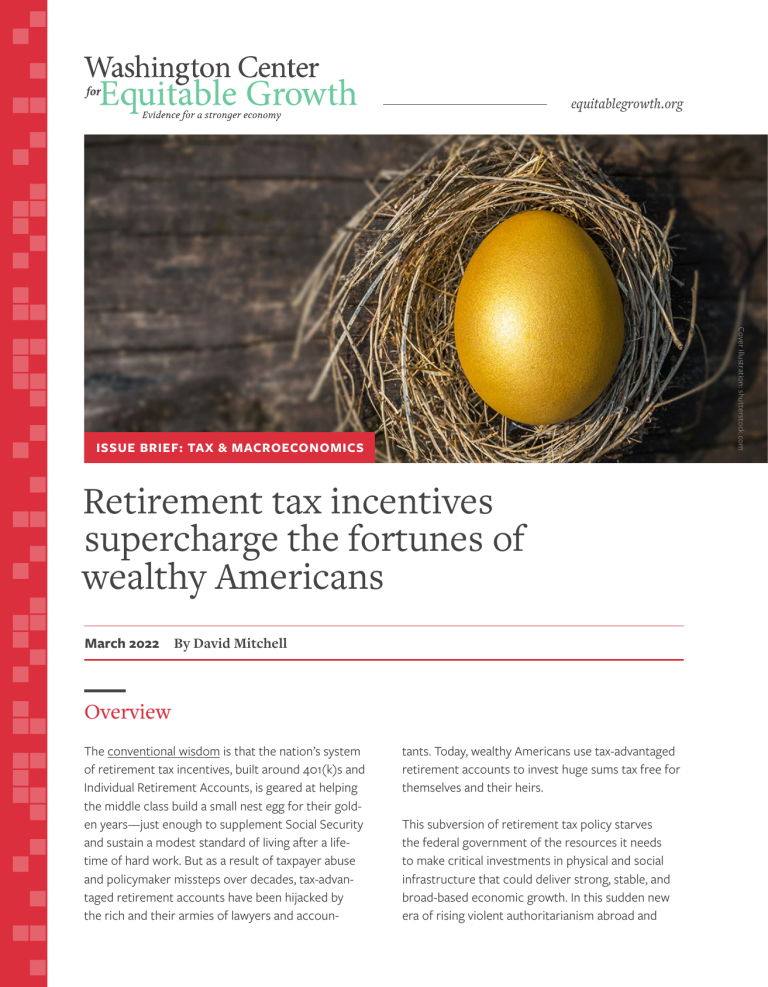
Retirement tax incentives supercharge the fortunes of wealthy Americans (opens in a new tab)
Issue Briefs MAR 17, 2022
The conventional wisdom is that the nation’s system of retirement tax incentives, built around 401(k)s and Individual Retirement Accounts, is geared at helping the middle class build a small nest…
By: David S. Mitchell (opens in a new tab)
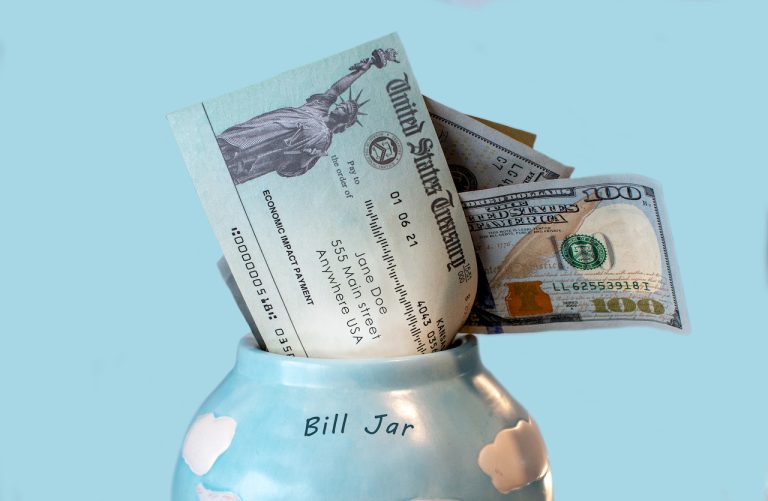
Fostering academic research on U.S. economic impact payments that goes beyond the marginal propensity to consume (opens in a new tab)
Blog JAN 18, 2022
Direct government payments to individuals are now a standard part of U.S. fiscal policymakers’ recession-fighting toolkit. Three rounds of so-called economic impact payments from the federal government have been paid…
By: Karen Dynan (opens in a new tab)
Capital Investment and Labor Demand (opens in a new tab)
Working Papers JAN 11, 2022
We study how tax policies that lower the cost of capital impact investment and labor demand. Difference-in-differences estimates using confidential US Census Data on manufacturing establishments show that tax policies…
By: E. Mark Curtis (opens in a new tab), Daniel G. Garrett (opens in a new tab), Eric C. Ohrn, Kevin A. Roberts (opens in a new tab), Juan Carlos Suárez Serrato (opens in a new tab)
Closing the Innovation Gap in Pink and Black (opens in a new tab)
Working Papers JAN 10, 2022
Recent research shows the negative impact of discrimination not only on the targets of discrimination but also on the economy as a whole. Racial and gender inequality can limit the…
By: Lisa D. Cook, Janet Gerson (opens in a new tab), Jennifer Kuan (opens in a new tab)

Billionaires Income Tax proposal seeks to ensure that U.S. ultra-wealthy pay their fair share in taxes (opens in a new tab)
Blog DEC 17, 2021
There is a growing recognition among policymakers in Washington that something must be done to address the ever-widening U.S. wealth divide, which is especially dramatic when broken out by race.…
By: David S. Mitchell (opens in a new tab)

The economic evidence behind 10 policies in the Build Back Better Act (opens in a new tab)
Issue Briefs NOV 24, 2021
The U.S. House of Representatives late last week passed a key plank of President Joe Biden’s economic agenda, the Build Back Better Act. Coming on the heels of the president…
By: Maryam Janani-Flores (opens in a new tab), David S. Mitchell (opens in a new tab)
 View Chart
(opens in a new tab)
View Chart
(opens in a new tab)
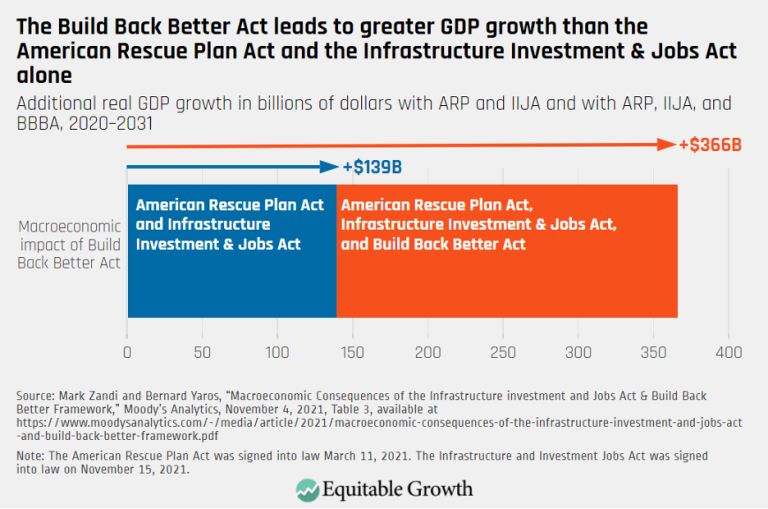
The Build Back Better Act leads to greater GDP growth than the American Rescue Plan Act and the Infrastructure Investment & Jobs Act alone (opens in a new tab)
Visualizations NOV 24, 2021

In Conversation with Carlos Fernando Avenancio-León (opens in a new tab)
In Conversation SEP 20, 2021
Equitable Growth in Conversation is a recurring series where we talk with economists and other academics to help us better understand whether and how economic inequality affects economic growth and…
By: David S. Mitchell (opens in a new tab)
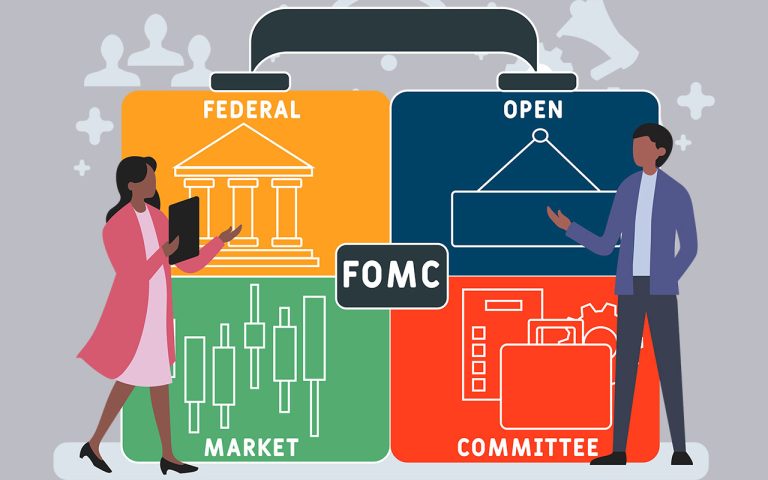
The value of racial and gender diversity at the Federal Reserve (opens in a new tab)
Blog SEP 16, 2021
The Federal Reserve’s so-called dual mandate to maintain overall price stability and maximum sustainable growth in U.S. employment is always on the minds of the U.S. central bank’s Federal Open…
By: Equitable Growth (opens in a new tab)
Diverse Policy Committees Can Reach Underrepresented Groups (opens in a new tab)
Working Papers SEP 16, 2021
In a randomized control trial that varies the salience of female and minority representation on the Federal Reserve’s monetary policy committee, the FOMC, we test whether diversity affects how Fed…
By: Francesco D’Acunto (opens in a new tab), Andreas Fuster (opens in a new tab), Michael Weber (opens in a new tab)

Completing the unfinished New Deal to overcome 21st century U.S. economic inequality (opens in a new tab)
Blog AUG 31, 2021
President Joe Biden wants Congress to enact his two signature legislative packages—the $1 trillion bipartisan physical infrastructure plan passed by the U.S. Senate earlier in August and a $3.5 trillion…
By: David S. Mitchell (opens in a new tab)

Congress needs distribution analyses to make informed, equitable policy choices, and the CBO FAIR Scoring Act would deliver it (opens in a new tab)
Blog AUG 11, 2021
Before voting on legislation, members of Congress usually receive a cost estimate, or score, for that legislation from the Congressional Budget Office. This score provides nonpartisan CBO analysts’ best estimate…
By: Corey Husak (opens in a new tab)

NBER Summer Institute 2021 Round-up: Week 2 (opens in a new tab)
Blog JUL 26, 2021
On July 12, the National Bureau of Economic Research kicked off its summer institute, an annual 3-week conference featuring discussions and paper presentations on specific subfields of economics, including wealth…
By: Equitable Growth (opens in a new tab)

NBER Summer Institute 2021 Round-up: Week 1 (opens in a new tab)
Blog JUL 19, 2021
On July 12, the National Bureau of Economic Research kicked off its summer institute, an annual 3-week conference featuring discussions and paper presentations on specific subfields of economics, including inequality…
By: Equitable Growth (opens in a new tab)

Climate change among many issues discussed at annual Western Economic Association International conference (opens in a new tab)
Blog JUL 15, 2021
The Western Economic Association International at the end of June held its 96th annual conference, bringing audiences together for more than 280 concurrent sessions to collaborate, share, and learn from…
By: Equitable Growth (opens in a new tab)
 View Chart
(opens in a new tab)
View Chart
(opens in a new tab)
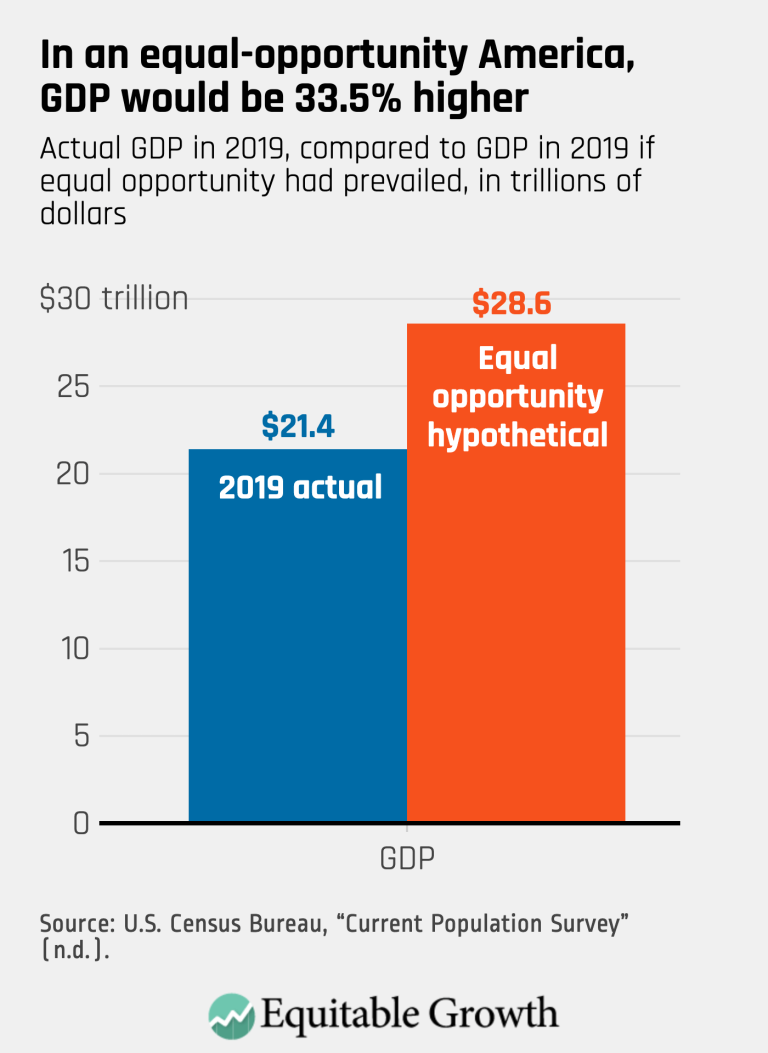
In an equal-opportunity America, GDP would be 33.5% higher (opens in a new tab)
Visualizations JUL 2, 2021
 View Chart
(opens in a new tab)
View Chart
(opens in a new tab)
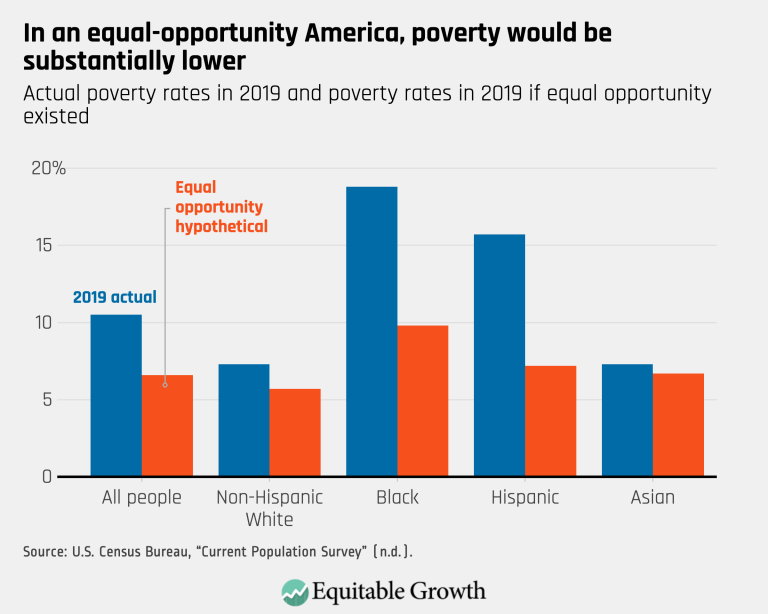
In an equal-opportunity America, poverty would be substantially lower (opens in a new tab)
Visualizations JUL 2, 2021
 View Chart
(opens in a new tab)
View Chart
(opens in a new tab)
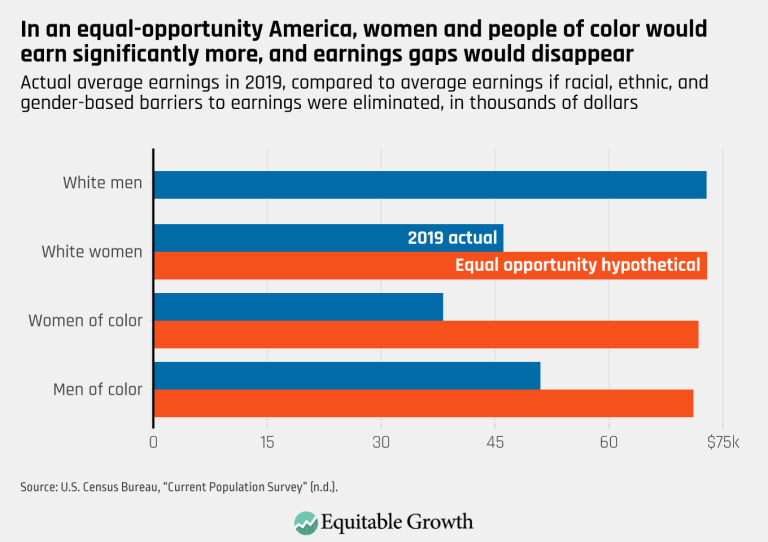
In an equal-opportunity America, women and people of color would earn significantly more, and earnings gaps would disappear (opens in a new tab)
Visualizations JUL 2, 2021
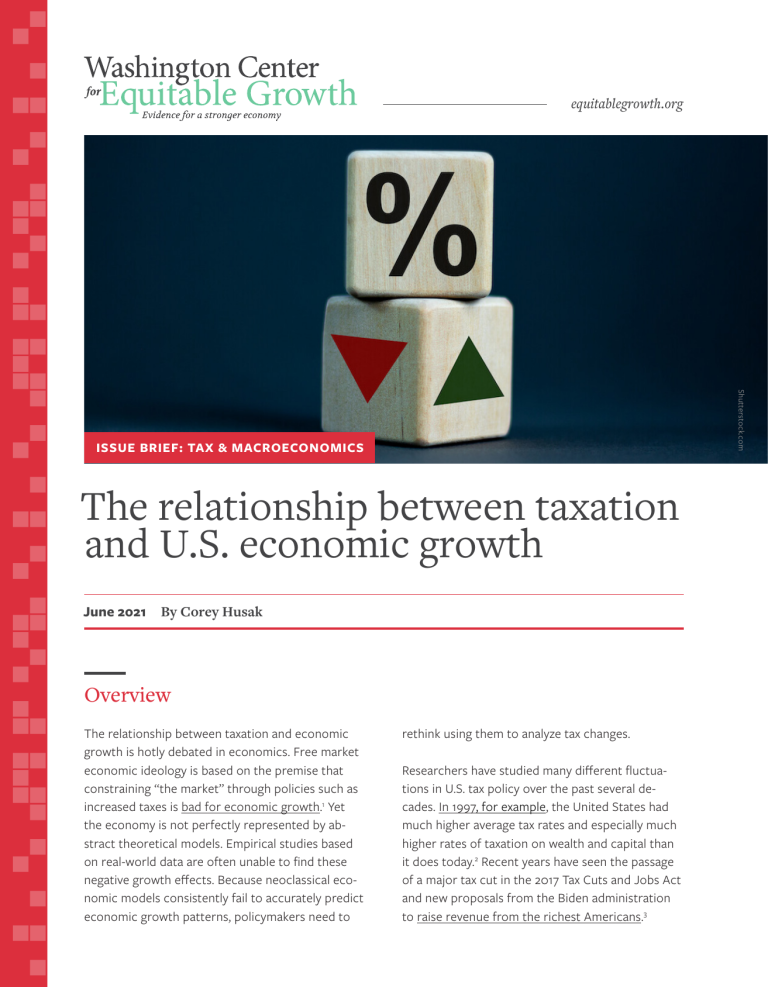
The relationship between taxation and U.S. economic growth (opens in a new tab)
Issue Briefs JUN 30, 2021
The relationship between taxation and economic growth is hotly debated in economics. Free market economic ideology is based on the premise that constraining “the market” through policies such as increased…
By: Corey Husak (opens in a new tab)
The economic benefits of equal opportunity in the United States by ending racial, ethnic, and gender disparities (opens in a new tab)
Issue Briefs JUN 29, 2021
Racial, ethnic, and gender disparities across the U.S. economy are a personal tragedy for the millions of individuals who suffer from the emotional, psychological, and social consequences. These disparities also…
By: Robert Lynch (opens in a new tab)
 View Chart
(opens in a new tab)
View Chart
(opens in a new tab)
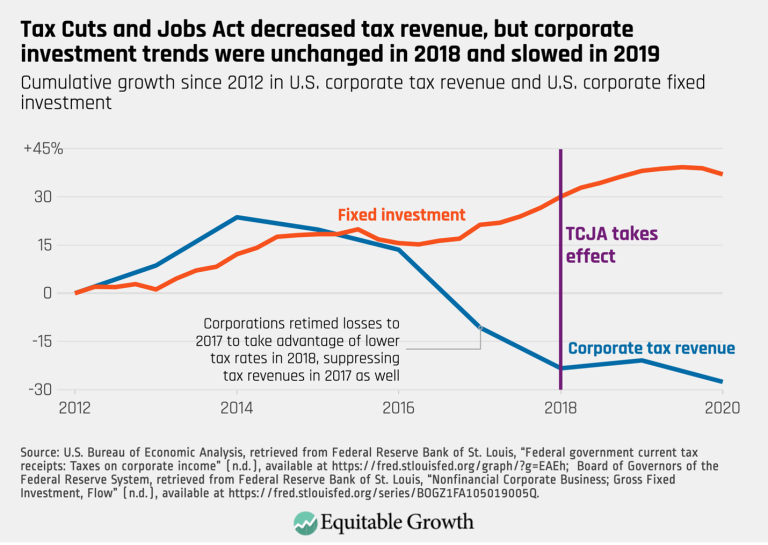
Tax Cuts and Jobs Act decreased tax revenue, but corporate investment trends were unchanged in 2018 and slowed in 2019 (opens in a new tab)
Visualizations JUN 28, 2021
 View Chart
(opens in a new tab)
View Chart
(opens in a new tab)
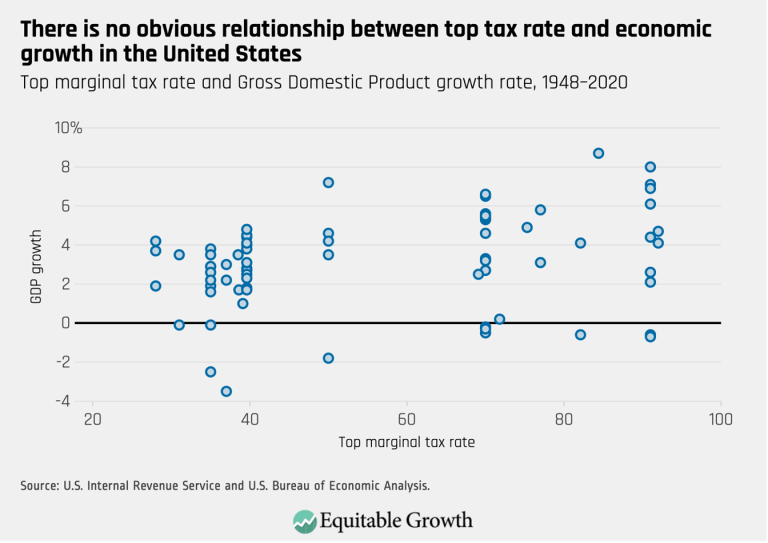
There is no obvious relationship between top tax rate and economic growth in the United States (opens in a new tab)
Visualizations JUN 28, 2021


Your Direct Line to Cutting Edge Research
Be the first to know about our latest events, research releases, and expert insights. Get exclusive updates delivered right to your inbox and never miss an opportunity to engage with our community.