


Resources
From peer-reviewed research to accessible policy briefs, explore the scholarship that’s shaping debates and driving change.

1,885 Results

What Work Does Generative AI Do? (opens in a new tab)
Essays SEP 8, 2026
Since August 2024, our Real-Time Population Survey (RPS), a nationally representative survey of U.S. adults ages 18 to 64, has tracked how many Americans use generative artificial intelligence (AI). The adoption…
By: Alexander Bick (opens in a new tab), Adam Blandin (opens in a new tab), David Deming (opens in a new tab), Tyler Schumacher (opens in a new tab)
What Work Does Generative AI Do? (opens in a new tab)
Working Papers SEP 8, 2026
We measure how workers use genAI for their jobs in a nationally representative survey linking genAI adoption to detailed occupations and tasks. Our data provide the first task-level genAI adoption…
By: Alexander Bick (opens in a new tab), Adam Blandin (opens in a new tab), David Deming (opens in a new tab), Tyler Schumacher (opens in a new tab)

What happens to U.S. workers without access to Unemployment Insurance amid economic downturns or disruptions related to AI? (opens in a new tab)
Essays SEP 2, 2026
The adoption of artificial intelligence in the workplace has led to predictions of U.S. labor market disruptions. In response, policymakers have increased attention on the fitness of the nation’s social…
By: Megan Rivera (opens in a new tab)

Economic research shows immigration is good for U.S. workers, the economy, and affordability (opens in a new tab)
Essays AUG 31, 2026
When President Donald Trump returned to the White House in 2025, mass deportations and immigration restrictions were renewed as one of the political priorities of his second administration. Since then,…
By: Christopher Bangert-Drowns (opens in a new tab)
 View Chart
(opens in a new tab)
View Chart
(opens in a new tab)
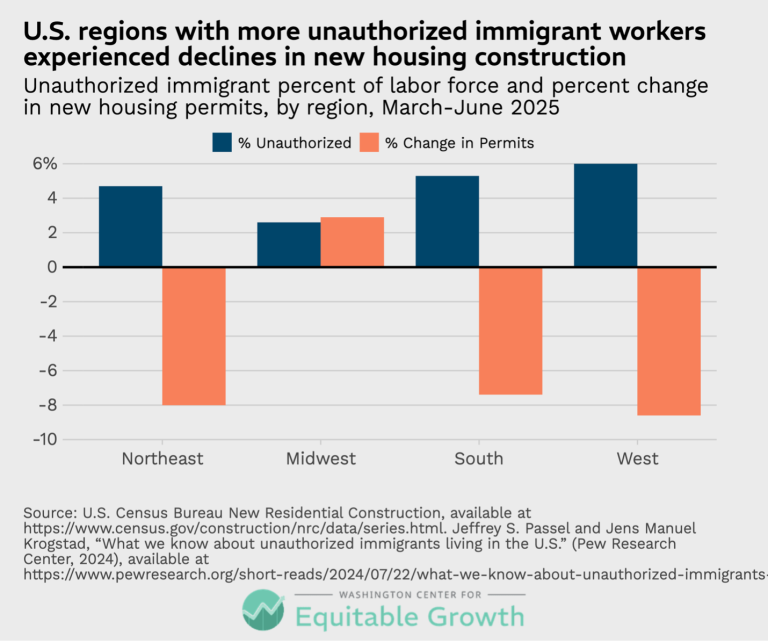
U.S. regions with more unauthorized immigrant workers experienced declines in new housing construction (opens in a new tab)
Visualizations AUG 31, 2026
 View Chart
(opens in a new tab)
View Chart
(opens in a new tab)
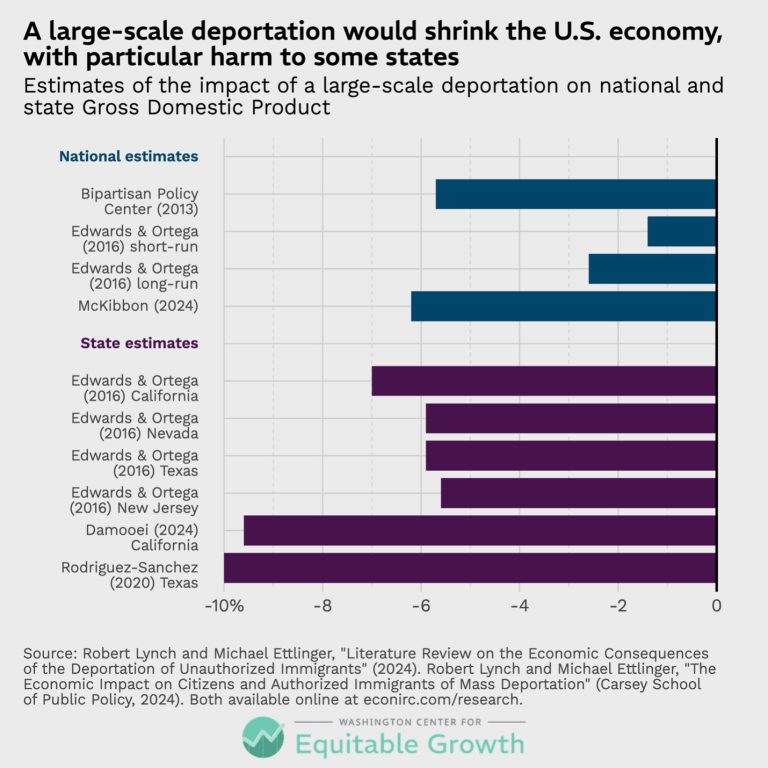
A large-scale deportation would shrink the U.S. economy, with particular harm to some states (opens in a new tab)
Visualizations AUG 31, 2026
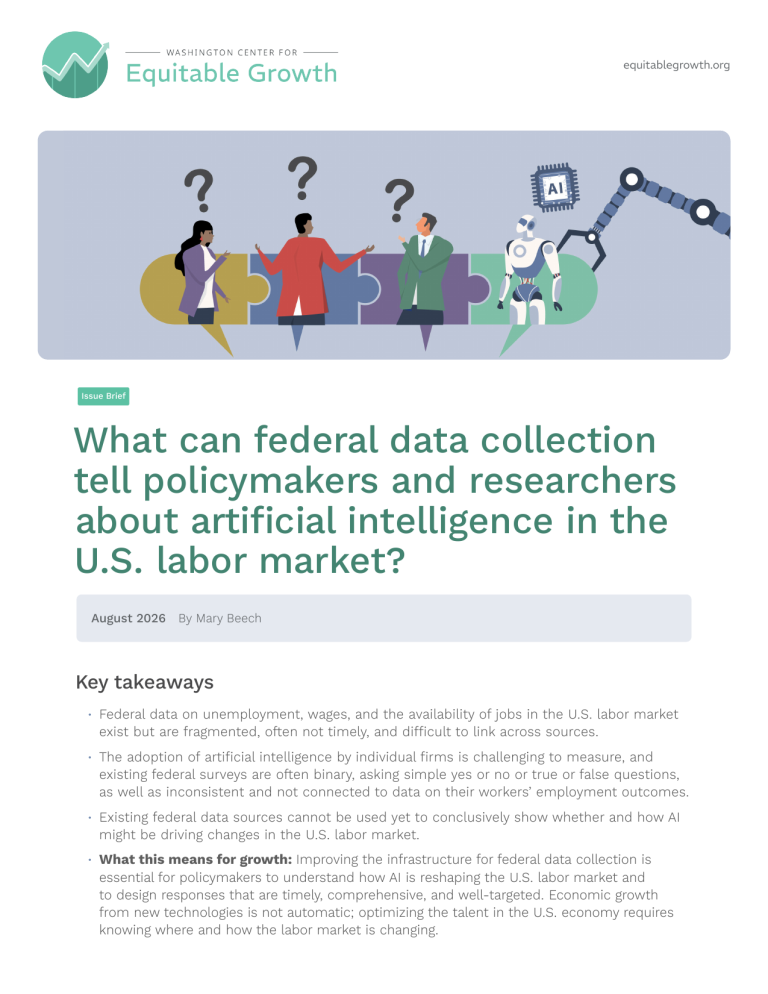
What can federal data collection tell policymakers and researchers about artificial intelligence in the U.S. labor market? (opens in a new tab)
Issue Briefs AUG 24, 2026
It is impossible to perfectly predict how artificial intelligence will affect the U.S. labor market. Policymakers and researchers are grappling with important questions around this topic, including what new opportunities…
By: Mary Beech (opens in a new tab)
Terms and conditions for generative AI users outline a new legal framework that puts U.S. consumers at risk (opens in a new tab)
Essays AUG 20, 2026
Generative AI, or genAI, is a form of artificial intelligence that produces content in response to prompts and includes large language model chatbots such as OpenAI’s ChatGPT or Anthropic’s Claude.…
By: Chiara Chanoi (opens in a new tab)
The Terms and Conditions of Generative AI (opens in a new tab)
Working Papers AUG 20, 2026
Generative AI raises pressing questions for myriad doctrinal areas. Policymakers and scholars have responded rapidly, devoting substantial attention to these difficult legal and policy questions. But, as a practical matter,…
By: John M. Newman, Andres Sawicki (opens in a new tab)
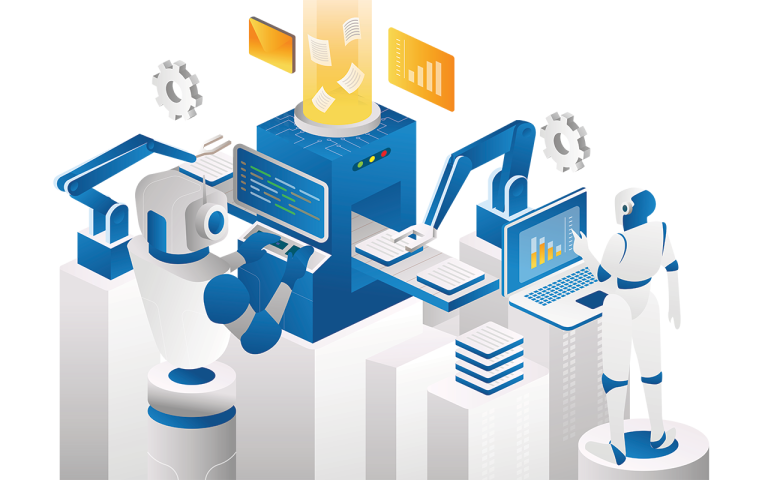
Estimating AI exposure is useful for research but cannot yet tell policymakers the whole story of AI’s impact on the labor market (opens in a new tab)
Essays AUG 7, 2026
Artificial intelligence has the potential to substantially change the nature and availability of work. To effectively manage the transitions this technology might bring to the U.S. economy, policymakers need information…
By: Chiara Chanoi (opens in a new tab)
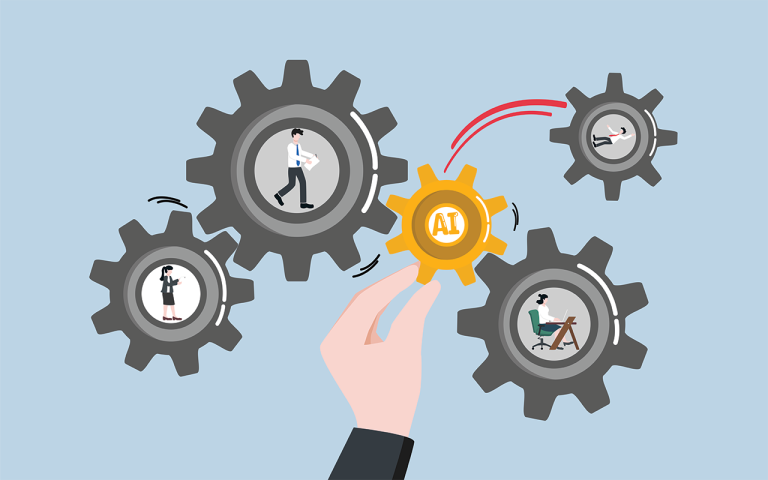
Tracking new research on artificial intelligence and its impact on the U.S. labor market (opens in a new tab)
Essays AUG 5, 2026
Headlines often paint extreme and dissonant pictures of the future impact of AI on the U.S. economy and labor market, with workers themselves echoing the conflicting feelings of optimism and…
By: Equitable Growth (opens in a new tab)
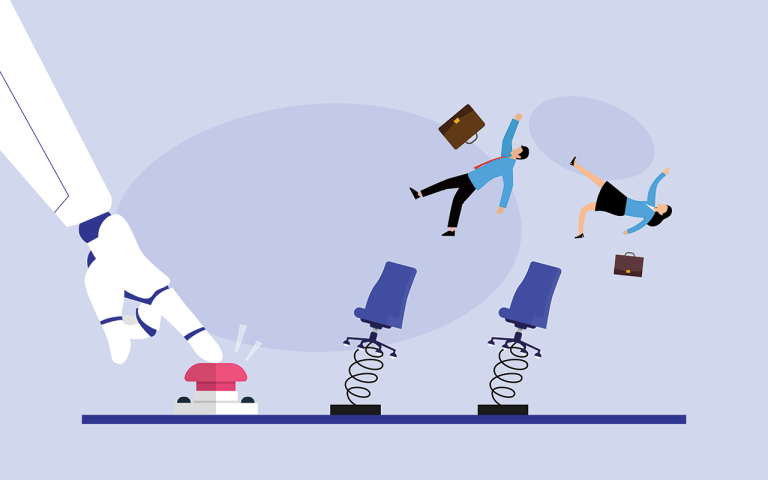
Why Unemployment Insurance Alone Is Not Enough in the AI Era (opens in a new tab)
Essays JUL 8, 2026
Since the large language model ChatGPT was rolled out in November 2022, artificial intelligence has captured the public’s attention and generated myriad debates over the emerging technology’s potential impacts on…
By: Megan Rivera (opens in a new tab)

Personal Income in the United States nudges up in May but is down 0.76 percent in the past 6 months (opens in a new tab)
Essays JUN 25, 2026
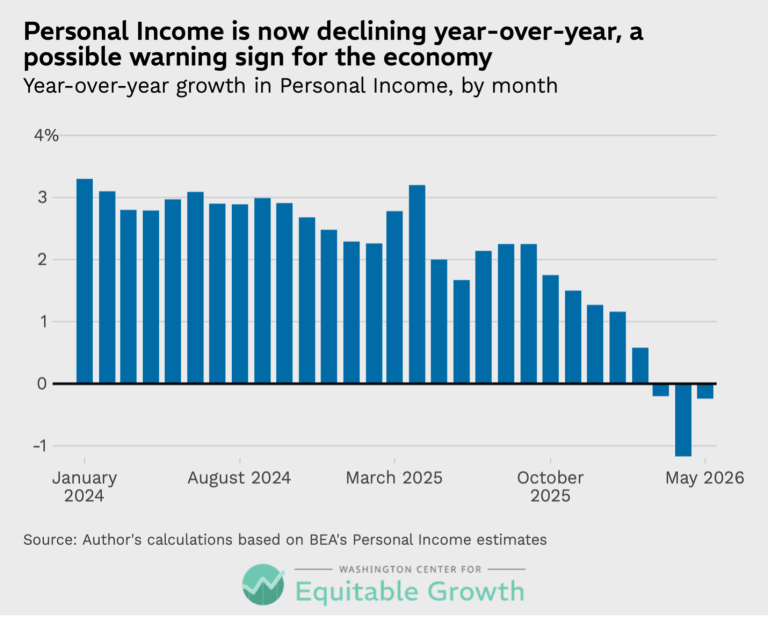
According to today’s release of Personal Income estimates from the U.S. Bureau of Economic Analysis, U.S. household incomes have fallen 0.76 percent in the past 6 months, with month-to-month declines…
By: Austin Clemens (opens in a new tab)
 View Chart
(opens in a new tab)
View Chart
(opens in a new tab)
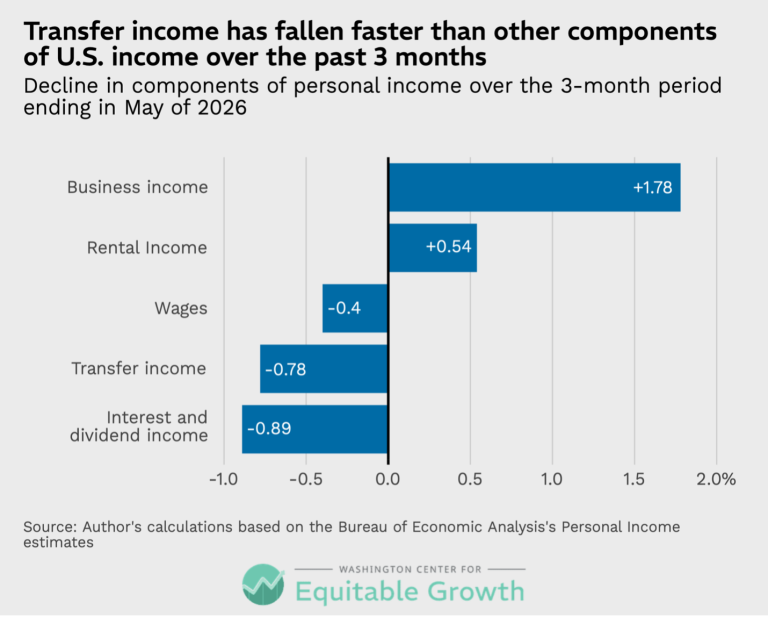
Transfer income has fallen faster than other components of U.S. income over the past 3 months (opens in a new tab)
Visualizations JUN 25, 2026
 View Chart
(opens in a new tab)
View Chart
(opens in a new tab)
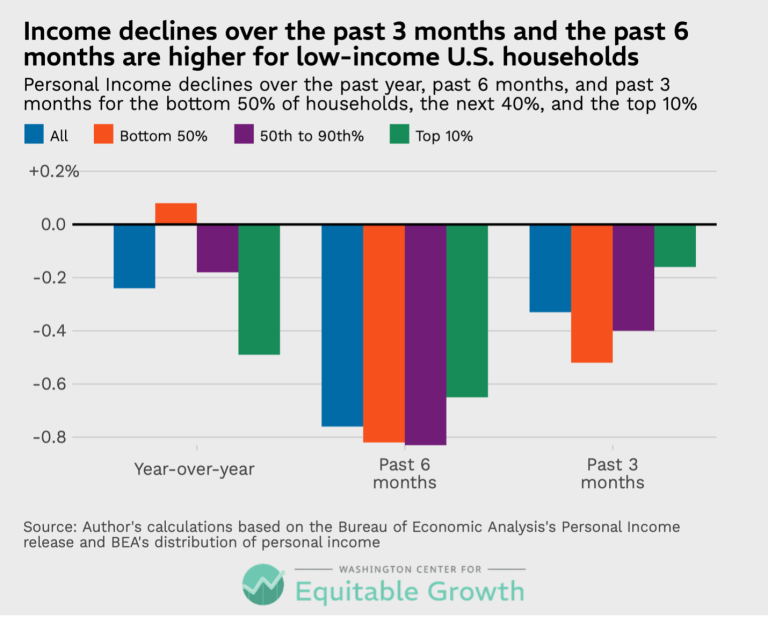
Income declines over the past 3 months and the past 6 months are higher for low-income U.S. households (opens in a new tab)
Visualizations JUN 25, 2026
 View Chart
(opens in a new tab)
View Chart
(opens in a new tab)
Personal Income is now declining year-over-year, a possible warning sign for the economy (opens in a new tab)
Visualizations JUN 25, 2026
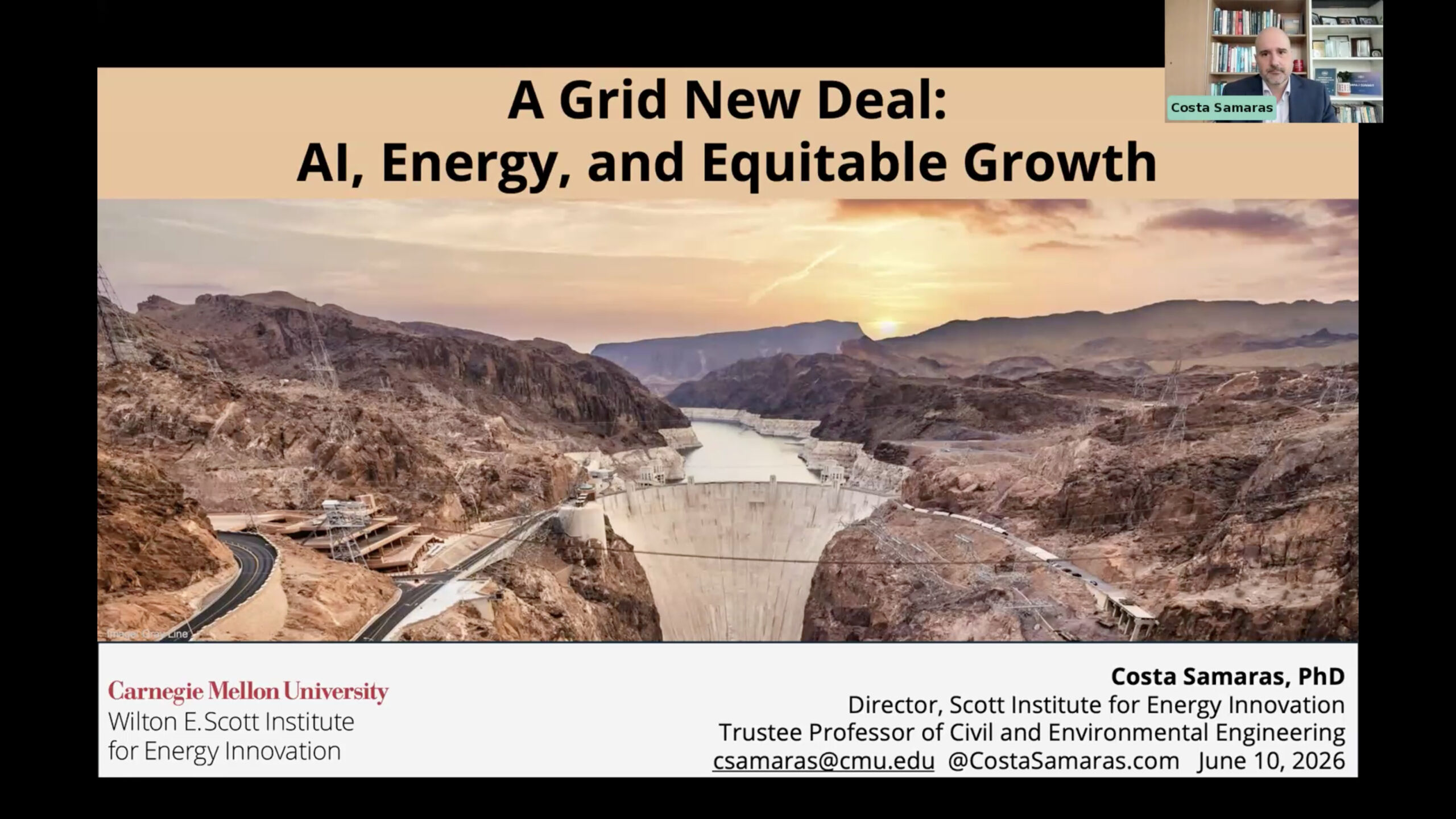
The United States can simultaneously foster an equitable AI boom and a clean energy economy (opens in a new tab)
Videos JUN 12, 2026
The Washington Center for Equitable Growth recently hosted a timely discussion exploring how the rapid expansion of artificial intelligence is colliding with—and reshaping—the clean energy transition. Bringing together researchers and…
By: Equitable Growth (opens in a new tab)

U.S. workers need sectoral bargaining now more than ever (opens in a new tab)
Essays JUN 4, 2026
U.S. union membership and coverage rates have declined for decades, fueled in part by legal barriers to new organizing, including the limiting of collective bargaining to specific workplaces or employers and misclassifying certain groups of workers so they…
By: Christopher Bangert-Drowns (opens in a new tab)
 View Chart
(opens in a new tab)
View Chart
(opens in a new tab)
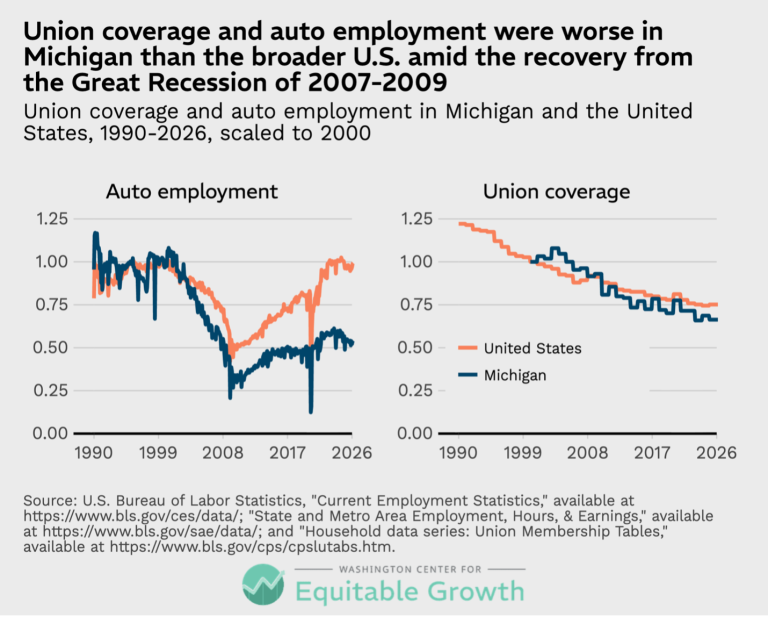
Union coverage and auto employment were worse in Michigan than the broader U.S. amid the recovery from the Great Recession of 2007-2009 (opens in a new tab)
Visualizations JUN 3, 2026
 View Chart
(opens in a new tab)
View Chart
(opens in a new tab)
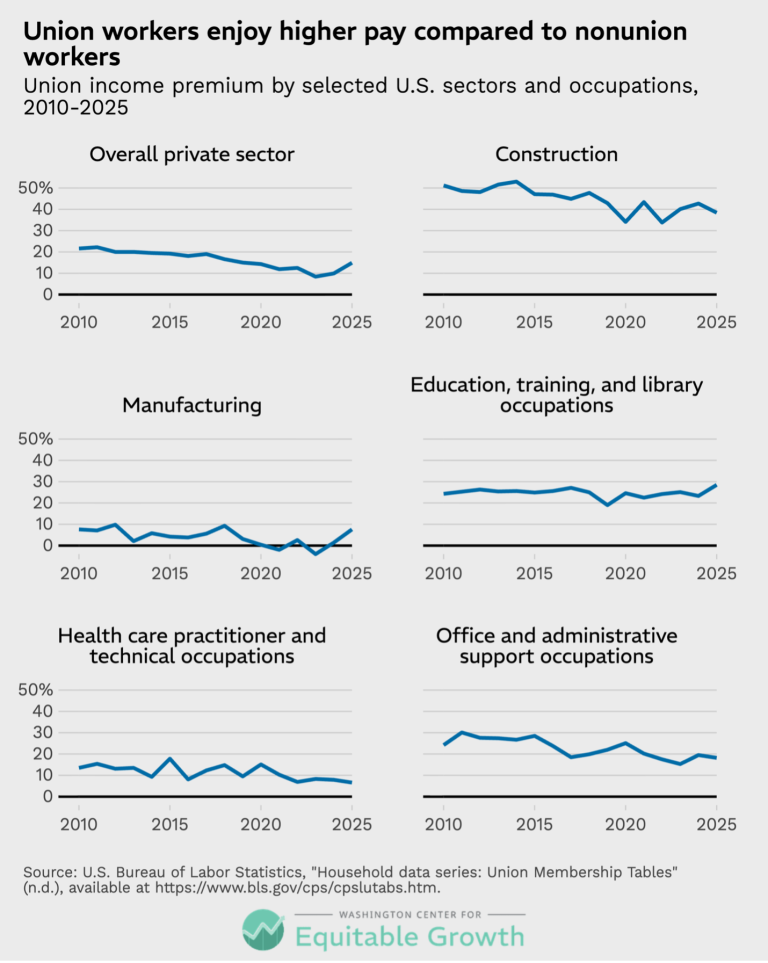
Union workers enjoy higher pay compared to nonunion workers (opens in a new tab)
Visualizations JUN 3, 2026
 View Chart
(opens in a new tab)
View Chart
(opens in a new tab)
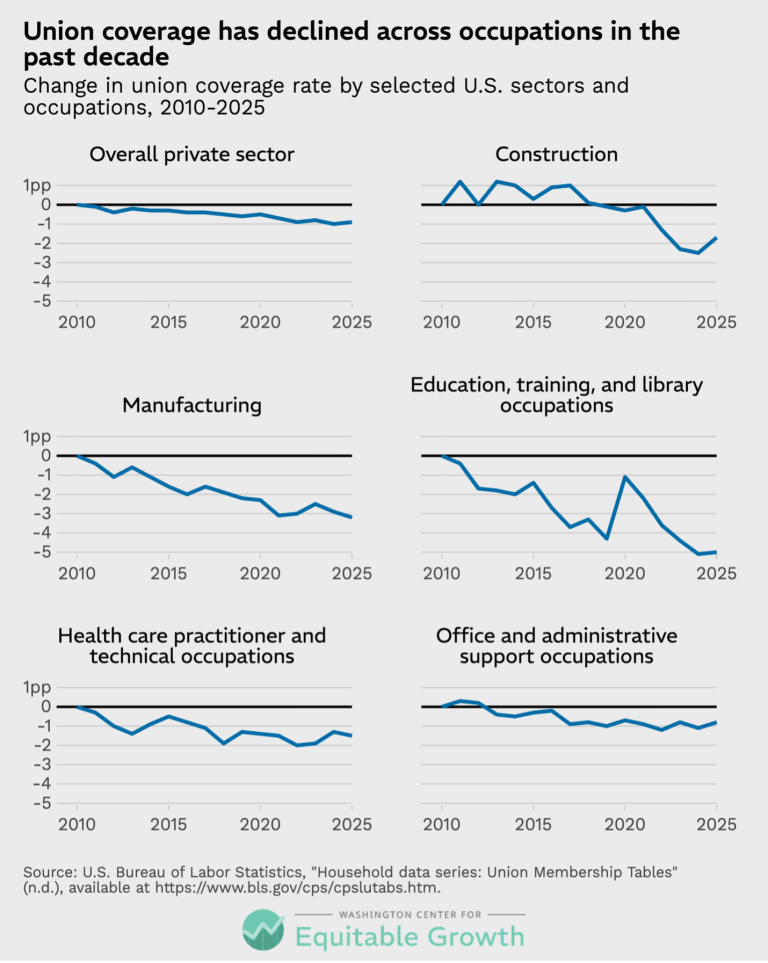
Union coverage has declined across occupations in the past decade (opens in a new tab)
Visualizations JUN 3, 2026

In Conversation with Costa Samaras (opens in a new tab)
In Conversation JUN 2, 2026
Equitable Growth in Conversation is a recurring series where we talk with economists and other academics to help us better understand whether and how economic inequality affects economic growth and…
By: Shayna Strom (opens in a new tab)
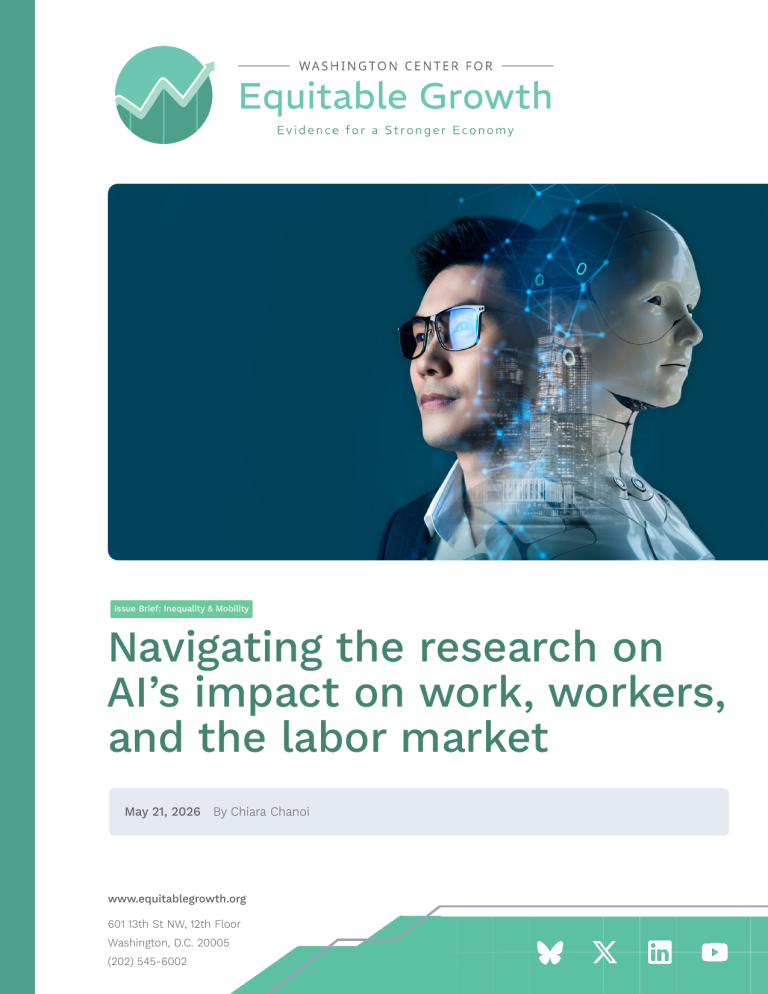
Navigating the research on the impacts of AI on work, workers, and the labor market (opens in a new tab)
Research Databases MAY 21, 2026
Artificial intelligence will have a largely unpredictable but potentially profound effect on the labor market. Individuals have speculated how AI will affect the workforce since its earliest developments. But public…
By: Chiara Chanoi (opens in a new tab)
Barriers to Benefits: Unemployment Insurance Take-Up and Labor Market Effects (opens in a new tab)
Working Papers MAY 19, 2026
Unemployment insurance (UI) take-up is relatively low in the United States. We implement a large-scale field experiment among 50,000 likely unemployed individuals to study the causes and labor supply implications…
By: Casey McQuillan (opens in a new tab), Brendan Moore (opens in a new tab)

What is the relationship between inflation, interest rates, and economic growth, and what does it mean for the new Federal Reserve chair? (opens in a new tab)
Issue Briefs MAY 18, 2026
Since regaining the Oval Office in early 2025, President Donald Trump has repeatedly called for lower interest rates and severely criticized former Federal Reserve Board Chair Jerome Powell’s cautious approach…
By: Jacob Robbins (opens in a new tab)

Research shows unions dampen support for right-wing populism and help workers navigate technological transitions (opens in a new tab)
Essays MAY 1, 2026
On May 1, much of the world—though not the United States—celebrates International Workers Day to honor the social and economic contributions of workers and labor unions. The May Day holiday began in large part to mark…
By: Christopher Bangert-Drowns (opens in a new tab)
 View Chart
(opens in a new tab)
View Chart
(opens in a new tab)
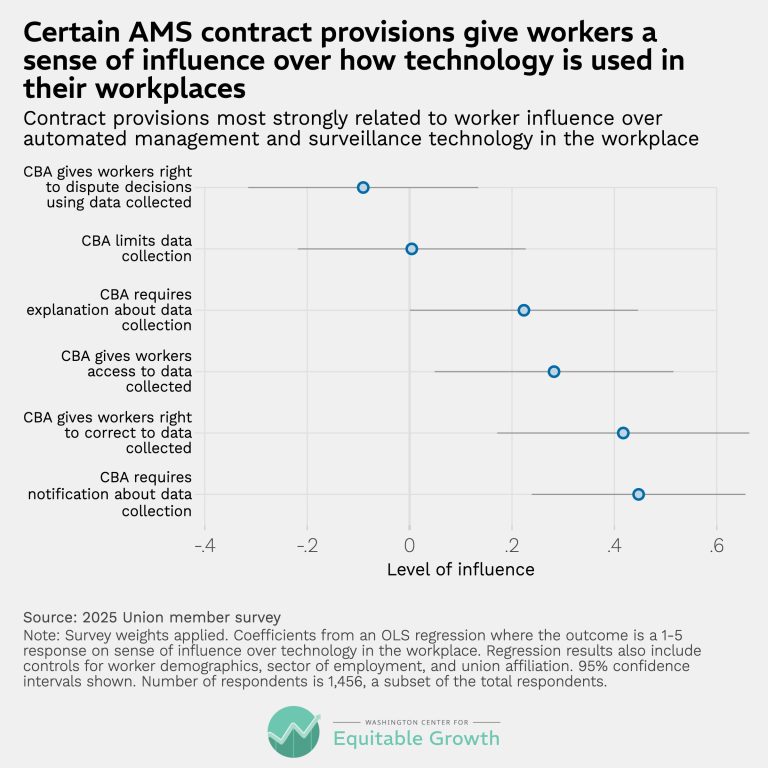
Certain AMS contract provisions give workers a sense of influence over how technology is used in their workplaces (opens in a new tab)
Visualizations MAR 12, 2026
How union contracts are protecting U.S. workers from automated management and surveillance in the workplace (opens in a new tab)
Reports MAR 12, 2026
Employers are increasingly using electronic and automated tools to collect data on their workers on and off the job and then using that data to inform decisions about workers’ pay,…
By: Alexander Hertel-Fernandez (opens in a new tab)
 View Chart
(opens in a new tab)
View Chart
(opens in a new tab)
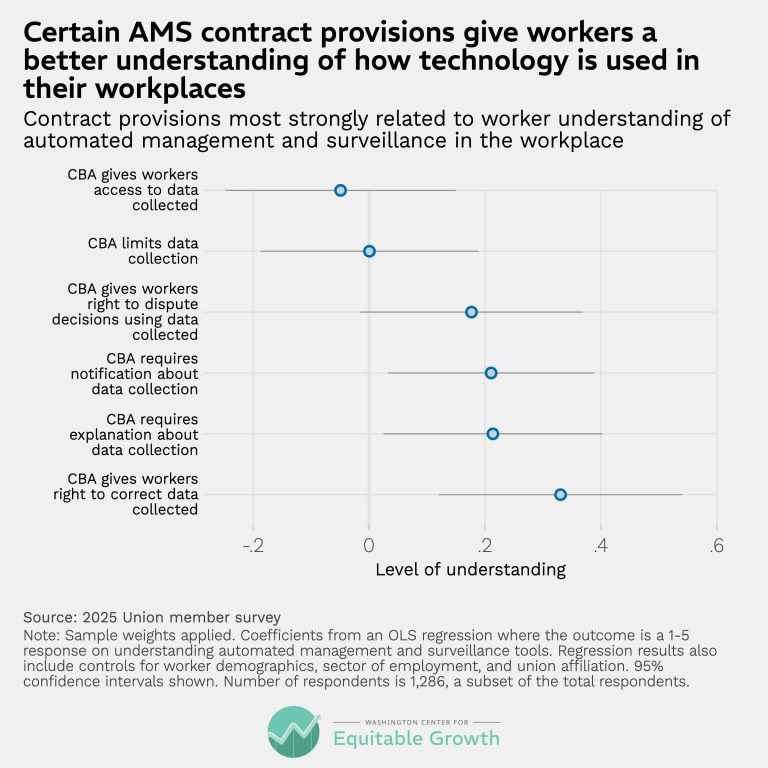
Certain AMS contract provisions give workers a better understanding of how technology is used in their workplaces (opens in a new tab)
Visualizations MAR 12, 2026
 View Chart
(opens in a new tab)
View Chart
(opens in a new tab)
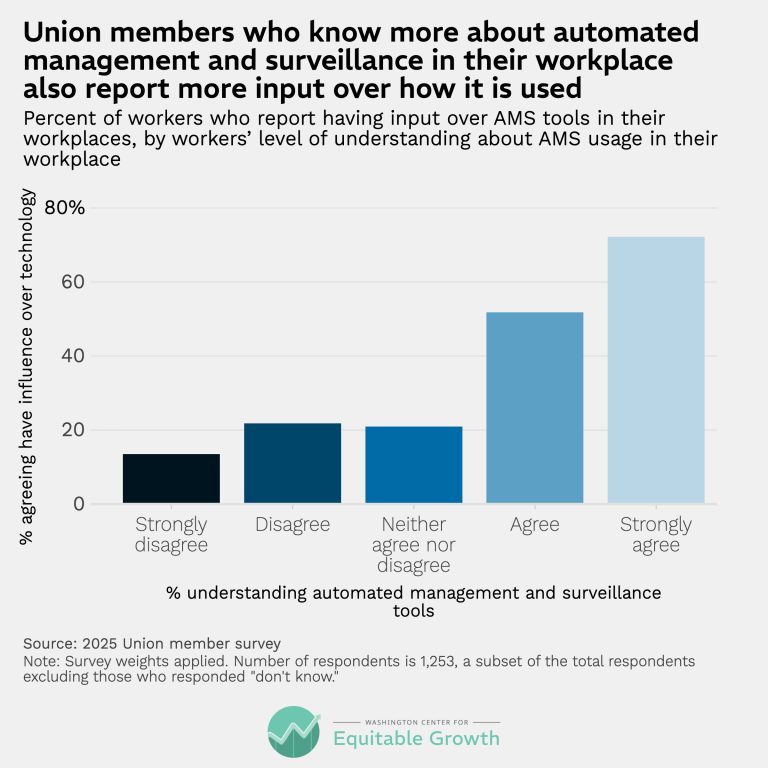
Union members who know more about automated management and surveillance in their workplace also report more input over how it is used (opens in a new tab)
Visualizations MAR 12, 2026
 View Chart
(opens in a new tab)
View Chart
(opens in a new tab)
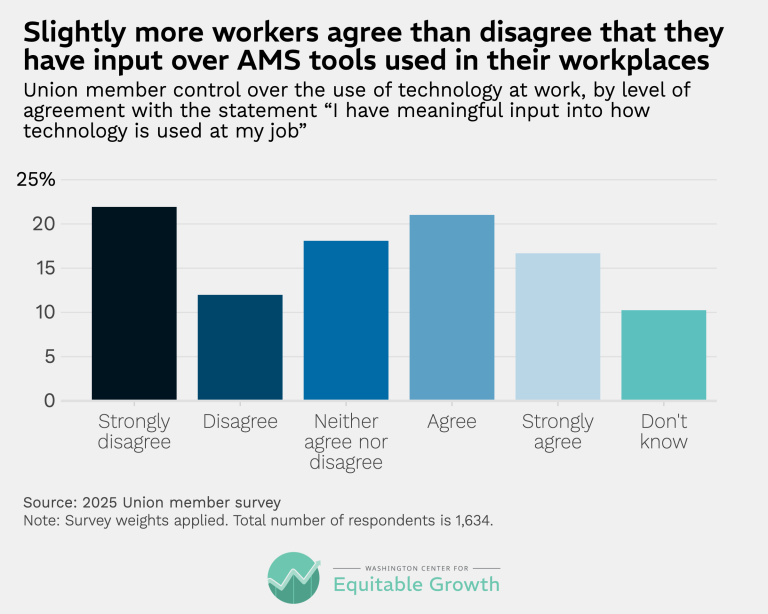
Slightly more workers agree than disagree that they have input over AMS tools used in their workplaces (opens in a new tab)
Visualizations MAR 12, 2026
 View Chart
(opens in a new tab)
View Chart
(opens in a new tab)
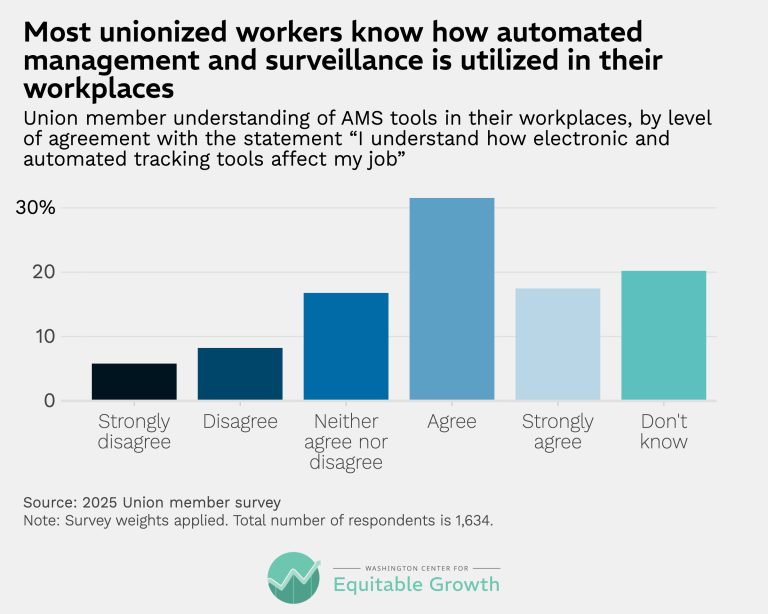
Most unionized workers know how automated management and surveillance are utilized in their workplaces (opens in a new tab)
Visualizations MAR 12, 2026
 View Chart
(opens in a new tab)
View Chart
(opens in a new tab)
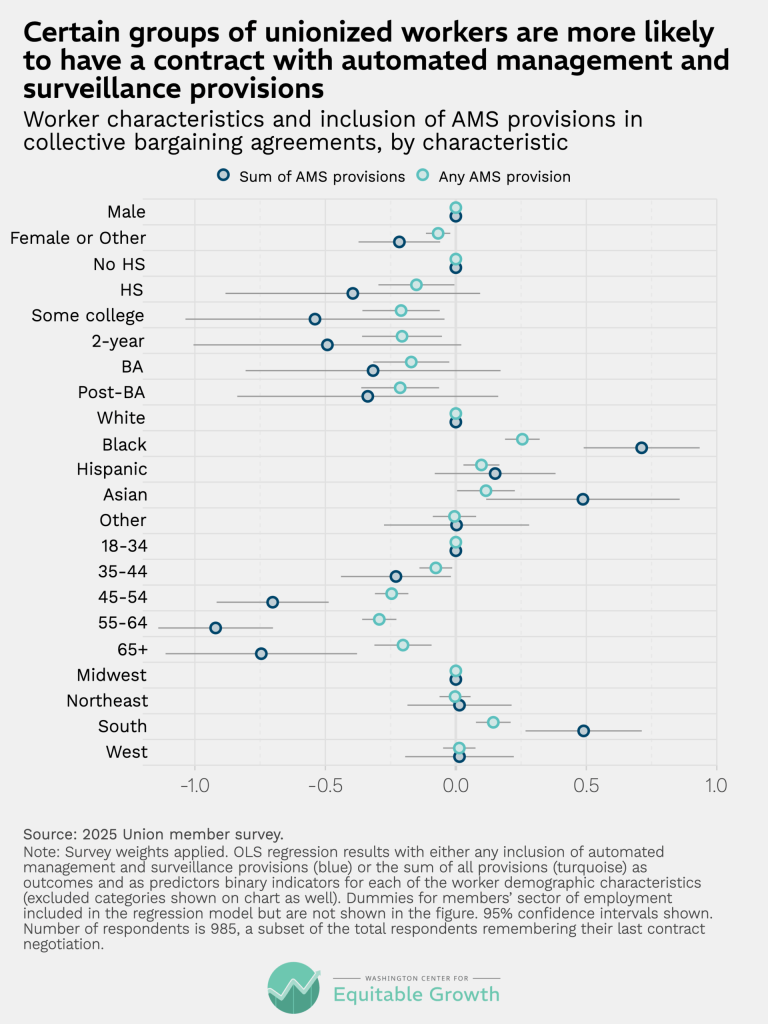
Certain groups of unionized workers are more likely to have a contract with automated management and surveillance provisions (opens in a new tab)
Visualizations MAR 12, 2026
 View Chart
(opens in a new tab)
View Chart
(opens in a new tab)
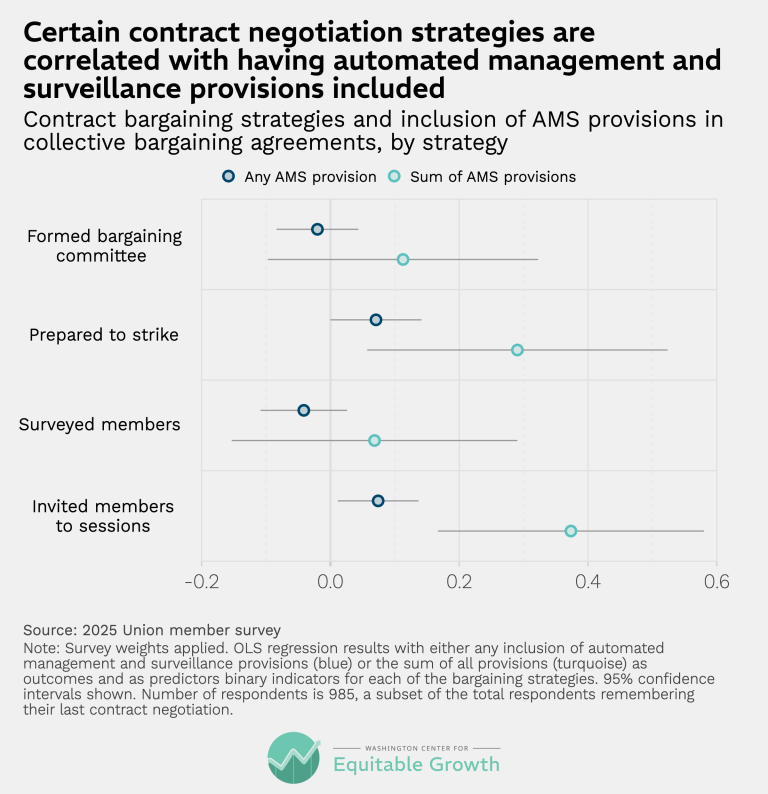
Certain contract negotiation strategies are correlated having automated management and surveillance provisions included (opens in a new tab)
Visualizations MAR 12, 2026
Lessons from past trade adjustment policies to support displaced workers in the era of artificial intelligence (opens in a new tab)
Reports MAR 11, 2026
More than 60 years ago, U.S. policymakers, economists, and labor leaders alike agreed that the potential for new economic forces to strengthen U.S. prosperity and security was just over the…
By: Jacob Leibenluft (opens in a new tab)

Factsheet: Using asset limits in public benefit programs (opens in a new tab)
Factsheets MAR 10, 2026
A household’s assets, or its overall wealth, are the resources required to ensure its family members can weather the financial disruption when unexpected expenses emerge. Yet many U.S. households do…
By: Megan Rivera (opens in a new tab)
ASSA 2026 Round-up: Day 3 (opens in a new tab)
Blog JAN 6, 2026
Yesterday was the third and final day of the 2026 annual meeting of the Allied Social Science Associations, which is organized by the American Economic Association. The 3-day conference, held…
By: Equitable Growth (opens in a new tab)
ASSA 2026 Round-up: Day 2 (opens in a new tab)
Blog JAN 5, 2026
Yesterday was the second day of the 2026 annual meeting of the Allied Social Science Associations, which is organized by the American Economic Association. The 3-day conference, held in Philadelphia…
By: Equitable Growth (opens in a new tab)
ASSA 2026 Round-up: Day 1 (opens in a new tab)
Blog JAN 4, 2026
Yesterday was the first day of the 2026 annual meeting of the Allied Social Science Associations, which is organized by the American Economic Association. The 3-day conference, held in Philadelphia…
By: Equitable Growth (opens in a new tab)
Expanding eligibility for Unemployment Insurance helps low-income U.S. workers find better jobs (opens in a new tab)
Essays DEC 9, 2025
Unemployment Insurance serves as a critical income support program for U.S. workers who lose their jobs through no fault of their own. It is also a valuable tool to stabilize…
By: Casey McQuillan (opens in a new tab), Brendan Moore (opens in a new tab)

U.S. social insurance programs support workers and economic growth (opens in a new tab)
Essays DEC 2, 2025
Since coming to power in early 2025, Republican majorities in Congress have shifted resources away from the nation’s social insurance programs, most notably to offset the cost of H.R. 1,…
By: Megan Rivera (opens in a new tab)

Equitable Growth hosts Econ 101 virtual event on how U.S. social insurance programs boost economic mobility (opens in a new tab)
Essays DEC 1, 2025
Microsoft Copilot helped draft this event recap. The Washington Center for Equitable Growth recently hosted its latest Econ 101 briefing aimed at providing in-depth evidence for policymakers on how U.S.…
By: Equitable Growth (opens in a new tab)
What impact is artificial intelligence having on the U.S. labor market and the nation’s economy? (opens in a new tab)
Essays NOV 14, 2025
As new and groundbreaking technologies emerge, they can function as a blank canvas onto which people project both aspirations and anxieties. Artificial intelligence—despite its quick uptake in broader society and…
By: Megan Rivera (opens in a new tab)
Workplace exposure to artificial intelligence is higher among U.S. workers with higher wages, depending on how AI is used (opens in a new tab)
Essays OCT 23, 2025
Recent advances using artificial intelligence in workplaces, particularly large language models such as Claude.ai and ChatGPT, are increasingly disrupting the U.S. labor market. The cognitive power of AI has the…
By: Chiara Chanoi (opens in a new tab), Christopher Bangert-Drowns (opens in a new tab)
AI exposure by U.S. occupations and work tasks and the effect on wages (opens in a new tab)
Working Papers OCT 23, 2025
This analysis of labor market AI exposure builds on previous work from the Pew Research Center and the AI firm Anthropic as well as Equitable Growth’s own job quality series,…
By: Chiara Chanoi (opens in a new tab), Chris Bangert-Drowns
 View Chart
(opens in a new tab)
View Chart
(opens in a new tab)
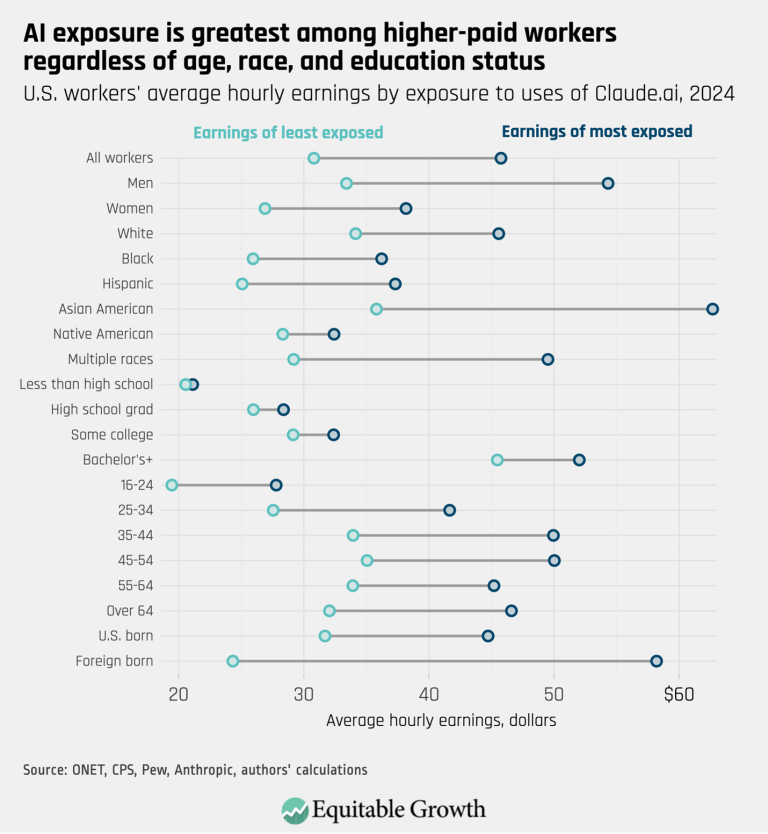
AI exposure is greatest among higher-paid workers regardless of age, race and education status (opens in a new tab)
Visualizations OCT 22, 2025
 View Chart
(opens in a new tab)
View Chart
(opens in a new tab)
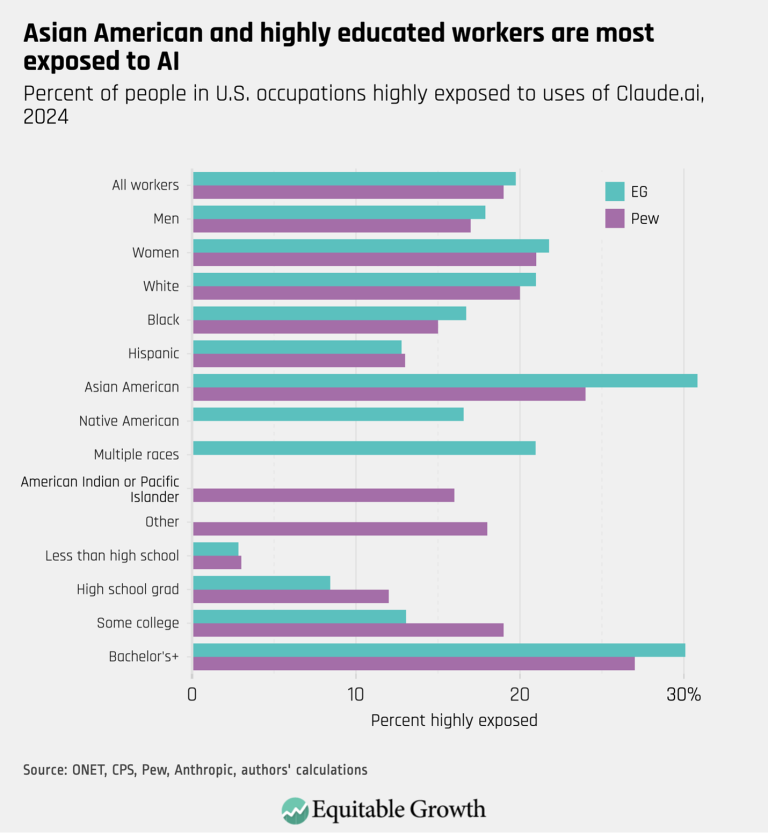
Asian American and highly educated workers are most exposed to AI (opens in a new tab)
Visualizations OCT 22, 2025

Equitable Growth supports scholars studying the economics of the energy transition (opens in a new tab)
Essays OCT 22, 2025
The Washington Center for Equitable Growth today announced a new cohort of grantees. These nine scholars will study how the design and implementation of federal policy influences how businesses and…
By: Equitable Growth (opens in a new tab)
The Benefits of Unemployment Insurance For Marginally Attached Workers (opens in a new tab)
Working Papers OCT 21, 2025
Existing research consistently finds that UI benefits delay job finding with limited effects on job quality, but focuses on changes in unemployment insurance (UI) generosity while holding fixed access to…
By: Casey McQuillan (opens in a new tab), Brendan Moore (opens in a new tab)

Payment for schedule changes under Fair Workweek laws in three U.S. cities (opens in a new tab)
Essays OCT 16, 2025
Fair Workweek laws set new standards for scheduling U.S. workers in jobs and industries characterized by fluctuating and unpredictable work hours, such as jobs in retail and food service. A…
By: Susan Lambert (opens in a new tab), Julia Henly (opens in a new tab)

U.S. workers’ and managers’ experiences with Fair Workweek laws can inform enforcement and education (opens in a new tab)
Essays OCT 2, 2025
Fair Workweek laws are intended to set new standards for scheduling workers in jobs and industries characterized by fluctuating and unpredictable work hours, such as jobs in retail and food…
By: Susan Lambert (opens in a new tab), Julia Henly (opens in a new tab)

How Are Workers Experiencing Fair Workweek Laws? Evidence for policymakers and advocates (opens in a new tab)
Essays OCT 2, 2025
This factsheet, “How Are Workers Experiencing Fair Workweek Laws? Evidence for policymakers and advocates,” originally appeared on WorkRise at https://www.workrisenetwork.org/sites/default/files/2025-08/howareworkersexperiencingfairworkweeklaws.pdf. New laws that regulate employer scheduling practic…
By: Susan Lambert (opens in a new tab), Julia Henly (opens in a new tab)
Federal data is under attack, but data users can work together to preserve and democratize it (opens in a new tab)
Essays OCT 1, 2025
Staffing shortages, political interference, and a federal government shutdown are all disrupting the routine operations of the nonpartisan federal statistical agencies that reliably gather facts and publish data about the…
By: Peter Norlander (opens in a new tab)
Extracting O*NET Features from the NLx Corpus to Build Public Use Aggregate Labor Market Data (opens in a new tab)
Working Papers OCT 1, 2025
Data from online job postings are difficult to access and are not built in a standard or transparent manner. Data included in the standard taxonomy and occupational information database (O*NET)…
By: Stephen Meisenbacher (opens in a new tab), Svetlozar Nestorov (opens in a new tab), Peter Norlander (opens in a new tab)
 View Chart
(opens in a new tab)
View Chart
(opens in a new tab)
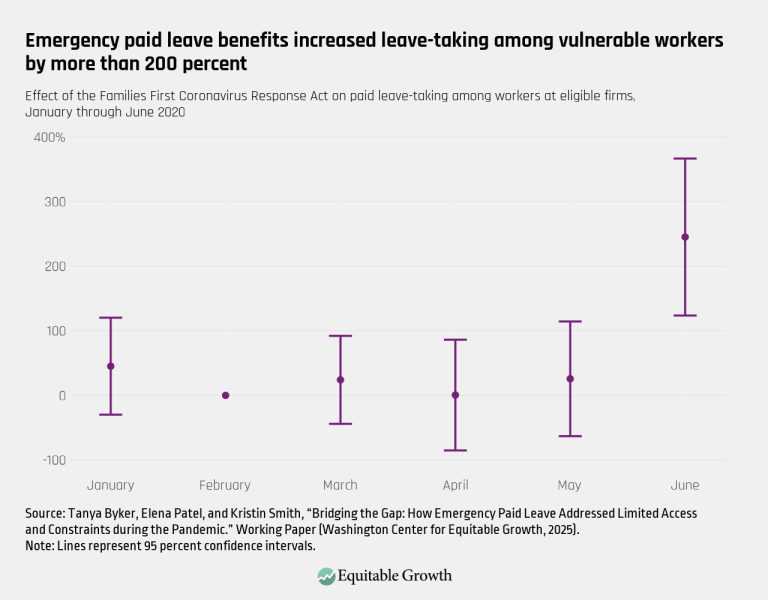
Emergency paid leave benefits increased leave-taking among vulnerable workers by more than 200 percent – Final (opens in a new tab)
Visualizations SEP 23, 2025
 View Chart
(opens in a new tab)
View Chart
(opens in a new tab)
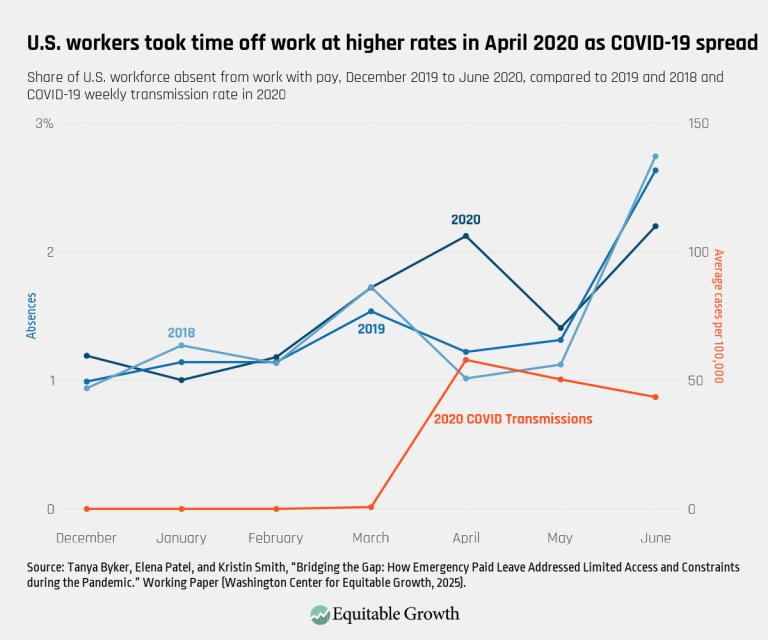
U.S. workers took time off work at higher rates in April 2020 as COVID-19 spread (opens in a new tab)
Visualizations SEP 23, 2025
Emergency paid leave during the COVID-19 pandemic offered essential protections for U.S. workers (opens in a new tab)
Essays SEP 23, 2025
When the COVID-19 pandemic swept across the United States in early 2020, it didn’t just bring about a public health emergency. It also exposed a longstanding weakness in the U.S.…
By: Tanya Byker (opens in a new tab), Elena Patel (opens in a new tab), Kristin Smith (opens in a new tab)
Fitting the Bill? The First Federal Paid Leave Mandate (opens in a new tab)
Working Papers SEP 23, 2025
We find that the first federal paid leave mandate in the US, enacted under the Families First Coronavirus Response Act, increased paid leave taking by nearly 200% for eligible workers,…
By: Tanya Byker (opens in a new tab), Elena Patel (opens in a new tab), Kristin Smith (opens in a new tab)

Equitable Growth announces funding for research on the impact of AI on U.S. workers and competition (opens in a new tab)
Essays SEP 18, 2025
The Washington Center for Equitable Growth today announced a new cohort of grantees studying how artificial intelligence and new technology can support workers and promote competition across the U.S. economy.…
By: Equitable Growth (opens in a new tab)

Even health care, the strongest sector of the U.S. jobs market, cannot deliver the wages its workers deserve without unionization (opens in a new tab)
Essays SEP 10, 2025
The growth of jobs in the U.S. health care industry is the linchpin to a strong U.S. labor market in 2025 and beyond. Health care is one of only a…
By: Adam Dean (opens in a new tab), Jamie McCallum (opens in a new tab)
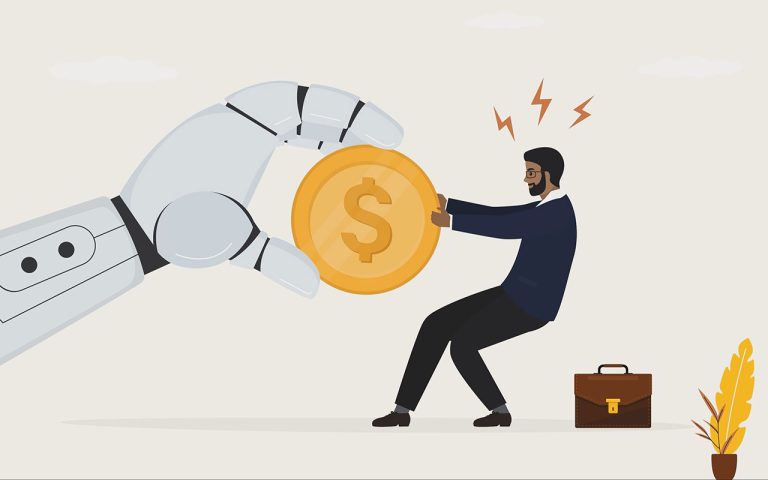
How artificial intelligence uncouples hard work from fair wages through ‘surveillance pay’ practices—and how to fix it (opens in a new tab)
Issue Briefs AUG 21, 2025
Correction: Freddie Mac and Udemy contacted the Washington Center for Equitable Growth on March 18, 2026 and April 2, 2026, respectively, to say they no longer had business relationships with…
By: Veena Dubal (opens in a new tab), Wilneida Negrón (opens in a new tab)
How are Municipal-Level Fair Workweek Laws Playing Out on the Ground? Experiences of Food Service and Retail Workers in Three Cities (opens in a new tab)
Working Papers JUL 24, 2025
An updated version of this paper was posted on December 09, 2025. The first municipal-level law regulating employers’ scheduling practices was enacted in SanFrancisco in 2015. A decade later, ten…
By: Susan J. Lambert, Julia R. Henly, Hyojin Cho (opens in a new tab), Resha Swanson-Varner (opens in a new tab), Yuxi He (opens in a new tab)

Adoption of generative AI will have different effects across jobs in the U.S. logistics workforce (opens in a new tab)
Essays JUL 10, 2025
Generative artificial intelligence promises to profoundly reshape labor markets, much like previous automation waves did, but with clear differences. Unlike earlier technologies, such as computerization, which primarily automated routine administrative…
By: Christophe Combemale (opens in a new tab), Dustin Ferrone (opens in a new tab), Andrew Barber (opens in a new tab), Laurence Ales (opens in a new tab)
 View Chart
(opens in a new tab)
View Chart
(opens in a new tab)
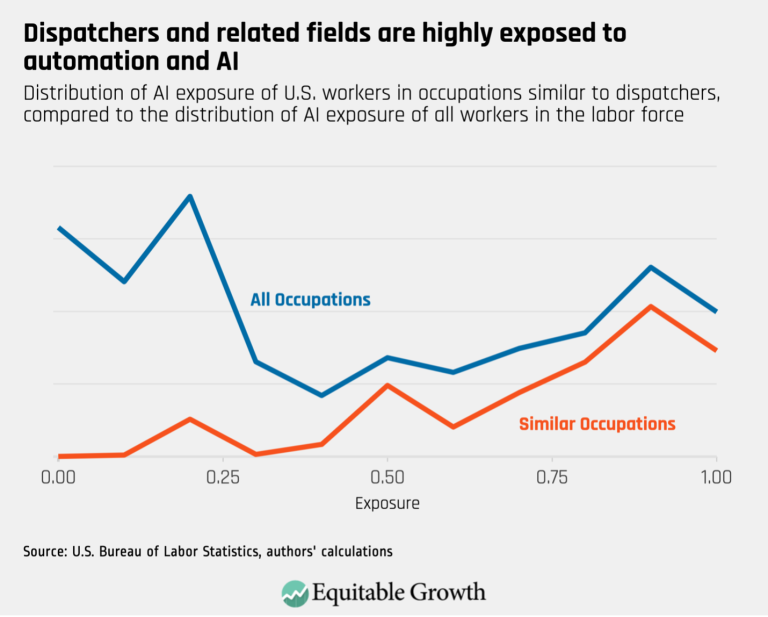
Dispatchers and related fields are highly exposed to automation and AI (opens in a new tab)
Visualizations JUL 10, 2025
 View Chart
(opens in a new tab)
View Chart
(opens in a new tab)
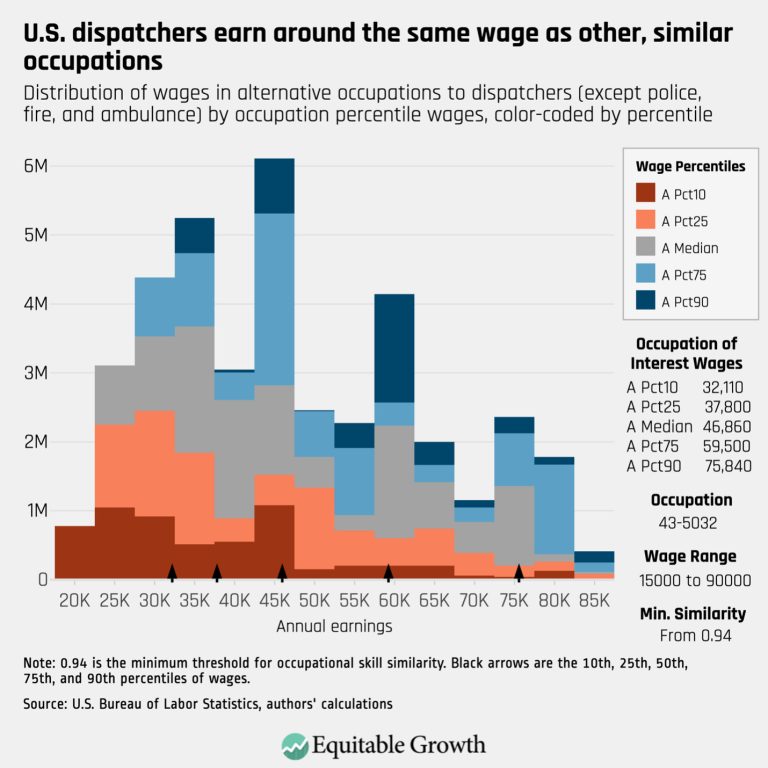
U.S. dispatchers earn around the same wage as other, similar occupations (opens in a new tab)
Visualizations JUL 10, 2025
 View Chart
(opens in a new tab)
View Chart
(opens in a new tab)
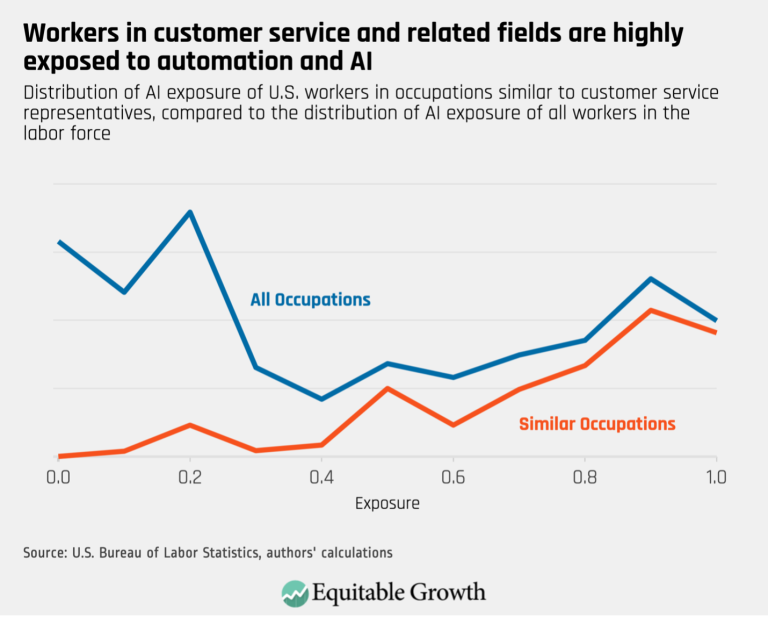
Workers in customer service and related fields are highly exposed to automation and AI (opens in a new tab)
Visualizations JUL 10, 2025
 View Chart
(opens in a new tab)
View Chart
(opens in a new tab)
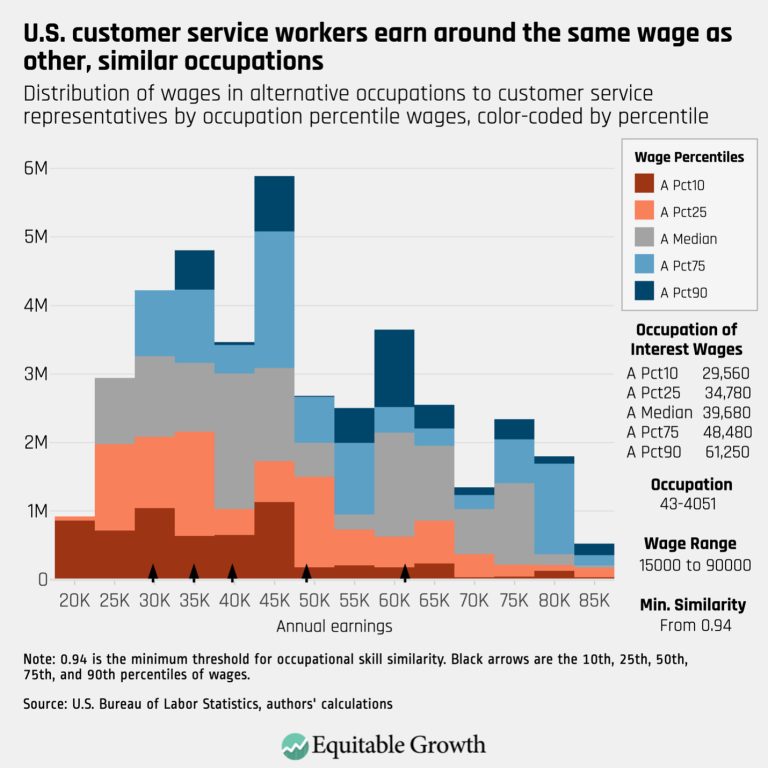
U.S. customer service workers earn around the same wage as other, similar occupations (opens in a new tab)
Visualizations JUL 10, 2025
 View Chart
(opens in a new tab)
View Chart
(opens in a new tab)
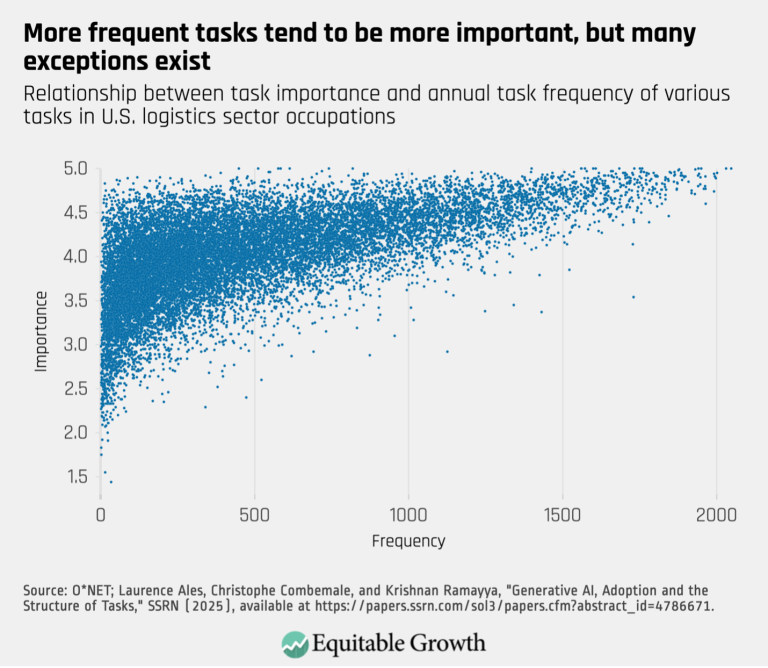
More frequent tasks tend to be more important, but many exceptions exist (opens in a new tab)
Visualizations JUL 9, 2025

Slow wage growth is the key to understanding U.S. inequality in the 21st century (opens in a new tab)
Issue Briefs JUL 8, 2025
The Washington Center for Equitable Growth today launched the U.S. Inequality Tracker, which tracks income and wealth inequality in the United States and highlights how particular components of income and…
By: Austin Clemens (opens in a new tab)
 View Chart
(opens in a new tab)
View Chart
(opens in a new tab)
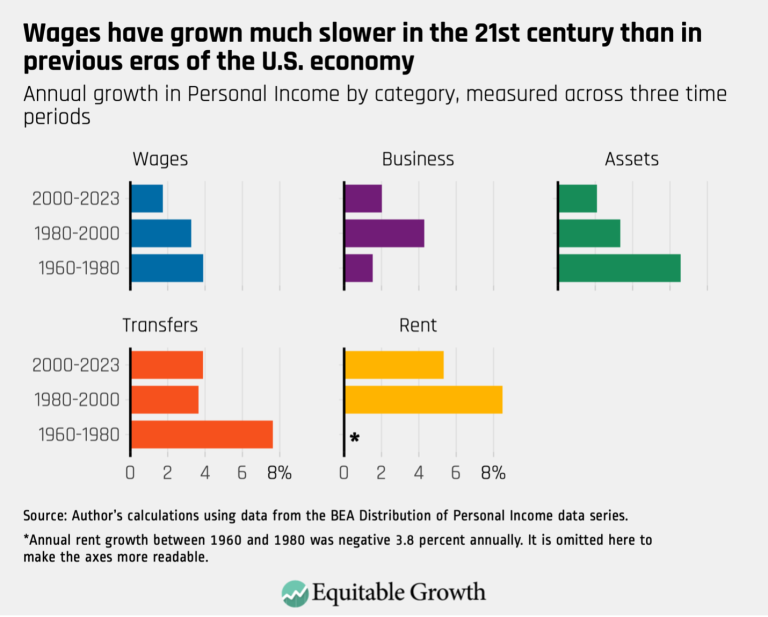
Wages have grown much slower in the 21st century than in previous eras of the U.S. economy (opens in a new tab)
Visualizations JUN 25, 2025
 View Chart
(opens in a new tab)
View Chart
(opens in a new tab)
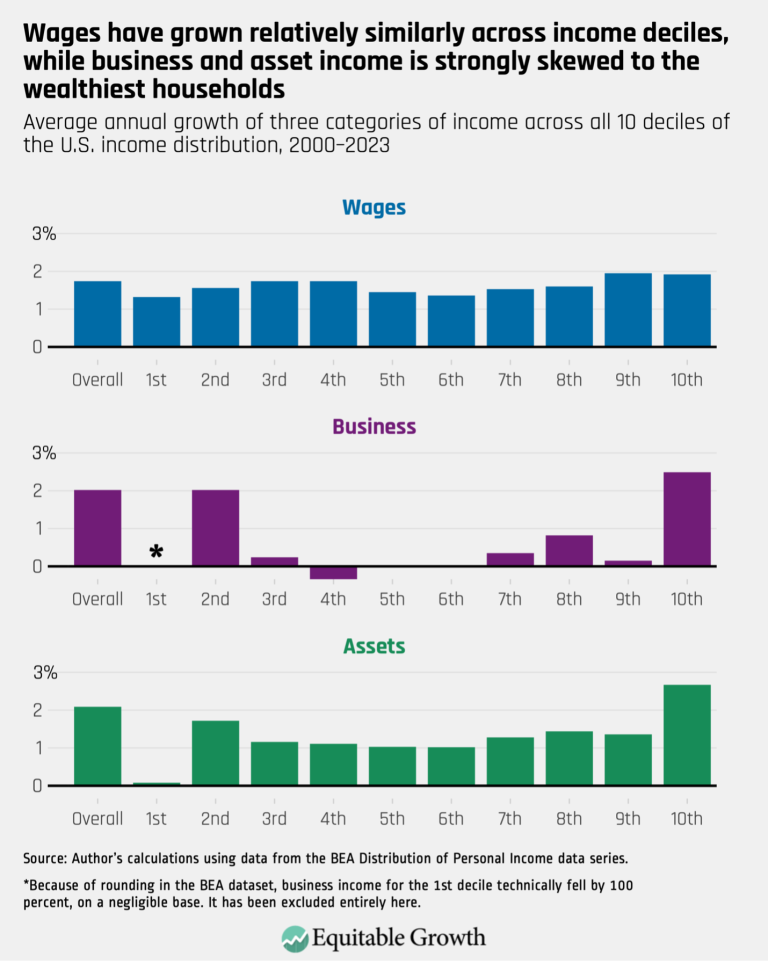
Wages have grown relatively similarly across income deciles, while business and asset income is strongly skewed to the wealthiest households (opens in a new tab)
Visualizations JUN 25, 2025
 View Chart
(opens in a new tab)
View Chart
(opens in a new tab)
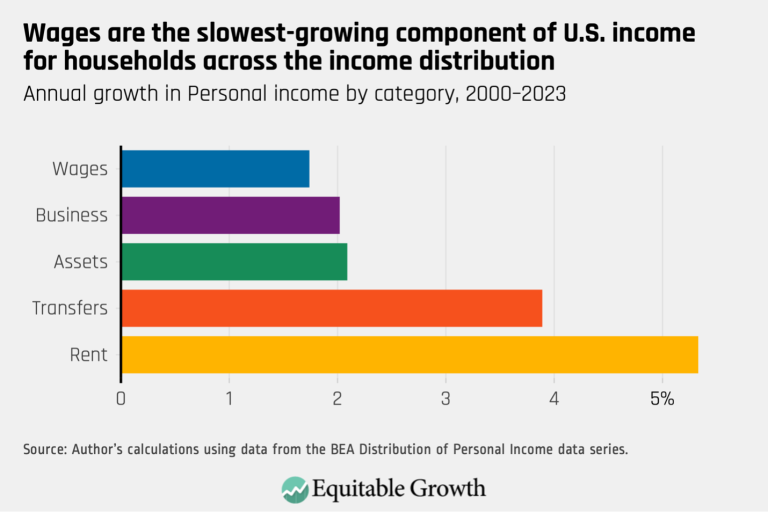
Wages are the slowest-growing component of U.S. income for households across the income distribution (opens in a new tab)
Visualizations JUN 25, 2025


Your Direct Line to Cutting Edge Research
Be the first to know about our latest events, research releases, and expert insights. Get exclusive updates delivered right to your inbox and never miss an opportunity to engage with our community.