


Resources
From peer-reviewed research to accessible policy briefs, explore the scholarship that’s shaping debates and driving change.

141 Results

What Work Does Generative AI Do? (opens in a new tab)
Working Papers SEP 8, 2026
We measure how workers use genAI for their jobs in a nationally representative survey linking genAI adoption to detailed occupations and tasks. Our data provide the first task-level genAI adoption…
By: Alexander Bick (opens in a new tab), Adam Blandin (opens in a new tab), David Deming (opens in a new tab), Tyler Schumacher (opens in a new tab)
The Terms and Conditions of Generative AI (opens in a new tab)
Working Papers AUG 20, 2026
Generative AI raises pressing questions for myriad doctrinal areas. Policymakers and scholars have responded rapidly, devoting substantial attention to these difficult legal and policy questions. But, as a practical matter,…
By: John M. Newman, Andres Sawicki (opens in a new tab)

In Conversation with Costa Samaras (opens in a new tab)
In Conversation JUN 2, 2026
Equitable Growth in Conversation is a recurring series where we talk with economists and other academics to help us better understand whether and how economic inequality affects economic growth and…
By: Shayna Strom (opens in a new tab)
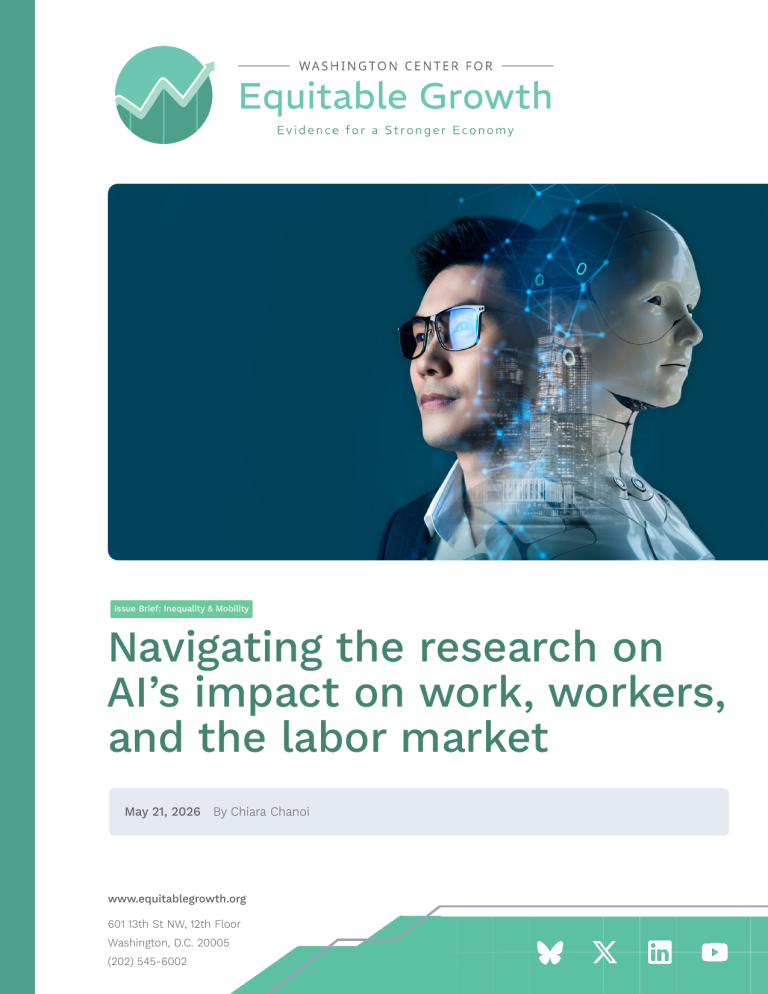
Navigating the research on the impacts of AI on work, workers, and the labor market (opens in a new tab)
Research Databases MAY 21, 2026
Artificial intelligence will have a largely unpredictable but potentially profound effect on the labor market. Individuals have speculated how AI will affect the workforce since its earliest developments. But public…
By: Chiara Chanoi (opens in a new tab)
Barriers to Benefits: Unemployment Insurance Take-Up and Labor Market Effects (opens in a new tab)
Working Papers MAY 19, 2026
Unemployment insurance (UI) take-up is relatively low in the United States. We implement a large-scale field experiment among 50,000 likely unemployed individuals to study the causes and labor supply implications…
By: Casey McQuillan (opens in a new tab), Brendan Moore (opens in a new tab)
AI exposure by U.S. occupations and work tasks and the effect on wages (opens in a new tab)
Working Papers OCT 23, 2025
This analysis of labor market AI exposure builds on previous work from the Pew Research Center and the AI firm Anthropic as well as Equitable Growth’s own job quality series,…
By: Chiara Chanoi (opens in a new tab), Chris Bangert-Drowns
The Benefits of Unemployment Insurance For Marginally Attached Workers (opens in a new tab)
Working Papers OCT 21, 2025
Existing research consistently finds that UI benefits delay job finding with limited effects on job quality, but focuses on changes in unemployment insurance (UI) generosity while holding fixed access to…
By: Casey McQuillan (opens in a new tab), Brendan Moore (opens in a new tab)
Extracting O*NET Features from the NLx Corpus to Build Public Use Aggregate Labor Market Data (opens in a new tab)
Working Papers OCT 1, 2025
Data from online job postings are difficult to access and are not built in a standard or transparent manner. Data included in the standard taxonomy and occupational information database (O*NET)…
By: Stephen Meisenbacher (opens in a new tab), Svetlozar Nestorov (opens in a new tab), Peter Norlander (opens in a new tab)
Fitting the Bill? The First Federal Paid Leave Mandate (opens in a new tab)
Working Papers SEP 23, 2025
We find that the first federal paid leave mandate in the US, enacted under the Families First Coronavirus Response Act, increased paid leave taking by nearly 200% for eligible workers,…
By: Tanya Byker (opens in a new tab), Elena Patel (opens in a new tab), Kristin Smith (opens in a new tab)
How are Municipal-Level Fair Workweek Laws Playing Out on the Ground? Experiences of Food Service and Retail Workers in Three Cities (opens in a new tab)
Working Papers JUL 24, 2025
An updated version of this paper was posted on December 09, 2025. The first municipal-level law regulating employers’ scheduling practices was enacted in SanFrancisco in 2015. A decade later, ten…
By: Susan J. Lambert, Julia R. Henly, Hyojin Cho (opens in a new tab), Resha Swanson-Varner (opens in a new tab), Yuxi He (opens in a new tab)

Request for Proposals: The economic effects of the Inflation Reduction Act (opens in a new tab)
RFPs APR 2, 2025
By: Equitable Growth (opens in a new tab)
Request for Proposals: Promoting competition and supporting workers in an era of AI innovation (opens in a new tab)
RFPs NOV 20, 2024
By: Equitable Growth (opens in a new tab)
Request for proposals: Research grants for early career scholars (opens in a new tab)
RFPs OCT 30, 2024
By: Equitable Growth (opens in a new tab)
Bonus Question: How Does Flexible Incentive Pay Affect Wage Rigidity? (opens in a new tab)
Working Papers JUL 17, 2024
We introduce dynamic incentive contracts into a model of inflation and unemployment dynamics. Our main result is that wage cyclicality from incentives neither affects the slope of the Phillips curve…
By: Meghana Gaur (opens in a new tab), John Grigsby (opens in a new tab), Jonathon Hazell (opens in a new tab), Abdoulaye Ndiaye (opens in a new tab)
Request for Proposals: How effective was the fiscal response to the COVID-19 recession for workers? (opens in a new tab)
RFPs MAR 18, 2024
By: Equitable Growth (opens in a new tab)
Request for proposals: Research grants for early career scholars (opens in a new tab)
RFPs NOV 30, 2023
By: Equitable Growth (opens in a new tab)
The Effect of Means-Tested Transfers on Work: Evidence from Quasi-Randomly Assigned SNAP Caseworkers (opens in a new tab)
Working Papers NOV 13, 2023
We provide a comprehensive evaluation of the dynamic labor supply effects of the Supplemental Nutrition Assistance Program (SNAP) for a representative population using novel administrative data and an examiner design.…
By: Jason Cook (opens in a new tab), Chloe N. East
Minimum wage effects and monopsony explanations (opens in a new tab)
Working Papers OCT 16, 2023
This working paper was updated on March 5, 2024 with a new version and an additional author. We present the first causal analysis of a seven-year run-up of minimum wages…
By: Justin Wiltshire (opens in a new tab), Carl McPherson (opens in a new tab), Michael Reich (opens in a new tab), Denis Sosinskiy (opens in a new tab)
How to Fund Unemployment Insurance with Informality and False Claims: Evidence from Senegal (opens in a new tab)
Working Papers OCT 5, 2023
This paper studies the welfare effects of unemployment insurance (UI) in low-income countries characterized by high levels of informality, weak enforcement of UI claims, and job search frictions. We assess…
By: Abdoulaye Ndiaye (opens in a new tab), Kyle Herkenhoff (opens in a new tab), Abdoulaye Cissé (opens in a new tab), Alessandro Dell’Acqua (opens in a new tab), Ahmadou A. Mbaye
Resilience in Collective Bargaining (opens in a new tab)
Working Papers SEP 27, 2023
A central finding of the theoretical literature on bargaining is that parties’ attitudes towards delay influence bargaining outcomes. However, the ability to endure delays, resilience, is often private information and…
By: Carlos F. Avenancio-León, Alessio Piccolo (opens in a new tab), Roberto Pinto (opens in a new tab)
Racial Inequality in the U.S. Unemployment Insurance System (opens in a new tab)
Working Papers JUL 19, 2023
The decentralized US unemployment insurance (UI) system lets states decide on key rules. Decentralization could help states efficiently adapt to local economic conditions, but it could also generate racial inequality.…
By: Daphné Skandalis (opens in a new tab), Ioana Marinescu (opens in a new tab), Maxim Massenkoff (opens in a new tab)
On Algorithmic Wage Discrimination (opens in a new tab)
Working Papers JUL 12, 2023
Recent technological developments related to the extraction and processing of data have given rise to widespread concerns about a reduction of privacy in the workplace. For a growing number of…
By: Veena Dubal (opens in a new tab)

In Conversation with Daron Acemoglu (opens in a new tab)
In Conversation MAY 8, 2023
Equitable Growth in Conversation is a recurring series where we talk with economists and other academics to help us better understand whether and how economic inequality affects economic growth and…
By: Kathryn Zickuhr (opens in a new tab)
Fitting the Bill? The First Federal Paid Leave Mandate (opens in a new tab)
Working Papers MAY 4, 2023
We find that the first federal paid leave mandate in the US, enacted under the Families First Coronavirus Response Act, increased paid leave taking by nearly 200% for eligible workers,…
By: Tanya Byker (opens in a new tab), Elena Patel (opens in a new tab), Kristin Smith (opens in a new tab)


Your Direct Line to Cutting Edge Research
Be the first to know about our latest events, research releases, and expert insights. Get exclusive updates delivered right to your inbox and never miss an opportunity to engage with our community.