


Resources
From peer-reviewed research to accessible policy briefs, explore the scholarship that’s shaping debates and driving change.

299 Results


New research shows how U.S. homeownership and the accumulation of housing wealth are linked to political participation (opens in a new tab)
Essays AUG 14, 2026
Persistent affordability pressures have driven up housing costs for millions of U.S. families in recent years. Home prices remain near record highs relative to incomes, mortgage rates and associated costs…
By: Carlos Fernando Avenancio-Leon (opens in a new tab)

Defining extreme wealth is more complicated than it looks (opens in a new tab)
Videos AUG 13, 2026
Facing high levels of income and wealth inequality and shrinking tax revenues, U.S. policymakers are showing increased interest in proposals to tax the richest households. Yet determining which households fall into that category is complex and changes based…
By: Equitable Growth (opens in a new tab)
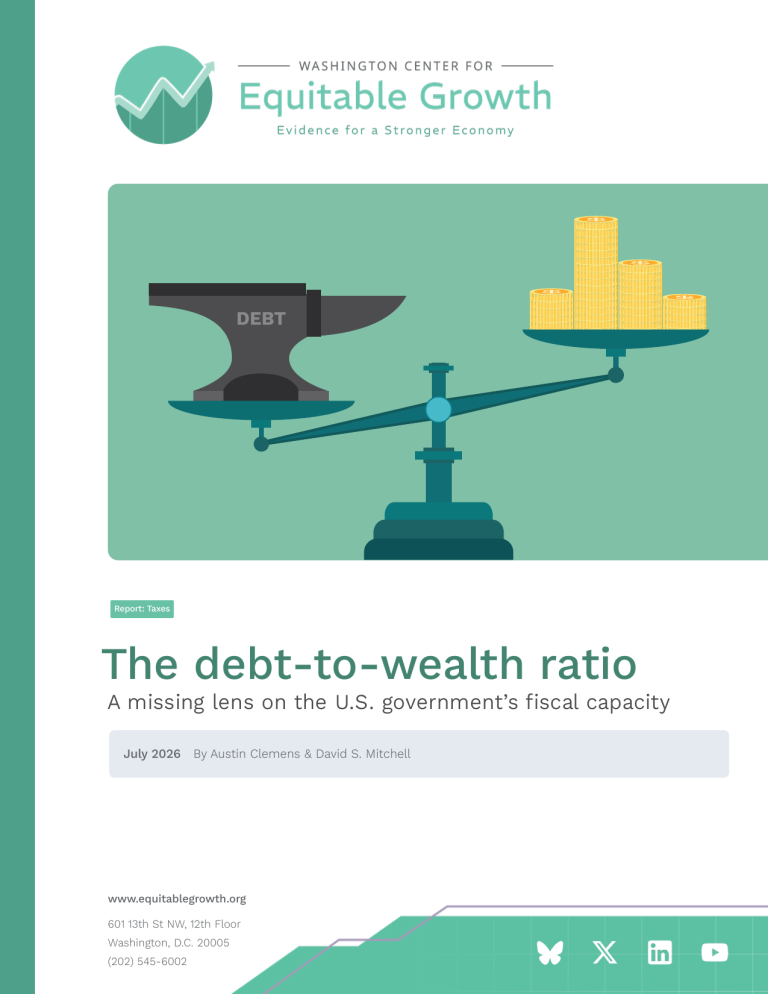
The debt-to-wealth ratio: A missing lens on the U.S. government’s fiscal capacity (opens in a new tab)
Reports JUL 30, 2026
Few statistics shape the fiscal debate in the United States as powerfully as the ratio of federal debt-to-Gross Domestic Product. Debt held by the public recently surpassed 100 percent of…
By: Austin Clemens (opens in a new tab), David S. Mitchell (opens in a new tab)

The costs of the Trump administration’s tariffs diverge for countries and industries so far in 2026 (opens in a new tab)
Essays JUL 14, 2026
The first 4 months of 2026 saw continued seismic changes in U.S. trade policy. In late February, the U.S. Supreme Court struck down the Trump administration’s use of the International…
By: Christopher Bangert-Drowns (opens in a new tab)

U.S. workers will be hurt by immigration enforcement overreach (opens in a new tab)
Essays JUN 17, 2026
President Donald Trump last week signed the $70 billion Secure America Act, a budget reconciliation package that boosts funding for immigration and border enforcement agencies while imposing no limits on their authority.…
By: Christopher Bangert-Drowns (opens in a new tab)

Factsheet: Defining top U.S. income and wealth thresholds for tax policy (opens in a new tab)
Factsheets MAY 27, 2026
Federal and state policymakers in the United States, responding to high levels of income and wealth inequality and shrinking tax revenues, are increasingly interested in proposals to tax households with…
By: Austin Clemens (opens in a new tab)
Defining top wealth and income thresholds for U.S. tax policy design and analysis (opens in a new tab)
Reports MAY 27, 2026
Wealth and income inequality are an ongoing area of interest for policymakers. In particular, the rise of the richest of the rich—not just the top 1 percent, but also the…
By: Austin Clemens (opens in a new tab)

Is Taxing Wealth Possible? Practical? Desirable? Yes, if we’re smart about it (opens in a new tab)
Essays MAY 7, 2026
While the American economy has outperformed much of the industrialized world in recent years, there are good reasons to be deeply concerned about its long-term prospects. It is dogged by…
By: David S. Mitchell (opens in a new tab)

The other two-tiered U.S. tax system: How pass-through businesses let the ultra-wealthy dodge federal taxes (opens in a new tab)
Essays APR 15, 2026
Many Americans likely remember when the legendary value investor Warren Buffett drew attention to a glaring unfairness in the tax code by pointing out that he paid a lower effective…
By: David S. Mitchell (opens in a new tab)
Equitable Growth event covers tariffs, tariff uncertainties, and the limits of U.S. trade policy (opens in a new tab)
Videos APR 1, 2026
The Washington Center for Equitable Growth recently hosted a webinar examining the economic, fiscal, and labor‑market effects of evolving U.S. tariff laws and regulations, particularly in the wake of the…
By: Christopher Bangert-Drowns (opens in a new tab)
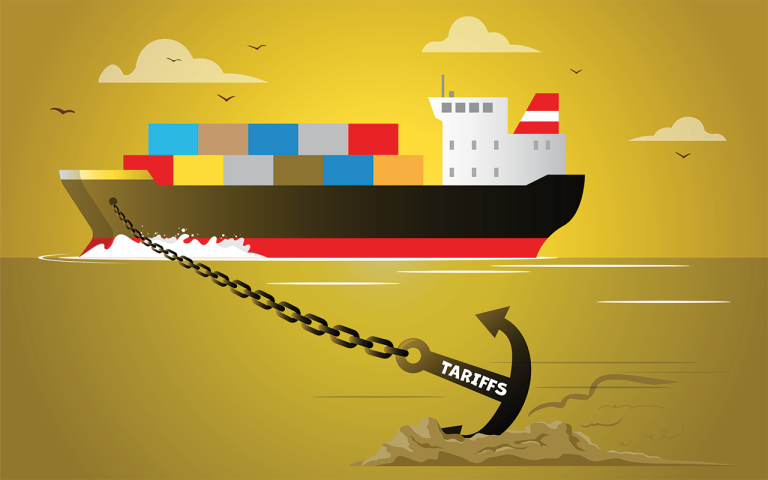
Tariff policies in 2025 increased input costs for key U.S. industries, threatening growth and investment (opens in a new tab)
Essays MAR 24, 2026
All tariffs are not created equal. Throughout U.S. history, policymakers have imposed import taxes for a variety of economic and ideological reasons, with varying impacts. Targeted tariffs have been effective…
By: Christopher Bangert-Drowns (opens in a new tab)

Factsheet: Using asset limits in public benefit programs (opens in a new tab)
Factsheets MAR 10, 2026
A household’s assets, or its overall wealth, are the resources required to ensure its family members can weather the financial disruption when unexpected expenses emerge. Yet many U.S. households do…
By: Megan Rivera (opens in a new tab)

U.S. businesses report that tariff policies will likely lead to price increases and labor market impacts in 2026 (opens in a new tab)
Essays JAN 15, 2026
As 2026 begins, U.S. manufacturers are contending with a varied and uncertain economic environment. Many are weighing growth driven by domestic investments in data centers and artificial intelligence against the…
By: Christopher Bangert-Drowns (opens in a new tab)
ASSA 2026 Round-up: Day 3 (opens in a new tab)
Blog JAN 6, 2026
Yesterday was the third and final day of the 2026 annual meeting of the Allied Social Science Associations, which is organized by the American Economic Association. The 3-day conference, held…
By: Equitable Growth (opens in a new tab)
ASSA 2026 Round-up: Day 2 (opens in a new tab)
Blog JAN 5, 2026
Yesterday was the second day of the 2026 annual meeting of the Allied Social Science Associations, which is organized by the American Economic Association. The 3-day conference, held in Philadelphia…
By: Equitable Growth (opens in a new tab)
Uncertainty created by ever-changing tariff policies harms U.S. economic growth (opens in a new tab)
Essays NOV 20, 2025
The approaches to international trade taken by the first and now second Trump administrations have been an endless jumble of tariff negotiations and ever-changing policies. Since 2018, duties have been…
By: Nirupama Rao (opens in a new tab)

Tariff costs impact industries with mostly White, male, and noncitizen workers (opens in a new tab)
Essays NOV 4, 2025
The U.S. economy is flying blind, with most economic-data publications paused indefinitely due to the shutdown of the federal government amid a general U.S. labor market slowdown and just as…
By: Christopher Bangert-Drowns (opens in a new tab)

Equitable Growth supports scholars studying the economics of the energy transition (opens in a new tab)
Essays OCT 22, 2025
The Washington Center for Equitable Growth today announced a new cohort of grantees. These nine scholars will study how the design and implementation of federal policy influences how businesses and…
By: Equitable Growth (opens in a new tab)

How U.S. tax policies have fueled right-wing populism (opens in a new tab)
Essays SEP 11, 2025
Among the many factors fueling support for right-wing populism in the United States is federal tax policies. The nation’s tax system confuses, frustrates, and angers many citizens in ways that…
By: Andrea Louise Campbell (opens in a new tab)
To restore democracy, end shareholder primacy at U.S. corporations and on Wall Street (opens in a new tab)
Essays SEP 11, 2025
Workers in the United States have no say over business decisions made in their workplaces by corporate America. Unions, of course, are important for workers’ ability to exercise power over…
By: Lenore Palladino (opens in a new tab)

Tariffs impact U.S. industries differently, with manufacturing the most exposed (opens in a new tab)
Issue Briefs JUL 29, 2025
Estimates in this brief were generated July 21, before the announcement of trade deals with Japan and the European Union. All data and code used in the Equitable Growth tariff…
By: Christopher Bangert-Drowns (opens in a new tab)

Accounting for capital gains in income significantly increases U.S. inequality (opens in a new tab)
Blog JUL 15, 2025
The Washington Center for Equitable Growth’s recently launched U.S. Inequality Tracker uses data from the U.S. Bureau of Economic Analysis to show how income and wealth inequality have evolved in…
By: Austin Clemens (opens in a new tab)

The 10 worst policies for equitable economic growth in the 2025 budget reconciliation law (opens in a new tab)
Essays JUL 14, 2025
The 2025 budget reconciliation law that was enacted earlier this month is a sprawling piece of legislation, touching almost every corner of the federal budget and the U.S. economy. It…
By: David S. Mitchell (opens in a new tab)

Equitable Growth responds to passage of the federal budget bill (opens in a new tab)
Blog JUL 7, 2025
On Friday, President Donald Trump signed the 2025 federal budget bill, cementing into law the most regressive piece of tax and budget legislation to be passed in the United States…
By: Equitable Growth (opens in a new tab)

Americans informed about the distributional effects of Republicans’ tax and budget bill overwhelmingly oppose it (opens in a new tab)
Essays JUL 3, 2025
Republicans in the U.S. Senate recently passed a version of the One Big Beautiful Bill Act, championed by President Donald Trump. The House of Representatives passed an earlier version of…
By: Jacob Hacker (opens in a new tab), Patrick Sullivan (opens in a new tab)

Congressional Republicans’ budget bill is the most regressive in at least 40 years (opens in a new tab)
Essays JUN 25, 2025
The U.S. Congress is in the midst of debating a budget bill that would make massive changes to U.S. tax and spending policy over the course of the next decade…
By: Jacob Hacker (opens in a new tab), Patrick Sullivan (opens in a new tab)

Medicaid and SNAP cuts in congressional Republicans’ budget bill will negatively impact local economies (opens in a new tab)
Essays JUN 24, 2025
The budget reconciliation bill recently passed by the U.S. House of Representatives proposes to make large cuts to Medicaid, the Supplemental Nutrition Assistance Program, and other social programs to pay…
By: Robert Manduca (opens in a new tab)

Testimony by Michael Linden on “The Big Beautiful Betrayal—Working Folks Pay While The Mega Rich Profit” (opens in a new tab)
Essays JUN 17, 2025
Senator Kaine, Senator Murphy, and members of the Forum, thank you for the opportunity to be here today. I’m going to make three key points. First, the Republican budget bill…
By: Michael Linden (opens in a new tab)

Factsheet: U.S. economic mobility and policies to increase upward mobility (opens in a new tab)
Factsheets JUN 17, 2025
The United States often has been touted as a land of opportunity, where hard work leads to success and children do better than their parents. But increasingly, these notions of…
By: Shira Markoff (opens in a new tab), Melissa Grober-Morrow (opens in a new tab)

The ‘funny math’ of top U.S. tax rates (opens in a new tab)
Essays JUN 11, 2025
The current reconciliation bill now before Congress won’t correct for the low tax rates paid by the richest Americans Overview Calculating the effective tax rate of the richest Americans can…
By: Patrick Driessen (opens in a new tab), David S. Mitchell (opens in a new tab)

Business owners often use their firms as tax shelters, reducing government revenue and reported income inequality (opens in a new tab)
Blog MAY 22, 2025
Picture this scene: After sharing a meal with friends, someone in the group grabs the check and says, “I’ll take this so I can expense it through my company.” It…
By: David Leite (opens in a new tab)

Advancing economic research on the Inflation Reduction Act: Q&A with Heather Boushey (opens in a new tab)
Issue Briefs APR 23, 2025
The Inflation Reduction Act of 2022 is the most significant economic and clean energy jobs program the United States has ever initiated. To improve overall understanding of whether the new…
By: Equitable Growth (opens in a new tab)

Factsheet: What we know about the federal employer-provided child care credit and how can it be better used by businesses (opens in a new tab)
Factsheets APR 22, 2025
The employer-provided child care credit, also referred to as Section 45F in the Internal Revenue Code, provides a limited subsidy to businesses in the United States that provide child care…
By: Megan Rivera (opens in a new tab)

“Econ 101” briefing on taxing multinationals brings Hill staffers up to speed on U.S. role in coordinating global crack-down on tax avoidance (opens in a new tab)
Blog APR 3, 2025
The Washington Center for Equitable Growth last week hosted a briefing for Capitol Hill staffers on multinational corporate tax trends and policies—another in our “Econ 101” series for Hill staffers.…
By: Elena Patel (opens in a new tab)
The qualified small business stock exclusion overwhelmingly benefits the wealthy and should be reformed in 2025 (opens in a new tab)
Issue Briefs APR 1, 2025
This year’s debate over the expiring personal income and estate tax provisions of the 2017 Tax Cuts and Jobs Act provides an opportunity for reforming the qualified small business stock…
By: Jean Ross (opens in a new tab)

Equitable Growth hosts Hill briefing on proliferation and taxation of U.S. pass-through businesses (opens in a new tab)
Blog MAR 13, 2025
On March 7, the Washington Center for Equitable Growth hosted a briefing—part of a series we call “Econ 101”—for Hill staffers curious about the proliferation of pass-through businesses and how…
By: Equitable Growth (opens in a new tab)

New research finds capital gains are highly concentrated and hardly taxed, underscoring widespread U.S. inequality (opens in a new tab)
Blog FEB 26, 2025
For two decades, booming stock, housing, and private business markets have driven large capital gains in the United States. Real capital gains, which are the inflation-adjusted appreciation of a financial…
By: Jacob Robbins (opens in a new tab), Cole Campbell (opens in a new tab), Sam Wylde (opens in a new tab)
Tax avoidance among large, complex partnerships in the United States (opens in a new tab)
Reports FEB 12, 2025
Decades-old conventional wisdom held that businesses organized as partnerships in the United States were mostly small enterprises with a handful of active individuals sharing personal liability for the businesses they…
By: David S. Mitchell (opens in a new tab)

Pro-growth tax reform in 2025 would boost the U.S. economy for years to come (opens in a new tab)
Videos JAN 15, 2025
In the aftermath of the presidential election in 2024, it’s clear that many Americans feel like the U.S. economy is not working for them. Even though policymakers on both sides…
By: Shayna Strom (opens in a new tab)

ASSA 2025 Round-up: Day 3 (opens in a new tab)
Blog JAN 6, 2025
Yesterday was the third and final day of the 2025 annual meeting of the Allied Social Science Associations, which is organized by the American Economic Association. The 3-day conference, held…
By: Equitable Growth (opens in a new tab)

ASSA 2025 Round-up: Day 2 (opens in a new tab)
Blog JAN 5, 2025
Yesterday was the second day of the 2025 annual meeting of the Allied Social Science Associations, which is organized by the American Economic Association. The 3-day conference, held in San…
By: Equitable Growth (opens in a new tab)

New U.S. Treasury Department research shows that it pays to be an S corporation (opens in a new tab)
Blog DEC 16, 2024
Businesses that are organized as so-called pass-through entities for tax purposes—meaning their profits show up on the owners’ personal tax returns rather than on an entity-based tax return—pay a lower…
By: Michael Linden (opens in a new tab)

Addressing pervasive tax evasion by cryptocurrency users (opens in a new tab)
Blog NOV 21, 2024
The price of bitcoin and other cryptocurrencies reached record highs last week, buoyed by the U.S. election of Donald Trump, who is seen as friendly to this novel asset class,…
By: Magne Mogstad (opens in a new tab), Tom Meling (opens in a new tab), Arnstein Vestre (opens in a new tab)
Equitable Growth virtual event details how tax policies affect U.S. economic growth and could combat income and wealth inequality (opens in a new tab)
Blog OCT 23, 2024
The Washington Center for Equitable Growth recently held the second in a two-part event series on tax policies for congressional staffers interested in learning more about using persuasive, evidence-backed arguments…
By: Equitable Growth (opens in a new tab)
The promise of equitable and pro-growth tax reform (opens in a new tab)
Reports OCT 16, 2024
The impending expiration of large portions of the 2017 Tax Cuts and Jobs Act at the end of 2025 presents federal policymakers with a significant opportunity to reform the federal…
By: Michael Linden (opens in a new tab), David S. Mitchell (opens in a new tab), Shayna Strom (opens in a new tab)
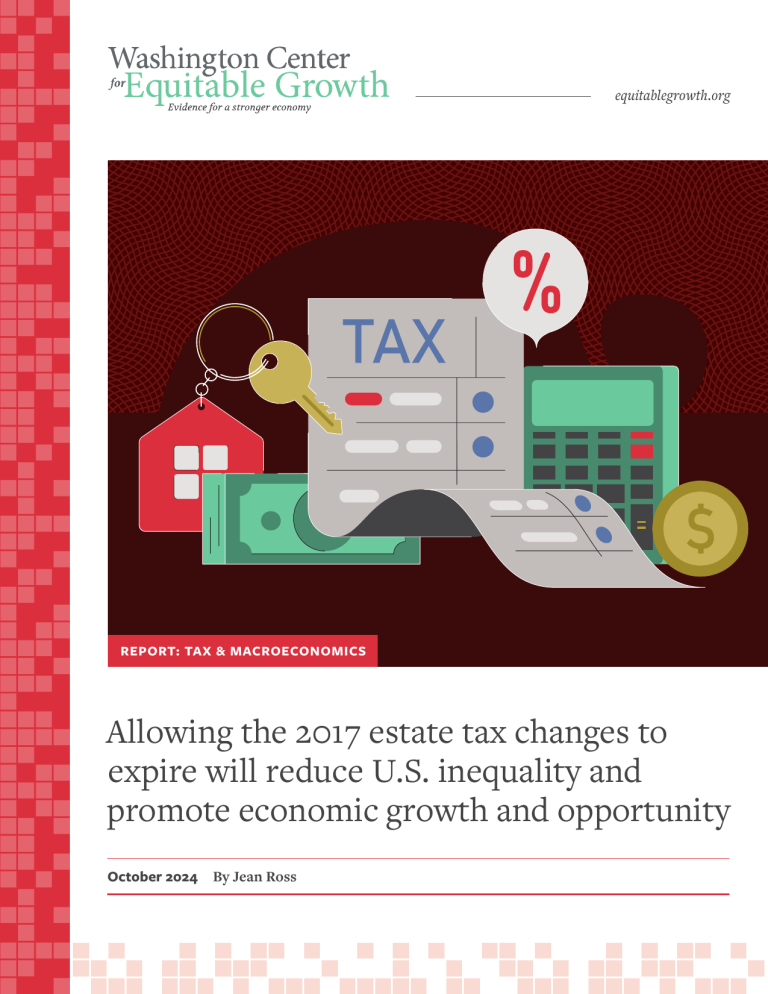
Allowing the 2017 estate tax changes to expire will reduce U.S. inequality and promote economic growth and opportunity (opens in a new tab)
Reports OCT 9, 2024
The 2017 Tax Cuts and Jobs Act made deep cuts to the personal income, estate, and corporate income taxes that were costly and heavily skewed toward the very wealthy. The…
By: Jean Ross (opens in a new tab)

End Ineffective Business Tax Breaks Before Creating New Ones (opens in a new tab)
Blog OCT 7, 2024
(This opinion piece first appeared in Tax Notes Federal on September 23, 2024.) Vice President Kamala Harris recently proposed an expanded tax benefit for start-up businesses, aimed at helping fledgling…
By: David S. Mitchell (opens in a new tab)

Equitable Growth’s ‘Econ 101’ offered congressional staffers a rundown of the contours of U.S. tax policy (opens in a new tab)
Blog OCT 2, 2024
The Washington Center for Equitable Growth recently hosted a congressional briefing—part of a series we call “Econ 101”—for Hill staffers interested in learning more about the ins and outs of…
By: Equitable Growth (opens in a new tab)

The unequal impact of the Federal Reserve’s monetary tightening and easing on firms in the United States (opens in a new tab)
Blog SEP 16, 2024
The easing of inflation in the U.S. economy beginning in 2022 and recent signs of weakness in the U.S. labor market over the past several quarters have led households and…
By: Ezgi Kurt (opens in a new tab)

The upcoming U.S. election’s most important policy effects are under the radar (opens in a new tab)
Blog SEP 3, 2024
Although the old maxim that Labor Day marks the true beginning of U.S. presidential campaigns may no longer hold, the end of summer and beginning of fall remain a period…
By: Kevin Rinz (opens in a new tab)

New economic analyses of the 2017 Trump tax cuts find mixed effects that policymakers should consider when those tax cuts expire in 2025 (opens in a new tab)
Blog AUG 22, 2024
Former President Donald Trump’s hallmark economic policy was a swathe of tax cuts for the wealthy and big corporations in 2017. His Tax Cuts and Jobs Act, or TCJA, supercharged…
By: Rakeen Mabud (opens in a new tab), Janelle Jones (opens in a new tab), Michael Linden (opens in a new tab)
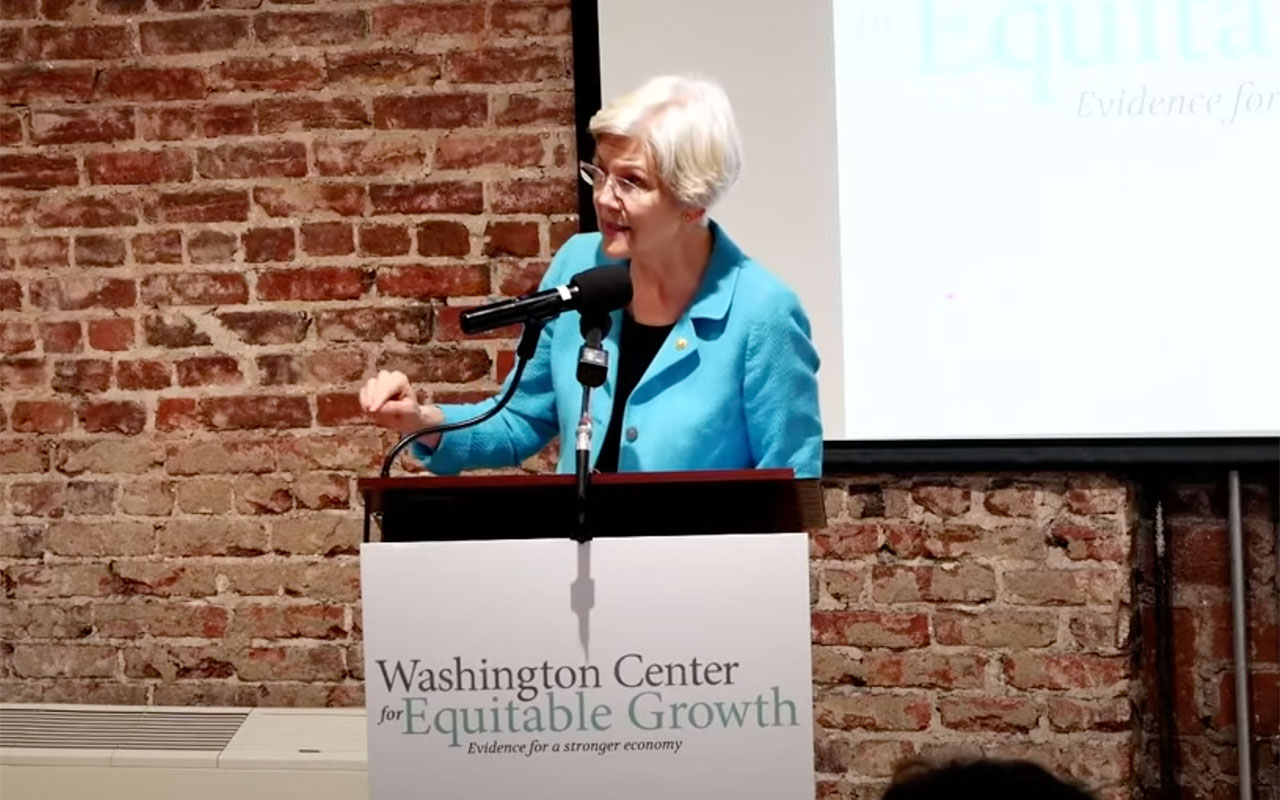
Equitable Growth hosts event featuring Sen. Elizabeth Warren on pro-growth tax reform in 2025 (opens in a new tab)
Videos JUN 20, 2024
Several provisions of former President Donald Trump’s 2017 tax cuts are set to expire next year, providing an opportunity to reimagine how federal taxes can both raise additional revenue for…
By: Equitable Growth (opens in a new tab)

A researcher’s guide to identifying policy-relevant research questions for the federal government (opens in a new tab)
Essays MAY 30, 2024
Social science researchers play an important role in the policymaking process. Researchers help policymakers at all levels of government to understand key trends and issues in the U.S. economy and…
By: Alexander Hertel-Fernandez (opens in a new tab)
2017 tax cut for pass-through business owners exacerbated inequality and failed to deliver economic benefits (opens in a new tab)
Issue Briefs MAY 1, 2024
Among the many regressive and ineffective elements of the Trump administration’s Tax Cuts and Jobs Act of 2017, one provision stands out as the most convoluted, unfair, and ripe for…
By: David S. Mitchell (opens in a new tab)
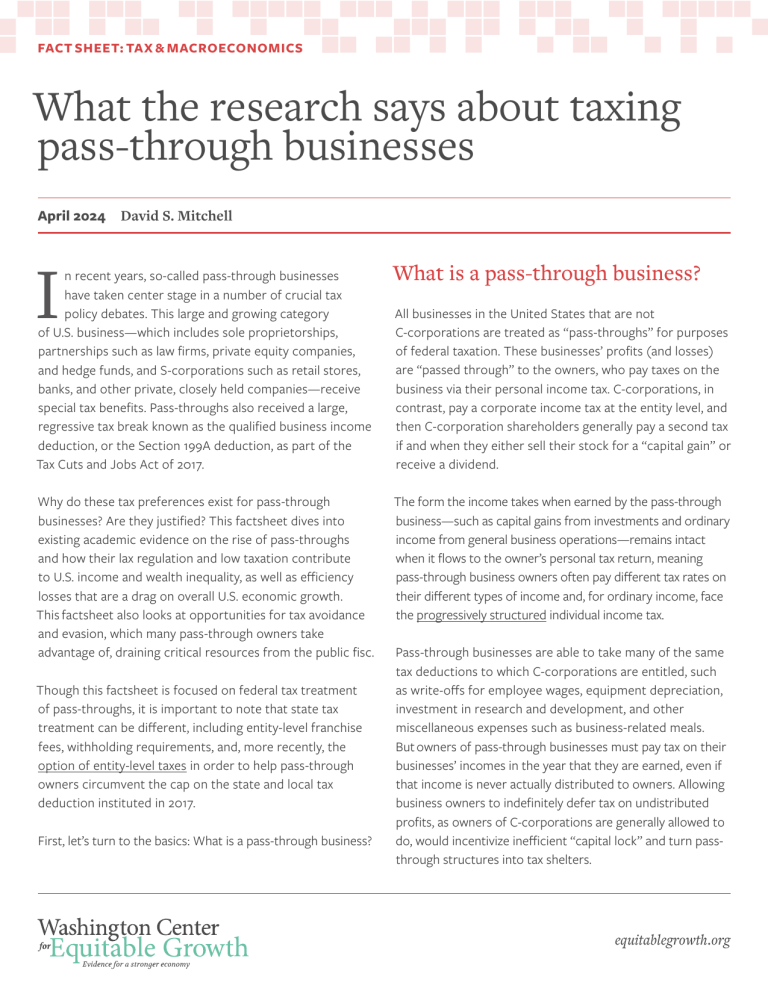
Factsheet: What the research says about taxing pass-through businesses (opens in a new tab)
Factsheets APR 30, 2024
In recent years, so-called pass-through businesses have taken center stage in a number of crucial tax policy debates. This large and growing category of U.S. business—which includes sole proprietorships, partnerships…
By: David S. Mitchell (opens in a new tab)

Combating market power through a graduated U.S. corporate income tax (opens in a new tab)
Issue Briefs APR 15, 2024
Editor’s note: This version has been updated from the original publication on April 15, 2024. The update corrects a prior underestimate of the revenue potential from graduated corporate tax rates…
By: Kimberly Clausing (opens in a new tab)
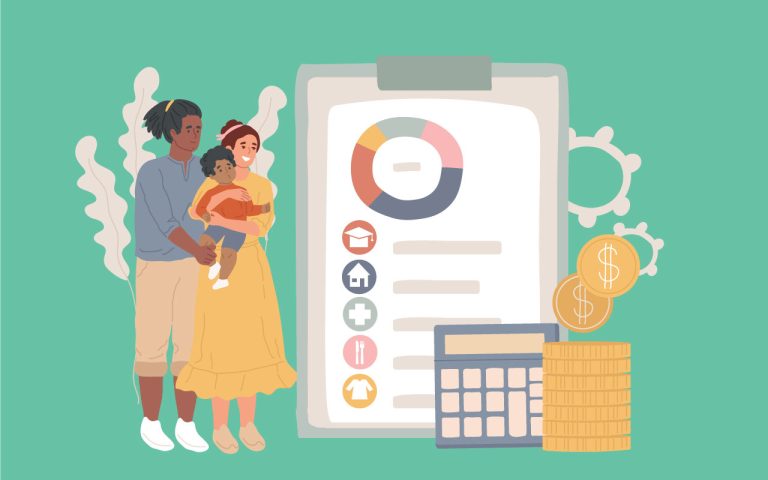
Enhanced Child Tax Credit helped U.S. families afford life-enhancing necessities and cope with inflation (opens in a new tab)
Blog APR 2, 2024
Amid ongoing congressional debate over expanding the Child Tax Credit for U.S. families, it’s important to understand why the fears about the expansion of that tax credit in 2021 were…
By: David S. Mitchell (opens in a new tab)

Closing the billionaire borrowing loophole would strengthen the progressivity of the U.S. tax code (opens in a new tab)
Issue Briefs FEB 5, 2024
The vast majority of Americans are concerned that some wealthy people don’t pay their “fair share” of federal taxes. They’re right to be bothered: Loopholes in the U.S. tax code…
By: Edward Fox (opens in a new tab), Zachary Liscow (opens in a new tab)

Doubling down on cuts to the IRS is bad for the federal budget and for tax fairness in the United States (opens in a new tab)
Blog JAN 9, 2024
The U.S. Congress recently announced a bipartisan budget deal for fiscal year 2024 appropriations for the U.S. federal government. The budget is largely consistent with the framework agreed to in…
By: David S. Mitchell (opens in a new tab)
Six years later, more evidence shows the Tax Cuts and Jobs Act benefits U.S. business owners and executives, not average workers (opens in a new tab)
Blog DEC 20, 2023
When policymakers were debating the Tax Cuts and Jobs Act of 2017, many proponents claimed that average U.S. workers would benefit via wage increases. These adherents of trickle-down economic theory…
By: David S. Mitchell (opens in a new tab)


Your Direct Line to Cutting Edge Research
Be the first to know about our latest events, research releases, and expert insights. Get exclusive updates delivered right to your inbox and never miss an opportunity to engage with our community.