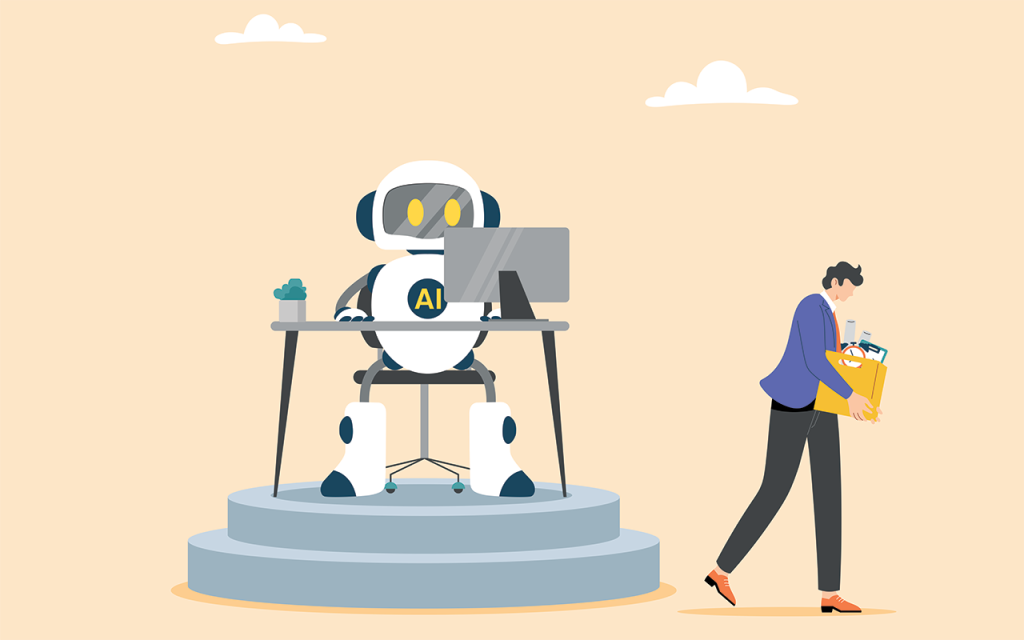

What impact is artificial intelligence having on the U.S. labor market and the nation’s economy?
Essays NOV 14, 2025
By: Megan Rivera
SEP 2, 2026
By: Megan Rivera
The adoption of artificial intelligence in the workplace has led to predictions of U.S. labor market disruptions. In response, policymakers have increased attention on the fitness of the nation’s social insurance programs. Of particular interest is the Unemployment Insurance system, the joint federal-state program (opens in a new tab) that provides temporary and partial wage replacement or income support to workers who lose their jobs typically through no fault of their own.
While the UI system provides vital income support to out-of-of work Americans and their families, and acts as an economic boost during downturns, the system has long been broken for many workers. Critically, the UI system excludes millions of workers in non-traditional labor arrangements, among them entry-level, self-employed, part-time, and gig workers. Workers without access to Unemployment Insurance will be the focus of this column. These workers typically are excluded from the nation’s social insurance infrastructure for a variety of reasons but are no less at risk of job losses or income disruptions.
Policymakers can learn from responses to past labor market disruptions, such as the targeted action taken during the COVID-19 pandemic to expand access to unemployment insurance (opens in a new tab) for gig workers, part-time workers, and workers with limited labor market history (opens in a new tab). (opens in a new tab) Unfortunately, the 2025 congressional budget reconciliation bill—the One Big Beautiful Bill Act or Public Law 119-21 (opens in a new tab)— included deep cuts to social programs, including the Supplemental Nutrition Assistance Program and Medicaid. These cuts reduce the options available to workers and their families when they face an interruption to their earned incomes or suffer job losses.
In the face of potential economic and employment disruptions from increasing use of AI across the economy, policymakers need to be prepared to take quick action. They must consider the limits of existing policies and programs, such as Unemployment Insurance and other social programs, in addressing the needs of all workers during potential large-scale labor market transformations. Future economic policies must ensure AI-related workplace disruptions do not further stratify the U.S. workforce into those with and those without the resources to adapt and thrive in an AI-dominant economy.
Although the academic literature on AI’s potential impact on the labor market and economy is genuinely unsettled, policymakers can prepare for the unknown. Investing in social insurance programs that provide income security to households and that evidence shows support the U.S. economy during economic disruptions will support economic resiliency. But policymakers must consider the limits of existing policies and programs, such as the nation’s underfunded social insurance programs, particularly Unemployment Insurance, in addressing the needs of all workers during potential structural transformations to the labor market. American workers and their families will likely need more economic support than the system can currently provide, and millions won’t be reached unless policymakers take focused action to reach them.
Our nation’s shared success in navigating a potential labor market transition spurred by emerging technologies will require policymakers to invest in the future of American workers to ensure they emerge economically secure and connected to the labor market. This will require a policy response that doesn’t apply a one-size-fits-all approach to ensure that all types of workers at all phases of their careers are supported through any economic transition. These policy responses might require multiple phases of engagement, such as initial triage tools in the event of a financial crisis worsened by widescale job losses. Longer-term support should enable workers to match their skills to comparable or higher paying jobs.
Fortunately, we can look to past government programs for lessons learned as we consider other levers available. Future economic policy must ensure AI-related workplace disruptions do not further stratify the U.S. workforce into those with and those without the resources to adapt and thrive in a changing economy.
In the meantime, equipping the UI system to be responsive to the U.S. labor market, supporting household consumption when workers suffer from involuntary unemployment, and enabling unemployed workers to engage in productive job searches or job retraining to secure new employment with higher pay are all no-regrets investments that policymakers can make to support shared economic prosperity and growth, regardless of what the future brings.
Essays NOV 14, 2025
By: Megan Rivera
In Conversation OCT 6, 2020
By: Alix Gould-Werth
Blog OCT 31, 2016
By: Till von Wachter
Get updates on our latest research, event announcements, and policy insights delivered straight to your inbox. Stay connected with the leading voices on equitable growth.