



Policy
What Work Does Generative AI Do?
Essays SEP 8, 2026
By: Alexander Bick, Adam Blandin, David Deming, Tyler Schumacher
AI, Tech & Energy
Labor, Wages & Worker Power
 Browse All Resources
MAR 11, 2016
By: Nick Bunker

This is a weekly post we publish on Fridays with links to articles that touch on economic inequality and growth. The first section is a round-up of what Equitable Growth has published this week and the second is work we’re highlighting from elsewhere. We won’t be the first to share these articles, but we hope by taking a look back at the whole week, we can put them in context.
As the United States moves toward a lower-carbon energy system, the shift to a new system will create (and destroy) many jobs. Arizona State University professor Christopher F. Jones looks at how this change might result in more equitable job growth (opens in a new tab).
The U.S. labor market is a far less dynamic place than it was 30 years ago. Workers today are less likely to get a job while unemployed, move into unemployment, switch jobs, or move across state lines. What’s behind this decline in fluidity? A new paper investigates.
A college degree is supposed to be a great equalizer when it comes to incomes. But new research has uncovered something surprising: Students from low-income backgrounds get less of an earnings bump from getting a college degree.
The lack of strong U.S. wage growth continues to confuse some economists. Wages across the country should be growing at a strong clip as unemployment is below 5 percent. Maybe it’s due to changes in the composition of workers getting jobs? That may be true, but it’s not proof that labor market slack is gone.
In 1930, John Maynard Keynes predicted that increasing productivity growth could make our workweeks just 10 to 15 hours long. But he was wrong. Very wrong in the case of professionals. Why? Ryan Avent argues it’s some combination of an arms race and increasing sense of identity forged through work. [1843 (opens in a new tab)]
Speaking of productivity growth, all of Silicon Valley’s advances in recent years haven’t amounted to much. We were promised jetpacks (opens in a new tab) but we got a decline in the growth rate of total factor productivity. Max Ehrenfreund lays out the argument—and it comes to gains in total factor productivity. [wonkblog (opens in a new tab)]
The past several decades have seen a fissuring of the workplace, as companies are more likely to contract or subcontract out work. The result: a disconnect between who sets the condition of work and who legally employs workers. Lydia DePillis profiles two policymakers focused on creating new rules for this work environment. [wonkblog (opens in a new tab)]
The rise of indexed mutual funds has been a boon for personal investors. But could the move to more passively managed funds have a negative impact? James Ledbetter looks at the argument that passive investment, at least in its current form, harms economic growth. [the new yorker (opens in a new tab)]
Could making sure the economy is in a permanent boom actually increase the economy’s productivity capacity? Evan Soltas is fairly certain the answer is no. But that doesn’t mean letting recessions happen would pull down long-run growth. [economics & thought (opens in a new tab)]
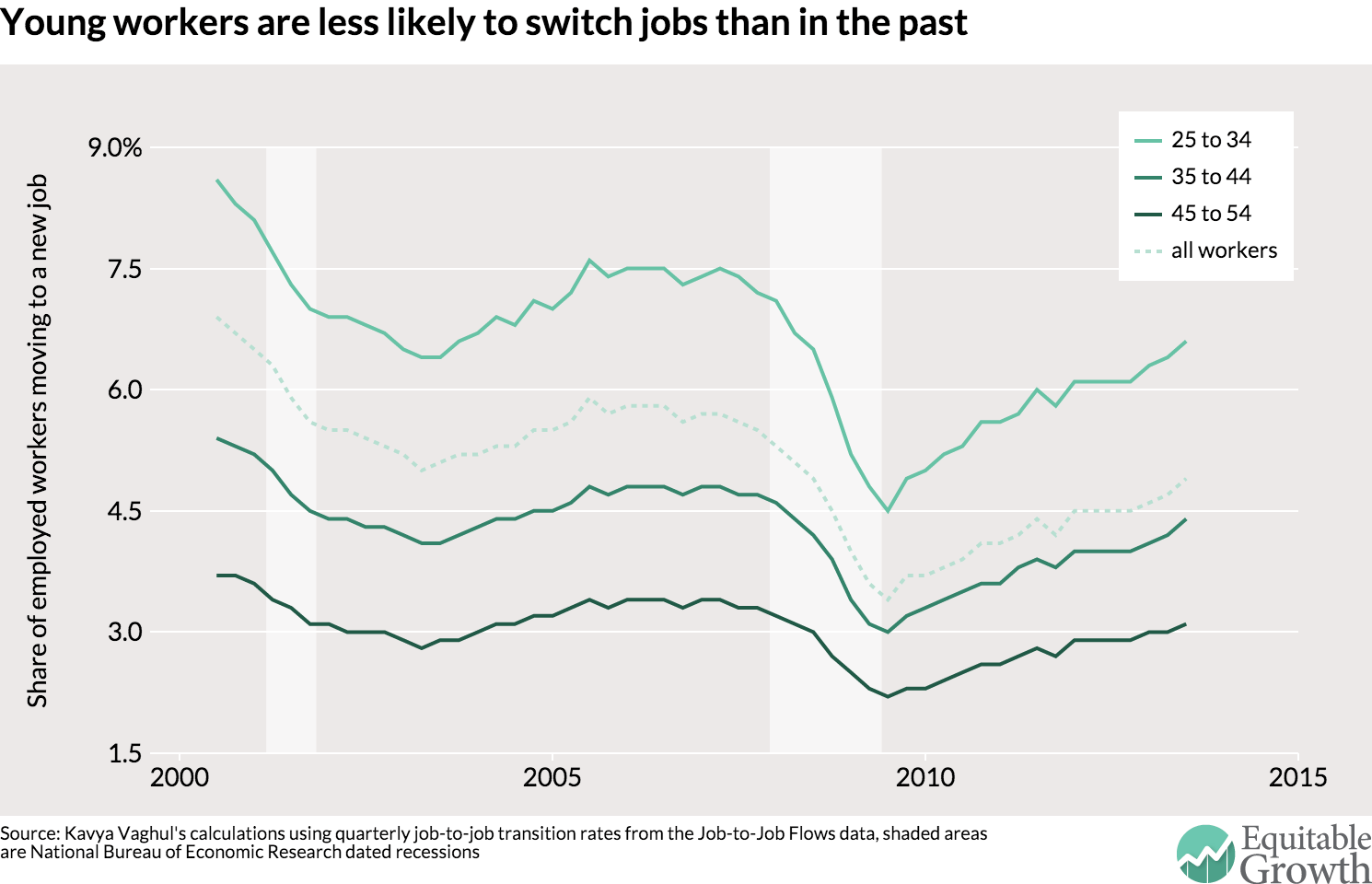
Figure from “Why it’d nice if the ‘job-hopping’ Millennial story were true” by Nick Bunker
Essays SEP 8, 2026
By: Alexander Bick, Adam Blandin, David Deming, Tyler Schumacher

Essays SEP 2, 2026
By: Megan Rivera

Essays AUG 31, 2026
By: Christopher Bangert-Drowns
Get updates on our latest research, event announcements, and policy insights delivered straight to your inbox. Stay connected with the leading voices on equitable growth.


