



Policy
What Work Does Generative AI Do?
Essays SEP 8, 2026
By: Alexander Bick, Adam Blandin, David Deming, Tyler Schumacher
AI, Tech & Energy
Labor, Wages & Worker Power
 Browse All Resources
JUN 2, 2017
By: Nick Bunker

This is a weekly post we publish on Fridays with links to articles that touch on economic inequality and growth. The first section is a round-up of what Equitable Growth published this week and the second is the work we’re highlighting from elsewhere. We won’t be the first to share these articles, but we hope by taking a look back at the whole week, we can put them in context.
Several central banks implemented previously unthinkable monetary policies during the Great Recession. How many of these tools will stick around? A new paper asks central bankers and academics just that question.
Bridget Ansel writes about a new study that uncovers a surprising performance enhancer for venture capital funds: hiring partners who have daughters.
New data on the U.S. labor market was released this morning from the U.S. Department of Labor in the form of the May Employment Situation Report. Check out five key graphs (opens in a new tab) using data from the report.
One part of President Trump’s proposed tax reform is a tax cut for pass-through business income. His administration is pitching it as a tax cut for small business, but Lily Batchelder of New York University Law School argues it’ll become a huge tax loophole. [nyt (opens in a new tab)]
Is the German trade surplus with the United States an issue? Unlikely. But is the German trade surplus with the rest of the world a problem for the global economy? Adam Davidson argues that it is. [new yorker (opens in a new tab)]
“Conversations about inequality often miss something essential, something that the families we met felt strongly: The financial problem they were most immediately focused on wasn’t about relative earnings or wealth. It was about their ability to create stable lives in our uncertain world.” Jonathan Morduch and Rachel Schneider write about their study of income volatility. [atlantic (opens in a new tab)]
As behavioral economics incorporated insights from psychology into economics, a new line of thinking from Nobel Laureate and Yale University economist Robert Shiller called narrative economics takes insights from the humanities. [chicago booth (opens in a new tab)]
In an interview with the Federal Reserve Bank of Minneapolis, University of California, Berkeley economist Hilary Hoynes talks about food stamps, the recessionary effects on labor market segments, and the importance of poverty research. [minneapolis fed (opens in a new tab)]
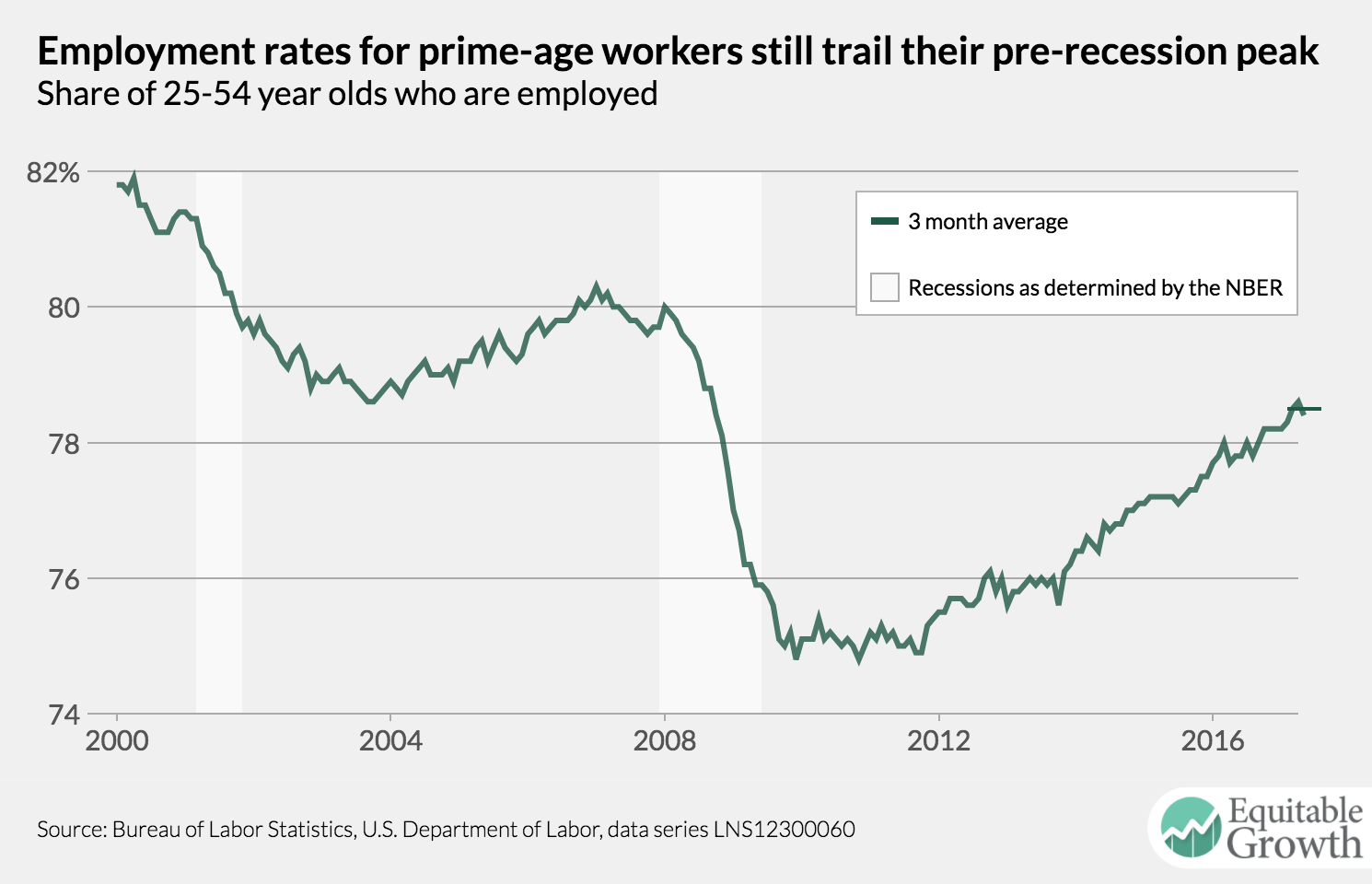
Figure from “Equitable Growth’s Jobs Day Graphs: May 2017 Report Edition (opens in a new tab)” by Equitable Growth
Essays SEP 8, 2026
By: Alexander Bick, Adam Blandin, David Deming, Tyler Schumacher

Essays SEP 2, 2026
By: Megan Rivera

Essays AUG 31, 2026
By: Christopher Bangert-Drowns
Get updates on our latest research, event announcements, and policy insights delivered straight to your inbox. Stay connected with the leading voices on equitable growth.


