



Policy
What Work Does Generative AI Do?
Essays SEP 8, 2026
By: Alexander Bick, Adam Blandin, David Deming, Tyler Schumacher
AI, Tech & Energy
Labor, Wages & Worker Power
 Browse All Resources
SEP 13, 2019

This is a post we publish each Friday with links to articles that touch on economic inequality and growth. The first section is a round-up of what Equitable Growth published this week and the second is relevant and interesting articles we’re highlighting from elsewhere. We won’t be the first to share these articles, but we hope by taking a look back at the whole week, we can put them in context.
Median household income has not changed in a statistically significant way between 2017 and 2018, writes Alix Gould-Werth in an analysis of this week’s U.S. Census Bureau release of the 2018 poverty rate and 2018 median household income in the United States. While the official poverty rate went down 0.5 percent, finally returning to its pre-Great Recession level, median household income has not improved significantly relative to 2007. A more nuanced look at the data shows that overall economic hardship did not decrease in 2018—despite an increase in Gross Domestic Product over the same time period—thanks to growing income inequality. This means millions of families are vulnerable to falling into poverty again when the next recession inevitably hits.
As wealth inequality grows, ideas about how to raise taxes on that wealth abound. In an issue brief, Greg Leiserson and Will McGrew outline a system of mark-to-market taxation, which changes the way we currently tax investment income such that investors would pay tax on the increase in the value of their investments each year, rather than deferring tax until those investments are sold. The brief reviews the revenue potential of this taxation system and summarizes the distribution of the resulting burden, which would fall overwhelmingly on wealthy individuals.
The U.S. Bureau of Labor Statistics this week released the July data from the Job Openings and Labor Turnover Survey, or JOLTS (opens in a new tab). Kate Bahn and Raksha Kopparam produced four graphs (opens in a new tab) using the data, which demonstrate an expansionary labor market even as job openings decreased slightly in July.
Read Will McGrew’s coverage of last month’s sixth annual Freedom and Justice Conference—hosted by the National Economic Association and the American Society of Hispanic Economists at University of New Mexico’s Department of Economics—which focused on better incorporating those who are economically marginalized into the field of economics, both as researchers and as subjects of research.
Equitable Growth announced more than $200,000 in funding for two grants studying the effects of state-level paid family and medical leave on labor market participation and on opioid abuse. The two off-cycle grants will study issues “that matter to families and that also have profound implications for the labor market and broader economy,” said Alix Gould-Werth in a press release.
Brad DeLong gives us his latest worthy reads, providing his takes on content from Equitable Growth and around the web.
During President Donald Trump’s second year in office, safety net programs—including the Supplemental Nutrition Assistance Program, Social Security, and housing subsidies—and the benefits they provide to low-income families kept almost 48 million people out of poverty. That’s close to 3 million more people above the poverty threshold than in 2017, reports Alexia Fernández Campbell (opens in a new tab) for Vox, analyzing the newly released U.S. Census Bureau data on poverty and median income. Yet, she continues (opens in a new tab), repeated efforts to slash welfare spending—including President Trump’s budget proposal for fiscal year 2020 and attempts to disable Obamacare—will only push more people into poverty, should they succeed.
Since 2009, the rate of uninsured people living in the United States has been declining, largely thanks to the Affordable Care Act and the creation of state healthcare exchanges in 2014. But in 2018, that progress halted, as almost 2 million more people became uninsured, bringing the total to 27.5 million Americans living without healthcare coverage—including more than 4 million children—reports Tami Luhby (opens in a new tab) for CNN (opens in a new tab).
After the California state legislature passed landmark legislation (opens in a new tab) on Wednesday changing the employment status of app-based company employees, companies such as Uber Technologies, Inc. And Lyft, Inc.—which are some of the main targets of the law—responded by declaring they were exempt from key provisions, leading to confusion about who, exactly, will be covered once it goes into effect. Under the law, workers are considered employees (with all the rights, benefits, and protections that implies), and not contractors, if a company controls how they perform their tasks or if their work is central to a company’s regular business. So, if this law doesn’t affect Uber and Lyft drivers, then who does it apply to? The ensuing debate “could have wide economic ramifications for businesses and workers alike in California, and potentially well beyond as lawmakers in other states seek to make similar changes,” write (opens in a new tab) Kate Conger (opens in a new tab) and Noam Scheiber (opens in a new tab) for The New York Times.
For the first time in history, write Heather Long (opens in a new tab) and Andrew Van Dam (opens in a new tab) for The Washington Post, most new hires of prime working age (ages 25 to 54) in the United States are people of color. Specifically, black and Hispanic women—who have been entering the workforce at an increasing rate since 2015—have reshaped the workforce and pushed it across this historic threshold. But, the authors ask (opens in a new tab), will these minority groups be able to hold on to these gains when the labor market weakens as the economy slows down?
Attorneys general for 50 states and territories—only California and Alabama have not signed on—announced an antitrust investigation into Alphabet Inc.’s Google unit, stopping short of filing a lawsuit for the time being. The probe (opens in a new tab) is focused on the tech giant’s online advertising, though could expand to other areas, including “the way the company processes and ranks search results to the extent to which it may not fully protect users’ personal information,” writes Tony Romm (opens in a new tab) for The Washington Post. This investigation comes as regulators around the world are looking into the company’s practices, including investigators in the European Union, who recently fined Google $9 billion for competition-related issues over the past 3 years.
Friday Figure
View FullscreenFriday Figure — opens in a new tab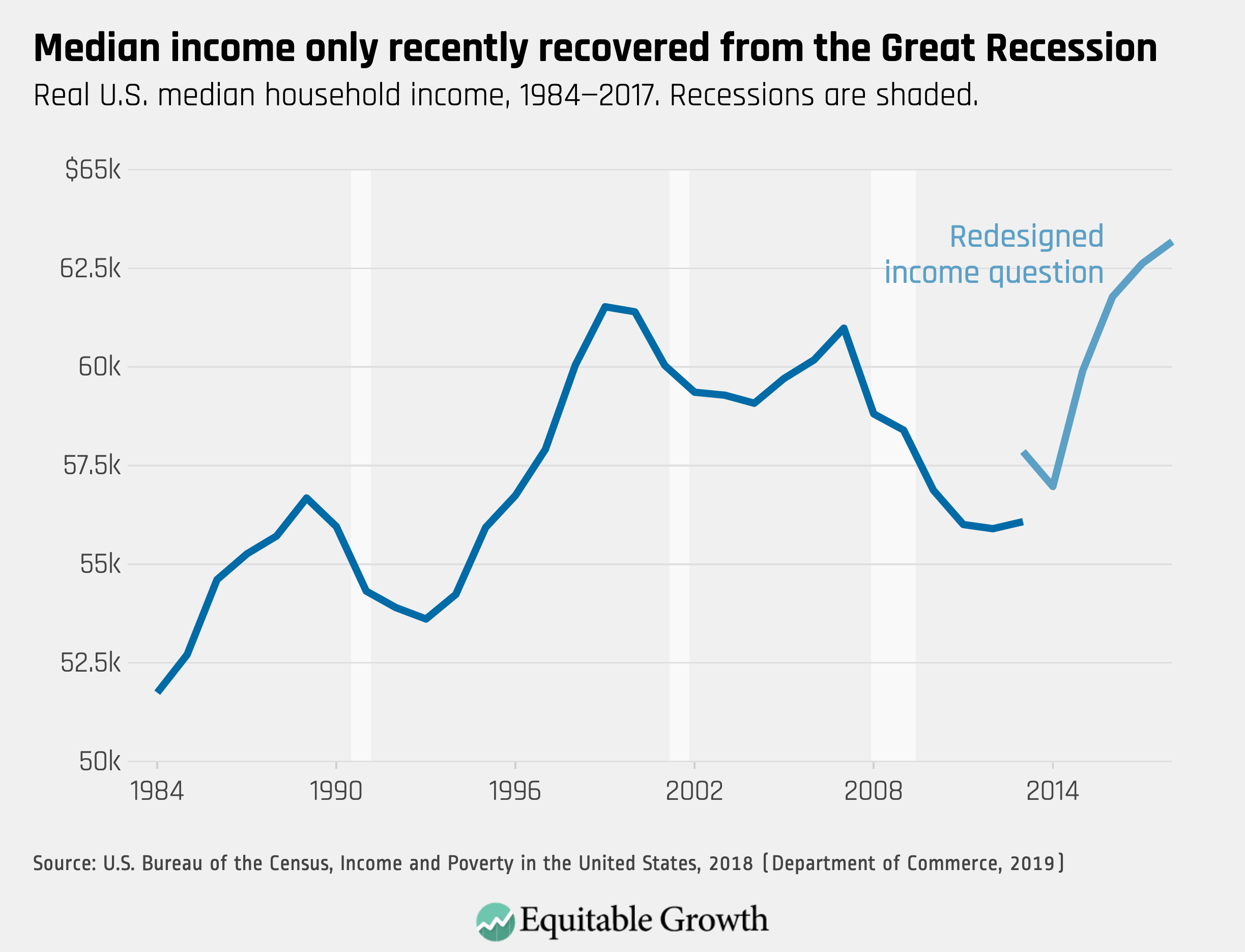
Figure is from Equitable Growth’s “Newly released U.S. poverty statistics show that recent economic growth is not broadly shared,” by Alix Gould-Werth.
Essays SEP 8, 2026
By: Alexander Bick, Adam Blandin, David Deming, Tyler Schumacher

Essays SEP 2, 2026
By: Megan Rivera

Essays AUG 31, 2026
By: Christopher Bangert-Drowns
Get updates on our latest research, event announcements, and policy insights delivered straight to your inbox. Stay connected with the leading voices on equitable growth.


