




Policy
What Work Does Generative AI Do?
Essays SEP 8, 2026
By: Alexander Bick, Adam Blandin, David Deming, Tyler Schumacher
AI, Tech & Energy
Labor, Wages & Worker Power
 Browse All Resources
MAY 26, 2017
By: Kavya Vaghul

This is a weekly post we publish on Fridays with links to articles that touch on economic inequality and growth. The first section is a round-up of what Equitable Growth published this week and the second is the work we’re highlighting from elsewhere. We won’t be the first to share these articles, but we hope by taking a look back at the whole week, we can put them in context.
It’s all about the President’s budget this week. Well, almost.
Anticipating the Trump administration’s fiscal year 2018 budget, Greg Leiserson discusses the possibility of double-counting of the benefits of improving the outlook for the federal deficit thanks to fantasy budgeting around policies and plans that have yet to be developed.
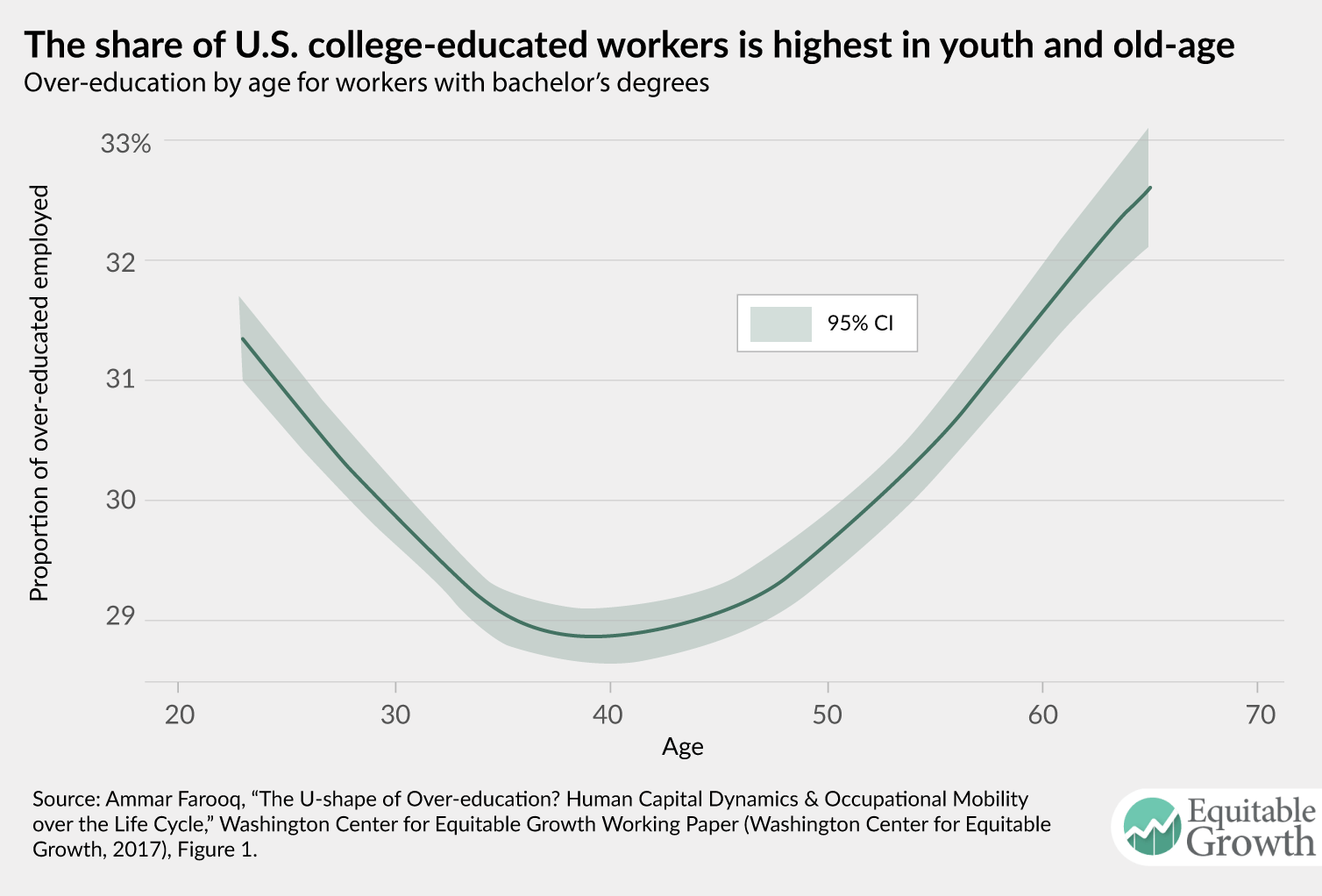
Equitable Growth released a new working paper by grantee Ammar Farooq, which takes a close look at the proportion of college-educated workers in occupations that don’t require a college degree. The findings suggest that the share of over-educated workers appears to be U-shaped over the life cycle.
Nick Bunker also writes on the incidence of over-education across a lifetime, noting that Farooq’s paper helps shed light on the fact that the “cruel game of musical chairs (opens in a new tab)” is not just a problem for young people but also for the middle-aged and the elderly.
Getting back to the budget, concerns over enforcing labor standards and worker protections are on the rise as the Trump administration proposed large cuts to the U.S. Department of Labor. Recent structural changes in the labor market—including the rise of the “fissured” workplace, the decline of union density, the lack of synergy between regulatory frameworks and industrial organization, and the rapid growth of technology—make enforcement even more important in this day and age, explains Elisabeth Jacobs.
In the latest installment of Equitable Growth in Conversation, John Schmitt sits down with Sandra Black, the Audre and Bernard Rapoport Centennial Chair in Economics and Public Affairs, professor of economics at The University of Texas at Austin, and former member of President Barack Obama’s Council of Economic Advisors, to talk about transitioning from academia to the policy world and the importance of bridging the gap between the two. Read the full interview transcript here.
The fiscal year 2018 budget put forward a 13 percent spending cut for the U.S. Department of Education and redirecting funding efforts toward school choice. Despite this focus on school choice, the administration has not yet unveiled their tax credit scholar program. Kavya Vaghul unpacks some of the key controversies with these programs.
Dylan Matthews breaks down the details of the trillions of dollars of cuts in President Donald Trump’s tax plan, calls out the “magical economic assumptions” in the plan, and predicts the possibility of these changes actually taking effect. [vox (opens in a new tab)]
Why has wage growth stagnated over the last three decades? Pedro Nicolaci da Costa explores the question, reflecting on the weak state of the labor market and how investments in workers and wages are low. [business insider (opens in a new tab)]
The American Health Care Act was scored by the U.S. Congressional Budget Office. According to the report, the House-passed legislation would reduce the deficit but render 23 million more people uninsured. Additionally, the CBO score makes clear that the American Health Care Act will help underwrite tax cuts, explains Casey Quinlan. [think progress (opens in a new tab)]
“Inclusive prosperity” in the United States has become increasingly unattainable, writes Richard Florida, though unemployment has decreased and economic output has increased since the Great Recession of 2007-2009. These gains appear to be accruing to certain advantaged groups across race and class in metro areas. [city lab (opens in a new tab)]
In a new report, Lawrence Mishel and Josh Bivens strike down on the argument that increasing automation—the robot apocalypse—leads to inequality and job displacement by reviewing key literature and refocusing attention to the importance of securing full employment. [epi (opens in a new tab)]
Essays SEP 8, 2026
By: Alexander Bick, Adam Blandin, David Deming, Tyler Schumacher

Essays SEP 2, 2026
By: Megan Rivera

Essays AUG 31, 2026
By: Christopher Bangert-Drowns
Get updates on our latest research, event announcements, and policy insights delivered straight to your inbox. Stay connected with the leading voices on equitable growth.


