



Policy
What Work Does Generative AI Do?
Essays SEP 8, 2026
By: Alexander Bick, Adam Blandin, David Deming, Tyler Schumacher
AI, Tech & Energy
Labor, Wages & Worker Power
 Browse All Resources
FEB 26, 2021

This is a post we publish each Friday with links to articles that touch on economic inequality and growth. The first section is a round-up of what Equitable Growth published this week and the second is relevant and interesting articles we’re highlighting from elsewhere. We won’t be the first to share these articles, but we hope by taking a look back at the whole week, we can put them in context.
The history of violence and suppression of Black Americans is long and atrocious, and the institutionalized racism and systemic oppression that began centuries ago continue to impact the economic outcomes of Black Americans. As Black History Month comes to a close, Liz Hipple and Shanteal Lake highlight how the lingering impacts of this historical discrimination and subjugation prevent many Black families from achieving the so-called American Dream. Hipple and Lake review a few of the papers that were presented at this year’s Allied Social Sciences Associations conference that elevate research on this topic and explain the impact that this research has on broader understandings of the Black experience in the United States. This research, they write, shows how decades of “violence, predatory financial practices, and labor market discrimination have stolen opportunities—and billions of dollars—from African Americans,” exacerbating racial disparities in areas from economic well-being to educational achievement to health. These policies were designed to promote racial inequality and violence, and therefore, they note, can be re-designed to promote equality and restore humanity.
Each month, Equitable Growth highlights scholars from our network and beyond who are working to better understand the effects of inequality of broad-based economic growth. This Black History Month, Christian Edlagan and Maria Monroe showcase Black scholars leading the way to diversify the economics profession. The lack of diversity in economics, both at university and professional levels, stymies research on economics, social sciences, and policy. These scholars and experts, Edlagan and Monroe write, are doing the critical work of increasing and sustaining diversity in the field and addressing pipeline and pathway challenges for people of color in economics.
Wage theft, which occurs when an employer doesn’t justly compensate an employee for their labor, exacerbates inequality and puts families at risk. The workers who are most at-risk are women, workers of color, and noncitizens—often already-vulnerable workers who occupy low-wage positions in industries where workers have little power to protect themselves and demand fair compensation and working conditions. An Equitable Growth factsheet looks at the dangers posed by wage theft for workers and the economy more broadly, and then provides several executive actions that President Joe Biden’s administration can take to crack down on wage theft, protect workers, and raise their wages and living standards.
As the Biden administration explores ways to improve efficiency and outcomes in government, it should consider eliminating the cost-benefit analysis requirement for tax regulations. An Equitable Growth factsheet explains why this requirement, which was implemented in 2018, fails to provide accurate assessments of the merits and downsides of tax regulations. The factsheet then lays out possible executive actions President Biden can take to properly evaluate tax regulations, particularly by examining the impacts of these rules on revenues, the level and distribution of the tax burden, and any compliance costs.
The prevalent zero-sum thinking on race and wealth in the United States takes a huge toll on society and the U.S. economy, writes (opens in a new tab) Heather McGhee in an op-ed for The New York Times. For too long, policies and politicians have pitted people against each other in a way that ends up leaving us all worse off than we could be, McGhee continues (opens in a new tab). Starting around the Civil Rights era, the percentage of White Americans who support government provision of public goods cratered and has remained low since then. Describing her 3-year quest to “understand what stops us from uniting for our mutual benefit,” McGhee looks at the impact of racial resentment on per-capita government spending and provision of services (or lack thereof) in the United States. She then urges policymakers, stakeholders, and the public to dispel the idea that there is a fixed quantity of prosperity to go around, and instead focus on uniting across racial lines to ensure the provision of basic needs for all, from a livable wage to clean air.
Tying economic relief for the coronavirus recession to economic indicators and trends is a vital way to ensure both that the aid is adequate and the economic recovery is strong. Because the COVID crisis is unlike any other modern economic downturn, it is hard to know for sure when things will be back to normal. As such, setting a random date—March 14, or the end of August, for instance—for badly needed government aid to expire sets up a cliff that the U.S. economy could easily tumble over. Instead, Vox’s Emily Stewart (opens in a new tab) explains, the relief programs ought to be phased out as the economy improves. Stewart describes (opens in a new tab) the benefits of these so-called automatic stabilizers and why they would be better (opens in a new tab) than arbitrary expiration dates for certain government supports and emergency benefits. This is the best idea left on the table for the next coronavirus stimulus package: It removes the guesswork involved in trying to predict an unpredictable “end” of the pandemic, and it eliminates the ability for political brinksmanship to cut-off important aid to U.S. households and families that are struggling the most.
Though there was much discussion surrounding the recent Congressional Budget Office projection that a $15 minimum wage would result in 1.4 million jobs lost, this estimate does not line up with the empirical evidence on the topic. In an op-ed (opens in a new tab) for The Washington Post, Arindrajit Dube runs through recent research on U.S. state and local minimum wage hikes (as well as those from countries abroad), which show an overall minimal impact on employment rates—and large economic and societal gains in terms of reducing poverty and improving standards of living. Indeed, Dube estimates (opens in a new tab), using modern literature and recent findings, raising the federal minimum wage to $15 would result in fewer than 500,000 jobs lost. While he concedes that a major national policy change such as this may result in more losses than were found in studies of cities and states that raised the minimum wage, he maintains that the CBO’s projections are off. He concludes by urging policymakers to consider the risks of keeping the minimum wage too low: increased poverty, heightened inequality, and exacerbated racial injustice.
Friday figure
View FullscreenFriday figure — opens in a new tab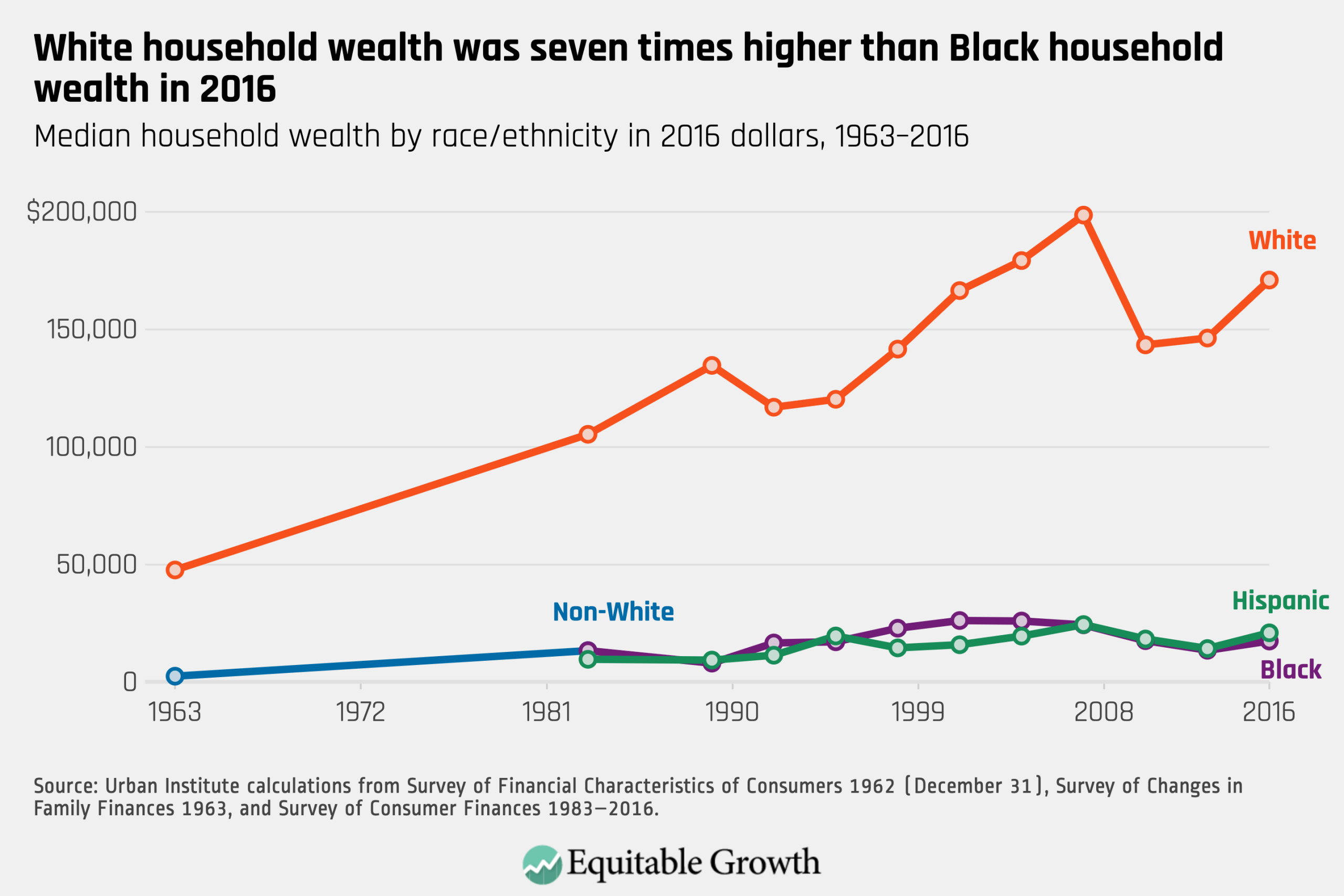
Median household wealth by race/ethnicity in 2016 dollars, 1963–2016
Figure is from Equitable Growth’s “Reconsidering progress this Juneteenth: Eight graphics that underscore the economic racial inequality Black Americans face in the United States” by Liz Hipple, Shanteal Lake, and Maria Monroe.
Essays SEP 8, 2026
By: Alexander Bick, Adam Blandin, David Deming, Tyler Schumacher

Essays SEP 2, 2026
By: Megan Rivera
Essays AUG 31, 2026
By: Christopher Bangert-Drowns
Get updates on our latest research, event announcements, and policy insights delivered straight to your inbox. Stay connected with the leading voices on equitable growth.


