



Policy
What Work Does Generative AI Do?
Essays SEP 8, 2026
By: Alexander Bick, Adam Blandin, David Deming, Tyler Schumacher
AI, Tech & Energy
Labor, Wages & Worker Power
 Browse All Resources
JAN 19, 2017
By: Bridget Ansel

This is a weekly post we publish on Fridays with links to articles that touch on economic inequality and growth. The first section is a round-up of what Equitable Growth published this week and the second is the work we’re highlighting from elsewhere. We won’t be the first to share these articles, but we hope by taking a look back at the whole week, we can put them in context.
A new report put out late last month by the White House Council of Economic Advisors that finds national spending levels on children are lowest for children under five. This is a major problem considering the growing body of research that clearly shows children’s future contributions to the U.S. economy are largely shaped by their early environment.
Nick Bunker writes about a study that looks at how the increase in domestic outsourcing and the use of independent contractors in the United States and Germany has affected wages and the wage distribution.
A new working paper finds that family policies, especially investment in childcare and early learning programs, boosts women’s employment outcomes in the leading developed economies.
The Upshot looked (opens in a new tab) at the extent of wealth concentrated within certain elite colleges. They found that some colleges have more students from the top 1 percent than the bottom 60 percent. The feature was based on research done by a group of economists, including Equitable Growth Steering Committee members, Raj Chetty of Stanford University and Emmanuel Saez of University of California-Berkeley, as well as Equitable Growth grantee Danny Yagan of University of California-Berkeley.
Dean Baker gives a good overview of the economics of Obamacare, arguing that those who want a replacement plan will have to deal with the same structural imbalances in the health care economy that the Affordable Care Act’s original authors faced. [inet economics (opens in a new tab)]
Dhruv Khullar, a resident physician at Massachusetts General Hospital and Harvard Medical School, writes about the extent to which our health system is sustained by “overworked and underappreciated” family caregivers. New research finds that our reliance on this unpaid “workforce” is unsustainable, and lays out ways we can better support caregivers. [the upshot (opens in a new tab)]
It’s not black and Latino people who are self-segregating into neighborhoods. Instead, sociologists find that it’s white residents, many of whom claim to want more diversity but end up looking for homes in less diverse neighborhoods, according to Alvin Chang. [vox (opens in a new tab)]
With the new Trump administration being critical of certain labor regulations, Bourree Lam writes about how more people are looking to the states to protect employees from wage theft and other illegal practices. [the atlantic (opens in a new tab)]
Rebecca Vallas and Katherine Gallagher Robbins give an overview of many scholars’ critical response to the controversial New York Times story claiming that soda is the No. 1 purchase by households that receive supplemental nutrition benefits. [talk poverty (opens in a new tab)]
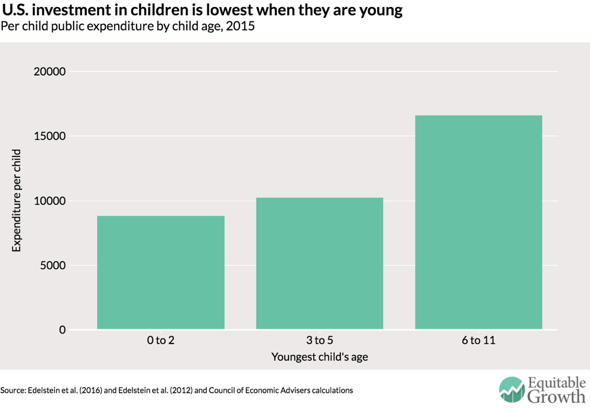
Figure from “Failing to invest in young kids is damaging the U.S. economy,” by Bridget Ansel.
Essays SEP 8, 2026
By: Alexander Bick, Adam Blandin, David Deming, Tyler Schumacher

Essays SEP 2, 2026
By: Megan Rivera

Essays AUG 31, 2026
By: Christopher Bangert-Drowns
Get updates on our latest research, event announcements, and policy insights delivered straight to your inbox. Stay connected with the leading voices on equitable growth.


