



Policy
What Work Does Generative AI Do?
Essays SEP 8, 2026
By: Alexander Bick, Adam Blandin, David Deming, Tyler Schumacher
AI, Tech & Energy
Labor, Wages & Worker Power
 Browse All Resources
APR 8, 2016
By: Nick Bunker

This is a weekly post we publish on Fridays with links to articles that touch on economic inequality and growth. The first section is a round-up of what Equitable Growth has published this week and the second is work we’re highlighting from elsewhere. We won’t be the first to share these articles, but we hope by taking a look back at the whole week, we can put them in context.
Family income growth in the United States over the past 30 or so years has been relatively tepid. This same time period has also seen increased labor market participation from women. Heather Boushey and Kavya Vaghul show that the growth in family incomes would have been much slower if not for women’s increased work hours and earnings.
Equitable Growth released our second set of working papers this week. This month’s batch of papers cover income and earnings mobility (opens in a new tab), the effect of student loans on the U.S. labor market, the labor market shock due to Chinese imports, and corporate profit shifting (opens in a new tab).
The leak of the Panama Papers—documents detailing the extensive use of shell corporations based in Panama (opens in a new tab)—has brought more attention to the role of offshore wealth. While many of the headlines around the leaks were about the activities of individuals, it’s worth looking at the global system that lets these havens exist.
In the second interview in the “Equitable Growth in Conversation” series, Heather Boushey talked with Byron Auguste, Managing Director of Opportunity@Work. The two discussed current problems with the U.S. labor market, how these problems may be mostly on the demand side, and how we might “rewire” the labor market.
Speaking of current problems with the labor market, the shift in the Beveridge Curve—the relationship between job openings and the unemployment rate—has sparked concern about structural problems in the labor market. A look at some of the other Job Openings and Labor Turnover Survey data should assuage those concerns.
Non-compete agreements might have some justification in making sure workers don’t jump to a competitor with trade secrets. But they seem to have expanded far beyond that original intent and become tools of employers to reduce workers’ bargaining power.
The United States has experienced a bit of an urban revival in recent decades. But Americans with high incomes are the disproportionate benefactors of this revival. Paul Krugman calls for a reduction in housing construction constraints to help make “cities for everyone.” [ny times (opens in a new tab)]
Alex Taborrak argues that restrictions on land use have reduced mobility in the United States. “On a national level,” he writes, “land restrictions mean less mobility, lower national productivity and increased income and geographic inequality.” [marginal revolution (opens in a new tab)]
Universal high-quality child care has become an increasingly popular policy proposal as the high price of care and its potential benefits for children have become more clear. As Danielle Paquette details, however, ramping up a universal high-quality program may be difficult. [wonkblog (opens in a new tab)]
According to new figures from the U.S. Department of Education, 43 percent of Americans with federal student loans are behind on their payments, and one in six are in default. Josh Mitchell runs through the numbers. [wsj (opens in a new tab)]
Structural reforms to help boost the long-run, supply-side potential of the economy have long been a key component of the International Monetary Fund’s advice to countries. But Shawn Donnan highlights a new study by IMF economists showing that the effectiveness of those reforms often depends on the macroeconomic conditions at the time of the reforms. [ft (opens in a new tab)]
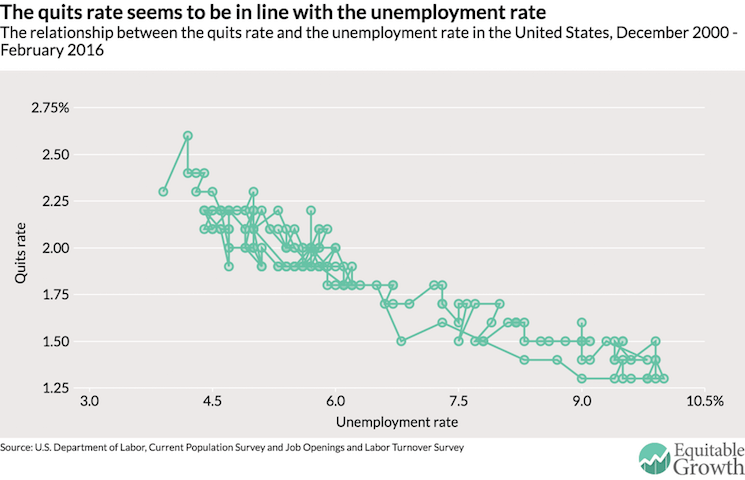
Figure from “JOLTS and another look at the health of the U.S. labor market” by Nick Bunker
Essays SEP 8, 2026
By: Alexander Bick, Adam Blandin, David Deming, Tyler Schumacher

Essays SEP 2, 2026
By: Megan Rivera

Essays AUG 31, 2026
By: Christopher Bangert-Drowns
Get updates on our latest research, event announcements, and policy insights delivered straight to your inbox. Stay connected with the leading voices on equitable growth.


