



Policy
What Work Does Generative AI Do?
Essays SEP 8, 2026
By: Alexander Bick, Adam Blandin, David Deming, Tyler Schumacher
AI, Tech & Energy
Labor, Wages & Worker Power
 Browse All Resources
NOV 13, 2020

This is a post we publish each Friday with links to articles that touch on economic inequality and growth. The first section is a round-up of what Equitable Growth published this week and the second is relevant and interesting articles we’re highlighting from elsewhere. We won’t be the first to share these articles, but we hope by taking a look back at the whole week, we can put them in context.
The extreme inequality that defines the U.S. economy rendered the country more susceptible to the coronavirus recession. The incoming Biden-Harris administration will have a lot of work to do to get the economy and society on the path to recovery and ensure all Americans prosper when the economy grows. To do so, the new administration and the next Congress will need to address rampant racial and economic inequality. Corey Husak and David Mitchell compiled the best ideas from Equitable Growth’s Vision 2020 initiative (opens in a new tab) and beyond to guide the new administration and incoming Congress in how to do just that. Husak and Mitchell direct readers to specific key policy categories, such as building worker power, providing universal paid family and medical leave, shoring up the Unemployment Insurance system, and addressing racial economic divides, among others. They explain how each of these proposals would work to address racial and economic inequality, implement the major structural changes needed, and ensure strong, stable, and broad-based economic growth for all Americans.
In mid-October, a group of scholars and advocates joined a webinar hosted by the Groundwork Collaborative (co-hosted by several organizations, including Equitable Growth) to discuss past policies that made the United States vulnerable to the worst impacts of the coronavirus, as well as ideas for how to promote a robust recovery from this and future downturns. The webinar, titled “EconCon presents: Building an economy that works for us all,” featured Sen. Elizabeth Warren (D-MA), Fair Fight Action Founder Stacey Abrams, and sociologist Tressie McMillan Cottom from the University of North Carolina at Chapel Hill, among others. Equitable Growth’s Shanteal Lake provides an overview of the event, which centered on the role of racial disparities and worker power in both the depth of the coronavirus public health and economic crises and the path forward for widespread economic growth.
Late last week, the U.S. Bureau of Labor Statistics released labor market data for the month of October, which showed unemployment rates declining, albeit at a slower pace than in previous months. Kate Bahn and Carmen Sanchez Cumming compiled five graphs to showcase the most important takeaways from the data and how the U.S. workforce is affected by the coronavirus. Namely, they note that the coronavirus recession is disproportionately harming less-educated workers and non-White workers—trends that must be addressed by the incoming administration as it works to ensure a broad economic recovery.
The U.S. Bureau of Labor Statistics also releases data every month on hiring, firing, and other U,S, labor market flows from the Job Openings and Labor Turnover Survey, or JOLTS. Earlier this week, the agency released the latest data for September 2020. Bahn and Sanchez Cumming put together four graphics highlighting key points in the data, including a slight uptick in the quits rate, which indicates that job prospects have stalled for many workers amid the coronavirus recession.
Head over to Brad DeLong’s latest Worthy Reads (opens in a new tab), in which he provides summaries and analyses (opens in a new tab) of must-read content from Equitable Growth and around the web.
It is long past time to abandon the false dichotomy between saving the U.S. economy or protecting people’s health during the coronavirus pandemic. The Atlantic’s Annie Lowrey (opens in a new tab) explains just how misguided this belief is by showing (opens in a new tab) how the decision to prioritize the economy over workers’ health led to worse economic outcomes by sickening and debilitating our workforce. The millions of U.S. cases of the coronavirus and nearly 250,000 deaths from COVID-19, the disease caused by the virus, are hampering our economic recovery by hobbling the workers who drive the economy. The pandemic led to a huge increase in short-term disability applications and medical leave requests, and many of those who are able to recover from the worst of COVID-19’s symptoms now must deal with the long-term health impacts that prevent them from doing their jobs. All of this is made worse by the country’s lack of universal paid sick leave, which would stem the spread of the virus and reduce some of the racial, economic, and educational disparities in who gets sick. As the incoming Biden-Harris administration looks for solutions to both the economic and health crises, it would do well to enact a permanent federal paid leave program that covers all workers. As Lowrey concludes (opens in a new tab), “there is no saving the economy without saving the people who make it up.”
In an op-ed for The New York Times, economist Justin Wolfers offers (opens in a new tab) the incoming administration some advice for how to deal with the economic challenges facing the country over the next 4 years—including, as a first step, getting the coronavirus under control in order to boost the economy. He, like Lowrey and many others, argues that controlling the spread of the virus is the best way to restart the economy. Wolfers suggests (opens in a new tab) that President-elect Joe Biden also immediately consider a vast yet targeted stimulus package to help those struggling the most. He then turns to some medium-term solutions to protect the economy from future shocks, including automatic stabilizers that would remove the question of politics from providing aid to support those in need. Finally, Wolfers urges the Biden-Harris administration to address long-term issues such as the climate crisis, universal healthcare, and inequality—challenges that will remain long after the coronavirus recession recedes, Wolfers writes, and delaying action won’t delay their impacts.
Structural racism is behind the racial wealth divide. The legacy of slavery, segregation, and racial discrimination is what suppresses Black Americans’ wealth, writes Michelle Singletary (opens in a new tab) in The Washington Post, despite where many place the blame for the disparities in wealth between Black and White families—on Black people’s spending habits. Relying on the stereotype that Black Americans would be richer if they didn’t spend “so much” on clothing, shoes, or smartphones is intellectually lazy, Singletary explains (opens in a new tab). Wealth in the United States is typically driven by owning a home—not day-to-day spending or saving behaviors—and Black Americans have long been shut out of homeownership, thanks to racist and discriminatory policies and practices dating back many decades. The American public and policymakers must acknowledge, Singletary concludes (opens in a new tab), that the difficulty many Black families face in catching up to their White peers’ wealth levels stems from these and other structural barriers to entry that hamper intergenerational transfers of wealth and mobility—not whether a family buys new sneakers for their child.
Friday figure
View FullscreenFriday figure — opens in a new tab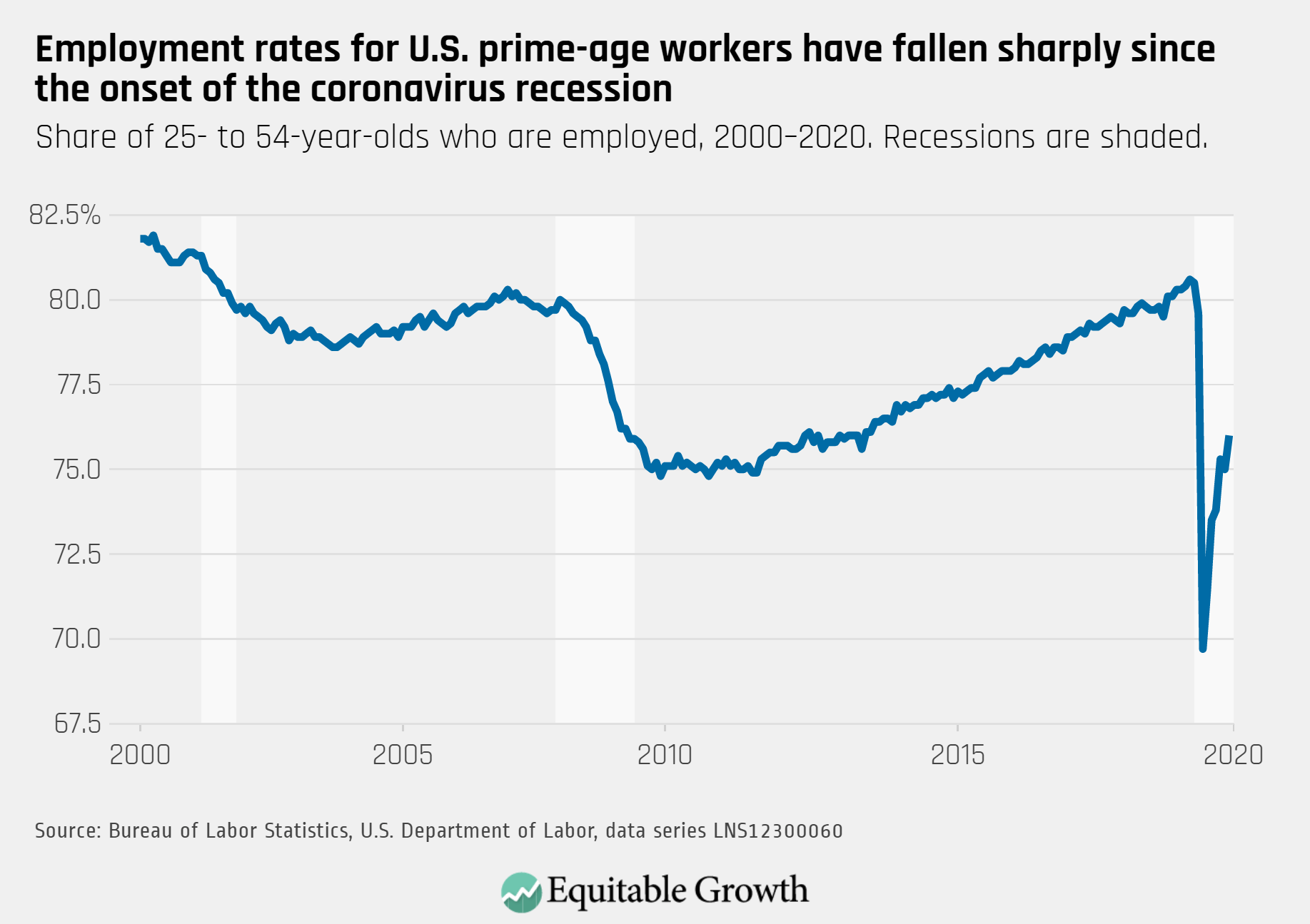
Share of 25-54 year olds who are employed 2000–2020
Figure is from Equitable Growth’s “Equitable Growth’s Jobs Day Graphs: October 2020 Report Edition” by Kate Bahn and Carmen Sanchez Cumming.
Essays SEP 8, 2026
By: Alexander Bick, Adam Blandin, David Deming, Tyler Schumacher

Essays SEP 2, 2026
By: Megan Rivera
Essays AUG 31, 2026
By: Christopher Bangert-Drowns
Get updates on our latest research, event announcements, and policy insights delivered straight to your inbox. Stay connected with the leading voices on equitable growth.


