



Policy
What Work Does Generative AI Do?
Essays SEP 8, 2026
By: Alexander Bick, Adam Blandin, David Deming, Tyler Schumacher
AI, Tech & Energy
Labor, Wages & Worker Power
 Browse All Resources
SEP 1, 2017
By: Nick Bunker

This is a weekly post we publish on Fridays with links to articles that touch on economic inequality and growth. The first section is a round-up of what Equitable Growth published this week and the second is the work we’re highlighting from elsewhere. We won’t be the first to share these articles, but we hope by taking a look back at the whole week, we can put them in context.
There is no single best measure of inequality, argues Austin Clemens. Income, wealth and consumption all need to be considered together to get a full picture of inequality.
As policymakers turn their attention to a potential reform of the U.S. tax code, there are renewed calls for reducing the mortgage interest tax deduction. Nisha Chikhale writes about new research on the impact of making such a deduction less generous.
With significantly more debt than before the Great Recession, should the U.S. government be concerned about fiscal stimulus making the debt unsustainable? Not really, according to new research.
The U.S. Bureau of Labor Statistics released new data on the labor market earlier this morning. Check out five key graphs (opens in a new tab) from the report chosen by Equitable Growth staff.
How much will reducing the corporate income tax boost wages? Paul Krugman points out that if lots of corporate profits are derived from market power, a tax cut would only let capital owners get more profits. [nyt (opens in a new tab)]
Speaking of the rise of market power, Noah Smith lays out the evidence for the “market power” story. [noahpinion (opens in a new tab)]
Believe it or not, Millennials are not the job-hopping, constant-quitters that some media narratives would have you believe. Danielle Paquette reviews a new report that shows Baby Boomers hopped jobs quite a bit when they were young. [wapo (opens in a new tab)]
In the wake of the Great Recession, governments tried out a number of new policies. But perhaps they didn’t go far enough. Martin Sandbu suggests three radical policies to consider. [ft (opens in a new tab)]
A universal basic income would clearly have an impact on the distribution of income, but what would it do to economic growth? Dylan Matthews writes about new research trying to figure out the macroeconomic impact of a UBI. [vox (opens in a new tab)]
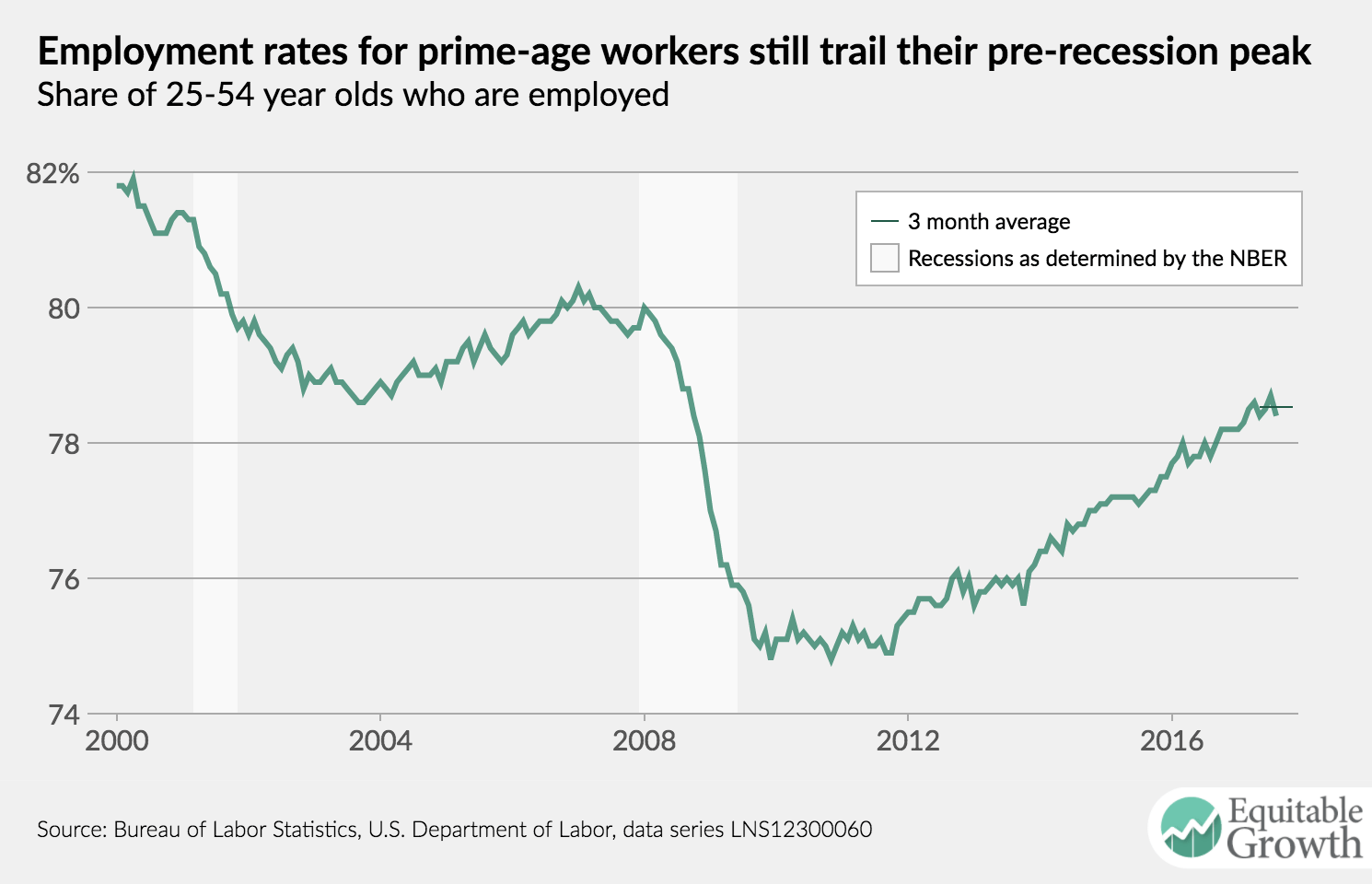
Figure is from “Equitable Growth’s Jobs Day Graphs: August 2017 Report Edition (opens in a new tab).”
Essays SEP 8, 2026
By: Alexander Bick, Adam Blandin, David Deming, Tyler Schumacher

Essays SEP 2, 2026
By: Megan Rivera

Essays AUG 31, 2026
By: Christopher Bangert-Drowns
Get updates on our latest research, event announcements, and policy insights delivered straight to your inbox. Stay connected with the leading voices on equitable growth.


