



Policy
What Work Does Generative AI Do?
Essays SEP 8, 2026
By: Alexander Bick, Adam Blandin, David Deming, Tyler Schumacher
AI, Tech & Energy
Labor, Wages & Worker Power
 Browse All Resources
APR 28, 2017
By: Nick Bunker

This is a weekly post we publish on Fridays with links to articles that touch on economic inequality and growth. The first section is a round-up of what Equitable Growth published this week and the second is the work we’re highlighting from elsewhere. We won’t be the first to share these articles, but we hope by taking a look back at the whole week, we can put them in context.
The preliminary research published in this week’s batch of Equitable Growth working papers focuses on unemployment insurance, specifically looking at what happens to a recipient’s income and spending when benefits run out.
Nisha Chikhale digs into the paper on income drops and unemployment insurance, showing how unemployment insurance does protect against some income drops but also the significant loss of income that happens after benefits expire.
Since the global financial crisis, many analysts and policymakers have reconsidered the costs of the free flow of capital, especially when it comes to financial stability. Nick Bunker asks whether the best course of action is to put some controls on capital or other forms of financial regulation.
Before the Trump Administration released its tax policy principles this week, Greg Leiserson warned that if the administration stuck to previously proposed tax rates then the path toward tax reform would become much harder.
What’s behind the rise in student loan default rates? Using new research on default rates, Kavya Vaghul argues that a weak labor market is the fuel for this on-going problem.
In a new brief (opens in a new tab), University of Massachusetts-Amherst economist Arindarjit Dube summarizes his recent research on the effect of minimum wage hikes on family incomes. One of Dube’s findings is that a 10 percent increase in the minimum wage reduces the poverty rate by about 5 percent.
When Uber, Airbnb, or other “sharing economy” companies are discussed in a policy context, policymakers are thinking about their effects on the labor market. But Kavya Vaghul points out that these companies should also be considered in the context of tax policy as well.
In the latest Equitable Growth in Conversation, Heather Boushey talks to Unversity of California-Berkeley economist Brad DeLong and the Roosevelt Institute’s Marshall Steinbaum about “After Piketty,” the new edited volume the three of them co-edited about where research should go after “Capital in the Twenty-First Century.”
Could a reduction in corporate income tax actually end up paying for itself? Alan Cole looks at how much economic growth would have to rise to pay for a reduction in the corporate income tax to 15 percent. It seems very unlikely. [tax foundation (opens in a new tab)]
“This increased business investment from lower corporate taxes is a common feature of macroeconomic models. But economists now dedicate entire conferences to figuring out whether the world continues to work as it used to.” The Economist writes on the idea of reducing the pass-though business tax rate to 15 percent. [free exchange (opens in a new tab)]
Speaking of the tax plan, how much would a higher deficit and more debt due to a tax cut reduce economic growth? Many macroeconomic models find a significant effect, but Jared Bernstein isn’t so sure interest rates would go up all that much. [on the economy (opens in a new tab)]
With increased concerns about the consolidation of the U.S. economy, antitrust policy is posed to become more visible. Cecilia Kang profiles Makan Delrahim, the president’s nominee for assistant attorney general for antitrust. [nyt (opens in a new tab)]
How much further does the Federal Reserve have to go on its interest-rate hiking campaign? Gauti Eggertsson, Neil Mehrotra, and Jacob A. Robbins argue that it may not have that far to go and that interest rates are likely to be low for some time. [vox eu (opens in a new tab)]
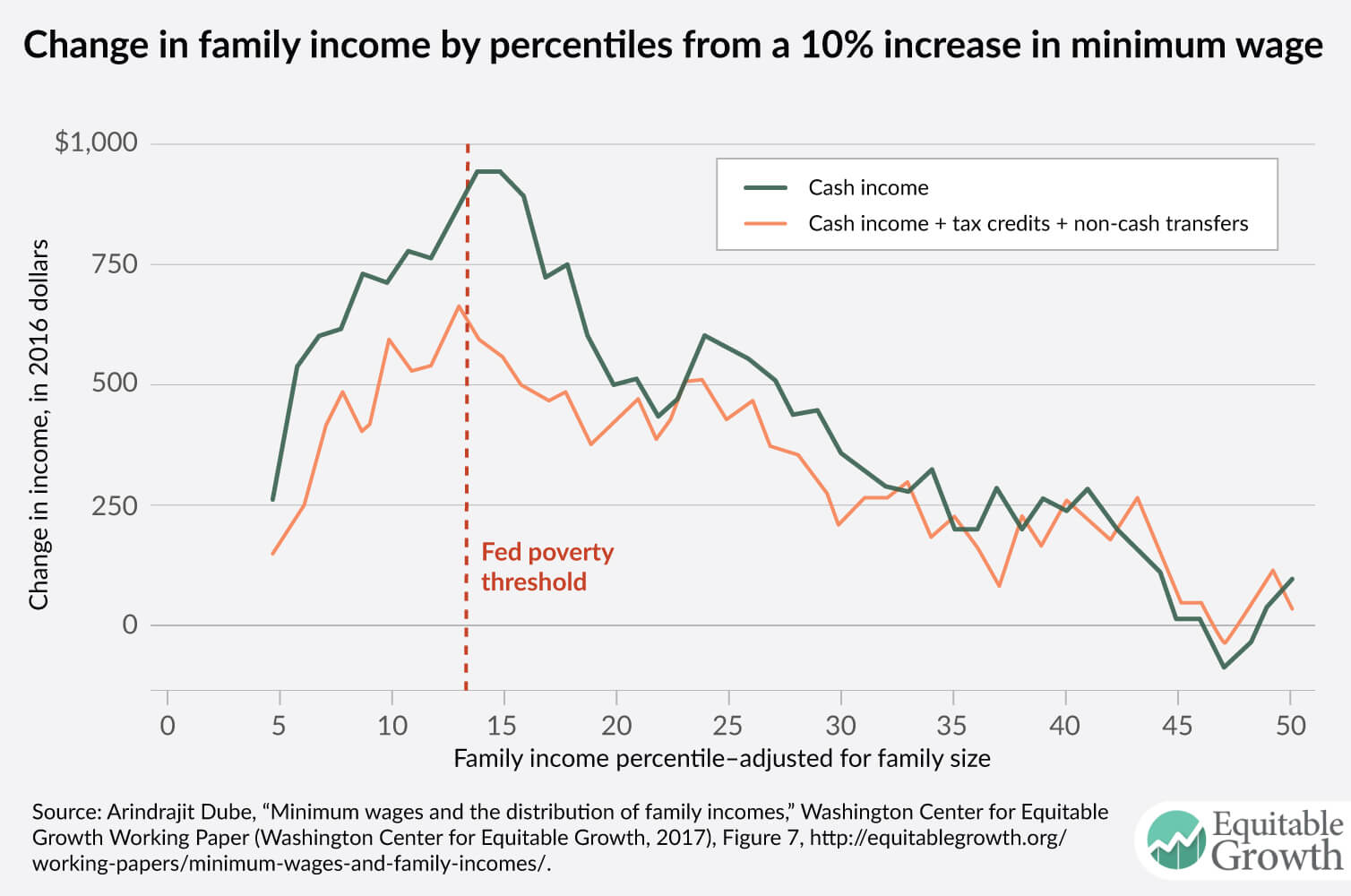
Figure from “Minimum wages and the distribution of family incomes in the United States (opens in a new tab),” by Arindrajit Dube.
Essays SEP 8, 2026
By: Alexander Bick, Adam Blandin, David Deming, Tyler Schumacher

Essays SEP 2, 2026
By: Megan Rivera

Essays AUG 31, 2026
By: Christopher Bangert-Drowns
Get updates on our latest research, event announcements, and policy insights delivered straight to your inbox. Stay connected with the leading voices on equitable growth.


