




Policy
What Work Does Generative AI Do?
Essays SEP 8, 2026
By: Alexander Bick, Adam Blandin, David Deming, Tyler Schumacher
AI, Tech & Energy
Labor, Wages & Worker Power
 Browse All Resources
JUL 14, 2017
By: Nick Bunker

This is a weekly post we publish on Fridays with links to articles that touch on economic inequality and growth. The first section is a round-up of what Equitable Growth published this week and the second is the work we’re highlighting from elsewhere. We won’t be the first to share these articles, but we hope by taking a look back at the whole week, we can put them in context.
The newest set of releases in the Equitable Growth Working Paper series contains new research on housing insecurity, labor force attachment on tribal reservations, the impact of credit supply shocks, and state and local government balance sheets.
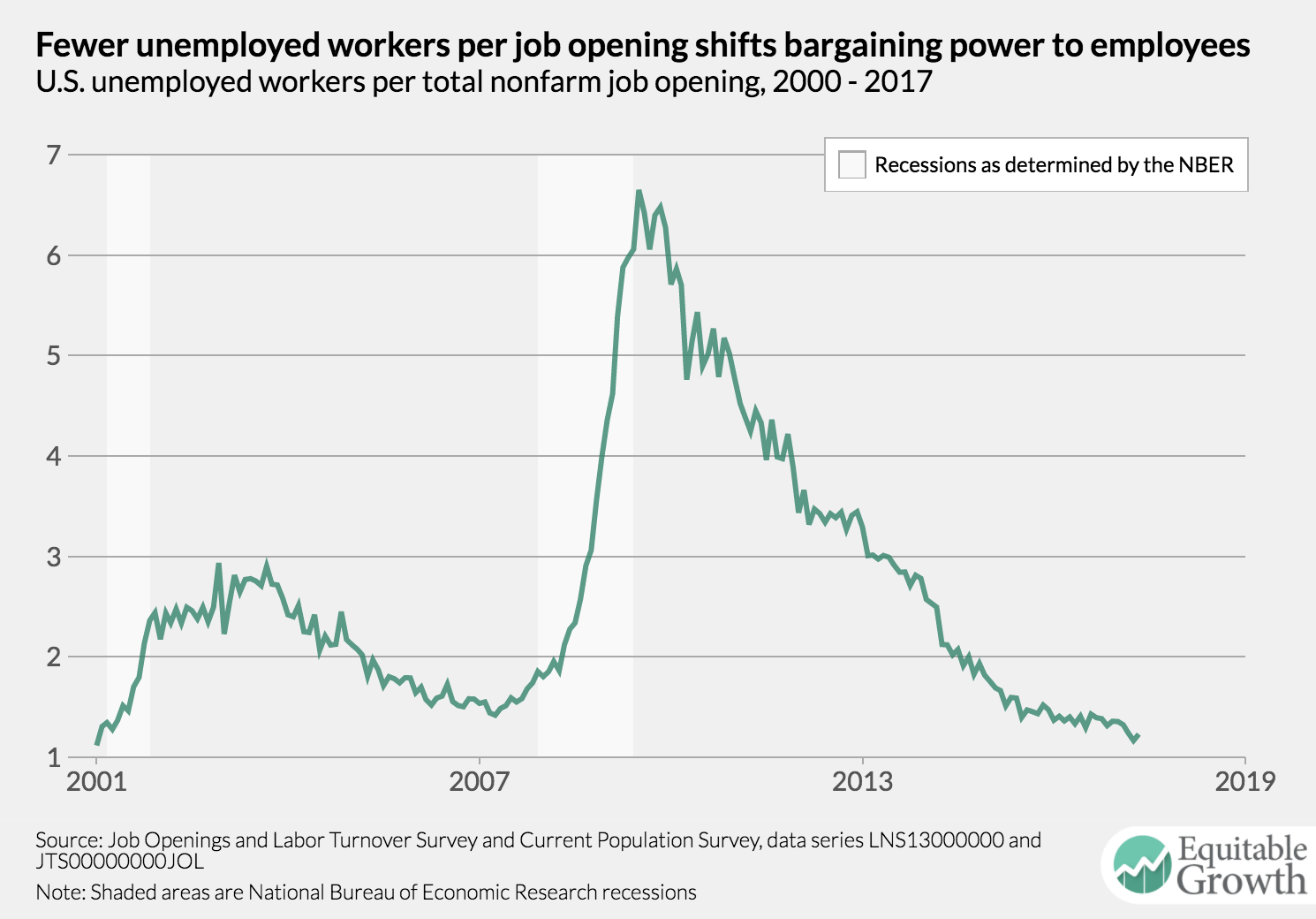
Earlier this week the U.S. Bureau of Labor Statistics released the new data on hiring, firing, and other labor market flows in the U.S. labor market. Check out three key graphs from the new release of the Job Openings and Labor Turnover Survey.
Robyn Cox of the University of Southern California notes that while low-income housing policies may soon be cut under the proposed budget from the Trump administration, researchers have no agreed upon measure of housing insecurity. That needs to change.
Increasing the supply of credit to households and businesses has the potential to boost the productive capacity of the economy by increasing investment. But new research shows that, instead, credit might make business cycles—both expansions and recessions—more severe.
Equitable Growth launched a new essay series this week looking at potential changes to the way we measure economic output and household incomes. The first two contributions come from Nancy Folbre of the University of Massachusetts, Amherst and Robert Solow of the Massachusetts Institute of Technology.
Ryan Avent argues that the weak recovery from the Great Recession means that the Federal Reserve and monetary policy need to undergo a regime change. The only way to do this, he writes, is the make the central bank more democratically accountable. [democracy (opens in a new tab)]
Wage growth isn’t as strong as many commentators would have expected with unemployment this low. Is something mysterious going on? No, says Adam Ozimek. [moody’s (opens in a new tab)]
University of Michigan economist Susan Dynarski argues that standard college admission tests, such as the SAT and the ACT, should be free and administered to all students in the United States. Such a change would “reduce the administrative barriers to applying to college, help identify talented disadvantaged children, and increase the likelihood they will attend a college that matches their skills.” [the upshot (opens in a new tab)]
The value of Medicaid has been under debate recently. Austin Frakt, pointing to a few studies, argues we shouldn’t be so certain all forms of private insurance are worth more than Medicaid. [incidental economist (opens in a new tab)]
Passive investment in the stock market might be a great way to most investors to reduce investment costs. But, as Noah Smith points out, there’s a chance it might be reducing overall economic growth. [bloomberg view (opens in a new tab)]
Essays SEP 8, 2026
By: Alexander Bick, Adam Blandin, David Deming, Tyler Schumacher

Essays SEP 2, 2026
By: Megan Rivera

Essays AUG 31, 2026
By: Christopher Bangert-Drowns
Get updates on our latest research, event announcements, and policy insights delivered straight to your inbox. Stay connected with the leading voices on equitable growth.


