




Policy
What Work Does Generative AI Do?
Essays SEP 8, 2026
By: Alexander Bick, Adam Blandin, David Deming, Tyler Schumacher
AI, Tech & Energy
Labor, Wages & Worker Power
 Browse All Resources
JUN 17, 2016
By: Nick Bunker

This is a weekly post we publish on Fridays with links to articles that touch on economic inequality and growth. The first section is a round-up of what Equitable Growth has published this week and the second is work we’re highlighting from elsewhere. We won’t be the first to share these articles, but we hope by taking a look back at the whole week, we can put them in context.
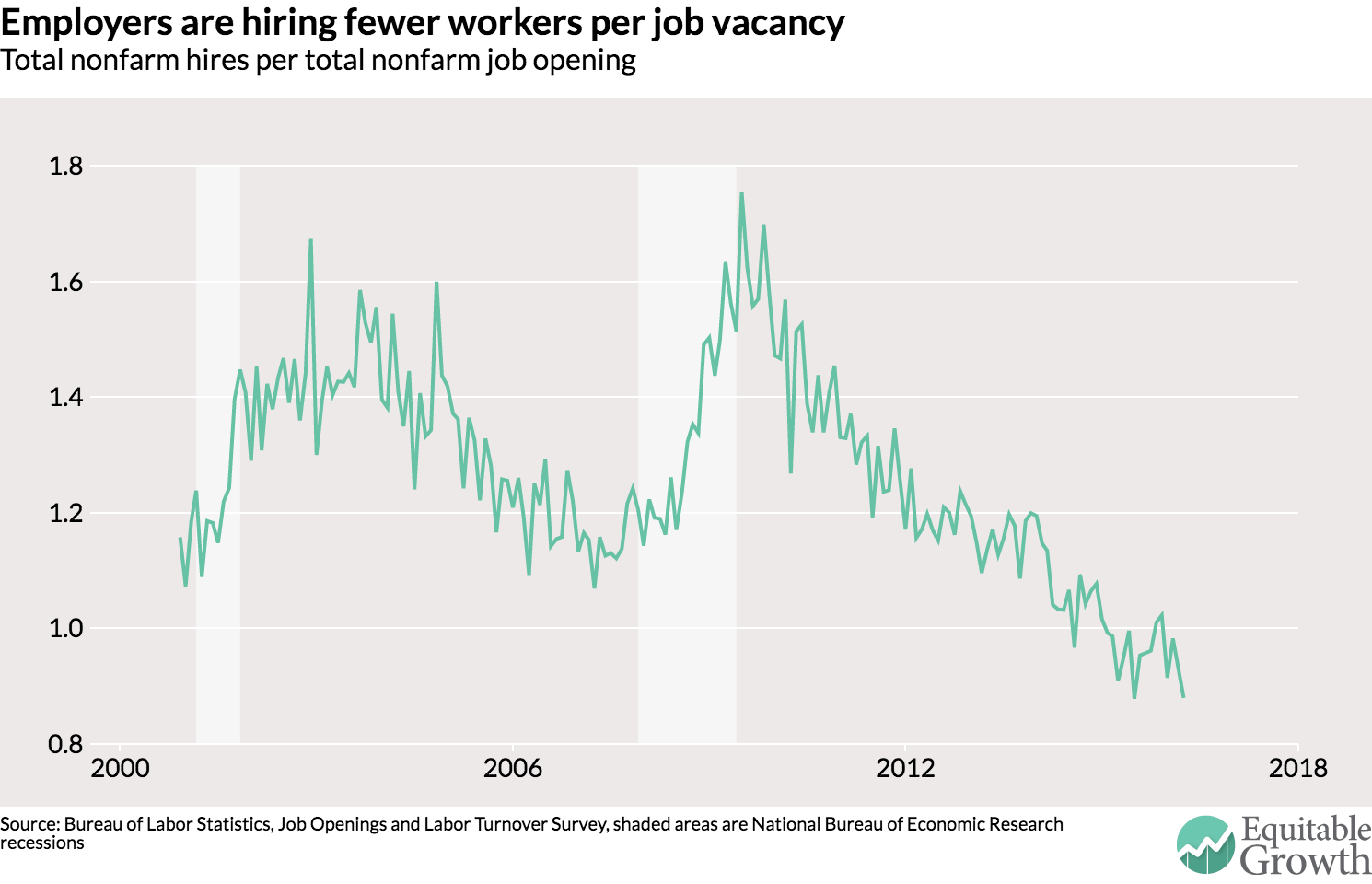
Job openings have grown much more quickly than new hires since the end of the Great Recession. Is that a sign of a “skills mismatch” in the labor market? Not likely. Evidence points to changes in how firms are posting jobs.
Tuesday afternoon Heather Boushey, Equitable Growth’s Executive Director and Chief Economist, addressed the White House United State of Women Summit on how women are reshaping the U.S. economy. Check out her remarks here.
Occupational licensing is under increasing scrutiny. One of the potential problems with licensing is that it may reduce geographic mobility as it hinders moving for a job. But new research doesn’t find much evidence for this hypothesis.
Getting people to respond to surveys can be tough. As the response rates to U.S. government surveys go down, the fact that hard-to-reach respondents are different from those who are easy to reach may pose some problems for official statistics.
A new Equitable Growth working paper from David Howell, Kea Fielder, and Stephanie Luce argues that the framing of the debate about the minimum wage should be changed from its current focus on preventing no job losses (opens in a new tab) whatsoever.
The ups-and-downs for economic growth have an effect on income and wealth inequality, but how about the other way around? New research shows how economic inequality can influence the severity of recessions and overall fragility of the economy.
Right now the amount of rent a federal housing voucher will cover is set by metropolitan level, despite the huge variation in housing costs within metros. Emily Badger describes a new rule that may end up setting voucher amounts by zip code and how that could improve life opportunities for low-income children. [wonkblog (opens in a new tab)]
Why is productivity growth slow despite all the apparent innovation in technology in recent years? As Dietrich Vollrath argues, it may be because overall productivity growth is determined by productivity in the service sector where it’s hard to get productivity growth. [growth economics (opens in a new tab)]
“The American workplace has basically become a Thunderdome where the victors are rewarded with long hours.” Jeff Spross writes about the rise of long hours in the U.S. economy as well as the distribution of those additional hours. [the week (opens in a new tab)]
Low and even negative interest rates may be necessary to boost economic growth, but their effects on the banking sector are unclear. Maybe their even contributing to the “death of banking.” Kadhim Shubber looks at some evidence. [ft alphaville (opens in a new tab)]
Speaking of low-interest rates, those negative interest rates may not be as low as you’d think. Remember, interest rates need to account for the pace of inflation as well. Peter Eavis notes that once you account for the deflation (negative inflation) in Europe, the cost of borrowing isn’t on the decline. [the upshot (opens in a new tab)]
Essays SEP 8, 2026
By: Alexander Bick, Adam Blandin, David Deming, Tyler Schumacher

Essays SEP 2, 2026
By: Megan Rivera

Essays AUG 31, 2026
By: Christopher Bangert-Drowns
Get updates on our latest research, event announcements, and policy insights delivered straight to your inbox. Stay connected with the leading voices on equitable growth.


