



Policy
What Work Does Generative AI Do?
Essays SEP 8, 2026
By: Alexander Bick, Adam Blandin, David Deming, Tyler Schumacher
AI, Tech & Energy
Labor, Wages & Worker Power

This is a post we publish each Friday with links to articles that touch on economic inequality and growth. The first section is a round-up of what Equitable Growth published this week and the second is relevant and interesting articles we’re highlighting from elsewhere. We won’t be the first to share these articles, but we hope by taking a look back at the whole week, we can put them in context.
Earlier this year, the U.S. Consumer Price Index registered inflation at 5 percent, leading some observers to panic about prolonged inflation and stagflation. Yet, write Francesco D’Acunto and Michael Weber, while long periods of inflation do have direct and immediate impacts on the economy and can exacerbate inequality, policymakers must assess whether the threat of inflation is real or if this is a short-term adjustment that will recalibrate as the economy begins to reopen. D’Acunto and Weber discuss four potential drivers of inflation in the medium to long term: demand pressures, supply chain disruptions, labor market pressures, and inflationary expectations. They detail what each of these drivers is, how it can affect inflation, and how it is relevant to the particular situation in which the U.S. economy currently finds itself. They conclude that while these factors may influence short-term inflation, they do not appear to imply that there will be sustained inflationary pressure in the coming 2–5 years. This means, they explain, that the Federal Reserve probably does not need to take any action to address inflation and that the Biden administration should continue to pursue its current policy agenda.
There has long been a gap in political participation along income lines in the United States, with wealthier Americans turning out to vote in higher numbers than their middle- and low-income peers. But in 2020, many states enacted new voting laws to ease access to the polls amid the coronavirus pandemic, such as expanding vote by mail and increasing the number of ballot drop boxes available, and new data released by the U.S. Census Bureau reveals the impact these laws had on election turnout. In a follow-up column to their February 2021 report on the relationship between voter suppression and economic inequality, Austin Clemens, Shanteal Lake, and David Mitchell analyze the new Census data to determine whether the income divide in voter turnout narrowed law year. They find that in states that made it easier to vote by mail, turnout was higher in the 2020 election across income groups, but that the effect was larger for lower-income individuals. The co-authors explain why the rash of new state laws restricting voting access, as well as the recent U.S. Supreme Court ruling that further defangs the Voting Rights Act, will have a disproportionate impact on low-income voters and voters of color—and what that means for U.S. economic policy. They conclude by urging the federal government to intervene with legislation that protects the right to vote and access to the polls for all Americans.
This week, the U.S. Bureau of Labor Statistics released data on hiring, firing, and other labor market flows from the Job Openings and Labor Turnover Survey, better known as JOLTS, for the month of May 2021. This report contains useful information about the state of the U.S. labor market, such as the rate at which workers are quitting their jobs and the ratio of unemployed workers-to-job openings. Kathryn Zickuhr and Clemens put together a series of graphics highlighting the trends in the data.
Check out Brad DeLong’s latest Worthy Reads (opens in a new tab) column, where he provides summaries and his analysis of recent must-read content (opens in a new tab) from Equitable Growth and around the web.
Wondering what inflation means for you and how it is impacting the broader U.S. economy? Vox’s Rani Molla (opens in a new tab) and Emily Stewart (opens in a new tab) explain the inflation debate (opens in a new tab) in the United States, what the recent increase in prices means, and the industries most affected right now and why. They detail the impact the coronavirus pandemic and the resulting recession have had on global supply chains and look at some specific examples of goods and services that have become more expensive as a result. Molla and Stewart then provide an update on what is happening in the lumber industry after perhaps the most talked-about price surge in the U.S. economy in the past year. They conclude (opens in a new tab) by discussing how experts are evaluating these higher prices and what to look for in terms of how long this will last.
Last week’s Employment Situation Report from the U.S. Bureau of Labor statistics shows a healthy 850,000 jobs were added in June. Julia Coronado compiles (opens in a new tab) seven charts that explain what is going on with the U.S. economy and recovery in The New York Times. She looks at how the “go early and go big” policy response to the coronavirus recession made a huge impact on the speed with which the economy is recovering. She also examines (opens in a new tab) the impact of this recession and the responding policy on wealth in the United States, consumer confidence and loan delinquency, labor market trends such as job openings, the racial unemployment divide, and inflationary pressures both now and in the future. She concludes that while the policies enacted to counteract the coronavirus recession were not perfect, the bold action is paying off and will allow us to emerge from this downturn into a stronger, healthier economy.
As the West Coast prepares for another heat wave this weekend, Robinson Meyer (opens in a new tab) explains in The Atlantic how unprepared U.S. infrastructure is to handle extreme weather. He details (opens in a new tab) the rise in climate change-related weather events, including heat waves, and how the Biden administration’s plans to include climate policy in its infrastructure plan will bolster U.S. preparedness for the increasing prevalence of these events. Meyer also writes (opens in a new tab) that engineering standards and new physical infrastructure construction have not incorporated the changing climate quickly enough to be innovative and well-equipped to handle the future—and that making these big shifts in resilience standards is more challenging and time-consuming than it may seem.
Friday figure
View FullscreenFriday figure — opens in a new tab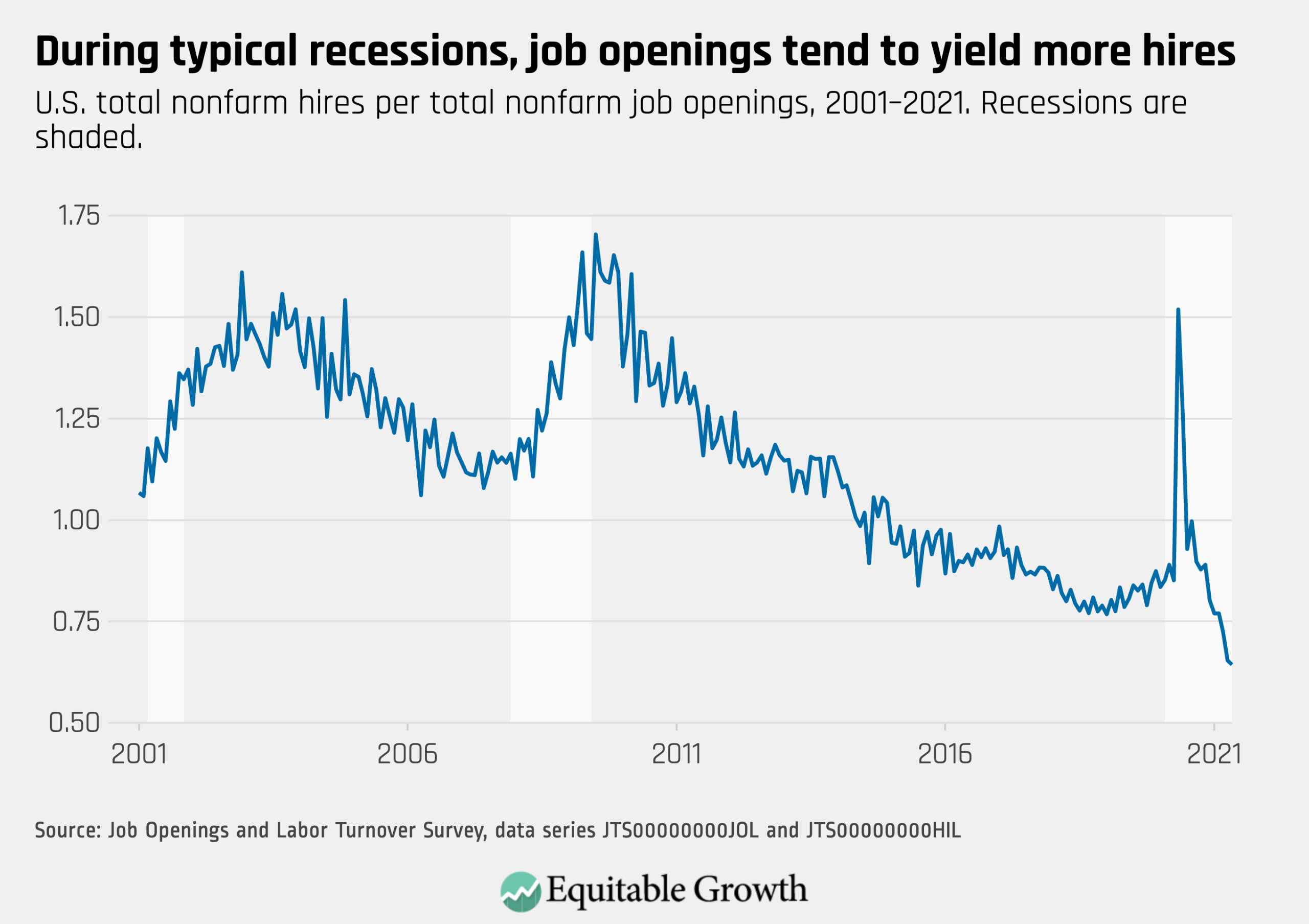
U.S. total nonfarm hires per total nonfarm job openings, 2001-2021. Recessions are shaded.
Figure is from Equitable Growth’s “JOLTS Day Graphs: May 2021 Edition,” by Kathryn Zickuhr and Austin Clemens.
Essays SEP 8, 2026
By: Alexander Bick, Adam Blandin, David Deming, Tyler Schumacher

Essays SEP 2, 2026
By: Megan Rivera
Essays AUG 31, 2026
By: Christopher Bangert-Drowns
Get updates on our latest research, event announcements, and policy insights delivered straight to your inbox. Stay connected with the leading voices on equitable growth.


