



Policy
What Work Does Generative AI Do?
Essays SEP 8, 2026
By: Alexander Bick, Adam Blandin, David Deming, Tyler Schumacher
AI, Tech & Energy
Labor, Wages & Worker Power
 Browse All Resources
AUG 6, 2021

This is a post we publish each Friday with links to articles that touch on economic inequality and growth. The first section is a round-up of what Equitable Growth published this week and the second is relevant and interesting articles we’re highlighting from elsewhere. We won’t be the first to share these articles, but we hope by taking a look back at the whole week, we can put them in context.
The coronavirus pandemic and resulting recession led to an unprecedented level of government investment in income support programs in the United States, from emergency Unemployment Insurance to an expanded Child Tax Credit, among others. These programs provide necessary support for U.S. households and workers but have long been underfunded, leading many of those who need this aid unable or prevented from accessing it. Liz Hipple (now at the Joint Economic Committee) and Alix Gould-Werth explain the three main barriers to these programs: eligibility rules that are too strict, benefits that are too hard to access even for those eligible, and benefit levels that are too low. These weaknesses, they write, reduce labor force participation, weaken the macroeconomy during recessions, and result in underinvestment in the next generation of workers—not to mention that most American adults will face a personal need for income support at some point in their lives. Comparing overly complex income support programs such as Temporary Assistance for Needy Families with Social Security and Medicare, Hipple and Gould-Werth show that income supports can be easily accessible to broad swathes of the population, and that the programs that are harder to access are intentionally so because of structural racism and discrimination in U.S. institutions and systems.
Tuesday, August 3 was Black Women’s Equal Pay Day, which recognizes that Black women in the United States have to work from the start of January 2020 through August 2, 2021 to earn as much as White men earned in 2020 alone. Equitable Growth pulled together a list of recent research on pay disparities that Black women face in the U.S. economy and the implications of this persistent income inequality. The scholars behind the research listed include our incoming President and CEO Michelle Holder, among others. For more about Black Women’s Equal Pay Day and how to address the economic inequalities that it marks, Kate Bahn and Carmen Sanchez Cumming’s piece from 2020 provides some answers.
The U.S. Bureau of Labor Statistics today released new data on the U.S. labor market during the month of July. Bahn and Sanchez Cumming put together five graphics highlighting important trends in the data. They then analyze the data in more detail, particularly the trends in employment in the construction sector.
The National Bureau of Economic Research is now more than halfway through its summer institute, an annual 3-week conference featuring discussions and paper presentations on specific subfields of economics, including measuring poverty, the costs of climate change, and systemic discrimination among large employers. Equitable Growth compiled a list of paper abstracts that caught our attention throughout the third and final week, including research from our grantee network (opens in a new tab) and members of our Steering Committee and Research Advisory Board (opens in a new tab). For highlights from the first week of the NBER Summer Institute 2021, click here. For coverage of the second week, click here.
Today’s employment numbers are encouraging, writes Neil Irwin (opens in a new tab) in The New York Times’ The Upshot blog. This job market growth hasn’t been seen in the past three recessions and appears to reflect a rapidly healing economy. Irwin runs through (opens in a new tab) the numbers and explains why, in almost all categories, this month’s report indicates a positive trend. Irwin then details (opens in a new tab) the implications of the gains—namely, that despite the complaints from business owners about labor shortages, Americans are getting back to work.
New data from the Bureau of Labor Statistics show that working mothers spent the equivalent of a full-time job on child care in 2020 during the coronavirus pandemic—while also working at the same time. In fact, the data show that moms of young children spent an average of 8 hours per day on child care and 6 hours working, writes (opens in a new tab) The 19th’s Chabeli Carrazana (opens in a new tab), and fathers spent around 5 hours on child care while working 8-hour days. This isn’t altogether surprising, Carrazana continues (opens in a new tab), considering that women often take on the majority of household responsibilities and that hundreds of thousands of women left the labor force last year to care for their children in the wake of school and day care closures. The lack of options for child care combined with the pandemic’s outsize impact on female-dominated industries such as hospitality and care are what led to the first so-called “shecession” in the United States, Carrazana explains (opens in a new tab), and even with recent gains in the labor market, there’s still a long road to full recovery for women workers.
Millions of Americans—almost 20 percent of adults, more than 60 percent of whom are women—provide unpaid and informal care to their loved ones with physical or mental health needs in the United States. Many of these family caregivers have been left behind amid the pandemic, without access to much-needed supports. Vox’s Katherine Harmon Courage (opens in a new tab) describes (opens in a new tab) the findings of a recent survey showing widespread and alarming rates of anxiety, depression, and other mental health issues. She tells the story (opens in a new tab) of caregivers who have had to manage the challenges of not only caring for their family members but also nursing home outbreaks and other care disruptions—and the toll it has taken on their mental health. Courage provides several options for policymakers to raise awareness about the difficulties family caregivers are facing and provide support for these vital players in the U.S. economy. The United States truly can’t afford to neglect caregivers, she writes, because there is “neither the budget nor the professional labor force to replace them.”
Friday figure
View FullscreenFriday figure — opens in a new tab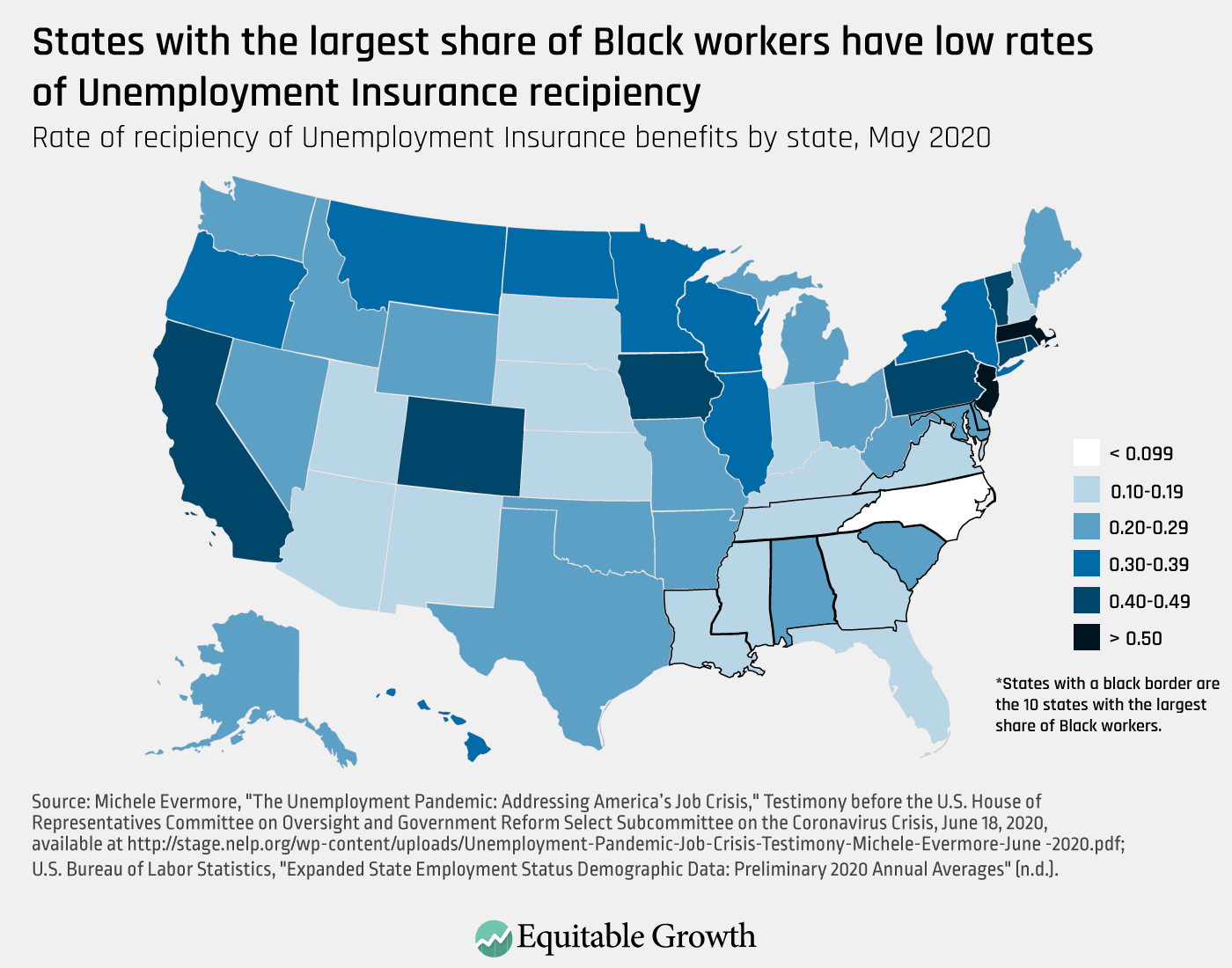
Rate of recipiency of Unemployment Insurance benefits by state, May 2020
Figure is from Equitable Growth’s “Weak income support infrastructure harms U.S. workers and their families and constrains economic growth,” by Liz Hipple and Alix Gould-Werth.
Essays SEP 8, 2026
By: Alexander Bick, Adam Blandin, David Deming, Tyler Schumacher

Essays SEP 2, 2026
By: Megan Rivera

Essays AUG 31, 2026
By: Christopher Bangert-Drowns
Get updates on our latest research, event announcements, and policy insights delivered straight to your inbox. Stay connected with the leading voices on equitable growth.


