



Policy
What Work Does Generative AI Do?
Essays SEP 8, 2026
By: Alexander Bick, Adam Blandin, David Deming, Tyler Schumacher
AI, Tech & Energy
Labor, Wages & Worker Power
 Browse All Resources
JUL 29, 2016
By: Nick Bunker

This is a weekly post we publish on Fridays with links to articles that touch on economic inequality and growth. The first section is a round-up of what Equitable Growth published this week and the second is the work we’re highlighting from elsewhere. We won’t be the first to share these articles, but we hope by taking a look back at the whole week, we can put them in context.
Weak U.S. productivity growth has been one of the most troubling trends since the Great Recession. Is it just a coincidence that productivity has been weak since the crash? Or did the recession have an impact?
The conventional wisdom about encouraging entrepreneurship is that policymakers should increase the return to starting a business. But increasing evidence shows that we should be concerned about reducing the cost of a failing business as well.
The permanent income hypothesis is an important tool for thinking about how people react to drops or boosts to their income. The idea, however, has some flaws and doesn’t hold up for the entire U.S. population.
With the policy conversation centered on proposals to raise the minimum wage to rates unseen in the United States, it’s hard to tell how such an increase would play out in the United States. New School economist and Equitable Growth grantee David Howell takes a look at the international data for answers. And Bridget Ansel pulls out some of the key graphs and takeaways from Howell’s brief.
The Federal Reserve kept U.S. interest rates steady at its most recent meeting this week. Ylan Mui writes that the central bank is coming around to the view that U.S. economic growth in the future will be much weaker than it previously thought. [wonkblog (opens in a new tab)]
Because the Federal Reserve has kept U.S. interest rates so low for so long, some economists have thrown out the idea that low interest rates are causing low inflation despite the established view that low interest rates increase inflation. Noah Smith reports on a new paper that tries to settle the question that has quite interesting results. [bloomberg view (opens in a new tab)]
Speaking of unconventional monetary policy, the prospect of “helicopter money” becoming a real world policy is starting to sink in among economists and policy analysts. Neil Irwin gives some background on the idea. [the upshot (opens in a new tab)]
How important is the U.S. government to economic growth and economic policy writ large? Mike Konczal reviews two books on the topic with very different opinions on the matter. [boston review (opens in a new tab)]
“Red tape no doubt prevents some firms from making growth-boosting investments. But bigger gains might come from creating an economy in which firms found themselves needing to compete to attract workers.” Ryan Avent writes on the increase evidence that economic sclerosis in high-income countries is related to inequality and insufficient demand. [the economist (opens in a new tab)]
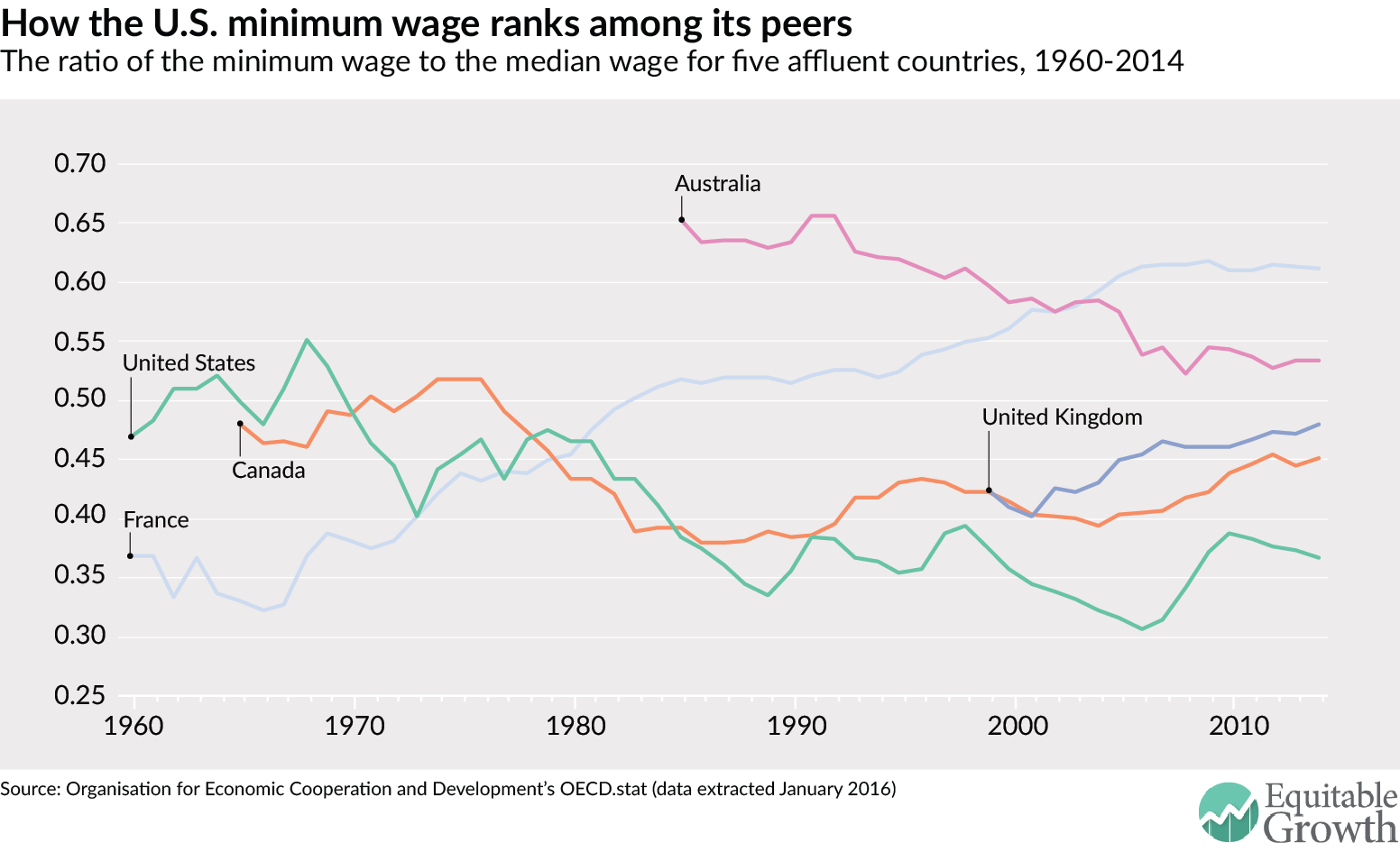
Figure from “The employment effects of a much higher U.S. federal minimum wage: Lessons from other rich countries” by David Howell
Essays SEP 8, 2026
By: Alexander Bick, Adam Blandin, David Deming, Tyler Schumacher

Essays SEP 2, 2026
By: Megan Rivera

Essays AUG 31, 2026
By: Christopher Bangert-Drowns
Get updates on our latest research, event announcements, and policy insights delivered straight to your inbox. Stay connected with the leading voices on equitable growth.


