



Policy
What Work Does Generative AI Do?
Essays SEP 8, 2026
By: Alexander Bick, Adam Blandin, David Deming, Tyler Schumacher
AI, Tech & Energy
Labor, Wages & Worker Power
 Browse All Resources
DEC 9, 2016
By: Nick Bunker

This is a weekly post we publish on Fridays with links to articles that touch on economic inequality and growth. The first section is a round-up of what Equitable Growth published this week and the second is the work we’re highlighting from elsewhere. We won’t be the first to share these articles, but we hope by taking a look back at the whole week, we can put them in context.
Did minimum wage increases during the Great Recession reduce employment for low-wage workers? A new paper by Ben Zipperer at the Economic Policy Institute argues that they did not and previous studies looking at this question have a flawed research design.
Economists Thomas Piketty, Emmanuel Saez, and Gabriel Zucman released new groundbreaking data on income trends in the United States. This new dataset, the Distributional National Accounts, allows researchers to look at trends in both pre-tax and post-tax incomes.
Heather Boushey argues that the Distributional National Accounts could do for our understanding of economic growth in the 21st century what the National Income and Product Accounts—the source of GDP—did for the 20th century.
The U.S. labor market is on its way toward full employment. But how close is it? A look at new data on quitting, job openings, and hiring gives some more information on how much stronger the labor market can get.
New research by a team of researchers from Stanford University, Harvard University, and the University of California-Berkeley shows a precipitous decline in U.S. income mobility. The authors summarize their results for Equitable Growth.
This research also shows something interesting about the relationship between U.S. absolute and relative mobility. Income growth was so strong and broad-based from 1940 to 1970 that the amount of relative mobility didn’t matter: Absolute mobility was going to be very high.
The loss of manufacturing jobs became a central part of U.S. politics over the past year and even more so after the presidential election. How much of the job loss can be attributed to more foreign competition? Matt Klein works out an estimate of about half of all lost jobs scine 1990. [ft alphaville (opens in a new tab)]
In 2011, Wisconsin enacted a law that reduced the bargaining power of public sector unions. What was the result? According to a new study, an 8 percent drop in compensation for public school teachers. Alana Semuels writes up the impact of declining union power on wages. [the atlantic (opens in a new tab)]
The sectors that increasingly provide jobs in the U.S. labor market are in the service sector and are traditionally dominated by women. Betsey Stevenson argues that men need to be more willing to take “girly” jobs. [bloomberg view (opens in a new tab)]
How much would it cost to boost the incomes of low-income American families directly so that they had shared in economic growth since 1979? Neil Irwin asked some budget experts and they came up with a price: $1 trillion over 10 years. [the upshot (opens in a new tab)]
Martin Sandbu makes the optimistic case for policy to boost economic growth in the short term, pointing to business investment, fiscal policy, and potential increases in labor supply. [free lunch (opens in a new tab)]
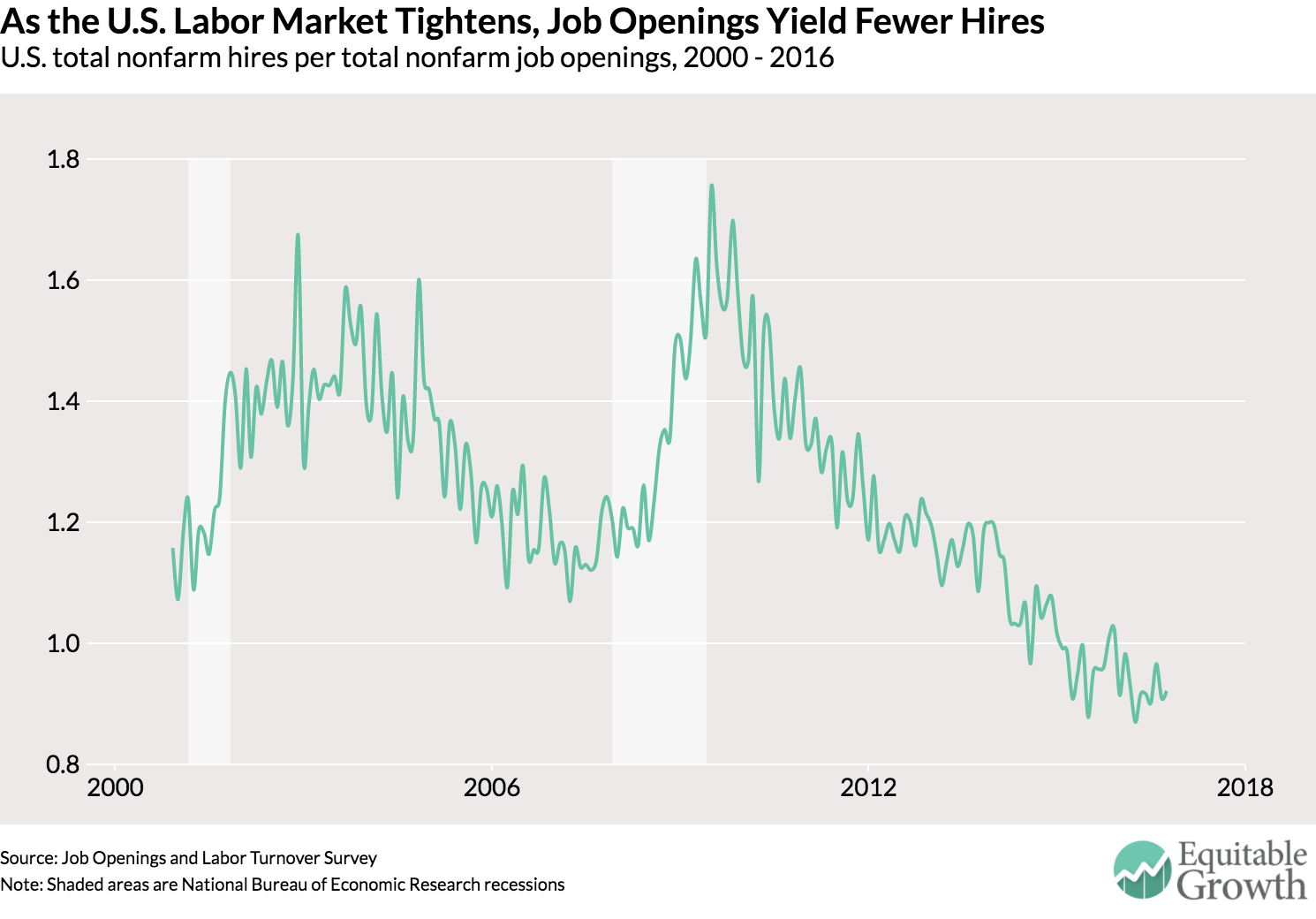
Figure from “How tight is the U.S. labor market? And how tight do we want it?” by Nick Bunker
Essays SEP 8, 2026
By: Alexander Bick, Adam Blandin, David Deming, Tyler Schumacher

Essays SEP 2, 2026
By: Megan Rivera

Essays AUG 31, 2026
By: Christopher Bangert-Drowns
Get updates on our latest research, event announcements, and policy insights delivered straight to your inbox. Stay connected with the leading voices on equitable growth.


