



Policy
What Work Does Generative AI Do?
Essays SEP 8, 2026
By: Alexander Bick, Adam Blandin, David Deming, Tyler Schumacher
AI, Tech & Energy
Labor, Wages & Worker Power
 Browse All Resources
SEP 2, 2016
By: Nick Bunker

This is a weekly post we publish on Fridays with links to articles that touch on economic inequality and growth. The first section is a round-up of what Equitable Growth published this week and the second is the work we’re highlighting from elsewhere. We won’t be the first to share these articles, but we hope by taking a look back at the whole week, we can put them in context.
Tax Increment Financing is a popular local economic development tool, but it may have an important unintended consequence. By reducing property taxes, it may affect educational spending. Kavya Vaghul digs into this issue.
The annual Jackson Hole conference is a time for central bankers and researchers to get together to discuss important macroeconomic trends. And sometimes it leads to signs that monetary policy may be changing. But, unfortunately, that didn’t happen this time.
You may have heard of the “47 percent,” the share of Americans who don’t pay federal income tax. But that nomenclature is based off a snapshot statistic from 2009. How do these trends look over time? A new study takes a look.
Gross domestic product was not intended to be a measure of economic welfare. But it gets used that way. A new study moves beyond GDP to create a new measure of welfare that has some interesting results.
Earlier today, the U.S. Bureau of Labor Statistics released new employment data for August 2016. Check out Equitable Growth’s key graphs (opens in a new tab) from this new report.
In studies of economic downturns, economists have often used models that assume all households are the same. But that’s starting to change. Kurt Mitman, Dirk Krueger, and Fabrizio Perri write up their study showing the impact of inequality on the severity of the Great Recession. [voxeu (opens in a new tab)]
What’s holding back productivity growth? Looking at a new report on the trend, Martin Sandbu looks at the roles of a lack of investment and a slowdown in total factor productivity and the potential policies to help boost growth. [free lunch (opens in a new tab)]
Residential housing investment has been very weak in the wake of the Great Recession. What’s holding back more housing construction? Adam Ozimek argues that it’s not supply-side constraints. [moody’s (opens in a new tab)]
Conversations about housing and rental prices almost always center on the median or mean price. But a new study, highlighted by Emily Badger, looks at the distribution of rental offers showing that U.S. locations with lower rents also have a narrower distribution. [wonkblog (opens in a new tab)]
A recent trend in economics research is to use the variation in trends or policies across the United States in order to try to answer questions often posed about the country as a whole. Many economists have done work in this area, but the Chicago Booth School of Business highlights some research by Chicago economists. [chicago booth review (opens in a new tab)]
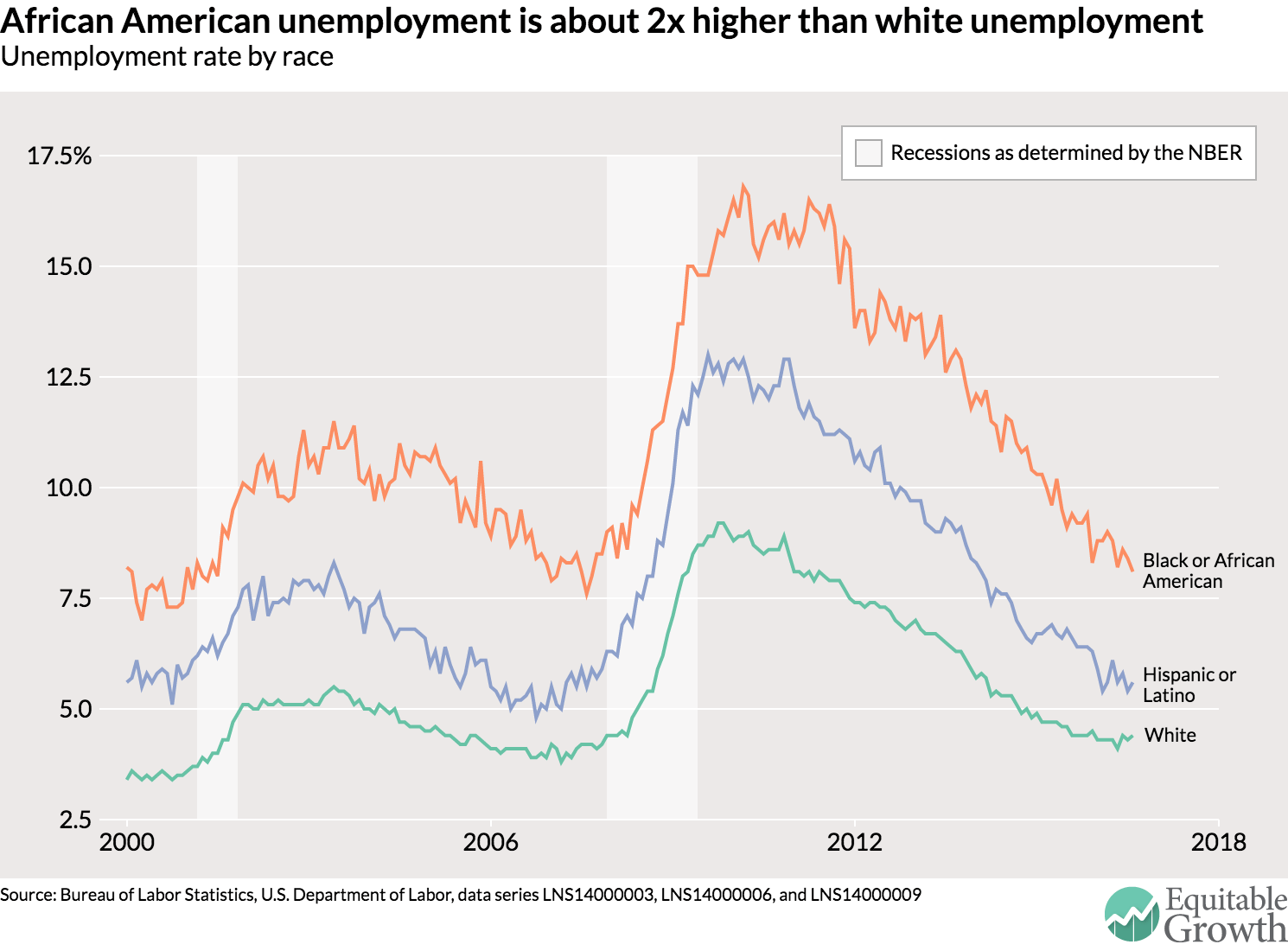
Figure from “Equitable Growth’s Jobs Day Graphs: August 2016 Report Edition (opens in a new tab)” by Equitable Growth staff
Essays SEP 8, 2026
By: Alexander Bick, Adam Blandin, David Deming, Tyler Schumacher

Essays SEP 2, 2026
By: Megan Rivera

Essays AUG 31, 2026
By: Christopher Bangert-Drowns
Get updates on our latest research, event announcements, and policy insights delivered straight to your inbox. Stay connected with the leading voices on equitable growth.


