



Policy
What Work Does Generative AI Do?
Essays SEP 8, 2026
By: Alexander Bick, Adam Blandin, David Deming, Tyler Schumacher
AI, Tech & Energy
Labor, Wages & Worker Power
 Browse All Resources
JAN 15, 2021

This is a post we publish each Friday with links to articles that touch on economic inequality and growth. The first section is a round-up of what Equitable Growth published this week and the second is relevant and interesting articles we’re highlighting from elsewhere. We won’t be the first to share these articles, but we hope by taking a look back at the whole week, we can put them in context.
For decades, the majority of U.S. workers experienced stagnating wages, sluggish economic growth, and disparities in pay based on race, ethnicity, and gender. These broad structural trends and inequality result today in the misallocation of talent and the undervaluation of certain occupations and industries—which, in turn, restricts economic growth and productivity. This week, Equitable Growth (in partnership with the Institute for Research on Labor and Employment at the University of California, Berkeley) published a series of essays that puts forward new policy ideas (opens in a new tab) to create an economy that works for everyone. The book of essays, titled Boosting Wages for U.S. Workers in the New Economy, features a diverse group of leading economic thinkers who present alternative ideas for policymakers to boost wages and living standards by addressing structural impediments to economic growth and fair pay. The essays are organized in three main sections: worker power, worker well-being, and equitable wages. Kate Bahn and Jesse Rothstein provide an overview of the book, summarizing each of the three sections and the essays within them, and explaining why creating structures to support worker empowerment and reduce wage inequality is essential to broadly shared economic growth.
After last week’s dismal Jobs Day report, Kate Bahn and Carmen Sanchez Cumming delve deeper into the data and focus specifically on the experience of the U.S. retail sector. This industry is particularly harmed by the ongoing coronavirus recession due to the nature of its in-person services, which have declined significantly amid public health restrictions. But the retail sector had several preexisting dynamics that may have influenced the impact of the pandemic, write Bahn and Sanchez Cumming, including the rise of e-commerce over the past decade. They then look at what these factors mean for U.S. retail workers, who tend to be some of the most vulnerable in the U.S. labor force, and provide ideas for how policymakers can protect these workers both in the short and long term.
The U.S. social safety net is a vital support system for many U.S. workers and their families, and has been particularly important in the coronavirus pandemic and recession. While many studies have shown the benefits of many of the safety net’s programs, from Unemployment Insurance to the Supplemental Nutrition Assistance Program, there is always more to discover about these policies and their impact. Enter the Equitable Growth 2021 Request for Proposals—which, Hilary Hoynes explains, features important questions surrounding human capital and development, and the role of the safety net in ensuring well-being for workers and families. Researchers studying these questions can help guide policymakers as they look for the most effective and timely investments to ensure worker well-being amid the coronavirus recession.
Another area of the 2021 Request for Proposals is the impact of rising inequality on the macroeconomy. Atif Mian explains why the oft-held belief that inequality doesn’t have much of an effect on macroeconomic outcomes is misguided. His recent research on savings behaviors finds that the rich save more than their less well-off counterparts, exacerbating inequality and putting downward pressure on aggregate demand, which can be offset by increased borrowing from nonrich households. This borrowing, however, can become a future drag on spending. Mian looks at the consequences of this so-called indebted demand and its implications, showing why Equitable Growth’s research network provides important lessons for policymakers looking to address extreme inequality.
Front-line healthcare workers across the United States face an almost constant lack of personal protective equipment, inconsistent safety measures, grueling hours, and heightened personal health risks amid the coronavirus pandemic. Many are expressing feelings that the systems and employers meant to protect them have failed—and, reports (opens in a new tab) NPR’s Aneri Pattani, many are expressing a renewed interest in unionization. Studies show that healthcare facilities with unions experience better patient outcomes, fewer workplace hazards, and even lower mortality rates from COVID-19, the disease caused by the coronavirus. Pattani writes (opens in a new tab) that many healthcare workers who previously opposed unionization are changing their minds as a result of the pandemic, which is amplifying many problems these workers face on a daily basis, from short-staffing to insufficient PPE provision.
The December 2020 unemployment report released late last week was bad, acknowledges (opens in a new tab) Neil Irwin (opens in a new tab) in The New York Times’ The Upshot blog. But there is a silver lining, too. Despite the data revealing a backslide in the economic recovery, there is a clear path forward out of the downturn, Irwin argues (opens in a new tab), thanks to the prospect of mass vaccinations against the virus. Much of the current jobs crisis is contained in industries that are directly affected by pandemic-related restrictions, such as leisure and hospitality, suggesting that these jobs will come back once enough of the public is vaccinated and feels comfortable engaging in in-person leisure activities, such as dining out and traveling. And though most other sectors of the economy are not yet back to their pre-pandemic employment levels, Irwin points out (opens in a new tab) that many are steadily rehiring. These trends, alongside a new U.S. Congress more receptive to passing coronavirus stimulus legislation, indicate that there is reason to be optimistic.
One potential piece of the next coronavirus stimulus legislation was unveiled on January 14 by President-elect Joe Biden—his proposed $1.9 trillion coronavirus relief package. Vox’s Emily Stewart (opens in a new tab) explains (opens in a new tab) the proposal, called the American Rescue Plan, and details how its three buckets of funding—$400 billion for combatting the coronavirus, including vaccination and testing efforts, $1 trillion in direct relief for families, and $400 billion in aid to communities and businesses—aim to both shore up the U.S. economy and deal with the virus. Stewart details the specific items President-elect Biden includes in the proposal, from $1,400 payments to individuals to a $15 minimum wage, and more. While this is a big deal, in terms of the size and scope of the proposal, Stewart reports (opens in a new tab) that some on the left worry it doesn’t go far enough, fearing a repeat of the sluggish recovery after the Great Recession of 2007–2009 and proposing added steps, such as canceling student loan debt.
Friday figure
View FullscreenFriday figure — opens in a new tab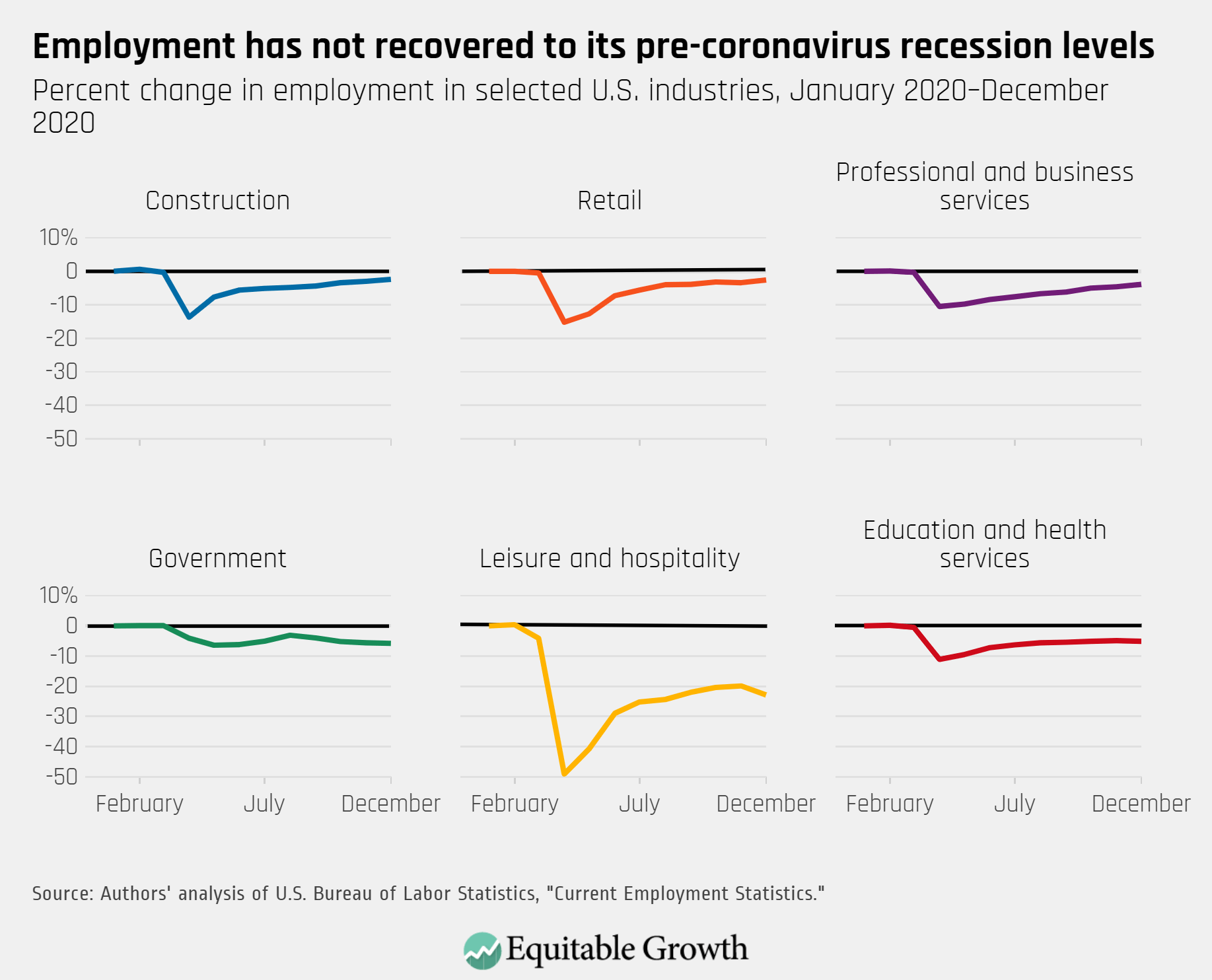
Percent change in employment in selected U.S. industries, January 2020–December 2020
Figure is from Equitable Growth’s “U.S. retail sector’s recession experiences highlight continuing labor market travails” by Kate Bahn and Carmen Sanchez Cumming.
Essays SEP 8, 2026
By: Alexander Bick, Adam Blandin, David Deming, Tyler Schumacher

Essays SEP 2, 2026
By: Megan Rivera
Essays AUG 31, 2026
By: Christopher Bangert-Drowns
Get updates on our latest research, event announcements, and policy insights delivered straight to your inbox. Stay connected with the leading voices on equitable growth.


