




Policy
What Work Does Generative AI Do?
Essays SEP 8, 2026
By: Alexander Bick, Adam Blandin, David Deming, Tyler Schumacher
AI, Tech & Energy
Labor, Wages & Worker Power
 Browse All Resources
FEB 9, 2018
By: Nick Bunker

This is a weekly post we publish on Fridays with links to articles that touch on economic inequality and growth. The first section is a round-up of what Equitable Growth published this week and the second is the work we’re highlighting from elsewhere. We won’t be the first to share these articles, but we hope by taking a look back at the whole week, we can put them in context.
This week marks the 25th anniversary of President Bill Clinton’s signing the Family and Medical Leave Act into law. As important as it has been, the FMLA alone does not meet the needs of today’s workers or the U.S. economy. Bridget Ansel and Heather Boushey argue that a “well-designed federal paid leave program based on a social insurance model” is the path forward.
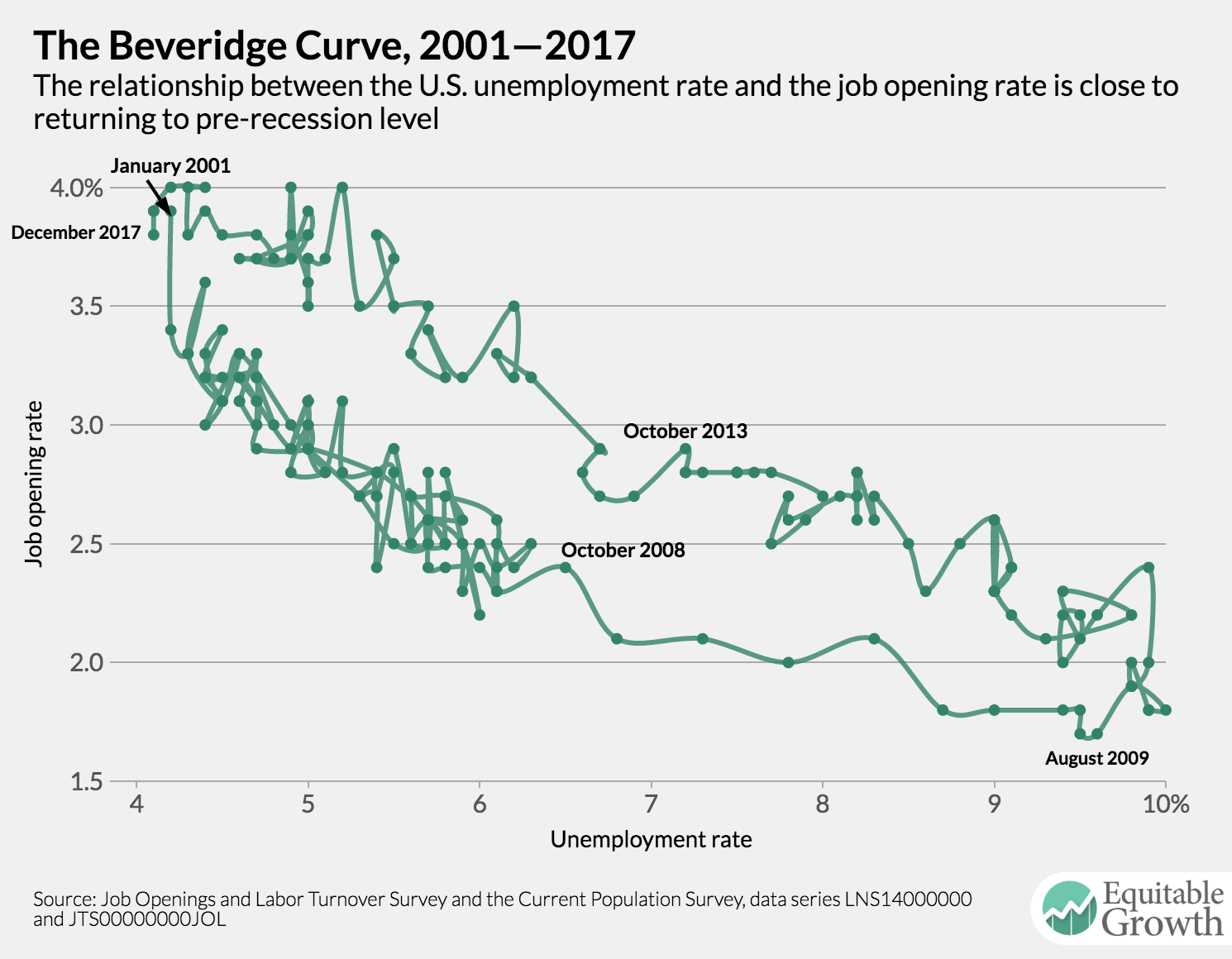
The Job Openings and Labor Turnover Survey (JOLTS) released new data for December 2017 on Tuesday. Check out 4 key graphs on the labor market using data from the report.
What would happen to the labor market if the federal government implemented a universal basic income? No one really knows. But new research looks at the labor market effects of an unconditional cash transfer program in Alaska – the Alaska Permanent Fund.
As a part of an essay series on sexual discrimination and harassment in the new issue of The New Republic (opens in a new tab), Heather Boushey asks, “If men cannot overcome their sexism toward women when discussing the qualifications of female economists, then how can they assume that any job market—or any market—is free of discriminatory bias?”
Dylan Matthews looks at the state of the Social Security Disability Insurance program, an oft-maligned social insurance program. Recipients are often described as lazy people with minor injuries. Matthews finds, instead, that the program gives needed support to people who would find work very difficult. [vox (opens in a new tab)]
In recent months, the Trump Administration and Congressional Republicans have suggested adding work requirements to social insurance and welfare programs, much as the 1996 “welfare reform” did. Vann R. Newkirk II writes about that change and how it altered cash assistance in the United States. [the atlantic (opens in a new tab)]
The U.S. government may borrow up to $1 trillion this year, according to estimates from Wall Street. Alexandra Scaggs asks readers to consider the impact of declining Federal Reserve purchases when thinking about this number and not to think it’s all because of higher spending or lower taxes. [ft alphaville (opens in a new tab)]
As policymakers consider a budget deal, Neha Dalal and Aaron Sojourner ask policymakers to consider increasing public investments in the U.S. families who often need it most: those with young children. [the hill (opens in a new tab)]
“Well into the information age, in a business ecosystem with low barriers to entry, where venture capital stands ready to throw itself at the next good idea, the economy has somehow forgotten how to create companies,” writes Eduardo Porter on the declining dynamism in the United States economy. [nyt (opens in a new tab)]
Essays SEP 8, 2026
By: Alexander Bick, Adam Blandin, David Deming, Tyler Schumacher

Essays SEP 2, 2026
By: Megan Rivera

Essays AUG 31, 2026
By: Christopher Bangert-Drowns
Get updates on our latest research, event announcements, and policy insights delivered straight to your inbox. Stay connected with the leading voices on equitable growth.


